E
WAS
AWICKA, D
OROTAŚ
REDNICKA, A
NNAD
ŁUGOSZScutellaria baicalensis
Inhibits Lipid Peroxidation
Caused by Chromium in Human Erythrocytes
Tarczyca bajkalska hamuje peroksydację lipidową
wywołaną związkami chromu w ludzkich erytrocytach
Chair and Department of Toxicology, Silesian Piasts University of Medicine in Wrocław, Poland Adv Clin Exp Med 2008, 17, 5, 539–544
ISSN 1230−025X
ORIGINAL PAPERS
© Copyright by Silesian Piasts University of Medicine in Wrocław
Abstract
Background. Because little is known about how environmental toxins interact with antioxidants, it is still an open question whether supplementation with antioxidants in oxidative stress caused by chemicals is useful or leads to harmful interactions. The aim of the study was to evaluate the utility of Scutellaria baicalensisroot extract (Anto− xid) in oxidative stress caused by chromium.
Material and Methods. The influence of Cr (III) and Cr (VI) on lipid peroxidation in human erythrocytes was me− asured spectrophotometrically with the TBARS method and expressed as the malonyldialdehyde (MDA) level. The activity of the extract standardized on baicaline was tested after exposure to chromium.
Results. Cr (III) in all the used concentrations (0.05, 0.5, 1.0, 5.0, 10 µg/ml) statistically significantly (p< 0.001) in− creased lipid peroxidation in erythrocytes, but chromium (VI) only at low concentrations (0.05 and 0.5 µg/ml). An− toxid at all the concentrations used (8, 20, and 60 µg/ml) inhibited lipid peroxidation caused by Cr (III) and (VI) in a dose−dependent manner. No harmful synergistic interactions in the examined free radical processes were noted. Conclusions. The extract from Scutellaria baicalensisroot seems to be a good membrane protector from exposu− re to chromium, inhibiting lipid peroxidation caused by this metal. Antoxid’s activity is probably connected with baicaline’s and baicaleine’s great ability to chelate metal ions (Adv Clin Exp Med 2008, 17, 5, 539–544).
Key words:Scutellaria baicalensis, chromium, lipid peroxidation, free radicals.
Streszczenie
Wprowadzenie. Wiedza na temat oddziaływania toksyn środowiskowych z antyoksydantami jest uboga. Dlatego wciąż aktualne jest pytanie, czy suplementacja antyoksydantami w stresie oksydacyjnym wywołanym czynnikami chemicznymi jest korzystna, czy prowadzi do szkodliwych interakcji.
Cel pracy.Ocena skuteczności wyciągu z tarczycy bajkalskiej standaryzowanego na bajkalinę (Antoxyd) w stre− sie oksydacyjnym wywołanym związkami chromu.
Materiał i metody.Oceniano wpływ CrIIIi CrVIna lipidową peroksydację w ludzkich erytrocytach, mierząc spek−
trofotometrycznie stężenie dialdehydu malonowego (MDA) metodą TBARS. Badano skuteczność ekstraktu z tar− czycy bajkalskiej (Antoxyd) standaryzowanego na bajkalinę w ekspozycji na związki chromu III i VI.
Wyniki. Chrom III we wszystkich zastosowanych stężeniach (0.05; 0.5; 1.0; 5.0 i 10 µg/ml) zwiększał statystycz− nie istotnie (p < 0.001) lipidową peroksydację w erytrocytach, podczas gdy CrVItylko w stężeniach niskich (0.05;
0.5 µg/ml). Antoxyd we wszystkich zastosowanych stężeniach (8, 20, 60 µg/ml) hamował lipidową peroksydację wywołaną związkami CrIIIi CrVIw sposób zależny od dawki. Nie stwierdzono niekorzystnych synergistycznych
reakcji w badanych procesach wolnorodnikowych.
Wnioski.Ekstrakt z tarczycy bajkalskiej (Antoxyd) wydaje się, że jest dobrym środkiem chroniącym błonę komór− kową przed lipidową peroksydacją w ekspozycji na związki chromu III i VI. Aktywność Antoxydu wynika praw− dopodobnie z dużej zdolności bajkaliny i bajkaleiny do chelatowania jonów metali (Adv Clin Exp Med 2008, 17, 5, 539–544).
Scutellaria baicalensis Georgi is an ingredient of many Chinese and Japanese herbal medicines also popular in Europe because of the intensive ad− aptogenic properties of this plant [1]. The flavono− ids isolated from the root of Scutellariae baicalen− sis(RadixScutellariae baicalensis) are characteri− zed with a very wide spectrum of pharmacological activity, involving the anti−inflammatory, antioxi− dative, antiallergic, and other effects [2]. In view of its unique antioxidative proprieties, there is a possibility of applying Scutellariae root in the prophylaxis and treatment of degenerative disea− ses connected with increased oxidative stress and inflammation [3].
The well−defined antioxidative properties of Antoxid, an extract produced from Scutellaria ba− icalensisroot, create the possibility of its use in the prevention of oxidative stress induced by external factors such as industrial pollution, some drugs, and ecotoxins. Chromium (Cr) seems to be one of these important factors. Cr is necessary for correct function of the body (e.g. GTF for the proper me− tabolism of glucose, some proteins, and lipids) and it is a component of some enzymes participating in the stability of proteins and nucleic acids [4]. Ho− wever, exposure to high concentrations of chro− mium can disturb its balance in the body and rele− ase such toxic effects as allergies, tissue damage, irritation of membranes, and, finally, cancer. Cr valence is essential for its toxicity. Only Cr (VI) is on the list of carcinogens published by the Interna− tional Agency for Research on Cancer (IARC). It is placed in a group with proven carcinogenic ac− tivity in people [4]. Cr (III) is considered the natu− ral form, while Cr (VI) is the result of human acti− vity. The toxic effect of Cr (VI) is closely connec− ted with its oxidative properties. In the body it is reduced to Cr (III).
Although one knows a lot about chromium to− xicity, information about the participation of chro− mium in free−radical reactions has been brought to light only in recent years. Chromium compounds are popular dietary supplements used in weight re− duction. There are many reports about the toxic in− teractions of medicinal herbs with drugs or ecoto− xins [5–7]. Therefore it seems of interest to exami− ne the influence of the extract from Scutellariae baicalensisroot (Antoxid), standardized on baica− lin, on the oxidative stress induced by chromium compounds. In this study the influence of Cr (III) and (VI) on lipid peroxidation in vitro in human erythrocytes was investigated. The object of the examination was to determine whether the extract from Scutellaria baicalensis (Antoxid) acts bene− ficially on oxidative stress provoked by chromium compounds or whether toxic interactions arise.
Material and Methods
The study was performed on anin vitro model of human erythrocytes. The material was fresh blood received from the Surgery Clinic taken on sodium citrate from healthy volunteers. The blood was centrifuged and the plasma rejected. The ery− throcytes were washed three times with physiolo− gical salt solution (0.9% NaCl) and then a 10% su− spension of blood corpuscles in PBS (phosphate− buffered saline, buffered physiological salt solution without calcium and magnesium ions), pH = 7.4, was prepared. The level of hemoglobin (Hb) in the blood corpuscle suspension was mea− sured by the Drabkin method with a commercial kit [8]. Water solutions of chromium (III) (CrCl3)
and chromium (VI) (K2Cr2O4) in concentrations of
0.05, 0.5, 1, 5, and 10 µg/ml were used.
Antoxid, a crystalline water−alcoholic extract from the root of Scutellariae baicalensisobtained according a described procedure [9] by BPF (Bio− active Product Factory) and standardized on baica− lin (65–70%), was dissolved in TRIS−HCl buffer, pH = 7.4, and used in concentrations of 8, 20, and 60 µg/ml. Oxidative stress was evaluated by deter− mining the degree of lipid peroxidation by spectro− photometric measurement of the amount of malon− dialdehyde (MDA) using Stock’s method and was expressed in nmol/g of hemoglobin [10]. At least 10 tests were performed for each concentration.
The General Method of Lipid
Peroxidation Measurement
To 2 ml of the blood erythrocyte suspension prepared as described above was added 25 µl of a 66 mmol/l solution of cumene peroxide in etha− nol and physiological salt solution (1:3). The sam− ples were incubated for 1 hour at 25°C and then 40 µl of an aqueous solution of chromium salt was ad− ded. The incubation was continued for 0.5 h at 37°C. Then 1.5 ml of a water solution of trichloro− acetic acid and sodium arsenite was added. The samples were centrifuged. Then 1 ml of thiobarbi− turic acid solution prepared according to Stocke’s [10] was added to 2 ml of supernatant and incuba− ted at 95°C for 15 min. After cooling, the absor− bance at l = 535 nm was measured. The MDA con− centration was read from a standard curve and expressed in nmol/g Hb. To examine Antoxid’s ac− tivity, 40 µl of the solution in buffer (prepared as described above) was added before the first incu− bation. Each experiment was accompanied by con− trol trials (without chromium or without Antoxid).
E. SAWICKA, D. ŚREDNICKA, A. DŁUGOSZ
Statistical Analysis
The results were evaluated statistically with the program Statistica PL 7.1. The variability of the distribution was checked with Lillefor’s test. Data with a normal distribution were evaluated using the one−factor analysis of variance ANOVA and the post hocRIR Tukey’s test. Differences we− re statistically significant at p< 0.05.
Results
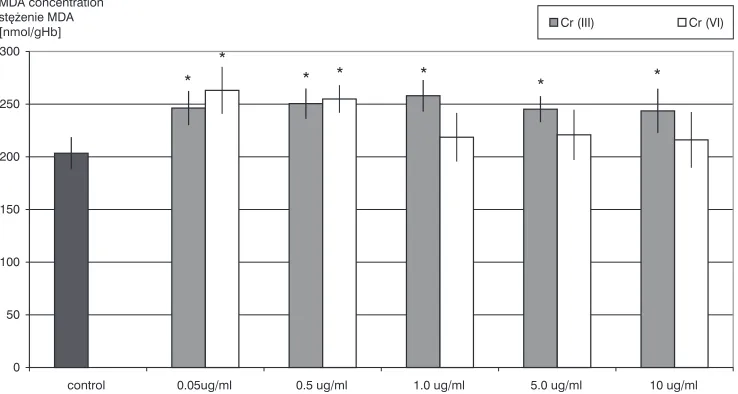
Chromium (III) at all the concentrations used statistically significantly (p< 0.001) increased li− pid peroxidation in erythrocytes in relation to the control. The MDA level increased to 258.552 ± ± ± 15.04 nmol/g Hb (control: 203.820 ± 16.16 nmol/g Hb) (Fig. 1). Only low concentrations (0.05 and 0.5 µg/ml) of chromium (VI) caused sta− tistically significant (p< 0.0002) increases in the malondialdehyde concentration in relation to the control (Fig. 1).
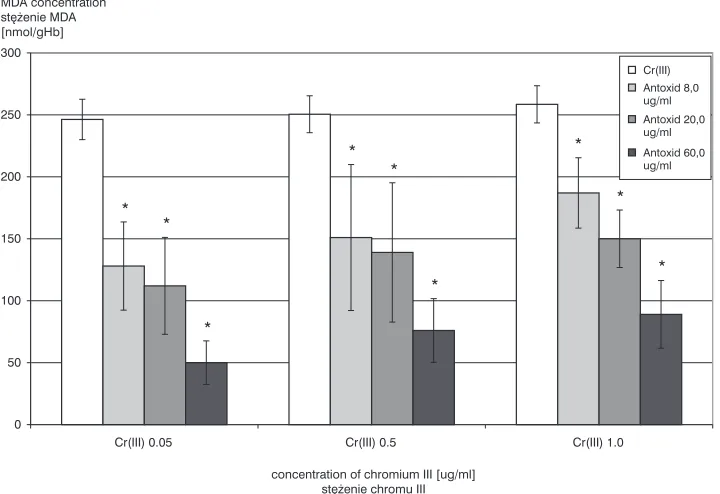
Antoxid at all the concentrations inhibited the lipid peroxidation induced by Cr (III) ions, decre− asing the MDA level very significantly. In all trials with Cr (III) at concentrations of 0.05, 0.5, and 1 µg/mL, Antoxid caused statistically significant differences in relation to the control (p< 0.0002). The effectiveness in decreasing the MDA level elevated by Cr (III) depended on the concentration of antioxidant. The highest activity was noted for the highest Antoxid concentration (60 µg/mL), which reduced the MDA level to as low as 50.173 ± ± 18.55 nmol/g Hb (control sample: 246.053 ±
± 16.31 nmol/g Hb) (Fig. 2). Antoxid showed a si− milar effect on lipid peroxidation induced by Cr (VI). It statistically significantly (p < 0.0002) lowered the MDA concentration elevated by Cr (VI) at concentrations 0.05, 0.5, and 1 µg/mL. Also in this case a dose−response dependence was observed (Fig. 3). No toxicological interactions (synergistic effect) in the examined processes we− re noted between chromium and the Scutellaria baicalensisextract.
Discussion
In this study, chromium (III) and (VI) increa− sed lipid peroxidation in erythrocytes measured by malondialdehyde (MDA) concentration. It is known that free radicals are produced during the reduction cycle of chromium in the body. The pre− dominant form of Cr (VI), the [CrO4]–2ion, is re−
duced to Cr (III) through short−term kinetically unstable intermediate forms such as Cr (V) and Cr (IV). The reduction process generates reactive forms of both radical and non−radical oxygen (RFT): superoxide radical (O2–•), hydroxyl radical
(•OH), hydrogen peroxide (H
2O2), and singlet oxy−
gen (1O
2–•) [11, 12]. Trivalent chromium was con−
sidered relatively nontoxic; however, it was de− monstrated that it could be reduced to Cr (II) with biological reductors such as L−cysteine and NADH and then react with hydrogen peroxide and generates hydroxyl radicals [13, 14]. As a transi− tion metal, chromium can replace iron and copper in Fenton’s reaction and generate hydroxyl radi− cals [11]. The hydroxyl radical is able to initiate li−
0 50 100 150 200 250 300
control 0.05ug/ml 0.5 ug/ml 1.0 ug/ml 5.0 ug/ml 10 ug/ml
concentration of chromiumCr (III) Cr (VI)
MDA concentration stê¿enie MDA [nmol/gHb]
* *
* * * *
*
Fig. 1.The influence of chromium (III) and (VI) on lipid peroxidation, * statistically higher than control (p < 0.05)
pid peroxidation, leading to elevated MDA con− centration [15]. Furthermore, hexavalent chro− mium inhibits the reduction of oxidazed glutathio− ne and sodium−potassium ATPase and increases phosphokinase, which indirectly intensifies its prooxidative proprieties [16, 17].
The extract from Scutellariae baicalensisroot used in this study caused an effective decrease in lipid peroxidation induced by both Cr (III) and Cr (VI) ions in erythrocytes. Flavonoids, the flavo− ne derivatives baicalein and vogonin and their gly− cosides baicalin and vogonosid, are among the
E. SAWICKA, D. ŚREDNICKA, A. DŁUGOSZ
542
0 50 100 150 200 250 300
Cr(III) 0.05 Cr(III) 0.5 Cr(III) 1.0
concentration of chromium III [ug/ml] stê¿enie chromu III
Cr(III) Antoxid 8,0 ug/ml Antoxid 20,0 ug/ml Antoxid 60,0 ug/ml
MDA concentration stê¿enie MDA [nmol/gHb]
* *
*
* *
*
*
*
*
Fig. 2.Effect of Antoxid on lipid peroxidation induced by chromium (III), * statistically lower than chromium III (p < 0.01)
Ryc. 2.Wpływ Antoxydu na lipidową peroksydację indukowaną Cr III, * statystycznie mniejsze niż chrom III (p < 0,01)
0 50 100 150 200 250 300
Cr(VI) 0.05 Cr(VI) 0.5 Cr(VI) 1.0
Cr (VI)
Antoxid 8,0 ug/ml Antoxid 200, ug/ml Antoxid 600, ug/ml
*
*
concentration of chromium VI [ug/ml] stê¿enie chromu VI MDA concentration
stê¿enie MDA [nmol/gHb]
*
*
* *
* *
*
Fig. 3.Effect of Antoxid on lipid peroxidation induced by chromium (VI), * statistically lower than chromium VI (p < 0.01)
main active compounds in Antoxid. These flavo− noids prevent RFT destruction in cells and tissues. The power of the antioxidative action diminishes in the sequence baicalein>baicalin>>vogonin>vo− gonosid [18, 19]. The mechanism of the flavono− ids’ antioxidative activity is connected with their ability to release a proton from the phenolic group, which then binds with a free radical, causing its deactivation [20–22]. Baicalin and baicalein effec− tively scavenge superoxide, hydroxyl, alkyl, and DPPH radicals. Baicalein is an inhibitor of enzy− mes which catalyze free−radical formation, such as xanthine oxidase (XO), 12−lipoxygenase, and ni− tric oxide synthase (NOS) [21, 23, 24]. Furthermo− re, it inhibits the nuclear transcription factor NF−κB (nuclear factor kappa B) and the transcription of genes induced in inflammatory states, such as COX−2, iNOS, and manganese superoxide dismu− tase, and also diminishes the production of the tu− mor necrosis factor TNF−α[25, 26]. Baicalein can also demonstrate indirect antioxidative activity th− rough the induction of the gene expression of pro− tective enzymes, such as heat shock protein HSP32 and the heme oxidase (HO−1) [25].
The basic reason for Antoxid’s beneficial acti− vity in oxidative stress induced by chromium ions seems to be the fact that flavonoids are strong che− lators of metal ions. Chromium ions can participa− te in Fenton’s reaction instead the iron and genera− te hydroxyl radicals. Both baicalein and baicalin are strong metal ion chelators [11, 18].
There are not many data on the interaction of the extract from Scutellariae baicalensisroot with xenobiotics. In vitroandin vivostudies have shown that baicalein and vogonin have protective effects on benzo[a]pyrene and aflatoxin B toxicity. This was connected with the inhibiting influence of fla− vonoids on enzymes metabolizing these xenobio− tics [26]. However, another investigation of baica− lein’s effectiveness in lead and cadmium poisoning did not demonstrate its beneficial activity [27].
In this study the protective influence of Anto− xid on oxidative stress induced by the action of chromium compounds was shown. The extract from Scutellariae baicalensis root seems to be a good membrane protector from exposure to chromium, inhibiting lipid peroxidation caused by chromium salts; however, further research is ne− cessary to explain the detailed mechanism.
1. Chromium (III) increased lipid peroxida− tion in all the examined concentrations, but chro− mium (VI) only at low doses (0.05 µg/ml and 0.5 µg/ml).
2. Scutellaria baicalensis extract (Antoxid) inhibited lipid peroxidation caused by Cr (III) and (VI) in a dose−dependent manner starting from the lowest examined concentration (8 µg/mL).
3. No unbeneficial interactions between An− toxid and the chromium compounds in the influ− ence on lipid peroxidation were noted in erythro− cytes.
References
[1] Lamer−Zarawska E:www.bpf.com.pl; Opracowanie literaturowe chińskiej rośliny leczniczej [a review of litera− ture on Chinese medicinal herbs].
[2] Jędrzejko M, Maniara M:The influence of the extract of the Baikal scullcap Scutellaria baicalensis on the deve− lopment of aerobic bacteria active in dry socket (Alveolitis sicca dolorosa). Ann Acad Med Sci 2006, 60, suppl. 95. [3] Schinella GR, Tournier HA, Prieto JM, Mordujovich de Buschiazzo P, Rios JL:Antioxidant activity of anti−
inflammatory plant extracts. Life Sci 2002, 70, 1023–1033.
[4] Seńczuk W:Toksykologia współczesna. Wydawnictwo Lekarskie PZWL, Warsaw 2005.
[5] Zhou S, Chan F, Pan SQ, Huang M, Lee FJ:Pharmocokinetic interactions of drugs with St. John’s wort. Psy− chopharmacology 2004, 18(2), 262–276.
[6] Piscitelli SC, Burstein AH, Welden N, Gallicano KD, Falloon J:The effect of garlic supplements on the phar− macokinetics of saquinavir. Clin Infect Dis 2002 Jan 15, 34(2), 234–238.
[7] Rajnarayana K, Reddy MS, Vidyasagar J, Krishna DR:Study on the influence of silymarin pretreatment on metabolism and disposition of metronidazole. Arzneim−Forsch/Drug Res 2004, 54, 2, 109–113.
[8] Gawlik M: Zastosowanie modelu krwinki czerwonej człowieka do badania właściwości antyoksydacyjnych związków zawartych w wodnych ekstraktach produktów spożywczych na przykładzie herbaty. Brom Chem To− ksykol 2004, XXXVII, 4, 311–316.
[9] Stawiany P, Gwardys P, Lamer−Zarawska E, Oszmiański J:Patent no. A1 (21) 319737 (22) 97 04 29 6(51) A61K 35/78. Biuletyn Urzędu Patentowego Nr 23 (649) 1998.
[10] Stocks J, Offerman EL:Model c.b., Dormandy t. L.; the susceptibility to autooxidation of human red cell lipids in health and disease. Br J Haematol 1972, 23, 713–724.
[12] Panda SK, Chaudhury I, Khan MH:Heavy metals induce lipid peroxidation and affect antioxidants in wheat leaves. Biol Plant 2003, 46(2), 289–294.
[13] Shrivastava HY, Ravikumar T, Shanmugasundaram N, Babu M, Unni NB: Cytotoxicity studies of chromium (III) complexes on human dermal fibroblasts. Free Radic Biol Med 2005, 38(1), 58–69.
[14] Bartosz G:Druga twarz tlenu. Wydawnictwo Naukowe PWN, Warszawa 1995, 94–103.
[15] Dey SK, Nabak P, Roy S:Alpha−tocopherol supplementation on chromium toxicity: a study on rat liver and kid− ney cell membrane. J Environ Sci (China) 2003, 15(3), 356–359.
[16] Geetha S, Sai−Ram M, Mongia SS, Singh V, Ilavazhagan G, Sawhney RC:Evaluation of antioxidant activity of leaf extract of Seabuckthorn (Hippophae rhamnoides L.) on chromium (VI) induced oxidative stress in albino rats. J Ethnopharmacol 2003, 87(2–3), 247–251.
[17] Ciesielska E, Gwardys A, Metodiewa D:Anticancer, antiradical and antioxidative actions of novel Antoksyd S and its major components, baicalin and baicalein. Anticancer Res 2002, 22(5), 2885–2891.
[18] Ciesielska E, Wolszczak M, Ulanowski B, Szulawska A, Kochman A, Metodiewa D:In vitroantileukemic, an− tioxidant and prooxidant activities of Antoksyd S (C/E/XXI): a comparison with baicalin and baicalein. In Vivo
2004, 18(4), 497–503.
[19] Zhao Y, Li H, Gao Z, Gong Y, Xu H:Effects of flavonoids extracted from scutellaria baicalensis Georgion he− min−nitrite−H2O2 induced liver injury. Eur J Pharmacol 2006, 536, 192–199.
[20] Gao Z, Huang K, Yang X, Xu H:Free radical scavenging and antioxidant activities of flavonoids exracted from the radix of Scutellaria baicalensis Georgi. Biochem Biophys Acta 1999, 16, 1472(3), 643–650.
[21] Oszmiański J:Polifenole jako naturalne przeciwutleniacze żywności. Przemysł Spożywczy 1995, 3, 94–96. [22] Deschamps JD, Kenyon VA, Holman TR:Baicalein is a potent in vitroinhibitor against both reticulocyte15−hu−
man and platelet 12−human lipooxygenases. Bioorg Med Chem 2006, 14, 4295–4301.
[23] Gao Z, Huang K, Xu H:Protective effect of flavonoids in the roots of Scutellaria baicalensis Georgi against hy− drogen peroxide−induces oxidative stress in HS−SY5Y cells. Pharmacol Res 2001, 43(2).
[24] Chen JMC, Lin CW, Wu CY, Shen SC:Baicalein inhibition of oxidative stress−induced apoptosis via modula− tion of ERKs activation and induction of HO−1 gene expression in rat glioma cells C6. Tox Appl Pharm 2006, 216, 263–273.
[25] Cheng PY, Lee YM, Wua YS, Chang TW, Jin JS, Yen MH: Protective effect of baicalein against endotoxic shock in rats in vivoand in vitro. Biochem Pharm 2007, 73, 793–804.
[26] Ueng YF, Shyu CC, Liu TY, Oda Y, Lin YL, Liao JF, Chen CF:Protective effect of baicalein and wogonin against benzo[a]pyrene and aflatoxin B(1)−induced genotoxicitie. Biochem Pharmacol 2001, 62(12), 1653–1660. [27] Figurska−Ciura D:Wpływ flawonoidów aronii (Aronia melanocarpa) i tarczycy bajkalskiej (Scutellaria baica− lensis) na toksyczność ołowiu i kadmu u szczurów doświadczalnych. Praca doktorska, Uniwersytet Przyrodniczy, Wrocław 2001.
Address for correspondence:
Ewa Sawicka
Chair and Department of Toxicology Silesian Piasts University of Medicine Traugutta 57/59
50−417 Wrocław Poland
Tel./fax: +48 71 344 43 75 E−mail: [email protected]
Conflict of interest: None declared
Received: 28.07.2008 Revised: 10.09.2008 Accepted: 30.09.2008
E. SAWICKA, D. ŚREDNICKA, A. DŁUGOSZ