Ryszard Wiącek
1, Katarzyna Kolossa
1, Tomasz Jankowski
1, Sławomir Jeka
1,
Andrzej Karmowski
2, Mikołaj Karmowski
2, Bohdan Gworys
3The Efficacy and Safety of Leflunomide in Patients
with Active Rheumatoid Arthritis
Skuteczność i bezpieczeństwo stosowania leflunomidu u pacjentów
chorych na aktywne reumatoidalne zapalenie stawów
1 Clinical Division of Rheumatology and Connective Tissue Diseases, Dr. J. Biziel’s 2nd University Hospital
in Bydgoszcz, Medical College of Nicolaus Copernicus University, Poland
2 1st Department and Clinic of Gynecology and Obstetrics, Wrocław Medical University, Wrocław, Poland 3 Department of Anatomy, Wrocław Medical University, Wrocław, Poland
Abstract
Objectives. The aim of this study was to evaluate the efficacy and safety of leflunomide in patients with active rheumatoid arthritis (RA).
Material and Methods. The study included 100 patients (88 women and 12 men) with rheumatoid arthritis (RA). The mean age was 46.5 years and the mean duration of the disease was 10.3 years. The inclusion criteria were a Disease Activity Score (DAS28) of over 3.2, and contraindications to methotrexate or failure of treatment with methotrexate for at least 3 months. The patients that were enrolled in the study had developed lesions of various grades according to the Steinbrocker Radiological Classification. Leflunomide was administered at a dose of 20 mg per day for the whole observation period. During the monitoring appointments the duration of morning stiffness, pain and disease activity were evaluated on a visual analogue scale (VAS), as well as the number of tender and swol-len joints and the DAS28 score. In compliance with the leflunomide therapy protocol, the following control tests were performed: erythrocyte sedimentation rate (ESR), C-reactive protein (CRP), hematology, creatinine and liver function tests. Safety assessment included monitoring of adverse events and laboratory test results.
Results. During the one-year monitoring period significant improvements were noted in 68% of the patients, expressed as a decrease of 1.2 or more in their DAS28 scores. DAS28 > 0 < 1.2 was achieved in a further 18% of the patients. No improvement was reported by 14% of the subjects. In one year of treatment leflunomide was effec-tive in 74% of the patients with aceffec-tive RA. The most marked clinical improvement in the DAS28 index was noted between the third and sixth months of treatment. In the next six months ESR, CRP and DAS28 scores continued to decline steadily, but the differences were not as clear as those recorded in the previous time period.
Conclusions. The most commonly observed adverse events were related to the gastrointestinal tract (i.e. diar-rhea and periodic increases in liver function tests), and reported hair loss. Mild to moderate adverse events were observed in 19% of the patients; they resolved spontaneously or in response to medication, and were not a reason for discontinuing therapy in any of the cases (Adv Clin Exp Med 2012, 21, 3, 337–342).
Key words: leflunomide, active rheumatoid arthritis, disease activity score (DAS28).
Streszczenie
Cel pracy. Ocena skuteczności i bezpieczeństwa leflunomidu podczas rocznej obserwacji pacjentów chorych na aktywne reumatoidalne zapalenie stawów (r.z.s.), spełniających kryteria zarówno ACR z 1987 r., jak i Narodowego Funduszu Zdrowia przed włączeniem do programu terapeutycznego.
Materiał i metody. Do badania włączono 100 pacjentów (88 kobiet i 12 mężczyzn) chorych na r.z.s. Średni wiek wynosił 46,5 lat, a średni czas trwania choroby wyniósł 10,3 lat. Kryteria włączenia były następujące: aktywność choroby wyrażona za pomocą DAS28 > 3,2; przeciwwskazania do metotreksatu lub niepowodzenie leczenia metotreksatem przez co najmniej 3 miesiące. Pacjenci uczestniczący w badaniu, którzy zostali zakwalifikowa-ni, byli w różnych okresach choroby ze względu na kryteria Steinbrockera. Leflunomid był podawany w dawce 20 mg/dobę przez cały okres obserwacji. Podczas badań kontrolnych oceniano: czas trwania sztywności poran-nej, ból i aktywność choroby według wizualnej skali analogowej (VAS), liczba bolesnych i obrzękniętych stawów
Adv Clin Exp Med 2012, 21, 3, 337–342 ISSN 1899–5276
ORIGINAL PAPERS
oraz DAS28. Według programu NFZ przeprowadzono następujące badania kontrolne: OB, CRP, hematologii, kreatyniny i prób wątrobowych. Przeprowadzono również ocenę bezpieczeństwa, w tym monitorowanie zdarzeń niepożądanych oraz wyników badań laboratoryjnych.
Wyniki. Podczas jednego roku obserwacji nastąpiła znaczna poprawa wyrażona przez DAS28 > 1,2; odnotowano ją u 68% pacjentów. Ponadto zmianę w DAS28 > 0 < 1,2 uzyskano również u 18% pacjentów. W przypadku 14% badanych nie odnotowano poprawy. Leflunomid był skuteczny podczas jednego roku leczenia u 74% pacjentów z aktywną postacią r.z.s. Najbardziej widoczną poprawę kliniczną mierzoną wskaźnikiem DAS28 odnotowano między 3. a 6. miesiącem leczenia. W ciągu kolejnych 6 miesięcy OB, CRP i wartości wskaźnika DAS28 systema-tycznie spadały, różnice nie były jednak tak widoczne jak w poprzednim okresie.
Wnioski. Do najczęściej obserwowanych działań niepożądanych należały te związane z przewodem pokarmowym, np. biegunka, okresowe zwiększenie aktywności enzymów wątrobowych, zgłoszono również wypadanie włosów. Działania niepożądane (łagodne i umiarkowane) zaobserwowano u 19% pacjentów, ustępowały samoistnie lub po zastosowaniu leków i nigdy nie były powodem przerwania leczenia (Adv Clin Exp Med 2012, 21, 3, 337–342).
Słowa kluczowe: leflunomid, aktywne reumatoidalne zapalenie stawów, wskaźnik aktywności choroby (DAS28).
Leflunomide is one of the classic disease modi-fying antirheumatic drugs (DMARDs). The active metabolite of leflunomide inhibits the enzyme di-hydroorotate dehydrogenase and has antiprolifera-tive properties. The dihydroorotate dehydrogenase pathway is particularly important for activated T lymphocytes. Leflunomide also inhibits tumor necrosis factor (TNF) activity. As an immunosup-pressive drug, leflunomide inhibits inflammation, thus delaying the destruction of the joints and leads to improved quality of life.
The aim of this study was to evaluate the ef-ficacy and safety of leflunomide during the annual observation of patients who met the criteria for ac-tive rheumatoid arthritis (RA) established in 1987 by the American College of Rheumatology (ACR – formerly the American Rheumatism Associa-tion) and the protocol for leflunomide therapy be-fore being included in the study.
Material and Methods
The study included 100 patients (88 women and 12 men) with RA, diagnosed according to ACR criteria. The mean age was 46.5 years and mean disease duration was 10.3 years.
The inclusion criteria were a Disease Activ-ity Score (DAS28) exceeding 3.2, failure of ther-apy with use of at least one conventional disease-modifying drug, including methotrexate therapy at
a dose of 20 to 25 mg/week for at least 3 months, or contraindications to methotrexate.
The patients that were enrolled in the study had developed lesions of various grades according to the Steinbrocker Radiological Classification. Lefluno-mide was administered at a dose of 20 mg/day for the whole observation period. During the monitor-ing appointments, the followmonitor-ing were assessed: the duration of morning stiffness and disease activity, on a visual analog scale (VAS); the number of ten-der and swollen joints; erythrocyte sedimentation rate (ESR); C-reactive protein (CRP); DAS 28 in-dex; blood counts; and creatinine and liver func-tion tests. Safety assessment included monitoring of adverse events and laboratory test results.
All the patients underwent physical examina-tion, and medical histories were taken, including questions about their use of DMARDs and ste-roids. The use of cigarettes, coffee and alcohol was also noted.
Laboratory testing was conducted in the labo-ratory of Dr. J. Biziel’s 2nd University Hospital in Bydgoszcz (Poland).
Results
The results of the study are shown in the ac-companying tables and figures.
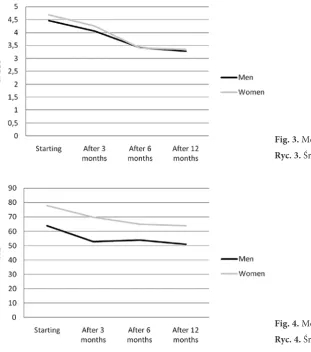
A significant decrease in DAS28 index value after one year of therapy (i.e. a decline equal to
Table 1. The correlation coefficient of ESR and CRP with the DAS28 in patients with rheumatoid arthritis. The arithmetic mean for these parameters was calculated
Tabela 1. Współczynnik korelacji parametrów krwi, takich jak OB i CRP z DAS 28 u pacjentów chorych na reumatoidalne zapalenie stawów. Obliczono średnią arytmetyczną dla wyżej wymienionych parametrów
Output parameter
(Wskaźnik wyjściowy) DAS 28 – average(DAS 28 – średnie) ESR after 1 hour – average(ESR po godzinie – średnie) CRP – average(CRP – średnie)
Women (Kobiety) 4.68 38.3 16.08
Table 2. The correlation coefficient of ESR and CRP with DAS28 values in patients with rheumatoid arthritis, after 3, 6 and 12 months of treatment. The arithmetic mean for these parameters was calculated
Tabela 2. Współczynnik korelacji parametrów krwi, takich jak OB i CRP z DAS 28 u pacjentów chorych na reumatoidalne zapalenie stawów. Obliczono średnią arytmetyczną dla wyżej wymienionych parametrów po 3, 6 i 12 miesiącach leczenia
Women (Kobiety) DAS28 ESR CRP
After 3 months (Po 3 miesiącach) 4.24 36.00 15.07
After 6 months (Po 6 miesiącach) 3.39 27.5 12.87
After 12 months (Po 12 miesiącach) 3.35 23.5 12.75
Men (Mężczyźni)
After 3 months (Po 3 miesiącach) 4.05 31.9 14.25
After 6 months (Po 6 miesiącach) 3.42 27.7 12.95
After 12 months (Po 12 miesiącach) 3.28 24.85 12.83
Table 3. VAS variability in relation to gender and the duration of treatment. The visual analogue scale was used for the patients’ own assessment of pain. The tables show the arithmetic mean of the VAS in relation to gender
Tabela 3. Zmienność VAS w zależności od czasu trwania leczenia i płci. Zastosowano analogową skalę VAS do oceny bólu przez pacjenta. W tabeli przedstawiono średnią arytmetyczną VAS w zależności od płci
Women (Kobiety) Men (Mężczyźni)
Baseline (Stan początkowy) 78 64
After 3 months (Po 3 miesiącach) 70 53
After 6 months (Po 6 miesiącach) 65 54
After 12 months (Po 12 miesiącach) 64 51
Fig. 1. Mean ESR
Ryc. 1. Średnie wartości OB
Fig. 2. Mean CRP
or greater than 1.2) was observed in 68% of the patients. Clinical improvement was most marked between the third and sixth months of treatment. In the second six-month period ESR, CRP and DAS28 index values continued to decline steadily; however, the differences were smaller.
A decrease in DAS28 less than 1.2 was achieved in another 18% of the patients during the year. In total, the one-year leflunomide therapy resulted in a decline in DAS28 in 86% of the patients.
A reduction of morning stiffness was noted, especially after the first 6 months of treatment.
The subjective VAS self-assessment showed improvement in the patients’ well-being, but with no significant correlation with DAS28 scores.
No significant difference based on gender was observed.
The most common observed side effects re-lated to the gastrointestinal tract (such as diarrhea and temporary increases in liver enzymes activity) and reported hair loss. Mild or moderate adverse events were observed in 19% of the patients. They resolved spontaneously or in response to medi-cation and did not cause discontinuation of the therapy.
Discussion
Theefficacy and safety of leflunomide in the treatment of rheumatoid arthritis has been the subject of numerous studies, both in Poland and elsewhere. Some difficulties in comparing these studies are related to differences in the principles of patient selection (the duration of the disease, previous therapy, the presence of cardiovascu-lar disease, metabolic, disorders, diet, habits, age, etc.).
This article reports on a study involving 100 patients who were qualified for leflunomide treatment, with no additional burden caused by diseases or disorders, and not using prescription drugs that are considered to affect leflunomide tolerance.
During the year-long study, disease activ-ity was assessed after 1, 3, 6 and 12 months of therapy on the basis of parameters such as ESR, CRP, a VAS and DAS28 index value. A decrease of > 1.2 in DAS28 score after one year of treat-ment was regarded as a good therapeutic response. This was achieved in about 68% of the patients; in nearly half of the patients this was achieved dur-ing the first six months of treatment. Average and
Fig. 3. Mean DAS28
Ryc. 3. Średnie wartości DAS28
Fig. 4. Mean VAS
mediocre improvement, expressed by a decrease in DAS28 value of < 1.2, was reported in 18% of respondents. In total, during the year-long treat-ment 86% of patients responded as expected to treatment with leflunomide.
Rell-Bakalarska et al. evaluated a population of 158 patients with active RA over a six-month period. A good therapeutic response (a DAS28 reduction > 1.2) was observed in about 65% of the patients, and an average response (a DAS28 reduction > 0.6 and < 1.2) was observed in about 12% [1].
Targońska-Stepniak et al. conducted a study on the impact of leflunomide treatment on indi-ces of inflammation in patients with rheumatoid arthritis. The study took into account the activity and indicators of inflammation within the first six months of treatment in 37 patients. Nearly 84% of the patients responded well to the treatment, but almost 16% stopped the treatment due to a lack of therapeutic effect or to adverse events [2].
Zoń-Giebel et al. evaluated a group of 87 pa-tients. A good therapeutic response during the 30 months (a decrease in DAS28 > 1.2) was ob-served in 57%. A response sufficient to warrant maintaining leflunomide treatment for two years of observation was noted in 87% of the partici-pants [3].
Raczkiewicz-Papierska et al. assessed lefluno-mide as a second choice in treating patients with rheumatoid arthritis. This group comprised 81 pa-tients that responded well to treatment. After five months of treatment, clinical improvement and a decrease in DAS28 > 1.2 were recorded in 54% of the patients; a decrease between 0.6 and 1.2 was noted in about 30%; in approximately 16% no im-provement was observed [4].
Agarwal et al. reported on the use of lefluno-mide in standard doses in 121 patients, of whom 102 achieved a good therapeutic response and could continue treatment. Within a short (16-week) fol-low-up DAS28 decreases were noted in 74% of the patients [5].
The efficacy of leflunomide was confirmed in a study by Balabanov et al. observing 200 patients from four clinical centers in Moscow. The au-thors evaluated its effectiveness based on DAS28 over 16 weeks, and found clinical improvement in 129 patients (65%); high activity of RA remained in only 17% [6].
A study by Dougados et al. showed the efficacy of leflunomide monotherapy. In a 24-week study on 968 patients qualified for the first phase, 17% of the participants were withdrawn due to side effects. However, 672 persons responded well to monotherapy. There were also 106 patients whose poor responsive to leflunomide led to their being qualified for combination therapy with sulphasala-zine or with concomitant sulphasalasulphasala-zine and pla-cebo [7].
Nguyen et al. reported on 378 people quali-fied for leflunomide therapy (out of an initial group of 407 patients). Based on DAS28 scores, in six months good efficacy was achieved in 21.8% of the participants and average efficacy in 61.8%. Side effects were observed in 15.9% of the patients. Serious adverse events affected 2.4% of those sur-veyed [8].
An analysis of the incidence of adverse events is as follows. In the present study involving 100 pa-tients, side effects were observed in 19% of patients during the one-year observation period, but did not lead to discontinuation of therapy in any of the cases. Rell-Bakalarska et al. reported adverse reactions in 8.86% of the participants in their six-month clinical trial involving 158 people; in 3.79% therapeutic effect was not achieved and treatment was discontinued [1]. Targońska-Stepniak et al. re-ported that after six months treatment was discon-tinued in 37 (16.2%) due to adverse events or a lack of therapeutic effect [2]. At the end of a two-year study with 87 participants, Zoń-Giebel et al. found that further treatment with leflunomide was not indicated in 13% of the patients [3]. In the study by Raczkiewicz-Papierski et al. on 81 patients over a five- month period, adverse reactions were noted in 44.4% of the people, but it was necessary to in-terrupt therapy with leflunomide in only 7.4% [4]. Nguyen et al. reported adverse events in 15.9% of 407 patients, of whom 2.4% were withdrawn from therapy [8]. In the study by Agarwal et al. involv-ing a group of 121 patients, side effects or a lack of response to treatment were reported in 19 pa-tients (about 16%); three persons died of unrelated causes before the end of the study [5].
As this analysis presented above shows, the ef-ficacy of leflunomide observed in this study was similar to what has been reported in the available literature.
References
[1] Rell-Bakalarska M, Jaworski J, Rutkowska-Sak L et al.: Leflunomid w terapii chorych na reumatoidalne zapale-nie stawów – wstępna obserwacja efektu terapeutycznego i objawów zapale-niepożądanych. Reumatologia 2006, 44, 1, 19–25.
[3] Zoń-Giebel A, Dec M, Kapołka D: Leflunomid w leczeniu chorych na reumatoidalne zapalenie stawów po niepo-wodzeniu terapii metotreksatem. Skuteczność i czynniki prognostyczne odpowiedzi na leczenie. Reumatologia 2008, 46, 2, 55–61.
[4] Raczkiewicz-Papierska A, Dudek A, Bachta A, Tłustochowicz M et al.: Leflunomid jako lek drugiego wyboru u chorych na reumatoidalne zapalenie stawów. Pol Merk Lek 2007, XXII, 132, 547.
[5] Agarval SK, Narsimulu G, Handa R et al.: Leflunomide (Arava) – the Indian experience: a multicenter assess-ment of its safety and effectiveness in the treatassess-ment of active rheumatoid arthritis. J Indian Rheumatol Assoc 2002, 10, 30–35.
[6] Balabanova RM, Makolkin VI, Shostak NA et al.: Changes in indices of inflammatory activity in patients with rheumatoid arthritis during early stages of basic therapy of leflunomide. Ter Arkh 2004, 76, 5, 28–32.
[7] Dougados M, Emery P, Lemmel EM et al.: When a DMARD fails, should patients switch to sulfasalazine or add sulfasalazine to continuing leflunomide? Ann Rheum Dis 2005, 64, 44–51.
[8] Nguyen M, Kabir M, Ravaud P: Short-therm efficacy and safety of leflunomide in the treatment of active rheu-matoid arthritis in everyday clinical use: open label, prospective study Clin Drug Invest 2004, 24(2), 103–112.
Address for correspondence
Sławomir Jeka
Clinical Division of Rheumatology and Connective Tissue Diseases Dr. J. Biziel 2nd University Hospital in Bydgoszcz
Medical College of Nicolaus Copernicus University Ujejskiego 75
85-168 Bydgoszcz Poland
E-mail: [email protected]
Conflict of interest: none declared