Marek J. Sąsiadek, Joanna Bladowska
Imaging of Degenerative Spine Disease
– the State of the Art
Obrazowanie w chorobie zwyrodnieniowej kręgosłupa
– obecny stan wiedzy
Department of General and Interventional Radiology and Neuroradiology, Wroclaw Medical University, Wroclaw, Poland
Abstract
The authors review the current state of imaging of degenerative spinal disease (DSD), which is one of the most common disorders in humans. The most important definitions as well as short descriptions of the etiopathology and clinical presentation of DSD are provided first, followed by an overview of conventional and advanced imag-ing methods that are used in DSD. The authors then discuss in detail the imagimag-ing patterns of particular types of degenerative changes. Finally, the current imaging algorithm in DSD is presented. The imaging method of choice is magnetic resonance, including advanced techniques – especially diffusion tensor imaging. Other imaging methods (plain radiography, computed tomography, vascular studies, scintigraphy, positron emission tomography, discog-raphy) play a supplementary role (Adv Clin Exp Med 2012, 21, 2, 133–142).
Key words: spine degeneration, intervertebral disc degeneration, magnetic resonance imaging.
Streszczenie
Autorzy przedstawiają obecne poglądy na temat obrazowania choroby zwyrodnieniowej kręgosłupa (ch.zw.kr.), która jest jedną z najczęstszych schorzeń u ludzi. W pierwszej części pracy omówiono najważniejsze definicje oraz opisano krótko etiopatogenezę i objawy kliniczne ch.zw.kr., po czym przedstawiono standardowe i zaawansow-ane metody diagnostyczne stosowzaawansow-ane w ch.zw.kr. Następnie omówiono szczegółowo zmiany obrazowe w posz-czególnych typach zmian zwyrodnieniowych kręgosłupa, wreszcie przedstawiono bieżący algorytm obrazowania w ch.zw.kr. Metodą obrazową z wyboru jest rezonans magnetyczny (MR), wraz z zaawansowanymi technikami, zwłaszcza obrazowaniem tensora dyfuzji (DTI). Inne metody obrazowe (radiografia konwencjonalna, tomografia komputerowa, badania naczyniowe, scyntygrafia, pozytronowa tomografia emisyjna, dyskografia) odgrywają rolę uzupełniającą (Adv Clin Exp Med 2012, 21, 2, 133–142).
Słowa kluczowe: zwyrodnienie kręgosłupa, zwyrodnienie krążka międzykręgowego, obrazowanie rezonansu mag-netycznego.
Adv Clin Exp Med 2012, 21, 2, 133–142 ISSN 1899–5276
EDITORIAl
© Copyright by Wroclaw Medical University
Degenerative spinal disease (DSD) is one of the most common disorders, affecting adults at every age, which means it is an important medical and social problem. The results of treatment of DSD depend strongly on precise diagnostics. With the development and increased availability of magnet-ic resonance (MR), imaging methods have become the most important tool in diagnosing DSD and planning its treatment.
The aim of this review is to present the current possibilities of various imaging modalities in
diag-nosing DSD and optimal diagnostic imaging algo-rithms in different types of degenerative disease.
Definitions
A disco-vertebral unit (functional spinal unit) is the complex of anatomic structures compris-ing a scompris-ingle segment of the spine. It consists of the intervertebral disc, adjacent parts of the vertebral bodies, facet joints, ligamenta flava and longitudi-nal ligaments at a given level. All the components of an FSU may be affected by degenerative spinal disease to varying degrees.
Spondyloarthrosis is one type of DSD; it main-ly affects the facet joints and causes facet degenera-tion.
Degenerative disc disease (or discopathy) is another type of DSD, mainly affecting interverte-bral discs.
Disc herniation and disc bulging are types of degenerative disc disease characterized by part of the disc or the whole disc protruding beyond the intervertebral space. Disc herniation is one of the most common and severe types of DSD.
It is important to remember that DSD affects many structures of the spine and it is not always equivalent to disc herniation or degenerative disc disease [1, 2].
Etiopathology
As the authors have noted elsewhere [3], degenerative changes of the spine are a part of normal aging; they start in late adolescence and progress with age. They may or may not manifest themselves clinically. Many factors can accelerate the formation of degenerative changes, e.g. de-velopmental anomalies or infectious diseases of the spine. However, the most important factor is trauma, both acute and chronic, including chronic overload [3–5].
Degenerative disease is most often located in the lumbar spine, followed by the cervical and tho-racic spine. The lower parts of the lumbar spine (segments l4–S1) and cervical spine (segments C4–C7) are the most commonly involved [3].
The first stage of disease is usually degenera-tive dehydration of the nucleus pulposus of the in-tervertebral disc, combined with the fissures in the adjacent annulus fibrosus (annular tears) and end-plate cartilage microfractures [1, 2, 6, 7]. Annular tears (concentric, transverse or radial) are pres-ent in almost all individuals over 40 years of age and could thus be considered paraphysiological; however, some (especially radial tears) may result in disc herniation. Other forms of disc degenera-tion are the vacuum phenomenon (gas collecdegenera-tions, mostly nitrogen) and calcifications [3].
Injury of the endplate cartilage, on the other hand, causes an aseptic reaction of the subchon-dral bone, with an increase in water content
(asep-tic spondylodiscitis). The further stages of verte-bral body degeneration are fatty transformation and endplate sclerosis, as well as edge osteophytes [1–3, 6, 8]. Degeneration of the endplates may re-sult in their irregularities (erosive osteochondro-sis) or in intravertebral disc herniations (Schmorl’s nodes) [3].
Facet joint degeneration appears as hypertro-phy and osteohypertro-phytes of the articular processes, with narrowing of the joint space, less commonly as the vacuum phenomenon, synovial hypertro-phy or synovial cysts. Facet degeneration along with disc degeneration can lead to degenerative spondylolisthesis (anterolisthesis, i.e. anterior displacement of the upper vertebra, or retrolis-thesis, i.e. posterior displacement of the upper vertebra) due to vertebral instability [1, 2, 6]. The involvement of the ligamenta flava results in their hypertrophy [3]. longitudinal ligaments may be compressed or broken by disc herniation; pos-terior longitudinal ligaments may also ossificate (ossification of the posterior longitudinal liga-ments: OPPl) [3].
All the changes mentioned above can lead to spinal stenosis, either central (narrowing of the central part of the spinal canal) or lateral (narrow-ing of the lateral recesses of the spinal canal and intervertebral foramina). Spinal stenosis can be accompanied by compression of the spinal cord, leading to its ischemia, edema, myelomalacia or gliosis [3, 9].
Clinical Presentation
The most common clinical symptom is back pain of variable severity, constant or intermittent, located at the levels of the involved segments of the spine [6, 10, 11]. Asymmetric disc herniation, lateral spinal stenosis or osteophytes compressing the nerve roots cause radicular pain along the af-fected root [6]. The same conditions may cause neurological deficits, e.g. weakness in the upper or lower extremities. Central spinal stenosis in the lumbar region may lead to neurological claudica-tion, and in the cervical or thoracic regions to my-elopathy due to chronic compression of the spinal cord [3, 6, 9].
Degenerative Spinal Disease
– Imaging Methods
are currently considered supplementary imaging techniques.
Conventional radiographs of the spine are still useful as an initial study, enabling detection of major abnormalities, e.g. narrowing of the disc space (which is compatible with discopathy), os-teophytes, degenerative sclerotization, scolio-sis, spondylolisthesis and other congenital spine anomalies. In mild cases of DSD radiography can suffice as the only imaging study [1, 2, 7].
MR is the imaging method of choice, and should be used in all patients with long-term pain, radicular symptoms or neurological deficits [12]. MR allows for a complex assessment of degenera-tive changes in all the structures of the disco-verte-bral unit – both the bony and soft tissue structures (see below).
Other methods are also currently used. Com-puted tomography (CT) was the primary diagnos-tic modality in DSD in the 1990s, but since then it has mostly been replaced by MR. Nowadays CT is a supplementary method to MR, especially in degenerative bony spinal canal stenosis [13]. Conventional myelography and radiculography and CT-myelography, which require intrathecal administration of the contrast medium, have been almost completely abandoned. Discography and CT discography are invasive studies, which are performed only in specialized centers and are of-ten followed by therapeutic procedures like nucle-olysis or nucleoplasty. Nuclear medicine methods (bone scintigraphy, PET/CT) are used in cases that require differentiation of DSD from neoplastic le-sions. Vascular studies (Doppler sonography, CT angiography, MR angiography) should be consid-ered in patients with cerebellar symptoms, which may be caused by osteophytes or disc herniations compressing the vertebral arteries [3, 14, 15].
Advances in Imaging
Techniques
In the last two decades the possibilities for imaging DSD have significantly improved thanks to technological developments. The image quality in conventional radiography has been markedly improved thanks to digitalization (digital radi-ography) and post-processing, [16, 17]. Since the introduction of multidetector scanners, as well as advanced muliplanar and three-dimensional reconstructions, computed tomography pro-vides very precise images of the bony spine struc-tures, which can be depicted with high resolution [18–21].
However, the most rapidly developing mo-dality has been MR. Thanks to technological
im-provements in MR equipment (fast gradient sys-tems, parallel imaging, multielement phased-array coils), basic MR techniques including spin-echo (T1- and T2-weighted images), gradient-echo and fat saturation sequences are now characterized by high resolution and increased signal-to-noise ra-tio. In addition, many supplementary techniques have been introduced, e.g. steady-state sequences (like CISS or FIESTA), which provide excellent delineation of the outlines of disc herniations; MR myelography, a non-invasive technique that has replaced conventional and CT myelographies; and post-contrast sequences, which are especially use-ful in post-operative studies [14, 22].
Recently there have been attempts to apply ad-vanced supplementary techniques, such as diffu-sion-weighted imaging (DWI) and diffusion tensor imaging (DTI), functional (motion) imaging,MR spectroscopy [23, 24] and functional MR (fMRI). The most promising of these methods seems to be DTI, which enables qualitative and quantitative evaluation of degenerative myelopathy. Motion imaging provides functional evaluations of the spinal structures, but it requires vertical MR units, which currently are not available in most MR de-partments; therefore, the alternative technique of axial loaded imaging is more commonly used. MR spectroscopy and functional MR provide interest-ing scientific results in degenerative myelopathy, but due to technical difficulties arising mainly from the small size of the spinal cord, these tech-niques have not yet been introduced into clinical practice [25, 26].
Imaging Characteristics
of Particular Types
of Degenerative Changes
Degeneration
of the Intervertebral Disc
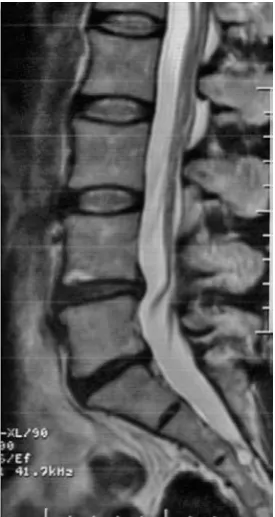
Degeneration of the intervertebral disc can in many cases be diagnosed on the basis conventional radiographs revealing narrowing of the interverte-bral space with sclerotization and osteophytes of adjacent parts of the vertebral bodies. However, simple degeneration cannot be differentiated from disc herniation or bulging on the base of these findings. The method of choice is MR, which de-tects direct signs of degeneration: a decreased sig-nal on T2 and T2*-weighted images (black disc disease), resulting from degenerative dehydration of the disc (Fig. 1) [1, 2, 6].
as symmetrical displacement of more than 180° of the disc’s circumference. Disc bulging is tradition-ally considered the first stage of disc herniation; however, many authors regard it as a separate enti-ty, because most bulging discs are asymptomatic. In many bulging discs, foci of increased signal on T2-weighted MR images (high intensity zones – HIZ) are visible, which are compatible with annulus fi-brosus tears (Fig. 2) [3]. Such discs are regarded as being more likely to develop disc herniation, but most HIZs are asymptomatic [6, 27].
Disc herniations are divided into three types (stages): protrusion (focal displacement of the nucleus pulposus into the annulus fibrosus with-out a complete tear of the latter), extrusion (focal displacement of the nucleus pulposus into the an-nulus fibrosus with complete tearing of the latter) and sequestration (displacement of a disc fragment with no continuity with the intervertebral disc). MR enables differentiation among the different types of disc herniation on the basis of their shape and re-lationship to the posterior longitudinal ligament. Moreover, it is possible to differentiate recent (ac-tive) disc herniations from old (non-ac(ac-tive) ones,
because the former have a partially increased sig-nal on T2-weighted images and T1-weighted post-contrast images, due to the inflammatory reaction, while old herniations are black, due to dehydration and fibrosis (Fig. 3). Finally, MR enables excellent visualization of the relationship between a herni-ated disc and the adjacent structures of the spinal canal and intervertebral foramina, especially com-pression of the nerve roots and spinal cord. In disc herniation all of the capabilities of MR mentioned here are very important for the prognosis and treat-ment planning [1, 2, 6–8, 28].
Disc bulging and disc herniation can also be di-agnosed with CT, but without most of the details mentioned above. On the other hand CT is superior to MR in detecting specific signs of disc degenera-tion: the vacuum phenomenon (gas produced in the degenerative process) and disc calcifications. These changes are seen on CT as foci of very low and very high density, respectively (Fig. 4A), while on MR both vacuums and calcifications are visible only in some cases, as low-signal areas (Fig. 4B) [3].
Degeneration
of the Vertebral Bodies
The most common degenerative changes of the vertebral bodies are Modic lesions (types 1, 2 and 3) and osteophytes. The latter can be diag-nosed easily on the basis of plain X-rays, but CT and especially MR can assess their relationship to
Fig. 1. MR, T2-weighted image, sagittal plane.
Decreased signals in the l4/l5 and l5/S1 intervertebral discs, consistent with the degenerative process. At the l4/l5 level herniation of the degenerative disc is also visible
Ryc. 1. MR, obraz T2-zależny, przekrój strzałkowy. Obniżony sygnał krążków międzykręgowych l4/l5 i l5/S1, wskazujący na proces zwyrodnieniowy. Na poziomie l4/l5 dodatkowo jest widoczna przepuklina zwyrodniałego krążka
Fig. 2. MR, T2-weighted image, axial plane. Disc bulg-ing with high intensity zone (HIZ) in its posterior part, probably representing an annular tear
the spinal canal, dural sac, intervertebral foramina, nerve roots and spinal cord [1, 2, 29].
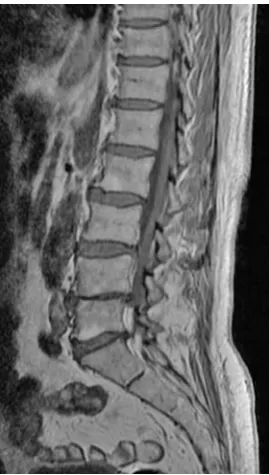
Modic type 1 lesions (aseptic spondylodiscitis) can be diagnosed only with MR, which detects in-creased water content in the parts of vertebral bod-ies adjacent to the endplates (a decreased signal on T1-weighted images and an increased signal on T2-weighted and fat saturation images – Fig. 5). Modic type 1 lesions are believed to correlate with persis-tent pain and radicular symptoms, especially when located at the l5/S1 level. Modic type 2 lesions
(fat-ty degeneration) can also be visualized only with MR, which reveals areas of increased signal on T1-weighted images and decreased signal on fat satura-tion images, which are compatible with increased fat content (Fig. 6). Modic type 3 lesions (sclerotic changes) can be seen on conventional radiography and CT as hyperdense areas and on MR as hypoin-tense areas in all pulse sequences [29–32].
A special type of vertebral body degeneration is erosive osteochondrosis (endplate degenera-tion). It manifests as irregularities in the endplates’
Fig.3. MR, T2-weighted images, axial plane. Disc herniations in two different patients. left image: recent (active) her-niation with bright appearance; right image: old (inactive) herher-niation with dark appearance
Ryc. 3. MR, obraz T2-zależny, przekrój osiowy. Przepukliny krążków międzykręgowych u dwóch różnych pacjentów. Obraz po lewej: wczesna (aktywna) przepuklina o wysokim sygnale (jasna). Obraz po prawej: przewlekła (nieaktywna) przepuklina z niskim sygnałem (ciemna)
Fig.4. Axial CT (A) and sagittal MR T1-weighted (B) images. Degenerative vacuum phenomenon visible as low-density (A) and low-signal (B) foci in the l4/l5 intervertebral disc
Ryc. 4. Osiowy obraz TK (A) i strzałkowy T1-zależny obraz MR (B). Zwyrodnieniowy objaw próżniowy widoczny jako ognisko niskiej gęstości (A) i niskiego sygnału (B) w krążku międzykręgowym l4/l5
A
outlines and can be visualized on conventional radi-ography and CT; however, the best modality is once again MR. Erosive osteochondrosis, like Modic changes, is usually accompanied by degeneration of the adjacent intervertebral discs (Fig. 7) [2].
Degeneration of the Facet Joints
Degeneration of the facet joints is character-ized by osteophytes and hypertrophy of the ar-ticular processes. Much less common signs are the vacuum phenomenon (gas in joint space) and facet joint synovial cysts. Facet degeneration and
its impact on the spinal canal (stenosis, compres-sion of dural sac) can be easily assessed with both axial MR and CT images [2, 3]
Degeneration
of the Ligamenta Flava
Degeneration of the ligamenta flava usually goes along with facet joint degeneration and can be assessed on axial MR and CT images as a thick-ening of the ligaments exceeding 4mm.
Degenerative Spondylolisthesis
Degenerative spondylolisthesis can easily be diagnosed on spine radiographs and CT, but MR provides the best evaluation of its impact on spinal canal structures.
Spinal Canal Stenosis
Degenerative changes of all the structures of the disco-vertebral unit may contribute to stenosis of the spinal canal, especially disc herniation or disc bulging, osteophytes of the posterior margins of the vertebral bodies, facet joint hypertrophy and osteophytes and/ or thickening of the ligamenta flava (Fig. 8). There
Fig.5. MR, sagittal plane, T2-weighted (upper row) and T1-weighted (lower row) images. There are hyperintense areas on the T2-weighted images and hypointense areas on the T1-weighted images in the l2 and l3 vertebral bodies, adjacent to the l2/l3 interverebral disc, which are consistent with Modic type 1 degenerative changes
Ryc. 5. MR, przekrój strzałkowy, obrazy T2-zależne (górny rząd) i T1-zależne (dolny rząd). Widoczne są strefy hiperintensywne w obrazach T2-zależnych i hipo-intensywne w obrazach T1-zależnych w trzonach l2 i l3, przylegające do krążka międzykręgowego l2/l3, odpo-wiadające zmianom zwyrodnieniowym typu Modic 1
Fig. 6. MR, sagittal plane, T1-weighted image. There are multiple hyperintense areas in the l2–l5 vertebral bodies, adjacent to interverebral discs, which are con-sistent with Modic type 2 degenerative changes
are two types of stenosis: central spinal stenosis, af-fecting the central part of the spinal canal, and lateral spinal canal stenosis, affecting the lateral recesses of the spinal canal and intervertebral foramina. Central canal stenosis is well visualized on both MR and CT axial images, while lateral stenosis is evaluated most reliably on parasagittal MR images. Stenosis is usu-ally assessed visuusu-ally on the basis of compression of the spinal canal structures. Another method is mea-surement of the canal, e.g. central spinal stenosis in lumbar region is diagnosed if the sagittal diameter of the canal is below 12 mm [1, 2, 6, 7, 33].
Changes in the Spinal Cord
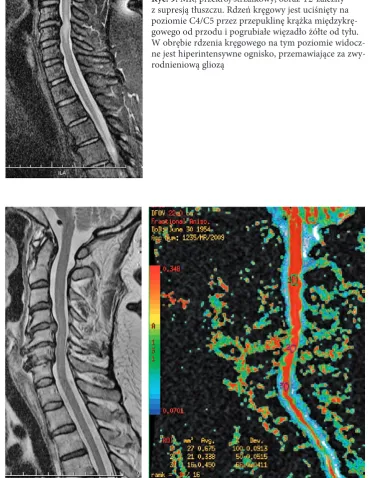
Changes in the spinal cord in the course of the degenerative process result from chronic compres-sion of the spinal cord by disc herniation or osteo-phytes. The only imaging method that can detect these changes is MR, which reveals foci of increased signals on T2-weighted images at the level of com-pression (Fig. 9). In many cases no changes are seen in the spinal cord despite clinical signs of myelopa-thy. Recently, diffusion tensor imaging has been found to be a valuable method in such cases, as de-creases in the fractional anisotropy (FA) have been found at the compression level in normal-appearing spinal cords (Fig. 10) [25, 26].
An Imaging Algorithm
in Degenerative
Spinal Disease
In mild cases of degenerative spinal disease, mani-festing as slight back pain, no imaging is necessary.
In patients with persistent pain, plain X-rays should be performed to diagnose gross degenera-tive abnormalities (osteophytes, narrowing of the
Fig.7. MR, sagittal plane, T2-weighted (left) and T1-weighted (right) images. There are irregularities of the vertebral endplates at the l2/l3 level, with a low signal in the adjacent intervertebral disc. This image is compatible with erosive osteochondrosis
Ryc. 7. MR, przekrój strzałkowy, obrazy T2-zależne (po lewej) i T1-zależne (po prawej). Widoczne są nieregularności płytek granicz-nych trzonów kręgowych na poziomie l1/l2, przy niskim sygnale przylegającego krążka mię-dzykręgowego. Obraz ten odpowiada zmianom typu osteochondrosis erosiva
Fig.8. MR, axial plane, T2-weighted image. Marked spinal stenosis with compression of the dural sac by a bulging disc, facet joint degenerative changes and thickened ligamenta flava
Ryc. 8. MR, przekrój osiowy, obraz T2-zależny. Znaczna stenoza kanału kręgowego z uciskiem worka oponowego przez uwypuklenie krążka
międzykręgowe-go (bulging), zmiany zwyrodnieniowe stawów
Fig. 9. MR, sagittal plane, T2-weighted fat suppressed image. The spinal cord is compressed at the C4/C5 level by disc herniation anteriorly and thickened ligamentum flavum posteriorly. There is a hyperintense area within the spinal cord at this level, which is consistent with degenerative gliosis
Ryc. 9. MR, przekrój strzałkowy, obraz T2-zależny z supresją tłuszczu. Rdzeń kręgowy jest uciśnięty na poziomie C4/C5 przez przepuklinę krążka międzykrę-gowego od przodu i pogrubiałe więzadło żółte od tyłu. W obrębie rdzenia kręgowego na tym poziomie widocz-ne jest hiperintensywwidocz-ne ognisko, przemawiające za zwy-rodnieniową gliozą
Fig.10. MR, sagittal plane, T2-weighted image (left) and diffusion tensor imaging (DTI) (right). Spinal stenosis at the C4/C5, C5/C6 and C6/C7 levels with compression of the spinal cord. No abnormal signal is seen in the spinal cord at these levels. However, on the DTI there are multiple foci of decreased fractional anisotropy (FA) in the anterior part of the spinal cord, which are compatible with degenerative injuries of the spinal cord due to chronic compression
Ryc. 10. MR, przekrój strzałkowy, obraz T2-zależny (po lewej) i obrazowanie tensora dyfuzji (DTI) (po prawej). Stenoza kanału kręgowego na poziomach C4/C5, C5/C6 i C6/C7, z uciskiem rdzenia kręgowego. Nie wykazano nie-prawidłowego sygnału rdzenia kręgowego na tych poziomach. W DTI są widoczne mnogie ogniska obniżonej frakcjo-nowanej anizotropii (FA) w przedniej części rdzenia, które wskazują na zwyrodnieniowe uszkodzenie rdzenia kręgo-wego spowodowane przewlekłym uciskiem
disc spaces, degenerative spondylolisthesis, etc.) and other findings (e.g. scoliosis, transitional ver-tebrae) as well to exclude large spine neoplasms.
Patients with severe persistent pain, radicular symptoms or neurological deficits should be ex-amined with MR, which provides a complex as-sessment of the degenerative process in both soft tissue and bony elements. Plain MR with spin-echo, gradient-echo and fat saturation sequences is usually sufficient. In some cases, e.g. in postop-erative patients, plain MR should be supplemented by contrast-enhanced sequences [34]. In patients with clinical signs of myelopathy, diffusion tensor imaging should be considered [25, 26].
CT is a supplementary method, used if detailed analysis of bone structures is needed, e.g. in spinal stenosis. CT should be also performed in patients with contraindications to MR.
If the differentiation between degenerative and neoplastic processes is not clear on the basis of MR and CT, nuclear medicine methods (bone scintig-raphy and/or PET/CT) should be applied [2, 3].
In some patients with cerebellar symptoms, supplementary vascular studies of the vertebral ar-teries (Doppler sonography, CT angiography, MR angiography) should be considered [35].
Finally, some spine centers perform discog-raphy or CT discogdiscog-raphy to determine whether changes in a particular disc are responsible for a patient’s symptoms and to establish access for in-terventional procedures such as nucleoplasty [2].
The authors concluded that imaging meth-ods are the most important diagnostic modalities in degenerative spinal disease. The initial study is usually plain radiography, but the imaging method of choice is MR, which – thanks to technological developments – provides a more and more pre-cise evaluation of degenerative changes. The role of other imaging modalities, such as CT, vascular studies, bone scintigraphy, PET/CT and discogra-phy, is supplementary. The imaging algorithm de-pends on the severity of the clinical symptoms and the results of previous imaging studies.
References
Gallucci M, Puglielli E, Splendiani A, Pistoia F, Spacca G:
[1] Degenerative disorders of the spine. Eur Radiol 2005, 15, 591–598.
Sąsiadek M, Konopka M:
[2] Choroby kręgosłupa. In: Postępy neuroradiologii: wydanie multimedialne. Eds.: Walecki J. Polska Fundacja Upowszechniania Nauki. Wydział Nauk Medycznych PAN, Warszawa 2007, 397–428.
Sąsiadek M:
[3] Degenerative conditions of the spine. In: Encyclopedia of Diagnostic Imaging. Ed. Albert l. Baert. Berlin, Springer, 2008; 611–615. ISBN 978-3-540-35278-5 (Print); 978-3-540-35280-8 (Online).
Dai L, Jia L:
[4] Central cord injury complicating acute cervical disc herniation in trauma. Spine 2000, 25, 331–335.
Daffner RH:
[5] Cervical radiography for trauma patients: a time-effective technique? AJR Am J Roentgenol 2000, 175, 309–311.
Hendrich B, Bladowska J, Sąsiadek M:
[6] Znaczenie badań obrazowych w diagnostyce nieurazowych zespołów bólo-wych kręgosłupa. Pol Przegl Neurol 2010, 6, 2, 92–100.
Sąsiadek M, Hendrich B:
[7] Diagnostyka obrazowa kręgosłupa z uwzględnieniem nowych technik obrazowania. Pol Przegl Neurol 2010, 5, 1, 38–39.
Kraemer J, Koester O:
[8] MRI of the lumbar Spine. Georg Thieme Verlag, Stuttgart New York 2003.
Storm PB, Chou D, Tamargo RJ:
[9] lumbar spinal stenosis, cauda equina syndrome, and multiple lumbosacral radiculopathies. Phys Med Rehabil Clin N Am 2002, 13, 3, 713–733.
Sheehan NJ:
[10] Magnetic resonance imaging for low back pain: indications and limitations. Ann Rheum Dis 2010, 69, 7–11.
Jabłońska R, Ślusarz R, Rosińczuk-Tonderys J, Beuth W, Ciemnoczołowski W:
[11] Functional Assessment of
Patients with lumbar Discopathy. Adv Clin Exp Med 2009, 18, 4, 389–399.
Wojtek P, Ziółko E, Adamczyk T, Trejtowicz D, Liszka J, Kwiatkowska A, Brodziak A:
[12] Results of magnetic
resonance imaging of the vertebral column in patients with myelodysplasticsyndrome. Pol J Radiol 2009, 74, 2, 44–47.
Bartynski WS, Lin L:
[13] lumbar root compression in the lateral recess: MR imaging, conventional myelography, and CT myelography comparison with surgical confirmation. AJNR Am J Neuroradiology 2003, 24, 3, 348–360.
Reul J, Gievers B, Weis J et al.:
[14] Assessment of the narrow cervical spinal canal: prospective comparison of MRI, myelography and CT-myelography. Neuroradiology 1995, 37, 187.
Hartel M, Kluczewska E, Simka M, Ludyga T, Kostecki J, Zaniewski M:
[15] Magnetic Resonance Venography of
chronic cerebrospinal venous insufficiency in patients with associated multiple sclerosis. Pol J Radiol 2011, 76, 1, 59–62.
Sozański T, Sokolska V, Gomułkiewicz M, Magdalan J, Trocha M, Bladowska J, Merwid-Ląd A:
[16] Filmless
Radiology – Digital Radiography Systems. Adv Clin Exp Med 2009, 18, 641–648.
Oborska-Kumaszyńska D, Wiśniewska-Kubka S:
[17] Analog and digital systems of imaging in roentgenodiagnostics. Pol J Radiol 2010, 75, 2, 73–81.
Myga-Porosiło J, Skrzelewski S, Sraga W, Borowiak H, Jackowska Z, Kluczewska E:
[18] CT Imaging of facial
Myga-Porosiło J, Skrzelewski S, Sraga W, Borowiak H, Jackowska Z, Kluczewska E:
[19] CT Imaging of facial
trau-ma. Role of different types of reconstruction. Part II – soft tissues. Pol J Radiol 2011, 76, 52–58.
Chruściak D, Staniszewska M:
[20] Number of active detector rows and quality of image in computed tomography. Pol J Radiol 2010, 75, 81–86.
Karbowski K, Urbanik A, Chrzan R:
[21] Measuring methods of objects in CT images. Pol J Radiol 2009, 74, 64–68.
Hendrich B, Zimmer K, Guziński M, Sąsiadek M:
[22] Application of 64-Detector Computed Tomography Myelography in the Diagnostics of the Spinal Canal. Adv Clin Exp Med 2011, 20, 3, 351–361.
Kubas B, Łebkowski W, Łebkowska U, Kułak W, Tarasów E, Walecki J:
[23] Proton MR spectroscopy in mild trau-matic brain injury. Pol J Radiol 2010, 75, 4, 7–10.
Tarasów E, Kochanowicz J, Brzozowska J, Mariak Z, Walecki J:
[24] MR spectroscopy in patients after surgical clip-ping and endovascular embolisation of intracranial aneurysms. Pol J Radiol 2010, 75, 4, 24–29.
Sąsiadek M, Szewczyk P:
[25] Imaging of the spine: New possibilities and its role in planning and monitoring therapy. Pol J Radiol 2009, 74, 52– 58.
Vargas MI, Delavelle J, Jlassi H et al.:
[26] Clinical application of diffusion tensor tractography of the spinal cord. Neuroradiology 2008, 50, 25–29.
Alyas F, Sutcliffe J, Connell D, Saifuddin A:
[27] Morphological change and development of high-intensity zones in the lumbar spine from neutral to extension positioning during upright MRI. Clin Radiol 2010, 65, 176–180.
Vroomen PCAJ, Wilmink JT, de Krom MCTFM:
[28] Prognostic value of MRI findings in sciatica. Neuroradiology 2002, 44, 59–63.
Sąsiadek M, Bladowska J:
[29] Hyperintense vertebral lesions. Neuroradiology 2011, 53 Suppl 1, S169–174.
Zhang YH, Zhao CQ, Jiang LS:
[30] Modic changes: a systematic review of the literature. Eur Spine J 2008, 17, 1289– 1299.
Fayad F, Lefevre-Colau MM, Drape JL:
[31] Reliability of a modified Modic classification of bone marrow changes in lumbar spine MRI. Joint Bone Spine 2009, 76, 286–289.
Vitzthum HE, Kaech DL:
[32] Modic changes in patients with degenerative diseases of the lumbar spine. ArgoSpine J 2009, 21, 57–61.
Sipola P, Leinonen V, Niemeläinen R, Aalto T, Vanninen R, Manninen H, Airaksinen O, Battié MC:
[33] Visual
and quantitative assessment of lateral lumbar spinal canal stenosis with magnetic resonance imaging. Acta Radiol 2011, 52, 9, 1024–1031.
Jabłońska R, Ślusarz R, Królikowska A, Rosińczuk-Tonderys J:
[34] Oswestry Disability Index as a Tool to Determine Agility of the Patients After Surgical Treatment of Intervertebral Disk Discopathy. Adv Clin Exp Med 2011, 20, 3, 377–384.
Maj E, Cieszanowski A, Rowiński O, Wojtaszek M, Szostek M, Tworus R:
[35] Time-resolved contrast-enhanced
MR angiography: Value of hemodynamic information in the assessment of vascular diseases. Pol J Radiol 2010, 75, 1, 52–60.
Address for correspondence:
Marek J. Sąsiadek
Department of General and Interventional Radiology and Neuroradiology Wroclaw Medical University
Borowska 213 50-556 Wrocław Poland
Tel.: +48 71 733 16 60
E-mail: [email protected]
Conflict of interest: None declared