The John Marshall Journal of Information Technology &
Privacy Law
Volume 2
Issue 1
Computer/Law Journal - 1980
Article 28
1980
Tax-Exempt Bond Financing of Computer
Telecommunications and other High Technology
Facilities, 2 Computer L.J. 805 (1980)
Fred M. Greguras
Follow this and additional works at:
http://repository.jmls.edu/jitpl
Part of the
Computer Law Commons
,
Internet Law Commons
,
Privacy Law Commons
,
Science
and Technology Law Commons
, and the
Tax Law Commons
http://repository.jmls.edu/jitpl/vol2/iss1/28
This Article is brought to you for free and open access by The John Marshall Institutional Repository. It has been accepted for inclusion in The John Marshall Journal of Information Technology & Privacy Law by an authorized administrator of The John Marshall Institutional Repository.
Recommended Citation
TAX-EXEMPT BOND FINANCING
OF COMPUTER,
TELECOMMUNICATIONS AND
OTHER HIGH TECHNOLOGY
FACILITIES
t
by
FRED M. GREGURAS *TABLE OF CONTENTS
INTRODUCTION ... 805
I. IMPORTANCE OF HIGH TECHNOLOGY TO THE UNITED STATES ... 808
II. OVERVIEW OF INDUSTRIAL DEVELOPMENT BONDS ... 812
III. DETERMINATION OF WHETHER A BOND IS AN INDUSTRIAL DEVELOPMENT BOND ... 814
IV. EXEMPT FACILITY INDUSTRIAL DEVELOPMENT BONDS ... 815
V. EXEMPT SMALL ISSUE INDUSTRIAL DEVELOPMENT BONDS . 815 A. Exempt Small Issues of $1 Million or Less ... 816
B. Exempt Small Issues of $10 Million or Less ... 817
C. $10 Million Exempt Small Issues combined with Equipment Leasing ... 819
D. Other Federal Tax Law Considerations ... 819
VI. STATE LAWS ... 820
A. Authority to Issue Bonds ... 820
B. Financing Structure ... 821
VII. BOND RATING CONSIDERATIONS ... 822
VIII. CONCLUSION ... 823
INTRODUCTION
The continuing development of high technology is as vital to the
t @ 1980 Kutak Rock & Huie.
COMPUTER/LAW JOURNAL
future of the United States as is an independent energy source. It is crucial to the economic recovery of the nation. The United States must shift from short-sighted and fragmented economic policies to comprehensive long-range policies and incentives for high technol-ogy.
James Martin, one of the world's foremost authorities on the commercial impact of computers, telecommunications and related technology, recently stated: "The reindustrialization of America has to begin with much higher levels of automation and productivity, and concentration on industries of the future, not industries of the
past."' As Martin points out, not only is the industry of producing
high technology hardware important but technology in some form, whether merely for information processing or for use in manufactur-ing a variety of products, will be essential to almost every type of American business in order for it to successfully compete in the 1980S.2 Capital will be needed by both the technology production in-dustry and by businesses which must use technology whether at a retail location, in a manufacturing facility or elsewhere.
The purpose of this article is both to urge the establishment of a national policy to stimulate high technology development and to ex-plain how some immediate relief from the capital crunch can be ob-tained through the use of tax-exempt industrial development bond financing. The importance of computers, telecommunications and other technology to the economic well-being of the United States is discussed first. The focus then shifts to the current authority and procedure for using tax-exempt bond financing as a tool for preserv-ing America's edge in technology.
The visibility of stock market results for high technology compa-nies has stimulated the demand for venture investment in such companies. High inflation has prompted people to turn to specula-tive investments with hopes the payoff will surpass the rate of infla-tion. New regulations have given pension funds, a major investor, greater latitude in their choice of investments.
A permanent recovery in the long-term bond market is depen-dent upon the government curbing inflation and reduced govern-ment borrowing. United States Treasury borrowing coupled with corporate needs have placed a heavy demand on a shrinking supply
1. At Home with James Martin, Computerworld Extra, Sept. 17, 1980, 17, 18
(in-terview). See also Frank, The Future According to James Martin, DATAMATION, Oct. 1979, at 86; New Wave Envisioned After 1980 Downturn, Computerworld, May 5, 1980, at 1.
2. Id. See, e.g., Rebuilding America, U.S. NEWS & WoRLD REP., Sept. 22, 1980, at 56; Bus. WEEK special issue on the reindustrialization of America, June 30, 1980, par-ticularly the article Technology Gives the U.S. a Big Edge, at 102.
TAX-EXEMPT BOND FINANCING
of capital, thus keeping interest rates high. Once inflation is con-quered and the federal government gets its financial affairs in order, those investors who place a high premium on safety and assured in-come will turn back to long-term bonds.
As an important element of a national economic strategy, tax-exempt bond financing can help America's private sector retain its competitive edge in technology. Bond proceeds can help users of technology acquire computers and other hardware or can assist businesses involved in the manufacture, assembly or distribution of technology. The resulting savings from using tax-exempt financing instead of conventional financing can be immense. For example, in raising $5 million of capital, a tax-exempt bond issue can save a company over $5 million in interest payments over a thirty-year pe-riod. Assuming a constant repayment schedule, the annual cash flow savings in debt service would amount to nearly $200,000. The present value of the total savings over the term of the obligation would range from $1.3 to $1.7 million, depending on the discount rate used.
Following are illustrative projects involving computers and tele-communications for which tax-exempt bond financing can be used:
• to acquire, construct or reconstruct manufacturing facilities for microprocessors, automated teller machines (ATMs), optical character readers (OCRs), facsimile communication devices, solid-state mass memories or office automation devices;
• to construct or improve satellite sending and reception facilities; • to reconstruct and reequip a production facility in order to
pro-duce sixteen bit chips instead of eight bit chips;
• to establish electronic funds transfer clearing "switch" facilities; • to acquire a host computer, other hardware and physical facili-ties for a time-sharing service, electronic mail service, videotex service or other information industry service;
" to acquire, construct or reconstruct maintenance depots for re-pairing computer equipment;
• to acquire the office of the future.
Since it has been estimated that up to $8 out of every $10 spent
on basic research costs is for buildings and equipment,3 tax-exempt
bonds could play an important role in financing research and devel-opment. The Stevenson-Wydler Act was enacted by the ninety-sixth Congress to establish research centers at universities and other
3. Joining Hands Against Japan, Bus. WEEK, Nov. 10, 1980, at 108. A recent sur-vey of United States business leaders found that government actions, regulations and tax policies were the primary determents to technological innovation. United States government policy changes were found to be a prerequisite for successfully meeting the industrial challenge from foreign nations. Business Ready to Up R&D,
DATAMA-TION, Dec. 1980 (Special Issue), at 27.
COMPUTER/LAW JOURNAL
nonprofit organizations to improve the nation's industrial
technol-ogy.4 Because of the low level of funding and the lack of any
mar-ketplace factors to direct and speed development, this law will have only minimal impact.
Although tax-exempt bond proceeds may not be used for
work-ing capital for computer software development,5 the capital saved or
preserved by the lower cost of financing facilities and equipment can be used for such development. The United States clearly re-tains the worldwide lead in computer software and funds will be needed for people resources to design and write system and applica-tion programs. Only continuing investment in people will enable
the private sector to keep this lead.6
Although the focus of this presentation is computers and tele-communications, the financing tool can be used with other forms of high technology as well.
I. IMPORTANCE OF HIGH TECHNOLOGY TO THE UNITED STATES
The economic competitiveness of the United States has eroded
worldwide. The nation's dominance in the key industries of
automobiles and steel has been chipped away by its more produc-tive foreign competitors. To reverse this trend, our federal govern-ment must establish a national policy to stimulate a capital flow into more knowledge-intensive production and employment industries such as computers, semiconductors, telecommunications, software systems and the information industry.
The development and application of semiconductor logic and memory are crucial to the nation's economic future. The use of semiconductors is expanding into an ever-widening array of prod-ucts, including virtually every commercial and consumer product
that runs on electricity.7 Mechanical functions are being replaced
with the less expensive and more reliable semiconductor. A recent study by a Congressional Japan Trade Task Force reported that the slippage of U.S. dominance in the semiconductor industry has been
4. S. 1250, 96th Congress, 2d Sess. (1980). See CONG. QTRLY, Oct. 18, 1980, at 3165,
for a discussion of this law.
5. I.R.C. §§ 103(b) (4)-(6).
6. For an analysis of this problem see Missing Computer Software, Bus. WEEK, Sept. 1, 1980, at 46. A recent study found that the average cost of capital for a semi-conductor company in the United States is over fifteen percent compared to only slightly more than nine percent in Japan. Chase Financial Policy, U.S. and Japanese Semiconductor Industries: A Financial Comparison 7 (Exec. Summary 1980).
7. See, e.g., Wave of New Products from High Technology, U.S. NEWS & WORLD REP., Sept. 15, 1980, at 56.
TAX-EXEMPT BOND FINANCING
caused by the difficulty of manufacturers in raising capital.8
Domes-tic production capacity must be expanded in order to meet the in-creasing demand. The domestic semiconductor industry must not be allowed to go the way of the auto and steel industries.
Japan's accelerated growth has been based on upgrading and in-corporating the best available technology more rapidly than other countries. According to James Martin, "America is in danger of los-ing its lead [in high technology products] to Japan if it doesn't fight
back aggressively with lots of money for R & D."9 The
government-industry team approach has allowed Japanese businesses to re-spond quickly to the dynamics of the technology market place. The results of expensive research and development efforts cannot have marketplace impact unless the financing is available to implement them quickly. Economic incentives provided by the United States government must allow business decisions to be rapidly imple-mented.
Capital is needed for both plant expansion and modernization. Investments in facilities and equipment are tied to technological ad-vance. Very few new technological products can be used with or made by old machinery. More technology must be used even in pro-ducing computer hardware. Because of IBM's pricing, computer central processing unit ("CPU") hardware prices have been pushed down to the point that manufacturing must be done efficiently in
or-der to be competitive.10
The demand for automation in all industries will rise during the 1980s. American industry must have economic equality with its for-eign competitors in order to successfully meet this demand. The market for retail banking computer equipment, for example, is pro-jected to be strong over the next five years." Teller terminal and ATM markets are estimated to grow nine percent a year through 1985.12 Competition in the bank automation industry in general is expected to be intense during the first half of the 1980s.
Although orders for computer equipment are slowing slightly,
8. SUBCOMM. ON TRADE OF THE HOUSE COMM. ON WAYS & MEANS, HIGH
TECHNOL-OGY AND JAPANESE INDUSTRIAL POLICY-A STRATEGY FOR U.S. POLICYMAKERS, 96th Cong. 2d Sess. (Comm. Print 1980).
9. At Home with James Martin, Computerworld Extra, Sept. 77, 1980, 17, 117
(in-terview).
10. See, e.g., Falling Behind in Mainframe Output, Bus. WEEI, Oct. 20, 1980, at 99. 11. See, e.g., In Face of Spending Cutbacks, ATM Makers Keep Pushing On, Am. Banker, May 29, 1980, at 2; see also, A Decade of Development Lies Ahead, Experts
Say, ABA BANKiNr J., June, 1980, at 97.
COMPUTER/LAW JOURNAL
the hardware boom defies the current recession.13 A recent survey
in Computerworld reported that seventy percent of all computer in-stallations in the U.S. are planning to spend more on hardware
dur-ing the next year.14
The merging of communications and information technology is creating sophisticated and widely used domestic and international communications networks. One of the fastest changing areas in telecommunications is the equipment manufacturing business. At one time, this industry was composed of the telephone companies' captive manufacturers. These "captives" are being increasingly challenged. A recent study projected that the worldwide telecom-munications market will more than double by 1990, from an esti-mated $40 billion in 1980 to about $87.5 billion (in 1979 dollars) in
1990.15
Total shipments of small computers are estimated to increase almost fourfold by 1984.16 The use of word processing and other au-tomated office equipment also is rapidly expanding. The computer service and maintenance industry is projected to become a $25
bil-lion industry within five years.17
The confluence of technologies involving computers, telecommu-nications and information will broaden the scope and capability of
computer services and products.18 The rapidly developing on-line
13. For analyses and estimates of growth in the computer and related industries
see Information Still on the Leading Edge of Growth, Bus. WEEK, Jan. 12, 1981, at 60; VDC Sees Industry Unscathed by World Recession Pressures, Computerworld, Dec.
22, 1980, at 55; Panelists Forecast Fair Skies in Semi Outlook for 1981, Computerworld,
Dec. 22, 1980, at 55; Terminal Demand Strong Despite Recession, Information Sys. News, July 7, 1980, at 29; Withington, 1980. Separating Fact from Fantasy,
DATAMA-TION, July 1980, at 76; The Softening Begins to Hurt, Bus. WEEK, May 12, 1980, at 104; Bagley, A Forecast of Future Trends in the Computer Industry, Mortgage Banker, April, 1979, at 20; Moderate Growth Forecast for Computing Equipment Industry, Bus.
America, March 24, 1980, at 17; Computer Services: The Decade Ahead, Com-puterworld, Jan. 21, 1980, at 25; DEP'T OF COMMERCE, 1980 U.S. INDUSTRIAL OUTLOOK,
chs. 23-25 (1980).
14. User Attitudes. They're Unaffected by Recession But Harried by Deadlines, Computerworld, Nov. 24, 1980, at 10; see also Attendees Predict 24% Rise in 1980
Com-puter Sales, ComCom-puterworld, Sept. 12, 1980, at 13.
15. Computerworld, Sept. 8, 1980, at 75; see also Communications Revolution
Pre-dicted for '80, Computerworld, Sept. 12, 1980, at 13; Highlights from the 1979 Bank Tele-communications Survey, ABA BANKING J., Feb. 1980, at 92; Dizard, The Revolution in
Communications Finance, INST. INVESTOR, Sept. 1979, at 143.
16. Small Computer Mart Seen Quadrupling by '84, Computerworld, Sept. 1, 1980, at 54.
17. Computer Service Costs Put at $25B by 1985, Information Sys. News, July 28, 1980, at 4.
18. It has been estimated that the broad scope of industries comprising the infor-mation industry is now responsible for about half of the Gross National Product
TAX-EXEMPT BOND FINANCING
information industry will need capital for equipment and facilities. This industry includes time-shared applications programs, elec-tronic mail, games and such data base services as Lockheed Dialog,
SDC Orbit, BRS, LEXIS and WESTLAW.19
Governmental policies which establish protectionism are not the answer to rebuilding America's position in the world market-place; national policies are needed which create economic equality. Although protectionism may have short-term benefits, its long-term impact only perpetuates weak industries and increases the costs of production. Ultimately, the inefficient producer loses out, even when protected. What is needed are national policies which allow our nation's high technology industry to compete on an equal eco-nomic basis in the world market place.
The next few years will determine whether America has the
po-litical will to develop a global competitive strategy for technology.20
Although there were miscalculations concerning the trends in semi-conductors, the United States generally has had the ability to ana-lyze and forecast competitive and demand trends. The Japanese advantage, however, has been the capability of acting on the
impli-cations of their analyses.2 1 Our nation's objective must be to
stimu-late faster progress in research and in marketplace implementation of such research in order to create new business opportunities.
The components of this national policy must include tax credits
for research and development expenditures,22 more accelerated
de-preciation, expanded tax-exempt financing, an easing of tax burdens on businesses operating in other nations, and a reconsideration of the federal antitrust laws, particularly as applied to research and
de-(GNP). Price, The Information Future and the Micrographics Industry, INFORMATION
& REC. MANAGEMENT, March 1980, at 14.
19. For a description of the current status and predictions as to the future of this industry, see Caswell, Microcommunications: An Evolving Bazaar, MIN-MIcRo Sys., Sept. 1980, at 110.
20. For an overview of the unfolding strategies of various nations, see, e.g., OECD,
POUCIES FOR THE STIMULATION OF INDUSTRIAL INNOVATION (1978) [volumes I, U-1, 11-21; UNITED STATES DEP'T OF COMMERCE, COOPERATIVE R & D PROGRAMS TO STIMULATE
INDUSTRIAL INNOVATION IN SELECTED COUNTRIES (1980); Northwestern Univ. Center
for Interdisciplinary Study of Science & Technology, The U.S. Consumer Electronics Industry and Foreign Competition (1980).
21. For more detailed analyses of the reasons for Japan's success, see, e.g.,
Learn-ing from the Japanese, DATAMATION, Jan. 1981 at 63; Lessons from Japan, Inc.,
NEWS-WEEK, Sept. 8, 1980, at 61; Vogel, Guided Free Enterprise in Japan, HARv. BuS. REV.,
May-June 1978, at 161.
22. S. 2906, introduced by Senator John Danforth in the 96th Congress, would
al-low a tax credit for investment in research and development. This proposal would provide a credit of 25 percent of the increase in R&D expenditures during the current year over the average of the three preceding years.
COMPUTER/LAW JOURNAL
velopment projects, in the light of our national economic objectives
within the world marketplace.23 Depreciation provisions must be
simple to apply and recognize that the useful life of much of the so-phisticated equipment used by high technology companies is shorter than in other industries. Such a policy should reward mar-ketplace performance more so than just activity. Industry groups should urge Congress to enact legislation to implement this policy. Tax-exempt industrial development revenue bond financing is one element which is partially in place and can be used immediately.
II. OVERVIEW OF INDUSTRIAL DEVELOPMENT BONDS
Revenue bonds historically were limited to financing toll bridges, water, electric and gas systems, and other facilities owned and operated by a state, city, county or other governmental subdivi-sion. Only the project revenues, e.g., the tolls, were pledged to the repayment of the obligation. In recent years, because of the eco-nomic benefits to the community, revenue bonds have been used in-creasingly to finance such enterprises as airports, parking garages, hospitals and certain industrial and commercial facilities. The capi-tal raised by the bonds creates greater employment and enlarges the property tax base. The revenue bonds issued by a city, county or other governmental subdivision for economic development pur-poses for private enterprise are commonly known as industrial
de-velopment bonds ("IDBs").24
Unlike general obligation bonds, revenue bonds are not backed by the full faith and credit, i.e., the taxing power, of the governmen-tal subdivision which issues them. IDBs have a limited specified source of income for the repayment of principal and interest. The source of repayment can be the net revenue of the specific income-producing facility which is financed or the net revenue of the entire business of which the facility is a part.
In the classic form, IDBs are issued by a city, county, or other governmental body which uses the proceeds of the bonds to build a
23. For similar views concerning the high technology industrial strategy which is
needed in the United States, see DG Exec Ties "Power of Future" to Public Policy,
Computerworld, Dec. 22, 1980, at 60 (president of Data General Corp.); Long-Term
In-dustry Strategy Prescribed for U.S., Computerworld, Oct. 6, 1980, at 95 (chairman of
Honeywell, Inc.); U.S. Industrial Policy Must be Treated as Major Priority, Am. Banker, Sept. 12, 1980, at 5 (vice president of Morgan Guaranty Trust Co.); Henriques,
Tax Credits for Research, Information Sys. News, Aug. 25, 1980, at 42 (position of the
Computer & Business Equipment Manufacturers Ass'n); Statement of Charles Sporck, president of National Semiconductor Ass'n, Before the House Comm. on Ways and Means, July 31, 1980.
24. I.R.C. § 103(b).
TAX-EXEMPT BOND FINANCING
factory or other industrial facility for lease to a business. The rental charged the business generally is sufficient to cover the payments of principal of and interest on the bonds. The term of the lease is nor-mally for the same period as the longest maturity on the bonds. The business has an option to purchase the facility for a nominal price at the end of the lease term.
When a company decides that debt financing is to be used for
raising capital, the primary advantage of a tax-exempt IDB financing
is its reduced cost. In the computer and telecommunication indus-tries, this savings could be diverted to people resources for research and development or for the development of computer software ap-plication programs. IDBs have relatively low interest rates because the interest, as income from obligations of a political subdivision of a state, may be excluded from federal gross income by an investor. Their tax-exempt nature makes them attractive to both individual
high-bracket taxpayers as well as major institutional investors. The
bonds currently could bear an interest rate up to four percent below the rate of interest payable on conventional corporate debt instru-ments.
Other significant advantages of using tax-exempt IDBs include the availability of the investment market for tax-exempt obligations as an alternate source of raising capital and the longer terms of the tax-exempt "loans" as compared to traditional corporate debt obliga-tions. These advantages are obtained without the loss of such other tax benefits as the investment tax credit and accelerated deprecia-tion.
Whether an investor may exclude interest from gross income for state and local income tax purposes depends on the state and local
laws where the investor resides.25 The use of the term "tax-exempt"
refers only to the exclusion of interest from gross income at the fed-eral level.
The use of the term "tax-exempt" also does not encompass capi-tal gains. Capicapi-tal gains (or losses) on tax-exempt obligations are
taxable at both the federal and state level.26 Capital gains would
oc-cur if a bond is priced higher when it is sold than when it was purchased, or if a bond is bought at a discount and held until it ma-tures at its par (face) value.
Before 1968, the federal tax law did not restrict the use of tax-exempt IDBs. If state law permitted bonds to be issued for the spe-cific facility, tax-exempt obligations could be used to finance it. The only constraint on the amount was marketability. Because of the
25. Ide §§ 61(4), 103(a).
26. Id. § 103(a).
COMPUTER/LAW JOURNAL
proliferation of such issues and the resulting federal revenue loss (because the interest was not taxable), Congress enacted legislation in 1968 which limited the use of tax-exempt financing to specified purposes involving important public needs, without regard to dollar
amount.27
Congress also authorized tax-exempt IDB financing for projects consisting of land and depreciable property, without regard for the nature of the project, if the amount of the bonds issued is less than
$1 million or $10 million when certain conditions are met.28 This is known as the "small-issue" exemption and has the most immediate potential for the tax-exempt financing of high technology facilities.
III.
DETERMINATION OF WHETHER A BOND IS AN INDUSTRIALDEVELOPMENT BOND
It is important to briefly examine how the Internal Revenue Service determines if an issue of bonds by a governmental subdivi-sion is an IDB issue. Section 103(a) (1) of the Internal Revenue Code provides that the gross income of a taxpayer does not include the interest on the bonds or other obligations of a state, county, mu-nicipality or other political subdivision.29 Section 103(b) (1), how-ever, provides that, with certain exceptions, an IDB is not a tax-exempt obligation.30
The label placed on a bond issue by an issuer or company is not controlling. The Internal Revenue Code establishes two tests which determine whether or not a bond issue is considered an IDB for the purpose of the federal tax law. The tests are based on how the pro-ceeds of the bond issue will be used and the source of repayment.
The "use of proceeds" test, known as the "trade or business test," is whether more than twenty-five percent of the proceeds of the bond issue will be used directly or indirectly in any trade or business carried on by a "nonexempt person," a person or entity subject to federal income taxes.31 The "source of the payment" test, known as the "security interest test," is whether the payment of the principal or interest on the bonds is more than twenty-five percent secured by an interest in property to be used in a trade or business, or secured by payments in respect of such property, or is to be de-rived from payments in respect of property or borrowed money used
27. Section 107 of Pub. L. No. 90-364, 90th Cong., 2d Sess. (1968). 28. I.R.C. § 103(b) (6).
29. Id. § 103(a)(1).
30. Id. § 103(b)(1).
31. Id. §§ 103(b) (2) (A), 103(b) (3).
TAX-EXEMPT BOND FINANCING
in a trade or business.32
If both of these conditions will be satisfied by the bond issue, it is an IDB issue for the purpose of the federal tax law. In almost every instance of a facility being financed for a private enterprise, except those financed by tax-increment bonds, these two conditions will be met and the issue will be considered to be an IDB issue. The feasibility of obtaining tax-exempt status then depends on the type of the project or facility being financed or the amount of the bond issue.
IV. EXEMPT FAcILrrY INDUSTRIAL DEVELOPMENT BONDS
The most significant type of tax-exempt IDBs in terms of dollar volume are those issued to finance "exempt" facilities, those activi-ties which Congress has found to have an important public purpose. Exempt facilities include pollution control facilities, mass
commut-ing facilities and solid waste disposal facilities.33 If a facility, or
por-tion thereof, such as pollupor-tion control equipment, fits the definipor-tion of an exempt facility established by Congress and the IRS, the en-tire facility or portion may be financed with tax-exempt IDBs.
Currently, "high technology facilities" are not considered
ex-empt facilities.3 Part of the comprehensive legislation which
should be introduced in the ninety-seventh Congress should expand the definition of exempt facilities to include various types of high technology manufacturing, assembly and distribution facilities and the use of high technology in other industries. Such an exemption could be tailored to conform to a national policy of encouraging the use of American technology in domestic facilities.
V. EXEMPT SMALL ISSUE INDUSTRIAL DEVELOPMENT BONDS
The small issue exemption currently offers the greatest opportu-nity for the tax-exempt financing of high technology projects. Since this technique can be used immediately, the scope of its availability and procedure for use are explained in detail. Section 103(b) (6) of the Internal Revenue Code provides the statutory basis for the tax exemption on interest on bonds issued to finance land or
deprecia-ble property in amounts up to $10 million.3 5 This provision does not
restrict the types of facilities which will qualify. The only limitation
32. Id. § 103(b)(2)(B).
33. See id. § 103(b)(4) for a complete listing of exempt activities and § 103(b)(5),
the exemption for industrial parks. See generally Treas. Reg. § 1.103-8.
34. IRC § 103(b) (4).
35. See generally Treas. Reg. § 1.103-10.
COMPUTER/LAW JOURNAL
is that substantially all of the proceeds must be used for land or de-preciable property.
A. Exempt Small Issues of $1 Million or Less
In an IDB issue of $1 million or less, the interest on the bonds is excludable from federal gross income if at least ninety percent of the proceeds actually expended are used (1) for the acquisition, construction, reconstruction or improvement of land or property of a character subject to the allowance for depreciation under Section 167 of the Internal Revenue Code, or (2) to redeem part or all of a
prior bond issue used for land or depreciable property.36 Thus, if
more than ten percent of the proceeds of a bond issue are used for working capital to finance research and development or the purchase of inventory, the interest on the bonds would not be ex-empt from federal income tax.
It is important to note that the proceeds of such a tax-exempt financing may be used to acquire or improve land, or to acquire, im-prove land, or to acquire, imim-prove, reconstruct or construct depre-ciable property. Depredepre-ciable property includes both buildings and
the equipment housed within them.37 A building need not be
con-structed but could be acquired and/or reconcon-structed.
Thus, tax-exempt IDBs may be used by a company to acquire technology for use in its business, such as the "office of the future" as well as by a company in the business of manufacturing, assem-bling or distributing high technology equipment. IDBs could be used, for example, for a microprocessor manufacturing or assembly facility including both the building and equipment within. A tax-ex-empt IDB issue could be used to acquire or construct a building and the equipment necessary for the research and development arm of a company, or to acquire and reconstruct or improve, or to construct a facility for a maintenance depot where computer system compo-nents are sent for repair.
Generally, for a single company, a city, county or other political subdivision may issue up to $1 million of tax-exempt IDBs for facili-ties or a project to be located within its boundaries. The outstand-ing indebtedness may not exceed $1 million at any time but, as the bonds are paid off by the company, another tax-exempt issue may be made to raise capital to keep the amount at $1 million.
Thus, for example, a group of satellite communications recep-tion and sending facilities, each in a separate political subdivision, could be financed by a series of independent small issue tax-exempt
36. I.R.C. § 103(b) (6) (A); see generally Treas. Reg. §§ 1.103-10(b) (1), (c)(1).
37. See generally I.R.C. § 167.
TAX-EXEMPT BOND FINANCING
financings. An exempt small issue could be used to acquire and in-stall a network of automated teller machines which would operate within the jurisdiction of the political subdivision which issues the bonds, or for a host computer for an electronic mail system or other information industry service. A state-wide network of ATMs could be financed by a group of independent issues by political subdivi-sions throughout a state.
The same city, county or other political subdivision may issue tax-exempt bonds for as many different companies as desire the financing assistance. Issues outstanding in the same political subdi-vision for related companies, however, must be aggregated in deter-mining whether the dollar amount limitations are being exceeded. Conversely, bonds generally may be issued for a company in any number of political subdivisions.
Although only $1 million of the project costs may be financed with tax-exempt bonds, no limitation is imposed on the cost of the entire project. Thus, the proceeds of a $1 million exempt small issue may be combined with funds raised by any other financing tool to complete the project.
B. Exempt Small Issues of $10 Million or Less
This option offers the possibility of using tax-exempt financing to raise up to $10 million in capital. In addition to the conditions identified above, several other conditions must be satisfied in order
to qualify.38 First, the governmental subdivision which issues the
bonds must file an election with the Internal Revenue Service to use the $10 million exemption rather than the $1 million exemption. If the $10 million election is made and project costs exceed that amount, the company may not have $1 million of tax-exempt financ-ing under the $1 million small issue exemption. In addition, unlike refundings under the $1 million exemption, a bond issue refunded with a $10 million exempt small issue must have been an exempt small issue.
Further, certain capital expenditures paid or incurred during the six-year period beginning three years before and ending three years after the date of the proposed issue must be counted in com-puting the maximum amount of $10 million. The outstanding amount of any prior exempt small issue must also be deducted in computing the maximum amount of the bond issue. If a business determines that the total project costs and includable capital ex-penditures will exceed $10 million, only $1 million of tax-exempt
COMPUTER/LAW JOURNAL
bonds may be issued for it. This requires a diligent review by a company of its recent capital expenditures as well as projections of future capital expenditures.
The term "capital expenditures" includes all expenditures
nor-mally chargeable to a business's capital account.3 9 Normal tax
ac-counting principles may be applied to determine when expenditures are "paid or incurred."4
In addition to the capital items financed out of the current bond issue or previous exempt small issues, the capital expenditures which must be counted toward the $10 million limit include those (1) made by any person or entity in connection with facilities or property, a principal user of which will be the same as, or a person or entity related to, the principal user of the facilities financed by the proceeds of the current $10 million issue, and which are (2) ex-penditures paid or incurred relative to property or facilities which are located within the same city or county or other political
subdivi-sion which will issue the bonds.4 1
The $10 million must be computed without regard to any provi-sions of the Internal Revenue Code which permit expenditures properly chargeable to a capital account to be treated as current
ex-penses.42 For example, expenditures for research and
experimenta-tion otherwise deductible as expenses under Secexperimenta-tion 17443 must be
considered a capital expenditure for the purpose of the $10 million limitation. On the other hand, routine maintenance expenditures for a building or equipment which are not permitted to be capital-ized under the Internal Revenue Code are not capital
expendi-tures.44
Because of the extent of research and development expendi-tures by high technology businesses, it is important to note that such expenditures made in one political subdivision with respect to a product to be manufactured in a second political subdivision are not capital expenditures in the first jurisdiction, but would be capi-tal expenditures in the second. If a product is to be manufactured in more than one political subdivision, the research and development expenditures are prorated among the jurisdictions in which the product is to be manufactured in proportion to the percentage of the total production in each of the political subdivisions.
39. Treas. Reg. § 1.103-10(b) (2) (ii) (e). 40. See generally; I.R.C. § 7701(a) (25).
41. Id. § 103(b) (6) (D) (ii), (E); Treas. Reg. § 1.103-10(b) (2) (ii). 42. Id. § 1.103-10(b) (2) (ii) (e).
43. I.R.C. § 174; Rev. Rul. 77-27, 1975-5 I.R.B. 5. 44. See I.R.C. § 167.
TAX-EXEMPT BOND FINANCING
Capital expenditures are not counted toward the $10 million lim-itation when they are made to replace property destroyed or
dam-aged by fire, storm or other casualty, or are required by law.45 The
$10 million limit is increased to $20 million for projects that are funded in part with Federal Urban Development Action Grants (UDAGs).46 These grants are used to provide assistance to econom-ically depressed cities and urban counties.
C. $10 Million Exempt Small Issues Combined with Equipment Leasing
Expenditures made under a true lease agreement (as distin-guished from a financing lease) do not count toward the $10 million
limitation.47 Because the costs of capital expansion have risen so
dramatically, using the proceeds of a $10 million exempt small issue for land and buildings while leasing equipment can expand the scope of the facility which may be financed with tax-exempt bonds. This can result in a considerable savings to the business. With care-ful planning, it may even be possible to lease both the land and equipment and to use the entire $10 million for the building.
The lessor in such a transaction must be the manufacturer of the property or a person or entity in the trade or business of leasing property, and the property must be of a type which, pursuant to gen-eral business practice, is ordinarily the subject of a lease.
The federal tax law which distinguishes a true lease from a financing lease is technical and complex. A financing which com-bines an exempt small issue and leasing must be planned carefully to ensure that the lease component will not be counted toward the
$10 million limitation.
D. Other Federal Tax Law Considerations
Bond proceeds in a tax-exempt financing generally may not be
used to refinance previously made expenditures.48 The exclusion of
interest from federal gross income is based on the use of the bond proceeds "to provide" the facilities. Treasury Department Regula-tions provide that the interest on exempt facility bonds will qualify for tax exemption only if the issuer adopts a bond resolution or takes "some other similar official action" toward the issuance of the bonds prior to the commencement of construction, reconstruction, improvement or acquisition of the project or facility being
45. Id. § 103(b)(6) (F); Treas. Reg. §§ 1.103-10(c), (d).
46. I.R.C. § 103(b) (6) (I).
47. Treas. Reg. § 1.103-10(b) (2) (iv) (b).
COMPUTER/LAW JOURNAL
financed.49 These timing rules are very technical, and each potential
financing has to be reviewed at the earliest possible date to assure compliance.
The timing requirement usually is satisfied by the adoption by the issuer of an intent resolution prior to commencement of the pro-ject by the company. An intent resolution states that the issuer will at some future time issue bonds in an objectively ascertainable dol-lar amount to provide facilities which are identified or at least
gener-ally described in the resolution.50 After the adoption of an intent
resolution, the company can spend funds on the project to be financed and be reimbursed from the bond proceeds.
In both exempt facility and exempt small issue financings, the failure to obtain an intent resolution or "some other similar official action" prior to beginning a project will cause those costs incurred prior to the adoption of the resolution to be ineligible for tax-exempt financing. That is, only those costs incurred after the timing re-quirement is satisfied may be financed with tax exempt IDBs.
Within the $1 million or $10 million limitations, the project costs which may be included as part of the tax-exempt bond issue are all capital expenditures for the facility, as well as all financing and le-gal, printing and other fees connected with the issuance of the bonds. Interest during construction is also a financeable cost, but only if the company which will be the user of the exempt facility may capitalize such expenditures for income tax purposes.
Another important tax consideration is that the interest on otherwise tax-exempt IDBs is taxable while the bonds are held by substantial users or parties related to the substantial users of the
facility financed with those bonds.5'
VI. STATE LAws
A. Authority to Issue Bonds
Federal tax law determines whether the interest on a specific bond issue is excludable from federal gross income, but state law controls whether a political subdivision may issue bonds for a pro-ject of a specific type. Cities, counties and other political subdivi-sions must look to state law for authority to issue bonds for a particular purpose. Thus, for example, in order for a city to issue tax-exempt bonds for a company to finance an ATM network, the definition of "project" in the state statute must be broad enough to
49. See id. § 1.103-8(a) (5).
50. Rev. Rul. 79-320, 1979-42 I.R.B. 51. Treas. Reg. § 1.103-10(a).
TAX-EXEMPT BOND FINANCING
encompass such a facility. Although nearly all of the states have laws authorizing IDB financing to some extent, they vary as to the
types of financeable facilities and financing structures.5 2
Generally, state laws authorize cities, counties, special authori-ties and other governmental subdivisions to issue IDBs to finance a wide variety of facilities which are generally referred to as "projects." The definition of a "project" determines the scope of the facilities and equipment which may be financed. State law also must be reviewed to determine if a project may involve acquisition, improvement or reconstruction as well as construction.
The trend among the states is to expand the legal definition of project. For example, slightly more than half of the states authorize "commercial enterprise" projects which would include almost any
type of business facility or equipment.5 3 In the absence of
congres-sional action, the trend toward authorizing such projects likely will continue since commercial projects currently create more employ-ment than manufacturing and similar industries. Manufacturing has become less labor-intensive because of the implementation of tech-nology in production. Not every type of facility or equipment will qualify under every state law, however, and such laws must be re-viewed carefully in the first stages of planning for the financing of a project.
B. Financing Structure
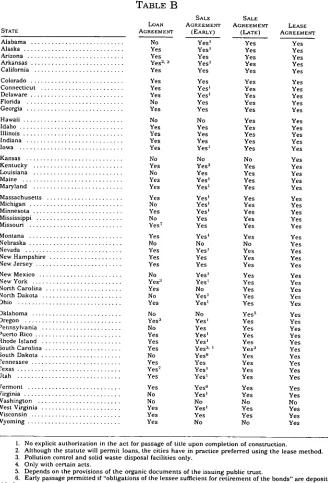
State law also governs the structure of the financing. Several structures may be available depending on the statute, including: (1) loan, (2) lease (with an option to purchase for a nominal sum at the end of the lease term), (3) lease/leaseback and (4) installment sale. A loan transaction is the simplest method but is not always
available under state law.54 The issuer lends the bond proceeds to
the company to enable it to construct the facility or to otherwise carry out the project. The company agrees, either in the loan agree-ment or in a promisory note issued pursuant to the loan agreeagree-ment, to make loan payments to the issuer sufficient to pay the principal of and interest on the bonds. Generally, if state law permits, the loan structure is used, unless there is some overriding reason to use another method. In a few states the lease structure is more advan-tageous because a property tax is not assessed on the facility if the lessor/owner is a political subdivision.
In a lease transaction, the issuer uses the proceeds from the
52. See Tables A and B following this article. 53. See Table A.
54. See Table B.
COMPUTER/LAW JOURNAL
sale of the bonds to construct the facility and leases the facility to the company for a rental sufficient to pay the principal of and inter-est on the bonds. In most cases the company actually construccts the facility on behalf of the issuer. The company is given an option to purchase the facility for a nominal sum at the end of the lease term.
In a lease/leaseback financing, the business leases the facility to the issuer for a "front-end" rental payment equal to the cost of con-struction of the facility or the bond proceeds, whichever is less. The issuer simultaneously subleases the facilities to the company for subrental payments sufficient to pay the principal of and interest on the bonds. This structure generally is used when a company cannot, for some reason, convey title to the issuer, such as when the prop-erty being financed is subject to the lien of a first mortgage inden-ture.
In an installment sale agreement, the issuer uses the bond pro-ceeds to construct the facility which it sells to the company for a purchase price sufficient to pay the principal of and interest on the bonds. The obligation of the company to make purchase price pay-ments may be either in the installment sale agreement itself or in a promissory note issued pursuant to the installment sale agreement. Title to the facility may pass to the company either upon completion of construction of the facility or upon payment in full of the princi-pal of and interest on the bonds.
VII. BOND RATING CONSIDERATIONS
The credit rating of the city, county or other issuer is not attrib-utable to an IDB issue. The rating and, hence, the marketability of an IDB financing is based on the economic feasibility of a project or the track record of earnings of a company, or both. The principal and interest on the revenue bonds are paid solely from the pay-ments by the company pursuant to the project financing agreement. As a result, unless a mortgage or a guaranty is given, the rating on the bonds depends primarily on the credit of the company.
Although a company which cannot obtain conventional financ-ing under normal economic conditions might be able to persuade a city or county to issue IDBs for it, the interest cost to the company would increase proportionately to the risk. For small companies without a track record of earnings, an exempt small issue would not have any rating. In such instances, local financial institutions are a primary market for the bonds.
TAX-EXEMPT BOND FINANCING
financing is structured as a lease or if a subsidiary of a larger com-pany is the party to the financing agreement. In a guaranty, the company directly guarantees to the bondholders the prompt and full payment of the principal of and interest on the bonds. The guaranty assures the bondholders that they will rank on par with all other un-secured creditors of the guarantor in the event of a bankruptcy or reorganization proceeding.
Another means of improving the credit rating of an IDB issue is to place a mortgage or security interest on the property being financed. If a mortgage is used, the issuer and the company both grant to the bondholders a mortgage interest in the financed facility. Federal Public Law 96-30255 authorized the Small Business Ad-ministration to guarantee loans in which tax-exempt financing is also used as a financing tool. This might enhance the feasibility of marketing IDB issues for small companies. Presently, relatively few small businesses can use tax-exempt financing because their credit risk is greater than that of larger, established companies. It has been proposed in Congress that the SBA be authorized to guarantee the repayment of exempt small issue IDBs in the same manner as it guarantees the bond obligations of small companies for pollution control devices. This action would make IDB issues for small and emerging businesses more marketable, thus allowing them to raise capital and to increase competition and accelerate the implementa-tion of technological developments in the marketplace.
VIII. CONCLUSION
Although legislation was introduced in the ninety-sixth Con-gress to increase the $10 million small issue exemption to $15 mil-lion and to exclude research and development expenditures from
the capital expenditure limitations on $10 million issues,5 6 the
mo-mentum at the federal level is generally to restrict tax-exempt IDB financings. Because of the strong public purpose, the high technol-ogy industry should urge the ninety-seventh Congress to examine the use of tax-exempt financing and other tax incentives with a fresh perspective.
The government-industry team approach to reindustrialization and to preserving and expanding a technology marketplace position, which has proved so successful in other nations, notably Japan, has yet to be embraced by our federal government. The concern and emphasis in the United States appears to be on the direct federal
55. Pub. L. No. 96-302, 96th Cong., 2d Sess. (1980).
56. This legislation was introduced in the 96th Congress by Senator Moynihan of New York.
COMPUTER/LAW JOURNAL
tax revenue loss associated with the income loss on a tax-exempt
bond, tax credit or accelerated depreciation.5 7 The focus instead
should be on the overall economic impact of such incentives.
The federal revenue gains generated by business expansion should be compared to the greater and continuing negative eco-nomic ripple effect on employment, related construction and other areas were the tax-exempt financing tool to be eliminated and other tax incentives not implemented. In fact, a recent study of small is-sue IDBs by Dr. Norman Ture concluded that increasing the small issue limit above $10 million would stimulate development so that net gains in tax revenues would be generated at the federal level as
well as at the state and local levels of governments.5 8
Because business decisions involving technology must be imple-mented rapidly, incentives which are simple and inexpensive to ap-ply, such as tax-exempt financing, tax credits and accelerated depreciation, must be continued and expanded as opposed to creat-ing costly and bureaucratic structures to administer loans and loan guarantee programs such as the ninety-sixth Congress enacted in its energy package. The administrative costs of such a sluggish ap-proach and its tendency to encourage sloppiness and overruns, rather than to develop marketplace competitive products, support the position that direct government spending to maintain our high technology superiority should be minimized. Direct federal govern-ment involvegovern-ment tends to encourage only activity, not
perform-ance.5 9 Performance is the ultimate test of the marketplace.
The objective of incentives must be to foster faster development of technology and to create new business opportunities, not to try to prop up ailing businesses. Business decisions must be made and implemented swiftly if the United States is to retain its diminishing
57. The federal tax revenue losses are generally grossly overstated in
Congres-sional Budget Office studies of tax-exempt IDBs. Compare CongresCongres-sional Budget Of-fice, A Study of Tax-Exempt Bonds for Single Family Housing for the Subcommittee on the City of the H.R. Committee on Banking, Financing and Urban Affairs (Comm.
Print 96-2, 1979) with Kormendi and Nagle, The Interest Rate and Tax Revenue Effects
of Mortgage Revenue Bonds (University of Chicago School of Business: 1979). The
federal studies have been based on the flawed assumption that an investor will ac-quire taxable investments if a single area of tax-exempt financing such as residential housing is eliminated. In fact, there are many substitute tax-exempt investments available even if a single exemption or a group of exemptions are eliminated. This fact, coupled with increasing investor sophistication, sharply diminishes the persua-sive value of such studies.
58. N. Ture, Inc., Economic and Federal Revenue Effects of Changes in the Small
Issue Industrial Development Bond Provisions (1980).
59. This approach is excellently stated in Hudson, A Prize Idea: Reward the
In-vention, Not the Feasibility Study, WASH. MONTHLY, Sept. 1980, at 14.
TAX-EXEMPT BOND FINANCING
edge in technology. The marketplace dynamics are much more criti-cal in high technology than in energy. The time for implementing a business decision could be long gone by the time a federal agency makes a determination on a loan application.
Implementation of a decision to raise capital through tax-exempt funds is uncomplicated and can be done rapidly. The first step is for the financial officers of the company and an underwriter to evaluate the marketability of the proposed bond issue. Other par-ties who would participate in the transaction, including company counsel and bond counsel, are consulted. Bond counsel determines whether and to what extent the facilities may be financed under the state law and whether interest on the bonds would be tax-exempt under the federal tax law.
If it is determined that a tax-exempt IDB financing is feasible, the company, the underwriter and bond counsel will contact the governing body of the governmental subdivision which would issue the bonds and request it to adopt an intent resolution. Because of the economic benefits to a community, cities, counties, and other governmental subdivisions generally are responsive to the desires of businesses to use tax-exempt financing and cooperate in providing the mechanism for making such financings possible. Once the
is-suer adopts the intent resolution, the project may begin.
America's high technology industry must achieve economic equality with its competitors. No single economic incentive will stimulate America's private sector to maintain its worldwide posi-tion in high technology, but continuing to allow and expanding the availability of tax-exempt financing would be a meaningful incentive among the set of necessary incentives. High technology industry groups should demonstrate to the ninety-seventh Congress the criti-cal need to expand such an effective incentive as part of a compre-hensive national policy to maintain America's position in the technology marketplace.
The outcome of the 1980 national election, with then President-elect Reagan's campaign pledge to foster development of the part-nership between government and the private sector, together with sweeping changes in both houses of the Congress, suggests that the
time for rethinking these issues is at hand.60
60. The Reagan tax cut proposals reportedly include another reduction in capital
gains taxes, greatly accelerated depreciation schedules for equipment and a tax credit plan for research and development expenditures. Industry Spokesmen
Wel-come Reagan, Computerworld, Dec. 1, 1980, at 69. The proposal for accelerated
depre-ciation is expected to be a simplified "10-5-3" scheme, which would allow businesses to write off the cost of structures over 10 years, the cost of most equipment over 5 years and vehicles over 3 years. DAILY TAx REP. (BNA), Nov. 17, 1980, at G-3.
COMPUTER/LAW JOURNAL [Vol. II
0)
0w v w 1, ow o
04 4~4)
~
D) 4)4 A2)a)0oa>, >, .0.
...0>))0 ) )>> 0>) 0
0 4))00)4))4)4)400)004))040)00)0000)0040)004))0w
2'2 > 4> 4> -> W > W - 2 4> 4> 2 ->
z
Z
u m ))) >000 0 .. 0 .. 0 00 ... >)
c
-w )000444000))040)))))0400)))4000 o
UE-4
4 o
oi
.) .0) . . ...
>4> . >
u
00w ))))))))))))))))))4444444444444444444
r
2 4>
0> )Z> W . >
0<00)))000)))000)))00 0))))))))))0000000000
0) 0)
3~. -a'D0) o
4) 0) 0
TAX-EXEMPT BOND FINANCING
.0 Q
~
.z> >, z>
0)00)0)0)0w00o )0o
>4> Z> )> Z Z 0>
0)00)0
~
00 z))0 )000000~'~0 A
00 >4 00 0> Z 000
ro..0 0
.0 . ' '
2 r00)
828 COMPUTER/LAW JOURNAL [Vol. II
TABLE B
SALE SALE
LOAN AGREEMENT AGREEME NT LEASE
STATE AGREEMENT (EARLY) (LATE) AGREEMENT
Alabama ... No Yes Yes Yes Alaska ... Yes Yes Yes Yes Arizona ... Yes Yes Yes Yes Arkansas ... Yes2" Yesi Yes Yes California ... Yes Yes Yes Yes Colorado ... Yes Yes Yes Yes Connecticut ... Yes Yes' Yes Yes Delaware ... Yes Yes Yes Yes Florida ... ... No Yes Yes Yes Georgia ... Yes Yes Yes Yes Hawaii ... ... No No Yes Yes
Idaho ... Yes Yes Yes Yes
Illinois ... ... Yes Yes Yes Yes Indiana ... Yes Yes Yes Yes Iowa ... Yes Yes' Yes Yes Kansas ... No No No Yes Kentucky ... Yes Yes3 Yes Yes Louisiana ... No Yes Yes Yes Maine ... Yes Yesi Yes Yes Maryland ... Yes Yes' Yes Yes Massachusetts ... Yes Yes' Yes Yes Michigan ... No Yesi Yes Yes Minnesota ... Yes Yes Yes Yes Mississippi ... No Yes Yes Yes Missouri ... Yes7 Yes Yes Yes Montana ... Yes Yesi Yes Yes Nebraska ... No No No Yes Nevada ... Yes Yes' Yes Yes New Hampshire ... Yes Yes Yes Yes New Jersey ... Yes Yes Yes Yes New Mexico ... No Yes Yes Yes New York ... Yes3 Yes' Yes Yes North Carolina ... Yes No Yes Yes North Dakota ... No Yesi Yes Yes Ohio ... Yes Yes' Yes Yes Oklahoma ... No No Yes5 Yes Oregon ... Yes' Yes' Yes Yes Pennsylvania ... No Yes Yes Yes Puerto Rico ... Yes Yesi Yes Yes Rhode Island ... Yes Yesi Yes Yes South Carolina ... Yes Yes3 i Yes3 Yes South Dakota ... No Yes6 Yes Yes Tennessee ... Yes Yes Yes Yes
Texas ... ... Yes7 Yesi Yes Yes Utah ... Yes Yes' Yes Yes Vermont ... Yes Yes6 Yes Yes Virginia ... No Yes Yes Yes Washington ... No No No No West Virginia ... Yes Yesi Yes Yes Wisconsin ... Yes Yes Yes Yes Wyoming ... Yes No No Yes
I. No explicit authorization in the act for passage of title upon completion of construction.
2. Although the statute will permit loans, the cities have in practice preferred using the lease method.
3. Pollution control and solid waste disposal facilities only.
4. Only with certain acts.
5. Depends on the provisions of the organic documents of the issuing public trust.
6. Early passage permitted if "obligations of the lessee sufficient for retirement of the bonds" are deposited with the trustee.
7. Industrial development facilities only.