Volume 02, No. 5, May 2016
P
age
1
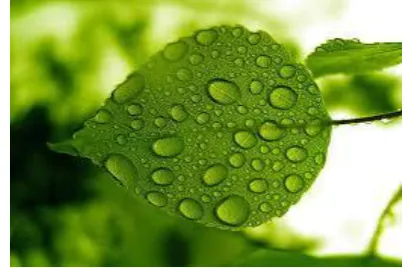
Figure 1: Non-Infected Fresh Leaf
Leaf Disease Detection Using K-Means Clustering And Fuzzy
Logic Classifier
Mr. Jagan Bihari Padhy*, Devarsiti Dillip Kumar**, Ladi Manish*** and Lavanya Choudhry****
*Assistant Professor, Gandhi Institute Of Engineering and Technology, Gunupur **Under Graduate Student, Gandhi Institute Of Engineering and Technology, Gunupur *** Under Graduate Student, Gandhi Institute Of Engineering and Technology, Gunupur ****Under Graduate Student, Gandhi Institute Of Engineering and Technology, Gunupur
ABSTRACT:
Identification of the plant diseases is the key to preventing the losses in the yield and quantity of the agricultural product. The studies of the plant diseases mean the studies of visually observable patterns seen on the plant. Health monitoring and disease detection on plant is very critical for sustainable agriculture. It is very difficult to monitor the plant diseases manually. It requires tremendous amount of work, expertise in the plant diseases, and also require the excessive processing time. Hence, image processing is used for the detection of plant diseases. Disease detection involves the steps like image acquisition, image pre-processing, image segmentation, feature extraction and classification. The work discussed the methods used for the detection of plant diseases using their leaves images. In future the entire system is to be implemented in hardware and Io T based Plant Motoring System will also be implemented.
1. INTRODUCTION
India is a cultivated country and about 70% of the population depends on agriculture. Farmers have large range of diversity for selecting various suitable crops and finding the suitable pesticides for plant. Disease on plant leads to the significant reduction in both the quality and quantity of agricultural products. The studies of plant disease refer to the studies of visually observable patterns on the plants. Monitoring of health and disease on plant plays an important role in successful cultivation of crops in the farm. In early days, the monitoring and analysis of plant diseases were
Volume 02, No. 5, May 2016
P age
2
is the technique which is used for measuring affected area of disease, and to determine the difference in the colour of the affected area.
2. LITERATURE SURVEY
Paper Methodology Future Work
[1] Detection And
Classification Of Plant Leaf
Diseases Using Image
Processing Techniques: A
Review
Review of ANN, SVM, PNN,SELF ORG MAPS AND FUZZY LOGIC
In neural network it’s difficult to understand structure of algorithm
and to determine optimal
parameters when training data is not linearly separable.
[2] Agricultural Plant Leaf
Disease Detection Using
Image Processing
Vision-based detection
algorithmwith Masking
the green-pixels and
Color Co-occurrence
Method.
NN’s can be used to increase the recognition rate of classification process.
[3] An Application Of
K-Means Clustering And
Artificial Intelligence In
Pattern Recognition For Crop Diseases
K-means clustering
algorithm with Neural networks for automatic
detection of leaves
diseases.
Artificial Neural Network and Fuzzy Logic with other soft computing technique can be used to classify the crop diseases.
[4] Detection Of Unhealthy Region Of Plant Leaves And Classification Of Plant Leaf
Diseases Using Texture
Features
Color co-occurrence
method with SVM
classifier.
The training samples can be increased and shape feature and color feature along with the optimal features can be given as
input condition of disease
identification.
[5] Applying Image
Processing Technique To
Detect Plant Diseases
Gabor filter for feature
extraction and ANN
classifier for
classification.
Recognition rate can be increased.
[6] Remote Area Plant
Disease
Detection Using Image
Processing
Texture segmentation by
co-occurrence matrix
method and K-means Clustering Technique.
Bayes classifier, K-means
clustering and principal
component classifier can be used to classify various plant diseases.
[7] Advances In Image
Processing For Detection Of Plant Diseases
The color co-occurrence texture analysis method was developed through the use of Spatial Gray
level Dependence
Matrices
Better result of detection can be obtained with the large database and advance feature of color extraction
[8] Leaf Disease Severity Measurement Using Image Processing
Simple threshold and
Triangle thresholding
segmentation methods
Volume 02, No. 5, May 2016
P
age
3
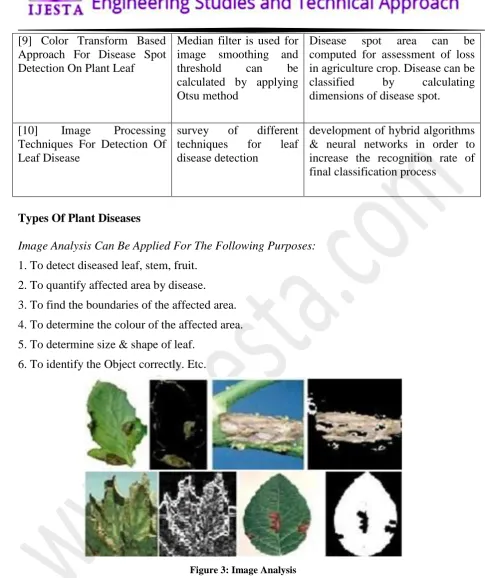
Figure 3: Image Analysis [9] Color Transform Based
Approach For Disease Spot Detection On Plant Leaf
Median filter is used for image smoothing and
threshold can be
calculated by applying Otsu method
Disease spot area can be
computed for assessment of loss in agriculture crop. Disease can be
classified by calculating
dimensions of disease spot.
[10] Image Processing
Techniques For Detection Of Leaf Disease
survey of different
techniques for leaf
disease detection
development of hybrid algorithms & neural networks in order to increase the recognition rate of final classification process
2.1 Types Of Plant Diseases
Image Analysis Can Be Applied For The Following Purposes:
1. To detect diseased leaf, stem, fruit.
2. To quantify affected area by disease.
3. To find the boundaries of the affected area.
4. To determine the colour of the affected area.
5. To determine size & shape of leaf.
6. To identify the Object correctly. Etc.
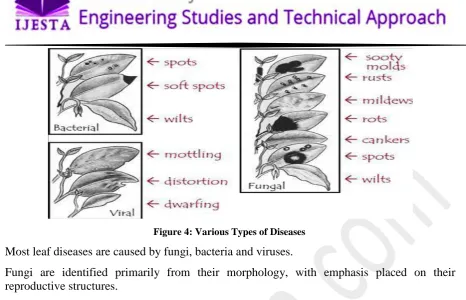
Various Types of Leaf Spot Diseases: Bacterial
Fungal
Volume 02, No. 5, May 2016
P
age
4
Figure 4: Various Types of Diseases
Most leaf diseases are caused by fungi, bacteria and viruses.
Fungi are identified primarily from their morphology, with emphasis placed on their reproductive structures.
Bacteria are considered more primitive than fungi and generally have simpler life cycles. With few exceptions, bacteria exist as single cells and increase in numbers by dividing into two cells during a process called binary fission.
Viruses are extremely tiny particles consisting of protein and genetic material with no associated protein.
3. BASIC STEPS FOR DISEASE DETECTION
Figure 5: Basic Steps for Plant Disease Detection and Classification
Processes Work
Image Acquisition Image
Pre-processing Image Clipping
Image Smoothing
Volume 02, No. 5, May 2016
P
age
5
Features
Digital Image Processing
1) Image Acquisition
The digital images are acquired from the environment referring different sites. Image pre-processing is a prophase relative to feature extraction and image recognizing. Many way to collect the images means we can visit the agricultural research units. In this research work the help of the research centres is taking which is working in agriculture department.
2) Image Pre-Processing
Image pre-processing is a prophase relative to feature extraction and image recognizing. The images which have input are always not satisfactory regardless of what image acquisition devices are adopted. For e.g., there are noises in the image, the region of interest in the image is not clear or other objects’ interference exist in the image and so on. Different pre-processing methods should be chosen for different image applications.
3) Image Segmentation
The image will be segmented into different parts according to the region of interest. Purpose of image segmentation is to divide the image into some meaningful regions. Simply to say, image segmentation means to separate the object from background for following processing in an image. It contains Thresholding, Binarization, and Segmentation.
4) Extraction of Features
When the input data to an algorithm is too large to be processed and it is suspected to be notoriously redundant then the input data will be transformed into a reduced representation set of features (also named features vector). Transforming the input data into the set of features is called feature extraction. If the features extracted are carefully chosen it is expected that the features set will extract the relevant information from the input data in order to perform the desired task using this reduce drepresentation instead of the full size input.
Image Segmentation
Binarization
Segmentation Thresholding
Extraction of
Statistical Analysis
Classification Based on Classifier Neural Network
Volume 02, No. 5, May 2016
P
age
6
Classification based on a classifier: We are using Artificial Intelligence Techniques to solve the problem. We are going to classify it with the original existing work. Artificial Neural Network and Fuzzy Logic can be used to classify the plant diseases.
5) Statistical Analysis
By comparing the classification results of ANN and Fuzzy Logic Technique. These analyzes , which system is better in sense of Accuracy, Speed, User friendly, easily adaptable topology of the network changes, a new sequence number is necessary before the network re-converges; thus, DSDV between nodes by sending full dumps infrequently and smaller incremental updates more frequently. Whenever there is not suitable for highly dynamic networks. (As in all distance-vector protocols, this doesnot perturb traffic in regions of the network that are not concerned by the topology change.
Non-Infected Leaf Followed By Output Segmented Images:
Output Segmented Image of Sample Non-Infected Leaf
Infected Leaf Followed By Output Segmented Images:
Volume 02, No. 5, May 2016
P
age
7
4. CONCLUSION:
From the study of the above techniques I come up with following conclusion.
A. By using Image Processing we can detect the infected part of a leaf and carry out the
desired action to prevent the plant from destroying.
B. From the above classification techniques:
i. The k-nearest-neighbour method is perhaps the simplest of all algorithms for
predicting the class of a test example. An obvious disadvantage of the k-NN method is the time complexity of making predictions. Additionally, neural networks are tolerant to noisy inputs. But in neural network it’s difficult to understand structure of algorithm.
ii. SVM was found competitive with the best available machine learning algorithms
in classifying high-dimensional data sets. In SVM computational complexity is reduced to quadratic optimization problem and it’s easy to control complexity of decision rule and frequency of error. Drawback of SVM is it’s difficult to determine optimal parameters when training data is not linearly separable. Also SVM is more complex to understand and implement.
5. REFERENCES:
i. Prof. Sanjay B. Dhaygude, Mr.Nitin P.Kumbhar “Agricultural plant Leaf Disease
Detection Using Image Processing” International Journal of Advanced Research in Electrical, Electronics and Instrumentation Engineering Vol. 2, Issue 1, January 2013
ii. Mrunalini R. Badnakhe and Prashant R. Deshmukh” An Application of K-Means
Clustering and Artificial Intelligence in Pattern Recognition for Crop Diseases”, International Conference on Advancements in Information Technology 2011 IPCSIT vol.20 (2011)
iii. S. Arivazhagan, R. Newlin Shebiah, S. Ananthi, S. Vishnu Varthini “Detection of
unhealthy region of plant leaves and classification of plant leaf diseases using texture features” Agric Eng Int: CIGR Journal, 15(1): 211-217 2013
iv. Anand.H.Kulkarni, Ashwin Patil R. K.” Applying image processing technique to
detect plant diseases”, International Journal of Modern Engineering Research, Vol.2, Issue.5, Sep-Oct. 2012 pp-3661-3664
v. Sabah Bashir, Navdeep Sharma “Remote Area Plant Disease Detection Using Image
Processing”, IOSR Journal of Electronics and Communication Engineering, ISSN: 2278-2834 Volume 2, Issue 6 2012, PP 31-34
vi. Smita Naikwadi, Niket Amoda” ADVANCES IN IMAGE PROCESSING FOR
DETECTION OF PLANT DISEASES”, International Journal of Application or Innovation in Engineering & Management, Volume 2, Issue 11, November 2013
vii. Sanjay B. Patil et al. “LEAF DISEASE SEVERITY MEASUREMENT USING
IMAGE PROCESSING”, International Journal of Engineering and Technology Vol.3 (5), 2011, 297-301
viii. Piyush Chaudhary et al. “Color Transform Based Approach for Disease Spot