A SECURE PASSWORD-BASED REMOTE USER AUTHENTICATION
SCHEME WITHOUT SMART CARDS
Bae-Ling Chen
1, Wen-Chung Kuo
2*, Lih-Chyau Wuu
3 1Graduate School of Engineering Science and Technology National Yunlin University of Science and Technology No. 123, Section 3, University Road, Douliu, Yunlin 64002, Taiwan
e-mail: [email protected]
2
Department of Computer Science and Information Engineering National Yunlin University of Science and Technology No. 123, Section 3, University Road, Douliu, Yunlin 64002, Taiwan
e-mail: [email protected]
3
Institute of Computer Science and Information Engineering National Yunlin University of Science and Technology No. 123, Section 3, University Road, Douliu, Yunlin 64002, Taiwan
e-mail: [email protected]
Abstract. There are many remote user authentication schemes proposed in literature for preventing unauthorized parties from accessing resources in an insecure environment. Due to inherent tamper-resistance, most of them are based on smart card authentication schemes. Unfortunately, the cost of cards and readers makes these schemes costly. In the real world, common storage devices, such as universal serial bus (USB) thumb drives, portable HDDs, mobile phones, Laptop or Desktop PCs, are widely used, and they are much cheaper or more convenient for storing user authentication information. However, since these devices do not provide tamper-resistance, it is a challenge to design a secure authentication scheme using these kinds of memory devices. In this paper, we will propose a secure password-based remote user authentication and key agreement scheme without using smart cards. According to our analysis, the proposed scheme guarantees mutual authentication and also resists off-line dictionary, replay, forgery, and impersonation attacks. Compared to related scheme, the proposed scheme’s computation cost is lower and the total message length is shorter. Therefore, our scheme is suitable even for applications in limited power computing environments.
Keywords: password-based; remote access; tamper-resistant; mutual authentication; impersonation attack.
*
Corresponding author
1. Introduction
With the increasing number of systems that provide services over open networks, remote authentication is critical for preventing unauthorized parties from accessing remote system resources. Smart cards are the most commonly used mechanism in password-based remote user authentication schemes. Smart card-based authentication schemes [5] provide strong authentication and reduce the risk of server side verification tables being tampered with using Lamport’s authentication scheme [9]. In order to improve security and efficiency, many authentication
schemes have been proposed [1, 4-7, 10-11, 14-15, 17-18] in the last decade.
infrastructure for smart card-based schemes, such as the cards and readers add substantially to the cost. In the real world, common storage devices, such as USB thumb drives, portable HDDs, mobile phones, and Laptop or Desktop PCs, are much cheaper or more convenient for storing user authentication information issued from the system server. However, since these common storage devices come without tamper-resistance, it is a big challenge to design a secure authentication scheme using these memory devices.
In 2009, Rhee et al. [12] analyzed the security of two remote authentication schemes proposed by Fan
et al. [4] and Khan and Zhang [7], respectively. Rhee
et al. showed that the two schemes are vulnerable to
impersonation attacks when the tamper-resistant property is eliminated from smart-card-based schemes; in other words, if any user in those two schemes is using insecure storage instead of using a tamper-resistant device such as a smart card, the user authentication procedure is insecure against impersonation attacks. In order to mitigate this weakness and enhance security when using insecure storage device, Rhee et al. proposed a remote user authentication scheme (RKL-scheme for short) based on ElGamal’s public key cryptosystem [3]. They stated that their scheme provides mutual authentication with no verification table at the cost of only two messages for login and authentication protocols. They also claimed that their scheme is resistant against impersonation and off-line dictionary attacks. However, Tan [16] performed a security analysis of RKL-scheme later in 2009 and pointed out that the RKL-scheme is insecure against impersonation and man-in-the-middle attacks.
So RKL-scheme is insecure because we find that there are much redundant information and they lack identification-related information in terms of their login request. In this paper, we will propose a novel secure password-based remote user authentication and key agreement scheme using common storage devices such as USB drives. The proposed scheme is based on the difficulty of cracking the computational Diffie-Hellman Problem (CDHP for short) [2, 13]. According to our security analysis, the proposed scheme cannot only withstand off-line dictionary and well-known on-line attacks, but also provides mutual authentication. Compared with the RKL-scheme, the proposed scheme’s computation cost is lower and the total message length is also shorter. Therefore, our scheme is efficient and more suitable for applications in power-limited computing environments.
The structure of this paper is organized as follows. Section 2 describes the preliminaries. In Section 3, we propose our secure password-based remote user authentication and key agreement scheme without using smart cards, and present the security analysis of the proposed scheme in Section 4. Our conclusions are given in Section 5.
2. Preliminaries
2.1. Notations
The notations used throughout this paper are as follows.
x IDi user Ui’s identity x PWi user Ui’s password x x server S’s secret key
x p, q two large prime numbers that satisfy p=2q+1
x H secure one-way hash function
x T timestamp
x T maximum transmission delay
x Zq ring of integers modulo q x Zq* multiplicative group of Zq x צ concatenation operation
2.2. Computational Diffie-Hellman Problem (CDHP) [2, 13]
Consider a multiplicative group G and an element
gѮ G having order p. The CDH problem states that, given ga mod p and gb mod p for randomly-chosen a,
b, it is computationally intractable to compute the value gab mod p. Note that this problem is closely related to the difficulty of computing the discrete logarithm problem (DLP for short) over a cyclic group.
2.3. Security of Common Storage Devices
USB drives are ease to use memory devices. There are commercially available products coming with fingerprint locks or protected by AES-256 encryption. We incorporate these kinds of products in our scheme to strengthen the tamper-resistant property. Checking fingerprints provides a better security on unauthorized access. Encrypting files also provides considerable protection against tamper attacks or stolen items.
2.4. Goals
(I) The proposed scheme should provide a mechanism to prevent data tampering even though the scheme comes without using tamper-resistant devices.
(II) The proposed scheme should protect stored data against off-line dictionary attack.
(III) The proposed scheme should withstand well-known on-line attacks, such as replay attack, forgery attack, and user/server impersonation attack.
3. Proposed Scheme
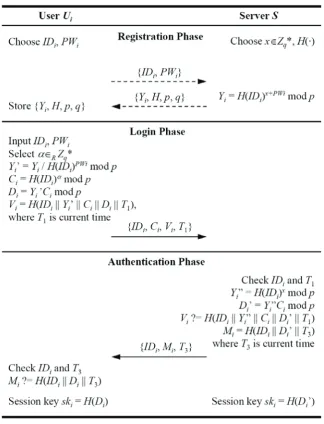
3.1. Registration Phase
In this phase, server S selects large prime numbers
p and q that satisfy p = 2q + 1, its secret key xѮ Zq*,
and a one-way hash function H. User Ui applies his
identity IDi and password PWi to S, obtains the
authentication information from S and stores the information on his local memory device.
Step R1. Ui chooses his identity IDi and
password PWi and sends them to S via a
secure channel.
Step R2. Upon receiving the registration information, S computes Yi = H(IDi)x + PWi
mod p.
Step R3.S sends the authentication information {Yi, H, p, q} back to Ui via the secure
channel.
Step R4. Upon receiving the authentication information, Ui stores it locally on his
memory device, i.e., his USB drive.
Figure 1. The proposed scheme
3.2. Login Phase
This phase is invoked whenever user Ui wants to
access system resources provided by server S. To log into the system, Ui retrieves the authentication
information stored on his USB stick, calculates the proper information, and submits his login request to S. In our scheme, the authentication information issued from the server is stored on a device without
Step L1. Ui chooses a random numbers D Ѯ
Zq* and computes Yi’ = Yi / H(IDi)PWi mod p,
Ci = H(IDi)D mod p, Di = Yi’Ci mod p, and Vi
= H(IDi || Yi’ || Ci || Di || T1), where T1 is the
current time of Ui.
Step L2. Ui sends his login request {IDi, Ci, Vi,
T1} to S.
Step L3. If Ui does not receive S’s reply
before timeout, Ui must go back to the
registration phase and re-obtain his authentication information.
3.3. Authentication Phase
Upon receiving the login request from user Ui,
server S checks the request and replies the mutual authentication message if Ui is legitimate. After
mutual authentication completed, Ui and S establish a
secure channel by their shared session key sk.
Step A1. S checks that IDi is valid and (T2
T1) < T, where T2 is the time which IDi
arrives to the server S. If either does not hold,
S drops the request and terminates the session.
Step A2. S computes Yi” = H(IDi)x mod p and
Di’ = Yi”Ci mod p and then verifies Vi with
H(IDi || Yi” || Ci || Di’ || T1). If they are not
equal, S rejects the login request and stops the session; otherwise, S authenticates Ui and
the login request is accepted.
Step A3. S computes Mi = H(IDi || Di’ || T3),
where T3 is the current time of S, and replies with response {Mi, T3} back to Ui.
Step A4. Upon receiving the message, Ui
checks if T3 is valid and Mi is equal to
H(IDiצDiצT3). If they hold, S is authenticated
and mutual authentication between Ui and S
is achieved; otherwise, S is not authenticated.
Ui ends the session and goes back to the
login phase.
Step A5. After the mutual authentication finished, Ui and S compute the symmetric
session key sk = H(Di)user-side = H(Di’)server-side
and use the key to launch a secure communication channel.
3.4. Password Change Activity
In the case where user Ui wants to change his
identity IDi and password PWi, he can choose his new
identity IDi* and password PWi*, go back to the
registration phase, and re-obtain his new authentication information from server S.
4. Security and Performance Analysis
In this section, we present the security analysis of the proposed scheme.
4.1. Security of Server S’s Secret Key {x}
In the proposed scheme, only the service providing server S knows the secret key x. An adversary A may monitor the network traffic and collect Ui’s login
request {IDi, Ci, Vi, T1} and S’s response {Mi, T3}.
However, A cannot recover x from Ci since Ci =
H(IDi)D mod p does not contain any knowledge of x.
Besides, Vi and Mi are two digests. Since H is a secure
one-way hash function, there is no way for A to regain
x based on these two messages. Therefore, it is impossible for A to get the server’s secret key x based on eavesdropped communication flows. Assume A
steals Ui’s authentication information {Yi, H, p, q},
and tries to retrieve x from Yi = H(IDi)x + PWi mod p.
Since there is no any redundancy inside the authentication information that can be used as a checking verifier, it is impossible for A to guess x
successfully. For a malicious user Ua, he can extract Ya
from his own authentication information {Ya, H, p, q}
and try to retrieve Ya’. To calculate x from Ya’ =
H(IDa)x mod p, he needs to break the difficult problem
of DLP [2]. Currently, it is believed that there is no polynomial time algorithm that can solve DLP.
4.2. Security of User Ui’s Password {PWi }
In the proposed scheme, there is no password table or verifier derived from PWi stored on the server side
after the registration phase. There is no way for an adversary A to retrieve Ui’s password PWi based on
the eavesdropped communication flows, such as Ui’s
login request message {IDi, Ci, Vi, T1} and S’s
response {Mi, T3}, since these communication flows
do not contain any information of Ui’s password PWi.
Assume A steals Ui’s authentication information {Yi, H,
p, q}, and tries to retrieve PWi from Yi = H(IDi)x + PWi
mod p. Since there is no redundancy inside the authentication information that can be used as a verifier, it is impossible for A to guess PWi
successfully.
4.3. Security of Authentication Information {Yi,H, p,q}
The only secret in the authentication information is
Yi. Assume that Ui’s authentication information is
stolen by an adversary A. By the above discussions in Sections 4.1 and 4.2, we know that A can guess neither the server S’s secret key x nor the user Ui’s
password PWi. Therefore, without correct x or PWi, it
is impossible that A can successfully calculate Ui’s
secret information Yi’ = H(IDi)x mod p. A may also
monitor network traffic and collect Ui’s login request
{IDi, Ci, Vi, T1} and S’s response {Mi, T3}, and try to
recover Yi’. However, H is a secure one-way hash
function; there is no way for A to retrieve x or PWi
based on Vi and Mi. Moreover, A cannot recover Yi’
from Ci = H(IDi)D mod p either since Ci does not
4.4. Off-line Dictionary Attacks
Assume that Ui’s authentication information {Yi, H,
p, q} is stolen by an adversary A, and A has also eavesdropped Ui’s communication flows {IDi, Ci, Vi,
T1} and {Mi, T3}. By the discussion in Section 4.1 of
the security of S’s secret {x}, we prove that it is very difficult that A can successfully recover the server’s secret key x from the user’s authentication information or eavesdropped communication flows. According to the security of Ui’s password {PWi} discussed in
Section 4.2, it is no way that A can retrieve the user’s password PWi from user’s authentication information
or eavesdropped communication flows. Also, from the discussion in Section 4.3, we see that it is impossible that A can successfully retrieve Ui’s secret information
Yi’ from Yi. Therefore, our scheme is secure against
off-line dictionary attacks.
4.5. On-line Attacks
We analyze the security of our scheme when it is attacking by: replay, forgery, and user/server impersonation attacks.
4.5.1. Replay Attacks
Assume that an adversary A pretends to be user Ui
or server S by replaying the eavesdropped communication flows, such as Ui’s login request
message {IDi, Ci, Vi, T1} or S’s response {Mi, T3}. For
Ui’s login request {IDi, Ci, Vi, T1}, S can easily detect
a replay attack by checking the timestamp T1. For S’s response {Mi, T3}, Ui can easily detect a replay attack
by checking the timestamp T3. Therefore, the attacker cannot circumvent the timestamp checking and complete the authentication phase. Note that, the man-in-the middle attack is a particular case of replay attack. It can also be detected by checking the timestamp.
4.5.2. Forgery Attacks
An adversary A may try to modify T1 in Step L2 or
T3 in Step A4 to achieve a forgery attack. This will not work unless he also modifies Vi = H(IDi || Yi’ || Ci || Di
|| T1) in Step L1 or Mi = H(IDi || Di’ || T3) in Step A3
with their corresponding values. However, it is difficult to compute the two digests Vi and Mi correctly
without user Ui’s password PWi or server S’s secret
key x. Unless A can compute the two digests Vi or Mi,
both S and Ui can easily calculate the corresponding
hash value and compare with the received Vi or Mi,
respectively.
4.5.3. User Impersonation Attacks
If an adversary Awants to forge the login request {IDi, Ci, Vi, T1} and impersonate user Ui to fool server
S, A needs to compute Yi’ = H(IDi)x mod p. However,
from the previous discussion in Section 4.3, A cannot
calculate the correct values of Di and Vi without Yi’.
Therefore, the proposed scheme is secure against user impersonation attacks.
4.5.4. Server Impersonation Attacks
Assume that there is an adversary A that intends to masquerade as server S and deceive user Ui. A needs
to generate a valid response {Mi, T3}, where Mi =
H(IDi || Di’ || T3). However, from the discussion in
Section 4.1, we proved that A cannot recover the server’s secret key x from the eavesdropped communication flows and authentication information. Therefore, A cannot correctly compute Di’ and
generate the forged mutual authentication message without x. Hence, the proposed scheme is secure against server impersonation attacks.
4.6. Mutual Authentication
The proposed scheme provides a mechanism that allows the user and server to verify each other. From the discussion in Section 4.2, we can recognize that only the legitimate user with the correct password can pass through the server’s verification. In addition, from the discussion in Section 4.1, we also can distinguish that only the correct server with correct secret key can be qualified by the user. Therefore, the scheme achieves mutual authentication between a valid user and the server.
4.7. Secure Channel
After mutual authentication completed, both Ui
and S can calculate their symmetric session key sk and establish a secure channel for subsequent communications. Note that if current session key is compromised by an attacker, the secrecy of previously established session keys is not affected. In the proposed scheme, the session key sk = H(Di) = H(Di’),
where Di = H(IDi)x + D mod p = Di’. Even if the system
session key x is compromised, the attacker cannot calculate any previous sk without the random value D chosen every login session by Ui.
4.8. Efficiency
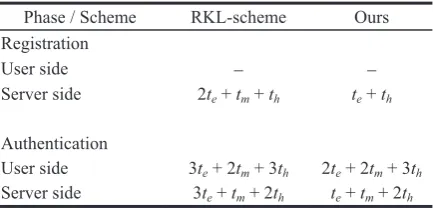
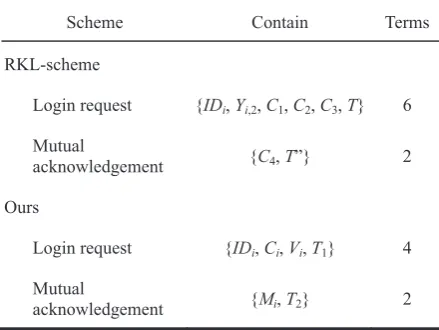
We evaluated the performance of the proposed scheme with related schemes. Tables 1 and 2 show the computation overhead and communication cost of RKL-scheme [12] and the proposed scheme.
Table 1. Computation overhead
Phase / Scheme RKL-scheme Ours Registration
User side
Server side 2te + tm + th te + th
Authentication User side 3te + 2tm + 3th 2te + 2tm + 3th
x te is the time complexity of exponentiation operation.
x tm is the time complexity of multiplication/division operation.
x th is the time complexity of hashing operation.
From Table 1, we can calculate the total computation overhead of RKL-scheme and ours to be 8te + 4tm + 6th and 4te + 3tm + 6th, respectively. It can
be seen that the proposed scheme can save four exponentiation and one multiplication operations compared to RKL-scheme.
From Table 2, the communication costs of RKL-scheme and the proposed RKL-scheme are 8 terms and 6 terms. We can reasonably assume that the lengths of the identity and the timestamp are 64 bits, the length of the prime number p is 128 bits, and the one-way hash function is SHA-1 with 160 bits throughout. The communication cost at the user side between RKL-scheme and the proposed RKL-scheme is 640(=64+128+128+128+128+64) bits and 416(=64+128+160+64) bits, respectively. It is demonstrated that the proposed scheme’s communication cost is shorter than RKL-scheme’s.
Table 2. Message length
Scheme Contain Terms
RKL-scheme Login request {IDi, Yi,2, C1, C2, C3, T} 6
Mutual
acknowledgement {C4, T”} 2
Ours Login request {IDi, Ci, Vi, T1} 4
Mutual
acknowledgement {Mi, T2} 2
According to our analysis on both computation overhead and communication cost, our scheme is efficient and more suitable for applications in power-limited computing environments.
4.9. Functionality
The functionality of the proposed scheme is compared with RKL-scheme when users use insecure devices instead of smart cards to store authentication information. We summarize the comparisons in Table 3.
Table 3. Functionality comparison
Functionality / Scheme
RKL-scheme Ours Resists
stolen-authentication-information attacks No Yes
Resists insider attacks No Yes Resists off-line dictionary attacks No Yes
Resists replay attacks No Yes
Resists man-in-the-middle attacks No Yes Resists forgery attacks No Yes Resists user impersonation attacks No Yes Resists server impersonation attacks No Yes Achieves mutual authentication No Yes Establishes secure channel No Yes
x Tan [16] has shown that RKL-scheme is insecure against impersonation and man-in-the-middle attacks.
5. Conclusions
In this paper, we have proposed a novel secure password-based remote user authentication scheme which solves the user impersonation attack problem by adding a blind factor into the authentication information stored on a user’s local memory device. The proposed scheme is based on the difficulty of cracking CDHP. We demonstrated that the proposed scheme cannot only withstand off-line dictionary and well-known on-line attacks, but also provides mutual authentication. It shows that the proposed scheme achieves our goals. In other words, the proposed scheme retains all the advantages of RKL-scheme while being robust against user/server impersonation attacks, and also provides more security properties at the same time. Compared with RKL-scheme, the proposed scheme’s computation cost is lower and the message length is shorter. Therefore, our scheme is efficient and more suitable for applications in power-limited computing environments.
Acknowledgment
This research was supported by NSC 100-2221-E-150-068.
References
[1] H. Y. Chien, J. K. Jan, Y. M. Tseng. “An efficient and practical solution to remote authentication: smart card,” Computers and Security 21(4) (2002) 372–375.
[2] W. Diffie, M. E. Hellman. New Directions in Cryptography, IEEE Transactions on Information Theory IT-22 (6) (1976) 644–654.
[3] T. ElGamal. A public-key cryptosystem and a signature scheme based on discrete logarithms, IEEE Transactions on Information Theory 31 (4) (1985) 469–472.
[4] C. I. Fan, Y. C. Chan, Z. K. Zhang. Robust remote authentication scheme with smart cards, Computers & Security 24 (8) (2005) 619–628.
[5] M. S. Hwang, L. H. Li. A new remote user authentication scheme using smart cards, IEEE Transactions on Consumer Electronics 46 (1) (2000) 28–30.
[7] M. K. Khan, J. S. Zhang. Improving the security of a flexible biometrics remote user authentication scheme, Computer Standards & Interfaces 29 (1) (2007) 82–85.
[8] P. Kocher, J. Jaffe, B. Jun. Differential power analysis. In: Advances in Cryptology, CRYPTO’99 (1999) 388–397.
[9] L. Lamport. Password authentication with insecure communication, Communications of the ACM 24 (1981) 770–772.
[10] C. T. Li, C. C. Lee. A robust remote user authentication scheme using smart card, Information Technology and Control 40 (2011) 236–245.
[11] J. Y. Liu, A. M. Zhou, M. X. Gao. A new mutual authentication scheme based on nonce and smart cards, Computer Communications 31 (10) (2008) 2205–2209.
[12] H. S. Rhee, J. O. Kwon, D. H. Lee. A remote user authentication scheme without using smart cards, Computer Standards & Interfaces 31 (1) (2009) 6–13.
[13] D. R. Stinson. Cryptography: Theory and Practice, Third Edition, CRC/C&H, 2005.
[14] H. M. Sun. An efficient remote use authentication scheme using smart cards, IEEE Transactions on Consumer Electronics 46 (4) (2000) 958–961.
[15] D. Z. Sun, J. P. Huai, J. Z. Sun, J. X. Li.
Cryptanalysis of a mutual authentication scheme based on nonce and smart cards, Computer Communications 32 (6) (2009) 1015–1017.
[16] Z. Tan. Security analysis of two password authentication schemes, Mobile Business, International Conference on, 296–300, 2009 Eighth International Conference on Mobile Business, 2009.
[17] X. M. Wang,ġW. F. Zhang, J. S. Zhang, M. K. Khan.
Cryptanalysis and improvement on two efficient remote user authentication scheme using smart cards, Computer Standards & Interfaces 29 (5) (2007) 507– 512.