Volume 01, No.7, July, 2015
P
age
1
.
Implementation Methodology of Real-Valued Augmented
Simulated Annealing Algorithm for Dependent Task Scheduling
S. Selvi,
Associate Professor, Department of Electronics and Communication Engineering, Dr.Sivanthi Aditanar College of Engineering, Tamilnadu, India.
ABSTRACT:
As computing resources are distributed in multiple domains in the Internet, the computational and storage nodes and the underlying networks connecting them are heterogeneous. Thus the heterogeneity results in different capabilities for job processing and data access. To achieve the promising potentials of tremendous distributed resources, effective and efficient scheduling algorithms are fundamentally important. Real-valued Augmented Simulated Annealing (RASA) effectively exploits the essentials of Genetic Algorithm(GA) together with the basic concept of simulated annealing method guiding the search towards minimal energy states. This paper explains the methodology of application of RASA algorithm for the constrained task scheduling problems.
Keywords: Real-valued Augmented Simulated Annealing, Constrained Task Scheduling,
DAG, Makespan, Ranking
INTRODUCTION:
A task scheduling is the mapping of tasks to a selected group of resources which may be distributed in multiple administrative domains. A scheduling problem is specified by a set of machines, a set of jobs/operations, optimality criteria, environmental specifications, and by other constraints[1]. Given an application modeled by the Directed Acyclic Graph (DAG), the scheduling problem deals with mapping each task of the application onto the available heterogeneous systems in order to minimize makespan [2]. DAG includes the characteristics of an application program such as the execution time of tasks, the data size to communicate between tasks and task dependencies. The task scheduling problem has been solved several years ago and is known to be NP-complete [3,4]. In general, task scheduling algorithm for heterogeneous systems is classified into two classes: static and dynamic [5]. In static scheduling algorithms, all information needed for scheduling must be known in advance [6]. Static task scheduling takes place during compile time before running the parallel application. In contrast, scheduling decisions in dynamic scheduling algorithms are made at run time.
PROBLEM DEFINITION:
The task scheduling problem is the process of assigning a set of v tasks in a DAG to a set of q
Volume 01, No.7, July, 2015
P
age
2
priority. If more than one task has equal upward rank value, the scheduling priority of the task is decided randomly.
In this paper, the schedule length of the given DAG application, namely makespan, is the largest finish time among all tasks, which is the actual finish time of the exit task, .The
objective of the task scheduling problem is to minimise the makespan (fitness), without violating the precedence constraints of the tasks. The objective function is defined in Equation (1) [4].
(1)
where EFT is the Earliest Finish Time of the task on the computing node , defined in the
Equation (2) [4].
(2)
where is the Earliest Start Time of the task on the computing node , defined
in the Equation (3) ([4].
(3)
where is the earliest time at which the computing node is ready for the
task execution and is the time when all data needed by has arrived at the
computing node , defined in the Equation (4)
[4]. (4)
where is the set of predecessor tasks of the task .
RASA ALGORITHM
The augmented simulated annealing method is the combination of two stochastic optimization techniques-genetic algorithm and simulated annealing. This method effectively exploits the essentials of genetic algorithm together with the basic concept of simulated annealing method, guiding the search towards minimal energy states. Real-valued augmented simulated annealing makes use of the replacement procedure which is controlled by Metropolis criterion. The algorithm 1 describes an implementation of the RASA[7].
Algorithm 1: Real-valued Augmented Simulated Annealing Algorithm
0) Initialize Tmax, countermax, successmax 1)Tt = Tmax , t =0
Volume 01, No.7, July, 2015
P
age
3
3) while (not termination condition)
4) counter = success= 0
5) while ( counter < countermax ^ success < successmax)
6) counter = counter +1, t = t +1 7) select mutation operator O 8) select individuals It from Pt 9) modify It by O to generate It' 10) p = exp((F(It) - F(It'))/Tt) 11) if (u(0,1) ≤ p)
12) insert It' into Pt 13) end
14) success = success+1 15) evaluate Pt
16) end
17) decrease Tt 18)end
Where F ( . ) be the fitness of the individual.
4.1List of mutation operators
The following set of real-valued operators, proposed in [23] is used for the implementation of RASA. In the sequel, we will denote L and U as vectors of lower/upper bounds on unknown variables, u (a, b) and u [a, b] as a real or integer random variable with the uniform distribution on a closed interval <a, b>.
4.1.1 Uniform mutation
Let k = [1, n]
4.1.2 Boundary mutation
Let k = u[1, n], p=u(0, 1) and set
4.1.3 Non-uniform mutation
Let k = [1, n], p = u(0, 1) and set
Volume 01, No.7, July, 2015
P
age
4
and b is the shape parameter.
4.1.4 Multi-non-uniform mutation
Apply non-uniform mutation to all variables of CHi.
4.1.5 Simple cross-over
Let k= [1, n] and set
4.1.6 Simple arithmetic cross-over
Let k= u [1, n], p= u (0, 1) and set
4.1.7 Whole arithmetic cross-over
Simple arithmetic cross-over applied to all variables of CHi and CHj.
4.1.8 Heuristic cross-over
Let Scaling factor F = u (0, 1), j = [1, n] and k= [1, n] such that j ≠ k and set
IMPLEMENTATION OF RASA ALGORITHM FOR SCHEDULING DEPENDENT TASKS
The following subsections deal with the representation of solution, and the generation of initial solution.
4.1 Solution representation
Volume 01, No.7, July, 2015
P age
5
J 1 J 2 J 3 J 4 J 5… Ji … G 2 G 5 G 9 G 1 G 7
… G j
… (a)
2 1 2 3 1 2 3 1 2 3 2 1 1 (b)
Grid Node 1
J2 J5 J8 J12 J13
Grid Node 2
J1 J3 J6 J9 J11
Grid Node 3
J4 J7 J10
(c )
Fig. 1. (a) Solution Representation (b) Solution for the problem of 13 tasks and 3 computing nodes (c) Mapping of tasks with computing nodes for the solution given in (b)
4.2 Initial solution generation
Numerous methods have been proposed to generate the initial solution when applying meta heuristics to the scheduling problem in the heterogeneous environment [9, 10]. Random solution may also be generated to initiate the process.
4.3 Computational experiments
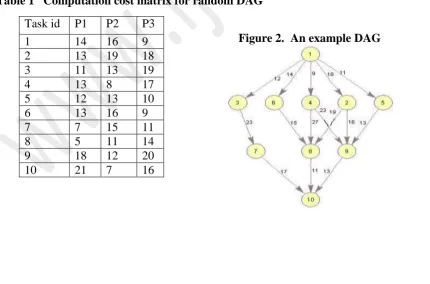
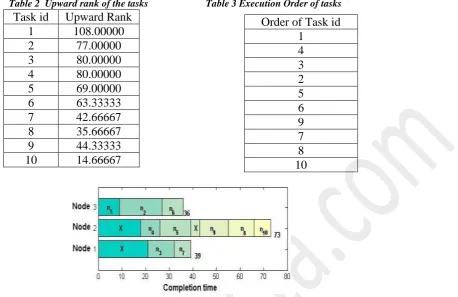
To illustrate, a small scale DAG scheduling problem involving 3 nodes and 10 tasks is considered (Fig 2) with the computation cost matrix given in Table 1.The upward rank and the order of the tasks for execution are given in Table 2 and 3 respectively. RASA algorithm was executed with the following parameters. Size of the population -15, T_frac -10-2, T_frac_min - 10-4, T_mult -0.9, Parameter q -0.09, Scaling factor -0.8, successmax(SM)-2,Number of iterations- 50. The makespan value obtained for the example problem is found to be 73.
Table 1 Computation cost matrix for random DAG
Figure 2. An example DAG
Task id P1 P2 P3
1 14 16 9
2 13 19 18
3 11 13 19
4 13 8 17
5 12 13 10
6 13 16 9
7 7 15 11
8 5 11 14
9 18 12 20
Volume 01, No.7, July, 2015
P
age
6
Table 2 Upward rank of the tasks Table 3 Execution Order of tasks
Figure 3. A schedule produced by the RASA algorithm for the example DAG
CONCLUSION
The methodology of implementation of RASA algorithm for the constrained dependent task scheduling problem had been discussed. The methodology adopted for this algorithm gives rise to the development of scheduling algorithms using other meta heuristic methods.
REFERENCES
i Selvi, S,Manimegalai, D.Research Journal of Applied Sciences, Engineering and Technology 8(8): 964-975, 2014
ii P. Chitra, R. Rajaram, P. Venkatesh, Application and comparison of hybrid evolutionary multiobjective optimization algorithms for solving task scheduling problem on heterogeneous systems, Applied Soft Computing 11 (2011) 2725–2734
iii E. Ilavarasan, P. Thambidurai, R. Mahilmannan, Performance effective task scheduling algorithm for heterogeneous computing system, in: Proc. 4th International Symposium on Parallel and Distributed Computing, France, 2005, pp. 28–38.
iv Topcuoglu, H., Hariri, S., Wu, M.Y.: Performance-Effective and Low-Complexity Task Scheduling for Heterogeneous Computing. IEEE Trans. Parallel and Distributed Systems 13(3), 260–274 (2002)
v B.Hamidzadeh, L.Y.Kit, D.J.Lija, Dynamic task scheduling using online
optimization, IEEE Trans. Parallel Distributed systems 11(11)(2000) 1151-1163.
Task id Upward Rank
1 108.00000
2 77.00000
3 80.00000
4 80.00000
5 69.00000
6 63.33333
7 42.66667
8 35.66667
9 44.33333
10 14.66667
Order of Task id 1
Volume 01, No.7, July, 2015
P
age
7
vi Mohammad I. Daouda, Nawwaf Kharma ,A hybrid heuristic–genetic algorithm for task scheduling in heterogeneous processor networks, J. Parallel Distrib. Comput. 71 (2011) 1518–1531
vii Hrstka, O., Kučerová, A., Lepš, M., Zeman, J.: A competitive comparison of different types of evolutionary algorithms, Computers and Structures . 81,1979-1990(2003)
viiiSelvi, S,Manimegalai, D. Task Scheduling using Two Phase Variable Neighborhood Search Algorithm on heterogeneous computing and grid environments, Arabian journal for science and engineering, March 2015, 40(3):817-844.
ix Abraham A, Liu H, Zhao M. Particle swarm scheduling for work-flow applications in
distributed computing environments. Studies in Computational Intelligence 2008; 128: 327–342.