86
Operationalizing local children nutrition
surveillance system: The Philippines'
Operation
Timbang
revisited, the case of Abra de
Ilog
Ma. Anna Rita M. Ramirez
Senior Science Research Specialist
Nutrition Intervention, Evaluation and Policy Section Nutrition Assessment and Monitoring Division Food and Nutrition Research Institute
Department of Science and Technology Taguig City, Metro Manila, Philippines Email: [email protected]
Rowena V. Viajar
Science Research Specialist II
Nutrition Intervention, Evaluation and Policy Section Nutrition Assessment and Monitoring Division Food and Nutrition Research Institute
Department of Science and Technology Taguig City, Metro Manila, Philippines Email: [email protected]
Glenda P. Azaña
Science Research Specialist II Nutritional Assessment Section
Nutrition Assessment and Monitoring Division Food and Nutrition Research Institute
87
Abstract
Background
: Malnutrition among Filipino children persists; underscoring the value of nutritional assessment procedures. In the Philippines, this is carried out at the local level in its annual Operation Timbang [weigh] (OPT or OPT Plus). Local government unit officials observed higher malnutrition prevalence rates in nutrition survey reports of the Department of Science and Technology’s Food and Nutrition Research Institute (DOST-FNRI) compared with its OPT. A revisit of the OPT provided evidence on the comparability of the two data sets and sources of variance analyzed.Objectives
: 1) describe municipal level assessment of OPT in 10 barangays of Abra de Ilog municipality; 2) identify facilitating and hindering factors in OPT; and 3) compare OPT results with DOST-FNRI local nutrition survey in Abra de Ilog and identify potential sources of variance therefrom.Methods
: Primary data were collected using focus group discussions and key informant interviews. Height and weight data were collected using standard methods of anthropometry.Results
: The OPT/OPT Plus is the mass weighing of 0-71 months old children, including height measurements conducted during the first and fourth quarter of the year in Abra de Ilog. It was found that facilitating factors were availability of calibrated equipment, latest master list, local government support and budget. Lack of manpower, work overload, low honoraria, low work commitment, uncooperative mothers and high turnover of barangay [village] nutrition scholars hindered OPT implementation. The Abra de Ilog 2016 OPT Plus and the 4th quarter “OPT” reported lower malnutrition prevalence rates than the DOST-FNRI local survey.Conclusions
: Significant differences in the two data sets could misguide program implementation. As an outcome of Sustainable Development Goal No. 2 of Zero Hunger, potential misclassification of nutritional status and misreporting of malnutrition prevalence rates have implications for the mapping of malnutrition, hence delivery of targeted nutritionintervention packages.
88
Introduction and Background
Malnutrition among Filipino children below five years old has been persisting for decades. The 2015 Updating Nutrition Survey conducted by the Department of Science and Technology’s Food and Nutrition Research Institute (DOST-FNRI) disclosed prevalence of stunting among Filipino children as 33.4% and wasting, 7.1%.
Survey results have also shown at least one in five children were found to be underweight for their age. Based on the World Health Organization (WHO) classification for assessing severity of malnutrition, this figure is “high” and warrants public health attention (WHO, 1997).
These findings parallel the 2015 Global Hunger Index (GHI) report where the Philippines’ GHI is in the “serious” category with a score of 20.0 (von Grebmer et al., 2015). Prevalence of wasting and stunting among children less than five years old are two of four indicators used in measuring GHI, with proportion of undernourishment and prevalence of under-five child
mortality being the other two. With half of the Global Hunger Index related to nutritional status, the value of nutritional assessment procedures is underscored. In the Philippines, this is carried out periodically in the annual Operation Timbang or OPT, now OPT Plus with inclusion of height measurement, conducted by the barangay health workers (BHW) and barangay nutrition scholars (BNS) in tracking the nutritional status of 0 to 71 months old children in their respective local government units. The BNS is a village volunteer dedicated to delivery of nutrition
services on the ground. Under Presidential Decree No. 1569, “the barangay nutrition scholar shall be a barangay-based volunteer worker responsible for delivering nutrition services and other related activities such as community health, backyard food production, environmental sanitation, culture, mental feeding, and family planning to the barangay”.
National prevalence estimates of the nutritional status of population groups are provided by the DOST-FNRI every five years and two years in-between for regional estimates in its series of updating nutrition surveys. The year 2018 was the pilot year when the DOST-FNRI started with a rolling-out survey that aimed at providing data on an annual basis. At the local level,
assessment of nutritional status of children less than 6 years old through weight and height measurements is carried out during the first quarter of each year.
Operation
Timbang
Timbang is the Tagalog word for weight or weigh. Over five decades, Operation Timbang
89
The OPT is a major tool for identifying nutritionally-challenged barangays (villages) for the implementation of the Philippine Plan of Action for Nutrition, as it aides in the identification of moderately and severely underweight-for-age preschool children and their families who need immediate intervention assistance.
Target population coverage and the addition of growth indices were the major changes in the OPT Plus. The target population was changed from 0 to 83 months to 0 to 71 months old.
Nutrition assessment
National and sub-national estimates of underweight, stunting and wasting provided by the DOST-FNRI in its national and updating nutrition surveys are used as indicators in evaluating past and current nutrition-specific as well as nutrition-sensitive programs. Specifically, these are used in monitoring and evaluation at midterm and post-term of the Philippine Plan of Action for Nutrition (PPAN), usually in terms of targeted reduction in malnutrition prevalence rates (MPR). In the same manner, results of OPT Plus are used to track progress in alleviating the nutrition situation at the local level. Results of OPT are collated, validated, reported and submitted, starting from the smallest administrative unit which is the barangay on to the municipal then the provincial levels for onward submission to the NNC.
transition of OPT to OPT Plus with the adoption of the new growth reference standards; inclusion of height measurement allowing for a more comprehensive nutritional assessment 2012
Box 1. OPT: Historical perspective
1976
1974
1968
OPT became integral to the national nutrition program
“adoption of OPT as one of the organizational strategies in implementing a Municipal Nutrition Action Program” (NNC)
“OPT as pre-staging of the Mothercraft Nutrition Center” (Dept. of Health)
“OPT Plus as source of data for nutritional
assessment, planning, management and evaluation of local nutrition programs” (NNC)
90
In other developing countries, assessments of children’s nutritional status are integral to growth monitoring and promotion among infants and young children and integrated child health and nutrition programs (Sulley et al., 2019; Loka Abaya District, Tekle, Tariku, Alagay, Zerihum & Bekele, 2019; Feleke, Adole & Bezabih, 2017; Ashworth, Shrimpton & Jamil, 2008) and are sources of data in nutrition surveillance (Friedman, 2014). In the Philippines, OPT is a stand-alone activity conducted on top of growth monitoring and promotion, and is considered to be a source of data for nutrition surveillance.
Rationale
Recognizing the OPT as a valuable tool in community diagnosis, studies have looked into the OPT process and identified areas for improvement such as efficiency of its use and adequacy of information provided. This is important, especially as the local nutrition committees at the
barangay, municipal and city level use the OPT as one of the bases for program planning, implementation and evaluation of programs carried out at the local level.
One such innovation is the e-OPT Tool. The development of the Electronic Operation Timbang
Plus Tool (the e-OPT+ Tool or excel-based tool) whose “worksheets are linked with the WHO CGS (p. 11)”, was an innovation that aimed to address perennial challenges with the OPT such as “manual calculation of ages of children, recording and submission of entries, accuracy and timeliness of submission (p. 8)”, via provision for detection and correction of errors, tabulation of results and built-in report preparation (p. 12)” (National Nutrition Council, 2017).
In the course of disseminating results of the National Nutrition Survey (NNS) in the regions, cities, and municipalities, local officials observed that prevalence rates of undernutrition
generated by the DOST-FNRI in its series of nutrition surveys have been higher compared with OPT data. It is in this context that a revisit of OPT implementation was conducted by the
DOST-FNRI. The insights and analysis provided in this study address the fundamental issues on target-setting and therefore derivation of MPRs which could be replicated in other country settings to substantiate claims on veracity of nutritional assessment data.
Objectives
The present study describes municipal level assessment of OPT in 10 barangays of Abra de Ilog; identifies facilitating and hindering factors in OPT; compares OPT results with DOST-FNRI local nutrition survey in Abra de Ilog; and identifies potential sources of variance therefrom.
Materials and Methods
Study Site and Sampling
91
𝑛𝑛 = 1.962(𝑝𝑝(1−𝑝𝑝)𝐷𝐷𝐷𝐷𝐷𝐷𝐷𝐷)
𝑑𝑑2 p=30.8%
DEFF=2
d=5
where:
p = prevalence rate
DEFF = design effect
d =absolute precision
In households with more than one child meeting the age qualification, the youngest child was used as index. The sample population was proportionately allocated to the 10 barangays. Using simple random sampling technique, the final selection of children was done.
Data Collection
The study employed mixed methods of data collection. Primary data collection employed techniques such as focus group discussions (FGD), key informant interviews (KII) and anthropometric survey. Records on file pertinent to OPT Plus were reviewed.
Focus group discussion was facilitated by the project team using field guide questions about the OPT process, facilitating and hindering factors in the conduct of OPT Plus. A total of 10 FGDs were conducted at the barangay level. Each FGD was composed of five to ten Barangay
Nutrition Committee (BNC) members usually barangay officials and barangay nutrition and health volunteers.
Key informant interviews (KII) were held at the municipal level among members of the Municipal Nutrition Committee about OPT Plus implementation and to identify facilitating or hindering factors in the conduct of its activities. A total of 5 key informants were interviewed. Key informants were the Municipal Health Officer (MHO), the Municipal Planning and
Development Coordinator (MPDC), the Public Health Nurse (PHN), the Rural Health Midwife (RHM) and the Sangguniang Bayan (Municipal Councilor) for Health (SB-Health).
Anthropometric data of children were collected by trained researchers in a designated area for accuracy and efficiency. Weight and height were measured using standardized techniques and calibrated equipment and recorded to the nearest 100 grams (.1 kilogram) and .1 centimeter, respectively. Infants and young children less than 2 years old were made to lie down on an infantometer and supine length was measured. Anthropometric measurements were based on the Anthropometry component of the 8th National Nutrition Survey. Weight; length/height-for-age and weight-for-height z scores (WAZ, L/HAZ, WHZ) were computed using the WHO Anthro software and nutritional status classified using the WHO Child Growth Standards (CGS) cut-off points.
92
The process flow of the OPT as observed in the field was validated with the OPT Plus procedure guidelines.
Data analysis
Anthropometric data collected by the DOST-FNRI field researchers in its local nutrition survey of Abra de Ilog were compared with the 2016 OPT report in terms of computed MPR based on the OPT guidelines.
Robustness of the OPT Plus report was assessed twice using chi-square test (p<.05) by: a) comparing the computed MPR based on:
i. the fourth quarter “OPT” data using the excel-based OPT Plus “tool” [to compute nutritional status], and
ii. data generated using the WHO Anthro software (based on the WHO Child Growth Standards [CGS]). Take note that the OPT Plus tool is also based on the WHO CGS; and
b) comparing the same data set with the DOST-FNRI local survey data, which were
collected at around the same quarter of the year. Children from the OPT Plus report were matched with children from the DOST-FNRI local survey data.
The first comparison checked if indeed those who were classified undernourished using the excel-based “tool” were similarly classified using the WHO Anthro software while the second comparison checked if the “4th quarter OPT” data is comparable with the DOST-FNRI local survey data.
Excerpts from the FGDs and KIIs were transcribed and encoded verbatim. Transcribed data were organized in thematic matrices to show the responses of the participants. Data were analyzed through extracted themes and constructs, portions of which were used to validate field observations of the OPT.
The research was issued ethical approval by the FNRI Institutional Ethics Review Committee (FIERC) on August 5, 2016 with protocol code, FIERC-2016-004.
Results
Conduct of OPT Plus
According to key informant interviews, mass weighing in Abra de Ilog is done twice a year, every first and fourth quarter wherein the 4th quarter “OPT” are meant to check if there were changes (in the nutritional status of children) vis-à-vis the programs that the LGU implemented to address malnutrition. The one conducted during the first quarter was submitted as consolidated OPT report to the province, then forwarded to the NNC.
93
underpants attached. Instead of a height board, there was also an instance when a stainless-steel ruler was brought by the rural health midwife “unattached” to the board.
The master list of children is an important record in the OPT Plus. In Abra de Ilog, the team uses an organized master list but does the initial recording on paper. Master lists contain the
children’s names, birthday, age in months, sex, weight, height, date of weighing and mother’s name. The OPT Plus is conducted campaign style by cluster, with the team resorting to house-to-house collection among children who cannot make it at the appointed time and venue. The children are weighed either by the BNS or the BHW. Lapses observed were in the protocol for anthropometric measurement per se as well as reading of measurements. For example, there were observations when readings of weight, length or height were taken only once (no
verification); a tall child was required to fold his legs when placed on the salter scale; some children were not properly positioned before taking the measurement; some measurements were temporarily recorded on the arm or forehead of the child; and nutritional status was not
determined during the OPT Plus activity (lost opportunity for a brief nutrition counselling with the mother or caregiver). Children who are found malnourished can be given outright nutrition counselling giving emphasis on their vulnerability to poor infant and young child feeding and caring practices. Not knowing the right age of the child could result in taking the child’s length instead of height.
There were trainings and orientation activities on how to conduct the OPT Plus, but the lapses that were observed reflect on the quality of the training and orientation received by the nutrition and health workers. According to key informants, points of validation are in the areas of master listing (number of children to be weighed), correctness of encoded data, equipment used (height board), competence of people on the ground, and improvements in nutritional status.
It was found that facilitating factors to an efficient implementation of OPT activities included logistics (equipment and master list), support coming from the LGU such as the legislative, local chief executive, budget appropriation, participation of officials and provision of security and teamwork. Parents’ cooperation, strategy used in dissemination of OPT schedule, and dedication of health workers facilitate conduct of OPT. In some cases, OPT activities are done at the same time as the conditional cash transfer and expanded immunization program thereby increasing the efficiency of program and service delivery at the grassroots.
These same factors appeared to hinder the conduct of a smooth OPT activity. Issues with
logistics (equipment, supplies, transportation), lack of manpower, work overload, low honoraria, lack of commitment, uncooperative mothers and high turnover of BNSs were identified to hinder the efficient implementation of the OPT.
94
Comparative analysis: DOST-FNRI local nutrition survey and Abra
de Ilog OPT Plus
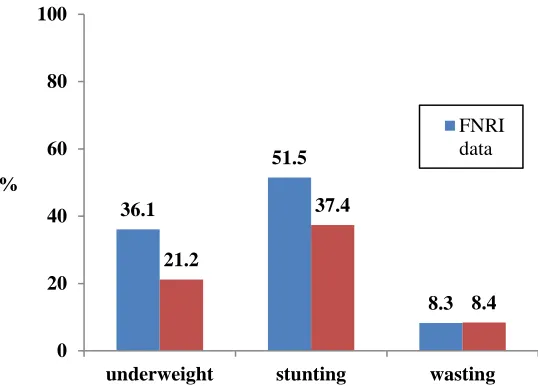
The computed OPT Plus MPR of Abra de Ilog was lower at 30.2% compared with the DOST-FNRI local survey, 36.3%. Stunting was at 44.76% in the 2016 OPT Plus and 49.5% based on the DOST-FNRI local survey data.
Fourth quarter “OPT”
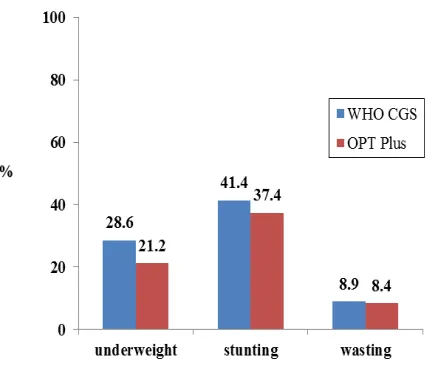
Prevalence of underweight, stunting and wasting were consistently higher in the data set processed using the WHO Anthro compared with the 4th quarter “OPT” data using the excel-based “tool” at 28.6% (vs. 21.2%), 41.4% (vs. 37.4%) and 8.9% (vs. 8.4%), respectively (Figure 1). Differences in prevalence rate were not significant except for underweight (p=0.0144).
Figure 1. Prevalence of underweight, stunting and wasting among children 0 to 71 months old using WHO CGS and OPT Plus: Abra de Ilog, 2016
DOST-FNRI local survey and OPT Plus
95 Figure 2. Prevalence of underweight, stunting and wasting among children 0 to 71 months old,
using FNRI and OPT Plus: Abra de Ilog, 2016
Discussion
Potential issues with OPT Plus
Issues with OPT Plus fall largely into the same areas as in other studies that looked at growth monitoring and promotion activities in developing countries. These range from lapses in following the weighing protocol (Sulley et al., 2019; Melkamu, Bitew, Muhammad &
Hunegnaw, 2019; Gurukartik, Ghorpade, Thamizharasi & Dongre, 2013), calculation of age in months of children (Davey, Davey & Datta, 2008) and correct reading of measurements (Sulley et al., 2019).
Field observation of the OPT Plus also disclosed errors in calibrating salter scales, positioning the children properly on the equipment before taking the measurement and reading of
measurements only once without concurrence from another health worker.
More than these breaches on the measurement protocol, potential issues lie in the technical aspects of setting targets (eligible children for weighing), derivation and reporting of MPR.
Targeting
Based on the OPT guidelines, if population census data is available, at least 80% of the total number of preschoolers is targeted to be weighed and measured. However, if census data are not available, the total population of the barangay is multiplied by 16.2% to arrive at the estimated number of preschoolers aged 0 to 71 months to be weighed as projected by the National Statistics Office (NSO) from 2010 census data. Possible shifts in population pyramid may have a bearing on the estimates of the target population.
36.1
51.5
8.3 21.2
37.4
8.4 0
20 40 60 80 100
underweight stunting wasting %
96
Deriving a malnutrition prevalence rate
The denominator in the formula for the estimation of the MPR is a function of proportions of the total client list and master list over the 80% of the total number of preschoolers or 16.2% of projected population in estimating the number of 0 to 71 months old children as target coverage. Accuracy of the database and therefore the master list is largely a function of accuracy in data measurements, calculation of age, encoding and validation of records all of which are prone to human error. The significant differences in reporting of severity of malnutrition as a public health concern derived from both the DOST-FNRI and OPT Plus data sets could involve such error.
With the DOST-FNRI local survey, sampling design is a function mainly of the desired level of population estimates (municipal, for this study). From there, prevalence or proportion of
undernutrition is computed after conducting the nutritional assessment using standardized techniques.
Reporting
Reports of MPR are based on OPT Plus reports with 80% to 110% coverage of barangays (for municipal level) and municipalities (for provincial level). Thus, MPR reports do not entirely reflect the true prevalence rate.
These findings reveal policy implications to the procedural implementation of the OPT Plus inasmuch as this underscores the importance of providing closest to the true prevalence of undernutrition as possible.
Policy Recommendations
Based on the results of this study, we recommend:1. the institutionalization of continuous training, orientation and re-orientation of
community health workers in anthropometric measurements and data recording (Davey et al., 2008; Ashworth et al., 2008);
2. the provision of appropriate and enough number of calibrated equipment for OPT (Gurukartick et al., 2013);
3. revisiting the OPT process and the development of effective delivery system including validation of measurements and records;
4. a reduction in the potential sources of variance in MPR estimates: start with the review and analysis of the efficiency of the 16.2% of projected population as basis for computing the target number of children.
5. review of the 80-110% as inclusion criteria for reporting MPR. A 110%-coverage by itself poses some issues with target setting. Exclusion of areas with less than 80% coverage in reporting MPR is defeating the purpose of providing the true picture of the nutritional situation of the area and, as such, could mask and underestimate the magnitude and severity of the problem.
97
(GIDA), thus facilitating efficient delivery of health and nutrition services to the underserved.
As an outcome of Sustainable Development Goal No. 2 of Zero Hunger, potential
misclassification of nutritional status and misreporting of MPR have implications to the mapping of malnutrition and delivery of targeted nutrition intervention packages.
The value of nutrition surveillance is underscored. At the national level, the DOST-FNRI started with a rolling-out survey in 2018 that aimed at providing data on an annual basis. The OPT Plus can supplement this with its data at the municipal level. Given the perennial challenges that the OPT Plus is faced with, efforts at controlling for fundamental issues at some phases of its operationalization (manual versus automated calculations and generation of reports) is
acknowledged as innovative. Institutionalization of training is reiterated. Nutrition surveillance is still justified for its very purpose of providing localized nutrition early warning system in an archipelagic country such as the Philippines, maximizing resources such as manpower and infrastructure in the process. This is one way at capacitating the local government to take stock of malnutrition among its young children, set some benchmark, act on it and progress therefrom.
Acknowledgements
The authors acknowledge the cooperation and support of the Abra de Ilog Municipal Health Office, municipal local government of Abra de Ilog, and the 657 households who participated in the research; the technical assistance of the local survey team of the DOST-FNRI, Project
Assistants Jazelle Anne S. Calayag and Heidenhein A. Ibarra in the field data collection and data organization; Apple Joy D. Ducay for statistical data management; Nina Fritzie Bruce and Nesrianne G. Buyco for assistance in formatting of the manuscript and references. For inspiring and challenging the team to carry out this research, sincerest gratitude is extended to Dr. Cecilia Cristina S. Acuin, Senior Scientist of the International Rice Research Institute and former Chief Science Research Specialist of the Nutritional Assessment and Monitoring Division of DOST-FNRI.
The authors declare no conflict of interest.
References
Ashworth, A., Shrimpton, R., & Jamil, K. (2008). Growth monitoring and promotion: review of evidence of impact. Maternal & Child Nutrition, 4(s1), 86–117. doi:
10.1111/j.1740-8709.2007.00125.x
Davey, A., Davey, S., & Datta, U. (2008). Role of reorientation training in enhancement of the knowledge regarding growth monitoring activities by Anganwadi workers in urban slums of Delhi. Indian Journal of Community Medicine, 33(1), 47. doi: 10.4103/0970-0218.39244 Department of Science and Technology-Food and Nutrition Research Institute (DOST-FNRI). (2016). Regional Dissemination Forum.
98
Feleke, F. W., Adole, A. A., & Bezabih, A. M. (2017). Utilization of growth monitoring and promotion services and associated factors among under two years of age children in Southern Ethiopia. Plos One, 12(5). doi: 10.1371/journal.pone.0177502
Friedman, G. (2014). Review of national nutrition surveillance systems. Washington, DC: FHI 360/FANTA
Gurukartick, J., Ghorpade, A. G., Thamizharasi, A., & Dongre, A. R. (2013). Status of growth monitoring in Anganwadi centres of a primary health care centre, Thirubhuvanai, Puducherry. Online Journal of Health and Allied Sciences, 12(2). Retrieved from
http://www.ojhas.org/issue46/2013-2-2.html
Inter-agency Technical Working Group on Child Growth Standards. 2012. Implementing guidelines on Operation Timbang Plus (OPT+). Philippines: National Nutrition Council.
http://www.nnc.gov.ph/downloads/category/23-board-resolution?download=643:nnc-governing-board-resolution-no-2-series-of-2012-file-2-of-2
Loka Abaya District, Tekle, M., Tariku, B., Alagaw, A., Zerihun, E., & Bekele, H. W. (2019). Exploring reasons for low attendance of mothers to growth monitoring and promotion program at Loka Abaya District, Southern Ethiopia: Exploratory Qualitative Study. Journal of Nutrition and Metabolism, 2019, 1–7. doi: 10.1155/2019/3510649
Melkamu, A. W., Bitew, B. D., Muhammad, E. A., & Hunegnaw, M. T. (2019). Prevalence of growth monitoring practice and its associated factors at public health facilities of North Gondar zone, northwest Ethiopia: an institution-based mixed study. BMC Pediatrics, 19(1). doi:
10.1186/s12887-019-1489-4
National Nutrition Council. (2017). e-OPT Plus Tools [PowerPoint slides].Retrieved from
https://www.nnc.gov.ph/phocadownloadpap/6thNationalConference_of_DCNPCs/e-OPT%20Plus%20Tools_DCNPC_17Aug2017.pdf
Sulley, I., Abizari, A.-R., Ali, Z., Peprah, W., Yakubu, H. G., Forfoe, W. W., & Saaka, M. (2019). Growth monitoring and promotion practices among health workers may be suboptimal despite high knowledge scores. BMC Health Services Research, 19(1). doi: 10.1186/s12913-019-4103-4
von Grebmer, K., Bernstein, J., de Waal, A., Prasai, N., Yin, S., and Y. Yohannes. 2015 Synopsis, Global Hunger Index: Armed Conflict and the Challenge of Hunger. IFPRI issue brief 88, October 2015
World Health Organization. 1997. WHO Global Database on Child Growth and Malnutrition. Geneva: WHO