USING ATTRIBUTES AND MERGING ALGORITHMS
FOR TRANSFORMING OCL EXPRESSIONS TO CODE
Andrius Armonas, Lina Nemurait
ė
Kaunas University of Technology, Department of Information Systems Studentų st. 50-308, LT-51368 Kaunas, Lithuania
e-mail: [email protected], [email protected]
Abstract. In this paper, we examine OCL-to-code transformations, which are dedicated to modern model and metamodel repositories facing with the requirements to perform search, validation and transformation of models that are usually stored in external data storages, e.g. RDBMS. Diversity and fast changes of data storage technologies make the development of such transformations a real challenge. This paper presents a method developed by the authors enabling reuse of OCL transformations, their adaptation to various data storage environments and evolution by applying attributes and graph merging algorithms.
Keywords: UML, OCL, model repository, code generation, transformation, attribute, merging.
1. Introduction1
As modelling became one of the essential aspects of software development, the need for an efficient teamwork environment for modelling arose. Such an environment should be equipped with capabilities for merging, synchronizing, reusing and evolution of models and metamodels independently from any specific problem domain. Such requirements are partly met by Eclipse EMF, IBM Jazz and No Magic Cameo platforms. These platforms use the OCL language to implement queries and ensure well-formedness of mo-dels, metamodels and their relationships. Being faced with the requirements to perform search, validation and transformation, models in such repositories are usually stored in external data storages, e.g. RDBMS, therefore OCL expressions need to be transformed to the source code of the data storage. Practically, highly different ordinary and advanced modelling tasks (as e.g. [1–4]) are coping with necessity to have a solid support for OCL. This paper examines the problem of transformation of OCL to program code by reusing existing transformations and facilitating evolution of transformations by teams working with repositories of models and metamodels. Variability and commonality analysis principles [5, 6] were used during the deve-lopment of the method.
The significance of the research presented in this paper is influenced by an increasing demand for
1 The work is supported by Lithuanian State Science and Studies
Foundation according to High Technology Development Program Project "VeTIS" (Reg.No. B-07042)
metamodel and model repositories as well as increa-sing requirements for quality of data, stored in them, and services, provided by them: frequent and efficient searching, validation, transformation and synchroni-zation of models. It is no longer sufficient only to pro-vide these services – a need arises to adapt them to the existing user infrastructure. If there were no possibi-lity to adapt and reuse OCL transformations to source code, the development of model repositories would slow down. Majority of modelling tool vendors are looking for faster ways to create new OCL trans-formations for generation of code in various languages by developing these transformations from existing ones.
Businesses would benefit from using this method as follows: it would improve design and support of
OCL transformations to source code; it would enable
reacting faster to changes in data storage software, decrease amount of required routine software coding work; provide an opportunity to reuse transformations and facilitate their collaborative development, making work of software analysts, designers and programmers easier.
2. Attribute grammars
Attribute grammars simplify operation of interpre-ters and compilers for such tasks as, for example, semantic checking or transforming concrete syntax trees (CST) to abstract syntax trees (AST). They have been described several decades ago, however, quite a substantial amount of papers are being published refining them. There are attribute grammar modifica-tions RAG [7–11], CAG [12–14], CRAG [15], ReCRAG [16], HAG [17], as well as composite [18] and conditional attribute grammars [19]. The method, described in this paper, uses the RAG attribute gram-mar. However, other modifications also are applicable.
Attribute grammars facilitate development of com-pilers and interpreters but they also decrease perfor-mance of these tools. For example, using ReCRAG grammars in Java compilers reduces their performance four times, even though language specification itself is two times smaller [16]. On the other hand, it is impossible to avoid using of these methods in large, continuous projects as they reduce amount of errors, make management of human resources more efficient, and cut down the time needed for analysis, implemen-tation and support.
3. Difference and merging algorithms
For facilitating reuse of attributes, created in pre-vious transformations, the following graph merging algorithms were analyzed: Alanen and Porres [20]; Zündorf, Wadsack and Rockel [21]; Sudarshan et al. [22]; Wang, DeWitt and Cai [23]; Cicchetti et al. [24– 26]; Bartelt [27]; Kelter, Wehren and Niere [28]; Ohst, Welle and Kelter [29]; Eclipse EMF Compare tool. A more detailed analysis of similar algorithms is available in [30].
Analyzed algorithms can be classified into two categories by how they identify elements: algorithms that identify elements heuristically and algorithms that rely on uniquely identified elements. It was found in this research that none of these algorithms combine those two approaches and this can be considered as a deficiency, because in such languages as UML part of elements have to be compared by using unique identi-fiers and the other part should be compared heuris-tically.
It is important to note that the analyzed algorithms except one do not have dependency and conflict con-cepts. This means that the algorithms are only capable of bulk change copying to one of the contributor graphs, i.e. partial copying is impossible.
None of the analyzed algorithms evaluate previous merges. They calculate differences between two ver-sions of a graph and try copying those changes to the graph that was derived from their common ancestor. Model merging difference from code merging here is that it is possible to get incomplete and incorrect mo-dels as there are many more dependencies and seman-tics when merging models instead of code. The afore-mentioned deficiencies are resolved in the method proposed in this paper. Our method uses merging
algorithms to allow collaborative work over OCL-to-code transformations as well as reusability of those transformations.
4. Applying attributes and graph merging algorithms for transforming OCL expressions to code
This section describes a method for transforming OCL expressions to code using attributes and graph merging algorithms.
4.1. Method overview
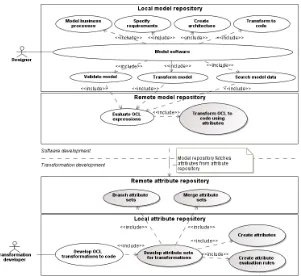
A high-level use case diagram, depicted in Fi-gure 1, shows how the created method is applied in two levels: in the overall software development pro-cess, which uses model repositories, and in the colla-borative development of OCL-to-code transformations thus extending both software and transformation development domains.
Models are validated [31], transformed [32] or ele-ment search is performed in models throughout the whole software development process (see all use cases included into the Model software use case). Also, in the collaborative environment, models are exchanged between the local and remote repositories. The OCL language is used for validating, transforming, and searching data in models. When performing these acti-vities in model repositories, OCL expressions are transformed to expressions of the underlying data storage environment and then are executed in it for returning the actual results to the software designer. The created method implements such a transformation that is represented by use case Transform OCL to code using attributes in Figure 1. OCL-to-code transforma-tions are performed in the remote (central) model repository.
Software designer performance (in terms of his/her daily tasks) is directly influenced by the performance and quality of OCL-to-code transformations. In other words, software development activities depend on transformation development activities. The created method enables collaborative development of OCL-to-code transformations by allowing creation, modifying, and reusability of attribute sets (see the Develop attri-bute sets for transformations use case).
Figure 1. Method (represented by greyed use cases) usage in software and transformation development domains
Inputs of the method consist of the DSML model and OCL constraints specified for that model (see Figure 2). When transforming OCL to code, each OCL expression is transformed to the concrete syntax tree (CST), which is then transformed to abstract syntax tree (AST). Abstract syntax tree is augmented with references to elements of the DSML model. In this phase of the transformation, the method presented in this paper augments the AST tree with attributes and values for each attribute (attribute evaluation rules are employed for this purpose). Attribute evaluation is
represented by the element AST tree with evaluated
attributes in the diagram. Attribute specifications for the specific language for which the code is being generated are fetched from the remote (central) attri-bute repository. Attriattri-butes are created and adapted for specific data storage environments by transformation or modelling tool developers, not end-user system developers. The created method uses AST trees aug-mented with attributes to generate code that fully ex-ploits capabilities of a specific data storage
environ-ment (this is represented by the eleenviron-ment Transform
OCL to code using attributes in Figure 2). The created method produces code running in the specific data storage environment.
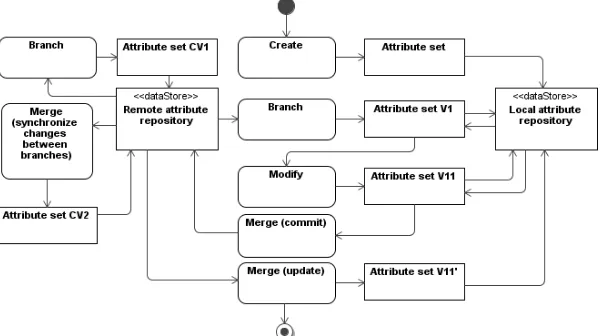
As stated earlier, attributes are created and adapted for specific data storage environments by transfor-mation and modelling tool developers. The created method specifies not only attribute usage for code generation but also describes principles for collabo-rative development (evolution) of attributes. Figure 3 depicts an overview of attribute creation and develop-ment process. When performing the actual OCL transformation, attributes are fetched from the remote
(central) attribute repository. This repository stores committed attribute sets (i.e. attribute graphs). New attribute sets can be created by reusing parts of exis-ting attribute sets. Transformation developers store intermediate versions of attribute sets in their local attribute repositories. Attribute sets between central and local repositories are synchronized by using bran-ching and the created merging algorithm. This algo-rithm is also used for synchronizing changes between branches in the central repository.
Figure 2. Overview of code generation using attributes
data storage environment. Central attribute repository
stores sets of attribute graphs, tracks attribute graph changes, graph branching and merging actions by versioning them.
Figure 3. Overview of attribute creation and evolution process
Graph G and its branches
Gi Gi+1 ... Gn-1 Gn Branching
Gn+ 1 Gi-1
G’i ... G’m G’m+1 ... G’m+l
Gn+2 ... Gk-1 Gk 2/3-way
merging
2/3-way merging
G’m+l+1 ... G’p
4-way merging
4-way merging
Graph H and its branch-es
Graph Z and its branch-es
...
Figure 4. Overview of central attribute repository structure and related operations
Figure 4 shows attribute sets and their evolutions
using elements Graph G and its branches, Graph H
and its branches, and Graph Z and its branches. For
example, element Graph G and its branches depicts
attribute set G and its evolution (branching from ver-sion Gi of the graph G creates graph G’i).
4.2. Using attributes in OCL AST trees
One of the best-known tools for generating code from OCL is Dresden OCL2 Toolkit. In this paper, we call transformations of this tool as standard transfor-mations. The standard way of generating code from OCL expressions is insufficient, because it attempts to directly map single OCL constructs to target language constructs. This means that if source and target lan-guages are not similar, i.e. if constructs from source language cannot be directly covered by constructs or groups of constructs from the target language, the standard way does not allow mapping from one lan-guage into other in all cases (or does this inefficient-ly). For being able to map complex constructs (sub-trees) of the source language into target language constructs, it is necessary to have context information in OCL AST tree nodes enabling to generate code for
the whole OCL AST sub-tree at once and ignore inter-nal nodes in the following traversals.
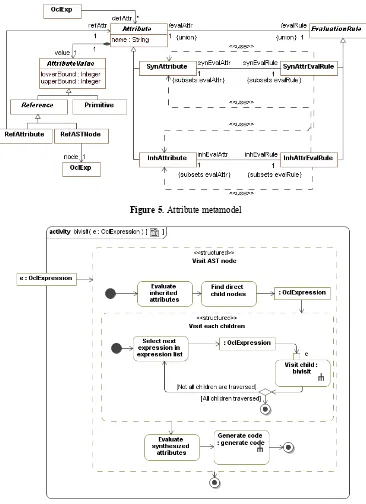
In the created method, context information is expressed by attributes and generated code is adapted to concrete data storage platform by computing values of these attributes. Each OCL metamodel element can have one or more attributes defined. Values are assigned to attributes by computing attribute evalua-tion rules.
Figure 5. Attribute metamodel
Figure 6. Algorithm for evaluating attributes in OCL AST tree
4.3. Generating code from OCL expressions using attributes
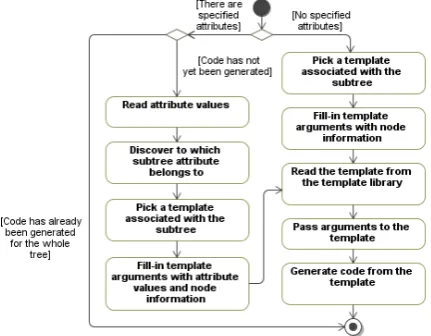
In previous sections it was described how attri-butes can be used to discover sub-trees of OCL AST trees. Having attribute set, identifying a certain OCL AST sub-tree, it is possible to generate code for this sub-tree. This allows adapting code to a specific data storage language and exploiting all its capabilities.
A metamodel for code generation from OCL expressions is depicted in Figure 7. AST tree (class ASTTree) consists of OCL metamodel elements (sub-classes of the OclExpression class, which are instan-ces of the OclExp class). For some of them attributes
are defined (class Attribute, playing defAttr role). AST sub-trees (class ASTSubtree) consist of at least one OCL metamodel element (role node). A sub-tree can be identified by a group of attributes (class Attribute, playing identAttr role). Each sub-tree is associated with a template of a certain language (class Pattern). Each pattern has arguments. After filling-in arguments with values, the actual code is generated.
Figure 7. A metamodel for code generation from OCL
Figure 8. Algorithm for code generation from OCL AST using attributes
4.4. Using graph merging algorithms for transformation evolution and reuse
In this sub-section, principles of collaborative work over attribute sets and method for reusing transformations by reusing attributes is presented. Also, graph merging algorithm is presented upon which collaborative development of attributes is based.
4.4.1. Transformation development cycle
When working with attributes in a team, they are stored in a central repository (Figure 9). If a developer of a transformation decides to change attributes, he/she has to fetch them into the local private repository. This action is called branching as it creates a branch from an attribute set in a central repository. After modifying attributes, the developer commits changes to the central repository. This action requires
attribute set merging, because two sets have to be
merged: the one from the local repository with the one from the central repository. The developer may update its local repository with new changes from the central repository. This action also requires merging.
Attributes can be reused, i.e. attribute sets can use other attribute sets for context evaluation (Figure 10). The figure presents attribute sets A1, A2, A3 and A4. Reusable subsets of attribute sets are depicted as inter-nal rectangles. Arrows show reused attribute sets, e.g.
sets A1 and A3 use subset A4‘ of attribute set A4. This concept is elaborated in section 4.4.3.
Local attribute repository
Central attribute repository Branching
Merging (commit)
Merging (update)
Branching
Merging
Figure 9. Attribute branching and merging schema
A2'
A4'
A4'
A3'’
A3'’
A2' A4'
A3'
A3'
A3'
A1 A2 A3
A4
Figure 10. Attribute reusability
4.4.2. Graph merging algorithm
In this section, a method of the higher level of abstraction is presented, which does not only allow merging attribute sets, but also merges any models, that have elements and relationships between them. The presented method evaluates previous merges which is what existing methods do not do.
4.4.2.1. Merging algorithm types
We classify merging algorithms by the number of used data sources: 2-way, 3-way, and 4-way merging algorithms. Graphs are merged in two stages: changes (i.e. differences) between graphs are discovered and then they are copied into one of the compared graphs. Usually graphs residing in central and local repositories are compared.
The simplest way to merge graphs is to use 2-way merge. It uses two graphs: one from which changes are copied and one into which changes are copied. Changes are detected by comparing these two graphs. This method is unreliable because two graphs that have evolved in parallel are compared, thus it is im-possible to say whether an element was deleted or created.
3-way merging algorithm resolves the unreliability problem found in the 2-way merging algorithm. In this algorithm, changes are detected between evolved graphs and their common ancestor, thus 3 data sources are used: two contributors and one common parent.
Target graph is compared with the first target graph version that was created after the last merge into the same target from the same-branched graph. In other
words, in our method it is discovered how graphs evolved from the last merge of the same direction.
Gi Gi+1 ... Gn-1 Gn
Branching
Gn+1 Result 2/3-way Merge
Common Ancestor
Gi-1
G’i ... G’m G’m+1 ... G’m+l
... Gk-1 Gk Gk+1
Result 4-way Merge Branch Ancestor
Target Ancestor Merging
Merging
Figure 11. Schema of 4-way merge algorithm
4.4.2.2.Basic concepts of merging algorithms
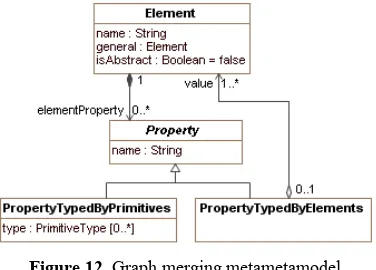
The graph merging algorithm suits not only for attribute sets, but also for any models, that have ele-ments and relationships. It can merge graphs whose metamodels conform to the one depicted in Figure 12. This metametamodel describes such metamodels, that
have metaelements (class Element) having
metapro-perties (class Property). A metaproperty can be a pri-mitive (class PropertyTypedByPrimitives) or a
refe-rence to other metaelements (class
PropertyTypedBy-Elements). Metaproperties can store many values whose order may be significant. If an element sub-classes another element, the general property stores a
reference to a more general element. The isAbstract
attribute specifies whether metalement is abstract.
Figure 12. Graph merging metametamodel
4.4.2.3. Combined identification of elements
In existing merging algorithms elements are iden-tified by using unique identification numbers or by analyzing relationships to other elements. In the crea-ted method, the two methods are combined into a single one. Let’s define element identity function
α(x, y),
where x is an element of the graph G; y – an element of the graph G‘; α – function that returns values from
0 to 1, where 1 means that elements are the same, and
0 – that they are not the same.
If compared elements x and y have unique iden-tifiers, then function α returns 1 or 0, because element
identity can be discovered by comparing their iden-tification numbers:
if δ(x) = δ(y), then α(x, y) = 1; if δ(x) ≠δ(y), then α(x, y) = 0,
where δ is a function that returns a unique identifier of an element.
Elements may not have unique identifiers. If
δ(x) = Ø or δ(y) = Ø, then identify functions, retur-ning values from 0 to 1, have to be defined for these elements, i.e. ∃ fx, fy ∈Φ, where fx and fy are identity functions for x and y elements; Φ is a set of identity functions. Then we can define element identity func-tion α(x, y):
if fx = f y, then α(x, y) = fx = fy,
if fx≠ f y, then α(x, y) = 0.
Identity functions encode heuristic methods of identification, e.g. they compare elements by their names, properties, and relationships to other elements. If most of them are the same (e.g. 80%), or elements are of the same type, we can state that these elements are probably identical. In such a case identity func-tions return equal values near to 1 (e.g. 0.8) and fx = fy. Thus fx and fy can be used for identifying whether elements are identical or not.
4.4.2.4. Graph changes
A difference of two graphs is a set of elements describing how one graph differs from another graph. In the created method, elements of such a set are
called changes. Sets of differences will be called
graph differences. Graph difference is such a graph whose nodes are changes and relationships between nodes are their dependencies or conflicts.
Changes can be classified as additions, removals, attribute modifications, and attribute value order changes. Changes can depend on each other and conf-lict with each other. Each change can be accepted for copying into the graph or rejected. If to summarize, in the proposed method changes have the following properties:
• type (addition, removal, modification, order
• state (accepted or rejected);
• a reference to the changed element;
• references to changes, on which a change
de-pends on and vice versa;
• references to conflicting changes.
A change can be selected to be copied into another graph or not. This is expressed as a change state which can be Accepted or Rejected.
When accepting one change for copying into the graph, it is sometimes needed to accept other changes too. In such a case one change depends on another. An example could be creation of a reference to a newly created element: element creation has to be accepted when accepting reference creation. Dependencies allow partial copying of changes to the graph, which is different from existing algorithms allowing copying all or no changes.
Conflicting changes are such changes that cannot be copied together into the graph. Conflicts occur in two different graph differences.
4.4.2.5. Rules for accepting and rejecting changes
In this section, we will use graphs G’ and G’’,
which evolved from their common ancestor graph G.
Let’s denote the difference of graphs G’, G as SG’,
and the difference of graphs G’’ and G as SG’’. The main idea behind the proposed merging algorithm is that when graphs G’ and G’’ are merged into graph
MG, it is built from graph G by using differences SG’
and SG’’. When the graph MG is created from the
graph G, all changes that are in Accepted state, are copied into graph MG.
If change A depends on change B, then if A
changes its state to Accepted, B also changes its state to Accepted. If change A depends on change B and change B changes its state to Rejected, change A also changes its state to Rejected. If change A conflicts
with change B and change A changes its state to
Accepted, change B changes its state to Rejected. The merging method described in this paper differs from existing algorithms in that it does not modify change sets according to each other. Instead, it evaluates two difference sets and sets change states accordingly.
4.4.3. Reusing transformation parts
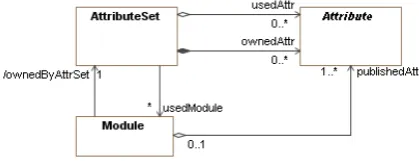
The created method introduces the concept of a module. A module is a reusable subset of an attribute set. A metamodel for modules is depicted in Figure 13.
Figure 13. Module metamodel
A module makes one part of an attribute set (class
AttributeSet) reusable (role publishedAttr). A module has at least one attribute. Attribute sets (class
AttributeSet) may use other attribute sets, which form modules. If an attribute set uses a module (role
usedModule), then all attributes from this module become accessible to the using attribute set (role
usedAttr).
5. Method implementation and experiment An experimental study consisting of two parts was carried out.
In the first part of the experiment it was verified whether the method is capable of adapting code generation from OCL expressions to code to a specific data storage platform. Eclipse EMF 3.4 with Dresden OCL2 Toolkit 2.0 plugin was chosen as an implementation platform, and Sun MySQL DBMS was chosen as a data storage platform.
For this purpose an attribute set was specified for transforming nested OCL conditional statements to non-nested SQL conditionals. A set of rules for such a mapping and a set of SQL templates for generating non-nested SQL conditionals were specified. The plugin for SQL code generation was developed on top of Eclipse platform and Dresden OCL2 Toolkit. A simplified UML state machine metamodel fragment with invariant containing nested OCL conditional statements was selected as a representative example and was transformed to relational schema of the chosen data storage platform (Sun MySQL DBMS). By comparing the code generated using attributes and without attributes, we have stated that the method works as expected allowing evaluation of the context and generation of a code adapted to a specific data storage platform. Also, the experiment has shown that the code, generated from nested conditionals without attributes (i.e. using standard transformation) cannot run on Oracle 10g and Microsoft SQL Server 2008 servers; it requires adaptation.
6. Method assessment
Assessment of the generated code has shown that the concrete tested code was executed approximately 33% faster than the code generated without attributes. This assessment was done for a concrete situation and code. However, the code that is adapted to a specific platform will always run faster than code that was not adapted to it and attributes facilitate adapting the code to specific platforms and allow generating code that uses resources more efficiently.
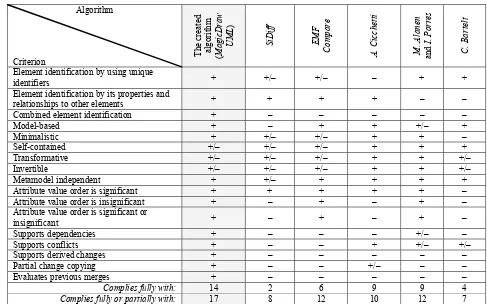
Comparison of the created graph merging algo-rithm to other graph merging algoalgo-rithms showed that
it allows a better discovery of changes and a more flexible merging process. The algorithm discovers more change types, their dependencies and conflicts, and allows partial copying changes to the graph; it also allows easier and faster change analysis and ging by using 4-way merge. The created graph mer-ging algorithm complies with 14 of the 17 criteria that are applied to merging algorithms that were analyzed in this research (Table 1). The rest 3 criteria are only partially satisfied as the algorithm is adopted for work in metamodel and model repository environment and has differences from code merging algorithms.
Table 1. Graph merging algorithm assessment
Algorithm
Criterion The created
algorithm (MagicDraw UML
)
SiDiff EMF
Compare A. Cicchetti M. Alanen
and
I.
Porre
s
C. Bartelt
Element identification by using unique
identifiers + +/– +/– – + +
Element identification by its properties and
relationships to other elements + + + + – –
Combined element identification + – – – – –
Model-based + – + + +/– +
Minimalistic + +/– +/– + + –
Self-contained +/– +/– +/– + + +
Transformative +/– +/– +/– + + +/–
Invertible +/– +/– +/– + + +/–
Metamodel independent + +/– + + + +
Attribute value order is significant + + + + + –
Attribute value order is insignificant + – + – + –
Attribute value order is significant or
insignificant + – + – + –
Supports dependencies + – – – +/– –
Supports conflicts + – – + +/– +/–
Supports derived changes + – – – – –
Partial change copying + – – +/– – –
Evaluates previous merges + – – – – –
Complies fully with: 14 2 6 9 9 4
Complies fully or partially with: 17 8 12 10 12 7
7. Conclusions
As a result of creating and evaluating the method for transforming OCL to code using attributes and graph merging algorithms, we can draw the following conclusions:
1. Analysis of existing code generation from OCL methods has shown that they are insufficient for applying them in metamodel and model reposi-tories in which OCL transformations to code have to be adapted to concrete data storage languages and developed by developer teams.
2. Analysis of attribute grammars has shown that attributes can be used in OCL-to-code transfor-mations thus adapting such transfortransfor-mations to generate code for specific data storage languages and platforms. Attributes enable mapping of OCL
construct groups to target language code thus exploiting all its capabilities.
3. The created graph merging algorithm and module system enables collaborative transformation deve-lopment: attribute sets can be compared, reused, and merged. The created merging algorithm differs from the analyzed algorithms in that it allows com-bined element identification and partial copying of changes, discovers dependencies and conflicts, and evaluates previous merges. These features allow decomposing transformations into several parts, developing those parts separately and then merging results into a single transformation.
5. An experiment was conducted during which SQL code was generated for one of the most popular open-source DBMS MySQL. The experiment has shown that attributes allow adapting code to the specific data storage platform and the code itself runs faster than the code generated without using attributes. The experiment has also shown that the code, generated from nested conditionals without attributes (i.e. code generated using standard trans-formation) cannot run on Oracle 10g and Micro-soft SQL Server 2008 servers without adaptation. 6. The attribute set merging experiment, which was
performed in MagicDraw UML tool by specifying attribute sets as domain-specific language models, has shown that the created merging algorithm works properly and can be used in teamwork for merging and reusing attribute sets.
7. The method can be developed further by creating a specialized attribute repository and evolving OCL-SQL transformations for model element searching, transformation, validation and other tasks that are relevant for collaborative model development using metamodel and model repositories.
References
[1] S. Gudas, A. Lopata. Meta-Model Based Develop-ment of Use Case Model for Business Function. Infor-mation Technology and Control, Vol. 36(3), 2007, 302–309.
[2] O. Vasilecas, D. Bugaite. Applying the Meta-Model Based Approach to the Transformation of Ontology Axioms into Rule Model. Information Technology and Control, Vol. 36(1A), 2007, 122–125.
[3] L. Ceponiene, L. Nemuraite, G. Vedrickas. Separa-tion of Event and Constraint Rules in UML&OCL Models of Service Oriented Information Systems. In-formation Technology and Control,Vol. 38(1), 2009, 29–37.
[4] S. Packevičius, A. Usaniov, E. Bareiša. The Use of Model Constraints as Imprecise Software Test Orac-les. Information Technology and Control, Vol. 36(2), 2007, 246–252.
[5] V. Štuikys, R. Damaševičius. Towards Knowledge-Based Generative Learning Objects. Information Technology and Control, Vol. 36(2), 2007, 202–212. [6] J. Coplien, D. Hoffman, D. Weiss. Commonality and
Variability in Software Engineering. IEEE Software, Vol. 15(6), November 1998, 37–45.
[7] G. Hedin. Reference Attributed Grammars. Informa-tica (Slovenia), Vol. 24(3), 2000, 301–317.
[8] A. Poetzsch-Heffter. Prototyping realistic program-ming languages based on formal specifications. Acta Informatica, Vol. 34(10), 1997, 737–772.
[9] J. T. Boyland.Descriptional Composition of Compi-ler Components: Ph.D. thesis. University of Califor-nia, Berkeley, California, 1996.
[10] G. Hedin. An overview of Door Attribute Grammars. InProceedings of the 5th international Conference on Compiler Construction, April 7-9, 1994, Edinburgh, UK. London: Springer-Verlag, 1994, 31–51.
[11] J. T. Boyland. Remote attribute grammars. Journal of the ACM (JACM), Vol. 52(4), 2005, 627–687. [12] R. Farrow. Automatic generation of
fixed-point-fin-ding evaluators for circular, but well-defined, attribute grammars. In Proceedings of the SIGPLAN´86 Sympo-sium on Compiler Construction, June 25-27, 1986, Palo Alto, California. ACM, 1986, 85–98.
[13] L. G. Jones. Efficient evaluation of circular attribute grammars. ACM Transactions on Programming Lan-guages and Systems, Vol. 12(3),1990, 429–462. [14] A. Sasaki, M. Sassa. Circular Attribute Grammars
with Remote Attribute References and their Evalua-tors. New Generation Computing, Vol. 22(1), 2004, 37–60.
[15] E. Magnusson, G. Hedin. Circular reference attribu-ted grammars – their evaluation and applications. Science of Computer Programming, Vol. 68(1), 2007, 21–37.
[16] T. Ekman, G. Hedin. Rewritable Reference Attribu-ted Grammars. InProceedings of 18th European Con-ference on Object-Oriented Programming (ECOOP 2004), June 14-18, 2004, Oslo, Norway. Springer Verlag, 2004, 144–169.
[17] H. H. Vogt, S. D. Swierstra, M. F. Kuiper. Higher order attribute grammars. In Proceedings of ACM SIGPLAN 1989 Conference on Programming lan-guage design and implementation, 1989, Portland, Oregon, United States. ACM, 1989, 131–145. [18] R. Farrow, T. J. Marlowe, D. M. Yellin.
Compos-able attribute grammars: support for modularity in translator design and implementation. In Proceedings of the 19th ACM SIGPLAN-SIGACT symposium on Principles of programming languages, 1992, Albu-querque, New Mexico, United States. ACM, 1992, 223–234.
[19] J. T. Boyland. Conditional attribute grammars. ACM Transactions on Programming Languages and Sys-tems (TOPLAS), Vol. 18(1), 1996, 73–108.
[20] M. Alanen, I. Porres. Difference and Union of Mo-dels. In Proceedings of the Unified Modeling Lan-guage, Modeling Languages and Applications, 6th International Conference, October 20-24, 2003, San Francisco, CA, USA. Springer, 2003, 2–17.
[21] A. Zündorf, J. P. Wadsack, I. Rockel. Merging Graph-Like Object Structures. InProceedings of the Tenth International Workshop on Software Configu-ration Management, May 12-19, 2001, Toronto, Canada. IEEE Computer Society, 2001.
[22] S. Sudarshan, A. R. Chawathe, H. Garcia-Molina, J. Widom. Change Detection in Hierarchically Struc-tured Information. In Proceedings of the 1996 ACM SIGMOD international Conference on Management of Data, June 4-6, 1996, Montreal, Quebec, Canada. New York: ACM, 1996, 493–504.
[23] Y. Wang, D. J. DeWitt, J. Cai. X-Diff: An Effective Change Detection Algorithm for XML Documents. In Proceedings of the 19th International Conference on Data Engineering (ICDE'03), March 5-8, 2003, Ban-galore, India. IEEE Computer Society, 2003, 519–530. [24] A. Cicchetti, D. Di Ruscio, A. A. Pierantonio.
[25] A. Cicchetti, D. Di Ruscio, R. Eramo, A. Pieranto-nio. Automating Co-evolution in Model-Driven Engi-neering. In Proceedings of the 2008 12th international IEEE Enterprise Distributed Object Computing Confe-rence – Volume 00, September 15-19, 2008, Washing-ton, DC, USA. IEEE Computer Society, 2008, 222– 231.
[26] A. Cicchetti, D. Di Ruscio, A. Pierantonio. Mana-ging Model Conflicts in Distributed Development. In Proceedings of the 11th international Conference on Model Driven Engineering Languages and Systems, September 28 – October 03, 2008, Toulouse, France. Springer-Verlag, 2008, 311–325.
[27] C. Bartelt. Consistence preserving model merge in collaborative development processes. In Proceedings of the 2008 international Workshop on Comparison and Versioning of Software Models, May 17, 2008, Leipzig, Germany. New York: ACM, 2008, 13-18. [28] U. Kelter, J. Wehren, J. Niere. A Generic Difference
Algorithm for UML Models. Software Engineering 2005, LNI Vol. 64, 2005, 105–116.
[29] D. Ohst, M. Welle, U. Kelter. Differences between versions of UML diagrams. InProceedings of the 9th European Software Engineering Conference Held Jointly with 11th ACM SIGSOFT international Sympo-sium on Foundations of Software Engineering, Sep-tember 1-5, 2003, Helsinki, Finland. New York: ACM, 2003, 227–236.
[30] P. Selonen. A Review of UML Model Comparison Approaches. In Proceedings of the 5th Nordic Work-shop on Model Driven Engineering, August 27-29, 2007, Ronneby, Sweden.Blekinge Tekniska Högskola, 2007, 43–51.
[31] E. Pakalnickiene, L.Nemuraite. Checking of Concep-tual Models with Integrity Constraints. Information Technology and Control, Vol. 36(3), 2007, 285–294. [32] K. Czarnecki, S. Helsen. Classification of Model
Transformation Approaches. In J. Bettin, G. Van E. Boas, A. Agrawal, E. Willink, J. Bezivin (eds.) Procee-dings of the 2nd OOPSLA workshop on Generative Techniques in the Context of Model-driven Architec-ture, October 2003. ACM Press, 2003, 1–17.
[33] D. Šilingas, R. Butleris. Towards Implementing a Framework for Modeling Software Requirements in MagicDraw UML. Information Technology and Cont-rol, Vol. 38(2),2009, 153–164.
[34] N. Neff. Attribute Based Compiler Implemented Using Visitor Pattern. In Proceedings of the 35th SIGCSE technical symposium on Computer science education, March 3-7, 2004, Norfolk, Virginia, USA. ACM, 2004, 130–134.