Enhancing Interdisciplinary Learning with a
Learning Management System
Ji Yong Park Senior Lecturer School of Curriculum
Queensland University of Technology Kelvin Grove, QLD 4059 AUSTRALIA
Kathy A. Mills
Senior Research Fellow (Australian Research Council) School of Curriculum
Queensland University of Technology Kelvin Grove, QLD 4059 AUSTRALIA
Abstract
Interdisciplinary learning is a form of knowledge production that is increasingly being embraced as an educational approach in higher education. A role of information and communication technologies (ICT) is to enhance interdisciplinary learning. Issues surrounding the mix of interdisciplinary pedagogic methodologies and emerging digital technologies are worthy of investigation. In this paper, the authors report the findings of a study that examined student perceptions of an interdisciplinary course on information technology (IT) and visual design that utilized a learning management system. Using questionnaire instrumentation, the authors sought the perceptions of first-year university students enrolled in a newly formed interdisciplinary IT course. Results indicate that ICT-based interdisciplinary learners prefer a self-directed and collaborative instructional modality, as well as teacher presence and interventions in the online environment. The types of student participation can significantly influence how students perceive ICT-based interdisciplinary learning design.
Keywords: interdisciplinary learning, learning management system (LMS), information technology (IT) education, visual design education
Introduction
A traditional characterization of university organizational and pedagogical structure is limiting. The changing role of a university is not served by a discrete autonomous and bound entity (Davies & Devlin, 2007; Sharma, 2012). A major part of contextual change has been the emergence of information and communication technology (ICT)-based teaching and learning environments. In response to the changing context of higher education, interdisciplinarity is seen as a way of confronting many contemporary challenges and opportunities including production of collaborative, collective, creative, and interdisciplinary knowledge (Holley, 2009).
In a narrow sense, ICT refers to tools that assist learners by ensuring lifelong access to knowledge and learning resources (Drigas & Ioannidou, 2013), whereas in a broad sense, it is a factor that shapes the global economy and produces rapid changes in society (Sharma, 2012). In higher education, it refers to a technological service that provides a facility for developing, contributing, and collaborating through expressions of individuals' ideas in more democratic and innovative ways (Kanvaria, 2012).
subject" (p. 289). This confluence of disciplinary power offers possibilities for richer and deeper student learning.
Traditionally, an academic discipline is a unique and discrete area of study with its own, history, methodology, philosophy, and content. In response to rapid and continuous technological changes, however, the Organization for Economic Cooperation and Development (2005) proposed that a key competency for societal participation is the ability to use technology and to interact in heterogeneous groups in which social interactions and diverse viewpoints contribute to the subject matter. The Australian Government Information Management Office (Callioni, 2007) emphasized the importance of graduates demonstrating proficiency in personal and interpersonal skills with ICT and interdisciplinary problem-solving approaches. In Australia, universities are requiring graduates to demonstrate a wide-range of employment-related skills, especially information and technology skills, and to be capable of dealing effectively with interdisciplinary learning and communication (Queensland University of Technology, 2008). Hence, interdisciplinary learning and ICT skills have become essential elements of education in terms of connecting universities with industry and professional communities (Davies & Devlin, 2007), yet the integrative approach to both domains is still unclear.
In a short-term view, a challenge for interdisciplinary pedagogy is to integrate shared thematic and methodological issues across the curriculum (Lee, 2007). This confronts students with the task of applying knowledge, methodology, and values to more than one academic discipline (Lee, 2007). In a long-term view, interdisciplinary techniques enrich the three dimensions of student learning: lifelong learning habits, academic skills, and personal growth (Jones, 2009). Inversely, the challenges determine the intrinsic nature of an interdisciplinary approach: an integration of methodology and pedagogy, and a much-needed promotion of learning beyond traditional schooling and throughout adult life (Delors et al., 1996). In an ICT learning environment, in this sense, an interdisciplinary approach plays a dual role. First, interdisciplinary pedagogic methodologies become the core of developing technology-enhanced learning in which a methodological challenge of utilizing ICT for students is to manage the diverse, and at times, divergent perspectives of all the disciplines and stakeholders involved. Second, ICT-based interdisciplinary learning requires advanced technological expertise to take advantage of, and to progress the human-computer interactions, which are requisite for the successful outcome of the first role.
When ICT is viewed through the prism of interdisciplinary learning, not only does interdisciplinary pedagogy serve as a means of delivering learning content for collaborative, interdisciplinary teaching and learning, but it can also provide an extension to communication and interpersonal interaction for lifelong learning. In reality, as Friedow, Blankenship, Green, and Stroup (2012) argued, there is often a tendancy to "neglect to treat collaborative interdisciplinary teaching as an ongoing pedagogical process" because of "varying and complex perceptions of interdisciplinary learning and teaching individual students hold" (p. 406). In this sense, one of the practical challenges is to explore where the types of student participation are in ICT-based interdisciplinary learning in order to accommodate interdisciplinary pedagogy.
In this paper, the authors report on a faculty-based study demonstrating that online learning via a learning management system (LMS), such as Blackboard, has the potential to enhance interdisciplinary learning. The course was an interfaculty collaboration between an information technology (IT) faculty and a performing arts faculty. The study saw the implementation of an innovative delivery method within an IT course based on the integration of visual design content. The aim of the module was to employ interdisciplinary learning across the disciplines of graphic design and IT business management in a group project task. The interdisciplinary challenge was to develop an online ticket selling system that applied a visually pleasing web interface. The students were required to use three different disciplinary methods and insights: visual design principles, web system development skills, and IT business marketing theories.
The authors identify pedagogical issues in the course design from an interdisciplinary perspective, and evaluate the ICT-based delivery method for interdisciplinary learning. The students were asked to evaluate and provide feedback on the module design and their learning. The data analysis and discussion aim to respond to two research questions:
1) Does LMS-based interdisciplinary learning suit a particular instructional format?
ICT-Based Interdisciplinarity Interdisciplinarity
Multidisciplinarity, interdisciplinarity, and transdisciplinarity are often used interchangeably, but they are conceptually and practically different. Multidisciplinary or cross-disciplinary learning refers to "a combination of various disciplines as independent and separate components of learning" (Park & Son, 2010, p. 83; see also Garner, 1995) and it works in "parallel or sequentially from disciplinary-specific bases to address common problems" (Rosenfield, 1992, p. 1351). "Interdisciplinary learning focuses on more collaboration and interactions between disciplines" (Park & Son, 2010, p. 83) and it requires an infrastructure or a platform that facilitates interdependent self-management and responsibility for group performance and student outcomes (Dyer, 2003), while "transdisciplinary learning focuses on the outcomes of interdisciplinary learning, which come from students' participation in learning and acquisition of knowledge and skills" (Park & Son, 2010, p. 83). Park and Son summarized the differences as follows:
Multidisciplinary learning highlights learning of various topics from diverse disciplines; while interdisciplinary learning has a mixture of diverse disciplines to solve a problem. Transdisciplinary learning, taking interdisciplinary learning a step further, facilitates collaborative learning through a shared conceptual framework. (p. 84)
The study examined interdisciplinary learning via an LMS and the contribution of the outcomes to transdisciplinary learning.
From graduate capabilities and outcomes, to the creation of diverse knowledge bases, the development of creative and practical skills enables application across industries and practices (Devlin, 2008). Even the research of higher education is increasingly looking to cross-pollinate previously tightly bounded disciplines (National Academy of Sciences, National Academy of Engineering, & Institute of Medicine, 2005; Sá, 2007). Interdisciplinarity, as a practice and a concept, preserves the idea of conflict and debate as core values of learning, but this understanding has not been fully integrated into learning processes (Hearn, 2003; Klein & Schneider, 2010).
Hearn (2003) argued that interdisciplinarity has been provisionally and tentatively treated in higher education, and it should aim for new formations of knowledge and inquiry to constitute new learning communities. Hearn proposed:
The challenge [of interdisciplinary learning in higher education] is ... to hold open spaces for thinking, developing, and teaching alternative values ... to link the intellectual work of interdisciplinarity with the generation of new forms of community inside and outside the walls of universities. (p. 11)
For the most part, however, interdisciplinarity remains the exploratory and experimental province of projects and small-scale institutional interventions, rather than embedded programmatic or systemic pedagogy (Klein & Schneider, 2010; National Academy of Sciences, National Academy of Engineering, & Institute of Medicine,2005). In particular, the increasing sophistication of LMS-based interdisciplinary learning in higher education is changing the educational landscape. Scherl, Dethleffsen, and Meyer (2012) argued that LMS-based interdisciplinary learning increases knowledge and transfer capabilities, and enhances the efficiency of learning. They proposed that individual learning can be supported with a conception of visualization of interdisciplinary relations, yet there is more.
Constructivism and ICT
The emergence of digital ICT-based teaching and learning in higher education has provided both challenges and opportunities for practitioners. Academics, with their institutional lineage dating from the 12th century in Western countries, are cautious in their enthusiasm for teaching and learning methodologies that claim to hold "revolutionizing" power. After all, they have gone through three such revolutionizing phenomena in the 20th century – film, radio, and television – in addition to more recent digital forms of ICT – technological applications, social networking systems, and global computer network systems (Toyama, 2011). The widespread accessibility of these technologies has changed the educational landscape irrevocably in the third millennium.
At the heart of collaborative forms of learning are constructivist ideas about the learning process. Essentially, constructivists posit that students generate knowledge and meaning through an interaction between their experiences and their cognitive systems (Woolfolk, 2001). By reflecting on those experiences, students construct an approximation of the world. There is no one constructivist theory of learning, but rather, a raft of learning theories that are united in the view that learning occurs in the interaction between cognition and sensory experience. Social constructivists consider an additional dimension – how learning occurs through social interaction, tool use, and activity (Woolfolk, 2001). Emerging digital technologies have had the most influence in education, particularly the construction of knowledge within interactive group settings (Toyama, 2011). In digital ICT's collaborative potentials, learning is seen as a search for meaning. Learning starts with the learner: that is, it is learner-centered – involving processes through which students are actively and collaboratively constructing meaning. In this way, the learning process is open to interdisciplinary modes of knowledge construction. In a constructivist-based learning environment, it is important to understand the cognitive schema that students use to perceive the world and the assumptions they make to support those schemata (Swan, 2005).
Constructivism calls for the elimination of standardized curricula, and for the implementation of interventions where learning activities and tools are used to provide students with an opportunity to collaboratively construct meaning (Ashcraft, Treadwell, & Kumar, 2008). It promotes curricula that enable students to make links between the unknown and the students' existing schema, with an emphasis on hands-on problem solving. Teachers focus on making connections between facts and fostering new understanding by scaffolding new ideas and concepts extending the schema. The connections can be facilitated by using digital ICT tools such as LMSs. Peters (2007) argued that LMSs can provide "unique educational affordances" ("m-Learning as a Practical Training Solution in Mobile Workplaces," para. 1), including portability, social interactivity, tailoring for context sensitivity, promoting connectivity, and catering for individuality. While many lecturers can still use LMSs in ways that may not promote constructivist learning, such as archiving slide shows, readings, and posting e-mails, certain features within LMSs offer potentials for interdisciplinary knowledge production by providing opportunities for students to learn independently and via new forms of interactions and communication by personalizing learning experiences (Johnson, Adams, & Cummins, 2012, Park, 2008; Salmon, 2003). Klein and Schneider (2010) extended further that Web 2.0 technologies drive information sharing across the infrastructure of distributed information systems, and are "enabling individuals and networks in dispersed locations to collaborate" (p. 18) for interdisciplinarity. In this way, LMSs can provide a platform for effective communication and interaction between students and students, and between students and teachers for interdisciplinary learning.
LMSs: Podcasts, Discussion Boards, and Virtual Groups
Podcasts
Delivering content via podcasts promotes flexible learning through the functionality of replay and pause while reading relevant materials. This contributes to an improvement in the student's academic standing as well as a decrease in student attrition rates (Kazlauskas & Robinson, 2012; Tynan & Colbran, 2006). The accession and selection of podcasting provides better cognitive-based personalization. In the present study, the students could choose to use an audio option to support their preferences for hearing over reading text, and choose linear or random content presentation (Dudas, 2012; Kazlauskas & Robinson, 2012). To maximize the benefits, in addition, podcast technology was combined with other media such as video and animation, and various types of pedagogy were employed, such as demonstration and discussion (Kazlauskas & Robinson, 2012). In an interdisciplinary learning module, video podcasts were used to include complex, realistic content of the module, and to support multiple modes of representation that are aligned with constructivist conditions for learning.
Discussion Boards
In the present study, a discussion board (or online forum) was used to provide a functional place where students could hold conversations in the form of posted messages called threads. The discussion board is hierarchical and linear in presentation structure. The online communication opportunities in LMSs, unlike traditional, face-to-face (F2F) configurations, allow multimedia capabilities synchronously and asynchronously with constructivist potentials (Lambropoulos, Faulkner, & Culwin, 2012; Levine, 2007). In particular, interaction and communication on discussion boards provide learners adequate time to investigate and deeply engage in learning, and enable teachers to nurture learners' self-awareness of the knowledge construction process (Lambropoulos et al., 2012). These constructivist conditions are believed to facilitate interdisciplinary learning by increasing self-management and responsibility on the part of team members for group performance and student outcomes.
Virtual Groups
In classroom-based environments, students can be arranged in groups, whereas, in online environments, similar divisions can be achieved through the use of virtual groups. A virtual group is a small cohort of students whose group size is determined by the task requirements. Group size is an important consideration for effective collaborative work, and a group of three to five with specific roles is typically ideal (Tomei, 2006). In the present study, students were divided into groups of four or five, depending on their expected team composition and needed skills for the project development, such as a project leader, an e-commerce expert, a web interface designer, web programmer, and/or a database developer. In this way, virtual groups both provide for social negotiation as an integral part of learning and also encourage ownership in learning (Lambropoulos et al., 2012). For active interdisciplinary learning, virtual groups can be used to facilitate and manage continued collaborative communication and interaction among students and teachers.
Course Design
In design and computer education, a module is part of a course that performs a distinct function and supports students' task or project completion. The content of the module, Visual Design for IT Professionals, was rearranged according to the course objectives. The LMS and podcasting technologies were the vehicles used to deliver the module on a weekly schedule. Students and teachers were assigned to virtual groups within the LMS on their project team. A project team was required to develop a visually pleasing website prototype based on visual design principles for a hypothetical project that presents an economically and functionally innovative solution for selling tickets to a local IT expo. Students were expected to commence each topic and participate in the discussion threads from Week 4 and complete their task by Week 8. A 1-hour lecture scheduled in Week 8 summarized the learning content, reviewed the weekly activities, and provided space for further discussion on specific issues related to the group project.
An LMS-Based Interdisciplinary Learning Environment Framework
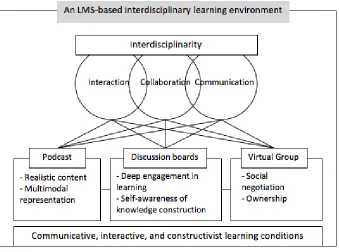
The authors' review of related research led to the discovery of the components of LMS-based interdisciplinary learning. To create communicative, interactive, and constructivist learning conditions, LMS structure and platforms with interdisciplinarity need to be integrated. The interdisciplinarity should facilitate interaction, communication, and collaboration among students and between teacher and students, and the LMS platforms need to be designed to reflect constructivist learning conditions and their functions. In a podcasting platform, LMS-based interdisciplinary learning should aim to embed realistic and relevant content of the module and support multimodal forms of representation, which include visual, spatial, audio, linguistic, and gestural modes of design (Mills & Levido, 2011). A discussion board platform needs to be designed to deeply engage in learning and to facilitate self-awareness of the knowledge construction process. To utilize a virtual group platform, social negotiation and ownership in learning need to be facilitated and encouraged. Figure 1 presents a visualized output of the LMS-based interdisciplinary learning environment for this study.
Figure 1. LMS-based interdisciplinary learning framework
In an LMS-based interdisciplinary learning environment, teachers develop interdisciplinary curriculum and teaching strategies based on learning objectives and students' learning situations. From the students' perspective, they will participate in the environment by utilizing designed platforms in order to implement given tasks through interdisciplinary collaboration and knowledge creation.
Student Participants and Learning Context
Questionnaire
Based on the LMS-based interdisciplinary learning framework (Figure 1), students' perceptions and experiences can be categorized into three sections: (1) individual students' learning experiences and self-study in the platform; (2) their experiences of interaction collaboration and communication via communication tools; and (3) their perceived participation types and frequencies. From this framework, a questionnaire of nine questions, plus open-ended feedback, was developed to gather data on students' experiences of the interdisciplinary module. The instrument consisted of four sections: Section 1 looked at learning experiences, Section 2 focused on LMS experiences and communication, Section 3 focused on perceptions and participation types, and Section 4 elicited open-ended written feedback from students and tutors.
The questionnaire, delivered in a paper form, was distributed and completed in class at the end of the semester. A total of 82 students, or 21.8% of the enrollment (82 out of 376), responded to all the questions. Respondents were asked to rate their responses on a 5-point Likert scale with Very Poor being the lowest rating, and Excellent being the highest. For qualitative data collection, students and teachers were asked to provide anonymous written feedback on this LMS-based interdisciplinary learning module. Twenty-two of the 82 respondents specified reasons for passive or no participation in the LMS-based interdisciplinary learning, and gave feedback or suggestions for how best to meet their needs. Thirteen teachers provided their feedback on this module.
Results
Learning Experiences
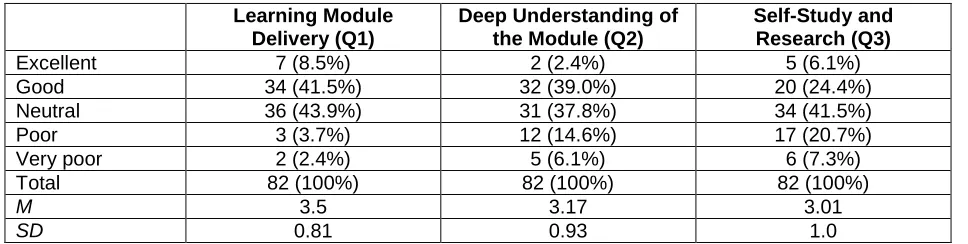
Section 1 of the questionnaire was made up of three questions, and the responses are presented in Table 1. The first question asked about the learning that students experienced in the module (lecture and tutorial) materials and video podcasts provided. The second and third questions asked about the usefulness of the module and effectiveness of LMS-based delivery methods, both in terms of content management, communication, and collaboration, and in terms of the extent to which the LMS-based delivery aided deep understanding of visual design and encouraged self-study and research. Exactly 50% of the respondents (8.5% Excellent and 41.5% Good) perceived that the module and its delivery method were helpful (Q1), and 41.4% (2.4% Excellent and 39.0% Good) agreed the module was helpful for their deep learning (Q2). As 41.5% chose Neutral (Q3), however, the response to the self-study and research was neutral. The results of the Section 1 need to be further analyzed in line with the frequency of students' online contributions to the discussions (refer to Table 5, later in the paper).
Table 1. Learning experiences responses (Section 1)
Learning Module Delivery (Q1)
Deep Understanding of the Module (Q2)
Self-Study and Research (Q3)
Excellent 7 (8.5%) 2 (2.4%) 5 (6.1%)
Good 34 (41.5%) 32 (39.0%) 20 (24.4%)
Neutral 36 (43.9%) 31 (37.8%) 34 (41.5%)
Poor 3 (3.7%) 12 (14.6%) 17 (20.7%)
Very poor 2 (2.4%) 5 (6.1%) 6 (7.3%)
Total 82 (100%) 82 (100%) 82 (100%)
M 3.5 3.17 3.01
SD 0.81 0.93 1.0
LMS Experiences and Communication
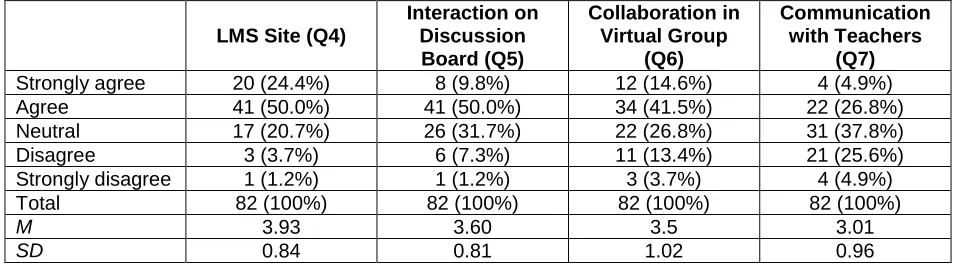
Table 2. LMS experiences and communication responses (Section 2)
LMS Site (Q4)
Interaction on Discussion Board (Q5)
Collaboration in Virtual Group
(Q6)
Communication with Teachers
(Q7)
Strongly agree 20 (24.4%) 8 (9.8%) 12 (14.6%) 4 (4.9%)
Agree 41 (50.0%) 41 (50.0%) 34 (41.5%) 22 (26.8%)
Neutral 17 (20.7%) 26 (31.7%) 22 (26.8%) 31 (37.8%)
Disagree 3 (3.7%) 6 (7.3%) 11 (13.4%) 21 (25.6%)
Strongly disagree 1 (1.2%) 1 (1.2%) 3 (3.7%) 4 (4.9%)
Total 82 (100%) 82 (100%) 82 (100%) 82 (100%)
M 3.93 3.60 3.5 3.01
SD 0.84 0.81 1.02 0.96
Perceptions and Participation Types
The items in Section 3 of the questionnaire asked about students' participation types. This was done to ascertain student levels of technology usage in order to understand student self-perceptions and visiting frequencies within the online learning site. As shown in Table 3, more than 70% of the respondents answered that they were either active (37.8%) or semi-active participants (36.6%). More than 90% of the respondents frequently visited the LMS site, with 28% reporting that they frequented the site daily, 29.3% visited two to four times a week, and 37.8% at least once a week. The self-reported participation types are used for further analysis (refer to Table 5).
Table 3. Participation types and frequencies (Section 3)
Participation Type (Q8) Frequency of Participation (Q9)
Active participant 31 (37.8%) Daily 23 (28%)
Semi-active participant 30 (36.6%) 2-4 per week 24 (29.3%)
Regular viewer 14 (17.1%) 1 per week 31 (37.8%)
Irregular viewer 7 (8.5%) 1 per fortnight 3 (3.7%)
Never visited 0 (0%) Never 1 (1.2%)
Total 82 (100%) Total 82 (100%)
M 4.04 M 3.79
SD 0.95 SD 0.94
Written Feedback
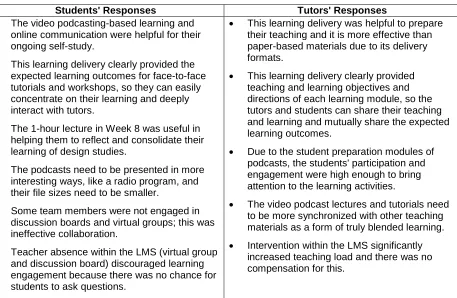
The written feedback obtained from students and tutors concerned the students' perceptions of the reasons why they did not participate in the module. In order of response percentages, in summary, these were: learning materials are not interactive (10 or 45.5%); no encouragement from teachers (6 or 27.3%); poorly defined site structure and discussion board (4 or 18.2%), with two (9.1%) responding that they had no time to visit. Within the open-ended feedback, student satisfaction focused on three criteria: course delivery, learning experience, and teaching staff evaluation. The tutor feedback aimed to obtain feedback about the course delivery and about student performance, attitudes, and behavior. A summary of the written responses can be found in Table 4.
Cross-Tabulation of Student Engagement and Participation Types
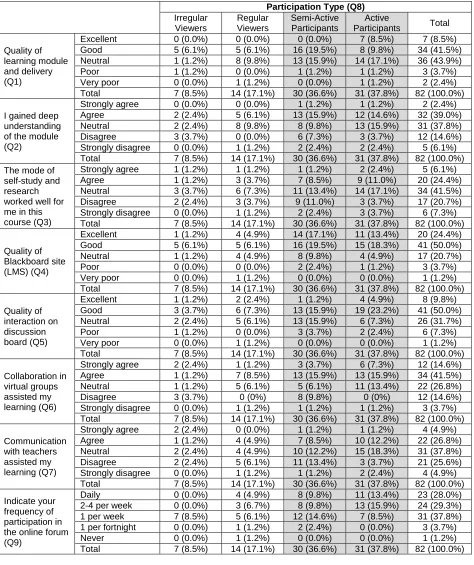
Table 5 indicates the level of student engagement in the module and its delivery method in terms of participation types (Q8). Overall, the four types of participation revealed positive responses to the questions above. In particular, the semi-active and active participants responded more positively to the questions than irregular and regular viewers.
addition, the cross-tabulation between the participation types and visiting frequencies (Q9) shows that the semi-active and active participants more regularly visited the LMS site than the irregular and regular viewers. 85.3% of the semi-active and active participants visited the LMS site daily, and two to four times per week.
Table 4. Written feedback summary
Students' Responses Tutors' Responses
• The video podcasting-based learning and online communication were helpful for their ongoing self-study.
• This learning delivery clearly provided the expected learning outcomes for face-to-face tutorials and workshops, so they can easily concentrate on their learning and deeply interact with tutors.
• The 1-hour lecture in Week 8 was useful in helping them to reflect and consolidate their learning of design studies.
• The podcasts need to be presented in more interesting ways, like a radio program, and their file sizes need to be smaller.
• Some team members were not engaged in discussion boards and virtual groups; this was ineffective collaboration.
• Teacher absence within the LMS (virtual group and discussion board) discouraged learning engagement because there was no chance for students to ask questions.
• This learning delivery was helpful to prepare their teaching and it is more effective than paper-based materials due to its delivery formats.
• This learning delivery clearly provided teaching and learning objectives and directions of each learning module, so the tutors and students can share their teaching and learning and mutually share the expected learning outcomes.
• Due to the student preparation modules of podcasts, the students' participation and engagement were high enough to bring attention to the learning activities.
• The video podcast lectures and tutorials need to be more synchronized with other teaching materials as a form of truly blended learning.
• Intervention within the LMS significantly increased teaching load and there was no compensation for this.
When the results of all the participant types include the irregular and regular viewers, however, the responses to the questions are not as high as the semi-active and active participants. More than 50% of the respondents gave favorable evaluations of the quality of the learning content, LMS site, discussion board and collaboration with team members in virtual groups, and less than 50% of the respondents gave favorable evaluations with respect to the quality of their deep understanding of the module, self-study and research, and communication with teachers. From the former results it can be inferred that the students were satisfied with LMS-based content delivery and learning, whereas the latter results show that this learning format may need to be facilitated by higher levels of tutor or lecturer intervention.
Discussion
The overall student satisfaction with quality of the module and its effectiveness of the module for learning was satisfactory, with more than 70% of respondents choosing stronglyagree and agree (Table 2). However, student engagement in the module in terms of their deep learning and self-study and research were less positive to the extent that approximately 50% were positive and approximately 30% were neutral (Table 1). Interestingly, more than 50% of the respondents answered that collaboration with team members had been positive, but only 30% felt positive about quality of the opportunities to communicate with teachers (Table 2).
and casual forms of podcasts incorporated into conversations and discussion rather than a teacher giving direct instruction as a voice-over, accompanied by a slide show.
Table 5. Cross-tabulation of learning experiences in terms of the participation types
Participation Type (Q8) Irregular Viewers Regular Viewers Semi-Active Participants Active
Participants Total
Quality of learning module and delivery (Q1)
Excellent 0 (0.0%) 0 (0.0%) 0 (0.0%) 7 (8.5%) 7 (8.5%)
Good 5 (6.1%) 5 (6.1%) 16 (19.5%) 8 (9.8%) 34 (41.5%)
Neutral 1 (1.2%) 8 (9.8%) 13 (15.9%) 14 (17.1%) 36 (43.9%)
Poor 1 (1.2%) 0 (0.0%) 1 (1.2%) 1 (1.2%) 3 (3.7%)
Very poor 0 (0.0%) 1 (1.2%) 0 (0.0%) 1 (1.2%) 2 (2.4%)
Total 7 (8.5%) 14 (17.1%) 30 (36.6%) 31 (37.8%) 82 (100.0%)
I gained deep understanding of the module (Q2)
Strongly agree 0 (0.0%) 0 (0.0%) 1 (1.2%) 1 (1.2%) 2 (2.4%)
Agree 2 (2.4%) 5 (6.1%) 13 (15.9%) 12 (14.6%) 32 (39.0%)
Neutral 2 (2.4%) 8 (9.8%) 8 (9.8%) 13 (15.9%) 31 (37.8%)
Disagree 3 (3.7%) 0 (0.0%) 6 (7.3%) 3 (3.7%) 12 (14.6%)
Strongly disagree 0 (0.0%) 1 (1.2%) 2 (2.4%) 2 (2.4%) 5 (6.1%)
Total 7 (8.5%) 14 (17.1%) 30 (36.6%) 31 (37.8%) 82 (100.0%)
The mode of self-study and research worked well for me in this course (Q3)
Strongly agree 1 (1.2%) 1 (1.2%) 1 (1.2%) 2 (2.4%) 5 (6.1%)
Agree 1 (1.2%) 3 (3.7%) 7 (8.5%) 9 (11.0%) 20 (24.4%)
Neutral 3 (3.7%) 6 (7.3%) 11 (13.4%) 14 (17.1%) 34 (41.5%)
Disagree 2 (2.4%) 3 (3.7%) 9 (11.0%) 3 (3.7%) 17 (20.7%)
Strongly disagree 0 (0.0%) 1 (1.2%) 2 (2.4%) 3 (3.7%) 6 (7.3%)
Total 7 (8.5%) 14 (17.1%) 30 (36.6%) 31 (37.8%) 82 (100.0%)
Quality of Blackboard site (LMS) (Q4)
Excellent 1 (1.2%) 4 (4.9%) 14 (17.1%) 11 (13.4%) 20 (24.4%)
Good 5 (6.1%) 5 (6.1%) 16 (19.5%) 15 (18.3%) 41 (50.0%)
Neutral 1 (1.2%) 4 (4.9%) 8 (9.8%) 4 (4.9%) 17 (20.7%)
Poor 0 (0.0%) 0 (0.0%) 2 (2.4%) 1 (1.2%) 3 (3.7%)
Very poor 0 (0.0%) 1 (1.2%) 0 (0.0%) 0 (0.0%) 1 (1.2%)
Total 7 (8.5%) 14 (17.1%) 30 (36.6%) 31 (37.8%) 82 (100.0%)
Quality of interaction on discussion board (Q5)
Excellent 1 (1.2%) 2 (2.4%) 1 (1.2%) 4 (4.9%) 8 (9.8%)
Good 3 (3.7%) 6 (7.3%) 13 (15.9%) 19 (23.2%) 41 (50.0%)
Neutral 2 (2.4%) 5 (6.1%) 13 (15.9%) 6 (7.3%) 26 (31.7%)
Poor 1 (1.2%) 0 (0.0%) 3 (3.7%) 2 (2.4%) 6 (7.3%)
Very poor 0 (0.0%) 1 (1.2%) 0 (0.0%) 0 (0.0%) 1 (1.2%)
Total 7 (8.5%) 14 (17.1%) 30 (36.6%) 31 (37.8%) 82 (100.0%)
Collaboration in virtual groups assisted my learning (Q6)
Strongly agree 2 (2.4%) 1 (1.2%) 3 (3.7%) 6 (7.3%) 12 (14.6%)
Agree 1 (1.2%) 7 (8.5%) 13 (15.9%) 13 (15.9%) 34 (41.5%)
Neutral 1 (1.2%) 5 (6.1%) 5 (6.1%) 11 (13.4%) 22 (26.8%)
Disagree 3 (3.7%) 0 (0%) 8 (9.8%) 0 (0%) 12 (14.6%)
Strongly disagree 0 (0.0%) 1 (1.2%) 1 (1.2%) 1 (1.2%) 3 (3.7%)
Total 7 (8.5%) 14 (17.1%) 30 (36.6%) 31 (37.8%) 82 (100.0%)
Communication with teachers assisted my learning (Q7)
Strongly agree 2 (2.4%) 0 (0.0%) 1 (1.2%) 1 (1.2%) 4 (4.9%)
Agree 1 (1.2%) 4 (4.9%) 7 (8.5%) 10 (12.2%) 22 (26.8%)
Neutral 2 (2.4%) 4 (4.9%) 10 (12.2%) 15 (18.3%) 31 (37.8%)
Disagree 2 (2.4%) 5 (6.1%) 11 (13.4%) 3 (3.7%) 21 (25.6%)
Strongly disagree 0 (0.0%) 1 (1.2%) 1 (1.2%) 2 (2.4%) 4 (4.9%)
Total 7 (8.5%) 14 (17.1%) 30 (36.6%) 31 (37.8%) 82 (100.0%)
Indicate your frequency of participation in the online forum (Q9)
Daily 0 (0.0%) 4 (4.9%) 8 (9.8%) 11 (13.4%) 23 (28.0%)
2-4 per week 0 (0.0%) 3 (6.7%) 8 (9.8%) 13 (15.9%) 24 (29.3%)
1 per week 7 (8.5%) 5 (6.1%) 12 (14.6%) 7 (8.5%) 31 (37.8%)
1 per fortnight 0 (0.0%) 1 (1.2%) 2 (2.4%) 0 (0.0%) 3 (3.7%)
Never 0 (0.0%) 1 (1.2%) 0 (0.0%) 0 (0.0%) 1 (1.2%)
Total 7 (8.5%) 14 (17.1%) 30 (36.6%) 31 (37.8%) 82 (100.0%)
blog platform) in a final year course for pre-service teacher education, demonstrating that e-portfolios empowered learners to manage their own learning. Their study implies that the LMS platforms can be used with e-portfolios to better encourage deep learning and self-study.
Second, a combination of learning content in ICT-based delivery requires designing a workable communication framework between students and students, and between students and teachers. It was expected that students would actively engage in the podcast-driven module and the discussion board. However, 30.5% of the students (25.6% to Disagree and 4.9% to strongly disagree in Q7) responded that communication with teachers was not effective and 37.8% of them gave a neutral response. The students indicated that a lack of encouragement from teachers was one of the main reasons for their decreased participation in the LMS site. Teacher presence in an online learning environment, such as a moderator and facilitator, is significantly and positively related to student affective learning, cognition, and motivation (Baker, 2010; Sheridan & Kelly, 2010). As Baker proposed, the teacher presence can be established by facilitating productive discourse where the teacher seeks to reach consensus and understanding and reinforcing student contributions. It can also be encouraged by implementing direct instruction, which include presenting questions, summarizing discussion, confirming understanding, and responding to technical concerns. The study implies that an LMS-based interdisciplinary learning can provide a learning platform where students can actively participate in learning, but also when the system is actively managed by the teacher. As the tutor's written feedback showed, in addition, the necessary workload and feasibility of teachers' frequent online engagement needs to be taken into account.
Third, various types of student participation, such as visiting frequency to the LMS site, indicate that usage of podcasts and communication needs to accommodate a diversity of student participation. The data revealed that there are various types of participation with students providing various reasons for participation. In other words, if a learning method (either problem-based learning or participatory approach) does not properly reflect various types of participation, it may not promote students' active participation and engagement in LMS-based interdisciplinary collaboration. It is believed that students become more active participants when either problem-based learning or a participatory approach is given in the learning process. A participatory approach facilitates cordial interactions and generates hybridized ideas among students, while problem-based learning promotes self-directed learning, integration of interdisciplinary knowledge, and collaboration (Agbulu & Idu, 2008; Chen, 2004; Hu, 2006). To make the learning methods effective, hence, the inference implies that various types of participation need to be considered and planned in the early stages of the LMS platforms and design of the module to facilitate interdisciplinary collaboration. These three implications can be further discussed in relation to the two research questions:
1) Does LMS-based interdisciplinary learning lend itself to a particular instructional modality? As seen, neither problem-based learning nor a participatory approach necessarily satisfies the LMS-based interdisciplinary learning requirements of self-study and collaboration. A combination of both, a collaborative self-study mode, would be a preferred instructional design in which learners both realize the value of self-study and develop and sustain relationships and teamwork with peers (Bodone, Guojónsdóttir, & Dalmau, 2004). This implies that LMS-based interdisciplinary learning aims to enable individual students and the networks in dispersed locations to interact and collaborate (Klein & Schneider, 2010). In this way, a preferred instructional modality for LMS-based interdisciplinary learning is a mixture of individualized and group feedback, with learning activities and outcomes that should facilitate self-directed and collaborative learning.
2) What would be the key factors affecting LMS-based interdisciplinary learning? The study showed two factors: the teacher's online presence and the various levels of student participation. The former needs to be strategically planned in response to the latter. Student engagement/participation should be reflected in designing a self-directed and collaborative instructional modality. To facilitate learners' engagement in an LMS-based interdisciplinary environment, the instructional design should encourage wider participation by reflecting the democratic nature of communication, ensure increased commitment to the interdisciplinary collaboration, and produce systematic interventions.
Conclusion
LMS-based learning platforms that support multimodal representation with realistic content. Such platforms encourage social negotiation and ownership as an integral part of learning. From the analysis of data drawn from participant evaluations, this study revealed LMS-based interdisciplinary learning can be enhanced by combining a mixture of individualized and group feedback for learning activities and outcomes in both self-directed and collaborative activity formats. Secondly, teacher online presence and intervention and the incorporation of a varied range of ways to increase student participation (e.g., forums, blogs, and wikis) can enhance the design of LMS-based interdisciplinary learning. Selecting successful instructional formats must be combined with strategic teacher moderation to tactically support the students' online participation.
The limitations of the study include: (1) teachers' proficiency of both ICT literacies and interdisciplinary teaching pedagogies; and (2) institutional supports for interdisciplinary efforts in developing interdisciplinary pedagogies. The ICT capacity of tutors and their pedagogical competencies of interdisciplinary teaching vary, which would negatively affect students' learning experience and perception of the LMS-based interdisciplinary learning. In particular, although regular and frequent faculty meetings were essential to not only share weekly teaching materials but also to practice consistent quality of teaching among tutors, these were restricted because of limited monetary compensation for casual tutors and the predetermined workload of full time tutors. However, the limitations imply future research: (1) Structured interdisciplinary instructions for both disciplines need to be developed to cope with financial and temporal restrictions; (2) episodes of interdisciplinary teaching and learning both online and F2F need to be collected and classified as case examples, which would enrich tutors' interdisciplinary pedagogical competencies; and (3) a specific conceptual framework for students' group tasks is required to further reify LMS-based interdisciplinary learning that contributes to transdisciplinary learning.
References
Agbulu, O. N., & Idu, E. E. (2008). The impact of participatory and expository approaches on learning of agricultural science in senior secondary schools in Benue State. Journal of Social Science, 16(3), 245-249. Retrieved from http://www.krepublishers.com/02-Journals/JSS/JSS-16-0-000-000-2008- Web/JSS-16-3-000-000-2008-Abst-Text/JSS-16-3-245-08-488-Ahbulu-O-N/JSS-16-3-245-08-488-Ahbulu-O-N-Tt.pdf
Ashcraft, D., Treadwell, T., & Kumar, V. K. (2008). Collaborative online learning: A constructivist example. MERLOT Journal of Online Learning and Teaching, 4(1), 109-117. Retrieved from http://jolt.merlot.org/vol4no1/treadwell0308.htm
Attwell, G., & Hughes, J. (2010). Pedagogic approaches to using technology for learning: Literature review. London, UK: Lifelong Learning UK. Retrieved April 14, 2011, from http://www.lluk.org/wp- content/uploads/2011/01/Pedagogical-appraches-for-using-technology-literature-review-january-11-FINAL.pdf (archived at http://webarchive.nationalarchives.gov.uk/20110414152025/http:/
www.lluk.org/wp-content/uploads/2011/01/Pedagogical-appraches-for-using-technology-literature-review-january-11-FINAL.pdf)
Baker, C. (2010). The impact of instructor immediacy and presence for online student affective learning, cognition, and motivation. The Journal of Educators Online, 7(1). Retrieved from
http://www.thejeo.com/Archives/Volume7Number1/BakerPaper.pdf
Bodone, F., Guojónsdóttir, J., & Dalmau, M. C. (2004). Revisioning and recreating practice:
Collaboration in self-study. In J .J. Loughran, M. L. Hamilton, V. K. LaBoskey, & T. Russell (Eds.), International handbook of self-study of teaching and teacher education practices (pp. 743-784). Dordrecht, The Netherlands: Kluwer. doi:10.1007/978-1-4020-6545-3_19
Boix Mansilla, V., & Duraising, E. D. (2007). Targeted assessment of students' interdisciplinary work: An empirically grounded framework proposed. The Journal of Higher Education, 78(2), 218-237. doi:10.1353/jhe.2007.0008
Brint, S. G., Turk-Bicakci, L., Proctor, K., & Murphy, S. P. (2009). Expanding the social frame of knowledge: Interdisciplinary, degree-granting fields in American colleges and universities, 1975-2000. The Review of Higher Education, 32(2), 155-183. doi:10.1353/rhe.0.0042
http://www.agimo.gov.au/archive/__data/assets/pdf_file/0019/56530/Patrick_Callioni_CeBIT_eGov_ Forum.pdf (archived at https://web.archive.org/web/20120324055217/http://www.agimo.gov.au/ archive/__data/assets/pdf_file/0019/56530/Patrick_Callioni_CeBIT_eGov_Forum.pdf)
Chen, S. (2004). Using appropriate strategies to improve teaching and learning in palaeontology at Chang'an University. The China Papers, 4, 36-40. Retrieved from http://science.uniserve.edu.au/ pubs/china/vol4/CP4_ES1.pdf
Chen, S., Hsu, I. C., & Wu, C.-M. (2009). Evaluation of undergraduate curriculum reform for interdisciplinary learning. Teaching in Higher Education, 14(2), 161-173.
doi:10.1080/13562510902757203
Davies. M., & Devlin, M. (2007). Interdisciplinary higher education: Implications for teaching and learning. Melbourne, Australia: The University of Melbourne, Centre for the Study of Higher Education. Retrieved from https://cshe.unimelb.edu.au/resources_teach/curriculum_design/docs/ InterdisciplinaryHEd.pdf
Delors, J., Al Mufti, I., Amagi, I., Carneiro, R., Chung, F., Geremek, B., ... Zhou, N. (1996). Learning: The Treasure Within. Report to UNESCO of the International Commission on Education for the Twenty-First Century. Paris, France: United Nations Educational, Scientific and Cultural Organization. Retrieved from http://www.unesco.org/education/pdf/15_62.pdf
Devlin, M. (2008, February). An international and interdisciplinary approach to curriculum: The
Melbourne Model. Keynote address delivered at the Universitas 21 Conference, Glasgow, Scotland.
Drigas, A., & Ioannidou, R. E. (2013). Special education and ICTs. International Journal of Emerging Technologies in Learning, 8(2), 41-47. doi:10.3991/ijet.v8i2.2514
Dudas, K. (2012). Podcast and unfolding case study to promote active learning. Journal of Nursing Education, 51(8), 476. doi:10.3928/01484834-20120719-02
Dyer J. A. (2003). Multidisciplinary, interdisciplinary, and transdisciplinary educational models and nursing education. Nursing Education Perspectives, 24(4), 186-188. doi:10.1043/1094-2831(2003)024<0186:MIATEM>2.0.CO;2
Ertas, A., Maxwell, T., Rainey, V. P., & Tanik, M. M. (2003). Transformation of higher education: The transdisciplinary approach in engineering. IEEE Transactions on Education, 46(2), 289-295. doi:10.1109/TE.2002.808232
Friedow, A. J., Blankenship, E. E., Green, J. L., & Stroup, W. W. (2012). Learning interdisciplinary pedagogies. Pedagogy, 12(3), 405-424. doi:10.1215/15314200-1625235
Garner, H. G. (1995). Teamwork models and experience in education. Boston, MA: Allyn & Bacon.
Gerbric, P., & Maher, M. (2008). Collaborative self-study supporting new technology: The Mahara e-portfolio project. In R. Atkinson & C. McBeath (Eds.), Hello! Where are you in the landscape of educational technology? Proceedings of the 25th ASCILITE Conference (pp. 320-324). Melbourne, Australia: Deakin University. Retrieved from http://www.ascilite.org.au/conferences/melbourne08/ procs/gerbic.pdf
Hearn, A. (2003). Interdisciplinarity/extradisciplinarity: On the university and the active pursuit of
community. History of Intellectual Culture, 3(1), 3. Retrieved from http://www.ucalgary.ca/hic/issues/ vol3/3
Holley, K. A. (2009). Interdisciplinary strategies as transformative change in higher education. Innovative Higher Education, 34(5), 331-344. doi:10.1007/s10755-009-9121-4
Hu, X. (2006). Improving teaching in computer programming by adopting student-centred learning strategies. The China Papers, 6, 46-51. Retrieved from http://science.uniserve.edu.au/pubs/china/ vol6/IT3.pdf
Jones, C. (2009). Interdisciplinary approach – advantages, disadvantages, and the future benefits of interdisciplinary studies. ESSAI: The College of DuPage Anthology of Academic Writing Across the Curriculum, 7, 26. Retrieved from http://dc.cod.edu/cgi/viewcontent.cgi?article=1121&context=essai
Kanvaria, V. K. (2012). Googling the group: Teacher education through ICT. American Academic & Scholarly Research Journal, 4(2), 99-113.
Kazlauskas, A., & Robinson, K. (2012). Podcasts are not for everyone. British Journal of Educational Technology, 43(2), 321-330. doi:10.1111/j.1467-8535.2010.01164.x
Klein, J. T., & Schneider, C. G. (2010). Creating interdisciplinary campus cultures: A model for strength and sustainability. San Francisco, CA: Jossey-Bass.
Lambropoulos, N., Faulkner, X., & Culwin, F. (2012). Supporting social awareness in collaborative e-learning. British Journal of Educational Technology, 43(2), 295-306.
doi:10.1111/j.1467-8535.2011.01184.x
Lee, J. T.-H. (2007). Interdisciplinary teaching in anthropology and history. Analytic Teaching, 27(2), 14-17. Retrieved April 7, 2014, from http://www.viterbo.edu/analytic/Vol.27%20no.2/Interdisciplinary.pdf (archived at https://web.archive.org/web/20140407005602/http://www.viterbo.edu/analytic/
Vol.27%20no.2/Interdisciplinary.pdf)
Levine, S. J. (2007). The online discussion board. New Directions for Adult and Continuing Education, 113, 67-74. doi:10.1002/ace.248
Mills, K. A., & Levido, A. (2011). iPed: Pedagogy for digital text production. The Reading Teacher, 65(1), 80-91. doi:10.1598/RT.65.1.11
National Academy of Sciences, National Academy of Engineering, & Institute of Medicine (2005). Facilitating interdisciplinary research. Washington, DC: The National Academies Press. Retrieved from http://www.nap.edu/openbook.php?record_id=11153
Organization for Economic Co-operation and Development. (2005). The definition and selection of key competencies: Executive Summary. Paris, France: Author. Retrieved from http://www.oecd.org/pisa/ 35070367.pdf
Park, J. Y. (2008). Online learning of visual design course: Framework for the interactive learning. The International Journal of Learning, 14(12), 13-22.
Park, J. Y., & Son, J. B. (2010). Transitioning toward transdisciplinary learning in a multidisciplinary environment. International Journal of Pedagogies and Learning, 6(1), 82-93. doi:10.5172/ijpl.6.1.82
Peters, K. (2007). m-Learning: Positioning educators for a mobile, connected future. The International Review of Research in Open and Distance Learning, 8(2). Retrieved from http://www.irrodl.org/ index.php/irrodl/article/view/350/894
Queensland University of Technology. (2008). C/4.3 Graduate capabilities. In Manual of Policies and Procedures. Brisbane, Australia: Author. Retrieved from http://www.mopp.qut.edu.au/C/C_04_03.jsp
Rosenfield, P. L. (1992). The potential of transdisciplinary research for sustaining and extending linkages between the health and social sciences. Social Science & Medicine, 35(11), 1343-1357. doi:10.1016/0277-9536(92)90038-R
Sá, C. M. (2007). "Interdisciplinary strategies" in U.S. research universities. Higher Education, 55(5), 537-552. doi:10.1007/s10734-007-9073-5
Salmon, G. (2003). E-moderating: The key to teaching and learning online (2nd ed.). London, UK: RoutledgeFalmer.
Scherl, A., Dethleffsen, K., & Meyer, M. (2012). Interactive knowledge networks for interdisciplinary course navigation within Moodle. Advances in Physiology Education, 36(4), 284-297.
doi:10.1152/advan.00086.2012
Sheridan, K., & Kelly, M. A. (2010). The indicators of instructor presence that are important to students in online courses. MERLOT Journal of Online Learning and Teaching, 6(4), 767-779. Retrieved from http://jolt.merlot.org/vol6no4/sheridan_1210.htm
Swan, K. (2005). A constructivist model for thinking about learning online. In J. Bourne & J. C. Moore (Eds.), Elements of quality online education: Engaging communities (pp. 13-30). Needham, MA: The Sloan Consortium.
Tomei, L. A. (2006). The impact of online teaching on faculty load: computing the ideal class size for online courses. Journal of Technology and Teacher Education, 14(3), 531-541. Available from EdITLib Digital Library. (5626)
Toyama, K. (2011, January). There are no technology shortcuts to good education. Educational Technology Debate. Retrieved from http://www.edutechdebate.org/ict-in-schools/there-are-no-technology-shortcuts-to-good-education/
Tynan, B., & Colbran, S. (2006). Podcasting, student learning and expectations. In L. Markauskaite, P. Goodyear, & P. Reimann (Eds.), Who's learning? Whose technology? Proceedings of the 23rd ASCILITE Conference (pp. 825-832). Sydney, Australia: The University of Sydney. Retrieved from http://www.ascilite.org.au/conferences/sydney06/proceeding/pdf_papers/p132.pdf
Winberg, C. (2008). Teaching engineering/engineering teaching: Interdisciplinary collaboration and the construction of academic identities. Teaching in Higher Education, 13(3), 353-367.
doi:10.1080/13562510802045394
Woolfolk, A. E. (2001). Educational psychology (8th ed.). Boston, MA: Allyn & Bacon.
Yang, M. (2009). Making interdisciplinary subjects relevant to students: An interdisciplinary approach. Teaching in Higher Education, 14(6), 597-606. doi:10.1080/13562510903315019
This work is published under a Creative Commons Attribution-Non-Commercial-Share-Alike License