ISSN: 2008-6822 (electronic)
http://dx.doi.org/10.22075/ijnaa.2018.11642.1581
Efficient elliptic curve cryptosystems
Kamal Darweesha, Mohammad Salehb,∗
aApplied Mathematics Department, Palestine Technical University–Kadoorie, Tulkarm, Palestine bMathematics Department, Birzeit University, P.O. Box 14, Palestine
(Communicated by M. Eshaghi)
Abstract
Elliptic curve cryptosystems (ECC) are new generations of public key cryptosystems that have a smaller key size for the same level of security. The exponentiation on elliptic curve is the most important operation in ECC, so when the ECC is put into practice, the major problem is how to enhance the speed of the exponentiation. It is thus of great interest to develop algorithms for exponentiation, which allow efficient implementations of ECC. In this paper, we improve efficient algorithm for exponentiation on elliptic curves defined over Fp in terms of affine coordinates. The
algorithm computes 2n2(2n1P+Q) directly from random pointsP andQon an elliptic curve, without computing the intermediate points. Moreover, we apply the algorithm to exponentiation on elliptic curves with width–w Mutual Opposite Form (wMOF) and analyze their computational complexity. This algorithm can speed up the wMOF exponentiation of elliptic curves of size 160–bit about (21.7%) as a result of its implementation with respect to affine coordinates.
Keywords: cryptography; elliptic curves; affine coordinates.
2010 MSC: 94A60.
1. Introduction
Elliptic curve cryptosystems, which were suggested independently by Miller [7] and Koblitz [5], are new generation of public key cryptosystems that have smaller key sizes for the same level of security. The elliptic curve cryptographic operations, like encryption/ decryption schemes generation/ ver-ification signature, require computing of exponentiation on elliptic curve. The computational per-formance of elliptic curve cryptographic protocol such as Diffie–Hellman [3]. Key Exchange protocol strongly depends on the efficiency of exponentiation, because it is the costliest operation. There-fore, it is very attractive to speed up exponentiation by providing algorithms that allow efficient implementations of elliptic curve cryptosystems [1, 4, 6, 8, 9, 12].
∗Corresponding author
Email addresses: [email protected] (Kamal Darweesh),[email protected](Mohammad Saleh)
There are typical methods for exponentiation such as binary methods and windowing methods [9]. These methods can speed up exponentiation by reducing additions, where addition of two points and doubling of two points are performed repeatedly.
One of the efficient windowing methods is wMOF [11]. It is a base–2 representation which provide the minimal hamming weight of exponent. Its great advantage is that it can be generated from left– to–right which means, that the recoding doesn’t have to be done in a separate stage, but can be performed on–the–fly during the evaluation. As a result, it is no longer necessary to store the whole recoded exponent, but only small parts at once.
Another approach to speed up exponentiation is by increasing the speed of doublings. One method to speed the doublings is direct computation of several doubling, which computes 2nP directly from
P ∈ E(Fq), without computing intermediate points 2P,22P, . . . ,2n−1P. Sakai and Sakurai [12]
proposed formulae for computing 2nP directly (∀n > 1) on E(F
p) in terms of affine coordinates.
Since modular inversion is more expensive than multiplication, their formulae requires only one inversion for computing 2nP instead of n inversions in usual add–double method.
In this paper, we improve efficient algorithm for exponentiation on elliptic curve defined over
Fp in terms of affine coordinates. We construct efficient formulae to compute 2n2(2n1P +Q)
di-rectly from P, Q ∈ E(Fp), without computing intermediate points 2P,22P, . . . ,2n1P, 2(2n1P +
Q), . . . ,2n2−1(2n1P +Q) where n
1 >1. Our formulae have computational complexity (4n+ 10)M+
(4n+ 6)S+I , whereM, S and I denote multiplication, squaring and inversion respectively in Fp ,
and n=n1+n2.
Moreover, we show in which way this new algorithm for direct computing 2n2(2n1P +Q) can be combined with wMOF exponentiation method [11]. We also implement wMOF exponentiation with and without these formulae and discuss the efficiency. The result of this implementation shows that 21.7% speed increase in wMOF exponentiation with these formulae on elliptic curve of size 160–bit. Let Fp denotes a prime finite field with p elements. We consider an elliptic curve E given
by Weierstrass non–homogeneous equation: E : y2 = x3 +ax+b, where a, b ∈ F
p, p > 3, and
4a3+ 27b2 6= 0 (i.e. E is smooth). Let
P1 = (x1, y1), P10 = (x
0
1, y
0
1),
P2n = 2nP1 = (x2n, y2n)∈E(Fp).
Let the elliptic curve point addition and doubling be denoted by ECADD and ECDBL, respectively. LetM, S and I denote multiplication, squaring and inversion, respectively in Fp, where S = 0.8M, as it is customary nowadays.
2. Previous work
In this section, we summarize the known algorithms for point addition, point doublings, and direct doublings.
2.1. Point addition
In terms of affine coordinates, point addition can be computed as follows:
Let P1 = (x1, y1), and Q= (x, y)6= O where O denotes the point at infinity, then P0 = (x0, y0) can
be computed as follows
x0 =λ2−x 1−x;
y0 =λ(x1−x0)−y1;
λ = (y−y1) (x−x1)
.
2.2. Point doubling
In terms of affine coordinates, point addition can be computed as follows: Assume LetP1 = (x1, y1)6=
O whereO denotes the point at infinity, then 2P =P2 = (x2, y2) can be computed as follows
x2 =λ2−2x1;
y2 =λ(x1−x2)−y1;
λ = (3x
2 1+a)
(2y1)
.
The formulae above have computational complexity 2S+ 2M +I [2].
2.3. Direct doubling
One method to increase the speed of doublings is direct computation of several doublings, which can compute 2nP directly fromP ∈E(F
q), without computing the intermediate points 2P,22P, . . . ,2n−1
(see [12]).
Guajardo and Paar [4] suggested increase doubling speed by formulating algorithms for direct computation of 4P,8P, and 16P on elliptic curves over F2m in terms of affine coordinates.
Sakai and Sakurai [12] proposed formulae for computing 2nP directly (∀n > 1) on E(Fp) in
terms of affine coordinates. These formulae require only one inversion for computing 2nP instead of
n inversions in regular add–double method.
In affine coordinate, direct computation requires only one inversion for computing 2nP instead of
n inversions in regular add–double method. Therefore direct computation of several doublings may be effective in elliptic curve exponentiation in terms of affine coordinate, since modular inversion is more expensive than modular multiplication [12].
3. Direct Computation of 2n2(2n1P +Q) in affine coordinate
In this section, we derive formulae for computing 2n2(2n1P +Q) directly from a given points P, Q∈ E(Fp) without computing the intermediate points 2P,22P, . . . ,2n1P,2(2n1P +Q), . . . , 2n2−1(2n1P +
Q), wheren1 ≥1, in terms of affine coordinate. These formulae can work with wMOF exponentiation
method [11].
We begin by constructing formulae for small n1, n2, then we will construct algorithm for general
n1, n2.
As an example, let n1 = 2, n2 = 1, andP1 = (x1, y1),Q= (x, y),P10(x01, y01)∈E(Fp). Then for an
elliptic curve with Weierstrass form in terms of affine coordinates P20 = 2P10 = 2(4P1+Q) = (x02, y
0
2)
can be computed as the following:
1) Computing 4P1 as in [12] 4P1 =P4 = (x4, y4) can be computed as follows:
Let
C0 =y1;
A0 =x1;
B0 = 3x21+a;
A1 =B02−8A0C02;
C1 =−8C04−B0(A1−4A0C02);
B1 = 3A21+ 16aC04;
A2 =B12−8A1C12;
Then 4P1 =P4 = (x4, y4) can be computed as follows:
x4 =
A2
(4C0C1)2
, (3.1)
y4 =
C2
(4C0C1)3
. (3.2)
2) Computing (4P1+Q)
Assume 4P1 = (x4, y4) 6= −Q, recall from Section 2, the point addition then P10 = (x
0
1, y
0
1) =
(4P1+Q) in term of affine coordinates, can be computed as follows:
x01 =λ2−x−x4, y10 =λ(x−x
0
1)−y. (3.3)
Substitutingx4, y4 inλ= y4
−y
x4−x we get
λ=
C2
(4C0C1)3 −y
A2
(4C0C1)2 −x
. (3.4)
Now let
T =C2−(4C0C1)3y,
S =A2−(4C0C1)2x.
Then we get:
λ = T (4C0C1)S
. (3.5)
Substituting,λ and x4 into the expression for x01, we find
x01 = T
2−S2(A
2+ (4C0C1)2x
(4C0C1)2S2
. (3.6)
LetM =A2+ (4C0C1)2x, we get:
x01 = T
2−M S2
(4C0C1)2S2
. (3.7)
LetA00 =T2−M S2 and, substituting λ, and x0
1 into the expression for y
0
1. Then we get:
y10 = −(4C0C1)
3yS3−T(A0
0−(4C0C1)2xS2)
(4C0C1)3S3
. (3.8)
Let
C00 =−(4C0C1)3yS3−T(A00−(4C0C1)2xS2).
Then we get:
y10 = C 0
0
(4C0C1)3S3
. (3.9)
3) Computing
Recall from Section 2, the point doubling, then 2P10 =P20 = (x02, y20) in term of affine coordinates, can be computed as follows:
λ= 3A 0
0 2
+a(4C0C1)4S4
2C00(4C0C1)S
. (3.10)
Now, letB00 = 3A002+a(4C0C1)4S4 and, substitutingλ, andx01 into the expression for x02. Then
we find:
x02 = B 0
0 2−
8A00C002
(2C00)2(4C
0C1)2S2
. (3.11)
LetA01 =B002−8A00C002, and substituting λ, y10, x01 and x02 into the expression for y02. Then we find
y20 = −8C 0
0 4−
B00(A01−4A00C002) (2C00)3(4C0C1)3S3
. (3.12)
LetC10 =−8C004−B00(A01−4A00C002). Then we get finally:
y02 = C 0
1
(2C00)3(4C0C1) 3
S3. (3.13)
The formulae above have computational complexity 18S+ 22M +I.
3.1. The formulae computing 2n2(2n1P +Q) in affine coordinate
From the above formulae for direct computing 2(4P1 +Q), we can easily obtain general formulae
that allow direct computing 2n2(2n1P +Q) forn
1 >1. Algorithm 1 describes these formulae.
Theorem 3.1 (bellow) describes the computational complexity of this formula.
Theorem 3.1. In terms of affine coordinates, there exits an algorithm that computes 2n2(2n1P +Q)
at most [4(n+ 2) + 2]M, [4(n+ 1) + 2]S, and I in Fp for any point P, Q∈E(Fp) where M, S and I
denote multiplication, squaring and inversion respectively and n=n1+n2.
Proof . The complexity of step 1 and step 2 (the same as in ([12] Algorithm 1) involve (2M + 3S)n1+ (M +S)(n1−1) +S.
In step 3, we first compute
n1−1
Q
i=0
Ci which takes n1 −1 multiplication. Secondly, we perform one
squaring to compute (2n1
n1−1
Q
i=0
Ci)2. Next, we perform one multiplication to compute (2n1 n1−1
Q
i=0
Ci)2x.
Then we obtain N and V. Next, we perform two multiplications, one multiplication to compute (2n1
n1−1
Q
i=0
Ci)2y and other to compute (2n1 n1−1
Q
i=0
Ci)(2n1 n1−1
Q
i=0
Ci)2y = (2n1 n1−1
Q
i=0
Ci)3y. Then we obtain
W. Third, we perform two squaring to compute W2, N2, and one multiplication to compute V N2.
Then we obtain A00. Fourth, we perform one multiplication to compute (2n1
n1−1
Q
i=0
Ci)N. Then we
obtainZ. Next, we perform two squaring to compute Z2, Z4 and one multiplication to compute Z3.
Next, we perform two multiplications to computeZ2x, Z3y. Finally, we perform one multiplication to computeW(A00−Z2x). Then we obtainC0
0. The complexity of step 3 involves (n1−1)M+ 9M+ 5S.
In step 4 we perform one squaring to compute A002. Next we perform one multiplication to compute
aZ4 where Z4 is computed in step 3. Then we obtain B00 . The complexity of step 4 involve M +S
Algorithm 1 Direct computation of 2n2(2n1P +Q) in affine coordinate, where n
1 > 1, and P, Q∈
E(Fp)
Input: p1 = (x1, y1), Q= (x, y)∈E(Fp)
Output: P20n2 = 2n2P0 = 2n2(2n1P1+Q) = (x02n2, y02n2)∈E(Fp)
1. Compute A0 and C0 and B0
2. For i from 1 to n1 Compute Ai, Ci, for i from 1 to n1 -1 Compute Bi
for i= 1 ton1 do
Ai =Bi2−1−8Ai−1Ci2−1
Ci =−8Ci4−1 −Bi−1(Ai−4Ai−1Ci2−1)
end for
for i= 1 ton1−1 do Bi = 3A2i + 16ia( i−1
Q
j=0
Cj)4
3. Compute the N, V, W, Z then,
N ←An1 −(2
n1
n1−1
Q
i=0
Ci)2x
V ←An1 −(2
n1
n1−1
Q
i=0
Ci)2x
W ←Cn1−(2
n1
n1−1
Q
i=0
Ci)3y
Z ←(2k1
k1−1
Q
i=0
Ci)N
A00 =W2−V N2 C00 =−Z3y−W(A0
0−Z2x)
4. if (n2 >0)
Compute B00 = 3A002+aZ4
For i from 1 to n2 Compute , for i from 1 to n2 -1 Compute
for i= 1 ton2 do .Compute A0 and C0 values
A0i =B02i−1−8A0iC02i
Ci0 =−8C04i−1−Bi0−1(A0i−4A0iC02i)
end for
for i= 1 ton2−1 do Bi0 = 3A
02
i−1+ 16ia Z4(
i−1
Q
j=0
C0j)4 .Compute B0 values
Compute Z ←Z(2n2
n2−1
Q
i=0
C0i)
Compute x02n2 ←
A0n2
Z2 , y 0
2n2 ←
Cn02
Z3
In step 4 we compute
n2−1
Q
i=0
Ci0 which takesn2−1 multiplications. Secondly, we perform one
multipli-cation to computeZ(2n2
n2−1
Q
i=0
Ci0). Then we obtain new value forZ. the complexity of step 4 involves
n2M. Hence, the complexity of step 4 involves 4n2M+ 4n2S.
In step 5, we perform one inversion to compute Z−1 and the result is set to T. Next, we perform one squaring to compute T2. Next, we perform one multiplication to compute A0
n2T
2. Then we
obtain x02n2. Finally we perform two multiplications to compute Cn0 2T
2T. Then we obtain y0
The complexity of step 5 involves 3M +S +I. So the complexity of above computations involve [4(n+ 2) + 2]M,[4(n+ 1) + 2]S, where n=n1+n2.
3.2. Complexity comparison
For application in practice it is highly relevant to compare the complexity of 2n2(2n1P +Q) our algorithm for direct computing of 2n2(2n1P +Q) with regular add–double method which requires (n1+n2) separated doublings and one addition, and with Sakai–Sakuri algorithm [12] for computing
2n1+n2P and 2n2Q. The performance of the new method depends on the cost factor of one inversion relatively to the cost of one multiplication. For this purpose, we introduce, as [4], the notation of a “break even point”. It is possible to express the time that it takes to perform one inversion in terms of the equivalent number of multiplication needed per inversion.
In general let n = n1 +n2, let us denote the direct computing of 2n2(2n1P +Q) by symbol
DECDBL(n). Then our formulae can outperform the regular double and add algorithm if the fol-lowing relation to hold:
Cost(separatenECDBL+ECADD)> Cost(DECDBL(n))
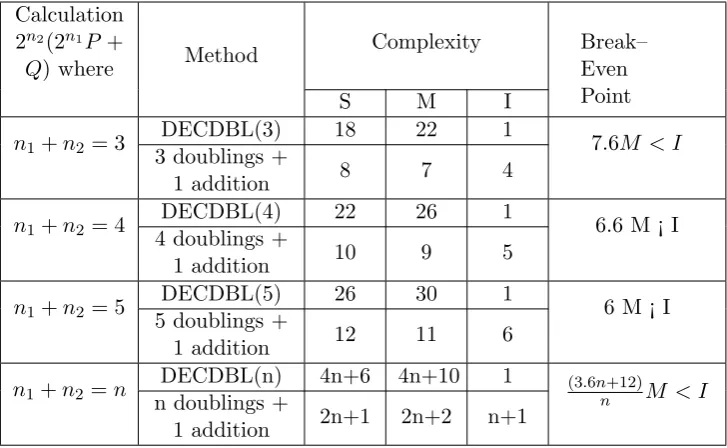
Table 1: Complexity comparison: direct computing of 2n2(2n1P +Q) vs. Individual (n
1+n2) doublings and one addition.
Calculation 2n2(2n1P+
Q) where Method
Complexity Break–
Even Point
S M I
n1+n2 = 3 DECDBL(3) 18 22 1 7.6M < I
3 doublings +
1 addition 8 7 4
n1+n2 = 4
DECDBL(4) 22 26 1
6.6 M ¡ I 4 doublings +
1 addition 10 9 5
n1+n2 = 5
DECDBL(5) 26 30 1
6 M ¡ I 5 doublings +
1 addition 12 11 6
n1+n2 =n DECDBL(n) 4n+6 4n+10 1 (3.6nn+12)M < I
n doublings +
1 addition 2n+1 2n+2 n+1
Ignoring squarings and additions and expressing the Cost function in terms of multiplications and inversions, we have:
(2nM + 2nS +nI + 2M +S+I)>(4(n+ 2)M + 4(n+ 1)S+ 2M + 2S+I).
We definer =I/M (the ratio of speed between a multiplication and inversion), and assume that one squaring has complexity S = 0.8M [12]. We also assume that the cost of field addition and multiplication by small constants can be ignored. One can rewrite the above expressions as:
nrM > (2nM + 8M + 1.6nM + 4M).
Solving for r in terms ofM one obtains:
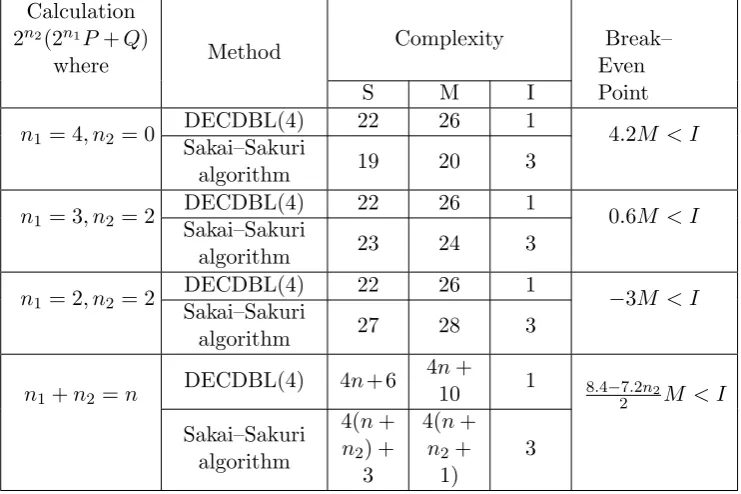
Table 2: Complexity comparison: direct computing of 2n2(2n1P+Q) vs. direct computing of 2n1+n2P and 2n2Q. Calculation
2n2(2n1P+Q)
where Method
Complexity Break–
Even Point
S M I
n1= 4, n2= 0 DECDBL(4) 22 26 1 4.2M < I
Sakai–Sakuri
algorithm 19 20 3
n1= 3, n2= 2
DECDBL(4) 22 26 1
0.6M < I
Sakai–Sakuri
algorithm 23 24 3
n1= 2, n2= 2 DECDBL(4) 22 26 1 −3M < I
Sakai–Sakuri
algorithm 27 28 3
n1+n2 =n
DECDBL(4) 4n+ 6 4n+
10 1 8.4−7.2n2
2 M < I
Sakai–Sakuri algorithm
4(n+
n2) +
3
4(n+
n2+
1)
3
As we see from Table 1, if a field inversion has complexity I > 7.6M, direct computation of 3 doublings and one addition may be more efficient than 3 separate doubling and one addition.
Moreover, our algorithm for direct computing of 2n2(2n1P +Q) can outperform Sakai–Sakuri al-gorithm for computing 2n1+n2P and 2n2Qif: Cost(direct computing of 2n1+n2P and direct computing of 2n2Q and then simply adding the two) > Cost( DECDBL(n
1+n2)).
In case, we ignore squaring and additions and expressing the Cost function in terms of multipli-cations and inversions, we have:
[(4n+ 1)M + (4n+ 1)S+ (4n2 + 1)M + (4n2 + 1)S+ 3I+ 2M +S]>
[4(n+ 2)M + 4(n+ 1)S+ 2M+ 2S+I].
After simplification we can rewrite the above expressions as:
2I >6M + 3S−4n2S−4n2M
Solving for r in terms ofM one obtains:
r >8.4−7.2n2
2 .
As we see from Table 2, if a field inversion has complexity I > 4.2M, direct computation of 4 doublings and one addition by using our algorithm is more efficient than 4 doublings by using Sakai– Sakuri algorithm and then performing one addition. Also, it is clear from the table and the above discussion that DECDBL(n) is different from the Sakai–Sakuri algorithm for computing 2n1+n2P and 2n2Q.2n2(2n1P +Q).
3.3. Exponentiation with direct computation of 2n2(2n1P +Q)
By using our previous formulae for direct computation of 2n2(2n1P +Q), where n
1 >1, and P, Q∈
the step 3.2 of algorithm B.1 [11] with a new step that compute 2n2(2n1P +Q) directly as in the following algorithm.
Algorithm 2Exponentiation with wMOF Using Direct Computation of 2n2(2n1P +Q)
Input: a non–zero t–bit binary string k, P ∈ E(Fp), and the multiple of the point P, γ0···tw and
ξ0···tw, the precomputed table look–up . Output: exponentiation kP.
i←t ; Q←O
while i>0 do
if (ki XOR ki−1) = 0 then
Q←ECDBL(Q)
i←i−1
else
index←((k >>(i−w))&(2w+1−1))−2w−1
if i < w then
Q←2i−(w−ξindex)+1(2(w−ξindexQ+γ
indexP) else
Q←2ξindex(2(w−ξindexQ+γ
indexP)
i←i−1
end if else end if else end While if i= 0 then
Q←ECDBL(Q)
if k0 = 1 then Q←ECADD(Q,−P)
return Q
In algorithm 2, for each window width w of wMOF, Step 3.1 performs direct computation of 2i−(w−ξindex)+1(2(w−ξindexQ+γ
indexP) if (i < w) otherwise Step 3.2 performs direct computations of
2ξindex(2(w−ξindexQ+γ
indexP) if (i>w), whereξindex= 0,1, . . . , w−1,γindexP ={±1,±3, . . . ,±(2w−1−
1)}.
3.4. Complexity analysis of the wMOF method
In this subsection, we perform an analysis of wMOF method when it used in conjunction with the 2n2(2n1P +Q) formulae. In addition, we compare the complexity of wMOF method, with and without formulae. Moreover we derive an expression that predicts the theoretical improvement of the wMOF method by using the formulae, in terms of the ratio between inversion and multiplication times. Theorem 3.2 describes the complexity of algorithm B.1 [11] for computing exponentiation with wMOF.
Theorem 3.2. In terms of affine coordinate, let P ∈ E(Fp), t–digits exponent in wMOF, then the
complexity of algorithm B.1 [11] for computing kP requires on average
(2w+ 4)t w+ 1 M +
(2w+ 3)t w+ 1 S+
(w+ 2)t w+ 1 I,
Proof . We noticed that algorithm B.1 [11] performs an ECADD operation each time the current digit is non–zero, recall from theorem 4[11] that the average non–zero density of wMOF is asymp-totically w1+1 also, one ECDBL operation is performed in each iteration (wherei>0) to double the intermediate result. Then on average, algorithm B.1 [11] for computing exponentiation with wMOF requires
t ECDBL+ t
w+ 1ECADD.
Recall that the computational costs for doubling and additions operations in affine coordinate. Then we can rewrite previous expression as:
(2M+ 2S+I)t+ t
w+ 1(2M +S+I) We can rewrite previous expression in terms ofM, S and I as:
(2w+ 4)t w+ 1 M +
(2w+ 3)t w+ 1 S+
(w+ 2)t w+ 1 I.
Theorem 3.3. In terms of affine coordinate, let P ∈E(Fp), and t–digits exponent in wMOF, then
the complexity of algorithm 1 for computing kP requires on average
4(w+ 3)t w+ 1 M +
4(w+ 2)t w+ 1 S+
2t w+ 1I,
where M, S and I denote multiplication, squaring and inversion respectively.
Proof . Recall from [11, Theorem 4] that for t–digits exponentkin its wMOF, if t→ ∞the average non–zero density of wMOF is asymptotically w1+1 and wMOF of k is infinity.
Long sequence constituted from two types of blocks: 1. b1 = (0), length of this block is 1;
2. b2 = (0i ∗0w−i−1), length of this block isw and 06i6w−1.
Then the number of blockb2 equals w1+1 because every blockb2 has a non–zero bit, and the number
of block b1 equals amount of 0s in wMOF – the amount of 0s in b2 which equals
w
w+1t−(w−1)( 1
w+1)t =
t w+1.
Now, step 3.1 of algorithm 1 performs w1+1t blocks b1 and step 3.2 performs w1+1t block b2 then
algorithm 1 for computing kP requires on average
t
w+1ECDBL+
t
w+1DECDBL(w).
Recall the computational costs for doublings and additions operations in affine coordinate. Then we can rewrite previous expression as:
n
w+ 1(2M + 2S+I+ 4(w+ 2)M + 4(w+ 1)S+ 2M + 2S+I). We can rewrite previous expression in terms ofM, S and I as:
4(w+ 3)t w+ 1 M +
4(w+ 2)t w+ 1 S+
2t w+ 1I.
Relative improvement
Let us denote the times it would take to perform exponentiation by using algorithms B.1 [11] and 1 by symbolsTRegularmethod and TF ormulamethod, respectively. According to theorems B.1[11], and Theorem
3.1, we can derive expressions for the time it would take to perform a whole exponentiation with wMOF as:
TRegular method =
(2w+ 4)t w+ 1 M +
(2w+ 3)t w+ 1 S+
(w+ 2)t
w+ 1 I, (3.14)
TF ormula method=
4(w+ 3)t w+ 1 M +
4(w+ 2)t w+ 1 S+
2t
w+ 1I. (3.15)
From equations (3.14), and (3.15), one can readily derive the relative improvement by defining
r=I/M (the ratio of speed between a multiplication and inversion) as:
Relative Improvement= TRegular method−TF ormula method
TRegular method
. (3.16)
By using (3.14) and (3.15)
Relative Improvement= wI−[(2w+ 8)M + (2w+ 5)S]
(w+ 2)I + [(2w+ 4)M + (2w+ 3)S]. (3.17)
In our implementationS ≈M and r= 12.6, let w= 4, then
Relative Improvementis= 4(r)−29
6(r) + 23, (3.18)
Relative Improvementis = 4(12.6)−29
6(12.6) + 23 ×100 = 21.7%. (3.19)
4. Implementation and results
In this section, we implement our methods and others, which have been given in previous sections to show the actual performance of exponentiation. Implementation of an ECC system has several choices. These include selection of elliptic curve domain parameters, platforms [1].
4.1. Elliptic curves domain parameters and platforms
Generating the domain parameters for elliptic curve is vary time consuming. It consists of a suitably chosen elliptic curveEdefined over a prime finite fieldFp, and a base pointG∈E(Fp). Therefore we select NIST–recommended elliptic curves domain parameters in [10]. We implement 4 elliptic curves over prime fieldsFp, the prime modulo pare of a special type (generalized Mersenne numbers) with
log2p= 160,192,224,256. We call these curves as P160, P192, P224 or 256 respectively. The ECC is implemented on a Pentium 4 personal computer (PC) with 2.0 GHz processor and 512 MB of RAM. Programs were written in Java language for multi–precision integer operations, and are ran under Windows XP.
4.2. Timings analysis of wMOF exponentiation method
Table 3: The ratio of speed between a multiplication and inversion in prime filed Fp.
Curves
Average Timing (msec) for M
Average Timing (msec) for S
Average Timing (msec) for I
r=I/M
P160 7.0 6.9 88.0 12.6
P192 8.7 8.6 108.8 12.5
P224 10 9.8 123.1 12.3
P256 11.9 11.8 145.2 12.2
4.2.1. Optimal window size
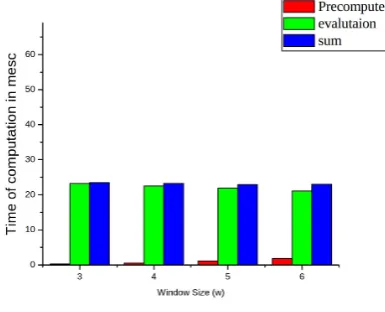
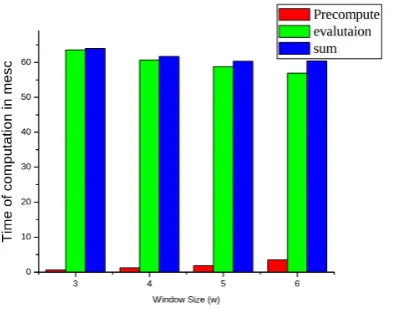
To show the actual improvement of wMOF method with our new formula, we must find out the most efficiency proper window size, where the length of input binary form is 160–bits, 192–bits, 224– bits, or 256–bits. Figures (1– 4) illustrate the relation among the window size w, the speed of the evaluation and pre–computed processes. We can notice from these Figures that when the window size increases, time of the evaluation will decrease, while time of the precomputation will increase, and the optimal w is 4 when the input is 160–bits, and the optimal w is 5 when the inputs is 192, 224 or 256–bits. So all the tests in this paper will be processed for w = 4 in 160–bits input and
w= 5 for 192, 224, or 256–bits.
Figure 1: Pre–compute and evaluation with 160– bits input
Figure 2: Pre–compute and evaluation with 192– bits input
4.2.2. The performance of improved wMOF method
Using Table 3, we can readily predict that the timings for performing a exponentiation with and without the formulae presented in Algorithm 1. In addition, using the complexity shown in equations (3.14, 3.15) and the timings shown in Table 3 we can make estimates as to how long an exponentiation with wMOF will take using both doublings with formulae and individual doublings.
5. Conclusion
In this paper, we constructed efficient algorithm for exponentiation on elliptic curve defined overFp
Figure 3: Pre–compute and evaluation with 224– bits input
Figure 4: Pre–compute and evaluation with 256– bits input
Table 4: Average time comparison required to perform an exponentiation without pre–computations stage of a random point in mesc (Pentium IV 2.0 GHz).
Curves Method Predicted
Timing
Measured Timing
% Improvement Predicted Measured
P 160
wMOF with
formulae (w= 4) 17.4 18.3 21.62 21.8
wMOF (w= 4) 22.2 23.4
P 192
wMOF with
formulae (w= 5 ) 23.8 24.3 25.62 25.7
wMOF (w= 5) 32 32.6
P 224
wMOF with
formulae (w= 5) 31.7 33.9 24.52 24.6
wMOF (w= 5) 42 45
P 256
wMOF with
formulae (w= 5 ) 43.8 47.4 23.5 23.3
wMOF (w= 5) 57.3 61.8
algorithm for computing 2n2(2n1P +Q) is more efficient than Sakai–Sakuri algorithm for computing 2n1+n2P and 2n2Q. A comparison was made based on notation of a “break even point”, which is the cost factor of one inversion relatively to the cost of one multiplication. Moreover, we applied the algorithm to exponentiation on elliptic curve with wMOF and analyze its computational complexity. This algorithm can speed the wMOF exponentiation of elliptic curve of size 160–bit about (21.7%) as a result of its implementation with respect to affine coordinates.
References
[1] M. Brown, D. Hankerson, J. L´opez and A. Menezes, Software implementation of the NIST elliptic curves over prime fields, In: Naccache D. (eds) Topics in Cryptology–CT–RSA 2001. CT–RSA 2001. Lecture Notes in Com-puter Science, vol 2020. Springer, Berlin, Heidelberg.
[3] W. Diffie and M.E. Hellman, New directions in cryptography IEEE Trans. Inf. Theory, 22 (1976) 644–654. [4] J. Guajardo and Ch. Paar, Efficient algorithms for elliptic curve cryptosystems, In: Kaliski B.S. (eds) Advances
in Cryptology–CRYPTO ’97. CRYPTO 1997. Lecture Notes in Computer Science, vol 1294. Springer, Berlin, Heidelberg.
[5] N. Koblitz,Elliptic curve cryptosystems, Math. Comp., 48 (1987) 203–209.
[6] K. Koyama and Y. Tsuruoka. Speeding up elliptic cryptosystems by using a signed binary window method, In: Brickell E.F. (eds) Advances in Cryptology–CRYPTO’ 92. CRYPTO 1992. Lecture Notes in Computer Science, vol 740. Springer, Berlin, Heidelberg.
[7] V.S. Miller. Use of elliptic curves in cryptography, In: Williams H.C. (eds) Advances in Cryptology – CRYPTO ’85 Proceedings. CRYPTO 1985. Lecture Notes in Computer Science, vol 218. Springer, Berlin, Heidelberg. [8] A. Miyaji, T. Ono and H. Cohen,Efficient elliptic curve exponentiation, In: Han Y., Okamoto T., Qing S. (eds)
Information and Communications Security. ICICS 1997. Lecture Notes in Computer Science, vol 1334. Springer, Berlin, Heidelberg.
[9] B. M¨oller. Improved techniques for fast exponentiation, In: Lee P.J., Lim C.H. (eds) Information Security and Cryptology — ICISC 2002. ICISC 2002. Lecture Notes in Computer Science, vol 2587. Springer, Berlin, Heidelberg.
[10] National Institute of Standards and Technology. Digital signature standard (dss). In Pil Joong Lee and Chae Hoon Lim, editors,Information Security and Cryptology-ICISC 2002. FIPS PUB 186-2, 2000.
[11] K. Okeya, K. Schmidt–Samoa, Ch. Spahn and T. Takagi,Signed binary representations revisited, In: Franklin M. (eds) Advances in Cryptology – CRYPTO 2004. CRYPTO 2004. Lecture Notes in Computer Science, vol 3152. Springer, Berlin, Heidelberg.