International Journal of Innovative and Emerging Research in Engineering
Volume 5, Issue 5, 2018
5
Available online at www.ijiere.com
International Journal of Innovative and Emerging
Research in Engineering
e-ISSN: 2394 – 3343 p-ISSN: 2394 – 5494
New Construction Technique – Robotics
Vaishali Shinde1
a, Rutuja Mahamumi2
b, Sayali Kachve3
c, Sayali Patekar4
dabcdStudent 1, Dr. D Y Patil Institute of Technology Pimpri Pune.
ABSTRACT:
This paper describes the working process of robotics on construction site. This paper describes basic concept of robotics application in brickwork used in construction site and operated by skilled labour. Many construction work are done by moving objects i.e. material so use of robotics is helpful. It is very difficult to handle equipment. It is difficult task to material on site. So that use of robotic is beneficial in different situation where labours could not work.
Keywords: construction site, construction work, construction industry, automation and robotics, labour, brickwork.
I. INTRODUCTION
India is the seventh largest country in the world and still its record of major projects is far from satisfactory. The any success or failure of project mainly depends on two factors time and cost, apart from its quality which are the lifelines of every project.It is very difficult task to handle equipment and material on site so, the robotics is beneficial.In difficult situation labours could not work so, we have application of robotics. The construction project’s requires people of different skills, equipment, materials and machinery for every activities. Difficulties faced by the construction industry the two factors safety and quality have been the major factors for the outcome of the construction projects. In Robotics and automation which has been the crux of scientific developments for the last century has been playing a major role in all sectors except construction.
II. METHODOLOGY
2.1 METHOD OF THE STUDY
Information regarding about robot with internally sensed information, and the environment with externally sensed information. By using this information in coexistence with planning algorithms, which can refer back to past experience, the computer develops control over the robot, causing it to move towards the correct execution of the task assigned to it. The main difference between a construction robot and a conventional construction equipment is that the robot is able to react with its environment without a human involvement. However, the publicity surrounding the introduction of robots into construction field exaggerates the true state of the theoretical and practical knowledge of robotics. The technical challenge is considerable because, at present, the characteristics of robot are far from attaining the performance required in an unstructured and dynamic construction field. Large construction companies with an interest on equipment automation have not given a great deal of attention to research in robotics. There are only a few international contractors who have introduced robotics into their field, however, these robots are not capable of detecting the complex information directed to them from the environment. If the number of repetitive operations are very large and the output product is fixed, then it might be economical to implement a fixed automation plant. For example, if a prefabricated plant is planning to build a large (infinite) number of fixed construction products (e.g., prestressed concrete beams) which does not require any change in size or type of material, then a fixed automation may reach a lower unit price than a flexible automated plant. This is due to the large volume of production and a lower variable cost. 72 Considering these sequential stages, the objective of this paper is to describe the feasibility of the last stage ( robotization) in relation with the other stages. In other words , what construction operations should be robotized
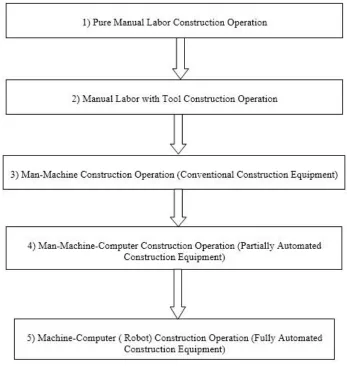
6 Figure. 1. - Sequential Stages in Construction Automation Process
SEQUENTIAL STAGES IN AUTOMATION :
To define an optimum level of automation for a given construction operation, the following five basic classifications as shown in Fig. 1 are developed:
1) Pure manual labor construction operation which involves no tools, e.g., material handling by hand, or packing.
2) Manual labor construction operation with tools, e.g., manual 67 f 1) Pure Manual Labor Construction Operation I 2) Manual Labor with Tool Construction Operation 3) Man-Machine Construction Operation (Conventional Construction Equipment) 4) Man-Computer Construction Operation (Partially Automated Construction Equipment) 5) Machine-Computer ( Robot) Construction Operation (Fully Automated Construction Equipment) Fig. 1. - Sequential Stages in Construction Automation Process 68 excavation with a shovel.
3) Conventional construction equipment , or man-machine operation. These are the construction machines which are controlled by human, e.g., drilling rock by a conventional drill, or excavation by a conventional loader. Most of the construction equipment at the present time are under this classification. Fig. 2 represents a simple graphical model of this stage.
International Journal of Innovative and Emerging Research in Engineering
Volume 5, Issue 5, 2018
7 CASE STUDY
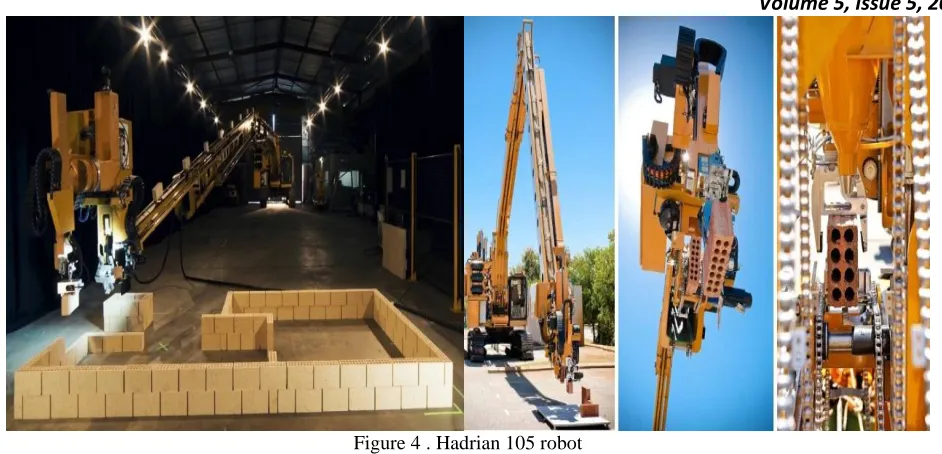
8 Figure 4 . Hadrian 105 robot
Its working process is shown in following :
The robot is 92ft (28 metres) long which is connected to its main body. This robot work that can grab bricks, pick them up, and place them down in sequence. 3D computer-aided design (CAD) is used to design house and structure required and robot calculate where each brick should placed.Mortar is also placed on brick by used of human hand. There should leave some spaces for wiring and plumbing.
International Journal of Innovative and Emerging Research in Engineering
Volume 5, Issue 5, 2018
9 III.CONCLUSIONS
As the above we conclude that the robotics are used in construction sector are best as compare to the labour. Dure to some labour we don’t achieve super quality of work. Because every labour is not a skilled labour but as compare to this robot is doing even work till over all the project completion. And accuracy and quality of the work is best than the labour. And for safety purpose robotics is better because robot is work every day in every time i.e.(24 X7)
REFERENCES
[1] Zavadskas EK. Automation and robotics in construction: International research and achievements. Automation in Construction. 2010; 19(3):286–90.
[2] Maas G, Van GF. automation and robotics on the performance construction. Automation in Construction. 2005; 14(4):435–41.
[3] Slaughter ES. Characteristics of existing construction automation and robotics. 1997; 6(2):109–20.
[4] Warszawski A. Robotics in Building Construction Technical Report R-84-147 Department of Civil Engineering, Carnegie-Mellon University, Pittsburgh, PA.1984; 1–8.
[5] Deodhar SV. Construction equipment and job planning. IN: Planning and Selection of Elattar, S.M.S. Automation and robotics in construction: opportunities and challenges. Emirates Journal for Engineering Research, 2008, Vol. 13 (2), p. 21 – 26.
[6] International Association of Automation and Robotics in Construction, iaarc.org homepage, available at: http://www.iaarc.org, September 2012