SHELL MOULDING PROCESS USING THE COMBINATION OF FAILURE MODE EFFECT
ANALYSIS AND AHP APPROACH
Vaibhav. S. Kamble *1, T. Z Quazi 2
*1Department of Mechanical Engineering, SCOE Navi Mumbai, Mumbai University. 2HOD of Automobile Engineering, SCOE, Navi Mumbai.
*Correspondence Author: [email protected]
Keywords:
FMEA, AHP, RPN, shell moulding process.Abstract
Failure Mode and Effect Analysis (FMEA) is one of the most widely used tool in industries and manufacturing firms, research etc. for improving the reliability of any product in the initial conceptualization phase. The concept of FMEA is extended here to analyze the drawbacks that are encountered in a Manufacturing Company. Studying the various modes of failures and their effect on the production rate, the causes are prioritized and categorized so that the available resources can be allotted to overcome them. Also the work includes the use of another powerful tool, Analytical Hierarchy Process (AHP) that helps in visualizing and determining the priorities of a set of alternatives and the relative importance of an attribute in a Multi-Criteria Decision Making (MCDM). A quantitative and brief evaluation procedure is discussed and the final conclusion based on the actual results and analysis is stated that will be helpful for the future use.
Introduction
At the present, the competition has become increasingly violence in various sectors. So manufacturers need to improve the quality of their product, use existing resources to achieve maximum efficiency, reduce the costs of production and delivery to customers on time. To make the customers confidence in their products and services, if manufacturers are able to maintain such as the properties of products and services, the manufacturers will be able to compete in the global arena. So that, each company has the quality indicators to evaluate the ability of their company, which is most often used as the quality goals and it can be compared to their competitors. The purpose of this work is to decrease the proportion of all problems from the process by applying the Failure Mode & Effects Analysis (FMEA) and Analytical Hierarchy Process (AHP) for shell moulding process.
Shell moulding is a process for producing simple or complex near net shape castings, maintaining tight tolerances and a high degree of dimensional stability. Shell moulding is a method for making high quality castings. These qualities of precision can be obtained in a wider range of alloys and with greater flexibility in design than die-casting and at a lower cost than investment casting. The process was developed and patented by Croning in Germany during World War II and is sometimes referred to as the Croning shell process. The shell mold casting process consists of the following steps-
(1) Pattern creation- A two-piece metal pattern is created in the shape of the desired part, typically from iron or steel. Other materials are sometimes used, such as aluminum for low volume production or graphite for casting reactive materials.
http: // www.gjesrm.com (C) Global Journal of Engineering Science and Research Management
sand-resin mixture to coat the pattern. The heated pattern partially cures the mixture, which now forms a shell around the pattern. Each pattern
Half and surrounding shell is cured to completion in an oven and then the shell is ejected from the pattern.
(3) Mould assembly- The two shell halves are joined together and securely clamped to form the complete shell mold. If any cores are required, they are inserted prior to closing the mold. The shell mold is then placed into a flask and supported by a backing material. (4) Pouring- The mold is securely clamped together while the molten metal is poured from a ladle into the gating system and fills the mold cavity.
(5) Cooling- After the mold has been filled, the molten metal is allowed to cool and solidify into the shape of the final casting. (6) Casting removal- After the molten metal has cooled, the mold can be broken and the casting removed. Trimming and cleaning processes are required to remove any excess metal from the feed system and any sand from the mold.
Problem Identification
In this work the concentration is created on to the shell moulding process. The industry is manufacturing fly wheel for one of the automotive industry. The product is made by using shell moulding process & supplied to customer. The FMEA will be conducted to whole process to identify the rejection rate. The shell moulding process involved so many sub processes such as raw material inspection, storage of the same, shell core making inspection, core finishing & painting & baking, shell sand testing, measurement of shell core tensile strength, Shell core gas determinator, pattern of core inspection, melting & inspection of metal chemical composition, pouring & cooling, breaking of runner & risers, shot blasting & casting dimension inspection. To maintain the high productivity rate throughout these processes is not possible always. Some failures occurred while execution of the processes which affects the production rate e.g. sand drop, rough, cold, swell, shrinkage, blow hole, slag, leak, extra metal, ingate crack, damage (break),shift, core crack, mould crush, scabbing, excess grinding, core lift, core gum, excess parting line etc. While doing case study of this process the major loss occurred near about 7-8% per month, ultimately which affects the quality, productivity & manufacturing cost. So some methods are developed to overcome from such failures. Among the several methods best & easiest method which is selected is FMEA & AHP. By using these tools one can resolve the potential problems occurred throughout the casting processes & discover the solutions with respect to increment of production rate with minimizing the manufacturing cost & quality of product as per the Specifications given by the customer.
OBJECTIVES
The main objective of the work is principally execution of Failure Mode & Effect Analysis for casting industry along with decision making tool of Analytical Hierarchy Process to identity the area from which rejection can be reduces. In other words, FMEA & AHP can be explained as a group of activities intended to:
a) Recognize & evaluate the potential failure of a shell moulding process and its effects b) Identify actions that could eliminate or reduce the chance of potential failures. c) Evaluate the risk priority number by means of the AHP.
d) Implement the better solution derived from the AHP to the system.
LITREATURE REVIEW
http: // www.gjesrm.com (C) Global Journal of Engineering Science and Research Management
product, the preventions suggested in the paper can considerably decrease the loss to the industry in terms of both money and time. Suggestions can easily help to improve the efficiency of the manufacturing processes and can also increase the productivity the casting industry. Swapnil B. Ambekar, Ajinkya Edlabadkar, Vivek Shrouty [7] represent A failure modes and effects analysis (FMEA) is a procedure in product development and operations management for analysis of potential failure modes within a system for classification by the severity and likelihood of the failures. A successful FMEA activity helps a team to identify potential failure modes based on past experience with similar products or processes, enabling the team to design those failures out of the system with the minimum of effort and resource expenditure, thereby reducing development time and costs. Piyush kumar parekh, Trupti v. nandikolmath, and Pravi n Gowda, [11] represented a paper for the FMEA implementation in a foundry industry in Bangalore to improve the quality and reliability. It depicts the description of FMEA methodology and its implementation in foundry in reducing rejection of bushes. It is used as a tool to assure product quality and as a mean to improve operational performance of the process. The work was developed in an Indian foundry in cooperation of part of the internal staff chosen as a FMEA team member and was focused on study of core making process.
METHODOLOGY
The work started by determining the causes of productivity problems at the shell moulding process. This process is important in the analysis system that should find the real cause of the problem. So, it is necessary to choose the right tool to find the relationship between cause and effect that have a direct impact on the process or not. One of the most powerful methods available for measuring the reliability of products or process is FMEA. The basic requirements of the shell moulding process are first studied with design point of view and then the potential failures are found out for all sub processes involved in shell moulding process. After that the potential effects of the failure modes are noted with their severity value and then the potential causes and their prevention are calculated along with their occurrence value. The Detection value was assigned to the failure mode and finally the R.P.N value is calculated. The evaluation of this no. is done by AHP & the system will modified with no. of better solutions. The best & suitable way out applied to the potential failed system as a corrective action. After the taking remedial actions the process efficiency calculated or observed in effect of increase the productivity & minimizes the defective product.
Failure Mode & Effect Analysis
FMEA is a systematic method of identifying and preventing system, product and process problems before they occur. It is focused on preventing problems, enhancing safety, and increasing customer satisfaction. Ideally, FMEA's are conducted in the product design or process development stages, although conducting an FMEA on existing products or processes may also yield benefits. FMEA is a tool that allows us to:
• Prevent System, Product and Process problems before they occur.
• Reduce costs by identifying system, product and process improvements early in the development cycle. • Create more robust processes.
• Prioritize actions that decrease risk of failure.
Steps of Performing FMEA
1. Describe the product or process.
2. Review a block diagram of the product or flow chart of the process. 3. Complete the headers of FMEA table as customized for the specific need.
4. Break down the product or process into its components or steps and list each step or component under the column with the header of "Parts/Components" in the FMEA Table.
5. Identify all potential failure modes associated the product component or process step.
6. List all potential failure modes for each item (product component or process step under the “Failure Mode" column in the FMEA Table.
7. Describe the effects of each of the listed failure modes and assess the severity of each of these effects on the product or process. Assign a severity rating to each effect on the FMEA Table.
8. Identify the possible cause(s) of each failure mode.
9. Quantify the probability of occurrence of each of the causes of a failure mode.
10. Identify all existing controls (Current Controls) that contribute to the prevention of the occurrence of each of the causes of a failure mode.
11. Determine the ability of each of the listed controls in preventing or detecting the failure mode or its cause. Assign a ranking score to indicate the detection effectiveness of each control.
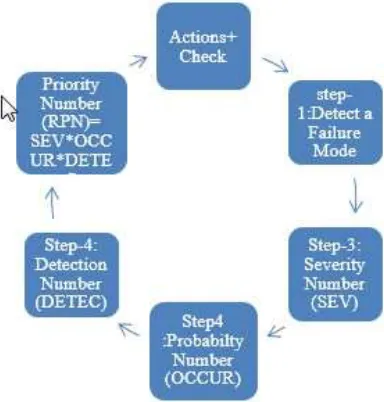
12. Calculate the Risk Priority Number (RPN) = (SEV x OCC x DET). 13. Identify actions to address potential failure modes that have a high RPN
14. Assign an individual responsible for implementation of the defined action(s) and a target date for completion.
15. After the defined actions have been implemented the overall effect on the failure mode that the actions were supposed to address must be re-assessed and a new RPN calculated.
16. The new RPN will help to determine if further action needs to be taken.
http: // www.gjesrm.com (C) Global Journal of Engineering Science and Research Management
Figure 5.1 FMEA Cycle
Implementation Method for FMEA
What statistical data is available from previous or similar process designs? Is the process a repeat of a previous design, or have there been some changes?
Is the process design completely new?
Has the environment in which the process is to operate changeable? Have mathematical or engineering studies been used to predict failure?
A failure mode is given an occurrence ranking (0), again 1-10. Actions need to be determined if the occurrence is high (meaning> 4 for non-safety failure modes and> 1 when the severity number from step 2 is 9 or 10), this step is called the detailed development section of the FMEA process. Occurrence also can be defined as %. If a non-safety issue happened less than 1 %. We can give 1 to it. It is based on your product and customer specification.Detection: Here we have to distinguish between two types of detection. On one hand we have to identify Current Controls (design or process). Current Controls (design or process) are the mechanisms that prevent the cause of the failure mode from occurring or which detect the failure before it reaches the Customer. The engineer should now identify testing, analysis, monitoring, and other techniques that can or have been used on the same or similar products/processes to detect failures. The other thing is to assess the probability that the proposed process controls will detect a potential cause of failure or a process weakness. Assume the failure has occurred and then assess the ability of the Controls to prevent shipment of the part with that defect. Low Occurrence does not mean Low Detection - the Control should detect the Low Occurrence. Each combination from the previous two steps receives a detection number (D). This ranks the ability of planned tests and inspections to remove defects or detect failure modes in time. The assigned detection number measures the risk that the failure will escape detection. A high detection number indicates that the chances are high that the failure will escape detection, or in other words, that the chances of detection are low. Risk Priority Numbers (RPN): The Risk Priority Number is a mathematical product of the numerical severity, Occurrence, and Detection ratings: RPN = (Severity) x (Occurrence) x (Detection) the RPN is used to prioritize items than require additional quality planning or action. Risk priority number (RPN) does not play an important part in the choice of an action against failure modes. They are more threshold values in the evaluation of these actions. After ranking the severity, occurrence and detection, the RPN can be easily calculated by multiplying these three numbers: RPN = S x 0 x D. This has to be done for the entire process and/or design. Once this is done it is easy to determine the areas of greatest concern. The failure modes that have the highest RPN should be given the highest priority for corrective action. This means it is not always the failure modes with the highest severity numbers that should be treated first. There could be less severe failures, but which occur more often and are less detectable. After these values are allocated, recommended actions with targets, responsibility and dates of implementation are noted. These actions can include specific inspection, testing or quality procedures, redesign (such as selection of new components), adding more redundancy and limiting environmental stresses or operating range. Once the actions have been implemented in the design/process, the new RPN should be checked to confirm the improvements. Actions: Determine Recommended Action(s) to address potential failures that have a high RPN. These actions could include specific inspection, testing or quality procedures; selection of different components or materials; de-rating; limiting environmental stresses or operating range; redesign of the item to avoid the failure mode; monitoring mechanisms; performing preventative maintenance; and inclusion of back-up systems or redundancy. After that we have to assign Responsibility and a Target Completion Date for these actions.
Implantation of Analytical Hierarchy Process
http: // www.gjesrm.com (C) Global Journal of Engineering Science and Research Management
importance that would be attached to different influential factors and to structure the complex and multi attribute system matrix. The AHP consists of three basic steps: design of hierarchy, the prioritization procedure and calculation of results. AHP initially breaks down a complex multi-criteria decision making problem into hierarchal structure. The decomposition forms the structure of the decision problem according to main components. The top level of hierarchy, referred to as focus, consists of single element or goal, which is the overall objective. The elements that affect the decision are called attribute or criteria, and are included in the subsequent levels, each of which may have several elements. Attributes are mutually exclusive and their priorities are independent of elements positioned below them in hierarchy. The lowest level of hierarchy is referred to as alternatives, which are decision options (Saaty, 1980).
Once the problem has been decomposed and the hierarchy constructed, the prioritization procedure starts in order to determine the relative importance of the elements within each level. The pair wise judgment starts from the second level (first level of attribute) and finishes in the lowest level alternatives. In each level, the elements are compared pair- wise with each other, according to their levels of influence upon an element position in the immediate higher level. The decision maker must express his/her preference between each pair of elements. Each pair-wise comparison is scored as equally important (1), weakly more important (3), strongly more important (5), very strongly more important (7), and absolutely more important (9) (Saaty 1980; 1982). An even preferential number scoring system can also be used to represent comparison among a pair of attributes. This method of ranking enables the decision maker to incorporate his/her experience and knowledge in an intuitive and natural manner. After forming the preference matrices, the mathematical process commences in order to normalize and find the priority weights for each matrix. The AHP process then determines the consistent nature of the pair wise comparison (i.e. consistency ratio (CR)) for all matrices. If the CR value is larger than 0.10 (which is acceptable upper limit for CR (Saaty, 1982), it implies that there is 10% chance that the elements are not compared well. In this case, the decision maker must review the comparisons again. The mathematical process then starts to integrate the assigned weights in order to develop an overall evaluation process (i.e. the mathematical process to determine the CR values and the corresponding weights for each alternative.) Although the mathematical process of AHP is tedious, the use of expert system makes it simple and accurate to apply.
Summary of Steps for Performing AHP: [4]
Step 1: Setup the decision hierarchy by breaking down the decision problem into a hierarchy of interrelated decision elements.
Step 2: Collect input data by pair wise comparison of decision elements. Use Ranking Scale for Criteria and Alternatives.
Step 3: Use the Eigen value method to estimate the relative weights of decision elements.
Step 4: Check for consistency using the consistency ratio (CR) is ((µ-n)/(n-l))/ACI. µ is the largest positive Eigen value. ACI is the average consistency index of randomly generated weights. According to Saaty, the values for ACI depended on the order (n) of the matrix and are as follows (first row is the order of the matrix; second row is the ACI value).
As a working rule of AHP,
If CR ≥ 10%, the data acquired is inconsistent
If CR < 10%, the data acquired is consistent
The test of consistency result will be very useful in the AHP method. If the test result is inconsistent (CR ≥ 10%), then the result from the AHP method will be of no use in decision making.
Relation between FMEA & AHP
FMEA gives better solution to the process after analysis. The FMEA team' gives the solution as per practical theorems used to conduct the process. The same nos. of solutions validates using the AHP technique. The AHP is having the mathematical approach to find out the appropriate & superior solution. The clarification is sought out from the matrix & Eigenvector. It allows use of qualitative & quantitative criteria in evaluation. Both qualitative and quantitative information can be compared by using informed judgments to derive weights and priorities.
EXPECTED OUTCOMES
In this work, a systematic approach for shell moulding process improvement has been proposed. The methodology operated allowed to analyze every single step of shell moulding process and to achieve an exhaustive knowledge and improvement of product and process and substantial cost savings can be realized. The process improvements can be done by the implementation of FMEA. Analytical Hierarchy Process has been employed to objectively assign weights to evaluation criteria. An AHP validates the outcome from the FMEA. In this way this techniques improve operational performance of the shell moulding process.
References
1. Swapnil B. Ambekar, Ajinkya Edlabadkar, Vivek Shrouty; "A Review: Implementation of Failure Mode and Effect Analysis" ;ISSN: 2277-3754 ISO 9001:2008 Certified International Journal of Engineering and Innovative Technology (IJEIT) Volume 2, Issue 8, February 2013.
2. Thomas L. Saaty; "Decision making with the analytic hierarchy process"; Int. J. Services Sciences, Vol. 1, No.1, 2008. 3. Arun Chauhan, Raj Kamal Malik, Gaurav Sharma, Mukesh Verma: "Performance Evaluation of Casting Industry by
FMEA A Case Study"; ISSN: 2249 - 6564; Vol 02, Issue 02; August-December 2011.
4. T.A. Selvan,C. Jegadheesan, P. Ashoka Varthanan, K. M. Senthilkumar ; "A Novel FMEA approach for ranking Mould Designs in foundries"; Life Sci J 2013; 10(2):51-60 (ISSN: 1097-8135).
5. Allen H. Hu, Chai Hsu, Tsai-Chi Kuo, Wei-chang Wu; “Risk evaluation of green component to hazardous substance using FMEA and FAHP”, Expert system with applications 36 (2009) 7142-7147.
6. B. Ravi, M. M. Akarte, R.C. Creese ; " Casting Process Selection using AHP and Fuzzy Logic"; International Seminar on Manufacturing Technology Beyond 2000, Bangalore, November 1999
http: // www.gjesrm.com (C) Global Journal of Engineering Science and Research Management
8. Parikshit K patel, Prof. Vidya Nair, Ashish Patel; "PFMEA (Product Failure Mode Effect Analysis) of Air-Duct Manufacturing Process to Improve Product Quality"; (ISSN 2250- 2459, ISO 9001:2008 Certified Journal, Volume 3, Issue 5, May 2013).
9. K. Maheswaran, T. Loganathan; "A Novel Approach for Prioritization of Failure modes in FMEA using MCDM"; ISSN: 2248-9622 Vol. 3, Issue 4, pp.733-739, Aug 2013.
10. Prachuab Klomjit and Thanitpol Juntasom."Process Improvement by Using FMEA and AHP at Dyeing Section in the Sample Factory". Symposium of Operations Research 2554. September 2009.
11. Piyush Kumar Pareekl , Trupti V Nandikolmathl and Praveen Gowdal ; "FMEA Implementation in A Foundry In Bangalore To Improve Quality And Reliability";ISSN 2278-0149, Vol. 1, No.2, July 2012
12. A.P More, Dr. R.N. Baxi, Dr. S.B.Jaju; “Review Of Casting Defects Analysis To Initiate The Improvement Process”, Int J Engg Techsci Vol 2(4), Page 292-295, 2011.