Iranian Rehabilitation Journal, Vol. 13, Issue 1, Spring2015
Original Article
The Effect of Working Memory Training on Auditory Stream
Segregation in Auditory Processing Disorders Children
Abdollah Moossavi
Iran University of Medical Sciences, Tehran, Iran
Saiedeh Mehrkian*; Yones Lotfi
University of Social Welfare and Rehabilitation Sciences, Tehran, Iran Soghrat Faghihzadeh
Zanjan University of Medical Sciences, Zanjan, Iran Hamed Sadjedi
Faculty of Engineering, Shahed University, Tehran, Iran
Objectives: This study investigated the efficacy of working memory training for improving working memory capacity and related auditory stream segregation in auditory processing disorders children.
Methods: Fifteen subjects (9-11 years), clinically diagnosed with auditory processing disorder participated in this non-randomized case-controlled trial. Working memory abilities and auditory stream segregation were evaluated prior to beginning and six weeks after completing the training program. Ten control subjects, who did not participate in training program, underwent the same battery of tests at time intervals equivalent to the trained subjects. Differences between the two groups were measured using a repeated measures analysis of variance.
Results: The results of this study indicated children who received auditory working memory training performed significantly better on working memory abilities and auditory stream segregation task than children do not received training program.
Discussion: Results from this case-control study support the benefits of working memory training for children with auditory processing disorders and indicate that training of auditory working memory is especially important for this population.
Keywords: working memory, working memory training, auditory stream segregation, auditory processing disorders
Submitted: 20 December 2014 Accepted: 22 February 2015
Introduction
Auditory processing disorder (APD) is defined as ineffective and/or inefficient use of auditory information by the central auditory nervous system (CANS) and characterized by poor discrimination, separation, grouping, localization, or ordering of sounds (1). APD children have typically difficulties in ‘listening’, particularly in a noisy environment, despite normal peripheral function (1,2). The incidence of APD has been estimated to be as high as 3 to 5 percent and is more common than the incidence of hearing loss (2-4). APD has attracted considerable interest in school-age children, because of suspicions that an impairment in auditory perception can be the underlying cause of many
learning problems, including specific reading and language disabilities (5). According to the American Speech-Language-Hearing, Association (ASHA) technical report, although individuals who have APD exhibit sensory processing deficits that are more pronounced in the auditory modality, but sensory processing in the central nervous system necessarily modulated by concurrent stimulation from other sensory modalities and top-down influences such as working memory (WM), attention and language (1). Thus APD cannot be defined as an exclusively modality-specific perceptual dysfunction because the brain is non-modular.
manipulates them for complex cognitive tasks (6-8) including process involving acoustic percepts from one’s environment (9,10). This system comprises separate stores for verbal (phonological loop) and visual information (visuo-spatial sketchpad) which are controlled by a central executive that has limited attentional capacity and is responsible for the manipulate of information (11,12). The concept of working memory capacity (WMC) becomes important due to a fundamental limitation of the nervous system that is everything cannot be processed at the same time. Thus, it has been proposed we have a limited pool of processing resources (13). The capacity of WM depends on the nature of the manipulation that has to be applied to the information that is held in it (14). Previous studies showed that working memory modulates attention (15) and supports auditory processing and speech recognition in noise.
Children with APD have poor speech perception especially in noisy environments. This may be due to a deficit in auditory stream segregation (16). The ability to segregate a single target, such as a talker, from a group of distracting signals commonly referred to as auditory stream segregation or auditory object formation (17). In the real world, processing a speech stream most often occurs within the context of other simultaneous sound streams, whether on a city street or at the office. Accurate segregation can be impaired in a noisy environment in two ways. First, segregation can be impaired when the cues related to target talker signal is simply overwhelmed by the non-target signal. These cues include temporal, spectral and spatial acoustic properties (bottom-up or primitive cues). Second, segregation can be affected when the non-target signal places a cognitive load on attention and/or working memory (top-down or schema-based cues) (18). Previous researches showed that a relationship exists between WMC and auditory stream segregation ability (19-21). Specifically, auditory stream segregation requires cognitive resources. Therefore, it is reasonable to expect that individuals with larger working memory capacities will perform better on auditory stream segregation tasks.
In the present study, we used the Concurrent Minimum Audible Angle (CMAA) for measuring auditory segregation mediated by the segregation of coincident sound sources on the basis of spatial cues. Because different natural sound sources usually come from different directions in space, the spatial/localization cues have been used very
extensively for the segregation of different talkers (22). Perrott defined the CMAA as the threshold separation angle required to distinguish two concurrent sounds (23). The CMAA is more acute when the sound sources are directly in front of listeners than when the sources are toward the side. According to Perrott the value of CMAAs in adults showed a significant effect of azimuth, with CMAAs of 4°-10° at the front increasing to 30°-45° at a lateral displacement of 67° (23). A large number of studies have investigated the effects of auditory processing training (such as auditory temporal training) on language skills and speech perception but there is a little study investigated top-down skill assessments such as working memory tasks and attention, before and after training (24). Despite the potential importance of working memory for speech perception (auditory processing), there has been no research attempting to modify working memory capacity as a method of improving auditory stream segregation.
The goal of this research is to improve auditory stream segregation by investigating the short-term effects of working memory training on WMC in APD children. To investigate the effects of the training, WMC and auditory stream segregation assessments were performed before and after training and were compared between the trained group and an untrained control group.
Methods
the local ethical committee of the USWR with number 1429.
APD subjects were recruited from audiology clinics of University of Social Welfare and Rehabilitation (USWR). APD Children had a clinical diagnosis of auditory processing disorder according to “Multiple Processing Auditory Assessment” subtests. Clinical diagnoses were established by experienced clinicians on the basis of a careful developmental history and a test battery including the Dichotic Digit test, Pitch pattern sequence test and monoral Selective Auditory Attention Test. In order to relatively homogeneity in APD group, only children who displayed auditory deficits evidenced by poor performance on all three auditory tests were included in the study. This study is a non-randomized observational case-control trials comparing patients before and after-training. Children in the experimental group underwent working memory and auditory segregation tests prior to and after six weeks following completion of the training program. The training group received twelve training sessions (45 minutes session, twice a week) within six weeks following the initial assessments. The control group underwent the same battery of tests at a time interval equivalent to the training program. Then APD children in control group enrolled in training program. Both the phonological loop and the central executive were assessed in order to evaluate working memory capacity. Two most reliable measures of phonological loop and verbal working memory that is widely used in studies are DF and non-word repetition (27). The central executive has been assessed by DB (28-30). DF assesses both attention and short-term memory capacity, whereas DB measures working memory capacity (31). DF and DB were obtained using the digit span subtests of the Wechsler Intelligence Scale for children. In each case, digit span was measured for forward and backward (reverse-order) recall of digit sequences. The validated Persian non-word repetition test was used in this study (32). The test consists of 40 non-words which ranged in length from one to four syllables. Subjects were instructed to repeat the non-word they had just heard. Performance in this task was analyzed by counting the error percent for each non-word length.
In this study auditory stream segregation was assessed by CMAA. A two trail forced-choice procedure was employed in this experiment. Subjects were presented with pairs of tones of
different frequency (500Hz & 800Hz), and asked them to judge the relative location of the pair by indicating whether the higher tone was to the left or right the lower tone, on the right hand side of the subjects. Testing took place using three reference locations on a horizontal plane: 0°, 30° and 60°. For each reference location, 10 test locations were chosen on the basis of preliminary testing. Using a criterion of 75% correct in each test location, we measured CMAAs. Stimuli were generated using MATLAB software (The Math works, Natick, MA) and Sound forge software (v10 by Sonic Foundry) with a sampling rate of 44.1 kHz. Stimuli were presented through earphones, at 50 dB SL.
The training group of ADP children underwent formal top-down auditory training and compared to the non-trained group. To train auditory working memory, we used rehearsal strategy. The training involves overt cumulative rehearsal, in which Children listen to a list of unrelated digits or words (which was presented at different locations in this study). Each time they hear a new digit or word, they repeat the list from the beginning. For example, the trainer begins the list” 5(right)-2(left)” by saying, "5" and points to the proper location (right) on a schematic diagram. The child repeats, "5" and points to the same location. The trainer give the next list item, "2" and points to the left position on the chart. The child repeats, "5 right -2 left". When the child remembers the list in correct order (with a criterion of 3 in a row), the number of items per list increases. During the sessions, if the child is struggling to remember an item, the trainer can give an auditory prompt. The difficulty level of the training program (number of to-be-remembered items) was manually set for each stage and session based on individual performance, to maintain average performance levels of approximately 70% of trials correct. Participants are required to complete 12 sessions over 6 weeks (2 sessions per week), actively training for 45 minutes a day.
Results
The mean scores and standard deviations of auditory stream segregation and working memory abilities for experimental and control group are shown in table (1). The results indicated that CMAA increased as a
function of the laterality of the sources in all children. A paired-sample t-test was conducted to compare working memory tasks in experimental group, before and after training program.
Table 1. Means and SDs of auditory stream segregation and working memory abilities pre- and post-treatment for experimental and control groups.
Pre-training Post-training Behavioral Tests
Training group Non-Training group Training group Non-Training group
Working memory :
Non-word repetition 33.73 ± 2.76 34.1 ± 2.7 36.46 ± 1.5 34 ± 2.5
Digit Span Forward 3.93 ±0.79 4.1 ± 0.73 5.06 ± 0.70 3.9 ± 0.56
Digit Span Backward 2.80 ±0.67 2.9 ± 0.73 3.6 ± 0.50 2.8 ± 0.63
Auditory segregation:
CMAA 0° 17.53 ± 5.38 17.1 ± 5.92 11.4 ± 2.87 16.2 ± 6.77
CMAA 30° 35.50 ± 5.14 36.2 ± 5.03 23.96 ± 4.51 35.35 ± 5.04
CMAA 60° 49.13 ± 5.08 48.2 ± 5.83 43.76 ±5.05 49.70 ± 5.96
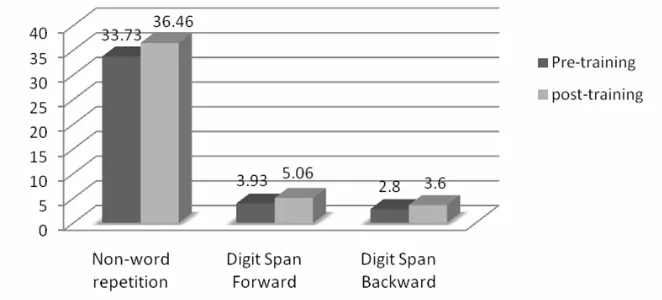
There were significant differences in the scores for non-word repetition, DB and DF before and after training (P<0.001) in experimental group (Fig. 1). The results of paired t-test indicated no significant differences in working memory abilities in control group before and after a time interval equivalent to
the training program (P>0.01). The results of independent sample t-test showed significant differences between experimental and control groups for non-word repetition, DB and DF (P=0.006, P<0.001, P=0.002 respectively) after training.
Fig 1. The mean scores of three working memory abilities in experimental group.
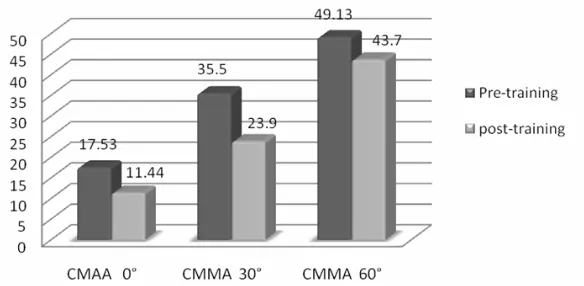
A repeated measure ANOVA was conducted to test intervention effect on auditory stream segregation using by CMAA. The results showed there were significant difference between intervention and control group on CMAA 0°, 30° and 60° over time, F(3,21)=51.12, P<0.001, η2=0.88 . Fig (2) shows means of CMAAs in different positions before and after training in experimental group. The repeated measures ANOVA revealed that the training group
Fig 2. Means of concurrent minimum audible angle before and after training in experimental group.
Discussion
This study investigated the effectiveness of informal top-down auditory training using rehearsal strategy for improvement auditory stream segregation. The trained group showed improvements in working memory capacity skills and auditory stream segregation tasks after training. Previous studies showed that performance in CMAA tasks become poorer in the horizontal dimension as azimuth increases (23,33). This was seen in the present data, where the angle of separation increased at the more lateral positions in APD children. The results of our previous research in normal children (9-10 years) indicated that the mean size of CMAA increased from 13° when the two signals were presented from 0° azimuth to 20° and 45° when they were presented from 30°and 60° azimuth respectively. The finding of this study revealed that APD children had poorer CMAA than age-match normal hearing children. In this study experimental group showed enhanced auditory stream segregation skills as indicated by reduction in CMAA, after auditory working memory training. Conway et al. demonstrated that subjects with high working memory capacity did better on auditory processing task (dichotic listening) than did subjects with low working memory (19). Moossavi et al. showed that working memory capacity had significantly negative correlation with auditory localization tasks in APD children (34). The findings of this study are in line with studies suggested that working memory underlies the auditory processing performance.
The results indicate that the auditory stream segregation can be modified by auditory working memory training. This in turn offers promise for new cognitive-based rehabilitative interventions. Recent models suggest that top-down influences guide plasticity in primary sensory areas. We propose that working memory training first drives cognitive enhancement that, in turn, shapes the nervous system’s response to sound. Working memory is known to be highly associated with language comprehension and recent evidence has shown significant generalization of learning from trained working memory tasks to improvements in sentence-repetition skills. Differences in working memory capacity may explain some of the variability in perception of speech in noise or difficulty environments. This evidence offers support for further investigation into the potential benefits of working memory training to improve speech perception abilities in difficulty situations or noisy environments in auditory processing disorders population.
Acknowledgment
We would like to thank the children who participated in this study and thankful to their families.
This study has been supported by University of Social Welfare and Rehabilitation Sciences.
References
1. American Speech-Language-Hearing, Association. (Central) auditory processing disorders. 2005.
2. Moore DR. The diagnosis and management of auditory
processing disorder. Language, speech, and hearing services in schools. 2011;42(3):303-8.
3. Chermak GD, Musiek FE, Craig CH. Central auditory
processing disorders: New perspectives. San Diego: Singular publishing group 1997.
Audiology. 1998;9(1):78-84.
5. Cacace AT, McFarland DJ. Central Auditory Processing Disorder in School-Aged ChildrenA Critical Review. Journal of Speech, Language, and Hearing Research. 1998;41(2):355-73.
6. Baddeley A. Working memory: looking back and looking forward. Nature Reviews Neuroscience. 2003;4(10):829-39. 7. Baddeley AD, Larsen JD. The phonological loop unmasked?
A comment on the evidence for a perceptual-gestural alternative. The Quarterly Journal of Experimental Psychology. 2007;60(4):497-504.
8. Cowan N. Working memory capacity. East Sussex, UK:
Psychology Press; 2005.
9. Martinkauppi S, Rà m à P, Aronen HJ, Korvenoja A,
Carlson Sv. Working memory of auditory localization. Cerebral Cortex. 2000;10(9):889-98.
10.Ries DT, DiGiovanni JJ. Release from interference in auditory working memory for pitch. Hearing research. 2007;230(1):64-72.
11.Baddeley AD, Hitch GJ. Working memory. The psychology of learning and motivation. 1974;8:47-89.
12.Baddeley AD, Lieberman K. Spatial working memory. East Sussex. UK: Psychology Press; 2006.
13.Kahneman D. Attention and effort. Englewood Cliffs, NJ.: Prentice-Hall Inc; 1973.
14.Conklin HM, Curtis CE, Katsanis J, Iacono WG. Verbal working memory impairment in schizophrenia patients and their first-degree relatives: evidence from the digit span task. American Journal of Psychiatry. 2000;157(2):275-7. 15.De Fockert JW, Rees G, Frith CD, Lavie N. The role of
working memory in visual selective attention. Science. 2001;291(5509):1803-6.
16.Cameron S, Dillon H. Spatial hearing deficits as a major cause of auditory processing disorders: Diagnosis with the LISN-S and management options. A Sound Foundation Through Early Amplification 2007 Proceedings of the Fourth International Conference; Phonak AG, Switzerland 2008. p. 235-41.
17.Bergman A. Auditory scene analysis. The perceptual
organisation of sound. Cambridge, MA: MIT Press; 1990.
18.Kidd Jr G, Arbogast TL, Mason CR, Walsh M.
Informational masking in listeners with sensorineural hearing loss. Journal of the Association for Research in Otolaryngology. 2002;3(2):107-19.
19.Conway ARA, Cowan N, Bunting MF. The cocktail party phenomenon revisited: The importance of working memory capacity. Psychonomic Bulletin & Review. 2001;8(2):331-5. 20.Dalton P, Santangelo V, Spence C. The role of working
memory in auditory selective attention. The Quarterly
Journal of Experimental Psychology. 2009;62(11):2126-32.
21.Engle RW. Working memory capacity as executive
attention. Current directions in psychological science. 2002;11(1):19-23.
22.Bodden M. Auditory demonstrations of a cocktail-party-processor. Acta Acustica united with Acustica. 1996;82(2):356-7.
23.Perrott DR. sConcurrent minimum audible angle: A
real examination of the concept of auditory spatial acuity. The Journal of the Acoustical Society of America. 1984;75(4):1201-6.
24.Murphy CFB, Schochat E. Effects of different types of auditory temporal training on language skills: a systematic review. Clinics. 2013;68(10):1364-70.
25.Oldfield RC. The assessment and analysis of handedness: the Edinburgh inventory. Neuropsychologia. 1971;9(1):97-113.
26.Shahim S. Wechsler’s Revised Intelligence Scale for children/ conformation and normalizing. Shiraz: Shiraz University 2004.
27.Baddeley A, Gathercole S, Papagno C. The phonological loop as a language learning device. Psychological review. 1998;105(1):158.
28.Alloway TP. Automated Working: Memory Assessment:
Manual. UK: Pearson; 2007.
29.Pickering S, Gathercole SE. Working memory test battery for children (WMTB-C). San Antonio, TX: Psychological Corporation; 2001.
30.Wechsler D. Wechsler Intelligence Scale for Children-WISC-IV: Psychological Corporation; 2003.
31.Gathercole SE, Pickering SJ. Working memory deficits in children with low achievements in the national curriculum at 7 years of age. British Journal of Educational Psychology. 2000;70(2):177-94.
32.Moossavi A, Khavargazalani B, Lotfi Y, Mehrkian S, Bakhshi E, Mahmoudi Bakhtiyari B. Validity and reliability non-word repetition test for the evaluation phonological working memory span in Persian speaking children Audiology Journal. 2014;23(4):31-9.
33.Mills AW. Auditory localization(Binaural acoustic field sampling, head movement and echo effect in auditory localization of sound sources position, distance and orientation). Foundations of modern auditory theory. 1972;2:303-48.