[Aleena* 5(9): September, 2018] ISSN 2349-4506
Impact Factor: 3.799
G
lobal
J
ournal of
E
ngineering
S
cience and
R
esearch
M
anagement
HOW INNOVATION SPEED AND QUALITY MEDIATE THE ASSOCIATION
BETWEEN INTELLECTUAL CAPITAL AND FIRM PERFORMANCE OF THE
PHARMACEUTICAL INDUSTRY PAKISTAN
Aleena*, Hamid Habib, Zeeshan Ahmad
*
University of Lahore, Lahore, Pakistan
Hailey College of commerce, university of the Punjab, Pakistan
University of okara, Lahore, Pakistan
DOI: 10.5281/zenodo.3734314
KEYWORDS
:
Intellectual capital, Innovation speed, Innovation quality, Organizational performance.ABSTRACT
In this study, we focused on intellectual capital, innovation speed, innovation quality, organizational culture and organizational performance of the Pharma industry Lahore Pakistan. Unlike previous studies, this study introduced organizational culture as a moderator and innovation speed & quality as a mediator. This model is based on the view of intellectual capital and innovation literature. We used structural equation modeling (SEM) to observe data from 300 managerial level employees of the Pharmaceutical industry. The result of our study indicates the significant impact of two components of intellectual capital namely human capital and relational capital, with organizational performance, while structural capital has a non-significant impact on organizational performance. Innovation speed & quality partially mediates the influence of structural and relational capitals on organization performance, while human capital is not mediated. Organizational culture does not moderate this relationship. This is the first study that finds out the influence of intellectual capital on organizational performance through the mediating role of innovation speed & quality and moderating role of organizational culture. Our study contributes to the literature of human resource management (HRM) and it makes the manger able to manage their human resource management (HRM) strategies to promote intellectual capital while stressing on innovation and performances.
INTRODUCTION
In knowledge-based economies, researchers and practitioners focused on Intellectual capital with repaid growth. It is the main point of firm progress and it is considered more reliable than other tangible resources (Pierre & Audet, 2011; Cai, Liang, Wang, & Xiang, 2018). The literature of intellectual capital is based on an organizational study in developed economies. Many researcher focused these developed economies and determined the intellectual of effective management of intellectual capital with organizational success (Kujansivu & Lönnqvist, 2007; López Sáez & Castro, 2008; Montequín et al., 2006; Pablos, 2004; Pierre & Audet, 2011; Tovstiga & Tulugurova, 2007; Youndt et al., 2004).
Many leading organizations have determined the worth of intellectual capital. They tried to improve and maintain intellectual capital by maintaining human resources(Kang & Snell, 2009; Sullivan, 1998; Z. Wang et al., 2018). However, the literature was insufficient to explain the impact of intellectual capital on organizational performance. Many researchers proposed direct influence of intellectual capital and its components on organizational performance (Ling, 2013; Z. Wang et al., 2018). While some other researcher mistrusts this relation and they ensured that excellent firm performance cannot be achieved only with intellectual capital. This is because many social changes can be unpredictable. Though there is an indirect influence on performance by many intermediate results (Hsu & Wang, 2012; Lan et al., 2013; Z. Wang et al., 2018).The main reason for this contradiction is the different methodology by which the idea of intellectual capital has been operationalized in former research. A few studies support only a single construct of intellectual capital ( Suraj & Bontis, 2012 ; Reed, 2000). Yet many other studies determine the many sub-constructs of it. They determine the different magnitudes of intellectual capital along with its components (Wang et al., 2018, 2014; Yang & Lin, 2009).
[Aleena* 5(9): September, 2018] ISSN 2349-4506
Impact Factor: 3.799
G
lobal
J
ournal of
E
ngineering
S
cience and
R
esearch
M
anagement
of intellectual capital may heterogeneously influence firm performance (Wang et al., 2014). Intellectual capital is the backbone of competitive gains of firms.(Edvinsson & Malone, 1997; Sullivan, 1998). We determined the specific impact of various intellectual capital components on performance. Some researchers suggested that knowledge utilization and capabilities mediate the impact of intellectual capital on organizational progress ( Hsu & Wang, 2012). Some earlier researchers determined not only influence of IC components on firm performance but also they proposed that its components are closely linked with innovation ( Hsu & Wang, 2012; Wu et al., 2008). Moreover, various researchers proposed that innovation will enhance firm performance. (Hsu & Wang, 2012). Consequently, innovation mediates influence of intellectual capital on organizational performance.Particularly innovation includes better products and services to achieve competitive gains( Hsu & Wang, 2012). According to former literature, the knowledge of innovation is influenced by strategies of firms (Castro, 2008). The implementation of technologies also affects innovation (Wu et al., 2008). Innovation has two important features namely speed and quality. These characteristics are closely associated with performance in rapidly developing economies ( Hsu & Wang, 2012). The firm can innovate better and faster. In this way, it will full needed markets to archives corporate goals(Lan et al., 2013; Sullivan, 1998). Moreover, intellectual capital and its components enhance innovation speed significantly. (Lan et al., 2013; Sullivan, 1998).
The literature of intellectual capital reveals the mediating role of innovation speed and quality on association between intellectual capital and organizational performance. Cabrita & Bontis, (2008) recognized organizational culture as an important moderator in the research of intellectual capital. Organizational culture is very important characteristic in intellectual capital management (Rikowski, 2007; Wu et al., 2008). They proposed that multidimensional culture leads to collaboration. Employees of developing countries differ from developed countries in having various values. The approach of intellectual capital and its components is based on RBV. According to its proper management of the firm, resources to make competitive advantages.
Very little attention was paid to these aspects. We made an operational framework to fulfill this research gap. According to this study, innovation speed & quality have a mediating role in firm performance while organizational culture has a moderating role. Then tested the hypothesis empirically using data surveyed from the Pharmacological industry Pakistan. It is playing a remarkable role in the Pakistan economy through its innovative products. However, the Pharmaceutical industry facing a lot of competition from all over the world. To exist and develop in this competitive world Pharmaceutical industry must is used intellectual capital to innovate rapidly. There are three important parameters of this study. Firstly, we find the association of these basic components of intellectual capital with organizational progress. These effects enhance managerial performance. The manager should align their human resource management (HRM) strategy to develop intellectual capital. Secondly, we observed the mediating effect of innovation speed and quality. It mediates the influence of structural and relational capital. Though innovation speed and quality do not mediate this relationship of human capital with firm performance. Third organizational culture moderates the relationship between human capital and innovation. While it does not the moderate association of the other two components of intellectual capital.
LITERATURE REVIEW
[Aleena* 5(9): September, 2018] ISSN 2349-4506
Impact Factor: 3.799
G
lobal
J
ournal of
E
ngineering
S
cience and
R
esearch
M
anagement
At the level of the firm, the former researcher has made the various framework of intellectual capital. For example, knowledge has two dimensions, one is explicit- tacit while another one is individual social criteria. (Spender, 1996), utilized these two dimensions of knowledge to make the background, with four diverse parts of intellectual capital. It comprises human and structural capitals (Edvinsson & Malone, 1997). However later on some researchers determined three basic types of intellectual capital, human, structural and customer capitals (Cabrita & Bontis, 2008). As a consequence of these findings, modern research proposed these three basic modules of intellectual capital namely human ,structural and relational capitals (Bontis et al., 2010; Herremans et al., 2011; Hsu & Fang, 2009).In literature HRM intellectual capital is a major apprehension. Particularly strategies human resource management shows intellectual capital as a basic factor which helps firm to accomplish its goal (Kalkan et al., 2014). Because the IC components are significant for firm performance. So the creation and accumulation of these components are of great significance. These components have attracted the attention of HR managers. These managers select employees and retain employees for valuable human resources to improve firm performance (Aslam & Amin, 2015).
Out of three components of intellectual capital, human capital comprises knowledge, abilities ,talents, wisdom, practice and capability of employees(Bontis et al., 2010). It comprises the knowledge that enables the organization to persist and develop in vigorous surroundings (Bontis et al., 2010). The firm always needs skill experienced to solve a problem and make an effective decision at the proper time. Thus human capital is obligatory to make a new product or improving productivity in addition to quality(Medina et al., 2011). Talented staff and determine various better ways to increase sales revenue and minimize lost revenue. In this way, human capital will enhance firm performance. The firms which focus on the improvement of the enjoy more competitive advantages (Batra, 2009; Medina et al., 2011).
Structural capital remains as intangible resources of the firm. It cannot be isolated even when they're out of their job (Edvinsson & Malone, 1997). It consists of methods of abilities talent and trademark of the company (Karagiannis et al., 2008). It also includes particular approaches to achieve goals. The competitor can hardly compete them. By improving structural capital, firms can better their methodology and work process to achieve high aim goals. It also helps to solve the problem with effectiveness and efficiency. By emphasizing another importance of structural capital. At the start of business, benefits are gain by strengthening the arrangement of knowledge assembly and presentation. This enhances the firm's capability to do the right things in the proper way. In this way, the quality of products will be enhanced and the cost will be lowered. This will lead to firm success(Karagiannis et al., 2008; Kianto et al., 2017). Moreover structural capital encludes unimportant struggles in the process of significance establishment. This helps to get the desired employees' productivity(Phusavat et al., 2011)
Relational capital includes the sharing of knowledge and commitment. The inter-association of the firm with its stakeholders is also included in relational capital (Bontis et al., 2010). The devotion of workers and management is a part of relational capital. It comprises loyalty of employees and the obligation of the valuable customer (Phusavat et al., 2011).Relational capital shares knowledge between the firm and its stakeholders. In this way, it supports a corporation that gives better ways to solve many problems. Relational capital makes a firm able to make a better association between partners and customers. From this experience, a firm can review and optimize its business model ( Handfield, et al., 2006). Moreover, it enables the employees to eradicate preconceptions and prejudice for further improvement and development It also advances the efficiency of works within a special network. It enables the firm to interact with its partners while without relational capital. It is difficult to make an association between the firm and its partners. If we don’t focus on relational capital. It may threaten its knowledge acquisition(Liu et al., 2010). So relational capital will reduce the cost and improve the quality. It will lead to high production and profit(Clercq & Sapienza, 2006; Khalique et al., 2012).
The mediating role of Innovation speed and quality:
[Aleena* 5(9): September, 2018] ISSN 2349-4506
Impact Factor: 3.799
G
lobal
J
ournal of
E
ngineering
S
cience and
R
esearch
M
anagement
Chakrabarti, 1996).To put into short, these dimension of innovation have a great influence on organizational performance.The time gap of the basic concepts of innovation is an advertisement for new products. This time interval is defined by innovation speed( Kessler & Chakrabarti, 1996). It is also important for the same companies which maintain above-average returns. They depend upon the strategy of first-mover advantages (Kessler & Bierly III, 2002). High innovation speed shows the ability of the firm to improve activates and task which depends upon innovation. High innovation speed enables the firm to fulfill the demand of customers so more profit is possible and the market is expanded (Verona, 1999).
This makes firm standard and brand to abstract to competitiveness progress(Shan et al., 2016). By high innovation speed, a firm can determine the influence of various factors in a short time. In this way, innovation improves its products; and better products than its competitors (Kessler & Bierly III, 2002). First is establish early segments in market share and customer loyalty. It also reduces the obsolescence of products. It improves early response and shows superior performance (Leede & Looise, 2005).
Innovation quality includes the ability of a firm to make innovative products and processes. It also includes performance in many other domains of innovation compared to the benchmark (Haner, 2002). We can measure intellectual capital by standardization creativity and logical process(Haner, 2002; Tseng et al., 2013). Collaboration among various individuals, teams, and groups can be achieved by higher innovation quality. Consequently, it improves the quality of management and customer satisfaction(Haner, 2002). Customer satisfaction is an important factor to gain more profit from novel products. The novel product fulfills the needs of the customer through is of better quality. In this firm can gain finical and non-finical benefits. In addition firm with higher innovation quality shows better and effective performance (Tseng et al., 2013).
We supplementary extended the mediating role of innovation speed and quality with influence of IC components on organizational progress. Innovation rely upon the skills information and skill of employees. This shows the association of human capital with innovation.
Organizational innovativeness is affected by the consolidation and accumulation of human capital. For example, innovation speed is improved and the problem is easily solved by human capital (Heirman & Clarysse, 2019; Escudero & Carbonell, 2010). Therefore, it is compulsory for a firm to develop incorporating staff. A firm need to process training by developing human capital. In this way, human capital develops the firms' employee and make them competent and reasonable. They become agile and able to effectively manage the problems. In addition, competent employees work together effectively to develop new ideas rapidly. It enhances innovation speed.
Moreover, competent employees communicate effectively with each other. This factor transfers the hidden knowledge of the employee for research and development. In this way, human capital explores and integrates the knowledge. This integrated knowledge gives critical inputs in the effect of research and development. Consequently high innovation quality is achieved (Bontis, Richardson, & Keow, 2000). This discussion shows that firm performance is influenced by innovation speed and quality. In other words, association of human capital with firm progress is mediated by both innovation speed and quality.
Furthermore, a structural capital comprises a non-human store of knowledge. Value behavior and pattern of business are counted in structural capital (Bontis et al., 2000). It makes basic infrastructure for research. This knowledge helps in business analysis (Kianto et al., 2017). Particularly structural capital reflects knowledge in the organization (Kianto et al., 2017; Youndt et al., 2004). Structural capital is an organizational memory. It provides various standards to avoid confliction. It responds to various fluctuations internal and external of the firm (Kianto et al., 2017; C. Wang et al., 2017).
[Aleena* 5(9): September, 2018] ISSN 2349-4506
Impact Factor: 3.799
G
lobal
J
ournal of
E
ngineering
S
cience and
R
esearch
M
anagement
customer (Costa et al., 2014).In addition structural capital assimilate and transform knowledge. It also results in the development of a supportive culture for innovation. It improves coordination during the research work.In this way, it transfers the wisdom to enhance innovation. Consequently, better structural capital makes the user to resources efficiently. It speeds up innovation speed and quality. This directly accelerates organizational progress .(Tseng et al., 2013). The relationship of structural capital with organizational progress is mediated by innovation speed and quality.Along with full usage of internal resources, it is compulsory for the firm to using technology, information, and abilities from external sources. The use of external stakeholders results in satisfying firm performance. The knowledge from external sources is essential for success because the knowledge from internal sources is inefficient (Chen et al., 2006; Cousins, Lawson, et al., 2006).In this way, relational capital explains the importance of various stakeholders to make high progress. A firm must invest with various stakeholders(Capello & Faggian, 2005; Dewhurst & Cegarra Navarro, 2004).
The effective relation of the firm with external stakeholders makes mutual trust and benefits. These benefits were very important. They certified the transmission of creative thinking by exchanging knowledge(Chen et al., 2009; Kodama, 2005).In sum, a favorable atmosphere for communication is the result of relational capital. It also improves the feedback mechanism. In this way it enables the firm to enhance the research and development process. Moreover, the solidary association of firm and its stakeholders is also the result of relational capital. It involves stakeholders as a supplier. It improves thinking and experimentation(Kianto et al., 2017). Furthermore, innovation and new products are the results of these activities. In sum, this improves organizational progress.
The moderating role of organizational culture:
The study of organizational culture is grounded on the research by Deal and Kennedy (1982) and Peter and Waterman (1982). Organizational culture gives direction to the firm to show progress in business(Barney, 1986). Organizational culture is based on belief behavior from the identity of a firm (Denison & Mishra, 1989). Culture is collectively a program of mind. It differentiates employees of one firm from another (Baron & Pfeffer, 1994; Franke et al., 1991).According to the above discussion organizational culture shoe clear identity to the member of the organization. In (1991) Sackman advanced prospective to focus on shred manning. Organizational culture gives competitive advantages due to its interference from a resource-based view. Due to historical and social conditions, we can't transfer the organizational from one firm to another firm (J. Barney, 1991).Culture moderates the organization's( Child ,1981). The preference based on culture affects the exercise of choice.
Methodology:
We surveyed the Pharmaceutical industry in Punjab, the most developed province in Pakistan, we test in the research model. Our study was based on modern technology in this industry for several reasons. High technology is knowledge-based so these three components of intellectual capital are important to gain economic benefits in the market. By this firm innovate lifecycle of their products with high speed and better quality.
The pharmacological organization in Pakistan makes full use of intellectual capital. So, intellectual capital innovates the products quickly and effectively. Consequently, the pharmaceutical industry in Pakistan provides an appropriate background to find the mediating effect of innovation speed and quality. This context also explains the moderating influence of organizational culture on innovation.
[Aleena* 5(9): September, 2018] ISSN 2349-4506
Impact Factor: 3.799
G
lobal
J
ournal of
E
ngineering
S
cience and
R
esearch
M
anagement
Measurements:
The existing scale in our literature modified the item in our questionnaire. Because literature was written in English so we translate these scale into Urdu. Two expert professor examined the validity of measurement items. The inappropriate items were dropped. In our questionnaire, we analyzed all items on a five-point Likert scale. Human capital was according to(Bontis, 1998; Subramaniam & Youndt, 2005). Structural capital was measure according to (1998) and Wu et al. (2008). A scale is given by Bontis(1998) and Hsu and Fang (2009) provided base for the measurement of relational capital. A technique to measure innovation speed and quilty was improved from Wang and Wang (2012). The measurement of organizational culture was adopted (Liu et al. 2010). Firm performance measurement was according to Wang et al. (2016a, Wang et al., 2016b).
RESULTS
Reliability Analysis:
To find the model of measurement we made confirmatory factor analysis which is based on seven possible constructs. In the table, every construct is given which shows mean, standard deviation and Cronbach’s alpha. By using Cronbach’s alpha we find out internal reliability among the items. The range of these statics is between 0.736 and 0.897. All results are higher than 0.7. This shows satisfaction and reliability.
Table: 1
Mean Standard deviation Cronbach’s alpha
Human capital 3.7900 .61468 0.736
Structural Capital 3.6371 .66353 0.748
Relational Capital 3.7313 .62110 0.868
Innovation speed 3.7260 .64915 0.868
Innovation quality 3.7080 .59816 0.762
Organizational Culture 3.6537 .63232 0.791
Firm Performance 3.7100 .47112 0.803
Correlation matrix:
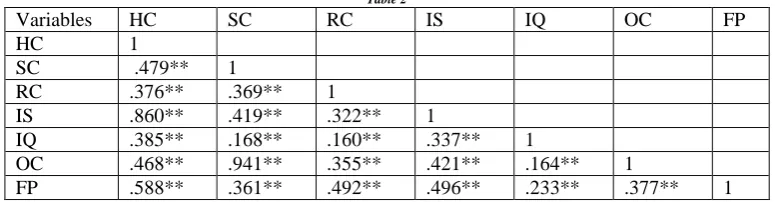
We determined the internal relations among constructs before analyzing regression. The results show that importance correlation exists among variables. When the value exceeds 0.80 multicolinarority may exist. When we analyzed by this value exceeds 0.80 but no multicolinatory exists. After that, all constructs are taken for mediation and regression study.
Table 2
Variables HC SC RC IS IQ OC FP
HC 1
SC .479** 1
RC .376** .369** 1
IS .860** .419** .322** 1
IQ .385** .168** .160** .337** 1
OC .468** .941** .355** .421** .164** 1
FP .588** .361** .492** .496** .233** .377** 1
**. Correlation is significant at the 0.01 level (2-tailed).
Confirmatory factor analysis:
[Aleena* 5(9): September, 2018] ISSN 2349-4506
Impact Factor: 3.799
G
lobal
J
ournal of
E
ngineering
S
cience and
R
esearch
M
anagement
Table: 3The direct impact of Intellectual capital on Firm performance:
We experienced a model based on structure to find out the direct impact of intellectual capital on organizational progress. According to the regression weight table, human capital has a very important impact on organizational performance. The estimated value of 0.640, so we accept the H1. Human capital has an important influence on organizational progress. The result in the regression weight table indicates the estimated value -.038 which is more than 0.05. It shows no important of structural capital on firm performance. So we reject the H2. Due to no important effect on organizational progress. We inspect the direct impact of relational capital on organizational progress. Correspondingly result in estimates 1.434 p-values less than 0.1 so we support H3. Relational capital has a important influence on organizational progress.
Table: 4
Hypotheses Path Estimate P-value Result
H1 HC -FP .640 *** SUPPORTED
H2 SC-FP -.038 .593 NOT SUPPORTED
H3 RC-FP 1.434 .*** SUPPORTED
Mediation Analysis
We used bootstrapping to analyze the mediation. This method is based on the structural equation model SEM with the help of bootstrap. We checked the curriculum of the instrument and estimated the strength (Barbara M. Byrne, 2010). Hypothesis 4a: The association of human capital with organizational progress is mediated by innovation speed. Without mediation direct beta 0.475***, with mediation direct beta is 0.0860***. The indirect influence on mediation is -0.144(ns) so there is no mediating relationship with firm performance. Therefore, this hypothesis is rejected .4b reveals that innovation quality mediates the relationship between human capital and firm performance. Mediation is 0.435***without mediation with beta is 0.385*** so the indirect influence on mediation -0.20(ns). Consequently, human capital does not mediate organizational progress.
Hypothesis 5a: Innovation speed mediates the association between structural capital and organizational performance. Results show that the value of direct beta is 0.132***with mediation, and direct beta with mediation is 0.419***, so indirect influence 0.110***. It represents a partial mediating effect.
Hypothesis 5b: The bond of structural capital with organizational progress is mediated by innovation quality. According to our findings, the value of beta is 0.730***without mediation, and the value of direct beta with mediation is 0.419***, so the value of indirect influence is 0.011***. This value shows that the condition of mediation is satisfied.There is a partial mediation between structural capital and organizational progress.
Hypothesis 6a: Innovation speed has a mediating association between relational capital and organizational progress. The value of direct beta is 0.281***without mediation, direct beta is 0.322*** with mediation and indirect impact is 0.078 ***. This value indicates that the fractional mediation relationship exists between relational capital and firm performance.
Hypothesis6b: Innovation quality has mediated the association between relational capital and organizational performance. The value of direct beta is 0.349*** without the mediation, the value of direct beta is 0.160 ***with mediation and the indirect effect is 0.008***. This value indicates the partial mediation association between relational capital and organizational performance.
Model fitness summary Threshold values
CMIN/DF 1.642 <3
GFI .876 ≥0.8
CFI .901 ≥0.9
RMSEA 0.046 <0.8
[Aleena* 5(9): September, 2018] ISSN 2349-4506
Impact Factor: 3.799
G
lobal
J
ournal of
E
ngineering
S
cience and
R
esearch
M
anagement
Table: 5Hypotheses Direct beta W/O mediation
Direct beta with mediation
Indirect effect Results
HC-IQ-FP .435*** .385*** -.020(ns) No Mediation
HC-IS-FP .475*** .860*** -.144(ns) No Mediation
SC-IQ-FP .230*** .168*** .011*** Partial Mediation
SC-IS-FP .132*** .419*** .110*** Partial Mediation
RC_IQ_FP .349*** .160*** .008*** Partial Mediation
RC_IS_FP .281*** .322*** .078*** Partial Mediation
Moderation analysis:
In this study for checking the moderation analysis, we used SPSS & AMOS. For this analysis, first of all, we calculate the z-value with the help of SPSS. As well as interaction terms of the dependent variable, independent variable and moderating variable.
Table: 6
Our study results show that organizational culture does not play a moderating role between components of intellectual capital and innovation speed & quality.
DISCUSSION
Theoretical contribution:
We determined the effect of intellectual capital components on organizational progress, Human capital, and relational capital have a direct influence on organizational progress. While structural capital doesn't affect organizational performance directly. Our outcomes agree with the arguments by a group of prior investigators that only a few components of intellectual capital have a positive influence on organizational progress (Ribiere & Worasinchai, 2011; Shih et al., 2011).
While other results contradict the finding made by another group of the researcher that all the components of intellectual capital have positive influence firm performance(Sharabati et al., 2013; Z. Wang et al., 2014; Yang & Lin, 2009).However, we determined that different components of intellectual capital have different effects on organizational progress. Particularly all components of intellectual have either direct or indirect impact. When we considered the effect of innovation speed and quality we come to know about no impact of structural capital on organizational performance. While on the other-hand human capital and relational capital have a direct influence on firm performance. These results show that expected firm performance is not guaranteed by Marley emphasizing structural capital In addition human capital and relational capital play an important role to enhance organizational progress. These findings are due to relationship-oriented culture in the Pakistani Pharmaceutical industry. This environment creates, harmony among employees. The organization becomes able to make good relationships with many stakeholders. It provides opportunities to proceeds to business. This needs to high firm performance. Consequently, these results support the literature of intellectual capital by exploring the mechanism of intellectual
Hypotheses Estimate p-value Results
OC- HC-IS -.006 .827 Not supported
OC- HC- IQ -.152 .002 Fully supported
OC- SC- IS .039 .071 Not supported
OC- SC- IQ .000 .993 Not supported
OC- RC- IS .000 .999 Not supported
[Aleena* 5(9): September, 2018] ISSN 2349-4506
Impact Factor: 3.799
G
lobal
J
ournal of
E
ngineering
S
cience and
R
esearch
M
anagement
capital by which it enhances firm performance. These results suggest the components of intellectual capital to which human resources should more devote. In this way, these results support the literature of human resource management (HRM).Secondly, our result declares that innovation speed and quilty have a mediating role in the association between intellectual capital and organizational progress. Many others mediate the impact of intellectual capital on organizational progress (I. Hsu & Sabherwal, 2011; L.-C. Hsu & Wang, 2012; Y.-H. Hsu & Fang, 2009).
However, the purpose of our study is to determine the mediating role of innovation speed and quality. It gives another description to demonstrate the relationship between intellectual capital and organizational progress. Particularly innovation speed & innovation quality partially mediate the influence of structural capital and relational capital on organizational progress. These results improved the existing literature on innovation and human resource management (HRM).
Thirdly innovation was operationalized as a single construct in some prior studies based on the bond between intellectual capital and innovation(Cheng et al., 2010; Musteen & Ahsan, 2013). Innovation speed and quality are the two main dimensions of firm innovation. We mainly focus on these dimensions to show a positive relationship with intellectual capital components. Our study gives a positive relationship between structural capital and relational capital with innovation speed & quilty. Between these two components of intellectual capital structural capital and relational capital is most important to innovation speed and quality.
Practical implication:
Our findings give two significant suggestions for specialists. First managers should improve and retain intellectual capital by advancing staff selection and recruitment because organizational performance depends upon all the modules of intellectual capital(Ruta, 2009; Sparrow & Otaye-Ebede, 2014). The manager should consider the prominence of the impact of intellectual capital. So the need to pay more attention to specific components according to the consequences of performance influenced by business plan .Particularly firm should enhance human capital and relational capital to improve the organizational performance. These suggestions are particularly important for human resource management in the pharmaceutical industry. Their employees may have some special skills and techniques for their work. In this field, it is not a primary concern to enhance structural capital. We should emphasize strategies to strengthen human capital and relational capital.
Secondly, the manager needs to consider the importance of innovation speed and quality in assessing the capabilities of intellectual capital. Particularly organizations need not maintain intellectual capital but also plans for enhancing innovation speed and quality in the strategies of intellectual capital. The capability of intellectual capital for enhancing firm performance will be limited if we ignored innovation speed and quality. The manager should discuss many basic problems for example clarity of goals, project integration, external sourcing and so on ti improve innovation speed and quality (Iqbal et al., 2019; Lu et al., 2014; Z. Wang & Wang, 2012). Notably, these efforts need feedback from several sectors in an organization. These practices of human resource management (HRM) influence innovation by moving obligation (Camelo-Ordaz et al., 2011). Strategic human resource management will create innovation in the product of an organization according to organizational culture(Chen et al., 2006). So manger from various sectors needs work together. It confirms that an inclusive plan on intellectual capital and innovation speed & quality is appropriately establishing.
Limitation and future opportunities:
There is some limitation in our study which provide bases for more research. First, our study was a cross-sectional design to determine the influence of intellectual capital on firm performance. Nevertheless, cross-sectional designed can't find out the interconnection of constructed. Future research should be conducted on a longitudinal study to find out the indistinct pivotal interconnection between intellectual capital and organizational performances.
[Aleena* 5(9): September, 2018] ISSN 2349-4506
Impact Factor: 3.799
G
lobal
J
ournal of
E
ngineering
S
cience and
R
esearch
M
anagement
progress is stronger in this study than others. It is suggested that research in the future should assemble from various other industries to check the legitimacy of our results.Thirdly this research work determined the primary relation of intellectual capital with organizational progress. The manager evaluates the scale items of these constructs instinctively. In future researchers should gain more impartial measurement of firm performance, for instance, return on assets (ROA) and return on equity (ROE) for organizational progress. To conclude our study is based on two mediator innovation speed & innovation quality. However, some appropriate factors, for example, the HR viewpoint may moderate their influence. In future research should explore the moderating influence of some appropriate factors for instance of human resource management strategy (HRM)(Kang & Snell, 2009), knowledge management (Yong et al., 2019)
CONCLUSION
In our study, we made a speculative agenda that shows the innovation speed and quality have mediating roles between intellectual capital components and organizational progress. We tested the hypothesis by studying data assembled from the Pharmaceutical industry in Pakistan. Our finding reveals that two components of intellectual capital, namely structural capital & relational capital have a significant association with innovation speed & quality. This, in turn, contributes to organizational progress. Innovation speed and quality partially mediate the influence of structural and relational capital While organizational culture does not moderate the innovation speed and quality.
REFERENCES
1. Amin, S., Aslam, S., Makki, M., & Abdul, M. (2014). Intellectual Capital and Financial Performance of Pharmaceutical Firms in Pakistan. Pakistan Journal of Social Sciences (PJSS), 34(2).
2. Bano, S., Zhao, Y., Ahmad, A., Wang, S., & Liu, Y. (2018). Identifying the impacts of human capital on carbon emissions in Pakistan. Journal of Cleaner Production, 183, 1082-1092.
3. Bate, P. (1984). The impact of organizational culture on approaches to organizational problem-solving. Organization studies, 5(1), 43-66.
4. Boekestein, B. (2006). The relation between intellectual capital and intangible assets of pharmaceutical companies. Journal of Intellectual Capital, 7(2), 241-253.
5. Bontis, N. (2001). Assessing knowledge assets: a review of the models used to measure intellectual capital. International journal of management reviews, 3(1), 41-60.
6. Cabrita, M. D. R., & Bontis, N. (2008). Intellectual capital and business performance in the Portuguese banking industry. International Journal of Technology Management, 43(1-3), 212-237.
7. Cabrita, M. D. R., & Bontis, N. (2008). Intellectual capital and business performance in the Portuguese banking industry. International Journal of Technology Management, 43(1-3), 212-237.
8. Carrillo, F. J., & Batra, S. (2012). Understanding and measurement: perspectives on the evolution of knowledge-based development. International Journal of Knowledge-Based Development, 3(1), 1-16. 9. Checchi, D. (2006). The economics of education: Human capital, family background and inequality.
Cambridge University Press.
10. Claycomb, C., Dröge, C., & Germain, R. (2002). Applied product quality knowledge and performance. International Journal of Quality & Reliability Management.
11. Comission, A. P. S., & Comission, A. P. S. (2013). Allee (2000) Allee, V.(2000). The value evolution Addressing larger implications of an intellectual capital and intangibles perspective. Journal of Intellectual Capital.
12. De Clercq, D., & Manigart, S. (2007). The venture capital post-investment phase: Opening the black box of involvement. Handbook of research on venture capital, 193218.
13. Denison, D. R., Dutton, J. E., Kahn, J. A., & Hart, S. L. (1996). ORGANIZATIONAL CONTEXT AND THE INTERPRETATION OF STRATEGIC ISSUES: A NOTE ON CEOS’INTERPRETATIONS OF FOREIGN INVESTMENT. Journal of Management Studies, 33(4), 453-474.
14. Feng, R., Wang, Y. C., & Ryan, B. (2018). Service Experiences at Luxury Hotels', Quality Services and Experiences in Hospitality and Tourism (Bridging Tourism Theory and Practice, Volume 9).
[Aleena* 5(9): September, 2018] ISSN 2349-4506
Impact Factor: 3.799
G
lobal
J
ournal of
E
ngineering
S
cience and
R
esearch
M
anagement
17. Graham, J. D. (2012). U.S. Patent No. 8,332,740. Washington, DC: U.S. Patent and Trademark Office. 18. Green, A., & Ryan, J. J. (2005). A framework of intangible valuation areas (FIVA). Journal of
Intellectual Capital.
19. Green, A., & Ryan, J. J. (2005). A framework of intangible valuation areas (FIVA). Journal of Intellectual Capital.
20. Gu, F., & Wang, W. (2005). Intangible assets, information complexity, and analysts’ earnings forecasts. Journal of Business Finance & Accounting, 32(9‐10), 1673-1702.
21. Hormiga, E., Batista-Canino, R. M., & Sánchez-Medina, A. (2011). The role of intellectual capital in the success of new ventures. International Entrepreneurship and Management Journal, 7(1), 71-92. 22. Hsu, L. C., & Wang, C. H. (2012). Clarifying the effect of intellectual capital on performance: the
mediating role of dynamic capability. British Journal of Management, 23(2), 179-205.
23. Hsu, L. C., & Wang, C. H. (2012). Clarifying the effect of intellectual capital on performance: the mediating role of dynamic capability. British Journal of Management, 23(2), 179-205.
24. Hsu, L. C., & Wang, C. H. (2012). Clarifying the effect of intellectual capital on performance: the mediating role of dynamic capability. British Journal of Management, 23(2), 179-205.
25. Hsu, L. C., & Wang, C. H. (2012). Clarifying the effect of intellectual capital on performance: the mediating role of dynamic capability. British Journal of Management, 23(2), 179-205.
26. Hsu, Y. H., & Fang, W. (2009). Intellectual capital and new product development performance: The mediating role of organizational learning capability. Technological Forecasting and Social Change, 76(5), 664-677.
27. Kalkan, A., Bozkurt, Ö. Ç., & Arman, M. (2014). The impacts of intellectual capital, innovation and organizational strategy on firm performance. Procedia-social and behavioral sciences, 150, 700-707. 28. Kang, S. C., & Snell, S. A. (2009). Intellectual capital architectures and ambidextrous learning: a
framework for human resource management. Journal of management studies, 46(1), 65-92.
29. Karagiannis, D., Waldner, F., Stoeger, A., & Nemetz, M. (2008, November). A knowledge management approach for structural capital. In International Conference on Practical Aspects of Knowledge Management (pp. 135-146). Springer, Berlin, Heidelberg.
30. Khalique, M., Bontis, N., Bin Shaari, J. A. N., & Isa, A. H. M. (2015). Intellectual capital in small and medium enterprises in Pakistan. Journal of Intellectual Capital.
31. Khalique, M., Bontis, N., Bin Shaari, J. A. N., & Isa, A. H. M. (2015). Intellectual capital in small and medium enterprises in Pakistan. Journal of Intellectual Capital.
32. Kianto, A., Sáenz, J., & Aramburu, N. (2017). Knowledge-based human resource management practices, intellectual capital and innovation. Journal of Business Research, 81, 11-20.
33. Kianto, A., Sáenz, J., & Aramburu, N. (2017). Knowledge-based human resource management practices, intellectual capital and innovation. Journal of Business Research, 81, 11-20.
34. Kitts, B., Edvinsson, L., & Beding, T. (2001). Intellectual capital: from intangible assets to fitness landscapes. Expert Systems with Applications, 20(1), 35-50.
35. Kitts, B., Edvinsson, L., & Beding, T. (2001). Intellectual capital: from intangible assets to fitness landscapes. Expert Systems with Applications, 20(1), 35-50.
36. Kitts, B., Edvinsson, L., & Beding, T. (2001). Intellectual capital: from intangible assets to fitness landscapes. Expert Systems with Applications, 20(1), 35-50.
37. Kong, E., Secundo, G., Margherita, A., Elia, G., & Passiante, G. (2010). Intangible assets in higher education and research: mission, performance or both?. Journal of intellectual capital.
38. Kotha, S., Rindova, V. P., & Rothaermel, F. T. (2001). Assets and actions: Firm-specific factors in the internationalization of US Internet firms. Journal of International Business Studies, 32(4), 769-791. 39. Kujansivu, P., & Lönnqvist, A. (2007). Investigating the value and efficiency of intellectual
capital. Journal of Intellectual Capital.
40. Liao, P. C., Chan, A. L. C., & Seng, J. L. (2013). Intellectual capital disclosure and accounting standards. Industrial management & data systems.
[Aleena* 5(9): September, 2018] ISSN 2349-4506
Impact Factor: 3.799
G
lobal
J
ournal of
E
ngineering
S
cience and
R
esearch
M
anagement
42. Marr, B., & Spender, J. C. (2004). Measuring knowledge assets–implications of the knowledge economy for performance measurement. Measuring business excellence.
43. Martín-de-Castro, G., Delgado-Verde, M., López-Sáez, P., & Navas-López, JE (2011). Towards 'an intellectual capital-based view of the firm': origins and nature. Journal of business ethics , 98 (4), 649-662.
44. Montequín, V. R., Fernández, F. O., Cabal, V. A., & Gutierrez, N. R. (2006). An integrated framework for intellectual capital measurement and knowledge management implementation in small and medium-sized enterprises. Journal of Information Science, 32(6), 525-538.
45. Phusavat, K., Comepa, N., Sitko‐Lutek, A., & Ooi, K. B. (2011). Interrelationships between intellectual capital and performance. Industrial Management & Data Systems.
46. Rhodes, J., Lok, P., Yang, S., & Bambacas, M. (2009). Resource based view of intangibles on ERP systems implementation and organizational performance in China. Journal of Global Strategic Management, 5(3), 87-96.
47. Rikowski, R. (Ed.). (2007). Knowledge management: Social, cultural and theoretical perspectives. Elsevier.
48. Rikowski, R. (Ed.). (2007). Knowledge management: Social, cultural and theoretical perspectives. Elsevier.
49. Rossetti, C. L., Handfield, R., & Dooley, K. J. (2011). Forces, trends, and decisions in pharmaceutical supply chain management. International Journal of Physical Distribution & Logistics Management. 50. Sánchez-Segura, M. I., Ruiz-Robles, A., & Medina-Dominguez, F. (2016). Uncovering hidden process
assets: A case study. Information Systems Frontiers, 18(6), 1041-1049.
51. St‐Pierre, J., & Audet, J. (2011). Intangible assets and performance. Journal of Intellectual Capital. 52. St‐Pierre, J., & Audet, J. (2011). Intangible assets and performance. Journal of Intellectual Capital. 53. Suraj, O. A., & Bontis, N. (2012). Managing intellectual capital in Nigerian telecommunications
companies. Journal of Intellectual Capital, 13(2), 262-282.
54. Suraj, O. A., & Bontis, N. (2012). Managing intellectual capital in Nigerian telecommunications companies. Journal of Intellectual Capital, 13(2), 262-282.
55. Wang, B., & Wang, Z. (2018). Imported technology and CO2 emission in China: Collecting evidence through bound testing and VECM approach. Renewable and Sustainable Energy Reviews, 82, 4204-4214.
56. Wang, Z., & Wang, N. (2012). Knowledge sharing, innovation and firm performance. Expert systems with applications, 39(10), 8899-8908.
57. Wang, Z., & Wang, N. (2012). Knowledge sharing, innovation and firm performance. Expert systems with applications, 39(10), 8899-8908.
58. Wang, Z., Cai, S., Liang, H., Wang, N., & Xiang, E. (2018). Intellectual capital and firm performance: the mediating role of innovation speed and quality. The International Journal of Human Resource Management, 1-29.
59. Wu, L. C., Ong, C. S., & Hsu, Y. W. (2008). Knowledge-based organization evaluation. Decision support systems, 45(3), 541-549.
60. Wu, L. C., Ong, C. S., & Hsu, Y. W. (2008). Knowledge-based organization evaluation. Decision support systems, 45(3), 541-549.