Author for correspondence:
PG Scholars, Department of Electrical and Electronics Engineering, Nandha Engineering College (Autonomous), Erode.
Volume-5 Issue-4
International Journal of Intellectual Advancements
and Research in Engineering Computations
Smart trolley in mega mall
1J.Tryphena,
*2Mrs.G.Ramani
ABSTRACT
Microcontroller based design, has acquired the status of most happening field in electronics. This is highly specialized field that has the power of integrating thousands of transistors on single silicon chip. Nowadays, in mall for purchasing variety of items it requires trolley. Every time customer has to pull the trolley from rack to rack for collecting items and at the same time customer has to do calculation of those items and need to compare it with his budget in pocket. After this procedure, customer has to wait in queue for billing. So, to avoid headache like pulling trolley, waiting in billing queue, thinking about budget, we are introducing new concept that is “SMART TROLLEY IN MEGA MALL”. For the blind person the special headphones are provided to help them to know the product details. When the blind person takes the product from the track, they are instructed to take the product near to their headphone in which the RFID scanner is inserted in the both headphones. Which scans the product and tell them what product it is and the total amount.
INTRODUCTION
In modern era, for automation of mall we are developing a microcontroller based TROLLEY which is totally automatic. It follows the customer while purchasing items and it maintains safe distance between customer and itself. Only customer has to hold the barcode side of the product wrapper in front of barcode scanner. Then corresponding data regarding product will be displayed on display. By using this trolley, customer can buy large number of product in very less time with less effort. At the billing counter, computer can be easily interfaced for verification and bill print out.
Motivation
Reason behind Choosing Microcontroller Based System: In this paper, we have designed system by using microcontroller, because microcontroller based system are less bulky and also easily transferable. It requires less power. So the system becomes cheap. It requires less space, easy to install, so can fitted easily in the robot.
Benefits to the Customers
This paper has an artificial intelligence of tracking the customer path required. So that, if track has been set then there is no need of manual function. That’s why customer needs less effort to pull trolley. Customer gets on the spot billing facility.
User Friendly and Cost Effective
As this system uses microcontroller, it operate on less power and ire less space, it is user friendly and cost effective.
Generic Approaches (Present Status)
Microcontroller based design, has acquired the status of most happening field in electronics. This is highly specialized field that has the power of integrating thousands of transistors on single silicon chip. Nowadays, in mall for purchasing variety of items it requires trolley. Every time customer has to pull the trolley from rack to rack for collecting items and at the same time customer has to do calculation of those items and need to
compare it with his budget in pocket. After this procedure, customer has to wait in queue for billing. So, to avoid headache like - Pulling trolley, waiting in billing queue, thinking about budget. We are introducing new concept that is “SMART TROLLEY IN MEGA MALL”.
RELATED WORKS
“Understanding the Roles of the Customer
and
the
Operation for
Better Queue
Management"
Queuing, a familiar element of most service delivery systems, has the potential for significantly affecting the customer′s overall satisfaction with the service encounter. A customer′s degree of satisfaction with waiting or with the service received in its entirety is dependent on the actual performance of the delivery system, the customer′s expectations regarding that performance and the customer′s perception of the service encounter. The actual operational performance of different queuing configurations has been previously addressed, as have the issues of managing customers′ expectations and perceptions regarding their queuing experiences. This earlier research has identified several factors which can affect a customer′s perception of waiting and consequently his or her satisfaction with that wait. Proposes a taxonomy based on the service manager′s ability to control the customer′s perception of the queuing experience. Defines which queuing factors can be controlled by the firm, which factors can partially be controlled by the firm and which factors are outside the firm′s control, and suggests tactics for managing queues for each category of factors.
"Waiting for service at the checkout: Negative
emotional responses, store image and overall
satisfaction"
Retailers have installed self-service technologies such as self-checkout that aim to improve the efficiency of checkout operations and minimize customers’ waiting experiences that reduce customer satisfaction. Customers’ expectation for self-checkout should influence their evaluation of checkout operations for existing checkout options when the new service is installed at the checkout. This study investigates how
expectations about self-checkout affects perceptions of waiting in terms of social injustice, unattractiveness, and un distraction as well as customer satisfaction when retailers change checkout operations through installing self-service technologies. The results from an online survey in Japan revealed that social injustice has a stronger negative impact on satisfaction when customers have low expectations for self-checkout. In contrast, unattractiveness and un distraction tend to affect satisfaction negatively when expectation is high. This study clarifies the mechanism of how installing self-service technologies influences customer satisfaction with pre-existing services in terms of the psychological factor of waiting.
“Intelligent Retail Checkout Management
System”
In today's world people do not afford to waste their valuable time with waiting in queues in supermarkets due to their busy lives. Therefore "Intelligent Retail Checkout Management System" will assist in reducing the waiting time of the customers at checkouts at hypermarkets and improve the customer satisfaction. Our objective is to reduce the waiting time of customers by directing them to an appropriate checkout with minimum waiting time which would serve the customers who shop in any quantities. In other circumstances, it allows the provision of better services and the achievement of higher efficiency. This paper focuses and presents the implementation of functions such as people counting, trolley volume detection, queue management, future predictions etc. In this way, Intelligent Retail Checkout Management System will help to provide comfort as well as fairness to customers by allowing them to maintain their position in the queue. The System will not only serve the customer but the supermarket as well by focusing on achieving high utilization with a low queuing delay.
“Shopping Assistance and Information
Providing Integrated in a Robotic Shopping
Cart”
Copyrights © International Journal of Intellectual Advancements and Research in Engineering Computations,
shopping cart system, the information providing is first started to provide directions and recommendations of the shopping mall. In addition, the robotic shopping cart is developed to be autonomous returning to starting position while customers logout from the service screen. Finally, the purchase record of customers can be send to the centralized system of shopping mall for further analysis of various shopping behaviors.
“Queues,
customer
characteristics
and
policies
for
managing
waiting
‐
lines
in
supermarkets”
Shoppers leaving four supermarket outlets (two in one of London’s most prosperous boroughs and two in London’s poorest) were questioned about their attitudes towards having to wait in queues, including express checkout lines. The list of interview questions incorporated items designed to assess whether customers possessed Type A or Type B personality traits. It emerged that although Type A inclination did help explain certain shoppers’ perspectives on waiting‐in‐line, customers’ locations in either a rich or a poor neighborhood and their subjective evaluations of whether their families were better‐off or worse‐off than other families in the area were more influential as determinants of attitudes concerning queues.
“Waiting
time
delays
and
customer
satisfaction in supermarkets”
Describes a laboratory study which tested the effect of customer attributions on customer satisfaction, both with the checker and with the store. Tests were carried out for situations where the perceived waiting time was longer than expected, and for situations where it was shorter than expected. The findings indicated the significant effect of customer attribution. Concludes that customer satisfaction/dissatisfaction is dependent not only on the perceived waiting time, but also on the customer identification of the causes, as well as the stability and control of the causes.
“Compa Rob: The Shopping Cart Assistance
Robot”
Technology has recently been developed which offers an excellent opportunity to design systems with the ability to help people in their own houses. In particular, assisting elderly people in their environments is something that can significantly improve their quality of life. However, helping elderly people outside their usual environment is also necessary, to help them to carry out daily tasks like shopping. In this paper we present a person-following shopping cart assistance robot, capable of helping elderly people to carry products in a supermarket. First of all, the paper presents a survey of related systems that perform this task, using different approaches, such as attachable modules and computer vision. After that, the paper describes in detail the proposed system and its main features. The cart uses ultrasonic sensors and radio signals to provide a simple and effective person localization and following method. Moreover, the cart can be connected to a portable device like a smartphone or tablet, thus providing ease of use to the end user. The prototype has been tested in a grocery store, while simulations have been done to analyse its scalability in larger spaces where multiple robots could coexist.
“Shopping
Center
Tracking
and
Recommendation Systems”
“Analysis of shopping behavior based on
surveillance system”
Closed Circuit Television systems in shopping malls could be used to monitor the shopping behavior of people. From the tracked path, features can be extracted such as the relation with the shopping area, the orientation of the head, speed of walking and direction, pauses which are supposed to be related to the interest of the shopper. Once the interest has been detected the next step is to assess the shopper's positive or negative appreciation to the focused products by analyzing the (non-verbal) behavior of the shopper. Ultimately the system goal is to assess the opportunities for selling, by detecting if a customer needs support. In this paper we present our methodology towards developing such a system consisting of participating observation, designing shopping behavioral models, assessing the associated features and analyzing the underlying technology. In order to validate our observations we made recordings in our shop lab. Next we describe the used tracking technology and the results from experiments.
“Development of smart shopping carts with
customer-oriented service”
This paper presents a preliminary development of the smart shopping cart (SSC) that can be integrated into the smart mall system. The SSC can provide customers with the efficient user interface so that the shopping service can be effectively promoted. In the current design, with the function of face recognition on the user interface, the SSC can recognize the customer and further provide the associated assistive shopping information based on the purchase history. With the use of radio-frequency identification (RFID) tags, the SSC can automatically detect the various products which are being added in the cart and show the related information on the user interface. Through the searching function of SSC, the purchasing efficiency and navigation aid in the mall can be effectively supplied. Finally, the automatic billing
service can be done by the SSC and the stored shopping data will be transmitted to the cloud server of shopping mall. The experimental demonstration shows the effectiveness of the proposed SSC which interacts with the customer and provides efficient shopping service.
RESULT AND ANALYSIS
Proposed system
Microcontroller based design, has acquired the status of most happening field in electronics. This is highly specialized field that has the power of integrating thousands of transistors on single silicon chip. Nowadays, in mall for purchasing variety of items it requires trolley. Every time customer has to pull the trolley from rack to rack for collecting items and at the same time customer has to do calculation of those items and need to compare it with his budget in pocket. After this procedure, customer has to wait in queue for billing. So, to avoid headache like - Pulling trolley, waiting in billing queue, thinking about budget. We are introducing new concept that is “SMART TROLLEY IN MEGA MALL
Copyrights © International Journal of Intellectual Advancements and Research in Engineering Computations, Figure 3.1 Block diagram of proposed system
For the blind person the special headphones are provided to help them to know the product details. When the blind person takes the product from the track, they are instructed to take the product near to their headphone in which the RFID scanner is inserted in the both headphones. Which scans the product and tell them what product it is and the total amount.
Now as we are using distance sensor this is analog sensor that converts distance between customer and trolley to corresponding voltage. This voltage is compared with the reference voltage comparator. According to output level of LM358, trolley runs or stops. In this way, whenever customer walks trolley will follow him. If at any time customer wants to turn or reverse the trolley, remote controlling is available. This is provided in customer’s hand. Whenever customer wants to turn, he just has to press the corresponding button on remote control. According to button pressing, code goes to IC encoder & this encoded data is given to RF transmitter & further transmitted. At receiver side, transmitted data is received by RF receiver &
decoded by using IC decoder & further provided to microcontroller.
Now whenever customer wants to buy a product, he will stop & obviously trolley too. Now whenever customer will take any of the products, then he has to hold the barcode side of that product in front of barcode scanner. Then scanner will scan & corresponding data will be compared with the database which is already stored in the ROM of microcontroller. As we have assigned the specific cost for every barcode, so it will display.
1. Number of items collected 2. Cost of current item 3. Total cost
Figure 3.2 Block Diagram for Smart trolley: Sever side
SIMULATION RESULT
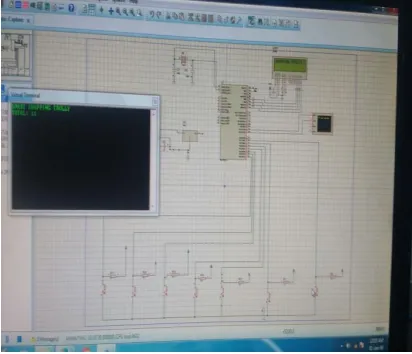
The pic microcontroller is heart of our system. The optical sensor which maintains distance between trolley and customer is connected to port 0 of microcontroller. According to distance between trolley and customer, microcontroller takes decision whether to drive motor or not.
Motor driver circuit is connected to port 2 of microcontroller. In our system, trolley turning, stopping, reversing facility is provided using RF trans-receiver section. Barcode scanner is used for on the spot billing purpose in trolley. RFID SCANNER is connected to
microcontroller at serial port pins using Quantity
mismatch detector is nothing but 38 KHz IR trans-receiver and is connected to port. LCD 16*2 alphanumeric display is used for displaying quantity & costing of products. When the power supply is switched on, system initializes and displays “MALL AUTOMATION”.
For the blind person the special headphones are provided to help them to know the product details. When the blind person takes the product from the track, they are instructed to take the product near to their headphone in which the RFID scanner is inserted in the both headphones. which scans the product and tell them what product it is and the total amount.
Figure 3.3 Transfer process
Copyrights © International Journal of Intellectual Advancements and Research in Engineering Computations,
ADVANTAGES
Advantages
1. There is no need to waste time in billing counter 2. By developing this system there will not be any
difficulty to shop and to forgetting the items they need to buy.
3. In this system customer need not to pull the trolley from rack to rack for collecting the items and at the same time customer need not to do calculation of those items and need not to compare it with his budget in pocket.
CONCLUSION
In Automatic trolley, there is no need to pull heavy trolley, no need to wait in billing queue and
no need of thinking about budget. The microcontroller based trolley automatically follows the customer. Also it maintains safe distance between customer and itself. It gives number of products in trolley and total cost of the products on the spot. It gives facilities like trolley stopping, turning right or left. So, we could successfully implement the concept of Automatic trolley.
This paper develops a robotic shopping cart that aims to effectively serve customers in a shopping mall. The information providing and shopping assistance can be offered in order to increase the satisfied shopping experience and acceptance. This study reveals the promising future of such a robot applied in shopping malls.
REFERENCES
[1]. http://www.semico.com
[2]. http://archive.computerhistory.org/resources/access/text/Or al_History/102658328.05.01.acc. pdf Oral History Panel on the Development and Promotion of the Intel 8048 Microcontroller, Computer History Museum oral history,2008, retrieved 2011, 4
[3]. Microchip unveils PIC16C84, a reprogrammable EEPROM-based 8-bit microcontroller 1993
[4]. The Most Widely Used Computer on a Chip: The TMS 1000. New Haven and New York: Ticknor & Fields. Retrieved 2009, 12-23.
[5]. "Atmel’s Self-Programming Flash Microcontrollers" by Odd Jostein Svendsli 2003.
[6]. Sarma, S, (2002), Towards the 5c Tag, Auto ID Center White Paper, CAMAUTOID-WH01, www.autoidcenter.org.
[7]. BBC, (2003), Supermarket Tries Out Smart Tagging, BBC News, www.bbc.co.uk.
[8]. Hewett, P, Auto ID and Product Life Cycle Management, Master’s Thesis, Manufacturing Engineering Tripos, University of Cambridge 2002.
[9]. ww.schneider electric.com.hk/.../Sympholux_Shopping_Mall_Solu.