https://doi.org/10.26637/MJM0704/0006
Relatively prime dominating polynomial in graphs
C. Jayasekaran
1* and A. Jancy Vini
2Abstract
We introduce the concept of relatively prime domination polynomial of a graphG. The relatively prime domination
polynomial of a graphGof ordern is the polynomialDr pd(G,x) =∑nk=γ
r pd(G)dr pd(G,k)x
kwhered
r pd(G,k)is the
number of relatively prime dominating sets ofGof sizek, andγr pd(G)is the relatively prime domination number
ofG. We compute this polynomial for pathPn, complete bipartite graphKm,n, starK1,n, bistarBm,n, spider graph K1,n,nand Helm graphHn.
Keywords
Dominating polynomial, relatively prime dominating polynomial, relatively prime dominating polynomial roots.
AMS Subject Classification 05C69, 11B83.
1Department of Mathematics, **Pioneer Kumaraswamy College, Nagercoil-629003, Tamil Nadu, India 2Department of Mathematics, **Holy Cross College (Autonomous), Nagercoil-629004, Tamil Nadu, India.
*Corresponding author:1jaya [email protected]; 2[email protected]
**Affiliated to Manonmaniam Sundaranar University, Abishekapatti, Tirunelveli, Tamil Nadu, India.
Article History: Received01July2019; Accepted09September2019 c2019 MJM.
Contents
1 Introduction. . . 643
2 Definition and Examples. . . 644
3 Main Results. . . 644
4 Conclusion. . . 650
References. . . 650
1. Introduction
By a graphG= (V,E)we mean a finite undirected graph without loops and multiple edges. The order and size ofGare denoted bynandmrespectively. For graph theoretical terms, we refer to Harary [5] and for terms related to domination we refer to Haynes [6]. A subset S ofVis said to be a dominating set inGif every vertex inV−S is adjacent to at least one vertex inS. The domination numberγ(G)is the minimum
cardinality of a dominating set inG.
Berge and Ore [2, 13] formulated the concept of domina-tion in graphs. It was further extended to define many other domination related parameters in graphs. LetGbe a non -trivial graph. A setS⊆V is said to be a relatively prime dominating set if it is a dominating set and for every pair of verticesuandvinSsuch that(d(u),d(v)) =1. The mini-mum cardinality of a relatively prime dominating set is called the relatively prime domination number and it is denoted by
γr pd(G)[8]. Switching in graphs was introduced by Lint and Seidel [12]. For a finite undirected graphG(V,E)and a sub-setσ⊆V, the switching ofGbyσ is defined as the graph Gσ(V,E0)which is obtained fromGby removing all edges betweenσ and its complementV−σ and adding as edges all non edges betweenσandV−σ. Forσ={v}, we writeGv instead ofG{v}and the corresponding switching is called as vertex switching [7]. Bistar is the graph obtained by joining the center of two starsK1,mandK1,nwith an edge and it is denoted byBm,n[14]. A spider is a tree with one vertex of degree at least 3, called the center, and all others with degree at most 2 and it is denoted byK1,n,n[4]. A wounded spider is the graph formed by sub dividing at mostn−1 of the edges of a starK1,nforn≥0 [11]. For more details about the basic definitions which is not appear here, we refer to Harrary [5]. Graph polynomials are powerful and well-developed tools to express graph parameters. Saeid Alikhani and Peng, Y. H. [1], have introduced the Domination polynomial of a graph. The Domination polynomial of a graphGof order n is the polynomialD(G,x) =∑ni=γ(G)d(G,i)xi, whered(G,i)is the
number of dominating sets ofGof sizei, andγ(G)is the
2. Definition and Examples
Definition 2.1. Let G= (V,E)be a graph of order n with
relatively prime domination numberγr pd(G). The relatively prime domination polynomial of G is,
Dr pd(G,x) = n
∑
k=γr pd(G)dr pd(G,k)xk
where dr pd(G,k)is the number of relatively prime dominating sets of G of size k andγr pd(G)is the relatively prime domina-tion number of G. The roots of the polynomial Dr pd(G,k)are called the relatively prime dominating roots of G.
Example 2.2. Let G be the graph given in Figure1. Clearly
γr pd(G) =2and there are only two minimum relatively prime dominating sets of size2, namely{v2,v4}and{v3,v5}, three
relatively prime dominating sets of size3, namely{v1,v4,v5}, {v1,v3,v5}and{v1,v2,v4}and two relatively prime
dominat-ing sets of size4, namely{v1,v2,v4,v5} and{v1,v3,v4,v5}.
Hence Dr pd(G,x) =2x2+3x3+2x4=x2(2+3x+2x2).
Figure 1.G
Example 2.3. Consider the graph G=2K2given in Figure
2. Clearlyγr pd(G) =2and there are only four minimum rela-tively prime dominating sets of size2, namely{v1,v3},{v1,v4}, {v2,v3}and{v2,v4}, four relatively prime dominating sets of
size3, namely{v1,v2,v3},{v1,v2,v4},{v2,v3,v4}and{v1,v3,
v4}and one relatively prime dominating set of size4which is {v1,v2,v3,v4}. Hence Dr pd(G,x) =4x2+4x3+x4=x2(4+ 4x+x2). Obviously, there are two relatively prime dominating roots of G which are0and−2.
Figure 2.G=2K2
Theorem 2.4. [8]For a complete bipartite graph Km,n,
γr pd(Km,n) =2if and only if(m,n) =1.
Theorem 2.5. [8]If G1∼=G2, thenγr pd(G1) =γr pd(G2).
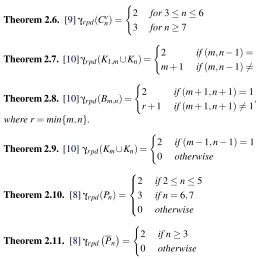
Theorem 2.6. [9]γr pd(Cnv) =
(
2 for3≤n≤6
3 for n≥7
Theorem 2.7. [10]γr pd(K1,m∪Kn) =
(
2 if(m,n−1) =1 m+1 if(m,n−1)6=1
Theorem 2.8. [10]γr pd(Bm,n) =
(
2 if(m+1,n+1) =1 r+1 if(m+1,n+1)6=1, where r=min{m,n}.
Theorem 2.9. [10] γr pd(Km∪Kn) =
(
2 if(m−1,n−1) =1
0 otherwise
Theorem 2.10. [8]γr pd(Pn) =
2 if2≤n≤5
3 if n=6,7 0 otherwise
Theorem 2.11. [8]γr pd Pn=
(
2 if n≥3
0 otherwise
Theorem 2.12. [9]For n≥2,γr pd K
v m,n
=2, where m6=n and m+n is odd.
3. Main Results
Theorem 3.1. If G1∼=G2, then Dr pd(G1,x) =Dr pd(G2,x).
Proof. Let G1∼=G2. Then by Theorem 2. 5, γr pd(G1) =
γr pd(G2). This implies thatDr pd(G1,x) =Dr pd(G2,x).
Theorem 3.2. Dr pd(Pn,x) =
x2 if n=2 3x2+x3 if n=3
3x2+2x3 if n=4 2x2+3x3 if n=5
2x3 if n=6 x3 if n=7
0 otherwise
Proof. Letv1v2...vnbe the pathPn. By Theorem 2.10,γr pd(Pn) has value 2 for 2≤n≤5, 3 forn=6,7 and 0 forn≥8.
We consider the following three cases.
Case 1.2≤n≤5
Clearlyγr pd(Pn) =2. We consider the following four sub-cases.
Subcase 1.1.n=2
set of size 2, namely{v1,v2}and henceDr pd(P2,x) =x2.
Subcase 1.2.n=3
In this case there are three relatively prime dominating sets of size 2, namely{v1,v2},{v1,v3}and{v2,v3}and only one
relatively prime dominating set of size 3, namely{v1,v2,v3}.
This implies that dr pd(P3,2) =3 and dr pd(P3,3) =1 and
henceDr pd(P3,x) =3x2+x3.
Subcase 1.3.n=4
Here there are three relatively prime dominating sets of size 2, namely {v1,v3},{v1,v4}and{v2,v4} and two
rela-tively prime dominating sets of size 3, namely{v1,v2,v4}and {v1,v3,v4}. This implies thatdr pd(P4,2) =3 anddr pd(P4,3) =
2 and henceDr pd(P4,x) =3x2+2x3.
Subcase 1.4.n=5
Here there are two relatively prime dominating sets of size 2, namely{v1,v4}and{v2,v5}and three relatively prime
dominating sets of size 3, namely{v1,v2,v5},{v1,v3,v5}and {v1,v4,v5}. This implies thatdr pd(P5,2) =2 anddr pd(P5,3) =
3. Clearly,dr pd(P5,4) =dr pd(P5,5) =0, since any relatively
prime dominating set of size greater than three must contain at least two vertices of same degree 2. HenceDr pd(P4,x) =
2x2+3x3.
Case 2.n=6,7
Clearly,γr pd(Pn) =3. We consider the following two sub-cases.
Subcase 2.1.n=6
In this case there are two relatively prime dominating sets of size 3, namely{v1,v3,v6}and{v1,v4,v6}and hence
dr pd(P6,3) =2. Clearly,dr pd(P6,4) =dr pd(P6,5) =dr pd(P6,6) =0, since any relatively prime dominating set of size greater than three must contain at least two vertices of same degree 2. HenceDr pd(P6,x) =2x3.
Subcase 2.2.n=7
In this case there is only one relatively prime dominating set of size 3, namely{v1,v4,v7} and hencedr pd(P7,3) =1.
Clearly, dr pd(P7,4) =...=dr pd(P7,7) =0, since any
rela-tively prime dominating set of size greater than three must con-tain at least two vertices of same degree 2. HenceDr pd(P7,x) =
x3.
Case 3.n≥8
In this caseγr pd(Pn) =0 and hencePnhas no relatively prime dominating set. This implies thatDr pd(Pn,x) =0.
The theorem follows from cases 1, 2 and 3.
Theorem 3.3. Dr pd(K1,n,x) =x[(1+x)n−1].
Proof. Let u be the centre and letu1,u2, ...,un be the end vertices ofK1,n=G. ThenV(G) ={u,ui/1≤i≤n} and
E(G) ={uvi/1≤i≤n}. LetA={u}andB={u1,u2, ...,un}.
We know thatγ(K1,n) =1 andγr pd(K1,n) =2. To find the num-ber of minimum relatively prime dominating sets each with size 2, we take the vertexu and one vertex fromB. This
can be done in
n 1
ways and hencedr pd(G,2) =
n 1
. In
a similar way we can prove thatdr pd(G,3) =
n 2
and so
on. HenceDr pd(K1,n,x) =dr pd(G,2)x2+dr pd(G,3)x3+...+
dr pd(G,n)xn=
n 1
x2+
n 2
x3+...+
n n
xn+1=x[(1+
x)n−1].
Theorem 3.4. For m,n≥2,Dr pd(Km,n,x) =mnx2if(m,n) = 1.
Proof. Let(V1,V2)be the bipartition of the vertex set ofKm,n with|V1|=mand|V2|=nand(m,n) =1. By Theorem 2.
4,γr pd(Km,n) =2. There aremnminimum relatively prime dominating sets of size 2. Any dominating set that contains more than two vertices also must contain at least two vertices of same degree and hence dr pd(G,3) =dr pd(G,4) =...= dr pd(G,mn) =0. Therefore,Dr pd(Km,n,x) =mnx2.
Theorem 3.5. Let G be the bistar Bm,n.
(i) If(m+1,n+1) =1,m=1and n6=1, then Dr pd(G,x) =
2x2+
n 0
+2
n 1
x3+
n 1
+
n 2
x4+...
+
n n−1
+
n n
xn+2+
n n
xn+3.
(ii) If(m+1,n+1) =1,n=1and m6=1, then Dr pd(G,x) =
2x2+
m 0
+2
m 1
x3+
m 1
+
m 2
x4+...
+
m m−1
+
m m
xm+2+
m m
xm+3.
(iii) If(m+1,n+1) =1and both m and n not equal to1, then Dr pd(Bm,n,x) =x2[(1+x)m+n]
(iv) If(m+1,n+1)6=1, then Dr pd(Bm,n,x) =xr+1[(1+ x)s], where r=min{m,n},s=max{m,n}and r+s= m+n.
Proof. Letuandvbe the vertices ofP2. Letu1,u2, ...,umbe the vertices attached withuand letv1,v2, ...,vnbe the vertices attached withv. The resultant graphGisBm,nwithV(G) = {u,v,ui,vj},1≤i≤m,1≤j≤nandE(G) ={uv,uui,vvj/1≤ i≤m,1≤j≤n}. Clearly,d(u) =m+1,d(v) =n+1,d(ui) =
1 andd(vj) =1,1≤i≤m,1≤ j≤n. LetA={u,v},B= {u1,u2, ...,um}andC={v1,v2, ...,vn}.
Subcase 1.1.m=1 andn6=1
Then m+1 is even. Since (m+1,n+1) =1,n+1 is odd and hence n is even. Now{u,v} and {u1,v} are the
two relatively prime dominating set of order 2 and hence dr pd(G,2) =2. To find the number of relatively prime domi-nating sets of size 3, we take either two vertices fromAand one vertex from eitherBorCor by selecting the verticesvand u1and a vertex fromC. This can be done inn+1+n=2n+1
ways and hencedr pd(G,3) =2n+1. Similarly,
dr pd(G,4) =n+
n 2
,dr pd(G,5) =
n 2 + n 3 , ...,
dr pd(G,n+2) =
n n−1
+ n n
,dr pd(G,n+3) =
n n
.
Hence Dr pd(Bm,n,x) =
dr pd(G,2)x2+dr pd(G,3)x3+dr pd(G,4)x4+ dr pd(G,5)x5+...+d
r pd(G,n+3)xn+3= 2x2+
n 0 +2 n 1
x3+ n 1 + n 2
x4+...
+
n n−1
+ n n
xn+2+
n n
xn+3.
Subcase 1.2.n=1 andm6=1
As in subcase 1. 1,Dr pd(Bm,n,x) =
2x2+ m 0 +2 m 1
x3+ m 1 + m 2
x4+...
+
m m−1
+ m m
xm+2+
m m
xm+3.
Subcase 1.3.m6=1 andn6=1
By Theorem 2.8, γr pd(Bm,n) =2. Clearly, there is only one minimal relatively prime dominating set of size 2, namely {u,v}. To find the number of relatively prime dominating sets each with size 3, we take two vertices fromAand one vertex
from eitherBorC. This can be done in
m+n 1
ways and
hencedr pd(G,3) =
m+n 1
. By a similar way, we can prove
thatdr pd(G,4) =
m+n 2
and so on. HenceDr pd(Bm,n,x) =
dr pd(G,2)x2+dr pd(G,3)x3+dr pd(G,4)x4+...
+dr pd(G,n)xn=x2+
m+n 1
x3+
m+n 2
x4+...
+
m+n m+n−1
xm+n+1+
m+n m+n
xm+n+2=x2h 1+xm+n
i
.
Case 2.(m+1,n+1)6=1
By Theorem 2. 8,γr pd(Bm,n) =r+1, wherer=min{m,n}. Clearly, there is only one minimal relatively prime domi-nating set of size r+1. To find a relatively prime domi-nating set of size r+2, first we choose the minimal car-dinality set from the sets B andC, the maximum degree
vertex from u and vand a vertex from the maximum
car-dinality set from the setBandC. This can be done in
s 1
ways and hencedr pd(G,r+2) =
s 1
, wherer=min{m,n}
ands=max{m,n}. By a similar way, we can prove that
dr pd(G,r+3) =
s 2
and so on. Hence, Dr pd(Bm,n,x) =
dr pd(G,r+1)x2+dr pd(G,r+2)x3+...+dr pd(G,n)xn=
xr+1+
s 1
xr+2+
s 2
xr+3+...+
s s
xr+s+1=
xr+1
1+xs
wherer=min{m,n},s=max{m,n}andr+s=m+n.
The theorem follows from case 1 and case 2.
Theorem 3.6. Let G be the spider graph K1,n,nwith centre v.
Then,
Dr pd(G,x) =
(
n2xn+ (n+1)xn+1, if d(v)is even n2xn+ (n+1)xn+1+nxn+2, if d(v)is odd.
Proof. Letvbe the center and letv1,v2, ...,vnbe the end
ver-tices ofK1,n. Letu1,u2, ...,unbe the vertices attached with
v1,v2, ...,vn, respectively. The resultant graphGis the spi-der graph withV(G) ={v,vi,uj/1≤i,j≤n} andE(G) = vvi,viuj/1≤i,j≤n. NowdG(v) =n,dG(vi) =2 anddG(uj) = 1,1≤i,j≤n. Clearly,γr pd(G) =γ(G) =n. LetA={v1,v2, ...,
vn−1,vn}andB={u1,u2, ...,un−1,un}.
Case 1.d(v)is even
A minimal relatively prime dominating set of sizenis ob-tained by selecting a vertex from setAandn−1 vertices from
setB. This can be done in
n 1
n n−1
= n 1 n 1 =n2
ways. Therefore,dr pd(G,n) =n2. A relatively prime dom-inating set of sizen+1 is obtained by selecting the setB and any one of the vertex fromA∪ {v}. This can be done inn+1 ways. Therefore, dr pd(G,n+1) =n+1. Clearly, dr pd(G,n+2) =dr pd(G,n+3) =...=dr pd(G,2n+1) =0, since any relatively prime dominating set of size more thann+
1 vertices must contain at least two vertices of even degrees. Therefore,Dr pd(G,x) =dr pd(G,n)xn+dr pd(G,n+1)xn+1= n2xn+ (n+1)xn+1.
Case 2.d(v)is odd
Clearly, dr pd(G,n) =n2. A relatively prime dominat-ing set of sizen+1 is obtained by selecting either the ver-texvand the setBor the vertexv, a vertexvi fromAand the setB− {ui},1≤i≤n. Therefore,dr pd(G,n+1) =n+ 1. A relatively prime dominating set of size n+2 is ob-tained by selecting a vertex fromA, the setBand the vertex
v. This can be done in
n 1
2) =n. Clearly, dr pd(G,n+3) =...=0, since any rela-tively prime dominating set of size more thann+2 vertices must contain at least two vertices of same degree. Hence Dr pd(G,x) =dr pd(G,n)xn+dr pd(G,n+1)xn+1+dr pd(G,n+ 2)xn+2=n2xn+ (n+1)xn+1+nxn+2.
Figure 3.K1,n,n
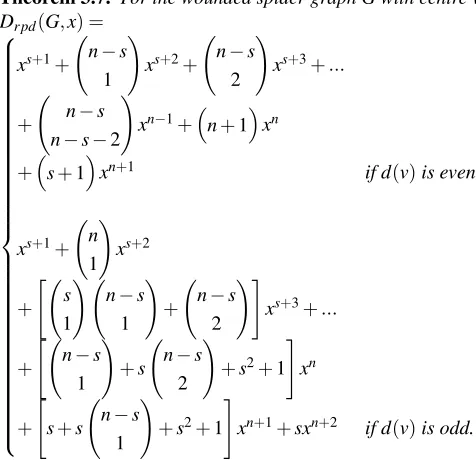
Theorem 3.7. For the wounded spider graph G with centre v,
Dr pd(G,x) =
xs+1+ n−s
1
!
xs+2+ n−s
2
!
xs+3+...
+ n−s
n−s−2
!
xn−1+n+1xn
+s+1xn+1 if d(v)is even
xs+1+ n
1
!
xs+2
+ "
s 1
!
n−s 1
!
+ n−s
2
!#
xs+3+...
+ "
n−s 1
!
+s n−s 2
!
+s2+1
#
xn
+ "
s+s n−s 1
!
+s2+1
#
xn+1+sxn+2 if d(v)is odd.
where s is the number of sub dividing edges of a star and s<n.
Proof. Let v be the centre and let v1,v2, ...,vn be the end vertices ofK1,n. Attachu1,u2, ...,uswithv1,v2, ...,vs, respec-tively wheres<n. The resultant graphGis the wounded spi-der withV(G) ={v,vi,uj/1≤i≤n,1≤ j≤s}andE(G) = {vvi,vjuj/1≤i≤n,1≤j≤s}. Now,dG(v) =n,dG(vi) =2, 1≤i≤n and dG(uj) =1, 1≤ j≤s. Clearly, γr pd(G) =
γ(G) =s+1. LetA={v1,v2, ...,vs,vs+1, ...,vn},B={v1,v2,
...,vs},C={vs+1, ...,vn}, andD={u1,u2, ...,us}.
Case 1.d(v)is even
The only minimal relatively prime dominating set of size s+1 is obtained by selecting the vertex setDand the vertexv. Therefore,dr pd(G,s+1) =1. A relatively prime dominating set of sizes+2 is obtained by selecting the vertex setD, a
ver-tex fromCand the vertexv. This can be done in
n−s 1
ways
and hencedr pd(G,s+2) =
n−s 1
. A relatively prime
dom-inating set of sizes+3 is obtained by selecting the vertex set D, two vertices fromCand the vertexv. This can be done in
n−s 2
ways and hencedr pd(G,s+3) =
n−s 2
. Similarly,
dr pd(G,s+4) =
n−s 3
, ...,dr pd(G,n−1) =
n−s n−s−2
=
n−s 2
. A relatively prime dominating set of size n is
obtained by selecting either the vertexv, the vertex setD and n−(s+1) vertices from C and this can be done in
n−s 1
=n−sways or the vertex setC, a vertexvjfrom
Bands−1 vertices fromD− {uj}and this can be done in sways or the vertex setsCandD. Therefore,dr pd(G,n) = n−s+s+1=n+1. A relatively prime dominating set of sizen+1 is obtained by selecting the vertex setsCandD and the vertex v and the vertex setsCandD, any one of the vertex fromB∪ {v}. This can be done ins+1 ways. There-fore,dr pd(G,n+1) =s+1. Clearly,dr pd(G,n+2) =...= dr pd(G,n+s+1) =0, since any dominating set that contains more thann+1 vertices must contain at least two vertices of same degree. Hence,Dr pd(G,x) =dr pd(G,s+1)xs+1+ dr pd(G,s+2)xs+2+dr pd(G,s+3)xs+3+...+dr pd(G,n)xn+
dr pd(G,n+1)xn+1=xs+1+
n−s 1
xs+2+
n−s 2
xs+3+
...+
n−s n−s−2
xn−1+ (n+1)xn+ (s+1)xn+1.
Case 2.d(v)is odd
The only minimal relatively prime dominating set of size s+1 is obtained by selecting the vertex setDand the ver-tex v. Therefore, dr pd(G,s+1) =1. A relatively prime dominating set of sizes+2 is obtained by selecting the ver-tex setD, the vertexv and a vertex fromA. This can be
done in
n 1
ways. This implies thatdr pd(G,s+2) =
n 1
.
A relatively prime dominating set of sizes+3 is obtained by selecting the vertex setD, the vertexv and either one vertex fromBand one vertex fromCor two vertices from
C. This can be done in
s 1
n−s 1
+
n−s 2
ways and
hencedr pd(G,s+3) =
s 1
n−s 1
+
n−s 2
. A relatively
can be done in
s 1
n−s 2
+
n−s 3
ways and hence
dr pd(G,s+4) =
s 1
n−s 2
+
n−s 3
. Proceeding like
this, we get dr pd(G,s+5) =
s 1
n−s 3
+
n−s 4
. A
relatively prime dominating set of sizenis obtained by se-lecting either the vertex v, the vertex set D and n−(s+
1)vertices fromCwhich can be done in
n−s n−(s+1)
=
n−s 1
ways or the vertex v, the vertex set D, a vertex
fromBandn−(s+2)vertices fromCwhich can be done in
s 1
n−s n−(s+2)
=s
n−s 2
ways or the vertex setC, a
vertex fromBands−1 vertices fromDand this can be done
in
s 1
s s−1
=s2ways or the vertex setsCandD.
There-fore,dr pd(G,n) =
n−s 1
+s
n−s 2
+s2+1. A relatively
prime dominating set of sizen+1 is obtained by selecting either the vertex setsC andDand the vertexvor the ver-tex setsCandDand one vertex fromBwhich can be done
in
s 1
=sways or the vertexv, the vertex setD, a vertex
fromB andn−(s+1)vertices fromCand which can be
done in
s 1
n−s n−(s+1)
=s
n−s 1
ways or the vertex
v, the vertex setC, a vertex fromBands−1 vertices fromD
and this can be done in
s 1
s s−1
=s2ways. Therefore,
dr pd(G,n+1) =s+s
n−s 1
+s2+1. A relatively prime
dominating set of sizen+2 is obtained by selecting the vertex setsCandDand one vertex fromBand the vertexv. This can be done insways. Therefore,dr pd(G,n+2) =s. Clearly, dr pd(G,n+3) =...=dr pd(G,n+s+1) =0, since any domi-nating set that contains more thann+2 vertices must contain at least two vertices of same degree. Hence,Dr pd(G,x) = dr pd(G,s+1)xs+1+dr pd(G,s+2)xs+2+
dr pd(G,s+3)xs+3+...+d
r pd(G,n)xn+ dr pd(G,n+1)xn+1+dr pd(G,n+2)xn+2=
xs+1+
n 1
xs+2+
s 1
n−s 1
+
n−s 2
xs+3+...
+
n−s 1
+s
n−s 2
+s2+1
xn
+
s+s
n−s 1
+s2+1
xn+1+sxn+2.
The theorem follows from cases 1 and 2.
Theorem 3.8. Let G=K1,m∪Kn.
(i) If(m,n−1) =1, then Dr pd(G,x) =n∑mi=0mCixi+2.
(ii) If(m,n−1)6=1, then Dr pd(G,x) =nxm+1.
Proof. Letube the central vertex andvi,1≤i≤mbe the end vertices ofK1,m. Letu1,u2, ...,unbe the vertices ofKn. Let
A={vi/1≤i≤m}andB={uj/1≤j≤n.
Case 1.(m,n−1) =1
By Theorem 2. 7, γr pd(K1,m∪Kn) =2. There are n ways to choose a minimal relatively prime dominating set of size 2 by choosing the central vertex ofK1,nand a ver-tex from Kn. Hence dr pd(G,2) =n. A relatively prime dominating set of size 3 is obtained by selecting the cen-tral vertex u, a vertex from A and vertex from B. There
are
m 1
ways to choose a vertex fromAand
n 1
ways
to choose a vertex fromB. This implies that number of
rel-atively prime dominating set each of size 3 is
n 1 m 1
. Hencedr pd(G,3) =n
m 1
. Since we can’t choose two
vertices fromB, the number of relatively prime dominating
set of size 4 isn
m 2
and hencedr pd(G,4) =n
m 2
.
Con-tinuing this, we see thatdr pd(G,m+2) =n
m m
. Clearly,
dr pd(G,m+3) =dr pd(G,m+4) =...=0, since there do not exist relatively prime dominating sets of sizek≥m+3. Hence Dr pd(G,x) =
dr pd(G,2)x2+dr pd(G,3)x3+dr pd(G,4)x4+...
+dr pd(G,m+2)xm+2=nx2+n
m 1
x3+n
m 2
x4+...
+n
m m
xm+2=n
∑mi=0mCixi+2.
Case 2.(m,n−1)6=1
By Theorem 2. 7,γr pd(G) =m+1. A minimal relatively prime dominating set is obtained by choosingmvertices from Aand a vertex fromB. The m vertices fromAcan be cho-sen in one way and a vertex from Bcan be selected in n ways. Therefore, the number of ways of choosing minimal relatively prime dominating set of sizem+1 isn. Clearly dr pd(G,m+2) =dr pd(G,m+3) =...=0, since there do not exist relatively prime dominating sets of sizek≥m+2. Hence Dr pd(G,x) =dr pd(G,m+1)xm+1=nxm+1.
The theorem follows from cases 1 and 2.
Theorem 3.9. Let G=Km∪Knwhere m,n≥2. Then,
Dr pd(G,x) =mnx2if(m−1,n−1) =1.
so on. Therefore,dr pd(G,3) =dr pd(G,4) =...=0. Hence, Dr pd((Km∪Kn),x) =mnx2.
Result 3.10. For n≥2,Dr pd(Km,n,x) =mnx2if(m−1,n− 1) =1.
Proof. Clearly,Km,n=Km∪Kn. By Theorem 3. 9,Dr pd(Km,n,x)
=mnx2if(m−1,n−1) =1.
Result 3.11. Dr pd(P3,x) =2x2+x3.
Proof. ClearlyP3=K1∪K2, whereK1isuandv,ware the
vertices ofK2. Hence there are only two relatively prime
dominating sets of size 2, namely{u,v}and{u,w}and only one relatively prime dominating set of size 3, namely{u,v,w}. This implies thatdr pd(G,2) =2 anddr pd(G,3) =1. Hence Dr pd(P3,x) =2x2+x3.
Result 3.12. Dr pd(P4,x) =3x2+2x3.
Proof. ClearlyP4∼=P4and hence by Theorem 3. 2,
Dr pd(P4,x) =3x2+2x3.
Theorem 3.13. For a path Pn where n≥5,Dr pd(Pn,x) =
2(n−3)x2.
Proof. Let v1v2...vn be the pathPn. LetA={v1,vn} and B={v2,v3, ...,vn−1}. By Theorem 2.11,γr pd(Pn) =2. A rel-atively prime dominating sets of size 2 is obtained by selecting v1fromAand a vertex fromB− {v3}or by selectingvnfrom
Aand a vertex fromB− {vn−2}this can be done in 2(n−3)
ways and hencedr pd(G,2) =2(n−3). Any dominating set that contains more than two vertices must contain at least two vertices of same degree. This implies thatdr pd(G,3) =...=0. HenceDr pd(Pn,x) =dr pd(G,2)x2=2(n−3)x2.
Theorem 3.14. Let G=Kn◦K1. Then Dr pd(G,x) =xn(n+
1+x).
Proof. Letu1,u2, ...,unbe the vertices ofKnand letvibe the vertex ofithcopy ofK1,1≤i≤n. Joinui withvi,1≤i≤ n. LetA={u1,u2, ...,un} andB={v1,v2, ...,vn}. Clearly,
γr pd(G) =n. A relatively prime dominating set of size n is obtained by selecting either a vertexui fromAandn−1 vertices fromB− {vi},1≤i≤nand this can be done inn ways or select all the vertices ofB. Therefore,dr pd(G,n) = n+1. A relatively prime dominating set of size n+1 is obtained by selecting a vertex fromAand all the vertices of B. This can be done innways. Therefore,dr pd(G,n+1) =n. Any relatively prime dominating set with more thann+1 vertices must contain at least two vertices of same degree. Therefore,dr pd(G,n+2) =dr pd(G,n+3) =...=0. Hence, Dr pd(G,x) =dr pd(G,n)xn+d
r pd(G,n+1)xn+1= (n+1)xn+ nxn+1=xn(n+1+x).
Theorem 3.15. For the star K1,nwhere n≥2is even,
Dr pd(K1v,n,x) =2(n−1)x2, if v is an end vertex of K1,n.
Proof. Clearly,K1v,n∼=K2,n−1. By Theorem 2. 4,γr pd(K2,n−1) =2 if and only if(2,n−1) =1. This implies thatn−16=
2r. Therefore, n6=2r+1 and hence n is even. Clearly
(2,n−1) =1. By Theorems 3. 1 and 3. 4,Dr pd(K1v,n,x) = Dr pd(K2,n−1,x) =2(n−1)x2.
Theorem 3.16. Let G=Km,n◦K1. Then Dr pd(G,x) = (m+
n+1)xm+n+ (m+n)xm+n+1.
Proof. Let(V1,V2)be the bipartition of the vertex set ofKm,n with|V1|=mand|v2|=n. By Theorem 2. 4,γr pd(Km,n) =2. LetV1={u1,u2, ...,um},V2={v1,v2, ...,vn}. Letwibe the
vertex ofithcopy ofK1,1≤i≤m+n. Joinuiwithwi,1≤i≤
mandvjwithwm+j,1≤j≤n. The resultant graphGisKm,n◦ K1. Clearly,γr pd(G) =m+n. LetC={w1,w2, ...,wm+n}. A relatively prime dominating set of sizem+nis obtained by selecting either a vertexui fromV1andm+n−1 vertices
fromC− {wi},1≤i≤mor a vertexvjfromV2andm+n−1
vertices fromC−{wm+j},1≤j≤nor select all vertices ofV2.
This can be done inm+n+1 ways. Therefore,dr pd(G,m+ n) =m+n+1. A relatively prime dominating set of sizem+
n+1 is obtained by selecting either a vertex fromV1and all the
vertices ofCor a vertex fromV2and all vertices ofC. This can
be done inm+nways. Therefore,dr pd(G,m+n+1) =m+n. Any relatively prime dominating set with more thanm+n+1 vertices must contain at least two vertices of same degree. Therefore, dr pd(G,m+n+2) =dr pd(G,m+n+3) =...= 0. HenceDr pd(G,x) =dr pd(G,m+n)xm+n+dr pd(G,m+n+ 1)xm+n+1= (m+n+1)xm+n+ (m+n)xm+n+1=xm+n(m+ n+1+ (m+n)x).
Theorem 3.17. Let G be a Helm graph and u be its centre.
Then,
Dr pd(G,x) =
(
nxn+ (n+1)xn+1 if d(u)is even nxn+ (2n+1)xn+1+nxn+2 if d(u)is odd.
Proof. Letube the centre,v1,v2, ...,vnbe the vertices of the outer cycle andu1,u2, ...,unbe the end vertices ofHn. Let A={u},B={v1,v2, ...,vn}andC={u1,u2, ...,un}.
Case 1.d(u)is even
A minimal relatively prime dominating set of size n is ob-tained by selecting a vertexvifromBand the setC− {ui},1≤ i≤n. This can be done innways and hencedr pd(G,n) =n. A relatively prime dominating set of sizen+1 is obtained either by selecting the vertexuand the vertex setCwhich can be done in one way or by selecting the vertex setCand one vertex fromBwhich can be done innways. Therefore, dr pd(G,n+1) =1+n=n+1. Clearly, dr pd(G,n+2) = dr pd(G,n+3) =...=0, since any relatively prime dominat-ing set of size more thann+1 vertices must contain at least two vertices fromBof same degree 4 or one vertex fromB and the vertexuboth have even degree. HenceDr pd(G,x) =
Case 2.d(u)is odd
As in case 1, we havedr pd(G,n) =n. A relatively prime dominating set of sizen+1 is obtained either by selecting the vertexuand the vertex setCwhich can be done in one way or by selecting the vertexu, a vertexvifromBand the setC− {ui},1≤i≤nwhich can be done innways or by selecting the vertex setCand one vertex fromBwhich can be done innways. Therefore,dr pd(G,n+1) =1+n+n=2n+1. A relatively prime dominating set of sizen+2 is obtained by selecting the vertex setC, a vertex fromBand the vertex u. This can be done in n ways and hencedr pd(G,n+2) =n. Clearly,dr pd(G,n+3) =dr pd(G,n+4) =...=0, since any relatively prime dominating set of size more thann+2 vertices must contain at least two vertices from B of same degree 4. HenceDr pd(G,x) =dr pd(G,n)xn+dr pd(G,n+1)xn+1+ dr pd(G,n+2)xn+2=nxn+ (2n+1)xn+1+nxn+2.
4. Conclusion
In this paper, we introduced the concept of relatively prime domination polynomial of a graph G. These polynomials establish the relationship between the relatively prime dom-ination number and the relatively prime dominating sets in graphs. Further we compute the relatively prime domination polynomial of some standard graphs.
Acknowledgment
The authors are thankful to the reviewer for their com-ments and suggestions for improving the quality of this paper.
References
[1] S. Alikhani and Y.H. Peng, Introduction to domination
polynomial of a graph,arXiv: 0905.2251v1 [math.CO] 14 May, 2009.
[2] C. Berge,Theory of Graphs and its Applications, London,
1962.
[3] G. Chartrand, H. Hevia, E. B. Jarette, M. Schultz, Sub
graph distance defined by edge transfers,Discrete Math., 170(1997), 63–69.
[4] G. Fana, l. Sunb, The Erdos Sos Conjecture for spiders,
Discrete Math.,307(2007), 3055–3062.
[5] F. Harary,Graph Theory, Addison-Wesley, Reading,
Mas-sachuselts, 1972.
[6] T. W. Haynes, S.T. Hedetniemi and P.J. Slater,
Funda-mentals of Domination in Graphs, Marcel Dekker, Inc., New York, 1998.
[7] C. Jayasekaran, Self vertex switching of disconnected
unicyclic graphs,Ars Combinatoria, 129(2016), 51–63. [8] C. Jayasekaran and A. Jancy Vini, Relatively prime
dom-inating sets in graphs,Annals of Pure and Applied Math-ematics, 14(3)(2017), 359–369.
[9] C. Jayasekaran and A. Jancy Vini, Relatively prime
dom-inating sets of vertex switching graphs, Communicated.
[10] C. Jayasekaran and A. Jancy Vini, Relatively prime
dom-inating sets of some graphs, Communicated.
[11] V. R. Kulli, Theory of Domination in Graphs, Vishwa
International Publications, 2010.
[12] J. H. Lint and J. J. Seidel. Equilateral points in elliptic
geometry,In Proc. Kon. Nede. Acad. Wetensch., Ser. A, 69(1966), 335–348.
[13] O. Ore. Theory of Graphs, Amer. Math. Soc. Colloq.
Publ., 38(Amer. Math. Soc., Providence, RI), 1962. [14] S. K. Vaidya and N. H. Shah, Cordial labeling for some
bistar related graphs,International Journal of Mathemat-ics and Soft Computing, 4(2)(2014), 33–39.
? ? ? ? ? ? ? ? ?
ISSN(P):2319−3786
Malaya Journal of Matematik
ISSN(O):2321−5666