Lowell Gustafson (Villanova University, USA)
Esther Quaedackers (University of Amsterdam, Netherlands) John Mears (Southern Methodist University, USA)
Mojgan Behmand (Dominican University of California, USA) Craig Benjamin (Grand Valley State University, USA) David Christian (Macquarie University, Australia)
Javier Collado Ruano (National University of Education, Ecuador Seohyung Kim (Ewha Womans University, South Korea) Andrey Korotayev (Moscow State University, Russia) Lucy Bennison Laffitte (North Carolina State University, USA) Johnathan Markley (University of California, Fullerton, USA) Barry Rodrigue (Symbiosis School for Liberal Arts, India) Fred Spier (University of Amsterdam, Netherlands)
Nobuo Tsujimura (Institute for Global and Cosmic Peace, Japan) Joseph Voros (Swinburne University of Technology, Australia) Sun Yue (Capital Normal University, China)
Editor: Associate Editor: Book Review Editor Editorial Board
JBH, the journal of the International Big History Association (IBHA), is published on line and is accessible to members of the IBHA. The IBHA also publishes its bulletin, Origins. The bulletin contains members’ accounts of their activities and views, announcements of conferences and meetings of interest, and other communication of interest to IBHA members.
We encourage readers of the JBH to send letters and responses to [email protected] to the address below: Brooks College of Interdisciplinary Studies
Grand Valley State University 1 Campus Drive
Allendale MI 49401-9403 https://bighistory.org/ 616-331-8035 [email protected]
The IBHA appreciates its members for their participation in the IBHA. Membership dues all go towards the administration of the association, but do not by themselves cover our costs. The only paid position is a part time administrative assistant. Other costs are for our website and for the JBH, for example. Please consider a tax deductible (in the US) gift to our 501(C)3 and please consider remembering the IBHA in your will.
Please visit journalofbighistory.org and submit manuscripts and other material to Journal of Big History (JBH) at [email protected]. The views and opinions expressed in JBH are not necessarily those of the IBHA Board.
JBH reserves the right to accept, reject or edit any material submitted for publication.
The Journal of Big History (JBH)
ISSN 2475-3610
Cover Photo Credit: National
Science Foundation (NSF) / Laser Interferometer Gravitational Wave Observatory (LIGO) / Sonoma State University / A. Simonnet
Contents
Articles
Refueling the Magic Furnace: Kilonova 2017 Rewrites
the Story of Element Origins
Barry Wood
Сингулярность XXI века в контексте Большой
истории: математический анализ
А. В. Коротаев
The 21st Century Singularity and its Big History
Implications: A re-analysis
Andrey Korotayev
O que é a Grande História?
David Christian
¿Qué es la Gran Historia?
David Christian
Book Reviews
Paul Raskin.
Journey to Earthland:
The Great Transition to Planetary Civilization.
Reviewed by
David Christian
Alan Rutherford.
A Brief History of Everyone Who Ever
Lived: The Human Story Told Through Our Genes.
Reviewed by
Barry Wood
... 1
... 17
... 73
... 121
... 139
... 157
Journal of Big History Volume II Number 3 Fall 2018 Introduction
Pangea had recently broken up . . . North America and Europe were slowly drifting apart
. . . the Himalayas had not yet appeared . . . tropical jungles harbored enormous predatory dinosaurs that would roam the earth for another 65 million years . . . mammals the size of housecats kept to the shadows . . . squirrel-sized primates cowered in caves . . .
Then . . .
an explosion of monumental proportions . . . Vibrations radiated out in all directions, traveling at 300,000 kilometers (186,000 miles) per second. One hundred and thirty million years later, on August 17, 2017, a unique signal reached Earth, detected by three recently constructed gravitational wave (GW) detectors in Italy, Louisiana, and Washington State.1
Beginning at 24 Hertz, it gradually rose over 100 seconds to several hundred Hertz—indicating the inspiraling of two massive bodies about to detonate in a cataclysmic collision. Following 3,000 cycles, the GW signal came to an abrupt end at 12:41:04.4 UTC (Coordinated Universal Time). Almost immediately (1.74 seconds later) a two-second gamma-ray burst was detected by the orbiting Fermi Gamma-ray Space Telescope (FGST) launched in 2008. Computers went to work, triangulating from signals milliseconds apart to identify a multi-moon sized region in the sky. Within
a minute FGST had identified a range and region in the
sky, narrowing the search to 100 galaxies. Alerts went out around the world. Every active astronomy team tuned in on the event, receiving signals that would eventually be combined into a minute-by-minute record of a neutron star collision—designated by its gravity waves and date of observance as GW170817. By year’s end, this had become the most thoroughly documented astronomical event in history.
The simultaneous arrival of gravity waves and gamma rays from a source 130 million light years
away confirmed the velocity of gravity waves as
equal to the speed of light. But gravity waves and
Refueling the Magic Furnace:
Kilonova 2017 Rewrites the Story of Element Origins
Barry Wood
University of HoustonAbstract For more than half a century, we have understood element creation in the stars—described in Marcus Chown’s colorful image as “the magic furnace.” From 1958 until 2017, supernova explosions were thought to be the primary site of element creation above Iron, No. 26 on the Periodic Table. This assumption was radically overturned with the August 17, 2017, arrival of signals from a catastrophic collision of neutron stars. This paper traces the history of element-creation science leading to the striking discoveries attending “Kilonova 2017” that now call for a rewriting of the nucleosynthesis chapter of Big History.
Correspondence | Barry Wood, [email protected]
Citation | Wood, B. (2018) Refueling the Magic Furnace: Kilonova 2017 Rewrites the Story of Element Origins. Journal of Big History, II(3); 1 - 15.
DOI | http://dx.doi.org/10.22339/jbh.v2i3.2300
Refueling the Magic Furnace
Page 2 Journal of Big History
gamma rays are invisible, while humans are attuned to visible light, images, photographs constructed from the electromagnetic spectrum. Following a systematic
search through the “90% confidence region,” aided
by comparisons with archival records, four Carnegie astronomers using the Swope Campanas Observatory in Chile located the light signal in NGC 4993, a distant galaxy known since John Herschel discovered
it in 1789. The source, identified 10.9 hours after the
event, was officially designated Swope Supernova
Survey 2017a (SSS 2017a).2 The account of this search is itself a dramatic story. The area of interest was viewable only from the southern hemisphere, thus eliminating northern observatories from direct viewing. Obscured by sunlight, observations were delayed for 10.9 hours until the southern hemisphere rotated into night—a delay that heightened anticipation of an optical record unique in astronomical history. The electromagnetic record ranged from visible light to infrared, allowing for precise spectral analysis. Five more teams provided primary observational platforms; seventy observatories around the world tuned in, with thousands of astronomers following this event, recognizing that this conjunction of gravity waves, gamma rays, and visible light had just ushered in a new era of “multi-messenger” astronomy.3
A Unique Moment in Science
As we look over the past two or three centuries,
a handful of significant events have changed our
understanding of the universe and provided a new
beginning in the unfolding narrative of scientific
discovery. Some reside in publications whose full
significance has unfolded over decades, like Darwin’s
Origin of Species (1859) or Einstein’s Special Theory of Relativity (1905). Others consist of a landmark discovery: James Hutton’s 1794 recognition of “deep time” visible in the geological unconformity at Siccar Point; Edwin Hubble’s 1929 observations of distant galaxies retreating according to a systematic constant. More recently, teams of scientists seeking precise
confirmation for signals from deep space, detected
by the Holmdel Horn Antenna in 1965, discovered it when the Cosmic Microwave Background (CMB),
was finally photographed by the Cosmic Background
Explorer (COBE). The image made news around the world in 1990.
Astronomers have long awaited direct evidence of gravity waves proposed by Einstein’s work. Indirect evidence of gravitational waves from orbital-period variations in a pulsar binary date to 1970 and won a Nobel Prize in physics in 1993. But direct evidence was long delayed. The physics of theoretical cosmic events led to predictions of neutron-star collisions decades ago, though as Li-Xin Li and Bohdan Paczynski (1988) recognized, a mathematical model “can provide only an order-of-magnitude estimate of peak luminosity and the timescale of the transient event that is likely to follow a violent merger of two neutron stars.”4 It is notable that Li and Paczinski did not mention gravity waves or gamma rays in 1988, focusing instead on light—our primary window into the universe for centuries—an indication of how the dominant technology of light-gathering telescopes limited the kind of evidence available for analysis.
Barry Wood
Page 3 Volume II Number 3 Fall 2018
the limit for prize sharing, though many contributed to its design, and development engaged more than 1000 researchers. Deciding who should receive the award
veered toward political conflict: at least four were deserving of the prize, but the decision was simplified
by the March 2017 death of physicist co-founder Ronald Dever at the age
of 85. Rainer Weiss, Kip Thorpe, and Barry Barish thus shared the Nobel Prize in physics, awarded in October 2017. Weiss, who set forth the key design for the detector in a paper in 1972, generously commented, “we’re symbols for the much bigger group of people who made it happen,” and Barish added, “I have somewhat ambivalent feelings about the recognition of individuals when so much of this was a team
effort.”5 The Prize, announced early in October 2017, provided a capstone for one of the most ambitious projects in physics. By this time Kilonova 2017 had demonstrated gravitational waves once again; its dramatic
announcement would soon follow.
The discovery and coordination of data was
kept under wraps for three months until its official
announcement in mid-November 2017, at which point a term for a neutron-star collision, “kilonova,” proposed by B. D. Metzger et al (2012), suddenly achieved common currency in the vocabulary of
science.6 Nothing has approached the flood of scientific publication attending this announcement, including advanced papers and more than 100 article preprints. Press releases appeared from dozens of news agencies and universities. Six letters appeared in the leading British publication, Nature; eight in the flagship
AAAS weekly, Science, with 32 in a special issue of The Astronomical Journal Letters; the lead article (149 pages) coordinating observations from 70 observatories was coauthored by 4,000 astronomers from 900 institutions.7 The 22 December 2017 issue of Science hailed this “cosmic convergence” of neutron stars as the breakthrough story of the year, marking the announcement with six more research papers.8 The Significance for Big History
One of the biggest problems for teachers of Big History is deciding what is important enough for incorporation into our cosmic narratives. Even a fraction of what we know may be too much. Beginning with astronomy, our territory ranges through physics, chemistry, biology, ecology, anthropology, sociology, psychology, and a welter of historical and cultural strands most of us are still sifting for their
significance. Our goal is to explore and construct a
continuous narrative that links Cosmos, Earth, Life, Humanity, and Culture, but the separate silos of our disciplines lure us toward our specialties. Astronomers Cover of Science Magazine, December 22, 2017, depicting the
Refueling the Magic Furnace
Page 4 Journal of Big History
feel comfortable up to the creation of Earth and the Hadean era; geologists focus on of rocks, mountains,
and plate tectonics; historians find significance in
the Holocene—from the Agricultural Revolution to the Internet. None of us are quite sure how to weight the Anthropocene chapter, which is so central for the present human situation that it threatens to overwhelm the preceding 13.8-billion-year narrative.
Here we are easily influenced by the enthusiasm
of specialists who observe these events. A neutron star merger has an exotic appeal for astronomers
because it is so rare, but just how do infinitesimal
gravity waves attending relatively rare events in far-away galaxies concern us? Or, if they occur closer to home somewhere in our own galaxy, should they be part of the big story? Pretelescopic sightings of nearby supernovae (1054, 1572, 1604) indicate these as sporadic, sometimes centuries apart, but more thorough sky surveys now suggest one or two in our galaxy every century. In contrast, a Milky Way neutron-star collision is estimated to occur once every
10,000 years. We are therefore far more likely to find
them elsewhere. But gravity waves seem distant, especially when we learn that the August 17, 2017, collision produce vibrations in our own space-time framework one thousandth the width of a proton. Our technological ability to measure perturbations this
fine seems more significant than the perturbations
themselves!
But, the optical data attending this event is another story. In the hours following the collision, a shower of heavy elements appeared. Most reports have mentioned gold and platinum—elements that hold particular
significance for humans—but these are the tip of the
iceberg or, in a more relevant metaphor, the top drawer of the mineral cabinet. The total of heavy elements observed added up to an estimated 16,000 Earth masses. We now recognize that neutron star collisions produce more than half of the sixty-six elements above Iron, number 26 on the Periodic Table. This moves
the significance of this event to the mainstream of the
Big History story. Element creation is a fundamental
chapter that falls between the emergence of Time, Space, Matter, and Energy when everything started up and the later combining of elements on a well-placed planet to form chemical molecules, and life. Thus positioned, the creation of the elements is an intermediate story of monumental importance. But
with the magnificent fireworks of Kilonova 2017, we
now recognize that this central chapter has long been incomplete, or regarded as complete when in fact the
final episode was understood imperfectly. For this, we
need to look at the story of element fusion in the stars as it unfolded over the previous eighty years.
The Fusion of Hydrogen to Iron in the Stars
The creation of the elements is a lynchpin chapter in Big History. It presents a sequence of material creativity before the much more complex innovations at the molecular, cellular, and organic levels. It also provides an arena for exploring a primary idea—the astonishing and unpredictable properties that appear as particles are added; for instance, as we move from element 78 to 79 to 80 (platinum to gold to mercury), from brilliant shiny minerals to a dull and viscous liquid poisonous to life. There is hardly any better illustration of the unifying theme of emergence. Yet the story is hardly known. My big history course, Cosmic Narratives, attracts students from roughly 25 majors, including the major sciences. On questioning chemistry majors, I am always surprised that this story is not routinely covered in their classes. The reason is simple; our
institutionalized silo separation of knowledge defines
Barry Wood
Page 5 Volume II Number 3 Fall 2018
text of 1030 pages shows professional chemists overlooking the multidisciplinary connections of their subject, disinterest in relating creative events at cosmic scale to human life, and a focus primarily on technological applications.
The fact is the story of element creation in the stars, by itself, constitutes a liberal education in the midst of astronomy, physics, and chemistry, a point where the structure of narrative from the humanities provides an organizing principle for the sciences.10 We are, after all, made of elemental materials forged billions of years ago in the stars. In this light, the contribution of Kilonova 2017 enters the picture. We need to review the story, noting the contribution of this singular event to rewriting this crucial chapter of Big History.
In an early myth, the stars were lights shining
through tiny holes in the celestial sphere. An ancient cosmic narrative has the sun-god Helios driving a
fiery chariot across the sky; the Egyptians named him
Ra, the Hindus Surya, the Romans Sol. The idea of the Sun’s warmth as simple combustion persisted until the eighteenth century when the extended age of the Earth suggested by geologists made clear that a Sun consuming fuel like wood or coal would have long ago burned out. In the early twentieth century, radioactivity was considered, but this was associated with heavy elements like uranium and thorium whose abundance
was insufficient to fuel the Sun for millions of years.
A conceptual breakthrough came with Sir Arthur Eddington’s classic study, The Internal Constitution of the Stars (1926) where he suggested that the source of the Sun’s heat was the “annihilation of matter,” an insight derived from Einstein’s equivalency of matter and energy, though Eddington had no idea how the conversion might occur.
Clarification came over the next three decades
as a new generation of physicists worked out the
principles of nuclear fusion. The first attempt came
with a seminar paper by Fred Hoyle, “The Synthesis of the Elements from Hydrogen,” presented at the Royal Astronomical Society meeting on November 8, 1946.11 Hoyle’s theory that synthesis occurred in stars was indeed a conceptual breakthrough; as Margaret Burbidge, who heard the paper, remarks, this was “a time when the current theory was that the elements were created primordially by the coagulation of neutrons just after the birth of the Universe.”12 Hoyle was persuasive in presenting his new view, asserting
that “our first object of finding a place in the universe
where the elements may be synthesized has been achieved.”13 Paralleling the development of particle accelerators,14 a generation of young physicists began a theoretical exploration of nuclear fusion, the idea of bombarding atomic nuclei with particles and working
out how difficult barriers might be overcome. It was
known that the electron shell preserves considerable space inside the atom that presents front-line stopping power; in addition, the enormous repellent force of Poster for the astronomical community event sponsored
Refueling the Magic Furnace
Page 6 Journal of Big History
positively charged protons in the atomic nucleus
presents withering firepower against anything but a
direct high-velocity frontal attack. Overcoming these, it was realized, would require impacts of electrically neutral neutrons and protons at enormous velocities attainable only with temperatures in the order of millions of degrees. Theory based on well-developed laws of physics held that a dead on collision with an atomic nucleus was more likely for a neutron while
very difficult for a proton, but construction of a more
complex nucleus depended on the addition of both protons and neutrons. Precise pathways would take much exploration.
A conceptual breakthrough had come with Harold Urey’s 1932 discovery of a rare and heavy isotope of hydrogen consisting of one proton and one neutron which he called “deuterium,” conveniently designated as (2D).15 Building on this, Charles Critchfield, who had studied under the Russian astronomer George Gamow, recognized that deuterium was a possible intermediate step in what eventually was called the proton-proton process, each step of which would result in some matter converted to energy.16 The process is easy to follow:
1H + 1H yields 2D + energy: a neutrino and a positron (e+) combine with a regular electron (e-) and are radiated as a gamma ray
2D + 1H yields 3H + energy: a gamma ray The end product, 3H, is incomplete helium missing one neutron, thus requiring another step;
3H + 3H yields 4H (Helium) + 1H + 1H (which can begin the process again)
While Critchfield developed the proton-proton (or
p-p) process, Hans Bethe, a Jewish physicist who
fled from Germany to United States in 1933, met and
worked with George Gamow. Known for his ability to work out nuclear reactions on paper, Bethe made a name for himself publishing papers on nuclear processes. His expertise was soon recognized, leading to his appointment in 1939 to the theory division at Los Alamos, New Mexico, in charge of developing
a nuclear bomb. Following the development of the
atomic (fission) bomb, tested in 1945, attention
turned to fusion, the result being the Hydrogen Bomb, successfully tested in 1948.
The H-Bomb proved that the proton-proton process worked, and the continuous radial heat of the Sun
verified it. This triggered a new era in physics: if
hydrogen could be fused to helium, perhaps helium nuclei could be fused to higher elements. An obvious process would lead to carbon (C):
4He + 4He + 4H might yield 12C
The fusion of 12C from three 4He nuclei looked simple on paper, though the probability of a simultaneous collision and fusion of three nuclei seemed impossibly low. But a two-step process through Beryllium (Be) looked promising:
4He + 4He would yield 8Be + a gamma ray 8Be + 4He would yield 12C + a gamma ray
Once a pathway to 12C had been developed, a more complex 6-step “carbon-carbon” (c-c) process proposed by Bethe would yield Nitrogen (N) and Oxygen (O) and multiple pathways to other elements. This series of ad hoc processes pointed the way to a comprehensive methodology while incidentally generating the four primary elements of life—H, C, N, and O.
In the 1950s, a remarkably talented team came
together: husband-and-wife astronomers Geoffrey
and Margaret Burbidge, the experimental physicist William Fowler, and the British theoretical physicist
Fred Hoyle, well known for his off-handed invention
Barry Wood
Page 7 Volume II Number 3 Fall 2018
elements above iron 26 required an infusion of energy. They could guess at steps for heavy-element fusion but could only speculate about the precise source of the needed energy.
The Hydrogen-Helium Mystery and the Big Bang Up until the B2FH paper, a long-term presence of foundational hydrogen was assumed, especially among astronomers such as Fred Hoyle who held steadfastly to the idea of an eternal universe. But George Gamow, Carl-Friedrich von Weizsacker, and
Charles Critchfield—a generation of physicists of remarkable skill and intuition—saw things differently.
Hydrogen provided a foundation for stellar fusion, but its origin was a mystery, emphasized by massive amounts available for star making. Related to this was the inordinate amount of helium across the universe which far exceeded what was deemed possible from stellar nucleosynthesis. In 1964 Fred Hoyle and Roger Taylor noted that synthesis of that much helium in stars would have led to galaxy brightness far in excess of what was observed. Their paper on the “mystery of cosmic helium abundance” asserted that “helium production in ordinary stars is inadequate to explain” the helium abundance observed. To assume hydrogen and helium as unexamined givens was too simple and lacked an empirical foundation. The conviction grew that there must be another process—indeed, another site—where hydrogen and helium in massive quantities came into existence. Hoyle and Taylor suggested a “radiation origin” for these foundational elements.18
We now know that the “radiation-origin” was the big bang, but from the 1940s until 1960s, the big bang remained a theory that took a back seat to the more widely held steady-state cosmology. In 1948 the theory of the big bang along with the mathematics of big-bang nucleosynthesis took shape at the hands of George Gamow and his former student Ralph Alpher.19 Later in the year, Alpher and Robert Herman published a brief note in Nature that included a general prediction of a remnant cosmic
microwave background (CMB), including an estimate
of its temperature at 5 K (five degrees above zero on
the Kelvin scale), remarkably close to the present measurement of 3 K.20 Alpher and Herman continued to explore the idea of a big bang, but no one else took particular note, and Fred Hoyle, who had derisively coined the term, stubbornly resisted the idea; thus it remained controversial until 1965 when Arno Penzias and Robert Wilson accidently discovered the CMB as a puzzling signal from deep space.21 When it finally took hold, it made its debut in 1967 as a “primeval
fireball” in Scientific American.22 Once serious consideration and mathematical reconstruction of the big bang began later in the 1970s, the pure energy that necessarily prevailed at the moment it all began (time zero) became the focus of attention. Einstein’s equivalency of energy and matter in his celebrated E = mc2 equation meant that hydrogen had precipitated from a precursor, an incredibly dense and hot energy
field that underwent rapid expansion and density
decline. As the theory developed, it seemed clear from
the known laws of physics and the effects of falling heat
and density that energy would precipitate as various particles, including hydrogen nuclei, and following intermediate production of deuterium and tritium, helium nuclei would fuse as long as temperature remained high enough. The result was an expanding cloud of debris consisting almost entirely of hydrogen and helium.23 Simple application of physical laws indicated that this was a temporary endpoint; fusion of helium into higher elements required temperatures in excess of 100 million degrees that were no longer available as big-bang material continued to expand.
Inordinate amounts of hydrogen and helium as the primary material of early stars now made sense, and still do: excluding the still-elusive dark matter, these two make up 99% of all ordinary matter even today.24 Further fusion in the stars and processes that
burned (or cooked, baked, or broiled) the first
Refueling the Magic Furnace
Page 8 Journal of Big History
million years and would depend on the formation of the earliest stars.
Building on a foundation of hydrogen and helium, the earliest stars took over the narrative. Star centers provide an environment where the pressure of gravity sends temperature soaring beyond the crucial 100-million-degree mark, allowing the cooking of helium to higher and heavier elements that will in turn sink to the center of the star. There, further fusion drives fusion up the Periodic Table. The p-p and c-c processes already described were then understood as steps in the evolution of stars in which they gradually developed an onion-like structure with the heaviest elements undergoing fusion at the core. Thus understood, the evolution of the elements was virtually inseparable from the life history of stars. By the end of the 1970s, fusion had settled into a two-chapter narrative; the creation of H and He during the big bang; and the fusion of beryllium 3 to iron 26 at the centers of very large stars. This was clear. What was not clear was how nucleosynthesis could bypass the iron 26 barrier. Where would the needed energy come from?
The answer was tentatively proposed as early as the 1950s: a site so catastrophic that unimaginable energy would be available. Physicists nursed an intuition that stellar explosions might be the place, especially since the spectra from remnants of such explosions indicated the presence of heavier elements. But decisive proof was missing: heavier elements could have been present before the source star exploded. Until stellar explosions could be observed in real time, a possible third chapter in element fusion was theory not yet established as fact.
Supernova Fusion
Supernova explosions are a relatively rare event
in the Milky Way. Speculation has identified the
star that allegedly foretold the assassination of Julius Caesar (44 BCE) as a supernova, but celestial signs accompanying human events are common in mythology from Europe to India and China. In the
context of science, multiple sightings are needed for
verification. Until the late 20th century three verifiable
Milky Way supernovas were known by their remnants. The 1054 explosion that created the Crab Nebula, was described by the Chinese as a “guest-star”; it was seen also by the Babylonians, and, as a petroglyph at Chaco Canyon suggests, possibly by Native Americans.25 When Tycho Brahe’s saw a supernova in 1572, he
said he was “amazed . . . astonished and stupefied.”
Kepler observed one visible for a year in 1604; known as “Kepler’s star” it was the most recent one until the twentieth century. For all of these, observations were limited to a light source so intense that it was visible even during daylight hours for several weeks or months, but these occurred too far in the past for reliable analysis. Waiting for one was discouraging because the Milky Way average seemed to run about one supernova every 250 years. From the limited timespan of human observation, this is a very long time, though there was little doubt about supernovas on a cosmic scale. Assuming that the Milky Way average applies to the estimated 350 billion large galaxies, the universe experiences 300 supernovas every second, possibly more: the Pinwheel Galaxy 20 million light years away has experienced an astonishing frequency of three supernovas since 1994, and 7 trillion dwarf galaxies would add to any estimate, raising it closer to Marcus Choun’s suggested total of 1000 supernovas every second. 26 Their importance in the overall narrative of cosmic history cannot be ignored.
Barry Wood
Page 9 Volume II Number 3 Fall 2018
years, slowly fusing hydrogen to helium, and perhaps a few of the lower elements. But in larger stars of nine or more solar masses, fusion continues until an energy barrier at iron 26 causes a material pileup that increases until fuel runs out. As long as fusion continues, the production of energy at the stellar core provides upward pressure against the downward force of gravity, but once fusion stops, gravity takes over. The atomic structure of the iron core cannot withstand the pressure; the electron shells break up; the vast interior space of the atoms is eliminated, and a catastrophic gravitational collapse ensues, with inward velocity approaching 70,000 kilometers (45,000 miles) per second. In a microsecond, a stellar core the size of the earth is reduced to the size of Manhattan or Singapore. This collapse is so violent, with energy and heat produced at such enormous levels, that a rebound and supernova explosion follows, with debris ejected into space at an estimated ten percent the speed of light— approximately 30,000 km (18,000 miles) per second.
Prior to the 1987 supernova, precisely what might happen during the demise of a star was little more than speculation. Broms admitted that “we are doing much
guessing about these last stages and final endings
of the star careers,” but he made an intuitive guess: “It may well be that within them the heavy elements are formed by higher temperature transmutations.”29 Writing about the same time, Norman Berrill was more committal: with the explosion of a red giant star as a supernova, it “adds to the space outside, so that stardust now consists of the whole range of the elements in roughly the proportions we are familiar with on earth.”30 By 1983 Nigel Calder could say
quite confidently, “more massive stars [than the sun]
come to a dramatic end in a supernova explosion that
manufactures heavy elements and flings many of
them out into space.”31 But qualifications appeared in the late 20th century that limited supernova fusion to elements from hydrogen 1 to zinc 30.32 The problem arose from the enormous velocity of supernova expansion; as John and Mary Gribbon point out, “the normal pattern of light and dark lines in the spectrum
get smeared out by huge Doppler shifts into broad bands of light and dark.”33 Precise identification of
specific heavy elements is thus problematic. In 2003,
a Carnegie Symposium on the Origin and Evolution of the Elements was attended by more than 130 scientists. Every phase of the process was examined; a collection of papers was produced by Cambridge University Press. Notably, the production location of the heaviest elements could not yet be determined; as
Bernard Pagel confirmed in the conference summary,
the r-process is basic to heavy element fusion, but he acknowledged that “many mysteries” remain, adding that “there is no certainty as to where it occurs (italics added).”34
Despite uncertainty among astrophysicists, the much-repeated popular view that every element above iron has a supernova origin has prevailed. This idea has been passed on like a baton for half a century; the list of well-known scientists and cosmologists who repeated it is rather astonishing: Preston Cloud, Carl Sagan, Timothy Ferris, Alan Guth, Neil de Grass Tyson, Eric Chaisson, and John Hands.35 Big History presentations, including the McGraw Hill textbook, repeat this view.36 As recently as the May 2, 2017, publication of Quarks to Culture, Tyler Volk could write, “Upon explosion, supernovas disperse their created products outward. The result is approximately eighty types of stable nuclei, a number based on how many protons each contains.”37 The long life of this tenuous assumption is easy to explain: no additional site for fusion was known; the universe contained all 92 elements; therefore, supernovas must be the site where all the heavy elements were born. The assumption thus became conventional wisdom that brought to completion a three-part narrative for the creation of the elements: (1) hydrogen 1 and helium 2 creation during the big bang; (2) lithium 3 to iron 26 fusion at the centers of large stars; and (3) nickel 27 to uranium 92 during supernova explosions.
Neutron Star Merger and Element Fusion
Refueling the Magic Furnace
Page 10 Journal of Big History
is usually tentative, rarely complete. Writing in 2010, B. D. Metzger et al anticipated gravity waves from a collision of neutron stars, along with an electromagnetic display from heavy-element fusion.38 When it happened on August 17, 2017, a fourth and corrective chapter was written and the dramatic term “kilonova” moved to center stage—the name referring to luminescence a thousand (kilo) or more times greater than any other cosmic event. Gamma-ray bursts that had been detected over several decades showed that black-hole creation and black-hole-neutron-star (BH-NS) collisions may have occurred, but the Kilonova
2017 event was a NS-NS collision, the first observed
in real time.As objects too small to be observed even through the most powerful telescope, neutron stars
are known from rapid light pulses flashed across
the universe—from which they derive their name as “pulsars.” As a neutron star rotates, pulses are sent out like lighthouse beams visible if sent in the direction of the earth; their frequency—up to several hundred times per second—tells us that neutron stars have preserved the angular momentum of their much larger originals and thus spin at unimaginable velocities.39
Neutron stars are downtown-city-size supernova cinders. Typically 8 to 12 miles in diameter, they contain protons and electrons compressed so densely into neutrons that all interior space has been eliminated; they are so weighty and solid that a teaspoon full would weigh up to a billion tons, a potful would outweigh a mountain—within Earth’s gravitational system. Their gravitational force on any common object would result in distortion and stretching, or what Nigel Calder once
called “spaghettification.”40 Their density dictates masses akin to sun-like stars: estimates have put the two observed on August 17 at 1.6 and 1.1 times the mass of the Sun. They were nothing less than cosmic bombs waiting for ignition.
Given the frequency of supernova explosions over 10 to 12 billion years, millions of neutron-stars may be wandering through the Milky Way, every other galaxy, and possibly intergalactic space. Survival of astronomical objects for 10 + billion years is
not unusual; the space between stars is so great— thousands or millions of times their diameters—that stellar collisions are rare, even when galaxies merge. Statistically, even close encounters of neutron stars are rare. Analysis indicates the two detected almost certainly originated in the same galaxy, NGC 4993.41 Precisely how two of these leftover cinders from widely separate events found each other is beyond discovery—the odds are miniscule—but once together, they formed a binary system that may have spun for millions of years until orbital decay doomed them to catastrophic collision. Estimates place neutron star mergers at several magnitudes fewer than supernovas, but the vastness of the universe assures regular occurrences.
The detection of gravity waves increasing from 24 Hertz to several hundred over just 100 seconds
provided a first-time record of inspiraling neutron
stars in a tightening orbit at breakneck speed, dozens of rotations per second. The 1.7 second silence
marked the final death plunge and collision at close to
the speed of light signaled by the two-second gamma-ray burst. Astrophysical theory suggests that the bulk of material from merging neutron stars totaling more than three solar masses will disappear into a black hole; meanwhile a starburst of radiation equal to billions of stars signaled an explosion of material blasted into surrounding space at 20 to 30% the speed of light—40,000 to 50,000 miles per second. Spectral analysis indicated rapid nucleosynthesis that peaked
during the first day.42 Fusion may have retraced fundamental pathways (the p-p and c-c processes, etc.) with new pathways made possible by kilonova conditions.
Colliding neutron stars provide a unique site for
fusion different from supernovas—a neutron-rich
Barry Wood
Page 11 Volume II Number 3 Fall 2018
neutron process (r-process) explored in detail in B2FH
bypasses this difficulty. Interestingly, the B2FH team
recognized the need for “a large flux of neutrons . . .
available in a short period of time,” adding that “the precise source of the neutrons is not important. . . .
any source capable of supplying a large neutron flux
on a short time-scale of order 10-100 sec, would meet the requirements.”43 Sixty years before any idea of
a kilonova existed and the first one was observed,
the B2FH theorists defined the precise environment Artist depiction of neutron-star collision.
Refueling the Magic Furnace
Page 12 Journal of Big History
needed for heavy-element nucleosynthesis.
Forced tunneling of neutrons into nuclei faster than they can decay builds isotopes by the hundreds while beta decay turns some neutrons into protons. The resulting presence of both neutrons and protons allows for conversion of the nucleus to the next element on the Periodic Table. An unremitting barrage of neutrons thus provides a foundation for a sequential
fusion of stable nuclei that effectively carve a pathway
through radioactive decay, leading to the fusion of roughly half the heavy elements on the Periodic Table.44 Spectral analysis shows an estimated 16,000 earth masses of higher elements created, including the lanthanide sequence of rare-earth elements, with gold and platinum estimated at four earth masses—a mineral display of unfathomable wealth.45 As we look at treasured necklaces and rings of gold, we are looking at the fabulous riches of ancient kilonovas. Conclusion
In retrospect, the first step of
hydrogen-helium creation was missing from Fred Hoyle’s 1946 paper: he thought the big bang was a mistake and never accepted it, even after the Cosmic Background Explorer (COBE) sent back an image of the Cosmic Microwave Background (CMB). His paper was heavily mathematical and focused on hydrogen-helium fusion in what he called “the hydrogen-helium zone.” But he was essentially right in recognizing stars as places where element evolution occurs. A brilliant generation of physicists continued his work, recognizing that the conditions required for constructing higher and heavier elements varied enormously—so much so that a single site for element building was impossible. The task of sorting through the possibilities has taken three quarters of a century and eventually depended on the construction of more powerful instruments that could bring observations of distant events down to earth. Our earliest observations through the Mount Wilson and Palomar telescopes were limited to the narrow range of visible light; the gravitational waves from Kilonova 2017 perturbed the space-time framework
where we reside one-thousandth of the width of a proton. We have indeed come a long way since the
Greek story of a fiery chariot driven across the sky
by the sun-god Helios and the belief that stars were
lights flickering from a celestial dome. Now we know
that the fusion of the whole range of elements has
required four distinctively different environments, all
of them occurring in unearthly places during events that are truly catastrophic. The kilonova chapter of the element-building story appears to complete the other three, though there remain puzzles and pathways not entirely sorted out. New atom smashers will increase understanding of heavy-element nucleosynthesis. One day we may have to write another chapter.
For those engaged in Big History, this merger of neutron stars and the resulting kilonova have completed the story of nucleosynthesis. The generation of the elements has profound importance for subsequent history, but this is easily passed over as if unimportant. Thus we read in a brief history of the universe by a prominent astrophysicist that “rapidly evolving massive stars are responsible for producing most of the heavy elements, such as carbon, oxygen, and silicon, from which we are made.”46 The added italics highlight the compression and virtual loss of the
larger narrative that adds significance to the element
creation story. It seems endemic to the sciences
to confine observation to disciplinary silos, thus
losing the most relevant connections that justify the investigation of cosmic history and provide meaning for discoveries. It is the role and task of Big History to bridge these academic silos—to see, understand, and communicate the unifying narrative that makes sense
of the fragmentary knowledge of discipline-defined
knowledge.
From ninety-two elements, a virtually infinite range
of chemical molecules have been built—in space, and more profusely in the congenial environments of Earth. Somewhere around four billion years ago, clusters of molecules, activated by continuous
Barry Wood
Page 13 Volume II Number 3 Fall 2018
the nearly interminable era of single-celled life was set in motion. Cells, we now know, are constructed from up to 100 trillion atoms, and when linked up to form living organisms, we must multiply by hundreds of trillions more. Ultimately, though, such life, from trilobites to tarantulas, plankton to primates, is built on the foundation of the elements—life’s emergent
skills, motivations, thoughts, and imaginings firmly
nested within the mysterious properties of the elements themselves. And while the elements basic to life are clustered in the lower twenty six, our creative energies have found uses for virtually all the others. What would life be without silver, gold, and platinum? Kilonova 2017 has indeed moved us a giant step closer to what Thomas Berry called the New Story—a captivating narrative of cosmic history.47
Endnotes
1. B. P. Abbott et al., “GW170817: Observation of Gravitational Waves from a Binary Neutron Star Inspiral,” Physical Review Letters, 119 (16 November 2017), 1-18.
2. D. A. Coulter, et al., “Swope Supernova Survey 2017a (SSS17a), the Optical Counterpart to a Gravitational Wave Source,” Science 358, Issue 6370 (22 December 2017), 1556-1558.
3. Eva Botkin-Kowacki, “Neutron Star Discovery Marks Breakthrough for ‘Multi-messenger Astronomy,” The Christian Science Monitor (16 October 2017).
4. Li-Xin Li, Bohdan Paczynski, “Transient Events from Neutron Star Mergers,” The Astrophysical Journal Letters Volume 507 (1 September, 1998).
5. Adrian Cho, “Trio Surfs Gravitational Waves to Nobel Glory,” Science 355, issue 6359 (6 October 2017), 17.
6. Metzger, B. D.; Martínez-Pinedo, G.; Darbha, S.; Quataert, E.; et al. (August 2010). “Electromagnetic counterparts of compact object mergers powered by the radioactive decay of r-process nuclei”. Monthly Notices of the Royal Astronomical Society. 406 (4): 2650-2662.
7. B. P. Abbott [+ 4000 coauthors], “Multi-messenger Observations of a Binary Neutron Star Merger,” The Astrophysical Journal Letters 848, Number 2 (16 October 2017), 1-147.
8. Adrian Cho, “2017 Breakthrough of the Year: Cosmic Convergence.” Science 358, Issue 6370 (22 December 2017), 1520-1521.
9. Darrell D. Ebbing, Steven D. Gammon, General Chemistry, 9th edition (New York: Houghton Mifflin, 2009), 857.
10. Barry Wood, “Bridging the ‘Two Cultures’: The Humanities, Sciences, and the Grand Narrative.” International Journal of Humanities Education, Vol. 10 (2013), 44-55.
11. Fred Hoyle, “The Synthesis of the Elements from Hydrogen.” Monthly Notices of the Royal Astronomical Society, Vol. 106 (1946), 343-369.
12. Margaret Burbidge, “Synthesis of the Elements in Stars: B2FH and Beyond,” Origin and Evolution of the Elements, ed. Andrew McWilliam (UK: Cambridge University Press, 2004), 8.
Refueling the Magic Furnace
Page 14 Journal of Big History
14. Andrew Robert Steere, A Timeline of Major Particle Accelerators. Master of Science Thesis (Michigan State University, 2005).
15. An element’s atomic number refers to its traditional position (1 to 92) on the Periodic Table. The use of preceding superscripts which follows astrophysical practice refers to the total protons + neutrons in a stable nucleus; with the sole exception of hydrogen, the nuclear total is always double the atomic number. Thus carbon 6 is No. 6 on the Periodic Table while its nuclear total is coded 12C. This symbolism is useful for designating isotopes; thus the radioactive form of carbon, 14C, is a well-known isotope that contains two extra neutrons in the nucleus.
16. Amos Harpaz, Stellar Evolution (Wellesley, MA: A. K. Peter, 1994), 48-50.
17. Geoffrey Burbidge, Margaret Burbidge, William Fowler,
Fred Hoyle, “Synthesis of Elements in Stars” [B2FH], Review of Modern Physics, Vol. 29 (1957), 547-650.
18. Fred Hoyle and Roger J. Taylor, “The Mystery of the Cosmic Helium Abundance,” Nature 203 (12 September 1964), 1108-1110.
19. R. A. Alpher, H. Bethe, George Gamow, “The Origin of Chemical Elements.” Physical Review Vol. 73, No. 7 (April 1, 1948), 803-804. Gamow and Alpher wrote the article, but Gamow, a prankster, raised the article to fame by adding Hans Bethe to create an authorial trilogy (Alpha-Bethe-Gamow), a
pun on the first three letters of the Greek alphabet (αβγ). Its
publication on April Fools Day enhanced the joke.
20. R. A. Alpher, R. Herman “Evolution of the Universe,” Nature 162 (November 13, 1948), 774-775.
21. Aldo Penzias, Robert Wilson, “A Measurement of Excess Antenna Temperature at 4080 Mc/s,” Astrophysical Journal 142 (1965), 419-421. For a summary of pre-1965 reticence about the term big bang, see Barry Wood, “Imagining the Unimaginable: Narratives of the Big Bang,” Big History Journal, Vol. 2, No. 1 (Spring 2017), 1-13.
22. P. J. E. Peebles and David T. Wilkinson, “The Primeval Fireball,” Scientific American 216 (June 1967), 28-38. 23. We now know that big bang material contained trace amounts
of lithium 3 but this had negligible effect on subsequent
fusion.
24. Steven Weinberg, The First Three Minutes, updated edition
(New York: Basic Books, 1993), provides a definitive account
of H and He creation during the big bang; see also Joseph Silk, The Big Bang. 3rd edition (W. H. Freeman, 2001).
25. John C. Brandt & Ray A. Williamson, The 1054 Supernova and Native American Rock Art, Astroaeoastronomy, No. 1, Journal for the History of Astronomy, Supplement, 10 (1979), 1–38.
26. Marcus Chown, The Magic Furnace (New York: Oxford University Press, 2001), 203.
27. Allan Broms, The Emerging Universe (New York: Doubleday, 1961), 178.
28. Heger, Alexander, et al., “How Massive Single Stars End Their Life”. Astrophysical Journal. 591 (2003): 288.
29. Broms, 80, 83.
30. Norman Berrill, You and the Universe (New York: Holt, 1958), 178.
31. Nigel Calder, Timescale: An Atlas of the Fourth Dimension (New York: Viking, 1983), 279.
32. Timmes, F. X.; Woosley, S. E.; Weaver, Thomas A. (1995). “Galactic Chemical Evolution: Hydrogen through Zinc”. Astrophysical Journal Supplement Series. 98 (1995), 617. 33. John and Mary Gribbon, Stardust: Supernovae and Life—the
Cosmic Connection (New Haven: Yale: 2000), 164.
34. Bernard E. J. Pagel, “Conference Summary,” Origin and Evolution of the Elements, 483.
35. Preston Cloud, Cosmos, Earth and Man (New Haven: Yale University Press, 1978), 11, 26; Carl Sagan, Cosmos (New York: Random, 1980), 233; Timothy Ferris, Coming of Age in the Milky Way (New York: William Morris, 1988), 279; Alan H. Guth, The Inflationary Universe: The Quest for a New Theory of Cosmic Origins (Reading, MA: Helix Books, 1997), 98-99; Neil deGrasse Tyson and Donald Goldsmith, Origins: Fourteen Billion Years of Cosmic Evolution (New York: Norton, 2004), 165; Eric Chaisson, Epic of Evolution (New York: Columbia University Press, 2006), 171; John Hands, Cosmosapiens: Human Evolution and the Origin of the Universe (New York: Overlook Duckworth, 2015), 131. 36. David Christian, a Cynthia Stokes Brown, Craig Benjamin,
Big History: Between Nothing and Everything (New York: McGraw Hill, 2014), 28.
37. Tyler Volk, Quarks to Culture: How We Came to Be (New York: Columbia University Press, 2017), 46.
Barry Wood
Page 15 Volume II Number 3 Fall 2018
39. The highest neutron-star rotation so far observed is 716 times per second.
40. Nigel Calder, The Key to the Universe: A Report on the New Physics (New York: Viking, 1977), 199.
41. B. P. Abbott, et al., “On the Progenitor of Binary Neutron Star Merger GW 170817,” The Astrophysical Journal Letters, Vol. 850: Letter 40 (1 December 2017), 1-18.
42. Iair Arcavi et al, “Optical Emission from a Kilonova Following a Gravitational-wave-detected Neutron-star Merger,” Nature 551 (16 October 2017), 1-24.
43. B2FH, 587.
44. Daniel Kasen et al, “Origin of the Heavy Elements in Binary Neutron-star Mergers from as Gravitational-wave Event,” Nature 551 (2 November 2017), 80-84.
45. Robert Sanders, “Astronomers Strike Cosmic Gold,” Berkeley News (16 October 2017), 1-10; Adrian Cho, “An Earthly Search for Gold’s Cosmic Origins,” Science, Vol. 358, Issue 6366 (24 November 2017), 981-982.
46. Joseph Silk, A Short History of the Universe (New York:
Scientific American Library, 1994), 217-218.
Journal of Big History Volume II Number 3 Fall 2018
Сингулярность XXI века в контексте Большой истории:
математический анализ
1А. В. Коротаев
Евроазиатский центр Большой истории и системного
прогнозирования Института востоковедения РАН, Национальный исследовательский университет «Высшая школа экономики», Факультет глобальных МГУ им. М. В. Ломоносова
Correspondence | А. В. Коротаев, [email protected]
Citation | Коротаев, А. В. (2018) Сингулярность XXI века в контексте Большой истории: математический анализ . Journal of Big History, II(3); 17 - 71.
DOI | http://dx.doi.org/10.22339/jbh.v2i3.2310
Аннотация.
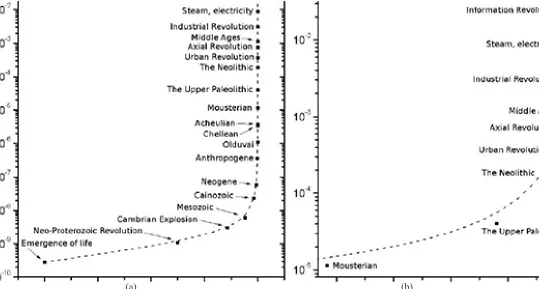
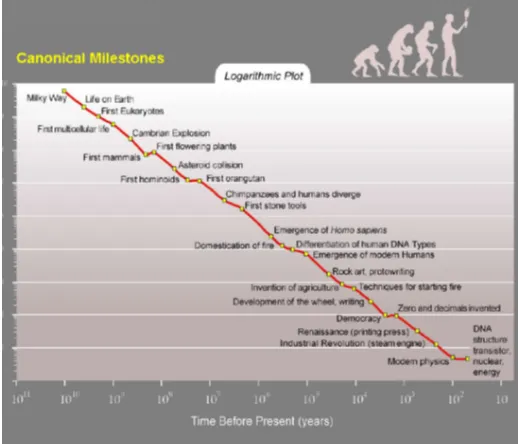
Представление о том, что в ближайшее время нас ждет некая «Сингулярность», стало в последнее время достаточно популярным, прежде всего благодаря деятельности технического директора Google в области технического обучения Рэймонда Курцвейла и его книге The Singularity Is Near (2005). Показано, что математический анализ приводимого им ряда событий, начинающегося с возникновения нашей Галактики и заканчивающегося расшифровкой кода ДНК, действительно практически идеально описывается (неизвестной самому Курцвейлу) крайне простой математической функцией с сингулярностью в районе 2029 г. Показано также, что составленный в начале 2000-х (совершенно независимо от Курцвейла) российким физиком А. Д. Пановым аналогичный временной ряд (начинающийся с возникновения жизни на Земле и заканчивающийся информационной революцией) также практически идеально описывается (не использованной А. Д. Пановом) математической функцией (крайне сходной с вышеупомянутой) с сингулярностью в районе 2027 г. Показано, что эта функция также чрезвычайно сходна с уравнением, открытым в 1960 г. Х. фон Ферстером, показавшим в своей знаменитой статье в журнале Science, что она практически идеально описывает динамику численности населения и характеризуется математической сингулярностью в районе 2027 г. Все это говорит о наличии достаточно строгих глобальных макроэволюционных закономерностей, которые могут удивительно точно описываться крайне простыми математическими функциями. Вместе с тем продемонстрировано, что в районе точки сингулярности нет основания вслед за Курцвейлом ожидать невиданного (на много порядков) ускорения темпов технологического развития; имеются бóльшие основания интерпретировать эту точку как индикатор зоны перегиба, после прохождения которой темпы глобальной эволюции будут систематически в долгосрочной перспективе замедляться.
Введение
Вопрос о «сингулярности» глобальной (или даже Большой) истории обсуждается в последнее время очень активно (см., например: Назаретян 2013, 2014, 2015а, 2015б; Eden et al. 2012; Shanahan 2015; Callaghan 2017; Nazaretyan 2015, 2016, 2017, 2018).
Этот вопрос был сделан особенно популярным благодаря усилиям Р. Курцвейла, технического директора в области машинного обучения и обработки естественного языка компании Goo-gle, и в особенности благодаря его книге The Singularity Is Near (2005), но также и через
1. Исследование выполнено при поддержке Российского
Сингулярность XXI века в контексте Большой истории: математический анализ
Page 18 Journal of Big History
создание им Университета Сингулярности (2009), активную PR-кампанию и т.п. В сфере Большой истории2 внимание к проблеме Сингулярности было привлечено благодаря деятельности таких специалистов в этой области, как А. П. Назаретян (2005, 2009, 2013, 2014, 2015а, 2015б; Балашова и др. 2017; Nazaretyan 2005, 2015, 2016, 2017, 2018), А. Д. Панов (2004, 2005, 2006, 2008; Panov 2005, 2011, 2017) и Г. Д. Снукс (Snooks 2005). В перспективе Большой истории «гипотеза Сингулярности» может представлять определенный интерес, так как она вроде предлагает «научно обоснованную» датировку «Девятой пороговой вехи Большой истории» (Big History Threshold 9).3 Однако попробуем прежде всего разобраться, могут ли математические расчеты даты Сингулярности нам действительно помочь выявить дату наступления очередной пороговой вехи Большой истории.
Временной ряда Курцвейла – Модиса и математическая сингулярность
Р. Курцвейл одним из первых расположил главные макроэволюционные сдвиги значительной части Большой истории вдоль гиперболической кривой, которая может быть описана уравнением с математической сингулярностью.4 Например,
2 Напомним, что по определению Международной ассоци-ации Большой истории, суть Большой истории заключается в «стремлении понять интегрированную историю Космоса, Земли, Жизни и Человечества с использованием надежных эмпирических данных и научных методов» (Big History seeks to understand the integrated history of the Cosmos, Earth, Life, and Humanity, using the best available empirical evidence and scholarly methods – https://bighistory.org/).
3 О понятии «пороговых вех Большой истории» (Big History Thresholds) см.: Christian 2008. Стоит, видимо, по-яснить, что в качестве 5-й пороговой вехи Большой исто-рии Д. Кристиан рассматривает возникновение жизни, 6-й – антропогенез и возникновение «коллективного обучения» (collective learning), 7-й – неолитическую революцию, а 8-й – глобальную модернизацию последних веков, особенно ак-тивно протеквшую в XIX–XX вв. (Modern Revolution). 4 Причины того, почему мы называем этот временной ряд «рядом Курцвейла – Модиса» станут понятны несколько ниже.
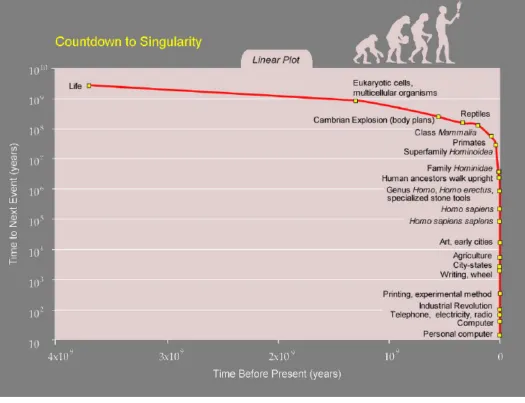
на с. 18 своего бестселлера The Singularity is Near (Kurzweil 2005) он приводит следующую диаграмму (см. Рис. 1)5.
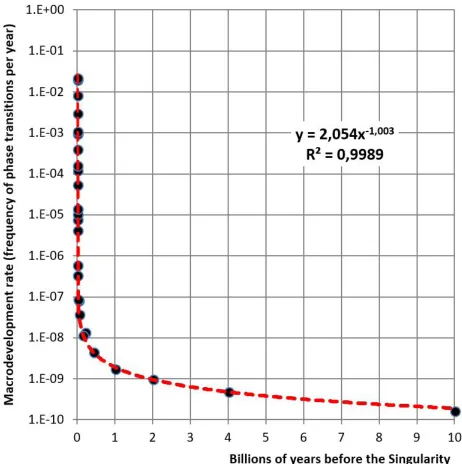
Однако, как это ни удивительно, Курцвейл, по-видимому, не заметил, что кривая, представленная на этом рисунке, является гиперболической, и что она описывается уравнением, имеющим самую настоящую математическую сингулярность (более того значение этой сингулярности, 2029 год, не так далеко от того, что предсказывается самим Курцвейлом). Это объясняется, прежде всего, некоторыми математическими неточностями, ха-рактерными для технического директора Google (достаточно упомянуть, что он упорно называет глобальный паттерн ускорения эволюции «экспоненциальным», не обращая внимания на то, что экспоненциальная функция не имеет какой-либо сингулярности).
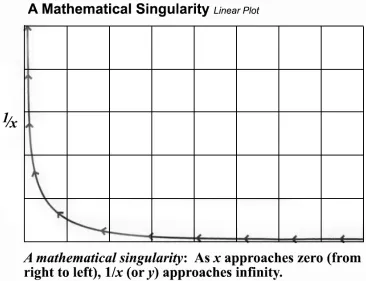
В свете этого не может не вызвать некоторого удивления то обстоятельство, что cам Курцвейл знает о понятии математической сингулярности и более или менее точно описывает его. Действительно, на страницах 22-23 своего бестселлера он дает довольно точное описание понятия «математическая сингулярность»:
А. В. Коротаев
Page 19 Volume II Number 3 Fall 2018
математическая функция никогда не достигает бесконечного значения, так как деление на ноль математически «неопределено» (это невозможно вычислить). Но значение у превосходит любой возможный конечный предел (приближается к бесконечности), когда знаменатель х стремится к нулю” (p. 22– 23).
Более того, на с. 23 он сопровождает свое описание понятия «математическая сингулярность» вполне адекватным иллюстрирующим графиком (см. Рис. 2).
Однако, представив достаточно адекватное описание понятия «математическая сингулярность», Курцвейл, похоже, теряет интерес к этому понятию – внезапно переключаясь на использование термина «сингулярность»
Сингулярность XXI века в контексте Большой истории: математический анализ
Page 20 Journal of Big History
астрофизиками (p. 23).
Одна из загадочных вещей в книге Курцвейла заключается в том, что он, похоже, не заметил, что форма гиперболической кривой на его графике «Математическая сингулярность» (стр. 23 книги Курцвейла, см. Рис. 2 выше) принципиально идентична (хотя, конечно, повернута на 180 градусов) с формой кривой на его графике «Обратный отсчет времени до Сингулярности» (стр. 18 той же книги, см. выше Рис. 1). Более того, как мы увидим ниже,
математическая модель, обеспечивающая наилучшую аппроксимацию кривой типа той, что изображена на Рис. 1, в основном идентична гиперболической функции, показанной на Рис 2, т.е. y = k / x. Таким образом, если бы Курцвейл сделал простой математический анализ временного ряда на своем Рис. 1, он бы нашел, что его лучше всего описывает математическое уравнение того самого типа, что он изображает на своем Рис. 2 (с той очень небольшой разницей что у нас в числителе уравнения оказалось бы «2», а не