Volume-7 Issue-1
International Journal of Intellectual Advancements
and Research in Engineering Computations
A study on challenges and behavioral problems of orphans and abandoned
children staying in orphan children home with special reference to Erode
Mrs.D.Shanthi MBA
1, C.R.Saravanakumar
21
Assistant Professor, Department of Management Studies, Nandha Engineering College (Autonomous)
2II - MBA, Nandha Engineering College
ABSTRACT
Orphaned students are among of the most vulnerable members of society, often lacking basic needs (food, clothing and shelter) and services related to better education. Orphans are the special group of children who are generally deprived and prone to develop psychiatric disorders even reared in well run institution. This cross-sectional descriptive study to explore the behavioral and emotional problems in these institutionalized children. This can be taken into account that the academic performance of orphaned students does not rely on the provision of school fees only but also depend much on the availability of basic needs like food, clothing, shelter, and psychological help relating to alleviation of traumas of their parental dea th. This can be taken into account that the academic performance of orphaned students does not rely on the provision of school fees only but also depend much on the availability of basic needs like food, clothing, shelter, and psychological help relating to alleviation of traumas of their parental death.
INTRODUCTION
Orphans and the other vulnerable children and adolescents (OVCA) living in institutional homes are more prone to behavioral and emotional problems than others as they are deprived of a family’s love and care. The present study was conducted in in order to understand living conditions, education, nutrition, networking, and wellbeing of orphan children. The mental health of a person of any age is dependent on the balance between elements that promote mental health and elements that are barriers to mental health. Promoting factors include interplay of environmental quality, self-esteem, emotional processing, self-management, and social participation. These challenges create emotional stress making the pupils difficult to concentrate and learn in the classroom. Since they lack basic needs such as love from parents, good shelter, food and clothes then they will be less motivated to perform well in class. Emotional and behavioral problems are more among orphans and
other vulnerable children because they are exposed to abuse, exploitation, neglect, lack of love and care of parents. In addition to these factors, most of them are brought up in institutional homes where individual care is inadequate. All these factors can socially and emotionally impair these children. Emotional and behavioral problems influence the child’s overall development, specifically academic and social outcome as adults. Hence, there is a need to assess and identify mental health problems in these institutionalized children so that suitable intervention measures can be designed for them at the right time. This cross‑sectional descriptive study to fill the information and knowledge gap about the extent and types of emotional and behavioral problems found in orphans and other vulnerable children adolescents (OVCA) living in children orphan homes.
STATEMENT OF THE PROBLEM
Orphans are the group of people who suffer a lot to lead their lives. They are more depressed and sensitive to environmental vulnerability. To analyze their problem and to provide suggestion, will create awareness and help them to an extent so I choose this topic as my research
OBJECTIVES OF THE STUDY
To identify the demographic profile of the respondents.
To Rank the challenges and behavioral problems faced by the orphans.
SCOPE OF THE STUDY
The present study will be helpful in understanding the factors influencing which leads to the behavioral problems of orphans
The study will also helpful in analyzing the problems faced by the orphans
It will also help in suggest suitable measures to overcome behavioral problems of orphans.
LIMITATIONS OF THE STUDY
The sample for the study was based on convenience and may not necessarily be representative of all the children’s.
There is a tendency that some children’s might have being responding in a socially desirable way which would tend to bias results against findings.
REVIEW OF LITERATURE
Ravnee Kaur, Archana Vinnakota, Sanjibani Panigrahi, R. V. Manasa., (2018) analyze that the orphans and OVCA in institutional homes are vulnerable to behavioral and emotional problems. The screening for conduct problems, emotional problems, hyperactivity, and peer problems needs to be done at a regular basis for these children. Given the paucity of data in this regard, several multicenter studies also need to be done to get an overall comprehensive view of these problems
Sharon M. Kirkpatrick, South Beverly J.., (2012) said that Healthcare professionals play a
key role in promoting the emotional health of orphan children through identification of deviant behaviors and the development of interventions to alleviate emotional and psychological distress. Unhappiness is not always manifested in an outward behavior, so caregivers may not have always known how the children were feeling. In spite of the everyday pressures to feed, clothe, and care for the children,
The caregivers were also perceptive and aware of the signs and symptoms of the children’s emotional distress.
Wasima Rahman1, MSI Mullick (2012) said that the all three of the children heading households were responsible for another child. Besides managing a household, producing food, earning cash to buy items they could not produce (such as clothing, salt, sugar, oil), and doing their own school work (in the cases of Joseph and Lucy), they were responsible for the wellbeing of a younger child, ensuring his or her needs were met and that they attended school.
RESEARCH METHODOLOGY
Research design
A Master plan that specifies the method and procedure for collecting and analyzing needed information.
Sample design
Sampling is the process of selecting a sufficient number of elements from the population. A Sample Design is a definite plan for obtaining a sample from the sampling frame. It refers to the technique or the procedure the researcher would adopt in selecting some sampling units from which inferences about the population is drawn.
Non-probability sampling
Non-probability sampling is a sampling technique where the samples are gathered in a process that does not give all the individuals in the population equal chance of being selected.
Convenience sampling
collection from population members who are conveniently available to participate in study
Size of the sample
The Sample size is 100.
DATA COLLECTION METHOD
Primary data
These are data which are collected for the first time directly by the Researcher for the Specific study undertaken by him. In this research primary data are collected directly from the Respondent by using Questionnaire.
Secondary data
These are data which are already collected and used by someone preciously. In this research review of Literature, Details of the industry are collected from the Internet.
STATISTICAL TOOLS USED
To analyze and interpret collected data the following simple percentage and ranking were used.
Simple percentage analysis
Formula
Number of respondents Percentage analysis=---X 100 Total number of respondents
Henry garrett ranking
Garrett’s ranking technique to find out the most significant factor which influences the respondent; Garrett’s ranking technique was used. As per this method, respondents have been asked to assign the rank for all factors and the outcomes of such ranking have been converted into score value with the help of the following formula:
Percent position = 100 (Rij – 0.5) Nj
Where Rij = Rank given for the ith variable by jth respondents.
Nj= Number of variable ranked by jth respondents.
DATA ANALYSIS
Demographic profile of the respondents
The Respondent who participated in the research is from diversified background with gender, age group, family members and educational qualification.
Table: 1: Demographic profile of the respondents
DETAILS OF RESPONDENT NO.OF REPSPONDENTS PERCENTAGE
Age
Below 5 Years 02 02 Between 5 -10 Years 35 35 Between 10 – 20 Years 63 63 Above 20 Years 0 0
Total 100 100
Gender
Male 65 65
Female 35 35
Total 100 100
Educational Qualification
No Formal Education 19 19
School Level Education 81 81
PG 0 0
Total 100 100
Medium of Schooling
State Board 32 32
Matriculation 40 40
CBSE 03 03
Other 25 25
Total 100 100
No of Brothers &Sisters
1 05 05
2 03 03
None 92 92
Total 100 100
Interpretation
From this study it is evident that age group of the 63% of the respondents fall under the category of 10-20years, 65% of the respondents fall under the gender of male, 81% of the respondents fall
under the category of School level education, 40% of the respondent children’s Medium of Schooling is Matriculation and 92% of the respondents have none of brothers and sisters.
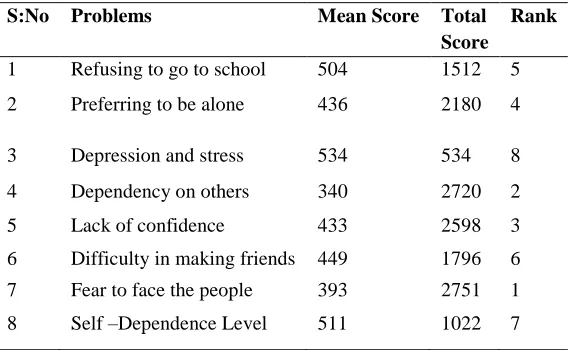
Table no: 2: Rank the problems faced by respondents S:No Problems Mean Score Total
Score
Rank
1 Refusing to go to school 504 1512 5 2 Preferring to be alone 436 2180 4
3 Depression and stress 534 534 8
4 Dependency on others 340 2720 2
5 Lack of confidence 433 2598 3
6 Difficulty in making friends 449 1796 6 7 Fear to face the people 393 2751 1 8 Self –Dependence Level 511 1022 7
Interpretation
From the above study it was found that from the table is evident that, Fear to face the people is ranked as no.1 with total score of 2751, Dependency on others is ranked as no.2 with total score of 2720, Lack of confidence is ranked as no.3 with total score of 2598 and Preferring to be alone is ranked as no.4 with total score of 2180.
FINDINGS
1) Fear to face the people is ranked as no.1 with total score of 2751
2) Dependency on others is ranked as no.2 with total score of 2720
3) Lack of confidence is ranked as no.3 with total score of 2598
5) 63% of the respondents are fall under the age group of 10-20 years.
6) 65% of the respondents fall under the gender of male.
7) 81% of the respondents fall under the category of School level education
8) 40% of the respondent children’s Medium of Schooling is Matriculation.
SUGGESTIONS
Special activities that conduct in children home like outdoor play, yoga for kids, special education activities makes children overcome the fear of facing people and society.
Overcome emotional dependency by learning to recognize and address your emotional needs. Instead of looking to others to make you feel a certain way, remind yourself that you are responsible for your emotions.
Meditation just means letting go of the racing thoughts in children mind and accepting that those thoughts, feelings and beliefs are transient, rather than parts of yourself. Meditation helps to overcome of lack of confidence in the children. The students are need to be given updates
through various workshops and conference in
various fields to establish the new innovation in the future.
Making of new friends and teachers can be friendly with their children, so that the emotional problems in children can be managed to the maximum extent.
CONCLUSION
Awareness on mental health problem among orphan children at all levels especially professionals related to the facilities should be built up. Majority of children yearned for parents and longed for love and affection. Apart from low self-concept and lack purpose in life long term bereavement had resulted in depression and anxiety issues among these children. Trying to forget parents, avoiding crowded places, making new friends and finding their family among inmates of orphanage were the coping mechanisms adopted by orphan children. Given the rising number of orphan children in the country this study signified that positive relationships with caregivers and peers are important for enriched development and healing of children’s mind.
REFERENCE
[1]. Tembo, S., & Banda, A.. “Results of the Orphans and Vulnerable Children Head of Household Baseline Survey in four districts in Zambia” (USAID/Zambia Research Report). Retrieved Science & Medicine, 69, 2002, 1186– 1193.
[2]. Shanthi K, Jeryda Gnanajane Eljo JO. “Emotional and behaviour problems of institutionalized street children. Indian” J Appl Res 4, 2014, 135‑7.