An Empirical Analysis of the Theory of
Planned Behavior
A Review of Its Application on E-democracy Adoption Using the Partial Least Squares Algorithm.
Abinwi Nchise
Southern University and A&M College, LA, USA, [email protected]
Abstract: Prior information systems (IS) research has provided valuable insight on technology adoption and use which is critical in deriving the benefits of information technology. These studies have utilized theories such as Technology Acceptance Model, Theory of Reason Action, and Technological determinism model to investigate technology adoption. This study continues in this line of research by evaluating the perspectives of investigating the concept of e-democracy within the framework of the Planned Behavioral Theory an extension to the Theory of Reason Action. The article seeks to explain internet and mobile enhanced citizen’s participation in democracy (e-democracy) base on their inherent (attitude) and environmental (subjective norms and perceived behavioral control) enablers and barriers to participate in e-democracy, and how the internet and wireless technologies can help to address democratic issues in resource poor settings such as the Sub Saharan Africa (SSA). The study takes the perspective of critical realism and thus provides an example of the application of this research paradigm in an empirical study. We investigated this phenomenon by providing a theoretical grounded model that explains e-democracy adoption adapted from the theory of Planned Behavior (TPB) and tested from an empirical examination of constructs using data from randomly selected sub-Saharan African countries. The results render support for the proposed hypotheses, emphasizing the role of human behavior on citizens’ e-democracy adoption.
Keywords: E-democracy, Democracy, Information and Communication Technology (ICT), Sub Saharan Africa (SSA)
Acknowledgement: This research is under the auspices of the International Center for Information Technology and Development support in part by the National Science Foundation (NSF) under Grant Nos. 1036324 and 0811453. Any opinions and recommendations expressed in this material are those of the authors and do not necessarily reflect the views of the National Science Foundation.
ubatana is an organization aimed to strengthen citizen participation through information provision. Kubatana manages Kubatana.net, a website portal that provides Zimbabwean civil society organizations with an online presence and a platform to voice their concerns and opinions about political issues and human rights abuses (Vosloo, 2003). It strengthens the use of mobile phones, email and internet strategies to enhance citizens participation in democracy. Kabutana has profoundly encouraged many Zimbabweans to use the information and communication technologies (ICTs) to advocate, mobilize lobby and monitor elections. A significant factor distinguishing Zimbabwe’s 2008 elections from previous ones was how the citizenry were able to use mobile phone technology to monitor the election process (Moyo, 2010).
flagrant disregard for democratic rights standards and processes. All these have greatly impeded citizen’s participation in democracy within the SSA region evident in low voter turnout during elections (Dugger, 2008). SSA countries current democratic institutions stem from an era in which transportation and communication was difficult and time consuming especially in the rural areas (Nzepu, 2007). Because of this communication impediment, politicians and other elected government officials developed a culture in which except at political campaigns, there was little or no feedback from citizens. It is important to note that most citizens in the world not only wish to be informed about major issues but also wish to articulate their own opinions in a way that may also affect decision making process.
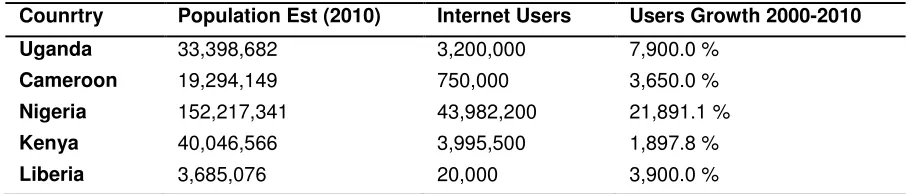
However, political scientists and information and communication scholars have advocated for the use of simple communication technologies like cell phones and the internet in assisting many developing countries to progress towards open and fair elections especially in countries where the traditional media (radio and television) is still under control by the government and citizens are intimidated and threaten over their fundamental right of expression (Nachali-Kambikambi, 2008; Albrecht, 2006). This mobile and internet enabled citizens participation has gradually been moving from the realms of hypothetical hopes and fears to the realms of practical experience. This is heightened by the exponential growth of Internet penetration in Sub-Saharan within the last decade as seen in the selected countries’ statistics in table 1.
Table 1. Internet Usage in Selected Sub-Saharan Africa Countries.
Counrtry Population Est (2010) Internet Users Users Growth 2000-2010
Uganda 33,398,682 3,200,000 7,900.0 %
Cameroon 19,294,149 750,000 3,650.0 %
Nigeria 152,217,341 43,982,200 21,891.1 %
Kenya 40,046,566 3,995,500 1,897.8 %
Liberia 3,685,076 20,000 3,900.0 %
Source; (Internet World Stats, June 2010)
The use of ICTs to expand citizens participation (e-participation) has greatly been expanding in the Sub Saharan African countries who though were late starters in adopting modern ICT in democracy are currently making strides as illustrated in the case above (Mbarika et al, 2002).
The article therefore proceeds as follows; we begin by defining the concepts of e-democracy, followed by examining the theory of Planned Behavior (TPB) and the rationale for selecting the said theory. We then proceed to propose a theoretical model for explaining the concepts of e-democracy adoption and the methodology to test the said model, while concluding with results and discussions.
1.
E-Democracy
E-Democracy is the use of cyberspace and mobile technologies to enhance effective governance (Hye, jong & Hae, 2008). Shirazi (2009) highlights the potential of e-democracy to create a new space for engagement, deliberation and collaboration in the political process that can make democratic processes more inclusive and transparent. The use of the Internet and mobile SMS transforms existing patterns of political participation, political mobilization and collective actions. E-Democracy is not, however, only about technological improvements and direct democratic technologies such as e-voting, e-registering, and on-line governmental forums, it is also refers to as long-term transformations of politics (Anttiroiko, 2000). E-Democracy which provides an uncensored use of the Internet and cell phone services can therefore serve as a democratic mediator and as a distributor of information by creating new channels of communication and new avenues for citizens to voice their opinions. These channels might include: e-campaign, e-voting systems, e-voter registration systems, public information terminals, electronic town meetings and results reporting.
2.
Theoretical Rational
The Theory of Plan Behavior (TPB) is one of the well-established social psychology theories employed to explain many human behavior related phenomenon. TPB is an extension of Theory of Reason Action (TRA) (Fishbein and Ajzen, 1975) which hypothesizes that behavior is influenced by an individual’s intention to perform the behavior. TPB postulates that, the psychological process to put up a behavior is stimulated by intention which is also influenced by some underlying beliefs (Ajzen, 1985; 1988; 1991).
Thus, intention tends to be the central pivot around which behavior revolves – meaning that people’s action is backed by their intention. Intention captures the motivational factors that influence the behavior (Azjen, 1991: 181). The extent to which an individual persists in an adopted behavior depends heavily on the existence of the motivational factors, which are means of further instilling and imbedding behavioral practices. By being able to identify and understand these motivational factors we come a step closer to understanding why an individual performs a behavior and, further, define measures to instill and imbed the behavioral practices in society.
3.
Theory of Planned Behavior
The starting point in investigating citizen participation in e-democracy is to seek to understand the factors which influence a citizen’s intention to perform this behavior. TPB is well-established and proven in both social science and information technology literature to explain and predict user behavioral intentions (Mykytyn and Harrison, 1993). As earlier noted, the theory postulates that the psychological process to put up a behavior is stimulated by intention which is also influenced by some underlying beliefs (Ajzen, 1985; 1988; 1991).The factors that determine intention are the individual’s attitude toward the behavior (A), the subjective norm (SN) and perceived behavior control (PBC). (see Figure 2).
Sub-Saharan Africa (SSA). As such, TPB lends itself to the application of this paper because it not only addresses why individuals engage in e-democracy but examines the impact of institutions on the decision to participate in democratic processes using the Internet and wireless technologies.
Based on the TPB, a testable research model was drawn from the constructs.
Figure 2. The relationship between Subjective norms (social pressure), perceived behavioral control (controllability and self-efficacy) on behavioral attitude (A) and intention to adopt e-democracy. The sign λi denotes the path coefficients within the outer model, while the sign βi denotes the path coefficients between the endogenous latent variables.
Based on the model, attitude towards a behavior refers to the degree to which a person has favorable or unfavorable evaluation of the behavior in question. Attitude relates to the individual’s perceptions of the behavior – the value of participating in democratic process and perception of the value of the Internet and wireless technologies in reducing the efforts to participate in the democratic process. Previous studies in studying behavior in the use of technology emphasize that this motivational factor is dependent on the individual’s level of knowledge on the behavior and of the application of a technology to perform or mediate that behavior (Cloete et al., 2002). These authors design attitudinal scales to assign individuals scores relative to their value of commitments, beliefs, and feelings. Individual scores are then compared with the standardized scores of others in order to position the individual on some continuum of the attitude being measured (Bert, 1954). This study adopted this method to operationalize attitude. Questions designed to measure the degrees of attitude in this research were typically ordinal-level measures with response categories implying levels of agreement. For example, respodents were asked to state the level to which you agreed with a statement concerning the impact of e-democracy in governance, with responses along a continuum of "1=strongly disagree" to "7=strongly agree."
Subjective norm refers to the perceived social pressure to perform or not to perform the behavior. It refers to one’s perception about other people’s force of influence (social pressure of some sort) to perform or not to perform the behavior (Fishbein and Ajzen, 1975). In e-democracy one may consider this as pressure from among journalists to use blogs and other social media (directly or indirectly) to communicate information promoting democracy. Pressure may also stem from social referents like peers within the sector, or government and e-democracy rhetoric and debates from academics, practitioners and the media. We designed a measure of subjective norms regarding e-democracy adoption using the guidelines provided by Ajzen and Fishbein (1980) as well as Ajzen and Madden (1986)
interest. Self-efficacy components can be measured by two types of items: (a) in terms of perceived difficulty (PD), i.e. for an individual to perform a behavior which is measured on a seven-point scale anchored by "very difficult/very easy"; and (b) in terms of how confident the actor is that they can perform the behavior if they wanted to (CON), measured on a seven-point scale anchored by "definitely true/definitely false." Concerning e-democracy an individual’s self-evaluation of the ability to use internet and wireless technologies can influence his/her intention to use these technologies. In addition, a journalist for an online news website may be likely to use the Internet as a medium for promoting democratic activities eg. Electronic forums. The controllability component of PBC involves people's beliefs that they have control over the behavior and that performance or non-performance of the behavior is up to them (Ajzen, 2002b). This could be measured by asking a question like how much control they think they have over performing the behavior. With seven response categories anchored by "no control/complete control"; and/or. The reflective measurement model below represents how this latent variable is measured from the two indicators.
Based on this theory, the researcher suggests the following testable hypotheses:
H1: Citizens’ attitude toward democracy positively influences their intention to adopt e-democracy.
H 2: Environment subjective norm positively influences citizens’ attitude to adopt e-democracy.
H3: Citizens’ perceived behavioral control over e-democracy positively influences their attitude to adopt e-democracy.
4.
Philosophical Basis of the Study
relatively modest and the trend keeps growing, the bulk of the literature "remains extremely theoretical" (p. 52). Room exists for knowledge contribution in the application of CR in empirical— quantitative or qualitative—IS research. Mingers (2004) adds that it enables the IS researcher to "get beneath the surface to understand and explain why things are as they are, to hypothesize the structures and mechanisms that shape observable events" (Mingers, 2004). A generalization therefore lies in the constituent properties being able to explain the particular occurrence of the phenomena as conceptualized by the theoretical research propositions herein.
5.
Research Methodology
A quantitative approach was used in testing the hypotheses. The unit of analysis is individual citizens of voting ages, drawn from civil society, NGOs, journalists, and political parties in SSA. This quantitative research approach will be employed to examine the relationships hypothesized in the model by using a larger sample of participants. We developed a measurement scale for each major variable consisting of multiple items (indicators) borrowed from previous studies. Guided by the theoretical understanding derived from the literature, we identified questionnaire items that were relevant to the constructs in this study. The principal constructs were developed based on existing measures where possible or were adapted from similar scales. Measures for attitude (A), perceived behavioral control (PBC), and subjective norms (SN) (societal norms and social influences) were based on the empirical studies of Taylor and Todd (1995), Mathieson (1991), and Miniard and Cohen (1981). Although most items were based on previous empirical studies, we developed the actual measurement scales to capture the context of this study. We then modified the questionnaire items to match his study of e-democracy in SSA.
5.1. Data Collection Procedure
We employed a rigorous approach survey methodology where participants were randomly selected from SSA to rate their responses regarding their online democratic activities. Relying on studies that have shown that there is no difference in mean scores between paper-based and web-administered questionnaires (Kandor, 1991; Rosenfeld et al., 1989), we web-administered the surveys using both paper-based and web-based surveys. The online survey instrument was administered to targeted groups of Internet users in randomly selected SSA countries, excluding North African countries and South Africa because of their distinct socio-economic characteristics from the rest of the SSA countries. Consequently, we collected email addresses of over 700 citizens in the SSA countries from multiple mailing lists. Invitation emails were sent to the selected participants, explaining the purpose of the survey and requesting their participation. In the invitation email, the researcher directed the respondents to the online survey instrument when they clicked on a URL link provided in the email message. A sample size of N=150 was considered for the study
The quantitative survey data collected was analyzed using statistical techniques. First, the psychometric quality of the measures was assessed by calculating their validity and reliability. Second, the theoretical relationship among the variables was tested by estimating structural models. To obtain more accurate results, the Structural Equation Modeling (SEM) technique using the Partial Least Square (PLS) algorithms was applied to evaluate the measurement model and structural model simultaneously. This approach lends itself to this research because SEM answers a set of interrelated research questions in a single, systematic, and comprehensive analysis (Gefen et al., 2000). It also accommodates latent variables (LV) that are unobservable and cannot be directly measured. Therefore the use of LVs in this study has the potential to model theoretical constructs such as intention, attitude, and perception that are difficult to measure directly
6.
Results
follow-up procedures that effectively improved on the response rate to a number above the recommended sample size according to Barclay et al. (1995). The sample size of N=150 was sufficient because the required number of cases for this PLS analysis is only ten times the number of indicators in the reflective constructs (Chin, 1998). Although Van der Stede et al. (2005) contend that high response rates usually reflect a study's rigor in the eyes of the reviewers and readers, other studies have shown that surveys with lower response rates do not necessarily yield less accurate measurements than surveys with higher response rates (Visser et al., 1996).
The proposed model derived from the Theory of Planned Behavior (TPB), was made up of all reflective constructs that are influenced by the prime latent indicators (Freeze & Raschke, 2008). These reflective latent constructs (attitude, intention, subjective norms and perceived behavioral control), are characterized by the fact that changes in the underlying latent construct will be reflected in changes in their corresponding measurement indicators. Since the indicators in a reflective construct represent the construct in a reflective model, we expected to see a high degree of correlation between the indicators.
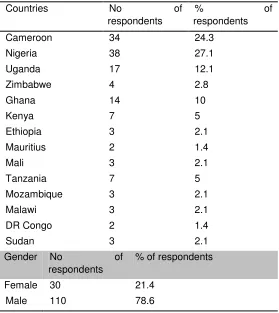
The table below (Table 4.1) shows a descriptive analysis of the data collected based on the two demographic questions in the survey. Respondents in the survey came from a total of 14 SSA countries made up of 79% of males and 21% of females.
Table 2. Descriptive statistics of the survey participants.
Countries No of
respondents
% of
respondents
Cameroon 34 24.3
Nigeria 38 27.1
Uganda 17 12.1
Zimbabwe 4 2.8
Ghana 14 10
Kenya 7 5
Ethiopia 3 2.1
Mauritius 2 1.4
Mali 3 2.1
Tanzania 7 5
Mozambique 3 2.1
Malawi 3 2.1
DR Congo 2 1.4
Sudan 3 2.1
Gender No of
respondents
% of respondents
Female 30 21.4
Male 110 78.6
6.1. Assessment of the Measurement Model
acceptable threshold representing strong reliability as suggested by Nunnally (1967). Construct validity for the four measurement scales (Attitude, Perceived Behavioral Control, Subjective Norms and Intention) was assessed from their convergent and discriminant validity values. Convergent validity which indicates how each measurement item strongly correlated with its specific theoretical construct was determined from the constructs’ respective average variance explained (AVE) values. Convergent validity was evaluated for the four measurement scales using three criteria suggested by Fornell & Larcker (1981): (1) all indicator factor loadings should be significant and exceed 0.7, (2) construct reliabilities should exceed 0.7, and (3) the square root of the average variance explained (AVE) by each construct should exceed the variance due to measurement error for that construct (i.e., AVE should exceed 0.50). All values in the confirmatory factor analysis (CFA) model exceeded 0.7 and were significant at p = 0.001. Composite reliabilities of constructs ranged between 0.78 and 0.93. AVE ranged from 0.58 to 0.87 indicating that on average, all LVs were able to explain more than half of the variance of their respective indicators and thus demonstrated sufficient convergent validity. Hence, all three conditions for convergent validity were closely met. Each scale item was modeled as a reflective indicator of its hypothesized latent construct. Model estimation was done using the maximum likelihood approach with the item correlation matrix used as input.
Finally, Fornell & Larcker (1981) recommend a stronger test of discriminant validity, where the square roots of every AVE (one for each LV) is calculated to see if anyone were much larger than any correlation among any pair of LVs. This basically implies that the AVE for each construct should exceed the squared correlation between that and any other construct. Our factor correlation matrix indicated that the largest squared correlation between any pair of constructs is 0.60, while the smallest AVE is 0.81. Hence, the latter test of discriminate validity was also met.
6.2. Assessment of Structural Model and Hypothesis
Figure 3. PLS Analysis of Research Model
Note: Measurement model not shown above for purposes of clarity
Note. * P<0.050; ** P<0.010; *** P<0.001, R2 = the coefficient of determination.
Hypotheses 1 examines the relationship between citizens’ attitude towards e-democracy and their behavioral intention to adopt e-democracy, (b=0.876, t-value=17.64, p<0.000). This hypothesis was strongly supported and therefore not rejected. Hypotheses 2, examine the relationship between environmental subjective norms and citizens’ attitude to adopt e-democracy (b=0.479, t-value=7.59, p<0.000). This hypothesis was also strongly supported and therefore not rejected. The third hypothesis examined the relationship between perceived behavioral controls and citizens’ attitude to adopt e-democracy. (b=0.271, t-value= 4.41, p<0.000). This hypothesis was also strongly supported and therefore not rejected. According to the research model shown in figure 3, two endogenous variables were tested (behavioral attitude and behavioral intentions). The exogenous constructs in the model explained 40% of the variation of behavioral attitude and 74% of the variation of behavioral intention with a significant overall model of fit of p > 0.05.
7.
Discussion
In evaluating inherent human behavior towards e-democracy adoption in SSA, respondents believed that perceived social pressure to adopt or not to adopt e-democracy (SNs) will significantly influence their attitude toward adoption (H6) with a significant path coefficient of 0.474. Similarly, respondents also believed that their PBC (controllability and self-efficacy) to adopt e-democracy significantly influences their attitude (H3) (path = 0.192). Attitude has been proposed in several studies using different theories to influence behavioral intentions (Fishbein and Ajzen, 1975).
In H1, we posited that citizens' attitude toward e-democracy positively influences their intention to adopt e-democracy. This hypothesis was strongly supported by the results. The results were not truly surprising because attitude is proposed to influence behavioral intentions in multiple theories examining technology adoption by citizens such as the Technology Acceptance Model (TAM) (Kifle et al., 2007) and the Theory of Reason Action (TRA) (Fishbein and Ajzen, 1975). This theoretical prediction has received considerable empirical support in a variety of settings (Madden et al., 1992; Akram & Malik, 2012). Attitude is an overall evaluation of an individual's perception of e-democracy adoption. Therefore, following the TPB, a positive attitude will undoubtedly affect the individual's intention to engage in e-democracy activities.
As expected, H3 received strong support. PBC involves people's beliefs that they have control over the behavior; performance or nonperformance of the behavior is up to them (Ajzen , 2002b). Several studies support the direct effect of PBC on intended and/or actual usage (Chau & Hu, 2002; Taylor & Todd, 1995).
Therefore, the application of TPB offers a theoretical base for the consideration of behavioral attributes in technology adoption. Relating these three variables (attitude, subjective norms and perceived behavioral control) to e-democracy, a citizen’s behavioral intention is argued to be stimulated by his attitude, subjective norm and perceived behavioral control to getting information, giving information and ultimately using the information in a manner which enhances democratic processes in a country. The democratic outcomes tend to be incremental (at the individual level) and transformative (at the institutional level). By incremental we refer to changes in citizen’s actual behaviors toward the use of Internet and mobile phone in democratic practices but leaving the underlying structures or institutions intact, whereas transformative change implies a paradigm shift or a democratic evolution in a given community or institution. According to Perkins et al. (2007) incremental changes lead to stable transformative organizational and community development. This research paper devotes assiduity on internet and mobile phone to enhance citizen’s participation looking at individuals’ perceptions on the importance of these technologies to enhance their democracy participation efforts. According to Vannoy & Palvia (2010), Technology adoption incorporates two essential elements, the embracement of the technology by individuals and its embedment in society. More attention in this study was laid on technology embracement in SSA which helps in evaluating the value of the technology to the individuals who view it as an empowerment in overcoming democratic disenfranchisement.
8.
Conclusions
The concept of e-democracy remains a crucial area of research since it affects citizens and governments on a global scale. This study contributes to the understanding of inherent contributors of e-democracy adoption. A major contribution is the specification, justification, and empirical validation of a set of interrelationships between key constructs that tend to be associated with behavioral attitudes to adopt e-democracy. Specifically, we this study examined the contributions made by TPB in developing current thinking on e-democracy. We focused on individuals' perception of e-democracy adoption and went beyond the plethora of technology transfer problems in SSA countries to identify the inherent factors that affect individuals' attitudes and intention to engage in adoption. Rather than jump to the conclusion that the proliferation of ICTs inevitably affects e-democracy adoption, we stepped back to look at individuals' behavioral factors that could affect their attitude in harnessing these technologies for democracy.
References
Ajzen, I. (1985). From intentions to action: A theory of planned behavior. In J. Kuhl & J. Beckman (Eds.) Action-control: From cognition to behavior, Heidelberg: Springer, 11-39.
Ajzen, I. (1988). Attitude, Personality and Behavior, The Dorsey Press, Chicago, Illinois, 1988.
Ajzen, I. 1991. “The Theory of Planned Behavior,” Organizational Behavior and Human Decision Processes (50:2), pp. 179-211
Albrecht, S. (2006). Whose Voice is Heard in Online Deliberation? A study of participation and
representation in political debates on the Internet. Information Communication and Society Vol.9, No.1
Anttiroiko, Ari-Veikko (2003). Building Strong E-Democracy – The Role of Technology in Developing Democracy for the Information Age, Communications of the ACM, Vol. 46, No. 9, p. 121-128.
Awan, A. (2005). Politics, Democracy in the Light of Information and Communication Technology. Communications of the IIMA. Vol. 5
Barclay, D., Higgins, C. & Thompson, R. (1995).The Partial Least Squares (PLS) Approach to Causal Modeling: Personal Computer Adoption and Use as an Illustration. Technology Studies: Special Issue on Research Methodology, 2(2), 285-309.
Brown, B. (2004). The Political Philosophy of Science Policy. A Review of Science, Learning and Policy 42, No. 1
Caldow, J. (2005). E- Democracy: Putting Down Global Roots. Institute for Electronic Government. IBM Corporation.
Carlsson, S.A. (2003). Advancing Information Systems Evaluation (Research): A Critical Realist Approach, Electronic Journal of Information Systems Evaluation, 6(2), 11-20.
Chin, W.W. (1998). The Partial least squares approach to structural equation modeling, Modern methods for business research, G. A. Marcoulides (ed.), London, 295-336.
Cloete, E., Courtney, S. and Fintz, J. (2002). Small Business’ Acceptance and Adoption of E-Commerce in the Western-Cape Province of South Africa, The Electronic Journal of Information Systems in Developing Countries, Volume 10, Issue 4, pp. 1-13
Dobson, P.J. (2002). Critical Realism and Information Systems Research: Why Bother with Philosophy, Information
Research,7(2), 1-13
Elster, J. (1998). A Plea for Mechanisms. In P. Hedstrom and R. Sweberg (eds) Social Mechanisms: An Analytical Approach to Social Theory, Cambridge: Cambridge University Press, pp. 45-73.
Fishbein, M. and Ajzen, I. 1975. Belief, Attitude, Intention and Behavior: An Introduction to Theory and Research, Reading, MA: Addison – Wesley.
Fornell, C.R. & Larcker D.F. (1981). Structural equation models with unobservable variables and measurement error: Algebra and statistics. Journal of Marketing Research, 18(3), 382-388.
Freeze, R. D. and Raschke, R. L. (2008). An assessment of formative and reflective constructs in is research. MIS Quarterly 29 (3), 427-459.
Funilkul, S. and Chutimaskul, W. (2009) the framework for sustainable eDemocracy development, Transformation Government: People, Process and Policy, Volume 3, 1pp. 16-3 General Elections in Kenya of 27 December 2007 Gefen, D., D. Straub, and M. Boudreau (2000) "Structural Equation Modeling Techniques and Regression: Guidelines for
Research Practice," Communications of the Association forInformation Systems (7)7 August,, pp. 1-78.
Hashim, J. (2007). ICT Adoption Among SME, Owners in Malaysia. International Journal of Business and Information. Vol. 2. No.2
Hye, K., Jong, K., and Hae, L. (2008). A Study on the Public Sphere of Mobile Media. Journal of Korea Information and Communications Society, Vol. 31, No. 4B.
Internet World Statistics (2010). Internet Usage Statistics for Africa. Retrieved from http://www.internetworldstats.com/stats1.htm.
Islam, M. (2008). Towards a Sustainable e-participation Implementation Model. European Journal of ePractice. No. 5.
Joreskog, K. G., & Sorbom, D. (1993). LISREL8: Structural equation modeling with the SIMPLIS command language. Hillsdale, NJ: Erlbaum
Kandor, J. (1991). Effects of computer administration and identification on the job descriptive index. Journal of Business and Psychology, (5), 309-323
Kifle, M., Mbarika, V., & Datta, P. (2008). Telemedicine in Sub Saharan Africa the Case of Teleophthalmology and Eye Care in Ethiopia. Journal of America Society for Information Science.
Kifle, M., Mbarika., Okoli, C., Tsuma, C., Wilkerson, D. & Tan, J. (2007). A telemedicine transfer model for Sub-Saharan Africa. Proceedings of the 41st Hawaii International Conference on System Sciences (IEEE Computer Society), January 2008
Mbarika, V. & Byrd, T.A. (2009). An Exploratory Study of Strategies to Improve Africa’s Least accessed on 14 August 2010
Mbarika, V. (2003). Using a Multi Media Case Study Approach to Communicate IT Concepts at Graduate Level. Medaglia, R. (2007). Measuring the Diffussion of eParticipation: A Survey on Italian Local Government. Information Polity
12- 265.
Meso, P., Musa, P., Straub, D. and Mbarika, V. (2009). Information Infrastructure, Governance, and Socio-Economic Development in Developing Countries. European Journal of Information Systems, 18(1), pp. 52
Moyo, D. (2010) The New Media as Monitor of Democracy. Mobile Phones and Zimbabwe’s 2008 Elections. IEEE 8, 11 Mykytyn, P.P. and Harrison, D.A. (1993) The Application of Theory of Reasoned Action to Senior Management and
Nachali-Kambikambi, Yuyo (2008). The Fight for Freedom of Information. The Human Rights Observer, September 2001, Vol 2.
Nunnally, J. (1967). Psychometric Theory, 1st ed., New York, McGraw-Hill.
Nzepa, O. (2007). Building the Future: civil society’s contribution towards the emergence of the information society in Cameroon. African Country Research Papers
Parvez, Z. (2003). Local Democracy Shaping E-Democracy. EGOV pp 63 -68.
Perkins, D., Kimberly D., Bess, D., Diana, J., Armstead, T. and Paul, W. (2007) Community Organizational Learning: Case Studies Illustrating A Three Dimensional Model Of Levels And Orders Of Change. Journal of Community Psychology,
Vol. 35, No. 3, 303–328 (2007)
Rahul, B. (2006). Modeling and Analysis of Complex Technology Adoption Decisions: An Investigation in the Domain of Mobile ICT. Georgia Institute of Technology.
Rosenfeld, P., Doherty, L., Kantor, J. & Greaves, J. (1989). Attitude assessment in organizations: Testing three micro-computer based survey systems. Journal of General Psychology, 116, 145-157
Shirazi, F (2009). The Contributions of ICTs to freedom and Democracy: An Empirical Analysis of Archival Data on Middle East. Electronic Journal of Information System in Developing Countries. Vol 35 No. 2.
Tan, Y. L. & Macaulay, L. (2007). Adoption of ICT Among Small Business; Vision Vs Reality. International Journal of E-business. Vol. 5. No. 2
Thomas C., Samuels D., Kanu M., Mbarika V., (2010). Facilitating Better Governance Through Government Initiatives: Successful Case in Sub-Saharan Africa. International Journal of Business and Public Administration, volume 7, number 1.
Van der Stede, Wim & Young, S. Mark & Chen, Clara Xiaoling (2005). Assessing the quality of evidence in empirical management accounting research: the case of survey studies. Accounting, organizations and society, 30 (7-8). pp. 655-684. ISSN 0361-3682
Vannoy, S.& Palvia, P. (2010). The Social Influence Model of Technology Adoption. Communication of the ACM, Vol, 53 No. 6
Visser, J.H., Piron P.M. & J. Hardie, 1996. The aphids’ peripheral perception of plant volatiles. Entomol. Exp. Appl. 80: 35-38.
Vosloo, S. (2003). Best Practices of ICT for Development Projects. Molotech
West, D. (2004). E-Government and the Transformation of Service Delivery and Citizens Attitudes. Public Administration Review. Vol.64, No.1
About the Author
Abinwi Nchise