21 Evaluating the Impact of Rural Entrepreneurship on the Development of Zavidat and Am-Nosheh
Villages and their Surroundings
Abdollah Gharibi
Persian Gulf International University – Department of Civil Engineering
Abstract
Rural Entrepreneurship is an activity that helps rural people identify economic opportunities in local communities and learn how to turn these opportunities into profitable economic activities. It has become a human being, through which all the factors, resources and capabilities of a society spontaneously embark on an evolutionary process towards achieving high social aspirations and the source of many positive socio-economic and environmental impacts and consequences. In this study, we attempt to investigate the impact of private sector entrepreneurial investment In the process of creating and Rural Development on Zavidat and Am-nosheh villages and surrounding areas has been studied.
Keyword: Rural Entrepreneurship, economic opportunities, Rural Development
Introduction
Entrepreneurship is an old but continually emerging field that attracts the attention of academics, policymakers and practitioners in various fields of economics, finance, management and sociology (Van Praag, 2007). In recent decades, it has been studied as a catalyst for development and as a key factor in achieving economic growth, job creation and increased productivity (Parker, S.C.,2009). It is also seen as a process in which an individual creates innovation opportunities that lead to additional and innovative contributions to society. Nowadays, the theory of entrepreneurship has expanded to new concepts where entrepreneurship is not only considered for its economic potential but also for subjective welfare and non-economic wellbeing (Naudé, W.2013) which people can achieve through their capabilities. This study examines and evaluates the impact of rural entrepreneurship on the development of Zavidat and Am-nosheh villages and its surrounding area. The importance of rural development is due to its impact and relationship with economic growth and the establishment of social security. Countries lacking rural development have heterogeneous economic growth. In fact, they do not have a good economic structure and lack social justice and are witnessing the increasing migration of villagers to the cities and consequently many social and economic problems. One of the most important strategies for sustainable rural development is the growth and development of rural entrepreneurship. Therefore, investigation of this issue is necessary and inevitable. Therefore, in the first chapter of this research, the generality of the research, the necessity and importance of the research, the aims, the questions of the research are discussed.
Rural development
22 agriculture-based economic activities. Though poverty is a universal problem, its high occurrence and incidence in rural areas makes it predominantly a rural phenomenon. (Lele, Uma J., 2004). Thus, the rural development debate has always been on the relationship between agriculture and the rural economy and in many cases rural development policies have been subsumed under an agricultural policy package. Recently however, an enduring claim that entrepreneurial activity promotes economic growth and development has attracted the attention of governments especially in developing countries to embark on various programs and strategies aimed at developing rural areas and increasing rural economic activity through entrepreneurial development. It is widely accepted that, entrepreneurship development, especially in the rural areas, is not only able to generate employment but also able to transform and enhance the living conditions of the poor and rural communities. (Nanjunda Dc, 2008).
Statement of the Problem
The role of villages in economic, social and political development processes at local, regional, national and international scales and the underdeveloped consequences of rural areas such as widespread poverty, increasing inequality, rapid population growth, unemployment, migration, urban marginalization etc is inevitable. (Azkia & Ghaffari, 2007: 19). In general, one of the factors affecting rural development is entrepreneurship, because entrepreneurship can play an important role in improving the economic and livelihoods of villages by creating new employment opportunities and generating income. Rural entrepreneurship is essentially no different from the general concept of entrepreneurship, but only the specific conditions of rural areas, such as higher risk, lack of facilities and poor management in these areas make entrepreneurship in these areas which differ from other areas and activities. Thus, many scholars today agree that entrepreneurship is the result of the interaction between individual attributes and the local surrounding environment (Ashok Kumar, M.,1989) and, therefore, it is not addressed as an isolated economic activity but as a social activity embedded in many cultural and economic contexts (Meccheri N.; Pelloni, G.,2006). In this sense, several studies relate entrepreneurship with spatial context and more recently with the concept of places. Spatial contexts is seen as a physical extension that entails proximity or distance in social relations while the notion of places entails that spatial context embraces experiential dimensions such as representations, meanings, imagery and emotional attachment to locations that can affect entrepreneurship in several ways (Mohammed, N. A.,2009). In the case of rural areas, entrepreneurship presents attributes derived from the context in which it is developed and from the generalized association between this environment and the resources on which rural business rely (Nanjunda, D.,2008). Examples of these attributes include large distances from points of sale, specialized market, predominance of primary sector activities and dense "networks" of mutual control, etc., which determine entrepreneurial activities (Ram Naresh, T.,2009). Furthermore, additional issues of declining economic activity, emigration of the labor force and the shortage of young entrepreneurs are more significant in depopulated rural areas, which makes it more difficult to carry our business activities and has negative impacts on the attractiveness of the region as a place to live and work (Smallbone, D., Welter, F.,2006).
23 Significance of the Study
Rural areas face a variety of problems due to specific ecological and socioeconomic conditions, including poverty and deprivation. Given the various roles that villages play in the national development process, especially in the area of food supply, the development and development of these areas is of great importance and importance (Razvani, 2004: 12). The importance of entrepreneurship in rural development stems from the fact that the entrepreneur can identify new opportunities and problems, and develop innovative strategies for growth and development. Entrepreneurship can thus play an important role in rural development through job creation, improvement of quality of life, proper distribution of income and optimal utilization of resources (Hosseini and Soleimanipour, 2006: 67). In Zavidat and Am-nosheh villages’ entrepreneurs have set up an Agricultural Complex dedicated to medicinal plants as well as creating a Zavidat and Am-nosheh Cultural and Tourism Complex that includes restaurants, guesthouses, gardens, shops and all tourist attractions. Based on objective evidence of entrepreneurship, the study seeks to evaluate its impact on rural (economic and social) development and its direct and indirect effects on the residents of the area.
Purposes of the Study
The main purpose of this study is to evaluate the impact of entrepreneurship on rural development, which then examines and evaluates the impact of entrepreneurship and the distribution of its benefits among rural people and the surrounding areas to determine how far the villagers and the surrounding areas are affected. They have the developmental (social-economic) dimensions and impacts of rural entrepreneurship created.
Research Questions
RQ1: What are the characteristics of rural entrepreneurs and under what conditions does entrepreneurship in rural areas succeed?
RQ2: Does entrepreneurship in Zavidat and Am-nosheh villages lead to rural development?
Zavidat village
Zavidat is a village in the central part of Khorramshahr city in Khuzestan province of Iran. The village was located in the eastern suburbs and according to the latest census of the Iranian Census conducted in year 6, its population was 33 (6 households).
Am-Nosheh village
24 Figure1. Geographical location of Am-nosheh village
Figure2.Geographical location of Zavidat village
Research Method
Research Method In our research, the research method is descriptive survey.
Statistical population
The statistical population refers to the whole group of people, events and phenomena of interest that the researcher intends to study. The framework of the statistical society is a list of all the members of the community from which the sample is extracted (Daneshfard et al., 2004: 391). The present study is a cross-sectional survey in terms of the type of survey method used. A cross-sectional approach is used to collect data on one or more traits at a time (one day, one week, one month) from a community. Such research describes a community based on one or more variables. As well as being a research on a real, objective and dynamic topic and its results can be used in practice, it is also an applied research. The purpose of applied research is to develop applied knowledge in a specific field. In other words, applied research is directed towards the practical application of knowledge. In the present study, the population of the village is Zavidat and Am-Nosheh villages and their surroundings which have a population of 1675 according to the 2013 census.
Instruments
Each phenomenon has quantitative and qualitative features that depend on the nature of these attributes and the way they are achieved. The purpose of any descriptive or explanatory research is to obtain information about these changes. Finding the answer and the solution to the problem selected in each research requires obtaining data through which to test the hypotheses that are presented as probabilistic answers to the research problem. There are a variety of data collection tools that can collect and record needed data, such as questionnaires, interviews, observations and documentation (library studies). To obtain the data needed for research, the researcher must use the tools appropriate to it, and then test the hypotheses by analyzing, processing and converting them into information.
25 Primary sources: Questionnaire and interview
Secondary Resources: a) Library. Examine documents, books, articles and theses and use of internet resources
B) Organizational documents (statistics, performance reports, ...) questionnaire
The questionnaire is a pre-formulated set of questions that respondents choose from within a range of specific options. When the researcher knows what information he needs and how to measure the variables concerned, the questionnaire is a useful and useful tool for data collection (Daneshfard et al., 2004). The main purpose of the questionnaire design is to convert the researcher's required information into a set of specific questions that the respondents are able to answer and are willing to do. There is no scientific basis on which to develop an ideal questionnaire. However, there are general guidelines that can assist the researcher in the process of designing a questionnaire and avoiding possible mistakes.
Descriptive characteristics of sample members
In order to better understand the nature of the study population and to become more familiar with research variables before analyzing statistical data, it is necessary to describe these data. Also, the statistical description of the data is a step towards identifying the pattern that governs them and a basis for explaining the relationships between the variables used in the research (Solar and Qureshi, 2002, 254).
Gender of respondents
Chart 1: Frequency distribution of respondents by gender
According to the results, out of the total number of male respondents were 130 persons (55.6%) and female respondents 104 persons (44.4%).
Marital Status of Respondents
According to the results, the number of single respondents was 70 (29.9%) and the number of married respondents was 164 (70.1%).
56%
44% Male
26 Chart 2: Frequency Distribution of Respondents by Marital Status
Age of respondents
As Table 3 shows, 82% of respondents were in the age group of 15-30 years, which is 35% of respondents. 48 respondents (20.5%) were in the age group of 31-45 and 59 persons (25.2%) were in the age group of 46-60 years and the last age group included 45 respondents. 19.2% of the respondents are included.
Chart 3: Frequency Distribution of Respondents by Age
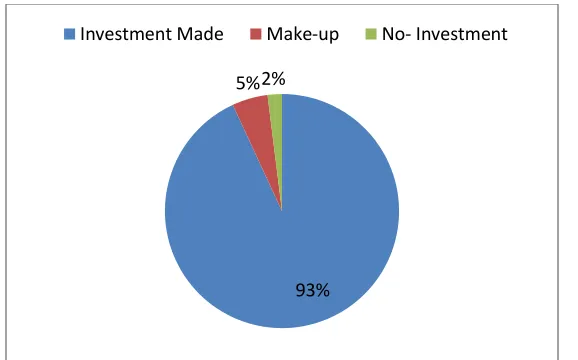
Investment status of the village
Among the 304 respondents who make up 92.9% of the respondents believe that investment has been made in their rural areas and 5% of the respondents make up 2.1% of the respondents believe that no investment has been made in their rural areas.
30%
70%
Single Married
35%
21% 25%
19%
15-30
31-45
46-60
27 Chart 4: Distribution of respondents in terms of investment status in the village
Respondents' employment status
Among the 12 respondents who make up 5.1% of total respondents are unemployed. The 85 people who make up 36.3% of all respondents are farmers and gardeners. 36 people, accounting for 16.2% of all respondents, are herders. 19 people, who make up 8.1% of the respondents, are employees. 51 people who make up 21.8% of all respondents are housewives. 29 respondents, accounting for 12.4% of all respondents, marked the option of other jobs.
Descriptive statistics of entrepreneurship interviewees
As mentioned in previously, the criterion for selecting individuals as an innovation entrepreneur was to innovate a new business or apply new methods and methods in a previous activity. Descriptive statistics of the interviewees are as follows:
Table 1 - Gender segregation of interviewees Frequency
Gender
9 Male
Female 1
As the table shows, the majority of entrepreneurs are men and there is only one woman in the field of entrepreneurs.
Table 2- Age range of interviewees F
Age
4 30-40
2 40-50
3 50-60
1 Over 60
The table above shows the largest number of entrepreneurs in the age group of 30 to 40 years, which represents the motivation and talent of the young population to create entrepreneurship and entrepreneurship. After that, the age range of 50 to 60 is the largest.
93% 5% 2%
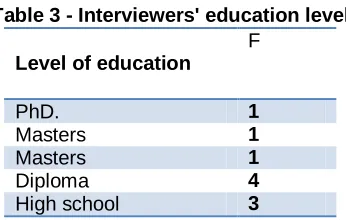
28 Table 3 - Interviewers' education level
F Level of education
1 PhD.
1 Masters
1 Masters
4 Diploma
3 High school
Of the entrepreneurs, three are college educated, and the majority of entrepreneurs are those with no college education.
Interviewees’ field of work
Most of the entrepreneurs in the field of agriculture and tourism have the most people. Farmers have started to innovate and change their practices by changing the methods of cultivation as well as cultivating new crops (eg: medicinal plants, Alvora, etc.).
Table4.Interviewees’ field of work F
Activity
4 Tourism
1 Industry
4 Agriculture
1 Others
Investigating the first research questions
RQ1: What are the characteristics of rural entrepreneurs and under what conditions does entrepreneurship in rural areas succeed?
To understand this, the researcher sought to find a meaningful relationship between economic development and social and cultural development with entrepreneurial investment.
Table 5 Pearson correlation coefficient between economic development and investment in Zavidat village
Variable Economic Status
Correlation Coefficient 0/303
Economic Development
Significance level 0/001
Number 132
29 Table 6. Chi-square coefficient between economic development and investment in Zavidat village
The
significance level
Xi statistic Degree of
freedom error
value
0/0001 1/719
76 0/05
Since the level of significance is 0.0001 and is smaller than the error of 0.05, then there is a significant relationship between economic development and investment in Zavidat village with 99% confidence. So the meaning is confirmed.
Table7. Pearson correlation coefficient between social and cultural development and amount of investment in Am-nosheh village
Variable Economic Status
Correlation coefficient 0/604
Social and cultural development
Significance level 0/0001
Frequency 172
This table shows that there is a positive and significant relationship between social and cultural development and the amount of investment in Am-nosheh village (0.0001). In other words, as the level of investment in the village of Am-nosheh rises, so too will social and cultural development, and be in a better position to do so.
Table 8. Chi-square coefficient between social and cultural development and amount of investment in Am-Nosheh village
Significance level Xi statistic
Degree of freedom Error
Value
0/0001 3/001
76 0/05
Since the level of significance is 0.0001 and is smaller than the error of 0.05, then with 99% confidence, there is a significant relationship between social and cultural development and the amount of investment in the village of Am-nosheh, so the research question is confirmed. Given the results of these two significant relationships between economic development, social and cultural development, and the amount of entrepreneurial investment, we can answer the basic research question: Does entrepreneurship in Am-nosheh village lead to rural development? In the relationships mentioned above, we can say that there is a significant relationship between rural entrepreneurship and rural development.
Investigating the second research question
RQ2: Does entrepreneurship in Zavidat and Am-nosheh villages lead to rural development?
30 Variable amount of investment
Table 9. Pearson correlation coefficient between economic and social status of women and amount of investment in Zavidat village
economic status Variable
0/205 Correlation
Variable amount of
investment Sig. level 0/002
132 N
Table 10 shows that there is a positive and significant relationship between economic and social status of women and the amount of investment in Zavidat village (0.002). In other words, as the level of investment in the village of Zavidat increases, the economic and social status of women is in a more favorable condition, thus meaningfully confirmed.
Table10. Chi-square coefficient between economic and social status of women and amount of investment in Zavidat village
Sig. Level Xi statistic Degree of Freedom Error Value 0/0001 94/668 56 0/05
Since the level of significance is 0.0001 and is smaller than the error of 0.05, then 95% confidence can be said that there is a significant relationship between the economic and social status of women and the amount of investment in the village of Am-nosheh.
Based on the tests, we conclude that the impact of rural entrepreneurship has had an impact on the status and status of women and other groups, resulting in improved economic and social status.
Table 11. Pearson correlation coefficient between economic and social status of women and amount of investment in Am-nosheh village
economic status Variable
0/215 Correlation
Variable amount of
investment Sig. level 0/002
172 N
Table 10 shows that there is a positive and significant relationship between economic and social status of women and the amount of investment in Am-nosheh village (0.002). In other words, as the level of investment in the village of Am-nosheh increases, the economic and social status of women is in a more favorable condition, thus meaningfully confirmed.
Table12. Chi-square coefficient between economic and social status of women and amount of investment in Am-nosheh village
Sig. Level Xi statistic Degree of Freedom Error Value 0/0001 88/004 49 0/05
31 Discussion
This study examines and evaluates the impact of rural entrepreneurship on the rural development of Zavidat and Am-Nosheh villages and their surroundings and the surrounding area. The importance of rural development is due to its impact and relationship with economic growth and the establishment of social security. Entrepreneurship, because entrepreneurship can have an impact on improving the economic and livelihoods of villages by creating new employment opportunities and generating income. The results showed that there is a significant relationship between the amount of investment and economic development in the studied rural areas.
The researcher then assessed the social and cultural dimension of development, and therefore sought to determine whether there was a significant relationship between the amount of entrepreneurial investment and social and cultural development that resulted from the Pearson and Chi-square tests. Given the findings and the significant relationship between the amount of entrepreneurial investment with economic development as well as social and cultural development, we came to the conclusion and answer to the question that Zavidat and Am-nosheh villages and their surroundings have led to rural development. Investigating the relationship between variables, the results showed that there is a significant relationship between the amount of investment and the economic and social status of women in the studied rural areas. Entrepreneurship and its benefits have been directly and indirectly benefited.
High social capital and access to community grants, as well as a strong indigenous motivation to promote Zavidat and Am-Nosheh villages and their surroundings, with 8 in common, ranked second, reflecting the values of solidarity and social cohesion in small and rural communities. At the same time, competing with both eyes and eyes, they care about the excellence of their small community and those around them, and do not hesitate to support one another. The appropriate infrastructure came in third, reflecting the importance of the right facilities and infrastructure for rural development. These can maintain and even compete with more advanced rural areas.
In terms of weaknesses, lack of recognition and evaluation of work, lack of access to financial resources and lack of clarity and lack of transparency in the tasks were jointly ranked first. Lack of knowledge and awareness of the work is due to the essence of innovation and the attempt to innovate is ambiguous. Also lack of relevant expertise and experience leads to this weakness. Lack of access to finance as another weakness which is due to lack of knowledge, appreciation of work and lack of crisis management and predictive power could be effective item about this subject. Uncertainty about the tasks of individuals is another problem that most often arises in firms that have kinship relationships between its members. The objection is the lack of disclosure of what is considered a disadvantage.
As a final word, if we divide threats and weaknesses into negative ones and opportunities and strengths into positive ones, we can conclude that the two main reasons for the negative ones are mostly due to external factors (inappropriate economic climate, rules And incompatible government regulation) and the two main causes are the positive part of the internal factors (the existence of indigenous elites and innovators, high social capital and access to financial assistance).
This result illustrates the important influence of macro factors on micro and local factors, which disrupts existing talent in the region. Initiating rural entrepreneurship is a multidimensional strategy that involves education, training, business/support networks and building strong infrastructures to assist rural entrepreneurs in identifying rural business opportunities and develop new businesses. Strengthening the rural entrepreneurial system will speed up the establishment of self-sustained rural communities, increase sources of income, support development of infrastructure, build capacities, revitalize the rural community, and make a significant impact in alleviating poverty.
32 are problems for them. It makes a difference in destructive effect of bad economic climate on entrepreneurship. Heat and warmth have an innovative and entrepreneurial spirit.
The entrepreneur and quick impact enterprises project in Iran with the aim of fair distribution of resources, increasing non-oil production and exports, and enhancing entrepreneurship, job creation and increasing new job opportunities was approved by Council of Ministers in the fall of 2005 and was implemented in the winter of the same year (Mostofi and Abbasi, 2010). Based on the report of the Islamic Consultative Assembly Research Center, this project and other similar ones have not been successful (Azhdari, 2012). Paying attention to creating more employments by establishing new enterprises rather than maintaining them, neglecting the withdrawal of enterprises from activity cycle has led to the loss of opportunities, so that studies show that most of the small businesses fail in the early years of their establishment (Feyzpour et al., 2011; Azar et al., 2012; Parsa Pour et al., 2012).
Limitation
The observational and methodological limitations identified are low or unequal participation of particular sectors of the population. Not all participants lend themselves to observational study, interviews, meetings, etc. Divergences in the data collection of different case studies. Personal bias of observers and slow research.
Conclusion
The movement of entrepreneurship promotion and development in the past few decades has gone a long way in Iran, particularly in Zavidat and Am-nosheh villages. Both governments and various industrial promotion and support institutions are making considerable efforts to facilitate the process of emergence of new entrepreneurs for setting up enterprises in small scale sector. These efforts involved making attractive schemes for availability of finance and various other assistances including technical knowledge, training, sales, purchases, etc. It is believed that these efforts have made a favorable impact on the growth of these micro and small village enterprises in the State as well as in the region. The success of rural entrepreneurship depends solely on the well established institutional set-up and hence to meet the requirements of the rapidly expanding entrepreneurship in rural small scale industries and emergence of micro enterprises at village level and cottage industries in the country, the Govt. gave adequate institutional support and may well claim to have achieved some success in this sphere. The role of various institutions set up specially to promote the growth of entrepreneurship in rural areas and SSI in villages, is quite unique.
References
Adams, W. M. (1990), Green Development: Environment and Sustainabilityin the Third World. London: Rutledge.
Aidis, R.(2003), Entrepreneurship and Economics Transition, Tin Bergen Institute Discussion Paper: Factulty of Economics and Econometrics, University of Amsterdam.
Alison, M.(1990), Entrepreneurship and Economic Transition, Tin Bergen Institute Discussion Paper: Faculty of Economics and Econometrics, University of Amsterdam.
Allen, J.C, et al.(2003), Examination of Community Action Field Theory Model for Locality Based Entrepreneurship, Presented at the Annual Rural Sociological Society Meeting, Montreal, Canada. Azhdari, A. A. (2012). Evaluating and analyzing the performance of the executive order development of
early-stage and entrepreneurial businesses. Islamic Consultative Research Center; Office of Energy Studies, Industry and Mines, Serial No. 12678.
Blake, R, B.(2003), Regional and Rural Development Strategies in Canada, The search for solutions, Available at: www.carletion. Ca/.
GTZ(Gmbh Techinische Zusammenarbeit)(2003), Guide to Rural Economic and Eanterprise Development, Working Paper, Deutsche Gesellschaft from Finland, Jyaskyla University of applied Science, Finland, OECD/IMHE conference Copenhagen, Danmark.
33 Mirjam, V. P.(1999), Some Classic Views on Entrepreneurship, Journal Economist, Vol. 147, No. 3,
pp311-335.
Mohammed, N. A.,“Interest-Free Microfinance to Micro Entrepreneurs in Rural Bangladesh”, Research paper presented at the First International Microfinance Conference on Microfinance held at ULB Brussels on June 2-4, 2009.
Nanjunda, D.,“Rediscovering Rural Development: A Reflection on Potential and Prospects”, Sarup & Sons, Delhi, 2008.
Parker, S.C. The Economics of Entrepreneurship; Cambridge University Press: Cambridge, UK, 2009. Scott, L. et al. (2006), Entrepreneurial Communities: Lessons From 10 Rural Demonstrations in North
Carolina, Rural Center Project Team, California: Humboldt State University Arcata.
Shane, S.; Venkataraman, S. The promise of entrepreneurship as a field of research. Acad. Manag. Rev. 2000, 25, 217–226. [CrossRef]
Shyam Sunder; S.,“Economic Reforms and Rural Development in India”, Indian Journal of Agricultural Economics, Indian Society of Agricultural Economics, High Beam Research., 29 Aug. 2011, [Online] Available: http://www.highbeam. com 2004.
Smallbone, D., Welter, F.,“Conceptualizing Entrepreneurship in a Transition Context”, International Journal of Entrepreneurship and Small Business, Vol. 3, No. 2, Inder science, pp. 190-206, 2006.
Tolba, M. K. (1984), The Premises for Building a Sustainable Society-Address to the World Commission on Environment and Development, October. Nairobi: United Nations Environment Program (UNEP). Van Praag, C.M.; Versloot, P.H. What is the value of entrepreneurship? A review of recent research.
Small Bus. Econ. 2007, 29, 351–382.
Verheual, I. et al.(2001), An Eclectic Theory of Entrepreneurship, Tinbergen Institute Discussion Paper for Development Strategies, Max Planck Institute of Economics, Indiana University.