INTRODUCTION
In the course of many processes and phenom-ena occurring during water and sewage treatment, oxidation and reduction reactions are extremely important. Knowledge of the physicochemical parameters of water, such as pH or redox poten-tial (ORP), allows to specify, among others, the oxidation state of ions in water or the existence of certain chemical reactions. For example, cor-rosion of materials of the water supply system, oxidation of iron and manganese, nitrification and disinfection are described or depended on the re-dox reactions.
The redox conditions in water supply systems may be significantly different, from virtually an -aerobic to -aerobic. Therefore, in various locations of the water treatment and distribution system, speciation may have a wide range, depending on the water reaction and redox conditions (James et. al. 2014). Both water reaction and redox po-tential values are easily changing as a result of water contact with the outside environment. In waters of the higher potential, the redox system
has stronger oxidizing properties. Low level of redox potential causes the ions present in water, e.g. iron and manganese, remain in the low oxi-dation state. The ORP values for different redox systems allow to predict the direction of redox reaction, and choose the most suitable oxidant or reducer (Drobnik & Latour 2003).
Performing the ORP measurements in the treated water can be applied as a tool for pro-cess control and pollution index of a distribution system (Peiffer 2000). Hovewer, the ORP mea -surements, mostly improperly conducted and in-terpreted, are rarely used in the water supply and treatment industry. In the case of natural waters, the ORP measurement accuracy is usually much lower. Under certain conditions, measurements of redox potential in such waters may not even be possible. The causes of problems may be, among others, slow kinetics, mixed potentials, or dam-aged electrode (Peiffer 2000). The value of redox potential of a single reaction under equilibrium conditions can also be determined theoretically (calculated), but the activity of reacting specia -tion must be known. However, the use of such
THE IMPACT OF THE STRUCTURE OF THE ACTIVE MASS TO CHANGES
IN SELECTED PARAMETERS OF WATER
Robert Nowak1
1 Faculty of Civil Engineering, Environmental and Geodetic Sciences, Koszalin University of Technology, Koszalin, Poland, e-mail: [email protected]
Volume 17, Issue 5, Nov. 2016, pages 155–162
DOI: 10.12911/22998993/65465 Research Article
ABSTRACT
The paper presents the results from studies upon the influence of chemical structure of filtration masses used for the treatment of groundwater on the values of selected physicochemical parameters of water. The pH value of treated water and the redox potential are important in process the oxidation of iron and manganese compounds. These values may change as a result of water contact with filter materials. The value of zeta potential of filtration masses characterizing the surface charge of particles and their affinity to counter-ions, is also important. The study tested masses of different chemical structure, i.e. manganese ores and de-acidifying masses. Experiments were carried out at two different pH values of the model water. The results showed that the filtration masses affected the water quality and water treatment processes, and the type and magnitude of changes in physicochemical parameters are closely related to, among others, the chemical structure of the filter bed.
Keywords: chemical structure, active mass, water. Received: 2016.08.16
an approach in studies on natural or underground water is limited, which is emphasized by the au-thor of the present paper (Dobrzyński 2010). He points out two main reasons hindering the water as a whole in achieving the state of equilibrium. These are: the co-existence of multiple pairs of redox speciation in natural waters and the fact that they very rarely remain in redox equilibrium. Up-to-date studies (Appelo & Postma 2005) con-firm that in the absence of balance, simultane -ously redox speciation, typical for different en -vironments, e.g. dissolved oxygen with hydrogen sulfide, methane, or iron ion (II), can occur.
In comparable conditions, oxidation of Mn (II) ions present in water causes more problems than Fe (II), and it is also difficult in terms of energy (Morgan 2000). Manganese solubility in-creases in an acidic environment and under anaer -obic conditions. In neutral conditions, the redox potential has a stronger impact on the mobility of manganese than pH (Nadaska et al. 2010). Under aerobic conditions (shallow aquifers and surface water), manganese concentrations in water is usu-ally low and most often does not reach the limits of detection. This is due to the fact that under aer-obic conditions, manganese is present in the oxi-dized form, which is highly insoluble. With the water infiltration into deeper aquifers, the water and soil environment becomes more anaerobic. Under such conditions, manganese is released from minerals and is reduced to soluble form Mn (II). For these reasons, much higher concentra-tions of manganese are determined in deep wa-ters than in surface water or shallow groundwater (Nadaska et al. 2010).
The active filtration masses are used in groundwater treatment technology. These are manganese ores, alkalizing materials or natural minerals modified by introducing to their struc -ture manganese cations. The process of iron and manganese removal from water with the partici -pation of alkalizing materials can be effectively carried out even in the aquifer. The authors of the present work (Biedroń et al. 2013) concluded that the effective removal of iron and manganese from infiltrated water is determined by the pos -sibility of pH value and redox potential of the aquifer corrections. As a result of enrichment of rock-ground environment by layers of alkalizing materials, binding of aggressive carbon dioxide can be achieved. In such environment, oxidation of Fe(II) to Fe(III) occurs due to chemistry or bio-chemistry, and generated hardly-soluble iron (III)
compounds are retained on porous materials. The contact of ground water with alkalizing material results in elevating the pH value of water and its basic alkalinity, while decreasing the aggressive -ness of carbonic acid in water.
Subsequent parts of the work present and discuss the results of research, defining the size and direction of changes in the select-ed physicochemical parameters of the model water as a result of its contact with filtration masses of different chemical structure.
MATERIAL AND METHODS
The study was conducted using two commercially available active masses: G-1 and Hydrocleanit. The G-1 mass is a manganese ore comprising more than 75% of MnO2. This mass is produced according to Polish technology by means of a special manganese ore processing. Share of the mass in the total volume of the filter fill may range from 30% to 100% (manufacturer’s recommendations). When treating the water us-ing G-1 mass, water alkalization is not provided.
Hydrocleanit mass is characterized by a dif-ferent chemical structure. It consists mainly of magnesium and calcium oxides. During the water treatment, height of the bed should be controlled and, if necessary, supplemented, because the mass is consumed during operation. Hydrocleanit is sensitive to very low water pH, and at pH val -ues below 2 it is dissolved.
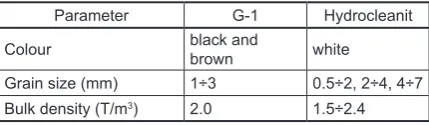
Basic physical parameters of studied active masses are presented in Table 1.
The aim of the study was to determine the influence of chemical structure of the active masses on values of selected physicochemical parameters of water containing manganese ions. Studies were carried out under static conditions at two values of the initial water pH (pH 7 and 9.5). Four different manganese concentrations in model water were accepted: 0.2, 1.0, 2.0, and 5.0 mg Mn/L. The scope of tests also included de-termination of the effect of iron ions presence in water. Iron concentration was 10 mg Fe/L. Tem-perature of solutions during testing was stable and amounted to approximately 25 °C. Changes in physicochemical parameters of water were de-termined by measuring the redox potential and
pH of model solution before and after contact of water with active masses.
Redox reactions, like all other chemical trans-formations, depend largely on the composition and concentration of a solution. For these rea-sons, in order to eliminate the impact of other fac-tors than assumed ones, the tests were conduct-ed using distillconduct-ed water. In order to prepare the model water, following solutions were prepared: MnSO4∙H2O at the concentration of 0.1 g/L, and FeSO4∙H2O at the concentration of 10 g/L. The required manganese concentration was obtained by introducing the appropriate amount of man-ganese sulfate into a graduated cylinder and ad-justing with water to 200 ml in the sample. The pH adjustment was carried out using NaOH. The pH-meter CX-551 (Adwa company) was used for measurements and the redox potential was mea-sured by applying plastic electrode. Active G-1 mass and Hydrocleanit were added into the water (1 g/200 ml each time). In order to achieve a fine material, particles of tested masses were ground in a bead mill. The samples prepared in such way were placed in a shaker LS (POL-EKO) and shak-en for 15 min at the speed of 230 rpm. Finally, samples were centrifuged in MPW-360 centrifuge (producer Centrifuge) for 15 min at 3800 rpm.
In physicochemical processes, the zeta po-tential value is a measure of the surface charge of particles and their affinity to counter ions (An -ielak 1998). Therefore, the value of zeta potential for the filter masses, is important. Zeta electro-kinetic potential measurements were carried out in 10 runs. Each of them consisted of electropho-retic mobility measurement of 20 particles. The value of the zeta potential for a given particle was calculated according to the Smoluchowski for-mula. Statistical zeta potential was determined on the basis of achieved values occurrence.
RESULTS AND DISCUSSION
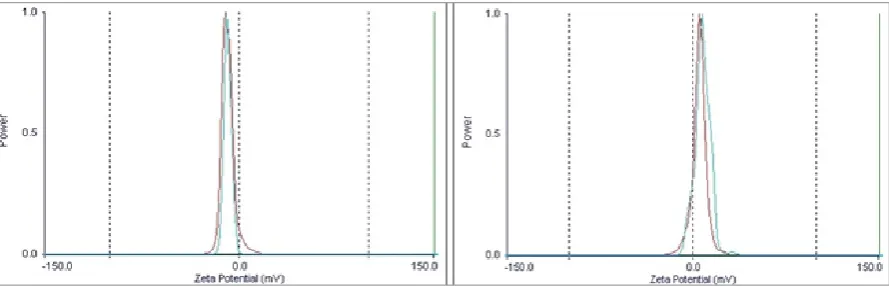
In the first part of the studies, zeta potential values were determined for the individual masses. The test results are shown in Table 2 and Figure 1.
Values in Table 2 are the arithmetic mean from two separate determinations of zeta potential (two graphs in Figure 1 for each of the active masses).
The results from tests showed that there are differences in the values of electro-kinetic poten -tial for particles of the studied filtration masses. A Table 1. Selected physical properties of the active
masses (based on the producers)
Parameter G-1 Hydrocleanit
Colour black and brown white
Grain size (mm) 1÷3 0.5÷2, 2÷4, 4÷7
higher absolute value of zeta potential character -izes particles of G-1. At a sample concentration of 20 mg/L, the potential averaged -9.27 mV. Lower potential value was determined for the mass Hy -drocleanit, i.e. 4.88 mV at pH 10.93. Particles of both masses did not show the dispersion stabil-ity. However, a greater ability to coagulate was shown by particles of Hydrocleanit mass. This is indicated by twice as high, compared to the G-1 mass, particle diameter, despite of their classifica -tion under equal condi-tions for both masses.
On the basis of the obtained results it is clear that Hydrocleanit mass particles exhibit lower catalytic properties than G-1 particles. A positive sign of the zeta potential proves that adsorption of cations on the surface of Hydrocleanit mass particles should be difficult. This means that the mechanism of a given mass action during the manganese removal from water is different. Chemical structure of mass Hydrocleanit shows that it consists in water alkalizing.
The results from test determining the influ -ence of active masses G-1 and Hydrocleanit con -tact on redox potential value of a model solution are presented below. The presence of manganese ions in water (tested concentrations: 0.2, 1, 2, and 5 mg Mn/L) as well as the presence (or absence) of iron ions (10 mg Fe/L) was taken into account.
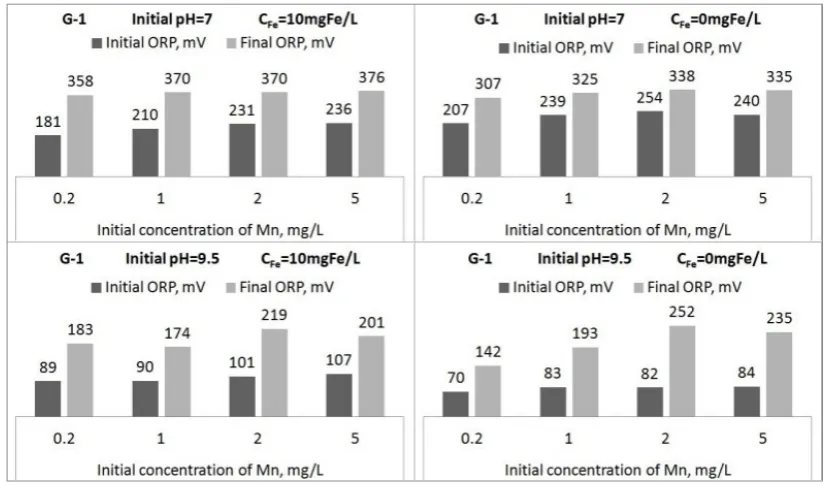
The data include results from studies for solutions characterized by neutral (pH=7) and alkaline re-action (pH=9.5). Changes in potential values of model water due to its contact with particles of G-1 active mass are presented in Figure 2.
The study showed that there was a significant increase in the redox potential of model water as a result of its contact with the G-1 active mass. Such relationship was found both at neutral and alkaline pH of test solution. The observed chang -es indicated an increase in the oxidizing proper-ties of the solution, which in the case of G-1 mass application for water treatment would mean bet-ter results of manganese removal.
It should be noted that during the model wa-ter contact with G-1 mass, the level of redox po -tential was strongly dependent on the water pH value. At pH 9,5 final potential found in the solu -tion was much lower than the one characterized by neutral reaction.
Iron ions may aid or impede the oxidation of manganese. In the case of G-1 active mass, the presence of iron in model water affected the value of solution redox potential, and the parameter determining the change direction was pH of the model solution. At neutral pH of a solution con-taining manganese besides iron ions, there was a higher potential growth than in water that did not contain Fe. An inverse relationship was record -ed in alkaline water. Negative influence of iron is associated with lower redox potential for the system Fe2+/Fe3+ than for Mn2+/Mn4+ and occurs when iron is present in water in a dissolved form (bivalent ions). Under such conditions, manga -nese oxidation takes place after prior iron oxida-tion. Other dependencies occur in the case of iron presence in non-dissolved form (as hydroxides). Therefore, iron may be an additional surface, onto which manganese ions could be adsorbed (Nawrocki 2010).
Table 2. Zeta potential values for particles of masses G-1 and Hydrocleanit along with conditions of measurement
Parameter G-1 Hydrocleanit
Zeta potential, mV -9.27 4.88
Particle size, nm 1195 2348
Concentration, mg/L 20 103
pH 6.10 10.93
Temperature, °C 25 25
Electric filed intensity, V/cm 14.4 15.8
Changes in model water pH values observed during its contact with G-1 mass (Tables 3 and 4) were also associated with the composition of the model water. The effect on the final pH of water was exerted, in addition to the initial reaction, by manganese concentration and iron ions presence.
The final pH of water was stable, though lower than initial one (pH about 6.1÷6.2) in the neutral solution and in the presence of iron ions. In the absence of iron ions in water, a continuous trend of decreasing the water pH with increasing concentrations of manganese (up to pH 6.71 at 5 mg Mn/L) was recorded.
In alkaline reaction, the contact of solution with G-1 mass resulted in a decrease in water pH value. Such tendency was present for all tested manganese
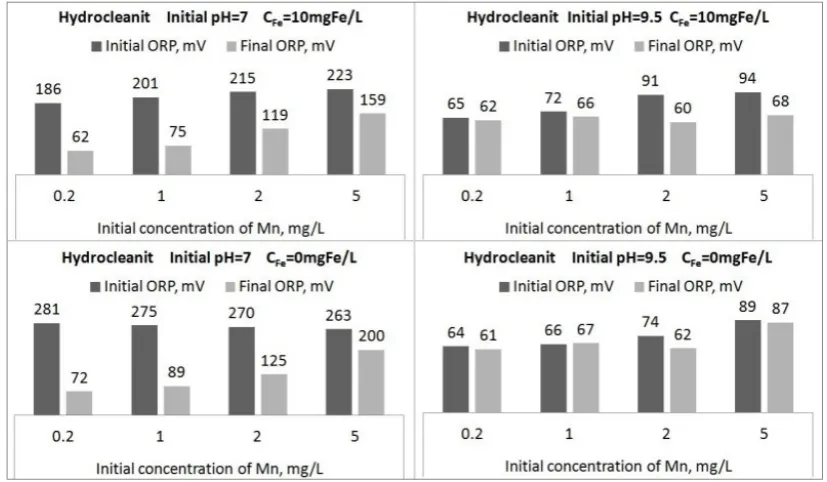
concentrations in water. More intensive changes were observed in water containing iron ions. Fig -ure 3 presents redox potential values for model water resulting from its contact with particles of Hydrocleanit active mass.
The study results showed that both in the so-lution with the initial pH = 7, and in the alkaline solution (pH 9.5), the redox potential decreased as a result of contact with the Hydrocleanit mass. This is a distinct trend in relation to that observed for the G-1 mass. The recorded decrease in the potential value was lower at higher manganese concentrations in water. This relation relates pri-marily to a neutral solution.
Comparison of the relevant data contained in Figure 3 clearly shows the dependence of the redox potential on the solution pH. The mea-sured values of potential and the nature of the solution oxidizing properties changes as a result of its contact with mass Hydrocleanit are much lower at pH 9.5 than at pH = 7.
The pH of the solution was changing due to the contact with Hydrocleanit mass (Tables 5 and 6). The amount of variations was strongly dependent on the initial pH value of water. When the pH of the model water was neutral, the alkalizing effect of the active mass was observed, which resulted in an increase in pH of the final solution. At the same time, the intensity of water pH value changes decreased along with increasing manganese con-centration (however, it remained above the initial Table 4. The pH values of water after contact with
G-1 active mass. Initial pH = 9.5.
Parameter Initial concentration of Mn, mg/L
0.2 1.0 2.0 5.0
Final pH (with Fe) 8.64 8.81 8.12 8.21
Final pH (no Fe) 8.91 8.74 8.12 7.64
Table 3. The pH values of water after contact with ac-tive G-1 mass. Initial pH = 7
Parameter Initial concentration of Mn, mg/L
0.2 1.0 2.0 5.0
Final pH (with Fe) 6.22 6.24 6.09 6.11
Final pH (no Fe) 7.19 7.01 6.79 6.71
pH up to 5 mg Mn/l). This tendency was more pro-nounced in water containing no iron ions (Table 5). For a solution with an initial pH 9.5 (Table 6), the values of a final reaction were slightly higher (about 9.8÷9.9) and stable, regardless of manga -nese concentration and iron ions presence in water. In order to compare the impact of the active masses on changes in redox potential of the solu-tion, Figures 4 and 5 summarize the test results ob-tained for the mass G-1 and Hydrocleanit. Figure 4 shows the relationships obtained during tests for the model solutions containing iron ions. Figure 5 illustrates the redox potential changes taking place as a result of the active masses contact with the model solution, in which iron ions were absent.
Values of the redox potential presented in fig -ures 4 and 5 clearly confirmed the fact that the tested active masses influenced the physicochem -ical properties of water in different ways. In the case of G-1 mass under all processing conditions (various manganese concentrations, presence and absence of iron ions, neutral and alkaline reaction), a significant increase in the redox po
-tential of the solution resulting from the contact of water with particles of a given mass, was re -corded. Potential values were higher along with increasing manganese concentrations in water. The greatest changes were observed in the neu -tral environment. The impact of Hydrocleanit mass on oxidizing properties of the model solu-tion was different. Regardless of the model solu -tion composi-tion, contact with particles of that mass not only did not increase the solution po-tential, but in virtually all cases resulted in low -ering its value. This relationship was particularly evident in the neutral reaction.
In the case of Hydrocleanit mass, the pres-ence of iron ions appeared to be especially impor-tant for changes intensity of the redox potential in the model water characterized by an alkaline reaction (Figure 5). Under such conditions, virtu -ally no changes in the redox potential of the so-lution upon contact with a given mass particles, were recorded. At the same time, under similar processing conditions, the G-1 mass significantly increased the level of water potential.
Table 5. The pH values of water after contact with Hydrocleanit active mass. Initial pH = 7.
Parameter Initial concentration of Mn, mg/L
0.2 1.0 2.0 5.0
Final pH (with Fe) 9.84 9.61 8.77 8.21
Final pH (no Fe) 9.81 9.46 8.60 7.78
Table 6. The pH values of water after contact with Hydrocleanit active mass. Initial pH = 9.5
Parameter Initial concentration of Mn, mg/L
0.2 1.0 2.0 5.0
Final pH (with Fe) 9.79 9.84 9.92 9.91
Final pH (no Fe) 9.89 9.93 9.96 9.97
CONCLUSIONS
1. Filtration masses affect the water qual -ity and its treatment processes. The inten-sity and direction of changes occurring in water during manganese and iron removal with the use of active masses, largely depend on their chemical structure.
2. It was also a clear relationship between the values of physicochemical parameters, such as zeta potential of active masses particles, redox potential, and pH value of the model solution vs. the course of water treatment processes in the presence of filtration masses.
3. In the case of active masses, the structure of which includes insoluble manganese oxides Figure 5. Influence of active mass type and water reaction (pH 7 and 9.5) on redox potential values during
man-ganese removal from water in the absence of iron ions
(G-1 mass), size and negative sign of zeta po -tential indicate a catalytic action of such mass during the manganese removal out of the water. These findings confirmed the results of water redox potential measurements. The redox po-tential of water increased through the contact with G-1 mass, which has been observed under all test conditions. The increase in the potential value proved the stronger oxidizing properties of the tested solutions. It must therefore be as-sumed that the process of manganese removal in the presence of G-1 mass will run effective -ly. At low values of water redox potential, iron or manganese ions present would remain at a low oxidation state, i.e. dissolved in the water. Their removal by means of catalytic oxidation would be difficult under such conditions. 4. A positive sign of zeta potential value found
for the Hydrocleanit mass suggests a different mechanism of manganese removal from water using a given mass. Action of the mass is based on water alkalizing. This type of interaction is also indicated by the size and direction of changes in the redox potential observed as a re -sult of water contact with Hydrocleanit mass. The redox potential, and thus the oxidizing properties of the solution, decreased as a result of contact with a given mass.
REFERENCES
1. Anielak, A.M. 1998. Znaczenie potencjału elek-trokinetycznego w fizykochemicznych procesach rozdziału faz. Mat. Sympozjum nt.: Oczyszczanie wody i ścieków oraz unieszkodliwianie odpadów. Politechnika Gdańska.
2. Anielak, A.M. & Nowak, R. 2002. Influence of fil-tration bed building on microorganisms develop-ment from Siderrocapsaceae family in the process of manganese and iron removal from water. Envi-ronment Protection Engineering. 3(28), 27–40. 3. Apello, C.A.J. & Postma, D. 2005. Geochemistry,
groundwater and pollution. 2-nd edition. Leiden, London, New York, Philadelphia, Singapore. Balkema Publishers.
4. Barlokova, D. & Ilavsky, J. 2010. Removal of iron and manganese from water using filtration by natural materials. Polish Journal of Environmental Studies. 19(6), 1117–1122.
5. Biedroń, I., Świderska-Bróż, M., Traczewska, T.M., Trusz-Zdybek, A. & Wolska, M. 2013. Wpływ rodzaju materiału filtracyjnego na zmiany wartości wybranych wskaźników jakości wody
podziemnej. Rocznik Ochrona Środowiska. 15, 845–862.
6. Dobrzyński, D. 2010. Badania potencjału re-doks na przykładzie sudeckich wód leczniczych. Przegląd Geologiczny. 58(1), 46–53.
7. Drobnik, M. & Latour, T. 2003. Badania wpływu procesów technologicznych w toku produk-cyjnym wód butelkowanych na ich właściwości utleniająco-redukcyjne. Rocznik PZH. 54(3), 275–285.
8. James, Ch.N., Copeland, R.C. & Lytle, D.A. 2014. Relationships between oxidation-reduction potential, oxidant, and pH in drinking water. AWWA Water Quality Technology Conference. San Antonio.
9. Jeż-Walkowiak, J., Dymaczewski, Z. & Sozański, M. 2011. Parametry technologiczne procesu filtracji pospiesznej wód podziemnych przez złoża oksyda-cyjne i chemicznie nieaktywne. Inżynieria Ekolog-iczna. 26, 112–121.
10. Morgan, J. J. 2000. Manganese speciation and re-dox kinetics in natural waters. Manganese and its role in biological processes. Ed. Sigel A., Sigel H., Dekker M., New York, 1–34.
11. Nadaska, G., Lesny, J. & Michalik, I. 2010. En-vironmental aspect of manganese chemistry. Hungarian Electronic Journal of Sciences, ENV-100702-A. http://heja.szif.hu/ENV.
12. Nawrocki, J. 2010. Uzdatnianie wody. Procesy fi-zyczne, chemiczne i biologiczne. PWN Warszawa. 13. Nowak, R. 2013. Wpływ wybranych składników
uzdatnianej wody na skuteczność jej odmangania-nia w obecności mas aktywnych. Rocznik Ochrona Środowiska. 15, 25–50.
14. Ormanci, T., Turkoglu Demirkol, G., Aydın, I. & Tufekci, N. 2013. An experimental study on manganese(II) removal with manganese dioxide recycling. Desalination and Water Treatment. 51, 2225–2230.
15. Peiffer, S. 2000. Characterization of the redox state of a aqueous systems: Towards a problem-oriented approach. Redox Fundamentals, Processes and Ap-plications, M.H.W. Springer. Berlin, 24–41. 16. Piispanen, J.K. & Sallanko, J.T. 2010. Mn(II)
re-moval from groundwater with manganese oxide-coated filter media. Journal of Environmental Sci-ence and Health. 13(45), 1732–1740.
17. Scott, M.J. 1991. Kinetics of adsorption and redox processes on iron and manganese oxides: reactions of As (III) and Se(IV) at Goethite and birnessite surfaces. EQL REPORT. 33.