www.theoryofcomputing.org
NOTE
The Complexity of the Fermionant and
Immanants of Constant Width
Stephan Mertens
Cristopher Moore
Received November 11, 2011; Revised January 20, 2013; Published February 26, 2013
Abstract: In the context of statistical physics, Chandrasekharan and Wiese recently intro-duced thefermionantFermk, a determinant-like function of a matrix where each permutation
π is weighted by−kraised to the number of cycles inπ. We show that computing Fermk is
#P-hard under polynomial-time Turing reductions for any constantk>2, and is⊕P-hard fork=2, where both results hold even for the adjacency matrices of planar graphs. As a consequence, unless the polynomial-time hierarchy collapses, it is impossible to compute the immanant ImmλAas a function of the Young diagramλ in polynomial time, even if the width ofλis restricted to be at most 2. In particular, unlessNP⊆RP, Ferm2is not inP, and there are Young diagramsλ of width 2 such that Immλ is not inP.
ACM Classification:F.2.1
AMS Classification:68Q17
Key words and phrases: fermionant, immanant, partition function, statistical physics, determinant, permanent, computational complexity, graph theory, representation theory
1
Introduction
The permanent and determinant of a matrix have deep and well-known connections with statistical physics. Physicists are generally concerned with a type of generating function called thepartition function,
Z=
∑
sIf the system consists ofnsites each of which has a spin that can point up or down, say, this sum ranges over all 2nstatessof the system. The summand is the Boltzmann factor, whereE(s)is the energy and
β
is the inverse temperature. Virtually any physical quantity can then be written as a derivative ofZwith respect to an appropriate variable, representing the physical interactions in the system.
In a number of systems of physical interest, such as the Ising model of magnetism,Zcan be rewritten as a sum over all perfect matchings of a weighted graph, where the weight of each matching is the product of the (possibly complex-valued) weights of its edges. In the bipartite case, this sum is the permanent of the weighted adjacency matrix. But in the planar case, the weights can be modified in such a way that this permanent (or in the non-bipartite case, a Pfaffian) becomes a determinant. Computing the partition function is then a simple matter of finding the eigenvalues of this matrix, and indeed this is one way to derive the celebrated exact solution of the Ising model in two dimensions [20, Ch. 13].
Inspired by these connections, Chandrasekharan and Wiese [10] recently showed that the partition functions of certain models in quantum statistical physics can be written in terms of a quantity they call thefermionant. LetAbe ann×nmatrix. ThefermionantofA, with parameterk, is defined as
FermkA= (−1)n
∑
π∈Sn
(−k)c(π) n
∏
i=1 Ai,π(i).
HereSndenotes the symmetric group, i. e., the group of permutations ofnobjects, andc(π)denotes the number of cycles inπ. This raises the interesting question of whether the fermionant can be computed in
polynomial time, especially in the casek=2, which corresponds to fermionic systems. Since(−1)n+c(π)is also the parity of
π, the fermionant fork=1 is simply the determinant, which
can of course be computed in polynomial time. But this appears to be the only value ofkfor which this is possible. We prove the following:
Theorem 1.1. For any constant k>2, computingFermkfor the adjacency matrix of a planar graph is
#P-hard under polynomial-time Turing reductions. Moreover, unlessNP⊂RP, for k>2there can be no fully polynomial randomized approximation scheme (FPRAS) that computesFermkwithin a multiplicative error1+εin time polynomial in n and1/ε with probability at least3/4.
Our proof consists of a reduction to the fermionant from certain values of the Tutte polynomial for planar graphs.Theorem 1.1then follows from Vertigan’s results [24] on the#P-hardness of planar Tutte polynomials, and the recent results of Goldberg and Jerrum [14] on their inapproximability.
For the most physically relevant casek=2, we have a slightly weaker result. Recall that⊕Pis the class of problems of the form “is|S|odd,” whereSis a set such that we can tell whetherx∈Sin polynomial time.
Theorem 1.2. ComputingFerm2for the adjacency matrix of a planar graph is⊕P-hard.
By Toda’s theorem [21], the polynomial-time hierarchyPHreduces to⊕Punder randomized polynomial-time reductions. Therefore, unlessPHcollapses, and indeed unlessNP⊂RP, Ferm2is not inP.
Theorems1.1and1.2also imply new hardness results for theimmanant. Recall that aYoung diagram
diagram isλ1, and itsdepthis the largesttsuch thatλt>0. Each Young diagram is associated with an irreducible characterχλ ofSn, and the immanant Immλ of a matrixAis
ImmλA=
∑
π∈Snχλ(π) n
∏
i=1 Ai,π(i).
Ifχλ is the parity(−1)π or the trivial character 1, the immanant is the determinant or the permanent
respectively. Thus we can think of the immanant as interpolating, in some sense, from detAto permA. Since the determinant is inPbut the permanent is#P-hard [22,20], it makes sense to ask how the complexity of the immanant varies asλ’s Young diagram ranges from a single row of lengthn(the trivial representation) to a single column (the parity). Strengthening earlier results of Hartmann [15], Bürgisser [8] showed that the immanant is#P-hard ifλ is a hook or rectangle of polynomial width,
λ1=w,λ2=· · ·=λn−w+1=1 or λ1=· · ·=λn/w=w,
wherew=Ω(nδ) for some δ >0. Recently Brylinski and Brylinski [7] improved these results by
showing that the immanant is#P-hard whenever two successive rows have a polynomial “overhang,” i. e., if there is anisuch thatλi−λi+1=Ω(nδ)for someδ>0. The case whereλ has large width but
small overhang, such as a “ziggurat” whereλi=w−i+1 andn=w(w+1)/2, remains open.
At the other extreme, Barvinok [3] and Bürgisser [9] showed that the immanant is in P if λ is
extremely close to the parity, in the sense that the leftmost column contains all butO(1)of thenboxes. Specifically, [9] gives an algorithm that computes ImmλA in timeO(sλdλn2logn), wheresλ and dλ
are the number of standard and semistandard tableaux of shapeλ respectively. Recall that a standard
tableau is a labeling of the boxes of a Young tableau with the numbers 1,2, . . . ,nsuch that each row and column is strictly increasing. In a semistandard tableau, the columns are strictly increasing and the rows are nondecreasing. If the height ofλ isn−cwherec=O(1), thensλ anddλ are bounded above by
n c
√
c!=O(nc)and nc n+cc−1=O(n2c)respectively, giving a polynomial-time algorithm for Immλ. Any function of the cycle structure of a permutation is aclass function, i. e., it is invariant under conjugation. Since any class function is a linear combination of irreducible characters, the fermionant is a linear combination of immanants. Ifkis a positive integer, it has nonzero contributions from immanants whose Young diagrams have widthkor less:
FermkA=
∑
λd(k)
λ ImmλTA. (1)
Hereλ ranges over all Young diagrams with depth at mostk,dλ(k)denotes the number of semistandard
tableaux of shapeλ and content in{1, . . . ,k}, andλT denotes the transpose of a Young diagram, i. e., its
reflection around the diagonal:
λiT =max{j:λj≥i}.
To derive (1), first note that the class functionkc(π)is the trace of
π’s action on(Ck)⊗nby permuting the
coordinates of the tensor product,
By Schur duality (see,e. g., [13]) the multiplicity ofλ in(Ck)⊗nisd(k)λ , so
kc(π)=
∑
λ
d(k)λ χλ(π).
We then transformkc(π)to(−1)n(−k)c(π)by tensoring each
λ with the sign representation, flipping it to
its transposeλT, which has width at mostk.
Ifk=O(1), there areO(nk−1) =poly(n)Young diagrams of widthkor less. Thus for any constant
kthere is a polynomial-time Turing reduction from the fermionant Fermkto the problem of computing the immanant Immλ whereλ is given as part of the input, and whereλ has width at mostk. Therefore, Theorems1.1and1.2give us the following corollary.
Corollary 1.3. For any constant integer k, the problem of computing the immanantImmλA as a function of A andλ is#P-hard under polynomial-time Turing reductions if k≥3, and⊕P-hard if k=2, even if λ is restricted to Young diagrams with width k or less.
In particular, unless the polynomial-time hierarchy collapses, there exist diagramsλ of width 2 such that
Immλ is not inP. This is somewhat surprising, since these immanants are “close to the determinant” in some sense.
This partly answers a question of Bürgisser [8], who asked whether immanants of widthk=2 are VNP-complete in the arithmetic model. Indeed, we conjecture that the fermionant is#P-hard, as opposed to just⊕P-hard, whenk=2. Moreover, we conjecture that the immanant is#P-hard for any family of Young diagrams of depthn−Ω(nδ), or equivalently, any family with a polynomial number of boxes to
the right of the first column:
Conjecture 1.4. Letλ(n)be any family of Young diagrams of depth n−Ω(nδ)for some constantδ >0.
ThenImmλ(n)is#P-hard.
Roughly speaking, this would imply that the results of [3,9] showing that Immλ is inPifλ has depth n−O(1)are tight.
2
#P
-hardness from circuit partitions and the Tutte polynomial
Proof ofTheorem 1.1. Our proof consists of reduction from the Tutte polynomial to the fermionant, through the circuit partition polynomial. LetGbe a directed graph. Acircuit partitionofGis a partition ofG’s edges into circuits, i. e., sets of directed edges{(v1,v2),(v2,v3), . . . ,(vs,v1)}. Letrt denote the number of circuit partitions containingtcircuits; for instance,r1is the number of Eulerian circuits. The circuit partition polynomial j(G;z)is the generating function
j(G;z) =
∞
∑
t=1
rtzt. (2)
This polynomial was first studied by Martin [19], with a slightly different parametrization; see also [1,4,
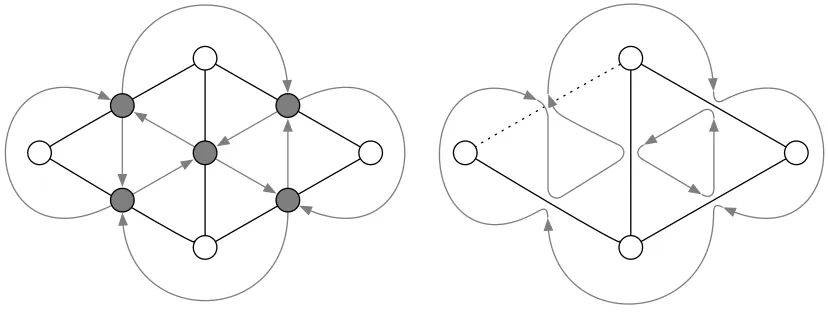
Figure 1: Left, a planar graphG(white vertices and black edges) and its medial graphGm(gray vertices and directed edges). Right, a subset of the edges ofG, and the corresponding circuit partition ofGm.
For planar graphs, j(G;z)has a known relationship with the Tutte polynomial [12,19] which we review here. Recall that the Tutte polynomial of an undirected graphG= (V,E)can be written as a sum over all spanning subgraphs ofG, i. e., all subsetsSofE,
T(G;x,y) =
∑
S⊆E(x−1)c(S)−c(G)(y−1)c(S)+|S|−|V|. (3)
Herec(G)denotes the number of connected components inG. Similarly,c(S)denotes the number of connected components in the spanning subgraph(V,S), including isolated vertices. Whenx=y,
T(G;x,x) =
∑
S⊆E(x−1)c(S)+`(S)−c(G), (4)
where`(S) =c(S) +|S| − |V|is the total excess of the components ofS, i. e., the number of edges that would have to be removed to makeSa forest.
IfGis planar, then we can define its directed medial graphGm. Each vertex ofGmcorresponds to an edge ofG, edges ofGmcorrespond to shared vertices inG, and we orient the edges ofGmso that they go counterclockwise around the interior faces ofG, and clockwise around the outside ofG(alternatively, we think ofGandGmas drawn on a sphere, in which case these edges go counterclockwise around the face consisting of the rest of the plane). Each vertex ofGmhas in-degree and out-degree 2, soGmis Eulerian. The following identity is due to Martin [19]; see also [17], or [2] for a review.
j(Gm;z) =zc(G)T(G;z+1,z+1). (5)
“bounces offe,” connecting each ofv’s incoming edges to the outgoing edge on the same side ofe. If
e∈/S, the partition crosses overein each direction. The number of circuits is thenc(S) +`(S), in which case (4) yields (5).
To reduce the circuit partition polynomial to the fermionant, we simply have to turn Eulerian-style circuit partitions, which cover each edge once, into Hamiltonian-style ones, which cover each vertex once. Given a directed graphG, letGebe its line graph. Each vertex ofGecorresponds to an edge(u,v)ofG, and there is an edge between(u,v)and(u0,v0)ifv=u0so that(u,v)and(u0,v0)could form a directed path of length two. Then each circuit partition ofGcorresponds to a permutationπof the vertices ofGe,
and
FermkAe=j(G;−k),
whereAeis the adjacency matrix ofGe. In particular, ifGis planar,Gmis its medial graph,Gm,eis the line graph ofGm(which is also planar) andAm,eis its adjacency matrix, then
FermkAm,e= (−k)c(G)T(G; 1−k,1−k). (6)
Having derived a reduction from the Tutte polynomial to the fermionant, we complete the proof by referring to known hardness results on the Tutte polynomial. Vertigan [24] proved that computing
T(G;x,y)for planar graphs is#P-hard under polynomial-time Turing reductions, except on the set
{x,y:(x−1)(y−1)∈ {1,2}} ∪ {(1,1),(−1,−1),(ω,ω∗),(ω∗,ω)},
whereω=e2πi/3is the cube root of unity. Moreover, Goldberg and Jerrum [14] showed thatT(G;x,y)
is inapproximable for planar graphs at many values ofxandy, and in particular in the regionx,y<−1. Then (6) implies that Fermk is#P-hard, and inapproximable, for anyk>2.
3
⊕
P
-hardness from Hamiltonian circuits
Proof ofTheorem 1.2. We will proveTheorem 1.2by showing that the fermionant Ferm2can be used to compute the parity of the number of Hamiltonian circuits in an undirected graph of sizen>4.
LetAbe the adjacency matrix of an undirected graphGwithnvertices and no self-loops or multiple edges. Each permutation π ∈Sn that gives a non-zero contribution to Ferm2(A) corresponds to a Hamiltonian-style circuit partition ofG; that is, a vertex-disjoint union of undirected cycles that includes every vertex. A 2-cycle inπ corresponds to a circuit that travels back and forth along a single edge. Any
circuit of length greater than 2 can be oriented in two ways, so a circuit partition withc22-cycles andc0 longer cycles corresponds to 2c0 permutations.
Taken together, these permutations contribute(−1)n(−2)c2(−4)c0 to Ferm
2A. This is a multiple of 8 unlessc0=0 andc2≤2, which impliesn≤4, or ifc2=0 andc0=1, which corresponds to a Hamiltonian cycle. In the latter case Ferm2Ais a multiple of 4 but not of 8. Thus ifn>4 we have
1
4Ferm2A≡2#H, (7)
computing #H mod 2 is⊕P-complete. Indeed, he showed this even in the case whereGis planar and every vertex has degree 2 or 3. Since (7) gives a reduction from⊕HAMILTONIANCIRCUITSto Ferm2, this shows that Ferm2is⊕P-hard as well.
More generally, Fermkis at least as hard as computing the number of Hamiltonian circuits modk. But fork≥3, our#P-hardness result fromTheorem 1.1is stronger.
4
Conclusion
Is the fermionant#P-hard fork=2? And are immanants#P-hard even for some Young diagrams of width 2, as inConjecture 1.4? For instance, is Immλ hard for the Young diagramλ of width 2 and height
n/2?
The reduction ofTheorem 1.1fails in this casek=2, since forx=y=−1 the Tutte polynomial is easy to compute [24]. In particular, ifG= (V,E)then
Ferm2Am,e= (−2)c(G)T(G;−1,−1) = (−2)c(G)(−1)|E|(−2)dimB.
Here dimBis the dimension ofG’sbicycle space—the set of functions fromE toZ2that can be written both as linear combinations of cycles and as linear combinations of stars—which we can determine in polynomial time using linear algebra.
However, there is no reason to think that we might not be able to prove#P-hardness for Ferm2using another reduction. After all, the number of Eulerian circuits of the medial graphGmis the number of spanning trees ofG, which is also inP—but Brightwell and Winkler showed that counting Eulerian circuits is#P-hard in general [6].
Finally, it is interesting that our proof of#P-hardness is an indirect reduction from, say, the chromatic polynomial, passing through the Tutte polynomial and its ability to perform polynomial interpolation (under polynomial-time Turing reductions) by decorating the graph. Thus another open question is whether there is a more direct reduction to the fermionant from the permanent or, say, #HAMILTONIAN
CIRCUITS.
Acknowledgments. This work was supported by the National Science Foundation grant CCF-1117426, and by the ARO under contract W911NF-09-1-0483. We are grateful to Uwe-Jens Wiese for telling us about the fermionant, and to Alex Russell, Leonard J. Schulman, Leslie Ann Goldberg, and David Gamarnik for helpful discussions.
References
[1] RICHARDARRATIA, BÉLABOLLOBÁS,ANDGREGORYB. SORKIN: The interlace polynomial
[2] ANDREA AUSTIN: The circuit partition polynomial with applications and relation to the Tutte and interlace polynomials.Rose-Hulman Undergraduate Mathematics Journal, 8(2):1:1–19, 2007.
http://www.rose-hulman.edu/mathjournal/v8n2.php. 277
[3] ALEXANDER I. BARVINOK: Computational complexity of immanents and representations of the full linear group. Functional Analysis and its Applications, 24(2):144–145, 1990. [doi:10.1007/BF01077707] 275,276
[4] BÉLA BOLLOBÁS: Evaluations of the circuit partition polynomial. J. Combin. Theory Ser. B, 85(2):261–268, 2002. [doi:10.1006/jctb.2001.2102] 276
[5] ANDRÉBOUCHET: Tutte-Martin polynomials and orienting vectors of isotropic systems. Graphs and Combinatorics, 7(3):235–252, 1991. [doi:10.1007/BF01787630] 276
[6] GRAHAMBRIGHTWELL ANDPETERWINKLER: Counting Eulerian circuits is #P-complete. In
Proc. 7th Workshop on Algorithm Engineering and Experiments and 2nd Workshop on Analytic Al-gorithmics and Combinatorics (ALENEX/ANALCO’05), pp. 259–262. SIAM Press, 2005. Available fromSIAM. 279
[7] JEAN-LUCBRYLINSKI ANDRANEEBRYLINSKI: Complexity and completeness of immanants. Technical report, 2003. [arXiv:cs/0301024] 275
[8] PETERBÜRGISSER: The computational complexity of immanants.SIAM J. Comput., 30(3):1023– 1040, 2000. Preliminary version inFPSAC’98. [doi:10.1137/S0097539798367880] 275,276
[9] PETER BÜRGISSER: The computational complexity to evaluate representations of general
lin-ear groups. SIAM J. Comput., 30(3):1010–1022, 2000. Preliminary version in FPSAC’98. [doi:10.1137/S0097539798367892] 275,276
[10] SHAILESHCHANDRASEKHARAN ANDUWE-JENS WIESE: Partition functions of strongly corre-lated electron systems as “fermionants”. Technical report, 2011. [arXiv:1108.2461] 274
[11] JOANNAA. ELLIS-MONAGHAN: New results for the Martin polynomial. J. Combin. Theory Ser. B, 74(2):326–352, 1998. [doi:10.1006/jctb.1998.1853] 276
[12] JOANNAA. ELLIS-MONAGHAN ANDIRASEMA SARMIENTO: Distance hereditary graphs and the interlace polynomial. Combinatorics, Probability & Computing, 16(6):947–973, 2007. [doi:10.1017/S0963548307008723] 277
[13] WILLIAMFULTON ANDJOEHARRIS: Representation Theory: A First Course. Springer, 2004. Available fromSpringer. 276
[14] LESLIE ANNGOLDBERG ANDMARKJERRUM: Inapproximability of the Tutte polynomial of a planar graph. Comput. Complexity, 21(4):605–642, 2012. [doi:10.1007/s00037-012-0046-4] 274,
278
[16] FRANÇOISJAEGER: On Tutte polynomials and cycles of plane graphs. J. Combin. Theory Ser. B, 44(2):127–146, 1988. [doi:10.1016/0095-8956(88)90083-4] 276
[17] MICHEL LAS VERGNAS: On Eulerian partitions of graphs. Research Notes in Mathematics, 34:62–75, 1979. 276,277
[18] MICHELLASVERGNAS: On the evaluation at(3,3)of the Tutte polynomial of a graph. J. Combin. Theory Ser. B, 45(3):367–372, 1988. [doi:10.1016/0095-8956(88)90079-2] 276
[19] PIERRE MARTIN: Enumérations eulériennes dans les multigraphes et invariants de Tutte-Grothendieck. Thesis, Université Scientifique et Médicale de Grenoble, 1977. Available inArchives Ouvertes. 276,277
[20] CRISTOPHERMOORE AND STEPHAN MERTENS:The Nature of Computation. Oxford University Press, 2011. [ACM:2086753] 274,275
[21] SEINOSUKETODA: PP is as hard as the polynomial-time hierarchy. SIAM J. Comput., 20(5):865–
877, 1991. Preliminary version inFOCS’89. [doi:10.1137/0220053] 274
[22] LESLIEG. VALIANT: The complexity of computing the permanent.Theoret. Comput. Sci., 8(2):189– 201, 1979. [doi:10.1016/0304-3975(79)90044-6] 275
[23] LESLIEG. VALIANT: Completeness for parity problems. InProc. 11th Ann. Internat. Computing and Combinatorics Conf. (COCOON’05), pp. 1–8. Springer, 2005. [doi:10.1007/11533719_1] 278
[24] DIRKL. VERTIGAN: The computational complexity of Tutte invariants for planar graphs. SIAM J. Comput., 35(3):690–712, 2005. [doi:10.1137/S0097539704446797] 274,278,279
AUTHORS
Stephan Mertens Professor
Institute for Theoretical Physics
Otto-von-Guericke University Magdeburg, Germany External Professor
Santa Fe Institute mertens ovgu de
http://www.ovgu.de/mertens
Cristopher Moore Professor
Santa Fe Institute moore santafe edu
ABOUT THE AUTHORS
STEPHANMERTENSreceived his Ph. D. in Physics from Georg-August-University Göttingen, Germany in 1991. His Ph. D. advisor wasAnnette Zippelius, and his thesis was on the theory of neural networks, which back then was very fashionable. His current research focuses on phase transitions in computational problems, algorithms for hard problems in statistical physics, and parallel computing. With Cristopher Moore he is the author of The Nature of Computation.