Antistreptolysin O titer in
health and disease: levels and
significance
Alyaa Amal Kotby, Nevin Mamdouh Habeeb, Sahar Ezz El Elarab
Pediatric Department, Ain Shams University, Early Cancer Detection Unit Ain Shams University Hospital, Cairo, Egypt
Abstract
Over diagnosis of acute rheumatic fever (ARF) based on a raised antistreptolysin O titer (ASOT) is not uncommon in endemic areas. In this study, 660 children (aged 9.2 ±1.7 years) were recruited consecutively and classified as: G1 (control group, n=200 healthy children), G2 (n=20 with ARF 1st attack), G3 (n=40 with recurrent ARF), G4 (n=100 with rheumatic heart disease (RHD) on long acting penicillin (LAP)), G5 (n=100 with acute follicular tonsilli-tis), and G6 (n=200 healthy children with histo-ry of repeated follicular tonsillitis more than three times a year). Serum ASOT was measured by latex agglutination. Upper limit of normal (ULN) ASOT (80thpercentile) was 400 IU in G1, 200 IU in G4, and 1600 IU in G6. Significantly high levels were seen in ARF 1st attack when compared to groups 1 and 5 (P<0.001 and P<0.05, respectively). ASOT was significantly high in children over ten years of age, during winter and in those with acute rheumatic cardi-tis. ASOT showed significant direct correlation with the number of attacks of tonsillitis (P<0.05). Egyptian children have high ULN ASOT reaching 400 IU. This has to be taken into consideration when interpreting its values in suspected ARF. A rise in ASOT is less prominent in recurrent ARF compared to 1st attack, and acute and recurrent tonsillitis. Basal levels of ASOT increase with age but the pattern of increase during infection is not age dependent.
Introduction
Although acute rheumatic fever (ARF) is rel-atively rare in developed economies, it is much more common in the developing world and among aboriginal populations.1 It has been estimated that worldwide 15.6 million people have RHD.2 Regions of major public health concern include the Middle East, the Indian subcontinent, and some areas of Africa and South America.3The prevalence of RHD was reported to be 5.1 per 1000 in school children
in Egypt.4In addition, the course of ARF was found to be severe and aggressive in different parts of the country where rheumatic fever is still one of Egypt’s major public health prob-lems.5,6
Evidence of a host immune response to group A βhemolytic streptococcal throat infec-tion (GAβHS) is required to confirm the diag-nosis of rheumatic fever.7,8Although ASOT has been used to diagnose recent infection, inter-pretative criteria suggested by manufacturers of commercial antibody test kits are not suit-able for children. It is not uncommon for labo-ratory personnel and physicians to misinter-pret streptococcal antibody titers because of a failure to appreciate that the normal levels of these antibodies are higher among school-age children than among adults.9 Moreover, it is often not feasible to obtain acute and convales-cent sera. Thus, the absolute value of ASO is of diagnostic importance.10
Upper limit of normal (ULN) values of ASOT are known to vary also with respect to different geographical locations, season, and site of infection. (11,12) Since over diagnosis of ARF based on a raised ASOT is not uncommon, the ULN value of ASO in normal children is of importance to interpret ASO titers in patients suspected to have ARF.
This study aimed to determine ASOT in nor-mal children and in those with rheumatic fever and tonsillitis. The variation of ASOT with age and season was also studied.
Materials and Methods
This is a cross-sectional case control study conducted on 660 patients chosen consecutive-ly from the Children’s Hospital and Pediatric Cardiology clinic, Ain Shams University Hospital, a tertiary referral center in Cairo.
Subjects were classified into six groups. Group 1: 200 apparently healthy children with no history of recent tonsillitis or sore throat served as a control group;
Group 2 (ARF): 20 cases in the 1stattack of ARF, diagnosed according to updated modified Jones criteria;8
Group 3 (recurrent RF): 40 patients with recurrent ARF, diagnosed according to updated modified Jones criteria for recurrent rheumat-ic fever.8,13They were non compliant to the LAP prophylaxis;
Group 4 (chronic RHD): 100 patients with chronic RHD, all of whom had mitral regurge with or without aortic regurge. They recieved LAP every two weeks based on the 1992 recom-mendations of Kassem et al.5 These patients had no history of acute follicular tonsillitis or rheumatic activity within three months prior to enrollment in the study.
Group 5 (acute follicular tonsillitis): 100
patients with acute follicular tonsillitis. Their inclusion criteria were: fever over 38°C, tender anterior cervical lymphadenopathy, lack of cough and the presence of pharyngotonsillar exudates.14
Group 6 (history of recurrent follicular ton-sillitis): 200 apparently healthy normal chil-dren with past history of repeated follicular tonsillitis more than three times a year. Children with proven attack of acute follicular tonsillitis within the three months before enrollment in the study were excluded.
Each group was sub-classified into three subgroups according to age: ≤5, 6-10 and ≥10 years. They were also classified according to the season of enrollment into the study: win-ter, spring, summer, and autumn. A full history was taken of all study subjects and they all underwent clinical examination with a partic-ular emphasis on the presence of acute tonsil-lar inflammation, the number of attacks of acute follicular tonsillitis per year, criteria of rheumatic activity and RHD.
Blood specimens were collected by venipuncture from all subjects and used for ASOT measurement by rapid latex agglutina-tion intended for semi quantitative determina-tion of ASOT in serum using Avitex ASO test kit. Avitex ASO latex particles are coated with purified and stabilized streptolysin-O. When the latex suspension is mixed with serum con-taining elevated levels of ASO antibodies on a slide, clear agglutination is seen within 2 min. This test has been calibrated to WHO ASO First International Standard Preparation 97/662. Isotonic saline serial dilutions of patients’ sera were prepared (1/2, 1/4, 1/8, 1/16, 1/32, etc.). The serum ASO concentration could then be calculated approximately by multiplying the dilution factor (i.e.2, 4, 8 or 16) by the detec-tion limit. Kit controls were tested with each Correspondence: Nevin Mamdouh Habeeb, Department of Pediatrics, Faculty of Medicine, Ain Shams University, 15A Saraya Al Kobba square, Cairo, Egypt. Tel: +20.110.830.844. E-mail: [email protected]
Key words: antistreptolysin O titer, rheumatic fever.
Received for publication: 18 September 2011. Revision received: 23 November 2011. Accepted for publication: 25 November 2011.
This work is licensed under a Creative Commons Attribution NonCommercial 3.0 License (CC BY-NC 3.0).
©Copyright A.A. Kotby et al., 2012 Licensee PAGEPress srl, Italy Pediatric Reports 2012; 4:e8 doi:10.4081/pr.2012.e8
Non-commercial
test run. Sera having titers between 200 lU/mL and 3500 lU/mL were reactive. This method was chosen because it is the widely used tech-nique for ASOT measurement in Egypt.
The study was explained to the parents of the patients, written consent was given before enrollment, and the study was approved by the institutional ethical committee.
Statistical analysis
Upper limit of normal ASOT was calculated in groups without recent streptococcal infec-tion (G1, 4 and 6) as the value exceeded by 20% of the studied population (80th per-centile).12ASOT values were positively skewed and so the raw data were log-transformed prior to using the statistical test, and the results were presented as geometric means and 95% confidence intervals. ANOVA (analysis of vari-ance) was used to test the difference about mean values of ASOT among the six groups, in different seasons and in different presenta-tions of patients with acute rheumatic fever. Multiple comparisons between pairs of groups were performed using Bonferroni test (post hoc range test); results were presented as geo-metric mean (GMT) and 95% confidence inter-vals (CI). To investigate the relationship between age and ASOT, Pearson’s correlation coefficient was calculated. Data were analyzed using SPSS (version 15).
Results
Six hundred and sixty patients were includ-ed in this study. The groups are shown in Table 1. The mean age and male to female percent-age of the different groups were recorded.
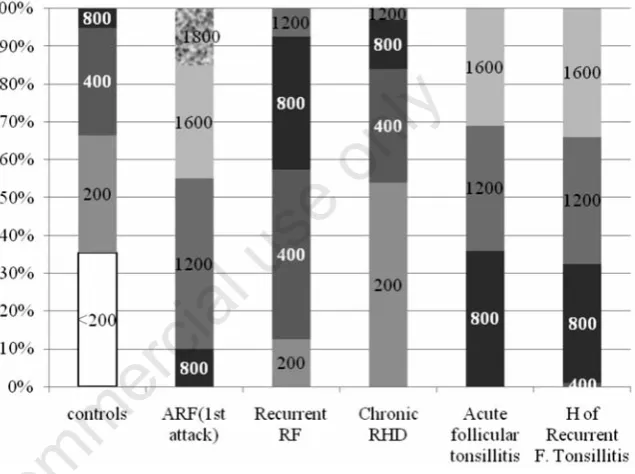
Group 1: 9.55±2.75 years (42.5-57.5%); Group 2: 9.35±2.06 years (60-40%); Group 3: 9.85±1.72 (47.5-52.5%); Group 4: 9.81±2.7 years (44-56%); Group 5: 8.42±2.8 years (44-56%); Group 6: 8.64±2.8 years (46%-54%). The data of ASOT in different groups are presented in Figure 1 and Table 1.
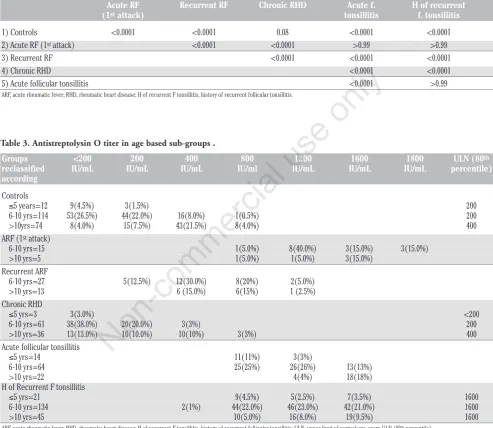
ASOT values were compared between each two studied groups as shown in Table 2.
Data of ASOT in age-based subgroups are shown in Table 3.
There was a statistically significant differ-ence of ASOT between age subgroups in G1 (P<0.0001), G4 (P<0.001), and G6 (P<0.0001); ASOT values were the highest at over ten years of age in all subgroups. In addition, there was a positive correlation between age and ASOT among subjects of G1(r=0.67, P<0.0001), G4(r=0.422, P<0.0001) and G6 (r=0.606, P<0.0001).
The ULN ASOT of groups 1, 4 and 6 in differ-ent seasons is presdiffer-ented in Figure 2. ASOT lev-els were significantly higher in winter and
autumn in all groups (P<0.0001) except in group 6 in which levels in different seasons were comparable.
ASOT reached the highest value in patients with rheumatic carditis (GMT 1638 IU/mL, 95% CI; 1534, 1749) with a statistically significant difference when compared with titers of patients with rheumatic chorea (979.80 IU/mL, 95% CI; 675.09, 1422.03, P<0.0001) and with rheumatic arthritis (1361.18 IU/mL, 95% CI; 1207.13, 1534.88, P<0.05).
Within group 6, ASOT showed significant direct correlation with the number of attacks of tonsillitis (r=0.61, P<0.001) (Table 4).
Discussion
Many Authors have studied the ULN ASOT in different populations. It was 333 Todd’s units in Minnesota, USA,15 240 IU/mL in another study conducted in different American states,9 326 IU/mL in Korea,16 305 IU/mL in Mombai,17239 IU/mL in a different region of India,10 200 IU/mL in Tanzania,18 and 200 Todd’s units in Sweden.19
Most of these values exceeded the normal level set by laboratories which is 200 IU/mL. The ULN in our studied control group was even
Figure 1. Antistreptolysin O titer in all groups. ARF, acute rheumatic fever; RHD, rheu-matic heart disease; H of recurrent F tonsillitis, history of recurrent follicular tonsillitis.
Figure 2. The upper limit of normal of antistreptolysin O titer in IU/mL in groups I, IV and VI in different seasons. ARF, acute rheumatic fever; RHD, rheumatic heart disease; H of recurrent F tonsillitis, history of recurrent follicular tonsilli
Non-commercial
Table 4. Correlation between the antistreptolysin O titer and number of attacks of tonsillitis in group 6.
ASO
N. of attacks N Mean Std. deviation F P
3 52 907.69 211.29
4 58 1137.93 316.13 8.943 <0.05
5 62 1406.45 237.38 S
6 28 1428.57 276.03
Table 1. Antistreptolysin O titer levels in the studied groups.
Groups Controls ARF Recurrent Chronic Acute follicular H of recurrent
(1stattack) RF RHD tonsillitis f. tonsillitis
ULN (80thpercentile) 400 200 1600
GM 245.09 1334.9 507.7 215.4 1133.8 1151.9
(95% CI) (229.9,261.3) (1193.3,1493.4) (430.1,599.2) (200.5,231.3) (1070.9,1200.22 (1104.5,1201.3)
ARF, acute rheumatic fever; RHD, rheumatic heart disease; H of recurrent F tonsillitis, history of recurrent follicular tonsillitis; ULN, upper limit of normal (80thpercentile); GM, geometric mean; CI, confidence
interval.
Table 2. Comparison between each two groups as regards the levels of antistreptolysin O titer.
Acute RF Recurrent RF Chronic RHD Acute f. H of recurrent
(1stattack) tonsillitis f. tonsillitis
1) Controls <0.0001 <0.0001 0.08 <0.0001 <0.0001
2) Acute RF (1stattack) <0.0001 <0.0001 >0.99 >0.99
3) Recurrent RF <0.0001 <0.0001 <0.0001
4) Chronic RHD <0.0001 <0.0001
5) Acute follicular tonsillitis <0.0001 >0.99
ARF, acute rheumatic fever; RHD, rheumatic heart disease; H of recurrent F tonsillitis, history of recurrent follicular tonsillitis.
Table 3. Antistreptolysin O titer in age based sub-groups .
Groups <200 200 400 800 1200 1600 1800 ULN (80th
reclassified IU/mL IU/mL IU/mL IU/ml IU/mL IU/mL IU/mL percentile)
according
Controls
≤5 years=12 9(4.5%) 3(1.5%) 200
6-10 yrs=114 53(26.5%) 44(22.0%) 16(8.0%) 1(0.5%) 200
>10yrs=74 8(4.0%) 15(7.5%) 43(21.5%) 8(4.0%) 400
ARF (1stattack)
6-10 yrs=15 1(5.0%) 8(40.0%) 3(15.0%) 3(15.0%)
>10 yrs=5 1(5.0%) 1(5.0%) 3(15.0%)
Recurrent ARF
6-10 yrs=27 5(12.5%) 12(30.0%) 8(20%) 2(5.0%)
>10 yrs=13 6 (15.0%) 6(15%) 1 (2.5%)
Chronic RHD
≤5 yrs=3 3(3.0%) <200
6-10 yrs=61 38(38.0%) 20(20.0%) 3(3%) 200
>10 yrs=36 13(13.0%) 10(10.0%) 10(10%) 3(3%) 400
Acute follicular tonsillitis
≤5 yrs=14 11(11%) 3(3%)
6-10 yrs=64 25(25%) 26(26%) 13(13%)
>10 yrs=22 4(4%) 18(18%)
H of Recurrent F tonsillitis
≤5 yrs=21 9(4.5%) 5(2.5%) 7(3.5%) 1600
6-10 yrs=134 2(1%) 44(22.0%) 46(23.0%) 42(21.0%) 1600
>10 yrs=45 10(5.0%) 16(8.0%) 19(9.5%) 1600
ARF, acute rheumatic fever; RHD, rheumatic heart disease; H of recurrent F tonsillitis, history of recurrent follicular tonsillitis; ULN, upper limit of normal; yrs, years ULN (80thpercentile).
Non-commercial
higher reaching 400 IU/mL owing to the repeated, frequently untreated, streptococcal infection in our community. Thus, for different populations in different geographical locations there may be significant differences in anti-body titers. This can be attributed to the cli-matic or socioeconomic conditions of each locality.12,20
In the current study the ULN (80th per-centile) of ASOT in children with history of repeated tonsillitis (while being free of strep-tococcal infection) was 1600 IU/mL. This was significantly higher than the value of the con-trol group. We expressed the value of ASOT in terms of upper limit (80thpercentile) rather than as mean to show the highest acceptable value in this particular group with previous infection. Although the levels are high, they do not warrant any further investigations or treat-ment since these children are normal and had no complaint at the time of sampling. Re-infec-tion usually results in sustained or continu-ously rising titers, and it is known from exper-imental studies that antibody responses are more impressive on repeated exposure.12
In the RHD group, ULN and not the mean ASOT was used to identify the levels above which we can diagnose streptococcal infection. The ULN ASOT was lower in RHD (200 IU) than in healthy controls (400 IU). This might be attributed to the effect of penicillin on the immune response to streptococci.21But on the other hand, this does raise concerns that acceptable levels of ASOT in the normal popu-lation can be clearly pathological in children under LAP. Similarly, Bosmanskay22 reported an ASOT of 187 IU/mL in patients with chronic RHD which was significantly lower than the titer in the normal population. The natural course of streptolysin response can be modi-fied by the administration of drugs, especially penicillin, by reducing the overall number of responders, and influencing the magnitude of antibody response.23
This study demonstrated a statistically sig-nificant difference between the ASOT in patients with ARF 1stattack and patients with recurrent RF. This further supports the hypoth-esis of an altered immune response to strepto-cocci following LAP prophylaxis. Although recurrence of rheumatic fever is evidence of non compliance to LAP, lower ASOT reflects partial prophylaxis with a decrease in inci-dence of streptococcal infection.24,25
There was a significant difference in ASOT according to age in groups without recent streptococcal infection (groups 1,4 and 6) being higher in children over ten years of age owing to the repeated exposure to streptococ-cal infection. Such a difference was not signif-icant in groups with recent streptococcal infec-tion, indicating an age-dependent basal ASOT, but the pattern of the increase with acute infection was not related to age.
The increase in the levels of ASOT with age was also demonstrated in many other stud-ies.9,10,16,19,26In contrast, in 2005, Danchin et al.27found that the mean titer of ASO in chil-dren over ten years of age (320 IU/mL) was sig-nificantly lower than those between five and ten years, although it was higher than those below five years.
In the current study, the ASOT of each group was significantly higher in winter and autumn. This seasonal variation was also demonstrated in a study conducted in Tehran.28Since strep-tococcal pharyngitis occurs more during win-ter, it is not surprising that streptococcal anti-body titers are higher in this season.12
In the present cohort, there was a signifi-cant variation in ASOT according to the type of presentation of rheumatic activity and showed the highest values in patients with acute cardi-tis. This is in agreement with Machado et al.26 The high levels seen in acute rheumatic cardi-tis may be due to the time lapse between the streptococcal infection and the occurrence of carditis which allows ASOT to reach its peak level. On the other hand, in patients with chorea by the time the choreic movements appeared the ASO antibodies declined owing to the longer latency period between the strepto-coccal infection and the clinical manifestation. In contrast to our study, Roodpeyma and co-workers concluded that variable clinical pre-sentations of rheumatic fever and increasing intensity of cardiac involvement are not relat-ed to ASOT.29
In conclusion, the ULN ASOT in normal Egyptian children is quite high, reaching up to 400 IU/mL. The rise is significant in ARF 1st attack and acute follicular tonsillitis, but it is less prominent in recurrent attacks of RF. Therefore, an isolated high ASOT is not suffi-cient to diagnose ARF. Basal levels of ASOT increase with age but age does not affect the peak level during acute streptococcal infection. ASOT shows the highest value in winter. LAP prophylaxis has a prominent effect on the mag-nitude of the host immune response to strepto-cocci as the ULN (80thpercentile) of ASOT was only 200 IU/mL in patients with chronic RHD, and this should be taken into consideration when diagnosing recurrent rheumatic activity. A twice weekly LAP regimen was associated with the lowest ASOT, suggesting its efficacy in preventing streptococcal throat infection.
References
1 Madden S, Kelly L. Update on acute rheu-matic fever. It still exists in remote com-munities. Can Fam Physician 2009;55:475-8.
2 Carapetis JR, Steer AC, Mulholland EK, Weber M. The global burden of group A
streptococcal diseases. Lancet Infect Dis 2005;5:685-94
3 Meador RJ, Russell IJ. Acute Rheumatic Fever. e-medicine Rheumatology Jul 31, 2009. Available from: http://emedicine. medscape.com/article/333103-overview 4 Abdel-Moula AM, Sherif AA, Sallam SA, et
al. Prevalence of rheumatic heart disease among school children in Alexandria, Egypt: a prospective epidemiological study. J Egypt Public Health Assoc 1998;73:222-54.
5 Kassem AS, Madkour AA, Massoud BZ, Zaher SR. Benzathine Penicillin G for Rheumatic Fever Prophylaxis: 2-Weekly Versus 4-Weekly Regimens. Indian J Pediatr 1992;59:741-8.
6 Kotby AA, Abd Elmoneim MT, Hassan AS. Assessment of rheumatic fever and rheu-matic heart disease in the Children’s hos-pital, Ain Shams University. Egypt J Pediatr 1996;3-4:183-205.
7 Carapetis JR, McDonald M, Wilson NJ. Acute rheumatic fever. Lancet 2005; 366: 155-68.
8 Ferrieri P. Jones Criteria Working Group. Proceedings of the Jones criteria work-shop. Circulation 2002;106:2521-31. 9 Kaplan EL, Rothermel CD, Johnson DR.
Antistreptolysin O and anti-deoxyribonu-clease B titers: normal values for children ages 2 to 12 in the United States. Pedia-trics 1998;101:86-8
10 Sethi S, Kaushik K, Mohandas K, et al. Anti-Streptolysin O Titers in Normal Healthy Children of 5-15 Years. Indian J Pediatr 2003;40:1068-71.
11 Kaplan EL. Rheumatic fever. In: AS Fauci, E Brawnwald, KJ Isselbacher, JD Wilson, JB Martin, Dl Kasper, SL Hauser, DL Longo (eds.) Harrison’s Principle of Internal Medicine. 14th ed. McGraw-Hill, New York, 2001, p 1340.
12 Shet A, Kaplan EL. Clinical use and inter-pretation of group A streptococcal antibody tests: A practical approach for the pediatri-cian or primary care physipediatri-cian. Pediatr Infect Dis J 2002;21:420-30.
13 Dajani AS, Ayoub E, Bierman FZ. Guide-lines for the diagnosis of rheumatic fever: Jones criteria, updated 1992. Circulation 1993;87:302-7.
14 Bisno AL, GerberMA, Gwaltney MJ Jr, et al. Practice guidelines for the diagnosis and management of group A streptococcal pharyngitis. Infectious disease Society of America. Clin Infect Dis 2002;35:113-25. 15 Wannamaker L, Ayoub E. Antibody titers in
acute rheumatic fever. Circulation 1960; 21:598-614.
16 Kim S, Lee YN. Asymptomatic infection by Streptococcus pyogenes in school children and diagnostic usefulness of antideoxyri-bonuclease B. J Korean Med Sci 2005;20:
Non-commercial
938-40.
17 Karmakar MG, Venugopal V, Joshi L, Kamboj R. Evaluation and revaluation of upper limits of normal values of anti-strep-tolysin O and anti deoxyribonuclease B in Mumbai. Indian J Med Res 2004;119:26-8. 18 Mhalu FS, Matre R. Antistreptolysin O and
antideoxyribonuclease B titres in blood donors and in patients with features of nonsuppurative sequelae of group A strep-tococcus infection in Tanzania. E Afr Med J 1995;72:33-6.
19 Renneberg J, Söderström M, Prellner K, et al. Age-related variations in anti-strepto-coccal antibody levels. Eur J Clin Microbiol Infect Dis 1989;8:792-5.
20 Nava A, del Rio L, Aguilar CM, et al. Serum levels of antistreptolysin O in teenagers from Mexican urban and rural areas. Rev Alerg Mex 2008;55950;196-200.
21 Gerber MA, Baltimore RS, Eaton CB, et al. Prevention of rheumatic fever and diagno-sis and treatment of acute Streptococcal
pharyngitis: a scientific statement from the American Heart Association Rheumatic Fever, Endocarditis, and Kawasaki Disease Committee of the Council on Cardiovascular Disease in the Young, the Interdisciplinary Council on Functional Genomics and Translational Biology, and the Interdisciplinary Council on Quality of Care and Outcomes Research: endorsed by the American Academy of Pediatrics. Circulation 2009; 119:1541-51.
22 Bosmansky K. Streptococcus antibodies in a rural population and in patients with inflammatory rheumatic diseases. Z Rheumatol 1985;44:213-7.
23 McCarty M. The hemolytic streptococci. In: RJ Dubos (ed.) Bacterial and mycotic infections of man. 3rd ed. JB Lippincott Co., Philadelphia, 1958, p 248.
24 Robertson KA, Volmink JA, Mayosi BM. Antibiotics for the primary prevention of acute rheumatic fever: a meta-analysis.
BMC Cardiovasc Disord 2005;5:11-20. 25 Cilliers AM. Rheumatic fever and its
man-agement. BMJ 2006;333:1153-6.
26 Machado CS, Ortiz K, Martins AB, et al. Antistreptolysin O titer profile in acute rheumatic fever diagnosis. J Pediatr 2001;77:105-11.
27 Danchin MH, Carlin JB, Devenish W, et al. New normal ranges of antistreptolysin O and antideoxyribonuclease B titres for Australian children. J Paediatr Child Health 2005;41:583-6.
28 Gharagozloo R, Ghavamian P. The range of antistreptolysin-O titer among 3129 healthy individuals in winter and summer in Tehran, Iran. Pahlavi Med J 1976;7:323-33.
29 Roodpeyma L, Kamali Z, Zare R. Rheuma-tic fever: the relationship between clinical manifestations and laboratory tests. J Paediatr Child Health 2005;41:97-100.