R E S E A R C H A R T I C L E
Open Access
Two-trocar appendectomy in children
–
description of technique and comparison
with conventional laparoscopic
appendectomy
Martin Salö
1*, Emil Järbur
1, Mette Hambraeus
1, Bodil Ohlsson
2, Pernilla Stenström
1and Einar Arnbjörnsson
1Abstract
Background:The aim of the study was to describe the technique of two-trocar laparoscopic appendectomy and compare the outcome between two- and three-trocar techniques in children.
Methods:All children who underwent laparoscopic surgery for suspected appendicitis from 2006 to 2014 in a center for pediatric surgery were included in the study. Converted surgeries and patients with appendiceal abscess or concomitant intestinal obstruction were excluded. A total of 259 children underwent appendectomy with either two (35 %) or three (65 %) laparoscopic trocars according to the surgeons’preference and intraoperative judgment. Patient demographics, clinical symptoms, surgery characteristics, and complications were reviewed.
Results:The mean age of the children was 10.4 years (range, 1–14 years). The mean follow-up time was 41.2 months (SD ± 29.2). No significant differences in age, gender, weight, or signs and symptoms were found between the two-and three-trocar groups. The mean surgery time was significantly shorter in the two-trocar group (47 min) than in the three-trocar group (66 min;p< 0.001). The rates of surgical complications were 2 % vs. 4 %, (p= 0.501), and the rates of postoperative complications were 0 % vs. 5 % (p= 0.054), in the two- and three-trocar groups. The overall incidence of postoperative wound infection was low (<1 %) and did not differ between groups.
Conclusions:Two-trocar laparoscopic appendectomy seems to be a safe and feasible technique with a low rate of postoperative wound infections. The present findings demonstrate that when the two-trocar technique could be applied, it is a good complement to the conventional three-trocar technique.
Keywords:Acute abdomen, Appendicitis, Appendectomy, Children, Laparoscopy
Background
Appendicitis is the most common abdominal disease that requires surgery in children [1–5] . Most studies show that laparoscopic appendectomy (LA) has advan-tages over open appendectomy (OA) in children [6–8]. Publications also claim that intravenous antibiotics may serve as monotherapy for acute appendicitis [9, 10], but long-term results of these findings are lacking.
Nonetheless, appendicitis is for sure, cured through appendectomy.
Since Kurt Semm described a technique for endo-scopic appendectomy in 1983 [4], several surgical tech-niques for LA have been described. Currently, the technology for performing appendectomy utilizes one, two, three, or more trocars [11–14]. The two-trocar LA is a result of trying to overcome two major disadvan-tages of three-trocar LA when it originally was compared to OA; longer operative time and greater cost [15, 16]. Two-trocar laparoscopic-assisted appendectomy has been described previously in children but without comparison with other techniques [13, 16]. In adults, two-trocar LA has been compared with OA and
* Correspondence:[email protected]
1Department of Clinical Sciences, Pediatrics, and Department of Pediatric
Surgery, Lund University, Skåne University Hospital, Lasarettsgatan 48, Lund 221 85, Sweden
Full list of author information is available at the end of the article
conventional three-trocar LA [17–20]. In our pediatric surgery clinic, the laparoscopic technique utilizes two trocars or conventional LA with three trocars. Some sur-geons are concerned about the two-trocar LA and afraid of increased rates of wound infections compared to con-ventional LA [16, 17, 20], and one study added cleansing of the wound with peroxide for 1 week postoperatively [15]. Our hypothesis was that the two-trocar LA tech-nique is as safe as three-trocar LA and does not increase the rate of wound infections. The aim of the present study was to describe the two-trocar LA technique in pediatric appendicitis and compare outcomes between two- and three-trocar techniques with regard to surgery time and complications, including the rate of postopera-tive wound infection.
Methods
The regional research ethics committee approved the study (registration no. 2010/49). Parents were informed about the intent to perform a LA and about the risk of conversion to open appendectomy. No specified infor-mation about the two- or three-trocar LA was given. Since this was a retrospective study of performed LAs, no written consent was taken beforehand.
Children and clinical data
Data collection
All children (<15 years of age) who underwent LA from January 2006 to December 2014 in the Department of Pediatric Surgery were retrospectively included in the study. Exclusion criteria were converted LAs, patients with an appendiceal abscess, and patients with concomi-tant intestinal obstruction. Data were retrieved from an electronic database of medical records.
Acute appendicitis was diagnosed based on clinical prediction scores. The diagnosis was occasionally assisted by ultrasound. The diagnosis of appendicitis was confirmed by surgical findings combined with the histo-pathological analysis. Age, gender, weight, preoperative work-up, and appendiceal grade of inflammation was re-corded. The time interval from admission to the start of surgery was defined as the time interval from the deci-sion that the child should be transferred from the emer-gency room to the start of the operation. Information about the surgical method used (i.e., two- or three-trocar technique) and the duration of surgery were collected from the surgical reports. Postoperative pain medication was recorded from the moment the child left the postoperative unit and arrived in the pediatric surgi-cal ward. Postoperative pain management, operative and postoperative complications (including wound infection), and duration of long-term follow-up were recorded.
Six surgeons attended and were responsible for the LAs. All of the responsible surgeons were specialists in
general surgery or pediatric surgery. The decision to per-form LA using the two-trocar technique was based on the surgeons’ intraoperative judgment for the individual child. In children where there was no need for diathermy or scissors to perform the appendectomy, only two tro-cars were used. All of the surgical interventions were preceded by antibiotic administration according to a previously published method [9]. Postoperative antibi-otics were given to patients with gangrenous or perfo-rated appendicitis.
Statistical analysis
SPSS (Statistical Package for the Social Sciences) was used for the statistical calculations. A power calculation of the sample size was performed with the aid of a statis-tician [10]. A minimum of 200 patients were needed to show a difference with 80 % power at a 5 % significance level. Children with appendiceal abscess were excluded to collect groups that are more comparable. To obtain comparable groups for calculation of pain management, patients with a negative appendectomy and patients with complications were excluded. Fisher’s exact test was used for dichotomous variables, and Student’st-test and the Mann–Whitney U-test were used for ranked results with and without a standard distribution, respectively. Values ofp< 0.05 were considered statistically significant.
Surgical techniques
The laparoscopy starts with the insertion of a 3- or 5-mm umbilical- or subumbilical trocar using an open access technique. It is intended for the insertion of 30-grade, 3- or 5-mm laparoscopic optics, which are used for diagnostic purposes. After having positioned the first trocar and collected some diagnostic information, the intraoperative findings enable the surgeon to choose in going on with two or three trocars.
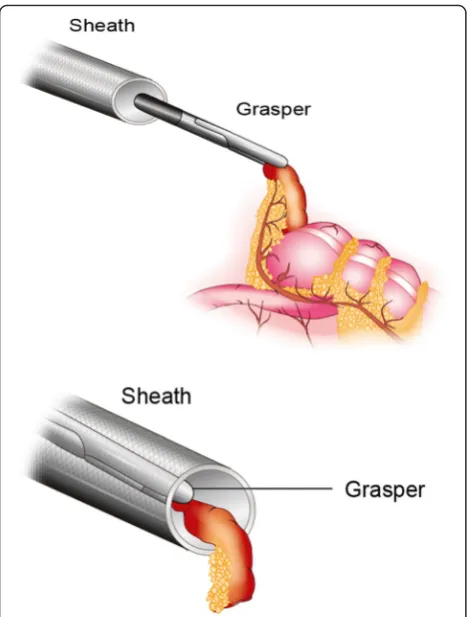
Two-trocar technique
sheath (acting as an endoscopic bag) is then gently with-drawn which exteriorizes the appendix removed. The pneumoperitoneum is slowly deflated when removing the trocar, which makes the exteriorization of the appen-dix easier. Electric cautery is used to divide and seal the vessels in the mesoappendix. The appendix is ligated at the base with an absorbable suture, leaving no metal staples in the growing body of the child. After remov-ing the appendix, pneumoperitoneum is established again and the abdominal cavity is inspected, ensuring hemostasis. Finally, the abdominal gas is emptied, and the trocar wounds are sutured.
Three-trocar technique
If three-trocar LA is chosen, two 5-mm trocars is placed; one at 1–2 in. above the symphysis and one to the left (usually in the left iliac fossa). The dissection of the mesoappendix is performed using an electrocautery hook, and the appendix is divided at the base with staples.
Results
Patient characteristics
During the studied period, 324 children underwent lap-aroscopic appendectomy. Of these, 56 children were
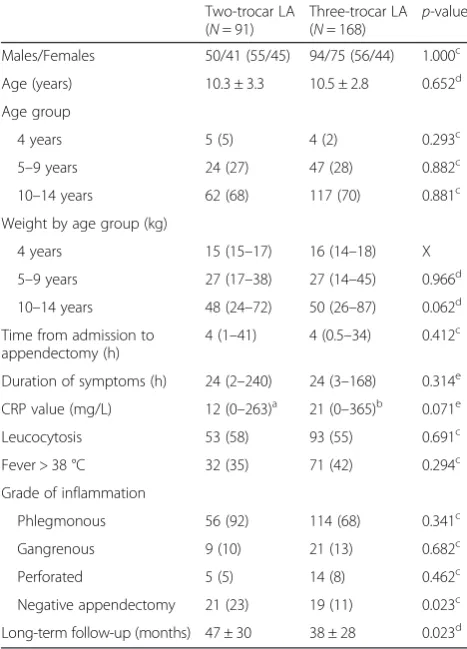
excluded from the study because of conversion from three-trocar LA to open surgery. The reasons for these conversions were: perforated appendicitis with pus spread in the abdominal cavity (n= 42); anatomical difficulties making the laparoscopic technique unsafe (n= 10); and technical difficulties with the laparo-scopic equipment (n= 4). No two-trocar LAs were converted to the conventional three-trocar technique or to open surgery. Further, six patients who had an appendiceal abscess diagnosed peroperatively and three patients with concomitant intestinal obstruction were also excluded, leaving totally 259 children in-cluded in the study. Of the children with an appendi-ceal abscess, two were operated on with three-trocar LA, one with two-trocar LA, and the other three were dir-ectly converted to open appendectomy. The clinical diag-nosis was assisted by ultrasound in 37 % of the patients. Of the 259 children, 168 (65 %) underwent surgery with the conventional three-trocar technique, and 91 (35 %) underwent surgery with the two-trocar technique. There was no difference in demographics between the two groups (Table 1). The mean long-term follow-up was 38 months (range, 3–104 months) for children who underwent the three-trocar procedure and 47 months (range, 2–106 months) for children who underwent the two-trocar procedure (Table 1). An equal number of pa-tients underwent surgery with the two-trocar technique each year during the study period.
With regard to the duration of symptoms, time to appendectomy, presence of fever or leukocytosis, and grade of inflammation, no significant differences were found between the two groups. However, a signifi-cantly higher rate of negative appendectomies was found in patients who underwent two-trocar LA (Table 1).
Evaluation of the surgical technique
The surgery time with the two-trocar technique was sig-nificantly shorter than with the three-trocar technique, both after inclusion and exclusion of negative appendec-tomies (Table 2).
The few surgical complications were iatrogenic perforations (n= 7), bleeding (n= 1), and diathermic injury (n= 1), which did not differ between groups. Further, no difference in the rate of postoperative complications, excluding wound infections, was observed between the two groups. The complications were postoperative abscess (n= 6) and postoperative intestinal obstructionn= 2). The rate of postoperative wound infection was low (<1 %) and did not differ between groups (Table 2).
No significant differences were found between the two groups in the postoperative use of morphine, paraceta-mol, or nonsteroidal anti-inflammatory drugs (NSAIDs) (Table 3).
Advantages and disadvantages of two- and three-trocar LAs are summarized in Table 4.
Discussion
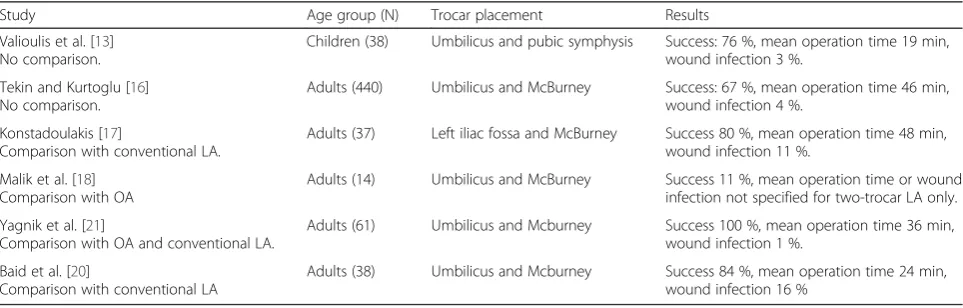
This was the first study with comparison of two-trocar LA with another appendectomy method in children (Table 5). Based on the study results presented here, we accepted the research hypothesis that two-trocar LA was a safe and quick technique with a low rate of postopera-tive wound infection.
Wound infection
One fear surgeons have with the two-trocar technique is that it may result in a higher rate of wound infec-tions, since the inflamed appendix comes in contact with all the layers of the abdominal wall and the skin
when it is being drawn out [16, 17, 20]. However, with our technique, the outer part of the trocar en-folds the inflamed appendix, which prevents contact with the abdominal wall. Accordingly, the rate of wound infection in the present study was very low (1 %). Previously studies have reported rates between 1 and 16 % [13, 16, 17, 20, 21]. Diverse types of tro-cars may explain these differences.
Table 1Descriptive data on children with suspected appendicitis who underwent either two- or three-trocar laparoscopic
appendectomy
Two-trocar LA (N= 91)
Three-trocar LA (N= 168)
p-value Males/Females 50/41 (55/45) 94/75 (56/44) 1.000c
Age (years) 10.3 ± 3.3 10.5 ± 2.8 0.652d
Age group
4 years 5 (5) 4 (2) 0.293c
5–9 years 24 (27) 47 (28) 0.882c
10–14 years 62 (68) 117 (70) 0.881c
Weight by age group (kg)
4 years 15 (15–17) 16 (14–18) X 5–9 years 27 (17–38) 27 (14–45) 0.966d
10–14 years 48 (24–72) 50 (26–87) 0.062d
Time from admission to appendectomy (h)
4 (1–41) 4 (0.5–34) 0.412c
Duration of symptoms (h) 24 (2–240) 24 (3–168) 0.314e CRP value (mg/L) 12 (0–263)a 21 (0–365)b 0.071e Leucocytosis 53 (58) 93 (55) 0.691c Fever > 38 °C 32 (35) 71 (42) 0.294c Grade of inflammation
Phlegmonous 56 (92) 114 (68) 0.341c Gangrenous 9 (10) 21 (13) 0.682c Perforated 5 (5) 14 (8) 0.462c Negative appendectomy 21 (23) 19 (11) 0.023c Long-term follow-up (months) 47 ± 30 38 ± 28 0.023d
Values are given as:n(%) = absolute number and percentage of patients; mean ± standard deviation (SD); or median (min–max); X = too few patients CRPC-reactive proteinLAlaparoscopic appendectomy
a
Three patients with missing data b
Seven patients with missing data c
Fisher’s exact test d
Studentst-test, two-tailed e
Mann–Whitney U–test, two-tailed
Table 2Differences in surgery time and complications between two- and three-trocar laparoscopic appendectomies
Two-trocar LA (N= 91)
Three-trocar LA (N= 168)
p-value Surgery time all included (min) 47 ± 16 66 ± 22 <0.001e Surgery time with negative
appendectomies and patients with surgical complications excluded (min)
46 ± 16 65 ± 20 <0.001e
Excluded patients 23 (25) 26 (15)
Surgery time > 60 min 12 (13) 86 (51) <0.001d
Surgery time in patients with surgical complications (min)
46 ± 1 81 ± 20 0.003e
Included patients 7 (8) 2 (1)
Number of surgical complications 2a(2) 7b(4) 0.501d Number of postoperative
complications
0 (0) 8c(5) 0.054d Wound infection 1 (1) 1 (1) 1.000d
Values are given as:n(%) = absolute number and percentage of patients; mean ± standard deviation (SD); or median (min–max)
LAlaparoscopic appendectomy a
Two iatrogenic perforations b
Five iatrogenic perforations, one postoperative bleeding, and one diathermic injury
c
Six patients with postoperative abscess and two patients with postoperative intestinal obstructions
d
Fisher’s exact test e
Student’s t-test, two-tailed
Table 3Postoperative pain management
Two-trocar LA (N= 68)
Three-trocar LA (N= 135)
p-value Morphine administration 15 (22) 37 (27) 0.502b
Total amount of morphinea
(mg/kg)
0.11 ± 0.09 0.11 ± 0.09 0.744c
NSAID administration 38 (57) 73 (54) 0.772b Single doses 25 (37) 45 (33) 0.644b Regular treatment 13 (20) 28 (21) 1.000b
Paracetamol intravenously (doses)
2 (0–10) 2 (0–18) 0.914d
Negative appendectomies and patients with surgical and postoperative complications excluded. Values are given as:n(%) = absolute number and percentage of patients; mean ± standard deviation (SD); or median (min–max) LAlaparoscopic appendectomy,NSAIDnonsteroidal anti-inflammatory drugs a
In patients receiving morphine b
Fisher’s exact test c
Student’st-test, two-tailed d
Surgery time
The mean duration of two-trocar LA in the present study was similar to some reports [16, 17], but longer compared to others [13, 20, 21]. The shorter surgery time in the two-trocar group compared to the three-trocar group may be due to selection bias, hence the two groups were non-equivalent since the decision about which kind of procedure performed depended on the surgeon. We presume that each surgeon in this study used the surgical method that was the most beneficial for the children according to the own experience, and selected children for whom two-trocar LA could be applied.
Feasibility and advantages with the two-trocar LA
In the present study, none of the patients who initially underwent two-trocar LA were converted to three-trocar LA or open appendectomy. To a certain extent, this may be explained by selection bias mentioned above. In previous studies, the reported rate of
successfully completed two-trocar surgeries was 11 % [18], 67 % [16], 76 % [13], 80 % [17], 84 % [20] and 100 % [21]. From the present and previous studies, it is impossible to draw the conclusion that the shortened surgery time per se could be related to a lower compli-cation rate. However, the two-trocar technique gives the surgeon more control over bleeding when dividing the mesoappendix. Also, less instruments are used and no staples are required, also reducing the cost. Since appen-dicitis is common, a small change in outcome can have major effect for the resources and costs of the health care system.
One limitation of the two-trocar technique is that it is difficult or impossible to use in a child with appendicitis and adhesions or retrocecal appendix [17]. Further, it may not always be advisable to grasp and pull an in-flamed appendix, which can be fragile and tortuous. This decision has to be based on the intraoperative judgment of the surgeon. Hence, if there is no need for diathermy or scissors to perform the appendectomy, a third trocar seems unnecessary. The technique described can be ap-plied for fat patients with ample adipose tissue, but hardly for extremely fat patients. Nevertheless, the tech-nique has been described in adults before in which the abdominal wall is much thicker compared to children. From this study, it seems that there may be three factors that influence which technique the surgeon chooses: 1) The anatomical position of the appendix. If the ap-pendix has a distinct retrocecal direction, the two-trocar technique may be more difficult; 2) adhesions that fixate the appendix that only can be dissected with the help of cautery; and 3) the preference of the surgeon, hence experience with the method. Regard-ing the last factor, we consider the two-trocar LA, compared to conventional LA, to be easier to learn for the young surgeon. In summary, this leads us to conclude that because of assumedly shorter learning curve compared to single-port LA [22], faster surgery
Table 4Advantages and disadvantages of two-vs. three-trocar laparoscopic appendectomy
Two-trocar LA Three-trocar LA Advantages •Less trauma
•Only two scars on the abdomen
•Shorter surgery time
•Cheaper
•Shorter learning curve
•More instruments in the abdomen
•Diathermy
•Can be used with adhesions or retrocecal appendix
•More often applicable Disadvantages •Only one instrument
•Cannot use diathermy
•Limited mobility in the abdominal cavity and less able to explore the intestinal package
•Cannot get traction to resolve adhesions
•Not always applicable
•Longer surgery time
•More scars
•More trauma
LAlaparoscopic appendectomy
Table 5Overview of studies of two-trocar LA in children and adults
Study Age group (N) Trocar placement Results Valioulis et al. [13]
No comparison.
Children (38) Umbilicus and pubic symphysis Success: 76 %, mean operation time 19 min, wound infection 3 %.
Tekin and Kurtoglu [16] No comparison.
Adults (440) Umbilicus and McBurney Success: 67 %, mean operation time 46 min, wound infection 4 %.
Konstadoulakis [17]
Comparison with conventional LA.
Adults (37) Left iliac fossa and McBurney Success 80 %, mean operation time 48 min, wound infection 11 %.
Malik et al. [18] Comparison with OA
Adults (14) Umbilicus and McBurney Success 11 %, mean operation time or wound infection not specified for two-trocar LA only. Yagnik et al. [21]
Comparison with OA and conventional LA.
Adults (61) Umbilicus and Mcburney Success 100 %, mean operation time 36 min, wound infection 1 %.
Baid et al. [20]
Comparison with conventional LA
Adults (38) Umbilicus and Mcburney Success 84 %, mean operation time 24 min, wound infection 16 %
time [17], shortened anesthesia, less trauma and reduced costs compared to conventional LA [23], and being a safe procedure; two-trocar LA has a role among different laparoscopic techniques of appendectomy.
No definitive conclusions can be drawn regarding which of the two laparoscopic techniques is best, and under what circumstances each technique should be used, until a prospective, randomized study in children is conducted. However, the data presented in this report certainly add information that we can use in our daily practice. If we perform the two-trocar technique, it may benefit the child and the health care itself with reduced costs [23].
Two-trocar LA vs. single-port LA
Many studies have described the technique of single-incision LA (SILA) or single-port LA (SPLA). We agree that SILA/SPLA is interesting and we recently published an article about this technique [24]. But, SILA/SPLA has also been shown to result in longer operative time, higher analgesic consumption, and greater hospital charges in children when a meta-analysis of RCT’s was performed [12]. Another meta-analysis in children found shorter length of hospital stay, but higher conversion rate, higher surgical difficulty, and higher hospitalization costs compared with conventional LA [25]. Quie et al. [26], concluded that “..there is no indication to use this approach over standard laparoscopic appendectomy”. Further, special instruments and longer learning curve are two other disadvantages of SPLA/SILA. Many ap-pendectomies are performed by junior doctors/residents which have a harder time dealing with instrument collision, reduced operative work space, inadequate re-traction and compromised view in SPLA/SILA [11]. As stated in Table 4, one disadvantage of the two-trocar LA, is the reduced ability to explore the abdominal cavity, especially when examining the small intestine. However, this is also stated when talking about the SILA/SPLA [27]. Together with the other advantages of the two-trocar LA mentioned before, we therefore be-lieve there is an obvious role for the two-trocar LA among appendectomy techniques.
Study limitations
As mentioned above, the main weakness of the study is that the decision about which kind of procedure per-formed depended on the surgeon. Hence, an obvious se-lection bias may be evident and the two groups are non-equivalent. A second weakness of the study is that it was retrospective, and not randomized. When we now know that the two-trocar laparoscopic appendectomy does not result in more complications including wound infection, a prospective, randomized study can be started. At last, there was an unequal number of patients in the two
groups compared. However, the only way this influences the statistical calculations is that the prerequisite to de-tect a, in beforehand given/hypothesized, difference is greater when the groups are equal in number (highest power). Hence, having different number of patients in the groups does not influence the statistical calculations and the conclusions drawn in this study.
Conclusions
Two-trocar LA seems to be a safe and feasible technique in children with a low rate of postoperative wound infec-tions, and the present findings demonstrate that it could be considered as a good and safe complement to the conventional three-trocar technique. Future research will determine which method is the best treatment. Until then, the minimalized method described herein may be a good option.
Abbreviations
LA, laparoscopic appendectomy; NSAID, non-steroidal anti-inflammatory drug; SD, standard deviation
Acknowledgements
The study was sponsored by grants from the Development Foundation of Region Skåne.
Funding
The study was sponsored by grants from the Development Foundation of Region Skåne.
Availability of data and materials
The database will not be shared due to restrictions formed by the ethical committee that approved this study.
Authors’contributions
MS collected the data, carried out the statistical analyses and drafted the initial manuscript. EJ collected the data and carried out parts of the statistical analyses. MH designed the figures and collected data. BO aided in the design of the study, controlled the statistical analyses and revised the manuscript. PS participated in the design of the study and revised the manuscript. EA designed the study, participated in the statistical analyses and revised the manuscript. All authors read and approved the final manuscript.
Competing interests
The authors declare that they have no competing interests including commercial associations regarding the publication of this article.
Consent for publication
Since this was a retrospective study of performed LAs, no written consent was taken beforehand.
Ethics approval and consent to participate
The regional research ethics committee approved the study (registration no. 2010/49). Parents were informed about the intent to perform a LA and about the risk of conversion to open appendectomy. No specified information about the two- or three-trocar LA was given.
Author details
1Department of Clinical Sciences, Pediatrics, and Department of Pediatric
Surgery, Lund University, Skåne University Hospital, Lasarettsgatan 48, Lund 221 85, Sweden.2Department of Clinical Sciences, and Division of Internal
Medicine, Lund University, Skåne University Hospital, Malmö 205 02, Sweden.
References
1. Addiss DG, Shaffer N, Fowler BS, Tauxe RV. The epidemiology of appendicitis and appendectomy in the United States. Am J Epidemiol. 1990;132(5):910–25.
2. Flum DR, Morris A, Koepsell T, Dellinger EP. Has misdiagnosis of appendicitis decreased over time? A population-based analysis. JAMA. 2001;286(14):1748–53.
3. Andersen S, Paerregaard A, Larsen K. Changes in the epidemiology of acute appendicitis and appendectomy in Danish children 1996–2004. Eur J Pediatr Surg. 2009;19(5):286–9.
4. Caperell K, Pitetti R, Cross KP. Race and acute abdominal pain in a pediatric emergency department. Pediatrics. 2013;131(6):1098–106.
5. Scholer SJ, Pituch K, Orr DP, Dittus RS. Clinical outcomes of children with acute abdominal pain. Pediatrics. 1996;98(4 Pt 1):680–5.
6. Aziz O, Athanasiou T, Tekkis PP, Purkayastha S, Haddow J, Malinovski V, et al. Laparoscopic Versus Open Appendectomy in Children. Ann Surg. 2006;243(1):17–27.
7. Sauerland S, Lefering R, Neugebauer EAM. Laparoscopic versus open surgery for suspected appendicitis. Cochrane Database Syst Rev. 2004;4:CD001546.
8. Esposito C, Calvo AI, Castagnetti M, Alicchio F, Suarez C, Giurin I, et al. Open versus laparoscopic appendectomy in the pediatric population: a literature review and analysis of complications. J Laparoendosc Adv Surg Tech A. 2012;22(8):834–9.
9. Hartwich J, Luks FI, Watson-Smith D, Kurkchubasche AG, Muratore CS, Wills HE, et al. Nonoperative treatment of acute appendicitis in children: A feasibility study. J Pediatr Surg. 2015;51(1):111-16.
10. Svensson JF, Patkova B, Almström M, Naji H, Hall NJ, Eaton S, et al. Nonoperative Treatment With Antibiotics Versus Surgery for Acute Nonperforated Appendicitis in Children. Ann Surg. 2015;261(1):67–71. 11. Kim HJ, Lee JI, Lee YS, Lee IK, Park JH, Lee SK, et al. Single-port
transumbilical laparoscopic appendectomy: 43 consecutive cases. Surg Endosc Other Interv Tech. 2010;24(11):2765–9.
12. Gao J, Li P, Li Q, Tang D, Wang DR. Comparison between single-incision and conventional three-port laparoscopic appendectomy: A meta-analysis from eight RCTs. Int J Color Dis. 2013;28:1319–27.
13. Valioulis I, Hameury F, Dahmani L, Levard G. Laparoscope-assisted appendectomy in children: the two-trocar technique. Eur J Pediatr Surg Off J Austrian Assoc Pediatr Surg [et al] = Zeitschrift fur Kinderchirurgie. 2001;11(6):391–4.
14. Agresta F, De Simone P, Leone L, Arezzo A, Biondi A, Bottero L, et al. Laparoscopic appendectomy in Italy: an appraisal of 26,863 cases. J Laparoendosc Adv Surg Tech A. 2004;14(1):1–8.
15. Koontz CS, Smith LA, Burkholder HC, Higdon K, Aderhold R, Carr M. Video-assisted transumbilical appendectomy in children. J Pediatr Surg. 2006;41(4):710–2.
16. Tekin A, Kurtoglu HC. Video-assisted extracorporeal appendectomy. J Laparoendosc Adv Surg Tech A. 2002;12(1):57–60.
17. Konstadoulakis MM, Gomatos IP, Antonakis PT, Manouras A, Albanopoulos K, Nikiteas N, et al. Two-trocar laparoscopic-assisted appendectomy versus conventional laparoscopic appendectomy in patients with acute appendicitis. J Laparoendosc Adv Surg Tech A. 2006;16(1):27–32.
18. Malik AM, Talpur AH, Laghari A a. Video-assisted laparoscopic extracorporeal appendectomy versus open appendectomy. J Laparoendosc Adv Surg Tech A. 2009;19(3):355–9.
19. Yagnik VD, Rathod JB, Phatak AG. A retrospective study of two-port appendectomy and its comparison with open appendectomy and three-port appendectomy. Saudi J Gastroenterol. 2010;16(4):268–71.
20. Baid M, Manoranjan K, Utpal D, Mukopadhyay M. Conventional Laparoscopic Appendicectomy and Laparoscope-Assisted Appendicectomy: a Comparative Study. Indian J Surg. 2015;77:330–5.
21. Yagnik VD, Rathod JB, Phatak AG. A retrospective study of two-port appendectomy and its comparison with open appendectomy and three-port appendectomy. Saudi J Gastroenterol [Internet]. 2010;16(4):268–71. Available from: http://www.pubmedcentral.nih.gov/articlerender. fcgi?artid=2995095&tool=pmcentrez&rendertype=abstract.
22. Nicola Z, Gabriella S, Alberto M, Saverio CF. Transumbilical laparoscopic-assisted appendectomy in children: Clinical and surgical outcomes. World J Gastrointest Endosc [Internet]. 2014;6(4):101–4. Available from: http://www.pubmedcentral.nih.gov/articlerender.fcgi?artid=3985149& tool=pmcentrez&rendertype=abstract.
23. Kulaylat AN, Podany AB, Hollenbeak CS, Santos MC, Rocourt DV. Transumbilical laparoscopic-assisted appendectomy is associated with lower costs compared to multiport laparoscopic appendectomy. J Pediatr Surg. 2014;49(10):1508–12.
24. Naredi M, Anderberg M, Stenström P, Arnbjörnsson E, Salö M. Single-Port Laparoscopy-Assisted Appendectomy in Children: A Method Described. J Surg. 2(3). http://dx.doi.org/10.16966/2470-0991.122.
25. Ding J, Xia Y, Zhang ZM, Liao GQ, Pan Y, Liu S, Zhang Y, Yan Z. Single-incision versus conventional three-Single-incision laparoscopic appendicectomy for appendicitis: a systematic review and meta-analysis. J Ped Surg. 2013;48(5):1088–98.
26. Qiu J, Yuan H, Chen S, He Z, Wu H. Single-port laparoscopic appendectomy versus conventional laparoscopic appendectomy: evidence from randomized controlled trials and nonrandomized comparative studies. Surg Laparosc Endosc Percutan Tech [Internet]. 2014;24(1):12–21. Available from: http://ovidsp.ovid.com/ovidweb.cgi?T=JS&PAGE=reference&D=medl& NEWS=N&AN=24487152.
27. St Peter SD, Adibe OO, Juang D, Sharp SW, Garey CL, Laituri CA, et al. Single incision versus standard 3-port laparoscopic appendectomy: a prospective randomized trial. Ann Surg. 2011;254(4):586–90.
• We accept pre-submission inquiries
• Our selector tool helps you to find the most relevant journal
• We provide round the clock customer support
• Convenient online submission
• Thorough peer review
• Inclusion in PubMed and all major indexing services
• Maximum visibility for your research
Submit your manuscript at www.biomedcentral.com/submit