R E S E A R C H A R T I C L E
Open Access
The validity of the non-exercise activity
thermogenesis questionnaire evaluated by
objectively measured daily physical activity by
the triaxial accelerometer
Hidetaka Hamasaki
1,2, Hidekatsu Yanai
1*, Masafumi Kakei
2, Mitsuhiko Noda
3and Osamu Ezaki
4Abstract
Background:Physical inactivity is a major cardiovascular risk factor. Recently, we showed that non-exercise activity thermogenesis (NEAT) assessed by the self-reported questionnaire is favorably associated with metabolic risks in patients with type 2 diabetes. The purpose of the present study was to examine the validity of the questionnaire by comparing with objectively measured daily physical activity (PA) by using the triaxial accelerometer.
Methods:Daily physical activity level (PAL) of 51 participants (24 men and 27 women) with type 2 diabetes was measured by the triaxial accelerometer. At the same time, we evaluated their NEAT score using our original questionnaire modified from a compendium of physical activities.
Results:The NEAT score was significantly and positively correlated with PAL measured by the triaxial accelerometer (r = 0.604, P < 0.001). PAL was also significantly and positively correlated with both the locomotive NEAT score and the non-locomotive NEAT score (r = 0.444, P = 0.001 and r = 0.526, P < 0.001, respectively).
Conclusions:The NEAT score measured by the self-reported questionnaire was highly correlated with PAL
measured by the triaxial accelerometer. Our original NEAT questionnaire may be useful for evaluation of daily PAL in clinical practices.
Keywords:Physical activity, Non exercise activity thermogenesis, Accelerometer, Type 2 diabetes
Background
A sedentary lifestyle is a major cardiovascular risk factor [1] and daily physical activity (PA) is associated with a re-duction in all-cause mortality and cardiovascular diseases (CVD) risk in patients with diabetes [2]. Only about 30% of Japanese adults fulfill the recommended physical activ-ity level (PAL) [3], therefore, it is important to understand whether daily PA including going to work, washing clothes and cleaning floors, defined as non-exercise activity thermogenesis (NEAT) [4] can improve CVD risk factors, or not [5,6].
We have previously demonstrated that NEAT score determined by our original questionnaire is favorably
associated with insulin sensitivity, waist circumference, high-density lipoprotein cholesterol (HDL-C), blood pres-sure in patients with type 2 diabetes [7]. However, our study had the limitation that the NEAT score calculated with the self-reported questionnaire is subjective data and may not always represent the true NEAT. Here we investi-gated the correlation between the NEAT score and PAL measured by the triaxial accelerometer under free living conditions in patients with type 2 diabetes and confirmed the validity of our NEAT questionnaire.
Methods
Study participants
This study was approved by the Ethical Committee of the National Center for Global Health and Medicine (reference number NCGM-G-001212-00). All participants provided written informed consent. The participants studied were * Correspondence:[email protected]
1
Department of Internal Medicine, National Center for Global Health and Medicine Kohnodai Hospital, Chiba, Japan
Full list of author information is available at the end of the article
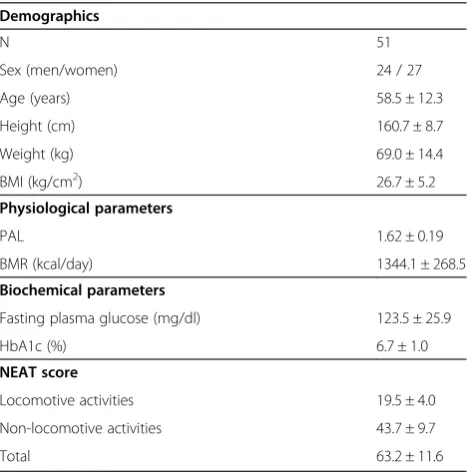
51 patients with type 2 diabetes without physical disability aged between 27 and 79 years old. Participants who en-gaged in active sports-like exercise and resistance training were excluded. Characteristics of the participants studied are shown in Table 1.
Daily physical activity measurement by the triaxial accelerometer
Daily PA was measured using the triaxial accelerometer (Active Style Pro HJA-350IT, Omron Co., Ltd, Kyoto, Japan), 74 × 46 × 34 mm and 60 g including batteries. Participants studied wore the accelerometer on the left side of the waist. Anteroposterior, mediolateral and ver-tical acceleration measurements were obtained during each physical activity at a rate of 32 Hz to 12-bit accur-acy. Each of three signals from the triaxial accelerometer was passed through a high-pass filter with a cut-off frequency of 0.7 Hz to remove the gravitational accel-eration component. The ratios of unfiltered to filtered total acceleration (TAU/TAF) and filtered vertical and horizontal acceleration (VAF/HAF) were calculated to determine the cut-off value for the classification of locomotive activities and non-locomotive activities includ-ing such as household and occupational activities, which resulted in almost 100% accurate demarcation for daily eleven different activities [8]. Furthermore, metabolic equi-valent values (METs) determined by the triaxial accelerom-eter have been reported to be closely correlated with METs calculated by using energy expenditure (EE) measured by the indirect calorimetry [8,9]. Participants studied wore the
accelerometer on the left side of the waist for consecutive 7 days, and physical activities were recorded. Participants were requested to wear the accelerometer except under special circumstances such as sleeping, bathing and during aquatic activities. Activity data were stored on a minute-by-minute basis and were downloaded to a personal computer before analysis. We excluded days in which participants did not wear the accelerometer for more than 8 hours from the data for analysis.
Basal metabolic rate (BMR) was estimated from multiple regression equation including age, sex, height and ideal body weight (IBW) as variables, the equation as follows: BMR (kcal/day) = [(0.1283 + 0.0481 × IBW (kg) + 0.0234 × height (cm) - 0.0138 × age (year) - 0.5473 × sex coefficient (man: 1, woman:2)) × 293] [10]. Total energy expenditure (TEE) was calculated by manufactured regression equa-tion using METs assessed by the triaxial accelerometer [9]. PAL was calculated by the following equation. PAL = TEE/BMR [11].
Assessment of NEAT by using an original questionnaire After measuring daily PA by the triaxial accelerometer, we asked participants about their daily PA to evaluate NEAT, by using an original questionnaire which we have previously reported (Additional file 1) [7]. The question-naire consisted of 11 question items about locomotive activities and 25 question items about non-locomotive activities. Table 2 showed questionnaire items about locomotive and non-locomotive activities, and also pre-dicted METs by each activity in our NEAT questionnaire [7,12]. We evaluated each questionnaire item with a score of 1 to 3 points in order of levels of daily PA and then added up the scores to determine the NEAT score.
Statistical analysis
Statistical analysis was performed using SPSS version 19 (IBM Co., Ltd, Chicago, USA). All values were expressed as the mean ± standard deviation (SD). Pearson’s correl-ation coefficient was calculated in order to analyze the as-sociation of the NEAT score with PAL. P value < 0.05 was considered to be statistically significant.
Results
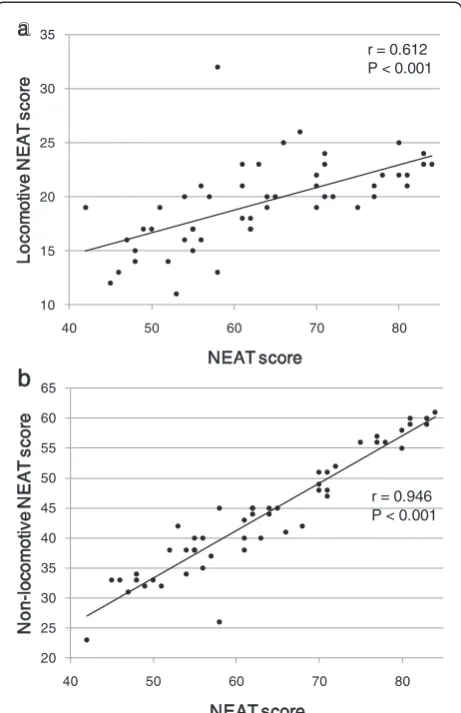
In the present study, the NEAT score was significantly and positively correlated with PAL measured by the triaxial ac-celerometer (r = 0.604, P < 0.001; Figure 1). PAL was also significantly and positively correlated with both the loco-motive NEAT score and the non-locoloco-motive NEAT score (r = 0.444, P = 0.001 and r = 0.526, P < 0.001, respectively; Figure 2). Both the locomotive NEAT score and the non-locomotive NEAT score were significantly correlated with the whole NEAT scores (r = 0.612, P < 0.001 and r = 0.946, P < 0.001, respectively; Figure 3).
Table 1 Participants characteristics
Demographics
N 51
Sex (men/women) 24 / 27
Age (years) 58.5 ± 12.3
Height (cm) 160.7 ± 8.7
Weight (kg) 69.0 ± 14.4
BMI (kg/cm2) 26.7 ± 5.2
Physiological parameters
PAL 1.62 ± 0.19
BMR (kcal/day) 1344.1 ± 268.5
Biochemical parameters
Fasting plasma glucose (mg/dl) 123.5 ± 25.9
HbA1c (%) 6.7 ± 1.0
NEAT score
Locomotive activities 19.5 ± 4.0
Non-locomotive activities 43.7 ± 9.7
Total 63.2 ± 11.6
Our previous study showed that the NEAT score was significantly and inversely associated with serum insulin levels, suggesting a beneficial association of NEAT with insulin sensitivity in all participants [7] (Table 3). The NEAT score was inversely associated with waist circum-ference, and also was positively associated with HDL-C level in women [7] (Table 3). However, a beneficial asso-ciation of NEAT with waist circumference and HDL-C was not observed in men.
There were no differences in PAL and locomotive NEAT score between men (1.59 ± 0.15 and 20.4 ± 3.9, respectively) and women (1.64 ± 0.22 and 18.6 ± 3.9, respectively). How-ever, the whole NEAT score and non-locomotive NEAT score were significantly higher in women (66.9 ± 12.7 and 48.3 ± 9.2) compared with those in men (59.0 ± 8.6 and 38.6 ± 7.4; P = 0.026 and P < 0.001, respectively).
Table 2 Locomotive and non-locomotive activities, and predicted METs by each activity in our NEAT questionnaire
Locomotive activities Non-locomotive activities
Specific activities Predicted METs Specific activities Predicted METs
Commuting on foot 4.0 cleaning 2.5-3.8
Walking a lot while working 3.5 cooking 3.5
Getting on a train or a bus 1.3 washing the dishes 3.3
Using stairs 3.5 ironing 1.8
Shopping for food 2.3 cleaning the bath 2.3
Taking the garbage out 2.5 cleaning the garden 4.0
Playing with children outside 3.5-5.8 weeding or gardening 3.5
Going for a walk 3.5 watering plants 1.5
feeding pets 2.5
looking after children 2.0-3.0
looking after the elderly 2.3-4.0
sewing 1.3
playing an instrument 2.0
NEAT, non-exercise activity thermogenesis; METs, metabolic equivalent values.
r = 0.604 P < 0.001
Figure 1Correlation between the NEAT score and PAL in study participants.
1 1.2 1.4 1.6 1.8 2 2.2
10 15 20 25 30
P
A
L
Locomotive NEAT score r = 0.444 P = 0.001
a
1 1.2 1.4 1.6 1.8 2 2.2
20 30 40 50 60
P
A
L
Non-locomotive NEAT score r = 0.526 P < 0.001
b
Discussion
In the present study, we compared daily PA measured by the triaxial accelerometer with our original NEAT score. To our knowledge, our NEAT questionnaire is the first to evaluate NEAT including locomotive and non-locomotive activities in clinical practices. Our findings showed that the NEAT scores measured by using our questionnaire were highly correlated with PAL measured
by the triaxial accelerometer in Japanese patients with type 2 diabetes. Although the NEAT score obtained from the questionnaire is practical and cost-effective to evaluate PA, they are subjective data and may not always represent the true NEAT [13,14]. The accelerometry technique have been found to have a significant correlation with EE measured by the indirect calorimetry, therefore, it has been extensively considered to be a validated method for evaluating PA under free living conditions [9,15-18]. In the present study, the validity of our ori-ginal NEAT questionnaire was confirmed by using the triaxial accelerometer.
Cooper AR et al. have showed that sedentary time was positively associated with metabolic risks [19], whereas the moderate-to-vigorous-intensity physical activity (MVPA) was associated with reduced metabolic risks [20]. Patients with type 2 diabetes generally show low levels of PA and have difficulty maintaining the recommended PAL [21,22]. The promotion of light-intensity daily PA such as NEAT is more practical and realizable as compared with the pro-motion of MVPA in the management of type 2 diabetes. We have previously demonstrated that the NEAT score determined by our original questionnaire is favorably associated with insulin sensitivity, abdominal obesity, lipid metabolism and blood pressure in patients with type 2 diabetes [7]. Taking account of present results, the promotion of NEAT may be useful for the manage-ment of type 2 diabetes.
We had unsolved things about the NEAT question-naire in our previous study. The NEAT scores measured by questionnaire were more significantly and beneficially correlated with metabolic parameters in women as com-pared with those in men [7]. Briefly, the NEAT score was inversely associated with waist circumference, and also was positively associated with HDL-C level in women. However, a beneficial association of NEAT with waist circumference and HDL-C was not observed in men. Our NEAT questionnaire consists of 11 question items about locomotive activities such as walking and going up stairs, and 25 question items about non-locomotive activities such as washing dishes, ironing and sewing, and 21 question items are related to housework. Therefore, our 10
15 20 25 30 35
40 50 60 70 80
L
o
c
o
m
o
ti
v
e
N
E
A
T
s
c
o
re
NEAT score
a
a
r = 0.612 P < 0.001
20 25 30 35 40 45 50 55 60 65
40 50 60 70 80
N
o
n
-l
o
c
o
m
o
ti
v
e
N
E
A
T
s
c
o
re
NEAT score
r = 0.946 P < 0.001
b
Figure 3Correlations between the whole NEAT score and (a) the locomotive NEAT score and (b) the non-locomotive NEAT score.
Table 3 Correlations of NEAT score with physiological and biochemical parameters in all participants, men and women
All participants (n = 45) Men (n = 23) Women (n = 22)
r P value r P value r P value
Waist circumference −0.013 0.944 0.460 0.055 −0.509 0.044
Systolic blood pressure 0.184 0.226 0.371 0.082 −0.034 0.882
Diastolic blood pressure −0.029 0.852 0.108 0.625 −0.137 0.543
Triglycerides −0.171 0.268 −0.028 0.903 −0.320 0.147
HDL cholesterol 0.079 0.608 −0.441 0.040 0.494 0.020
Serum insulin −0.420 0.019 −0.422 0.104 −0.421 0.118
questionnaire can evaluate non-locomotive activities ad-equately, however, may underestimate locomotive activ-ities. The NEAT score of non-locomotive activities was more strongly correlated with the whole NEAT scores as compared with that of locomotive activities, supporting that our NEAT questionnaire is more excellent to evaluate non-locomotive activities such as housework as compared with locomotive activities such as walking. This may cause different effects of NEAT on metabolic parameters be-tween men and women.
We have to mention the limitations of this study. We might overestimate or underestimate PA in the question-naire. EE was estimated by regression equation assessed by the triaxial accelerometer. Leenders et al. indicated that the predictive equations based on the relationship between acceleration and EE during locomotive move-ments led to under- and overestimation of TEE [23]. It is possible that EE and PAL measured by the triaxial accelerometer differ from the true amount. For example, the accelerometer was worn on the left side of the waist and the movements of upper extremities could not be measured completely. The movement of upper extrem-ities contributed less to EE than whole body trunk movements [24], however, our NEAT questionnaire in-cluded PA of upper extremities such as washing dishes, ironing and sewing, EE by those activities might have been underestimated.
Conclusion
We confirmed the validity of NEAT questionnaire by in-vestigating the correlation of the NEAT score to PAL mea-sured by the triaxial accelerometer. Our original NEAT questionnaire may be useful for evaluation of daily PAL in clinical practices.
Additional file
Additional file 1:Non-Exercise Activity Thermogenesis (NEAT) score.
Competing interests
The authors declare that they have no competing interests.
Authors’contributions
All five authors have substantially contributed to conception and design, acquisition of data or analysis and interpretation of data; drafting the article or revising it critically for important intellectual content; and all authors read and approved the final manuscript.
Acknowledgments
This study was supported by a grant from the National Center for Global Health and Medicine (25–203). The authors would like to thank Tomoko Kaga, Yukari Takano, Fumi Kawasaki, Yukie Kawamura, and Naomi Inoue at Clinical Research Center, National Center for Global Health and Medicine Kohnodai Hospital, for their technical help.
Author details
1
Department of Internal Medicine, National Center for Global Health and Medicine Kohnodai Hospital, Chiba, Japan.2Division of Complementary
Medicine, First Department of General Medicine, Saitama Medical Center, Jichi Medical University School of Medicine, Saitama, Japan.3Department of Diabetes Research, Diabetes Research Center, National Center for Global Health and Medicine, Tokyo, Japan.4Department of Human Health and Design, Faculty of Human Life and Environmental Sciences, Showa Women’s University, Tokyo, Japan.
Received: 11 March 2014 Accepted: 1 July 2014 Published: 5 July 2014
References
1. Thompson PD, Buchner D, Pina IL, Balady GJ, Williams MA, Marcus BH, Berra K, Blair SN, Costa F, Franklin B, Fletcher GF, Gordon NF, Pate RR, Rodriguez BL, Yancey AK, Wenger NK, American Heart Association Council on Clinical Cardiology Subcommittee on Exercise, Rehabilitaion, and Prevention:Exercise and physical activity in the prevention and treatment of atherosclerotic cardiovascular disease: a statement from the Council on Clinical Cardiology (Subcommittee on Exercise, Rehabilitaion, and Prevention) and the Council on Nutrition, Physical Activity, and Metabolism (Subcommittee on Physical Activity). Circulation2003,107:3109–3116.
2. Kodama S, Tanaka S, Heianza Y, Fujihara K, Horikawa C, Shimano H, Saito K, Yamada N, Ohashi Y, Sone H:Association between physical activity and risk of all-cause mortality and cardiovascular disease in patients with diabetes: a meta-analysis.Diabetes Care2013,36:471–479.
3. Shibata A, Oka K, Harada K, Nakamura Y, Muraoka I:Psychological, social, and environmental factors to meeting physical activity recommendations among Japanese adults.Int J Behav Nutr Phys Act
2009,6:60.
4. Levine JA:Non-exercise activity thermogenesis (NEAT).Nutr Rev2004,
5:S82–S97.
5. Healy GN, Dunstan DW, Salmon J, Cerin E, Shaw JE, Zimmet PZ, Owen N:
Objectively measured light-intensity physical activity is independently associated with 2-h plasma glucose.Diabetes Care2007,30:1384–1389. 6. Healy GN, Wijndaele K, Dunstan DW, Shaw JE, Salmon J, Zimmet PZ, Owen N:
Objectively measured sedentary time, physical activity, and metabolic risk: the Australian Diabetes, Obesity and Lifestyle Study (AusDiab).Diabetes Care2008,31:369–371.
7. Hamasaki H, Yanai H, Mishima S, Mineyama T, Yamamoto-Honda R, Kakei M, Ezaki O, Noda M:Correlations of non-exercise activity thermogenesis to metabolic parameters in Japanese patients with type 2 diabetes. Diabetol Metab Syndr2013,5:26.
8. Oshima Y, Kawaguchi K, Tanaka S, Ohkawara K, Hikihara Y, Ishikawa-Takata K, Tabata I:Classifying household and locomotive activities using a triaxial accelerometer.Gait Posture2010,31:370–374.
9. Ohkawara K, Oshima Y, Hikihara Y, Ishikawa-Takata K, Tabata I, Tanaka S:
Real-time estimation of daily physical activity intensity by a triaxial accelerometer and a gravity-removal classification algorithm.Br J Nutr
2011,105:1681–1691.
10. Ganpule AA, Tanaka S, Ishikawa-Takata K, Tabata I:Interindividual variability in sleeping metabolic rate in Japanese subjects.Eur J Clin Nutr2007,
61:1256–1261.
11. Energy and protein requirements:Report of a joint FAO/WHO/UNU expert consultation.World Health Organ Tech Rep Ser1985,724:1–206.
12. Ainsworth BE, Haskell WL, Herrmann SD, Meckes N, Bassett DR Jr, Tudor-Locke C, Greer JL, Vezina J, Whitt-Glover MC, Leon AS:Compendium of physical activities: a second update of codes and MET values.Med Sci Sports Exerc
2011,43:1575–1581.
13. Colbert LH, Matthews CE, Havighurst TC, Kim K, Schoeller DA:Comparative validity of physical activity measures in older adults.Med Sci Sports Exerc
2011,43:867–876.
14. Colbert LH, Schoeller DA:Expending our physical activity (measurement) budget wisely.J Appl Physiol2011,111:606–607.
15. Welk GJ, Corbin CB, Dale D:Measurement issues in the assessment of physical activity in children.Res Q Exerc Sport2000,71:S59–S73. 16. Midorikawa T, Tanaka S, Kaneko K, Koizumi K, Ishikawa-Takata K, Futami J,
Tabata I:Evaluation of low-intensity physical activity by triaxial accelerometry. Obesity2007,15:3031–3038.
17. Plasqui G, Bonomi AG, Westerterp KR:Daily physical activity assessment with accelerometers: new insights and validation studies.Obes Rev2013,
18. Ekelund U, Sjöström M, Yngve A, Poortvliet E, Nilsson A, Froberg K, Wedderkopp N, Westerterp K:Physical activity assessed by activity monitor and doubly labeled water in children.Med Sci Sports Exerc2001,
33:275–281.
19. Cooper AR, Sebire S, Montgomery AA, Peters TJ, Sharp DJ, Jackson N, Fitzsimons K, Dayan CM, Andrews RC:Sedentary time, breaks in sedentary time and metabolic variables in people with newly diagnosed type 2 diabetes.Diabetologia2012,55:589–599.
20. Rennie KL, McCarthy N, Yazdgerdi S, Marmot M, Brunner E:Association of the metabolic syndrome with both vigorous and moderate physical activity.Int J Epidemiol2003,32:600–606.
21. Jakicic JM, Gregg E, Knowler W, Kelley DE, Lang W, Miller GD, Pi-Sunyer FX, Regensteiner JG, Rejeski WJ, Ridisl P, Walkup MP, Wolf DL:Activity patterns of obese adults with type 2 diabetes in the look AHEAD study.Med Sci Sports Exerc2010,42:1995–2005.
22. Morrato EH, Hill JO, Wyatt HR, Ghushchyan V, Sullivan PW:Physical activity in U.S. adults with diabetes and at risk for developing diabetes, 2003. Diabetes Care2007,30:203–209.
23. Leenders NY, Sherman WM, Nagaraja HN:Energy expenditure estimated by accelerometry and doubly labeled water: do they agree?Med Sci Sports Exerc2006,38:2165–2172.
24. Kumahara H, Tanaka H, Schutz Y:Daily physical activity assessment: what is the importance of upper limb movements vs whole body
movements?Int J Obes Relat Metab Disord2004,28:1105–1110.
doi:10.1186/2052-1847-6-27
Cite this article as:Hamasakiet al.:The validity of the non-exercise activity
thermogenesis questionnaire evaluated by objectively measured daily physical activity by the triaxial accelerometer.BMC Sports Science, Medicine, and Rehabilitation20146:27.
Submit your next manuscript to BioMed Central and take full advantage of:
• Convenient online submission
• Thorough peer review
• No space constraints or color figure charges
• Immediate publication on acceptance
• Inclusion in PubMed, CAS, Scopus and Google Scholar
• Research which is freely available for redistribution