Open Access
Study protocol
Interrupted or continuous slowly absorbable sutures – Design of a
multi-centre randomised trial to evaluate abdominal closure
techniques INSECT-Trial [ISRCTN24023541]
Hanns-Peter Knaebel
†1, Moritz Koch
†1, Stefan Sauerland
2, Markus K Diener
1,
Markus W Büchler*
1, Christoph M Seiler
1and the INSECT Study Group of the
Study Centre of the German Surgical Society (SDGC)
Address: 1University of Heidelberg, Department of General, Visceral and Trauma Surgery, Im Neuenheimer Feld 110, D-69120 Heidelberg,
Germany and 2University of Cologne, Biochemical & Experimental Department, Ostmerheimer Str. 200, D-51109 Cologne, Germany
Email: Hanns-Peter Knaebel - [email protected]; Moritz Koch - [email protected]; Stefan Sauerland - [email protected]; Markus K Diener - [email protected];
Markus W Büchler* - [email protected]; Christoph M Seiler - [email protected] * Corresponding author †Equal contributors
Abstract
Background: The closure of the abdomen after median laparotomy is still a matter of debate among surgeons. Further well designed and performed randomised controlled trials determining the optimal method of abdominal fascial closure are needed.
Design: This is a three armed, multi-centre, intra-operatively randomised, controlled, patient blinded trial. Over 20 surgical departments will enrol 600 patients who are planned for an elective primary abdominal operation. The objective of this study is to compare the frequency of abdominal incisional hernias between two continuous suture techniques with different, slowly absorbable monofilament materials and an interrupted suture using an absorbable braided suture material at one year postoperatively.
Conclusion: This trial will answer the question whether the continuous abdominal wall closure with a slowly absorbable material with longitudinal elasticity is superior to the continuous suture with a material lacking elasticity and to interrupted sutures with braided thread.
Background
Median laparotomy is the most common technique of abdominal incisions because it is simple, provides ade-quate exposure to all four quadrants, is rapid to open and usually bloodsparing [1]. A major problem after median laparotomy remains the adequate technique of abdomi-nal fascia closure. In prospective studies the incidence of incisional hernias varies from 9% to 20% [2,3]. Wound infection, obesity and suture closure technique are
addressed as major risk factors for the development of an incisonal hernia [4,5].
Whereas patient related factors such as age, gender, body mass index (BMI), underlying disease, co-morbidities, prior surgical procedures and life-style factors (e. g. smok-ing) cannot be controlled or standardised, the decisive chance to lower the incidence of incisional hernias is to optimise the surgical technique. Therefore, a great variety Published: 08 March 2005
BMC Surgery 2005, 5:3 doi:10.1186/1471-2482-5-3
Received: 13 February 2005 Accepted: 08 March 2005
This article is available from: http://www.biomedcentral.com/1471-2482/5/3
© 2005 Knaebel et al; licensee BioMed Central Ltd.
of suture materials and needles has been developed to provide an adequate closure of the fascia and thus the abdominal wall. Thousands of patients have been included in trials in order to answer the question which is the optimal method in abdominal fascia closure and today a number of reviews and a meta-analysis are availa-ble. However, the reliability of the existing evidence is compromised by the low number of relevant randomised controlled trials (RCT's) [6-8].
Therefore the discussion regarding the optimal technique of abdominal fascia closure continues and most surgeons practice according to their own experience rather than act-ing evidence-based. This attitude resulted in an unchanged frequency of incisional hernias over the last decades [5]. None of the prior studies comparing rapidly absorbable braided materials with interrupted sutures ver-sus slowly absorbable monofilament suture materials in a continuous technique were able to determine a definite superiority for one technique. Possible reasons may be small numbers of patients in each group or short follow-up [9-12].
We therefore conclude that there is a lack of data from a truly well-designed long-term trial performed in the daily practice of surgery. This has led us to develop a large ran-domised controlled trial comparing different surgical techniques of abdominal closure after median laparot-omy. INSECT is a multi-centre, intraoperatively ran-domised controlled trial comparing three different standardised surgical techniques with certain needle/ suture combinations on the occurrence of incisional her-nia in patients with elective primary midline laparotomy. Two groups will use running sutures with different longi-tudinal elasticity (one group PDS™ and the other Mono-Plus™) combined with an atraumatic needle and one group interrupted sutures (Vicryl™) with a traumatic nee-dle. A three-group parallel equivalence design was selected because due to the results of the latest published meta-analysis [11] the superiority for one closure method has not been definitely proven. The randomisation proce-dure will be done stratified for participating centers. The planned sample size is at least 600 patients with a follow up period of three years.
INSECT is the first large-scale trial that started after a detailed theoretical and practical training of the partici-pating surgical centers in March 2004 in order to reduce surgical bias in the study. INSECT will provide internal valid data for an adequate surgical technique of abdomi-nal closure. Although we are well aware that this study cannot answer all open questions, the results should help to further improve evidence based surgery.
Design
Trial organization
INSECT has been designed and carried out by the Study Centre of the German Surgical Society (SDGC). The SDGC is an independent research group of the German Surgical Society and the Medical School of the University of Hei-delberg that has to design, conduct and analyse large ran-domised surgical trials in order to improve daily surgical practice. The role of the sponsor (BBD Aesculap) is limited to material supply and local first-level-support. The spon-sor is not involved in the database management and has no access to the randomisation code.
Coordination
The trial is coordinated by the SDGC, which is responsible for overall trial management, trial registration (Interna-tional Standard Randomised Controlled Trial Number (ISRCTN 24023541), http://www.controlled-trials.com), database management, quality assurance including mon-itoring, reporting and for the scientific program of all trial related meetings.
Investigators
Patients will be recruited by over 20 surgical centres in Germany. All investigators are hospital-based surgeons with a focus on general surgery. In order to obtain a rep-resentative trial result hospitals of all levels of care and education (county/community, private and university centres) are participating in this trial.
Adverse events committee
This committee consists of 3 surgeons and decides on the final diagnostic classification of critical clinical events. For all serious adverse events the documentation and relevant patient data are verified by co-ordinating personnel of each centre before submitting the data to the Adverse Events Committee for diagnostic classification.
Analysis of safety related data is performed with respect to frequency of:
• Serious Adverse Events and Adverse Events stratified by body-system
• Adverse Events stratified by severity
• Adverse Events stratified by causality.
Study material supply
Study materials for all centres will be acquired by the BBD Aesculap company. Each type of suture material derives from a single batch to eliminate material inconsistencies. All materials are delivered to the participating centres by local representatives of the sponsor who also guarantee local first-level-support.
On-site monitoring
During recruitment of patients each centre is monitored on site according to good clinical practice (GCP) guide-lines. The data monitoring for this trial will be performed by an independent study nurse who is not involved in the trial or in completion of the case report form (CRF). The surgical monitoring will be done by independent sur-geons being not involved in conducting this trial.
Ethics, Informed Consent and Safety
The final protocol was approved by the ethics committee of the University of Heidelberg, Medical School. Second-ary approval is gathered from all local ethics committees responsible for the participating centres. Informed con-sent will be obtained from each patient in oral and written form before inclusion in the trial.
Patient selection
INSECT focuses on hospitalised patients over 18 years of age who are planned for an elective primary abdominal
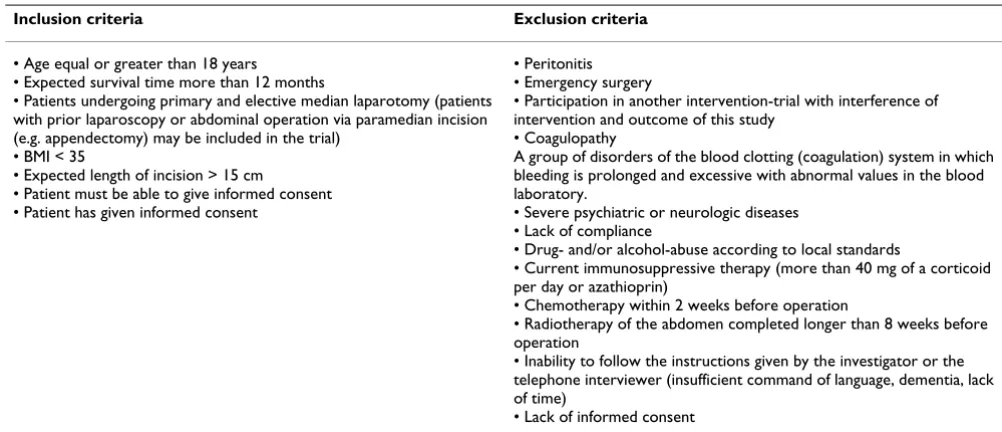
operation and are eligible for a vertical abdominal inci-sion in order to perform the planned surgical procedure. A detailed overview of all eligibility criteria is given in Table 2.
Study objectives
The primary objective of this study is to compare the fre-quency of incisional hernias between three different abdominal fascia closure methods after one year postop-eratively: two continuous slowly absorbable monofila-ment suture materials with and without longitudinal elasticity respectively (MonoPlus™ USP 1, 150 cm loop, with a HRT-48 needle, BBD Aesculap Tuttlingen, Ger-many and PDS II™ USP 1, 150 cm loop, Ethicon Norder-stedt, Germany) and a interrupted suture with an absorbable braided suture material (Vicryl™ USP 2, 6 × 45 cm, non-needled plus a traumatic needle, Ethicon Norder-stedt, Germany).
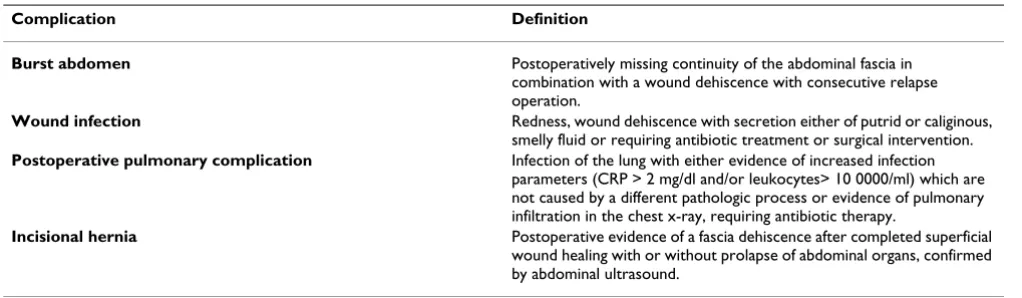
Secondary objectives are the frequencies of early and late onset complications such as burst abdomen, postopera-tive pulmonary complications, wound infections and incisional hernias after three years postoperatively. Addi-tionally a set of surgical and non-surgical parameters related to the operation will be analysed as secondary objectives such as the frequencies of various complica-tions, the lung function and the postoperative length of hospital stay. A qualitative analysis is included in the study to assess the relevance of the primary endpoint from the patient's and the surgeon's perspective. The following aspects are ranked in a descending order from 1 (= most important) to 9 (= least important): postoperative com-plication, intraoperative comcom-plication, length of hospital stay, onset of enteral nutrition, death, postoperative pain, postoperative fatigue, convalescence of the complete physical maximum resilience and cosmetic result [13]. The ranking by the surgeon is done once for each surgeon before the operation. Patients are completing the ranking
Table 1: Definition of early onset and late complications
Complication Definition
Burst abdomen Postoperatively missing continuity of the abdominal fascia in
combination with a wound dehiscence with consecutive relapse operation.
Wound infection Redness, wound dehiscence with secretion either of putrid or caliginous, smelly fluid or requiring antibiotic treatment or surgical intervention.
Postoperative pulmonary complication Infection of the lung with either evidence of increased infection parameters (CRP > 2 mg/dl and/or leukocytes> 10 0000/ml) which are not caused by a different pathologic process or evidence of pulmonary infiltration in the chest x-ray, requiring antibiotic therapy.
twice: first at inclusion and second at their discharge, to investigate if the patient's initial perspective changes within the hospital stay. Those various outcome parame-ters will be evaluated as part of an additional scientific project to build up a basis for further relevant questions in abdominal wall closure.
Randomisation and surgical technique
A block-randomisation-list is generated via computer sys-tem (SAS Version 8.2, SAS Institute Inc., Cary, USA) and stratified for the individual centre. Each centre will con-tribute 30 patients (10 to each group). The sealed ran-domisation list is stored in the investigator file. Patients are randomised using sealed opaque envelopes in the operation theatre after the surgical procedure has been started and before the abdominal wall will be closed.
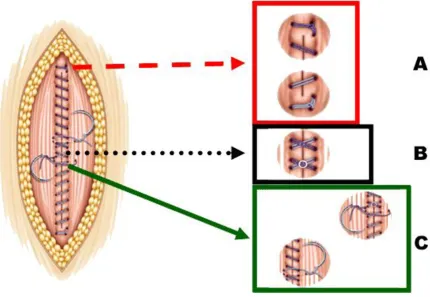
Major challenge in this surgical trial compared to pharma-ceutical trials is the standardisation of the surgical tech-nique. All patients undergo a skin incision using electric cautery. Upon completion of the surgical procedure, clo-sure of the abdominal wall is performed in all three groups in a standardised manner: four sharp Mikulicz-Clamps are placed at the corners of the incision and in the middle of the edges of the abdominal fascia and then the closure technique will be performed according to ran-domisation. Three groups are available: a continuous, all-layer closure technique with either two monofilament loops or an interrupted technique using a braided mate-rial (matemate-rial as described above). In all three groups suturing is initiated at both ends of the incision towards the middle, whereas the continuous suture line is
overlap-ping at the centre for at least 2 cm to secure each other (for details see figure 1). Neither a subcutaneous closure nor a subcutaneous drainage is to be inserted. Skin closure is done with skin clips. Measurement of the length of scar in centimeters (cm) is performed. A detailed description of the required surgical technique is given in the INSECT-study protocol enhanced by images and sketches as well as video material used during the investigator meeting and provided to all centres and investigators.
In an investigator meeting before trial initiation (March 5th – 6th, 2004, AESCULAPIUM, Tuttlingen, Germany) all
participating centres have been trained in the required techniques using abdominal wall models of mini-pigs. An evaluation of the investigator meeting was performed by all participants and will be published shortly. Investiga-tors being unable to attend were trained on-site using the same training materials as in the investigator meeting. Training materials were supplemented by videos demon-strating the abdominal wall closure techniques (both con-tinuous and interrupted) in the in vivo situation and in the animal model giving all sub-investigators good insight into the required techniques. Furthermore, a trial manager of the SDGC is available and responsible for all trial related issues and questions.
Blinding
The patient is blinded for the technique of abdominal wall closure as the randomisation is performed intra-operatively. The patient will remain blinded until the assessment of the primary end-point at one year post-operatively. If feasible within the infrastructure of the
Table 2: Eligibility Criteria
Inclusion criteria Exclusion criteria
• Age equal or greater than 18 years
• Expected survival time more than 12 months
• Patients undergoing primary and elective median laparotomy (patients with prior laparoscopy or abdominal operation via paramedian incision (e.g. appendectomy) may be included in the trial)
• BMI < 35
• Expected length of incision > 15 cm
• Patient must be able to give informed consent • Patient has given informed consent
• Peritonitis • Emergency surgery
• Participation in another intervention-trial with interference of intervention and outcome of this study
• Coagulopathy
A group of disorders of the blood clotting (coagulation) system in which bleeding is prolonged and excessive with abnormal values in the blood laboratory.
• Severe psychiatric or neurologic diseases • Lack of compliance
• Drug- and/or alcohol-abuse according to local standards
• Current immunosuppressive therapy (more than 40 mg of a corticoid per day or azathioprin)
• Chemotherapy within 2 weeks before operation
• Radiotherapy of the abdomen completed longer than 8 weeks before operation
• Inability to follow the instructions given by the investigator or the telephone interviewer (insufficient command of language, dementia, lack of time)
participating centre, observers should be independent and not involved in completing the CRF and would thus also be blinded for the used technique.
Follow up
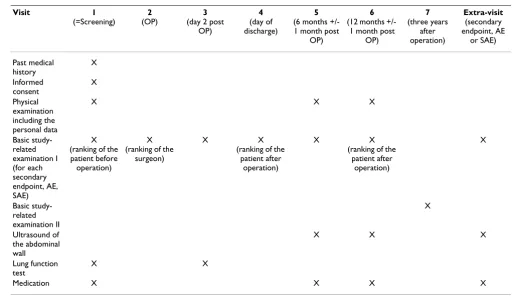
Patients are observed for 30 days postoperatively for early onset complications defined as secondary endpoints such re-admittance for burst abdomen. One year after the oper-ation the primary end-point will be assessed by docu-menting the incidence of incisional hernia with a physical examination and ultrasound of the abdominal wall. Fol-low up is completed 3 years after the primary operation to register any long-term complications of the used method for abdominal wall closure and to document any late-occurring hernias (see table 3 for detailed follow up).
Data management and quality assurance
Investigators enter data directly in paper-based case report form (CRF). These are arranged for each visit time-point and contain instructions and relevant definitions. All treatments are recorded in treatment logs. Standard adverse events forms are used to document (serious) adverse events and relevant clinical procedures that have
been carried out. After verification of the data entered according to "Good Clinical Practice" (GCP), one copy of each completed CRF is sent by mail to the SDGC. A con-current database is maintained there. All incoming CRF are scanned to be electronically archived. Data are entered in a specially developed relational data base management system. The data entry module contains on-line range and logical checks. For data that are found missing, illegible or inconsistent, data clarification forms are generated which are sent to the on-site monitor for resolution.
Certain events must be reported immediately by the inves-tigator by fax on preprinted forms directly to the coordi-nating centre. Examples are: informed consent and randomisation form, serious adverse events and prema-ture withdrawal form the trial. The reporting of serious adverse events complies with national regulatory requirements.
Statistical considerations and sample size estimation
Statistical methods are used to assess the quality of the data, homogeneity of treatment groups, endpoints and safety of the three different techniques.
Principles of continuous abdominal wall closure
Figure 1
The analysis is performed on the basis of an intention to treat (ITT) population and with respect to ITT principles. A patient belongs to the ITT population after the randomi-sation. The primary endpoint will also be analysed on the basis of a "per protocol" population.
To enable multiple comparisons in this three-armed study the closed testing procedure will be used[14]. All three treatment groups are considered separately without assuming any pre-specified monotonic trend among groups. All testing is done two-sided. The three elemen-tary hypotheses address pairwise comparisons of the inci-sional hernia rates R1, R2, and R3. These hypotheses H12: R1 = R2, H13: R1 = R3, and H23: R2 = R3, are all contained in the global null hypothesis H123: R1 = R2 = R3. Sample size estimation, however, will be based on the elementary hypotheses, thus leading to sufficient power in the global test. Bauer had recommended that "sample sizes should
be chosen large enough to give a high chance of jumping over the initial hurdle." [15].
The calculation of sample size is based on literature data, as summarised most recently by van 't Riet et al [11]. With interrupted suturing with an absorbable material, such as Vicryl®, incisional hernias were seen in about 13% of
patients. This number is primarily based on the four-armed trial by Wissing et al. [16]. With the use of slowly absorbable materials, such as PDS®, MonoPlus® or
Maxon®, lower herniation rates were found, but this holds
true only for continuous suturing. So far, only one trial has compared fast and slowly absorbable materials for interrupted sutures [17].
The comparison of interrupted rapidly absorbable versus continuous slowly absorbable sutures has been the aim of four previous studies. The results of these studies showed
Table 3: Flow Chart INSECT-Trial
Visit 1
(=Screening)
2
(OP)
3
(day 2 post OP)
4
(day of discharge)
5
(6 months +/- 1 month post
OP)
6
(12 months +/- 1 month post
OP) 7 (three years after operation) Extra-visit (secondary endpoint, AE or SAE) Past medical history X Informed consent X Physical examination including the personal data
X X X
Basic study-related examination I (for each secondary endpoint, AE, SAE) X (ranking of the patient before operation)
X (ranking of the
surgeon)
X X
(ranking of the patient after
operation)
X X
(ranking of the patient after operation) X Basic study-related examination II X Ultrasound of the abdominal wall
X X X
Lung function test
X X
Medication X X X X
Past medical history: past medical history, past surgical history, indication for operation, diabetes, renal insufficiency, smoking, lung disease Personal data: gender, date of birth, height in cm, weight in kg
Basic study related examination I: physical examination for evaluation of all secondary endpoints including adverse events/serious adverse events where appropriate
Basic study related examination II: telephone visit of patient and/or practitioner and physical re-examination if necessary in case of unclear abdominal wall status
Physical examination: vital signs (blood pressure systolic/diastolic in mmHg, heartrate in /min), prior abdominal incisions, rectus diastasis Ultrasound: standard abdominal wall investigation (if hernia present: length and width in cm)
a non-significant tendency towards a lower rate of inci-sional hernia. Taking this data and the improved suture properties into consideration, a hernia incidence of 4% could be reasonably expected in one or both of the non-Vicryl® groups over the first postoperative year. Smaller
differences are also unlikely to be of clinical relevance.
Assuming annual hernia incidences of 13% and 4% in at least two of the groups, a raw sample size of 172 patients per group can be calculated with a two-sided alpha of 0.05 and a beta of 0.20 (employing Fisher's exact test). We used the PS power and sample size program of Dupont and Plummer (Version 1.0.17) for sample size estimation (freely available at: http://www.mc.vanderbilt.edu/ prevmed/ps.htm). To account for an estimated 10% loss to follow-up and 2% surgical non-compliance with treat-ment allocation, sample size should be increased to 200 patients per group. In summary, the trial should recruit a total of 600 patients, with equal randomisation into the three groups. Thus a total of 720 patients have to be screened according to the CONSORT statement (Figure 2) [18].
In the primary intention-to-treat analysis, testing will start with the global null hypothesis H123: R1 = R2 = R3. Only if this global test is significant at the 0.05 level, the three ele-mentary hypotheses H12: R1 = R2, H13: R1 = R3, and H23: R2 = R3 will be tested next. These pairwise comparisons (Vic-ryl® versus PDS®, Vicryl® versus MonoPlus®, and PDS®
ver-sus MonoPlus®) use the same alpha level of 0.05, because
closed test procedures in three-armed designs do not require alpha level adjustment. If, however, the first global hypothesis cannot be rejected at alpha level, the family of elementary hypotheses will not be tested at all, except for exploratory reasons.
To control for possible differences with regard to surgical procedures (colorectal vs. gastric or pancreatic opera-tions), centre, and surgical expertise (board-certified sur-geon vs. assistant sursur-geon), logistic regression will be used. We expect that the use of logistic regression will not essentially comprise power assumptions when compared to univariate testing. The inclusion of time-to-event data in the primary statistical analysis (e.g. by applying Kaplan-Meier-curves or Cox-regression) does not confer specific advantages and seems unwarranted, also because an inci-sional hernia causes similar consequences for the patient irregardless of whether the hernia occurred after 3, 6 or 9 months.
Secondary endpoints, demographic and other variables
The analysis of the secondary endpoints and demographic variables will be descriptive.
The description of continuous variables includes at least: numbers of observations, mean, standard deviation, median, minimum and maximum. The description of cat-egorical variables (ordinal or nominal) includes at least the number and percentage of patients belonging to the relevant categories in the trial population as well as in each treatment group.
The description of the ranking of parameters of interest (patient's view before, after operation (day of discharge and 12 months later) and surgeon's view) includes the mean and median for each category in the trial popula-tion. There will be a listing for all measurements taken for the patients. In order to improve the presentation of the observed data, graphical methods will be applied.
Closing of the clinical database and follow up database
The clinical database including all information until 12 months after the operation will be closed six months after the last visit, complete documentation of all cases and res-olution of all queries. At this time the primary endpoint of the trial will be ascertained. The information of the final follow-up three years after the operation will be added later. This database will be closed three months after the last telephone three years after the last operation.
Current status and planning
The initial idea and hypothesis for the study was devel-oped in March 2003. After a systematic review of the liter-ature according to Cochrane standards has been performed the study protocol was completed in October 2003. The study protocol was approved by the local ethics committee of the University of Heidelberg in December 2003. Preparation of all study and instructional materials (including video clips) was completed in February 2004 and the first investigator meeting was held in Tuttlingen, Germany on March 5th and 6th, 2004. In June 2004,
fol-lowing completion of contracts and approval of local eth-ics committees, the first centres were initiated and the first patient was recruited in July 2004. Currently 23 centres are in an active status recruiting the required 30 patients per centre. Further 6 centres are processed and will be acti-vated within the next months. Assuming an enrolment of 5 patients per month and centre the end of recruitment is assumed to be in October 2005.
Discussion
INSECT-Trial according to CONSORT (Moher et al. Lancet 2001)
Figure 2
number of patients based on the sample size calculation needs to be transparent in order to evaluate whether results from this trial are transferable to daily practice. Therefore a flow chart according to the CONSORT state-ment should be included in study protocols (Figure 1). However, many important details of a randomised surgi-cal trial are interesting to the reader and can not be pub-lished together with the final results. It also seems out of the question that medical journals that surgical trials should be internationally registered [21].
INSECT is designed to help answering the question which is the optimal method for abdominal wall closure. Although there are a substantial number of randomised studies and several meta-analyses examining different techniques of abdominal fascia closure the optimal and definite method for closing the abdomen has not yet been found [6,7,11]. Therefore, the technique and materials for abdominal wall closure are still determined by local mate-rial supply and surgical tradition. These preconditions and a detailed literature research gave us reason to design a trial comparing three standardised common techniques of abdominal fascia closure in abdominal surgery.
Several design features of INSECT were discussed before the trial started. A two armed or a three armed study design was debated before writing the protocol. As we wanted to compare the clinically most relevant and most evidence-based suture materials and suture techniques for closure of midline abdominal incisions the most recent and most relevant meta-analysis as a data-base for choos-ing the different groups in our trial was used [11]. Two dif-ferent suture techniques and materials became clear to show the best results in abdominal fascia closure and revealed the lowest incidence for incisional hernias: slowly absorbable continuous (or running) sutures and absorbable interrupted sutures. Aside from those two groups of suture techniques (continuous versus inter-rupted sutures) we included a third group using the same technique as one of the other groups (continuous suture) but using a different suture material (monofilament suture with longitudinal elasticity) which is supplied by a different company. INSECT depicts the surgical reality and variety of abdominal wall closure as it compares not only different suture techniques but also several suture materials offered by different companies. Therefore, the results of INSECT will be relevant for the majority of sur-geons as the materials and techniques used in this trial are widely accepted in daily use.
An important issue for a good trial is to define adequate and well designed end-points. Regarding the optimal method for abdominal closure a great variety of objectives has to be considered: wound infection, wound dehis-cence, incisional hernia, suture sinus, wound pain, etc.
The socio-economic and surgical most relevant objective is the incidence of incisional hernias [4]. Because 50–70% of incisional hernias will occur within one year after oper-ation we selected the frequency of incisional hernias at one year postoperatively as the primary end-point of our study. All other relevant objectives such as wound infec-tion, pain, pulmonary impairment, etc. were included as secondary endpoints into the trial design. Additionally a qualitative analysis for surgeons and patients was planned to evaluate the importance of different outcome variables between surgeons and patients.
A major challenge in this INSECT trial compared to other studies, e. g. pharmaceutical trials, is the standardisation of the surgical technique. Lack of standardisation in surgi-cal trials is often an argument of opponents who state that the achieved trial results would not be transferable to sur-gical routine. Therefore all patients in the INSECT trial undergo a standardised skin incision and opening of the abdominal cavity as well as the closure of the abdominal wall is performed in all three groups in a standardised manner. To provide an overall highly standardised surgi-cal procedure in every study site all participating centres have been trained in the required techniques using abdominal wall models of mini-pigs during an investiga-tor meeting before trial initiation. For investigainvestiga-tors who were unable to attend the meeting training materials and videos demonstrating the different abdominal wall clo-sure techniques (both continuous and interrupted) used in the study were provided. For further quality assurance there will be a regular surgical monitoring during the trial. Additionally, randomisation is stratified for each individual centre and the trial results will be therefore comparable among the different participating centres.
Conclusion
of the INSECT trial will help to create more evidence and to guide surgeons to a critical review of their surgical routine.
Abbreviations
AWC Abdominal wall closure
CRF Case Report Form
GCP Good Clinical Practice
ICH International Conference on Harmonisation of Technical
Requirements for Registration of Pharmaceuticals for Human Use
IEC Independent Ethics Committee
ITT Intention-to-treat-analysis
PDS® Polydioxanone (absorbable suture material)
RCT Randomised Controlled Trial
SDGC Study Centre of the German Surgical Society
Competing interests
The author(s) declare that they have no competing interests.
Authors' contributions
Hanns-Peter Knaebel and Moritz Koch designed and wrote the manuscript, Stefan Sauerland prepared bio-sta-tistics of the trial and is in charge of the data management, Markus K Diener searched and assessed the literature, Markus W Büchler sponsors the trial and provides neces-sary infrastructure, Christoph M Seiler searched and assessed the literature and overlooked the completion of the manuscript.
Acknowledgements
The trial is designed, managed and conducted by the Study Centre of the German Surgical Society (SDGC) and supported by the BBD Aesculap Company, Tuttlingen, Germany. Finally recruitment is performed by the participating surgical centres of the INSECT study group (Klinikum Augs-burg, St. Josefs-Hospital Bochum, Klinikum links der Weser Bremen, Fürst-Stirum-Klinik Bruchsal, St. Josefs-Hospital Dortmund, Klinik Eichstätt, Westküstenklinikum Heide, Chirurgische Universitätsklinik Erlangen, Krankenhaus Mittleres Erzgebirge, Evangelische Kliniken Gelsenkirchen, Waldklinikum Gera, Chirurgische Universitätsklinik Heidelberg, Klinikum Herford, St. Bonifatius-Krankenhaus Lingen, Klinikum Lüdenscheid, Städtisches Klinikum Magdeburg, Kreiskrankenhaus Mosbach, Chirurgische Universitätsklinik München-Grosshadern, Chirurgische Universitätsklinik Regensburg, Klinikum Südstadt Rostock, Marienhospital Stuttgart, Robert-Bosch-Krankenhaus Stuttgart, Kreiskliniken Traunstein, Krankenhaus
Ger-resheim Düsseldorf, Dreifaltigkeits-Krankenhaus Wesseling, Krankenhaus Wermelskirchen, Westpfalz-Klinikum Kaiserslautern).
References
1. Ellis H: Midline abdominal incisions. Br J Obstet Gynaecol 1984,
91:1-2.
2. Mudge M, Hughes LE: Incisional hernia: a 10 year prospective study of incidence and attitudes. Br J Surg 1985, 72:70-71. 3. Sugerman HJ, Kellum JMJ, Reines HD, DeMaria EJ, Newsome HH,
Lowry JW: Greater risk of incisional hernia with morbidly obese than steroid-dependent patients and low recurrence with prefascial polypropylene mesh. Am J Surg 1996, 171:80-84. 4. Yahchouchy-Chouillard E, Aura T, Picone O, Etienne JC, Fingerhut A:
Incisional hernias. I. Related risk factors. Dig Surg 2003, 20:3-9. 5. Hoer J, Stumpf M, Rosch R, Klinge U, Schumpelick V: [Prevention
of incisional hernia]. Chirurg 2002, 73:881-887.
6. Hodgson NC, Malthaner RA, Ostbye T: The search for an ideal method of abdominal fascial closure: a meta-analysis. Ann Surg 2000, 231:436-442.
7. Weiland DE, Bay RC, Del Sordi S: Choosing the best abdominal closure by meta-analysis. Am J Surg 1998, 176:666-670. 8. Rucinski J, Margolis M, Panagopoulos G, Wise L: Closure of the
abdominal midline fascia: meta-analysis delineates the opti-mal technique. Am Surg 2001, 67:421-426.
9. Niggebrugge AH, Trimbos JB, Hermans J, Steup WH, Van De Velde CJ: Influence of abdominal-wound closure technique on com-plications after surgery: a randomised study. Lancet 1999,
353:1563-1567.
10. Rink AD, Goldschmidt D, Dietrich J, Nagelschmidt M, Vestweber KH:
Negative side-effects of retention sutures for abdominal wound closure. A prospective randomised study.Eur J Surg 2000, 166:932-937.
11. van 't RM, Steyerberg EW, Nellensteyn J, Bonjer HJ, Jeekel J: Meta-analysis of techniques for closure of midline abdominal incisions. Br J Surg 2002, 89:1350-1356.
12. Hsiao WC, Young KC, Wang ST, Lin PW: Incisional hernia after laparotomy: prospective randomized comparison between early-absorbable and late-absorbable suture materials. World J Surg 2000, 24:747-751.
13. Nies C, Celik I, Lorenz W, Koller M, Plaul U, Krack W, Sitter H, Roth-mund M: [Outcome of minimally invasive surgery. Qualitative analysis and evaluation of the clinical relevance of study var-iables by the patient and physician]. Chirurg 2001, 72:19-28. 14. Marcus R, Peritz G, Gabriel KR: On closed testing procedures
with special references to ordered analysis of variance.
Biometrika 1976, 63:655-660.
15. Bauer P: Multiple testing in clinical trials. Stat Med 1991,
10:871-889.
16. Wissing J, van Vroonhoven TJ, Schattenkerk ME, Veen HF, Ponsen RJ, Jeekel J: Fascia closure after midline laparotomy: results of a randomized trial. Br J Surg 1987, 74:738-741.
17. Corman ML, Veidenheimer MC, Coller JA: Controlled clinical trial of three suture materials for abdominal wall closure after bowl operations. Am J Surg 1981, 141:510-513.
18. Moher D, Schulz KF, Altman DG: The CONSORT statement: revised recommendations for improving the quality of reports of parallel-group randomised trials. Lancet 2001,
357:1191-1194.
19. Lubsen J, Poole-Wilson PA, Pocock SJ, van Dalen FJ, Baumann J, Kir-wan BA, Parker AB: Design and current status of ACTION: A Coronary disease Trial Investigating Outcome with Nifed-ipine GITS. Gastro-Intestinal Therapeutic System. Eur Heart J 1998, 19 Suppl I:I20-I32.
20. Poole-Wilson PA, Lubsen J, Kirwan BA, van Dalen FJ, Wagener G, Danchin N, Just H, Fox KA, Pocock SJ, Clayton TC, Motro M, Parker JD, Bourassa MG, Dart AM, Hildebrandt P, Hjalmarson A, Kragten JA, Molhoek GP, Otterstad JE, Seabra-Gomes R, Soler-Soler J, Weber S:
Effect of long-acting nifedipine on mortality and cardiovascu-lar morbidity in patients with stable angina requiring treat-ment (ACTION trial): randomised controlled trial. Lancet 2004, 364:849-857.
Publish with BioMed Central and every scientist can read your work free of charge "BioMed Central will be the most significant development for disseminating the results of biomedical researc h in our lifetime."
Sir Paul Nurse, Cancer Research UK
Your research papers will be:
available free of charge to the entire biomedical community
peer reviewed and published immediately upon acceptance
cited in PubMed and archived on PubMed Central
yours — you keep the copyright
Submit your manuscript here:
http://www.biomedcentral.com/info/publishing_adv.asp
BioMedcentral
from the International Committee of Medical Journal Editors. Lancet 2004, 364:911-912.
22. Jenkins TR: It's time to challenge surgical dogma with evi-dence-based data. Am J Obstet Gynecol 2003, 189:423-427.
Pre-publication history
The pre-publication history for this paper can be accessed here: