http://www.sciencepublishinggroup.com/j/fm doi: 10.11648/j.fm.20180401.11
ISSN: 2575-1808 (Print); ISSN: 2575-1816 (Online)
Numerical Analysis of Fluid Flow and Heat Transfer Based
on the Cylindrical Coordinate System
Mohammad Hassan Mohammadi
Institute of Mathematics, Department of Differential Equations, National Academy of Sciences of Armenia, Marshal Baghramyan Av., Yerevan, Armenia
Email address:
To cite this article:
Mohammad Hassan Mohammadi. Numerical Analysis of Fluid Flow and Heat Transfer Based on the Cylindrical Coordinate System. Fluid Mechanics. Vol. 4, No. 1, 2018, pp. 1-13. doi: 10.11648/j.fm.20180401.11
Received: October 18, 2017; Accepted: December 8, 2017; Published: January 15, 2018
Abstract:
In this work we will apply the three-dimensional mathematical modelling of fluid flow and heat transfer inside the furnaces based on the cylindrical coordinate system to describe the behavior of the transport phenomena. This modelling is constructed by using the mass, momentum, and energy conservation laws to achieve the continuity equation, the Navier-Stokes equations, and the energy conservation equation. Due to the moving boundary between the solid and melted materials inside of the furnaces we will impose the Stefan condition to describe the behavior of the free boundary between two phases. We will derive the variational formulation of the system of transport phenomena, then we will discrete the domain to complete the finite element method stages and we will obtain the system of nonlinear equations in 256 equations in 256 unknowns. To get the numerical solution of the large-scale system we will prepare a convenient mathematical work and gain some diagrams where they would be applicable in the design process of the furnaces shapes.Keywords:
Fluid Flow, Heat Transfer, Mathematical Modeling, Stefan Condition, Cylindrical Coordinate1. Introduction
Mathematical modeling of heat transfer is applied to investigate the environment of the furnaces and transport phenomena inside them, because it has the advantages of low cost and acceptable exactness. Quan-Sheng and You-Lan consider the two-dimensional Stefan problem in (1985) and they used the singularity-separating method to prepare the numerical solution. Ungan and Viskanta in (1986), (1987) investigated modeling of circulation and heat transfer in a glass melting tank in three-dimension. Henry and Stavros in (1996) prepared the convenient work about the mathematical modelling of solidification and melting process. Vuik, Segal, and Vermolen in (2000) studied about the discretization approach for a Stefan problem where they focused on interface reaction at the free boundary.
Pilon, Zhao, and Viskanta in (2002), (2006) in their papers considered three-dimensional flow and researched about the behavior of thermal structures in glass melting furnaces by using the three-dimensional mathematical modeling. Their works were included theoretical and numerical sections where they applied sufficient boundary conditions. Sadov,
Shivakumar, Firsov, Lui, and Thulasiram, provided an article about the mathematical model of ice melting on transmission lines in (2007). Choudhary, Venuturumilli, and Matthew in (2010) in their common paper introduce the mathematical modeling of flow and heat transfer phenomena in glass melting where it consists of delivery and forming processes, especially the turbulent conditions has been discussed in the paper for Newtonian and non-Newtonian fluids. Kambourova, and Zheleva had modelized and described temperature distributions ina tank of glass melting furnace in (2002).
phenomena in the cylindrical coordinate system in three-dimension to use its symmetric properties.
The melting process in the Garnissage furnace starts when we impose the heat to the solid material by electrical boosters inside it, but the heat transferring by electrical boosters couldn’t melt the whole materials and whenever the central parts are melted the parts far from the boosters is solid. In this case the boundary between the solid and liquid materials are moving during the process, then we will have free boundary problem. The Stefan condition is sufficient tool to describe the behavior of the free boundary and we will handle three-dimensional version of the Stefan condition in the mathematical modeling process.
We state the conservation equations in the cylindrical coordinate, so the Stefan condition, then we convert the system of equations into the weak formulation. For expressing the system in the variational formulation we will use convenient test functions with small support and then we will discrete the domain to follow the finite element method. The approximate values of the variables would be applied
instead of the variables, and finally we will get the system of equations that they are combination of linear and nonlinear equations, thus to solve the system numerically the Newton’s method would be recommended.
2. Mathematical Modeling
We start the paper by reviewing the mathematical modeling of fluid flow in three-dimension. Cylindrical coordinate is applied for modeling because it provides the convenient environment to express the modeling, hence we can use the symmetric properties to introduce the equations. There are three different parts in the modeling process which we will introduce them.
2.1. Continuity Equation
+ = 0 (1)
2.2. Navier-Stokes Equations
+ + = − + + − + (2)
+ + = − + + + (3)
2.3. Energy Equation
+ + = + + (4)
Deriving the weak formulation is second stage of the work after the mathematical modeling, then the variational version of the modeling has been obtained by imposing the convenient smooth test function with small support and using the integration by parts technique. Like the classical modeling the variational formulation has three sections:
2.4. Continuity Equation (Weak Formulation)
− − = 0 (5)
2.5. Navier-Stokes Equations (Weak Formulation)
+ ! + + + − − = − " − (6)
+ + +! + + = − " − (7)
2.6. Energy Equation (Weak Formulation)
# $ + + + + + %+ # + & = − (8)
3. Discretization of Domain
After weak formulation we discrete the domain Ω, and replace the approximate variables (, (, "(, and #( in the variational formulation to obtain the algebraic system of equations. Assume that *( ⊂ ,- Ω , which consists of test functions that they are piecewise continuous with the fix degree, and also suppose that
dim *(= 2 ℎ ,
*( = 4"5678 , 8!, 89, … , 8; ( <,
where the basis functions 8= , >, ?, @ , A = 1,2, … , 2 ℎ , have small support. If we choose the finite dimensional subspace *(, and also the correspond variables in *(, then we redefine the heat transfer problem as the problem of finding
(5), (6), (7), and (8). Now we define the approximate solutions (, (, "(, and #( in terms of the basis functions 8= , >, ?, @
( , >, ?, @ = ∑; (=F E=8= , >, ?, @ , (9)
( , >, ?, @ = ∑; (=F E =8= , >, ?, @ , (10)
"( , >, ?, @ = ∑; (=F G=8= , >, ?, @ , (11)
#( , >, ?, @ = ∑; (=F #=8= , >, ?, @ , (12)
where E =, E=, G=, #=, A = 1,2,3, … , 2 ℎ , must be determined. We insert the values of (, (, "(, #(∈ *( instead of , , ", #in the variational formulation of the heat transfer problem. In this case the heat transfer problem is restated as the problem of finding UKL, UK , … , UKM N ∈ RP Q, URL, UR , … , URM N ∈ RP Q, Sθ , θ!, … , θP QU ∈ RP Q, where they are satisfied in the system of equations ∑; (=F SE =5= − E=V= U= 0, (13)
∑; (=F E =W= + ∑=F; ( ∑; (XF E =E XY=X + ∑; (=F ∑; (XF E =E XZ=X + ∑; (=F G=[= + \ = 0, (14)
∑; ( E =W]= =F + ∑=F; ( ∑; (XF E =E XY]=X + ∑=F; ( ∑; (XF E =EXZ]=X + ∑; (=F G=[]= + \] = 0, (15)
∑; (=F #=^= + ∑=F; ( ∑; (XF #= E X+ EX _X + , = 0, (16)
` = 1,2,3, … , 2 ℎ , which coefficients of the system are defined as
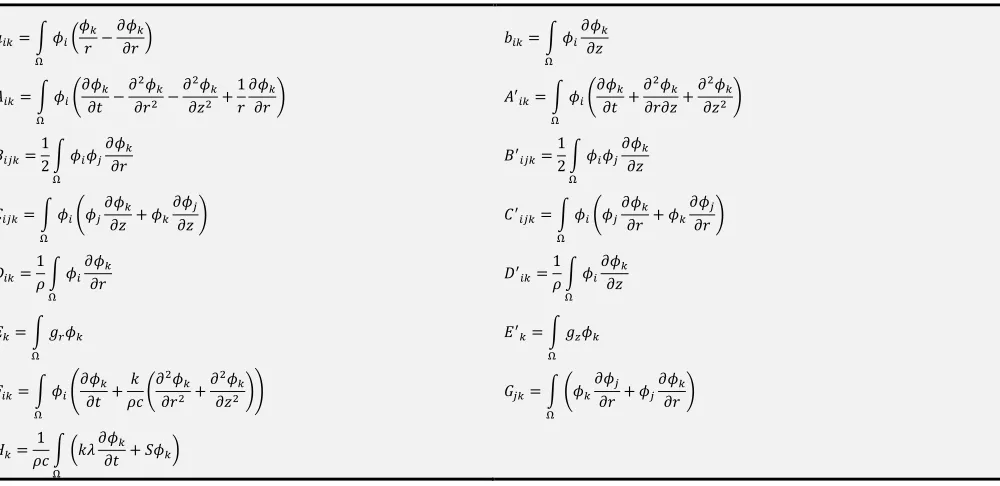
Table 1. System Coefficients.
5= = a 8=b8 −c8c d V= = a 8=c8c?
W= = a 8=$c8c@ −c !8
c ! −
c!8
c?! +
1 c8
c % W]= = a 8=$c8c@ +c !8
c c? +c
!8
c?!%
Y=X =12 a 8=8Xc8c Y]=X =12 a 8=8Xc8c?
Z=X = a 8=$8Xc8c? + 8 c8c? %X Z]=X = a 8=$8Xc8c + 8 c8c %X
[= =1a 8=c8c []= =1a 8=c8c?
\ = a 8 \] = a 8
^= = a 8=ec8c@ +`f $c !8
c ! +c !8
c?!%g _X = a $8 c8c + 8X Xc8c %
, = 1f a b`hc8c@ + 8 d
We need to determine the values of the coefficients to derive the numerical solution of system, then we must define the sufficient domain and discrete it to compute the relevant integrals, and at last we would found all coefficients and finally we will earn the numerical solution of the system for the interpretation of the fluid behavior in the furnaces.
4. Unknown Coefficients
Figure 1. Ai` −Mesh cube.
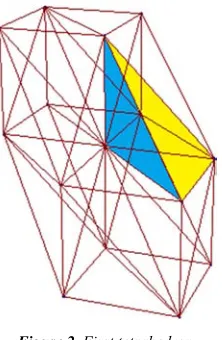
To define the test functions we divide the Ai` −mesh cube into the 24 tetrahedrons as Figure 2.
Figure 2. First tetrahedron.
Now we are looking for the continuous piecewise linear function 8 = 8 j, k, @ where it equals to 1 in the origin node ofAi` mesh cube, and 0 in the other nodes.
Suppose that
8 j, k, @ 5 Vj fk l@
for example to the point j, k, ? in the first tetrahedron
8 mSj=, kX, @ U 1
8 WSj=n , kXo , @ U 0
8 YSj=n , kX, @ U 0
8 ZSj=, kX, @ n U 0
then we will have
5 j=V kXf @ l 1
5 j=n V kXo f @ l 0
5 j=n V kXf @ l 0
5 j=V kXf @ n l 0
We get the solution of the linear system as
5 13 j= @ 1,
V l 13, f 0,
then we derive the test function
8 j, k, @ 13 j j= @ @ 1
We perform the same approach for all of the other tetrahedrons and we demonstrate them as
Parts 1, 2
8 j, k, @ 13 j j= @ @ 1
Parts 3, 4
8 j, k, @ 3 S j j1 = k kXU 1
Parts 5, 6
8 j, k, @ 13 S k kX @ @ U 1
8 j, k, @ =1ℎ j − j=+ @ − @ + 1
Parts 9, 10
8 j, k, @ =ℎ Sj − j1 =+ k − kXU + 1
Parts 11, 12
8 j, k, @ =1ℎ Sk − kX− @ + @ U + 1
Parts 13, 14
8 j, k, @ =1ℎ −@ + @ + 1
Parts 15, 16
8 j, k, @ =1ℎ j − j= + 1
Parts 17, 18
8 j, k, @ =1ℎ S−k + kXU + 1
Parts 19, 20
8 j, k, @ =1ℎ @ − @ + 1
Parts 21, 22
8 j, k, @ =1ℎ Sk − kXU + 1
Parts 23, 24
8 j, k, @ =ℎ −j + j1 = + 1
We are in the position to compute the coefficients of the continuity equation 5= and V= for the system (13), then we continue the process by determining the 5= for
` = A,
` = A − 2!+ 2 − 1 ,
` = A + 2!+ 2 − 1 ,
and it is trivial that 5= = 0 in the other cases. Then we divide the integral as
5== = a 8=b8=−c8c d=
= q 8=b8=−c8c d l l?l@=
rsKt
-+ q 8=b8=−c8c d l l?l@=
rsKt -!
+ ⋯ + q 8=b8=−c8c d l l?l@=
rsKt !v
.
We compute the values of integrals in different tetrahedrons separately and derive the final value of 5== as
j=+ ℎ 6j=!− 8j= j=+ ℎ !+ 3 j=+ ℎ 9
6ℎ! ln b1 +jℎ=d −j=
v− 4j
=ℎ9+ 3ℎv
6ℎ! ln b1 −jℎ=d −j= 3j=
!+ ℎ!
9ℎ ,
and by the similar operation we gain
5=,=oS; n;o U=72ℎ 12j1 =9− 6j=!ℎ + 40j=ℎ!− 3ℎ9 −6ℎ1! j=v+ 3j=!ℎ!+ 2j=ℎ9− 2ℎv ln b1 +jℎ =d,
5=,=nS; n;o U=72ℎ 12j1 =9+ 6j=!ℎ + 40j=ℎ!+ 3ℎ9 +6ℎ1! j=v+ 3j=!ℎ!− 2j=ℎ9− 2ℎv ln b1 −jℎ =d.
Also for the coefficient V= in (13) we get
V=== 0,
V=,=oS; n;o U= −ℎ !
12,
V=,=nS; n;o U=ℎ !
12. Suppose that the domain
Ω = •0.3, 0.9€ × •0.3, 0.9€ × •0.3, 0.9€,
j 0.3, j!= 0.45, j9= 0.6, jv= 0.75,
after inserting the values in the system (13) we will reach the coefficients matrix G, ƒ with 64 rows and 128 columns, where
G = „ … … … … … … … … … … †
0.41 0 … 0 0.0009 0 0 0 ⋱ 0 0 0 0 0
0 0.62 0 … 0 0.0001 0 0 ⋱ 0 0 0 0 0
⋮ 0 0.67 0 … 0 −0.0003 0 ⋱ 0 0 0 0 0
0 ⋮ 0 0.41 0 … 0 −0.0006 ⋱ 0 0 0 0 0
0.003 0 ⋮ 0 0.41 0 … 0 ⋱ 0 0 0 0 0
0 0.002 0 ⋮ 0 0.62 0 … ⋱ 0.0009 0 0 0 0
0 0 0.002 0 ⋮ 0 0.67 0 ⋱ 0 0.0001 0 0 0
0 0 0 0.002 0 ⋮ 0 0.41 ⋱ ⋮ 0 −0.0003 0 0
0 0 0 0 0.003 0 ⋮ 0 ⋱ 0 ⋮ 0 −0.0006 0
0 0 0 0 0 0.002 0 ⋮ ⋱ 0.41 0 ⋮ 0 0.0009
0 0 0 0 0 0 0.002 0 ⋱ 0 0.41 0 ⋮ 0
0 0 0 0 0 0 0 0.002 ⋱ 0 0 0.62 0 ⋮
0 0 0 0 0 0 0 0 ⋱ 0 0 0 0.67 0
0 0 0 0 0 0 0 0 ⋱ 0.003 0 0 0 0.41 ‰
Š Š Š Š Š Š Š Š Š Š ‹ and ƒ = „ … … … … … … … … … … †
0 0 … 0 0.002 0 0 0 ⋱ 0 0 0 0 0
0 0 0 … 0 0.002 0 0 ⋱ 0 0 0 0 0
⋮ 0 0 0 … 0 0.002 0 ⋱ 0 0 0 0 0
0 ⋮ 0 0 0 … 0 0.002 ⋱ 0 0 0 0 0
−0.002 0 ⋮ 0 0 0 … 0 ⋱ 0 0 0 0 0
0 −0.002 0 ⋮ 0 0 0 … ⋱ 0.002 0 0 0 0
0 0 −0.002 0 ⋮ 0 0 0 ⋱ 0 0.002 0 0 0
0 0 0 −0.002 0 ⋮ 0 0 ⋱ ⋮ 0 0.002 0 0
0 0 0 0 −0.002 0 ⋮ 0 ⋱ 0 ⋮ 0 0.002 0
0 0 0 0 0 −0.002 0 ⋮ ⋱ 0 0 ⋮ 0 0.002
0 0 0 0 0 0 −0.002 0 ⋱ 0 0 0 ⋮ 0
0 0 0 0 0 0 0 −0.002 ⋱ 0 0 0 0 ⋮
0 0 0 0 0 0 0 0 ⋱ 0 0 0 0 0
0 0 0 0 0 0 0 0 ⋱ −0.002 0 0 0 0 ‰
Š Š Š Š Š Š Š Š Š Š ‹
Now we have obtained a linear system of equations that it has 128 variables EL, E , … , EŒ•; EL, E , … , EŒ• within 64 equations. We will return to the system (13) in the next sections again, thus we focus on the Navier-Stokes system (14) to earn the remainder coefficients.
We continue the process by determining the coefficients of the Navier-Stokes system (14), (15). We start by specifying the coefficient W= , and as we done before we suppose the Ai` −mesh cube that it was divided to 24 tetrahedrons, then after integration process in the whole parts we gain
W== = −Ž•
•n(•
9( ln 1 +
( Ž• +
Ž••o(•
9( ln 1 −
(
Ž• +
‘Ž•n!(
’( , (17)
W=,=oS; n;o U= − “( 6j=!+ 15j=ℎ + 11ℎ! + Ž•n( •
9( ln 1 +
( Ž• −
(
!, (18)
W=,=nS; n;o U= − “( 6j=!− 15j=ℎ + 11ℎ! + Ž•o( •
9( ln 1 −
(
Ž• +
(
!. (19)
„ … … … … … … … … … … †
0.008 0 … 0 0.004 0 0 0 ⋱ 0 0 0 0 0
0 0.003 0 … 0 0.002 0 0 ⋱ 0 0 0 0 0
⋮ 0 0.002 0 … 0 0.001 0 ⋱ 0 0 0 0 0
0 ⋮ 0 0.001 0 … 0 0.0005 ⋱ 0 0 0 0 0
−0.07 0 ⋮ 0 0.008 0 … 0 ⋱ 0 0 0 0 0
0 −0.33 0 ⋮ 0 0.003 0 … ⋱ 0.004 0 0 0 0
0 0 −0.78 0 ⋮ 0 0.002 0 ⋱ 0 0.002 0 0 0
0 0 0 −1.43 0 ⋮ 0 0.001 ⋱ ⋮ 0 0.001 0 0
0 0 0 0 −0.07 0 ⋮ 0 ⋱ 0 ⋮ 0 0.0005 0
0 0 0 0 0 −0.33 0 ⋮ ⋱ 0.001 0 ⋮ 0 0.004
0 0 0 0 0 0 −0.78 0 ⋱ 0 0.008 0 ⋮ 0
0 0 0 0 0 0 0 −1.43 ⋱ 0 0 0.003 0 ⋮
0 0 0 0 0 0 0 0 ⋱ 0 0 0 0.002 0
0 0 0 0 0 0 0 0 ⋱ −0.07 0 0 0 0.001‰
Š Š Š Š Š Š Š Š Š Š ‹
We continue the process of finding the coefficients of the Navier-Stokes system (14) by focusing on the coefficient Y=X from ∑; (=F ∑; (XF E =E XY=X , and we achieve
Y=== = 0
Y=,=oS; n;o U,== −ℎ !
20
Y=,=nS; n;o U,==ℎ !
20
Y=,=oS; n;o U,=oS; n;o U=ℎ !
20
Y=,=nS; n;o U,=nS; n;o U= −ℎ !
20
Y=,=,=oS; n;o U=ℎ !
60
Y=,=,=nS; n;o U= −ℎ !
60
then by applying the values Y=X we will obtain the value of ∑=F; ( ∑; (XF E =E XY=X as
for ` < 20
ℎ!
10 E•E•–S— –—˜LU+
ℎ!
60 E!•– — –—˜L
for 20 ≤ ` ≤ 45
−ℎ10 E! •E•˜S— –—˜LU+
ℎ!
10 E•E•–S— –—˜LU−
ℎ!
60 E!•˜ — –—˜L +
ℎ!
60 E!•– — –—˜L
for ` > 45
−ℎ10 E! •E•˜S— –—˜LU−
ℎ!
60 E!•˜ — –—˜L
Also the values of Z=X are as
Z==== 0
Z=,=oS; n;o U,==ℎ !
Z=,=nS; n;o U,== −ℎ !
15
Z=,=,=oS; n;o U=ℎ !
15
Z=,=,=nS; n;o U= −ℎ !
15
Z=,=oS; n;o U,=oS; n;o U= −ℎ !
5
Z=,=nS; n;o U,=nS; n;o U=ℎ !
5 then we insert the values Z=X to get the ∑=F; ( ∑; (XF E =E XZ=X as
for ` < 20
−15 Eℎ! •E•–S— –—˜LU−
ℎ!
5 E•E•–S— –—˜LU+
ℎ!
15 E•–S— –—˜LUE•–S— –—˜LU
for 20 ≤ ` ≤ 45
−ℎ15 E! •˜S— –—˜LUE•˜S— –—˜LU+ℎ5 E! •˜S— –—˜LUE•+
ℎ!
15 E•E•˜S— –—˜LU−
ℎ!
15 E•E•–S— –—˜LU−
ℎ!
5 E•–S— –—˜LUE•
+ℎ15 E! •–S— –—˜LUE•–S— –—˜LU
for ` > 45
ℎ!
15 E•E•˜S— –—˜LU−
ℎ!
15 E•˜S— –—˜LUE•˜S— –—˜LU+
ℎ!
5 E•˜S— –—˜LUE•
We terminate this section by computing the coefficients [= form (14) and we have
[=== 0,
[=,=oS; n;o U=ℎ !
12,
[=,=nS; n;o U= −ℎ
!
12, then we will get the coefficient matrix [= ‘vבv from ∑; (=F G=[= as
1
„ … … … … … … … … … … †
0 0 … 0 0.002 0 0 0 ⋱ 0 0 0 0 0
0 0 0 … 0 0.002 0 0 ⋱ 0 0 0 0 0
⋮ 0 0 0 … 0 0.002 0 ⋱ 0 0 0 0 0
0 ⋮ 0 0 0 … 0 0.002 ⋱ 0 0 0 0 0
−0.002 0 ⋮ 0 0 0 … 0 ⋱ 0 0 0 0 0
0 −0.002 0 ⋮ 0 0 0 … ⋱ 0.002 0 0 0 0
0 0 −0.002 0 ⋮ 0 0 0 ⋱ 0 0.002 0 0 0
0 0 0 −0.002 0 ⋮ 0 0 ⋱ ⋮ 0 0.002 0 0
0 0 0 0 −0.002 0 ⋮ 0 ⋱ 0 ⋮ 0 0.002 0
0 0 0 0 0 −0.002 0 ⋮ ⋱ 0 0 ⋮ 0 0.002
0 0 0 0 0 0 −0.002 0 ⋱ 0 0 0 ⋮ 0
0 0 0 0 0 0 0 −0.002 ⋱ 0 0 0 0 ⋮
0 0 0 0 0 0 0 0 ⋱ 0 0 0 0 0
0 0 0 0 0 0 0 0 ⋱ −0.002 0 0 0 0 ‰
Š Š Š Š Š Š Š Š Š Š ‹
We note that the last coefficient \= in the system (14) is
\== ℎ9.
Now we reach to the nonlinear system in 64 variables
EL, E , … , EŒ•in 64 equations, then we repeat precisely the
equations (15), and again we get the second nonlinear system, that it has 64 variables EL, E , … , EŒ•within 64 equations.
5. Numerical Solution
As we have shown in the section (4) equation (13) may be exhibited as a linear system in 64 equations in 128 variables, where we got the coefficients matrix G, ƒ before, now we return to the equation (13) and rewrite it in the matrix form as
G, ƒ bEE d = 0, GE + ƒE = 0.
Since the matrix G is invertible therefore we can derive the E uniquely as
E = −Go ƒE (20)
Also remember from section (5) that the Navier-Stokes systems (14), and (15) respectively have the styles
WE + › E , E + [" + \ = 0, (21)
W]E + ›
! E , E + []" + \]= 0, (22)
where the matrices W, [, W], and [] are obtained in the section (5) and› , ›! are the nonlinear parts of the systems
(14) and (15). Also we know that
[ = −[],
\ = ℎ9 1,
\]= ℎ9 1.
After the summation of (21) and (22) we will reach to
WE + W]E + › E , E + \ + \]= 0, (23)
where › E , E = › E , E + ›! E , E , and we replace the value of E from (20) into the (23) to earn
W]− WGo ƒ E + › E = −ℎ9 + 1 (24)
The system (24) has 64 equations within 64 variables. Our purpose is to find its numerical solution by invoking the Newton’s method, thus we need the initial solution to start the process of iterations, so we assume that the nonlinear part of the system (24) be zero, that is
› E = 0, then
W]− WGo ƒ E = −ℎ9 + 1. (25)
From the system (25) immediately we compute
E L = E = E • = E œ = E Œ= E • = E ž = E•Ÿ= E•L= E••= E••= E•œ= E••= E• = −16.5
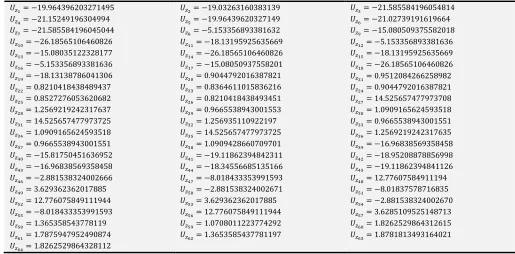
Newton’s algorithm after sufficient iterations leads to the following solutions of the system (24).
Table 2. Numerical values of E.
EL= −19.964396203271495 E = −19.03263160383139 E•= −21.585584196054814
E•= −21.15249196304994 Eœ= −19.96439620327149 EŒ= −21.02739191619664
E•= −21.585584196045044 E = −5.153356893381632 Ež= −15.080509375582018 ELŸ= −26.18565106460826 ELL= −18.13195925635669 EL = −5.153356893381636
EL•= −15.08035122328177 EL•= −26.18565106460826 ELœ= −18.13195925635669
ELŒ= −5.153356893381636 EL•= −15.08050937558201 EL = −26.18565106460826
ELž= −18.13138786041306 E Ÿ= 0.9044792016387821 E L= 0.9512084266258982
E = 0.8210418438489437 E •= 0.8364611015836216 E •= 0.9044792016387821
E œ= 0.8527276053620682 E Œ= 0.8210418438493451 E •= 14.525657477973708
E = 1.2569219242317637 E ž= 0.9665538943001553 E•Ÿ= 1.0909165624593518
E•L= 14.525657477973725 E• = 1.256935110922197 E••= 0.9665538943001551
E••= 1.0909165624593518 E•œ= 14.525657477973725 E•Œ= 1.2569219242317635
E••= 0.9665538943001551 E• = 1.0909428660709701 E•ž= −16.96838569358458
E•Ÿ= −15.81750451636952 E•L= −19.11862394842311 E• = −18.95208878856998
E••= −16.96838569358458 E••= −18.34556685135166 E•œ= −19.11862394841126
E•Œ= −2.881538324002666 E••= −8.018433353991593 E• = 12.77607584911194
E•ž= 3.629362362017885 EœŸ= −2.881538324002671 EœL= −8.01837578716835
Eœ = 12.776075849111944 Eœ•= 3.629362362017885 Eœ•= −2.881538324002670
Eœœ= −8.018433353991593 EœŒ= 12.776075849111944 Eœ•= 3.6285109525148713
Eœ = 1.365358543778119 Eœž= 1.0708011223774292 EŒŸ= 1.8262529864312615
EŒL= 1.7875947952490874 EŒ = 1.3653585437781197 EŒ•= 1.8781813493164021 EŒ•= 1.8262529864328112
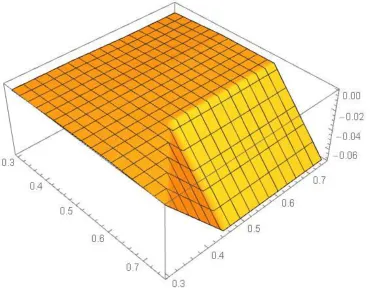
Figure 3. Simulation of the function (.
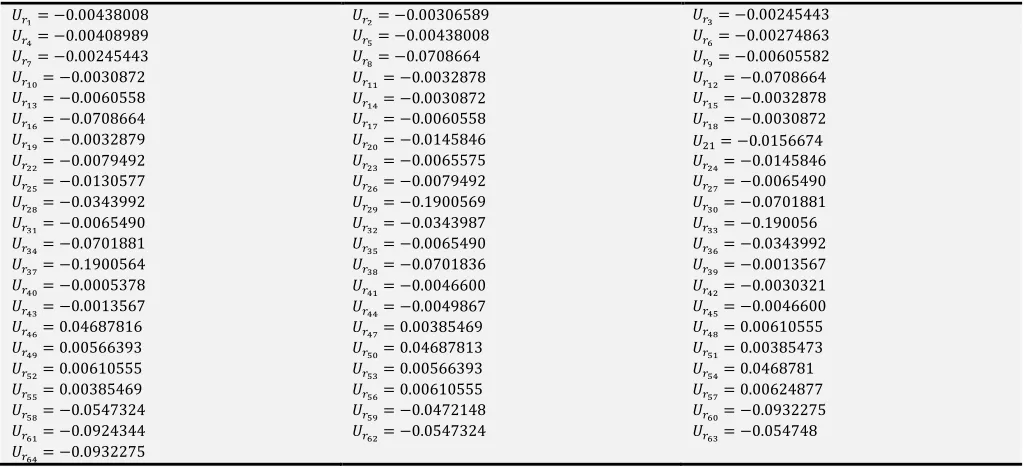
We insert E valuesto compute the E from (20).
Table 3. Numerical values of E.
EL 0.00438008 E = −0.00306589 E•= −0.00245443
E•= −0.00408989 Eœ= −0.00438008 EŒ= −0.00274863 E•= −0.00245443 E = −0.0708664 Ež= −0.00605582
ELŸ= −0.0030872 ELL= −0.0032878 EL = −0.0708664
EL•= −0.0060558 EL•= −0.0030872 ELœ= −0.0032878 ELŒ= −0.0708664 EL•= −0.0060558 EL = −0.0030872
ELž= −0.0032879 E Ÿ= −0.0145846 E! = −0.0156674
E = −0.0079492 E •= −0.0065575 E •= −0.0145846 E œ= −0.0130577 E Œ= −0.0079492 E •= −0.0065490 E = −0.0343992 E ž= −0.1900569 E•Ÿ= −0.0701881 E•L= −0.0065490 E• = −0.0343987 E••= −0.190056
E••= −0.0701881 E•œ= −0.0065490 E•Œ= −0.0343992 E••= −0.1900564 E• = −0.0701836 E•ž= −0.0013567
E•Ÿ= −0.0005378 E•L= −0.0046600 E• = −0.0030321
E••= −0.0013567 E••= −0.0049867 E•œ= −0.0046600 E•Œ= 0.04687816 E••= 0.00385469 E• = 0.00610555
E•ž= 0.00566393 EœŸ= 0.04687813 EœL= 0.00385473 Eœ = 0.00610555 Eœ•= 0.00566393 Eœ•= 0.0468781 Eœœ= 0.00385469 EœŒ= 0.00610555 Eœ•= 0.00624877
Eœ = −0.0547324 Eœž= −0.0472148 EŒŸ= −0.0932275 EŒL= −0.0924344 EŒ = −0.0547324 EŒ•= −0.054748
EŒ•= −0.0932275
Figure 4. Simulation of the function (.
In the section 5 we have computed the values of E and E , then in the final stage we are ready to determine the coefficients of energy conservation equation. We can apply the computed values of E and E to earn the linear system of equations in 64 equations in 64 variables. After determining the relevant integrals in 24 tetrahedrons and summation we prepare the necessary coefficients as
,=== 10ℎ,
,=,=oS; n;o U,== 0,
,=,=oS; n;o U,=oS; n;o U= 0,
,=,=,=oS; n;o U=253 ℎ,
,=,=nS; n;o U,== 0,
,=,=nS; n;o U,=nS; n;o U= 0,
,=,=,=nS; n;o U=253 ℎ,
¡ = −^f ℎ9,
Also we compute the _=X by applying the Mathematica codes, and at last we derive # as
Table 4. Numerical values of #.
# = 267464.5078493500 #!= 248522.6313318577 #9= 307632.2765236602
#v= 307560.1642197024 #¢= 279837.7344858227 #‘= 321624.6206048220
#£= 427070.98850310955 #“= 196160.3580918937 #’= 3066.7775345885548
#-= 186800.7827549864 # = 121034.4905810277 #!= 196594.3191942781
#9= 2152.441237715346 #v= 188106.5416768024 #¢= 121684.1356482915
#‘= 197507.5771545514 #£= −74.8655135629144 #“= 191421.1027365251
#!! 16553.2395549419 #!9= −15559.4804962354 #!v= −13416.8361963791
#!¢= −14444.3019556148 #!‘= −12094.5116324607 #!£= 2288889.553754123
#!“= −19412.9119058730 #!’= −26223.6525347567 #9-= −16086.2781566500
#9 = 2294428.379661617 #9!= −19492.9492477656 #99= −26169.6517726984
#9v= −16049.7064357589 #9¢= 2306132.915719399 #9‘= −19683.5593562787
#9£= −26029.2197438298 #9“= −15944.7220984291 #9’= 171548.6330508735
#v-= 160669.1329869789 #v = 196734.1927353769 #v!= 196477.2036791131
#v9= 186387.4932733776 #vv= 220899.00388040626 #v¢= 333148.2212944843
#v‘= −178843.4387299384 #v£= −198087.481717315 #v“= 85489.45076041944
#v’= 23049.55145269956 #v-= −179359.7530518020 #¢ = −200293.621391681
#¢!= 82636.400388273181 #¢9= 20157.04122994467 #¢v= −180465.9496057742
#¢¢= −205556.800967222 #¢‘= 75306.140893004793 #¢£= 12048.14127260225
#¢“= −31523.73111885111 #¢’= −31697.6883903928 #‘-= −31297.29104957784
#‘ = −30510.6513150699 #‘!= −30577.26948649386 #‘9= −26586.2177068013
#‘v= −19116.16815249271
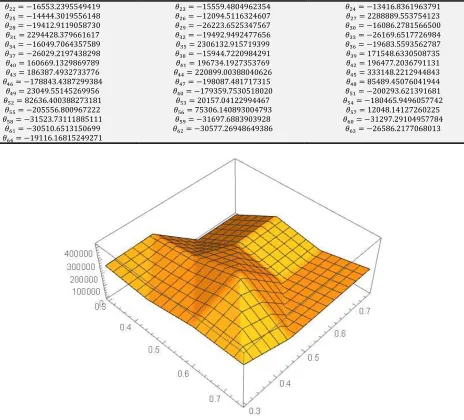
Figure 5. Simulation of the function #(.
We enter the values of # into the relation (12) to simulate the function #(, and we will show the result in the Figure 5.
Numerical solution of the transport phenomena and its mathematical simulation, where they have been gotten in the current work, are suitable tools to describe the environment of furnaces and fluid flow inside them. Also they help to designers to determine the optimal position of the electrical boosters. In particular designers analyze the mathematical simulation to decide about the optimized style of the furnaces, then we hope this work is useful for them.
6. Summary and Conclusion
In this work we performed the process to get the mathematical modeling of heat transfer in the Garnissage furnace in three dimension in the cylindrical coordinate system. The cylindrical coordinate system has chosen for the modeling process because of its symmetric advantages, then we applied the physical conservation laws, that is the mass,
momentum, and energy conservation laws, to achieve the continuity, Navier-Stokes, and heat equation. To modeling the free boundary between the solid and liquid phase we used the three dimensional version of Stefan condition.
Nomenclature
, >, ? cylindrical coordinates ¤, ¤ approximate velocity components in cylindrical
coordinate
, velocity components in cylindrical coordinate "( approximate pressure
@ time # temperature
, gravity acceleration components h latent heat f specific heat capacity dynamic viscosity
` thermal conductivity density
" pressure #( approximate temperature
heat source ,- Sobolev space with compact support
References
[1] Ungan A., R. Viskanta, Three-dimensional Numerical Modeling of Circulation and Heat Transfer in a Glass Melting Tank. IEEE Transactions on Industry Applications, Vol. IA-22, No. 5, pp. 922–933, 1986.
[2] Ungan A, R. Viskanta, Three-dimensional Numerical Simulation of Circulation and Heat Transfer in an Electrically Boosted Glass Melting Tank. Part. 2 Sample Simulations, Glastechnische Berichte, Vol. 60, No. 4, pp. 115–124, 1987. [3] Sadov S. YU., P. N. Shivakumar, D. Firsov, S. H. Lui, R.
Thulasiram, Mathematical Model of Ice Melting on Transmission Lines, Journal of Mathematical Modeling and Algorithms, Vol. 6, No. 2, pp. 273-286, 2007.
[4] Pilon L., G. Zhao, and R. Viskanta, Three-Dimensional Flow and Thermal Structures in Glass Melting Furnaces. Part I. effects of the heat flux distribution, Glass Science and Technology, Vol. 75, No. 2, pp. 55–68, 2002.
[5] Pilon L., G. Zhao, and R. Viskanta, Three-Dimensional Flow and Thermal Structures in Glass Melting Furnaces. Part II. Effect of Batch and Bubbles. Glass Science and Technology, Vol. 75, No. 3 pp. 115-124, 2006.
[6] Choudhary Manoj K., Raj Venuturumilli, Matthew R. Hyre, Mathematical Modeling of Flow and Heat Transfer Phenomena in Glass Melting, Delivery, and Forming Processes. International Journal of Applied Glass Science, Vol. 1, No. 2, pp. 188–214, 2010.
[7] Alexiades V., A. D. Solomon, Mathematical Modeling of Melting and Freezing Processes, Hemisphere Publishing Corporation, 1993.
[8] Henry Hu, Stavros A. Argyropoulos, Mathematical Modelling of Solidification and Melting: a Review, Modelling and Simulation in Materials Science and Engineering, Vol. 4, pp. 371-396, 1996.
[9] Rodrigues J. F., Variational Methods in the Stefan Problem,
Lecture Notes in Mathematics, Springer-Verlag, pp. 147-212, 1994.
[10] Vuik C., A. Segal, F. J. Vermolen, a Conserving Discretization for a Stefan Problem with an Interface Reaction at the Free Boundary, Computing and Visualization in Science, Springer-Verlag, Vol. 3, pp. 109-114, 2000.
[11] Byron Bird R., Warren E. Stewart, Edwin N. Lightfoot, Transport Phenomena, John Wiley & Sons, Inc. 2nd Edition, 2002.
[12] Irving H. Shames, Mechanics of Fluids, McGraw-Hill, 4th Edition, 2003.
[13] Robert W. Fox, Alan T. McDonald, Philip J. Pritchard, Introduction to Fluid Mechanics, John Wiley & Sons, Inc. 6th Edition, 2004.
[14] Xu Quan-Sheng, Zhu You-Lan, Solution of the Two-Dimensional Stefan Problem by the Singularity-Separating Method, Journal of Computational Mathematics, Vol. 3, No. 1, pp. 8-18, 1985.
[15] Brenner S., R. Scott, the Mathematical Theory of Finite Element Methods. Springer Verlag, 1994. Corr. 2nd printing 1996.
[16] Johnson C., Numerical Solution of Partial Differential Equations by the Finite Element Method. CUP, 1990. [17] Epperson J. F., an Introduction to Numerical Methods and
Analysis, John Wiley & Sons, Inc. 2002.
[18] Mohammadi M. H., Mathematical Modeling of Heat Transfer and Transport Phenomena in Three-Dimension with Stefan Free Boundary, Advances and Applications in Fluid Mechanics, Vol. 19, No. 1, pp. 23-34, 2016.
[19] Mohammadi M. H., Three-Dimensional Mathematical Modeling of Heat Transfer by Stream Function and its Numerical Solution, Far East Journal of Mathematical Sciences (FJMS), Vol. 99, No. 7, pp. 969-981, 2016.