water
Article
Research on Class-Based Storage Strategies for Flood
Control Materials Based on Grey Clustering
Wei Wang1 , Li Huang2,*, Weiwei Le3, Yu Zhang1, Peng Ji1and David Proverbs4
1 College of Harbor, Coastal and Offshore Engineering, Hohai University, Nanjing 210098, China;
[email protected] (W.W.); [email protected] (Y.Z.); [email protected] (P.J.) 2 School of Public Administration, Hohai University, Nanjing 210098, China
3 Business School, Sichuan University, Chengdu 610065, China; [email protected]
4 Computing, Engineering and Built Environment at Birmingham City University, Birmingham B4 7XG, UK;
* Correspondence: [email protected]; Tel.: +86-25-8378-7354
Received: 13 September 2018; Accepted: 19 October 2018; Published: 25 October 2018
Abstract:Scientific and rational class-based storage can effectively improve the management level of flood control materials, providing assurance for the material support that is essential in flood control. Based on an analysis of the three key factors—importance, cost, and reserve—of flood control materials and combined with the correlations of different classes of materials, a comprehensive evaluation index system and a class-based model for these materials are developed using the grey clustering method. An empirical analysis is also conducted based on the realistic requirements of a warehouse of the Jiangsu provincial water conservancy and flood control materials reserve centre, which results in the proposal of a class-based materials storage strategy for this warehouse.
Keywords:flood control materials; grey clustering; class-based storage
1. Introduction
In the history of the development of human society, water has been regarded as an important natural resource of irreplaceable significance in the promotion of the development of social economy. However, flood hazards with frequent, multiple, and complicated occurrence have brought severe damages to the life and property of the people, especially in areas with a high flood occurrence frequency. Flood disasters are usually easily predicted and prevented compared with other natural disasters [1]. Some preparatory activities may be made in advance to prevent flooding from actually happening [2,3]. Therefore, we shall attach great importance to work related to flood control, the preparation to control and fight against great floods, and deal with emergencies.
To keep to the concept of all-time preparedness, we shall first guarantee adequate reserves and the good management of flood-prevention materials, which, as the prerequisite and safeguard of different flood-controlling measures, are of direct relation to the smooth progression of work related to flood control.
Emergency logistics are of vital significance in flood fighting, on which relevant researchers have already conducted preliminary studies. However, flood emergency preparedness lacks insight into logistical aspects [4,5]. Garrido et al. put forward a model to assist decision-makers in the logistics of a flood emergency. The model attempts to optimize inventory levels for emergency supplies as well as vehicles’ availability, in order to deliver enough supplies to satisfy demands with a given probability. This methodology emerges as a valuable tool to help decision makers to allocate resources both before and after a flood occurs, with the aim of minimizing the undesirable effects of such events [6]. Leeuw et al. developed a framework of logistical aspects of emergency measures that support
Water2018,10, 1506 2 of 12
preventing the catastrophic breaching of flood defences during extreme situations. The Netherlands is taken as a reference because large parts of the country are prone to flooding. Furthermore, the Netherlands has a long-standing experience with implementing flood emergency measures. This paper is particularly focused on the role of Water Boards, the Dutch government agencies responsible for securing flood defences [7]. Alem et al. develop a new two-stage stochastic network flow model to help decide how to rapidly supply humanitarian aid to victims of a disaster within this context. The model takes into account the practical characteristics that have been neglected by the literature so far, such as budget allocation, fleet sizing of multiple types of vehicles, procurement, and varying lead times over a dynamic multiperiod horizon. By attempting to improve demand fulfilment policy, we present some extensions of the model via state-of-art risk measures, such as semi-deviation and conditional value-at-risk. A simple two-phase heuristic to solve the problem within a reasonable amount of computing time is also suggested. Numerical tests based on the floods and landslides in the Rio de Janeiro state, Brazil, show that the model can help plan and organise relief to provide good service levels in most scenarios, and how this depends on the type of disaster and resources [8]. These researches mainly focus on the macroscopical emergency logistics organization for flood control. Flood control materials form the bedrock for flood control and provide important assurances for rescue work. As society becomes increasingly demanding of flood control, the scientific and rational storage of flood control materials has become a key condition for guaranteeing security during flood control. It has been noted that the dispatch of flood control materials from warehouses is characterised by few varieties, few batches, and large quantities. Therefore, this study analyses the warehousing and storage strategy for flood control materials, which is useful for lowering access costs, increasing warehouse space utilization, and outflow efficiency, and is, theoretically and practically, important for improving the reserve management level of flood control materials and guaranteeing supply.
A class-based storage strategy has drawn immense attention from researchers since it was proposed by Hausman [9]; moreover, this strategy has been widely applied in commercial logistics. Larson et al. conducted a study on a class-based storage strategy with the goal of increasing floor space utilisation and decreasing the material handling distance [10]. Thonemann, Byung, Ene et al. applied the turnover rate to classify items, and storage locations were assigned based on the classification results [11–13]. Brynzer, Mantel et al. proposed the concept of materials correlation using the probability of materials appearing together in the same order according to the order history as a basis for class-based storage [14,15]. Li conducted a heuristic classification of products by using an algorithm, considering the underlying factors, and grouping them to set up a highly efficient dispatch centre [16]. Using a heuristic approach, Muralidhran et al. studied a storage strategy that combined automated warehouses using both random and class-based storage [17].
Water2018,10, 1506 3 of 12
materials has been seldom reported on. Certainly, no one has investigated class-based storage strategies of flood control materials quantitatively.
Thus, the research problem addressed in this paper is how to construct class-based storage strategies for flood control materials in a quantitative manner. This study has an important practical significance and research value and can effectively fill the gap. Based on existing research results and common class-based storage strategies, this paper established an evaluation index system to classify flood control reserve materials. An evaluation model for the class-based storage of flood control materials was constructed based on grey clustering. Taking the Zhenjiang branch warehouse of the Jiangsu provincial water conservancy and flood control reserve materials centre as an example and considering the characteristics and requirements of flood control materials according to the roles and functions of different materials in flood rescue, a class-based storage management strategy was proposed to improve the warehouse outflow efficiency of flood control materials.
2. Analysis of Storage Strategies for Flood Control Materials
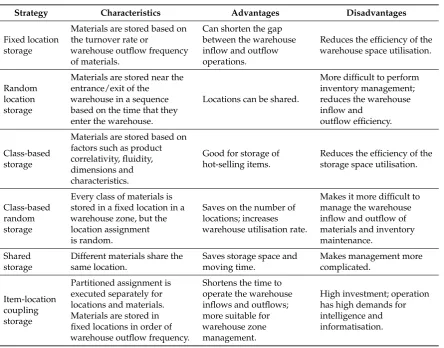
Table1presents the commonly used storage strategies [26]—fixed location storage, random location storage, class-based storage, class-based random storage, shared storage, and item-location coupling storage—and a comparison of their characteristics, advantages, and disadvantages.
Table 1.The comparison of the different storage strategies characteristics.
Strategy Characteristics Advantages Disadvantages
Fixed location storage
Materials are stored based on the turnover rate or
warehouse outflow frequency of materials.
Can shorten the gap between the warehouse inflow and outflow operations.
Reduces the efficiency of the warehouse space utilisation.
Random location storage
Materials are stored near the entrance/exit of the
warehouse in a sequence based on the time that they enter the warehouse.
Locations can be shared.
More difficult to perform inventory management; reduces the warehouse inflow and
outflow efficiency.
Class-based storage
Materials are stored based on factors such as product correlativity, fluidity, dimensions and characteristics.
Good for storage of hot-selling items.
Reduces the efficiency of the storage space utilisation.
Class-based random storage
Every class of materials is stored in a fixed location in a warehouse zone, but the location assignment is random.
Saves on the number of locations; increases warehouse utilisation rate.
Makes it more difficult to manage the warehouse inflow and outflow of materials and inventory maintenance.
Shared storage
Different materials share the same location.
Saves storage space and moving time.
Makes management more complicated.
Item-location coupling storage
Partitioned assignment is executed separately for locations and materials. Materials are stored in fixed locations in order of warehouse outflow frequency.
Shortens the time to operate the warehouse inflows and outflows; more suitable for warehouse zone management.
High investment; operation has high demands for intelligence and informatisation.
Water2018,10, 1506 4 of 12
sorting the materials, followed by a fixed location storage by considering attributes such as materials correlativity and utilisation frequency. The class-based storage strategy is critical for improving the warehouse outflow efficiency of the flood control materials and increasing the ability to provide support [27].
3. Class-Based Storage Model for Flood Control Materials Based on Grey Clustering
Grey clustering is a method for segregating observations (or subjects) based on a grey incidence matrix [28]. Based on grey clustering, the class-based storage model for flood control materials was constructed by comprehensively considering the three factors of such materials, namely, their importance, reserve, and cost, to improve the scientific basis for the class-based storage for flood control materials.
Assumingmobservations and every observation havingnattribute data, the following sequence is obtained:
X1= (x1(1),x1(2), . . . ,x1(n))X2= (x2(1),x2(2), . . . ,x2(n))Xm= (xm(1),xm(2), . . . ,xm(n)) (1)
The observation subjects X1−Xmhave similar lengths and are not zero. Accordingly, the following equations are obtained:
X0i =x0i(1),x0i(2), . . . ,x0i(n)X0j = (x0j(1),x0j(2), . . . ,x0j(n)) (2)
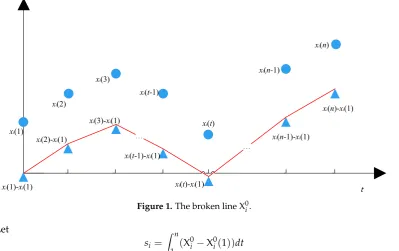
X0i and X0j represent the starting-point annihilating images of Xi and Xj, in which X0i = Xi− xi(1), X0j =Xj−xj(1) (i=0, 1, 2, . . . ,m;j=0, 1, 2, . . . ,m). X0i and X0j are actually the sequence ofn −1 values. Taking X0i as an example, we can use a broken line graph to present then−1 values, as shown in Figure1. The broken line connects pointsxi(2)−xi(1),xi(3)−xi(1), . . . , xi(n)−xi(1). It is clear that this line is made sectionally continuous.
Water 2018, 10, x FOR PEER REVIEW 4 of 12
location storage. Given that flood control materials are characterised by few varieties, large quantities, low warehouse inflow and outflow frequencies, and strong constraints on warehouse outflow timeliness and response time, a class-based storage strategy is mostly appropriate for such materials. The strategy begins by sorting the materials, followed by a fixed location storage by considering attributes such as materials correlativity and utilisation frequency. The class-based storage strategy is critical for improving the warehouse outflow efficiency of the flood control materials and increasing the ability to provide support [27].
3. Class-Based Storage Model for Flood Control Materials Based on Grey Clustering
Grey clustering is a method for segregating observations (or subjects) based on a grey incidence matrix [28]. Based on grey clustering, the class-based storage model for flood control materials was constructed by comprehensively considering the three factors of such materials, namely, their importance, reserve, and cost, to improve the scientific basis for the class-based storage for flood control materials.
Assuming m observations and every observation having n attribute data, the following sequence is obtained:
X = (𝑥 (1), 𝑥 (2), … , 𝑥 (𝑛)) X = (𝑥 (1), 𝑥 (2), … , 𝑥 (𝑛)) X = (𝑥 (1), 𝑥 (2), … , 𝑥 (𝑛))
(1)
The observation subjects X − X have similar lengths and are not zero. Accordingly, the
following equations are obtained:
X = (𝑥 (1), 𝑥 (2), … , 𝑥 (𝑛))
X = (𝑥 (1), 𝑥 (2), … , 𝑥 (𝑛)) (2)
X and X represent the starting-point annihilating images of X and X, in which X = X −
𝑥 (1), X = X − 𝑥 (1) (𝑖 = 0,1,2, … , 𝑚; 𝑗 = 0,1,2, … , 𝑚). X and X are actually the sequence of n − 1 values. Taking X as an example, we can use a broken line graph to present the n − 1 values, as shown in Figure 1. The broken line connects points 𝑥 (2) − 𝑥 (1), 𝑥 (3) − 𝑥 (1), … , 𝑥 (𝑛) − 𝑥 (1). It is clear that this line is made sectionally continuous.
Figure 1. The broken line X .
Let
t
xi(2)
xi(3)
xi(n)
xi(t-1)
xi(t)
xi(t)-xi(1)
xi(n)-xi(1)
xi(2)-xi(1)
xi(3)-xi(1)
xi(t-1)-xi(1)
...
...
xi(n-1)-xi(1)
xi(n-1)
xi(1)
xi(1)-xi(1)
Figure 1.The broken line X0i.
Let
si=
Z n
1
(X0i −X0i(1))dt (3)
si−sj=
Z n
1 (X 0
Water2018,10, 1506 5 of 12
Hence, the absolute degree of grey incidence of Xiand Xjcan be defined as
γij=
1+|si|+ sj
1+|si|+ sj
+
si−sj
(5)
The upper triangular matrix calculated is as follows:
A=
γ11 · · · γ1m . .. ...
γmm
(6)
whereγii=1(i=1, 2, . . . ,m).
Taking the threshold valuer∈[0, 1],r>0.5 is generally required; whenγij≥r(i6=j), Xiand Xj can be grouped into one class. The value of r can be determined based on the specific situation and actual need, and an r closer to 1 indicates a narrower class and fewer materials in each class, accordingly. A smaller r indicates a broader class and, accordingly, in this case, more materials in each class.
4. Case Study
4.1. Case Warehouse
To emphasize the issues of the class-based model in Chinese flood control material reserve management, a case study was conducted.
The Jiangsu Provincial Hydraulic and Flood Control Material Reserve Center (HFCMRC) is a specialized establishment for flood control material reserves and their transportation in the Jiangsu Province, taking charge of reserving, management, allocation, and transportation of central and provincial flood-control material, and acting as a provincial flood control material reservation and management unit with the strongest emergency security capability in China, providing flood-fighting material support for flood control, disaster relief, and severe sudden disasters. HFCMRC has set up six provincial flood control material reserve warehouses including one central- and provincial-level flood-fighting warehouse in Zhenjiang. The Zhenjiang Warehouse, founded in the 1970s, is a the key warehouse in the Jiangsu province for flood-fighting material reserve, a central-level designated warehouse which is a flood control material reserve, a warehouse with the biggest scale and the most complete material varieties in Jiangsu Province, and the only central- and provincial-level flood-fighting material warehouse in Jiangsu Province. It is one of the most representative flood-fighting material reserve warehouses in China. For this reason, this study chose the HFCMRC Zhenjiang Warehouse as the case study example.
HFCMRC Zhenjiang Warehouse currently stores the following varieties of material: rubber dinghy, assault boat, life vest, outboard motor, woven bag, colour strip cloth, geotechnical cloth, square timber, lumps of wood, steel wire tuck net, tent, flood-control work light, generator unit, etc., fitted with mechanical equipment and auxiliary lighting facilities of all kinds. Zhenjiang Warehouse has completed tasks in flood control and emergency response in the Jiangsu Province in all the previous years and the allocation and transport of rescue supplies for the Wenchuan earthquake in 2008. It has been praised by State Flood Control and Drought Relief Headquarters and the Jiangsu Provincial Flood Control and Drought Relief Headquarters for its positive and significant contributions to the victories of flood control and emergency response.
Water2018,10, 1506 6 of 12
4.2. Classification of Flood Control Materials
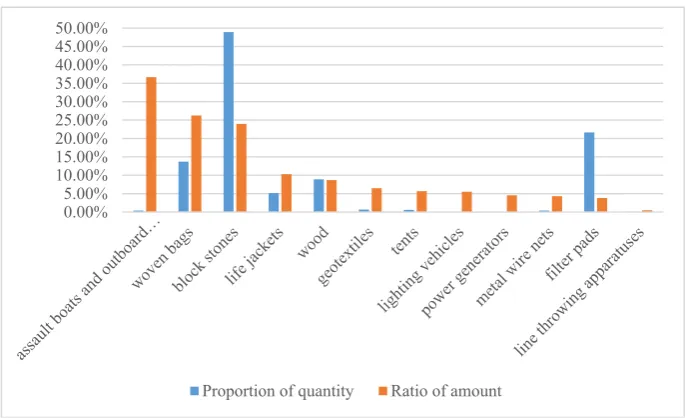
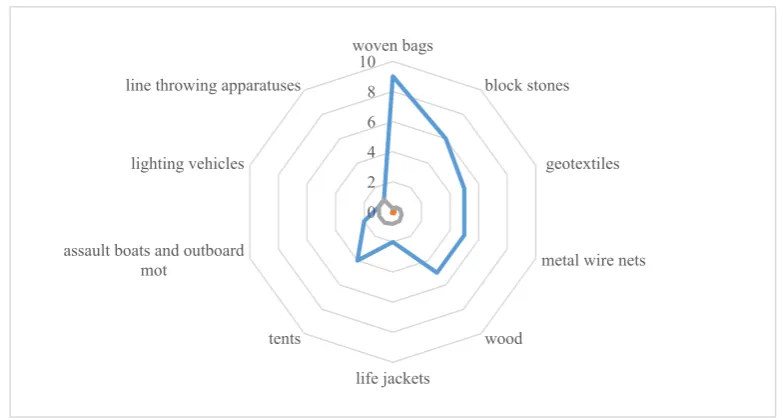
The case warehouse currently has 14 types of provincial-level flood control materials in reserve, including block stones, metal wire nets, line throwing apparatuses, woven bags, tents (specially made for flood control), lighting vehicles, geotextiles, filter pads, life jackets, assault boats, dinghy, outboard motor, power generators, and wood. Among these items, the dinghy is made of rubber and must be kept at a constant temperature. Given this special requirement, the rubber dinghy is not considered in this paper because it is typically stored in a warehouse at a constant temperature. The outboard motor and rescue boats must be used as a package and, thus, are typically stored together. Considering the factors above, we selected 12 types of widely universal and highly practical materials to study in this paper. For this paper, we consider only the assault boat class, and the associated outboard motor class is adjacently stored. The selected key flood control materials are block stones (X1), metal wire nets (X2), line throwing apparatuses (X3), woven bags (X4), tents (specially made for flood control) (X5), lighting vehicles (X6), geotextiles (X7), filter pads (X8), life jackets (X9), assault boats (X10), power generators (X11), and wood (X12). Statistics on the 12 classes of the Jiangsu provincial-level flood control materials are shown in Figure2. The utilisation frequency is shown in Figure3.
Water 2018, 10, x FOR PEER REVIEW 6 of 12
the flood control governments, food control materials governments, and food control materials
enterprises were conducted.
4.2. Classification of Flood Control Materials
The case warehouse currently has 14 types of provincial-level flood control materials in reserve, including block stones, metal wire nets, line throwing apparatuses, woven bags, tents (specially made for flood control), lighting vehicles, geotextiles, filter pads, life jackets, assault boats, dinghy, outboard motor, power generators, and wood. Among these items, the dinghy is made of rubber and must be kept at a constant temperature. Given this special requirement, the rubber dinghy is not considered in this paper because it is typically stored in a warehouse at a constant temperature. The outboard motor and rescue boats must be used as a package and, thus, are typically stored together. Considering the factors above, we selected 12 types of widely universal and highly practical materials to study in this paper. For this paper, we consider only the assault boat class, and the associated outboard motor class is adjacently stored. The selected key flood control materials are block stones (X ), metal wire nets (X ), line throwing apparatuses (X ), woven bags (X ), tents (specially made for flood control) (X ), lighting vehicles (X ), geotextiles (X ), filter pads (X ), life jackets (X ), assault boats (X ), power generators (X ), and wood (X ). Statistics on the 12 classes of the Jiangsu provincial-level flood control materials are shown in Figure 2. The utilisation frequency is shown in Figure 3.
Figure 2. The statistics on the 12 classes of the Jiangsu provincial-level flood control materials. The
proportion of quantity: the proportion of the amount of flood control materials in the total amount of provincial-level flood control materials in HFCMRC Zhenjiang Warehouse. The ratio of amount: the proportion of funds for flood control materials procurement in the total funds for provincial-level flood control materials procurement in the HFCMRC Zhenjiang Warehouse.
0.00% 5.00% 10.00% 15.00% 20.00% 25.00% 30.00% 35.00% 40.00% 45.00% 50.00%
Proportion of quantity Ratio of amount
Water2018,10, 1506 7 of 12
Water 2018, 10, x FOR PEER REVIEW 7 of 12
Figure 3. The utilisation frequency of the 12 classes of Jiangsu provincial-level flood control materials.
4.3. Class-Based Evaluation Index System
A three-tiered comprehensive class-based evaluation index system for flood control materials was constructed. Level 1 is the final target level, including three Level 2 indices. The Level 2 indices include the importance (B ), reserve (B ), and cost (B ) of the materials. Importance (B) is the degree of importance of the flood control materials, reserve (B ) is the reserve attribute of the flood control materials, and cost (B ) is the cost attribute of the flood control materials. Every Level 2 index can be further segregated into three levels of evaluation indices, including eight evaluation indices, such as urgency of demand (C1), shortage and loss (C2), utilisation frequency (C3), reserve life (C4),
warehousing requirement (C5), purchasing costs (C6), transportation costs (C7), and storage costs (C8).
See Figure 4 for details.
Figure 4. The evaluation index system and class-based model for flood control materials.
Experts for evaluating the weight and index mainly came from the relevant administrative departments related to flood control, as well as from rescue work, all-level units in reserving flood control materials, and research institutions. Weight and index evaluation are carried out by the Delphi expert method by 20 experts. Ultimately, three Level 2 weighted indices were derived: the weighted indices of importance w = 0.5, the weighted indices of reserve w = 0.3, the weighted indices of cost w = 0.2. The scoring of the evaluation sets was obtained through consultation and face-to-face discussions with experts to give the experts a full understanding of the construction of the class-based index system for flood control reserve materials and its significance.
0 2 4 6 8 10 woven bags block stones geotextiles
metal wire nets
wood
life jackets tents
assault boats and outboard mot
lighting vehicles line throwing apparatuses
Figure 3.The utilisation frequency of the 12 classes of Jiangsu provincial-level flood control materials.
4.3. Class-Based Evaluation Index System
A three-tiered comprehensive class-based evaluation index system for flood control materials was constructed. Level 1 is the final target level, including three Level 2 indices. The Level 2 indices include the importance (B1), reserve (B2), and cost (B3) of the materials. Importance (B1) is the degree of importance of the flood control materials, reserve (B2) is the reserve attribute of the flood control materials, and cost (B3) is the cost attribute of the flood control materials. Every Level 2 index can be further segregated into three levels of evaluation indices, including eight evaluation indices, such as urgency of demand (C1), shortage and loss (C2), utilisation frequency (C3), reserve life (C4), warehousing requirement (C5), purchasing costs (C6), transportation costs (C7), and storage costs (C8). See Figure4for details.
Water 2018, 10, x FOR PEER REVIEW 7 of 12
Figure 3. The utilisation frequency of the 12 classes of Jiangsu provincial-level flood control materials.
4.3. Class-Based Evaluation Index System
A three-tiered comprehensive class-based evaluation index system for flood control materials was constructed. Level 1 is the final target level, including three Level 2 indices. The Level 2 indices include the importance (B ), reserve (B ), and cost (B ) of the materials. Importance (B ) is the degree of importance of the flood control materials, reserve (B ) is the reserve attribute of the flood control materials, and cost (B ) is the cost attribute of the flood control materials. Every Level 2 index can be further segregated into three levels of evaluation indices, including eight evaluation indices, such as urgency of demand (C1), shortage and loss (C2), utilisation frequency (C3), reserve life (C4),
warehousing requirement (C5), purchasing costs (C6), transportation costs (C7), and storage costs (C8).
See Figure 4 for details.
Figure 4. The evaluation index system and class-based model for flood control materials.
Experts for evaluating the weight and index mainly came from the relevant administrative
departments related to flood control, as well as from rescue work, all-level units in reserving flood control materials, and research institutions. Weight and index evaluation are carried out by the Delphi expert method by 20 experts. Ultimately, three Level 2 weighted indices were derived: the weighted indices of importance w = 0.5, the weighted indices of reserve w = 0.3, the weighted indices of cost w = 0.2. The scoring of the evaluation sets was obtained through consultation and face-to-face discussions with experts to give the experts a full understanding of the construction of the class-based index system for flood control reserve materials and its significance.
0 2 4 6 8 10 woven bags block stones geotextiles
metal wire nets
wood
life jackets tents
assault boats and outboard mot
lighting vehicles line throwing apparatuses
Figure 4.The evaluation index system and class-based model for flood control materials.
Water2018,10, 1506 8 of 12
4.4. Grey Clustering Calculations
Based on the class-based index system previously constructed, the Level 3 indices were quantified using the Delphi method, a 10-point expert scoring method: 10 points for very high, 8 points for high, 5 points for moderate, 2 points for low and 0 points for very low. The overall scores of the 8 Level 3 indices of the 12 classes of flood control materials are presented in Table2.
Because the Level 3 evaluation index C5 is a negative index relative to the Level 2 index, the reversion value 10−C5is used when performing the conversion of the Level 3 evaluation index to the Level 2 index. Hence,
B1= 1
3(C1+C2+C3)w1 B2= 1
2(C4+10−C5)w2
B3= 1
3(C6+C7+C3)w3
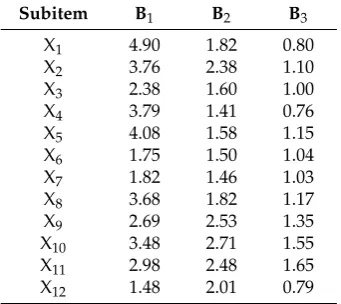
The weighted overall scores of the three Level 2 indices for the 12 classes of flood control materials obtained are presented in Table3.
Table 2.The overall scores of the 8 Level 3 indices of the 12 classes of flood control materials.
Subitem C1 C2 C3 C4 C5 C6 C7 C8
X1 9.7 9.8 9.9 10 2.15 3.05 4.9 4.05
X2 8.89 6.3 7.35 9.8 6.05 5.15 5.9 5.45
X3 5.6 4.85 3.8 3.5 7.15 4.05 5.15 5.75
X4 7.85 6.55 8.35 3.35 6.05 3.35 3.2 4.85
X5 7.9 7.05 9.5 3.65 6.9 5.45 5 6.85
X6 3.95 3.65 2.9 3.95 6.05 4.25 5.15 6.15
X7 4.65 3.35 2.9 3.5 6.2 4.75 5.3 5.4
X8 8.7 7.25 6.1 4.9 7.2 6.45 4.4 6.65
X9 6.7 6.4 3.05 8.5 8.35 7.6 6.4 6.3
X10 8.5 7.7 4.7 9.1 8.95 8.8 7 7.5
X11 7.35 6.15 4.35 8.75 7.75 9.4 7.5 7.85
X12 4.1 2.15 2.6 7.5 5.9 3.95 3.2 4.7
Table 3.The weighted overall scores of the 3 Level 2 indices for 12 classes of flood control materials.
Subitem B1 B2 B3
X1 4.90 1.82 0.80
X2 3.76 2.38 1.10
X3 2.38 1.60 1.00
X4 3.79 1.41 0.76
X5 4.08 1.58 1.15
X6 1.75 1.50 1.04
X7 1.82 1.46 1.03
X8 3.68 1.82 1.17
X9 2.69 2.53 1.35
X10 3.48 2.71 1.55
X11 2.98 2.48 1.65
X12 1.48 2.01 0.79
Water2018,10, 1506 9 of 12
Table 4.The upper triangular matrix for the Level 2 indices.
Subitem X1 X2 X3 X4 X5 X6 X7 X8 X9 X10 X11 X12
X1 1 0.86 0.74 0.64 0.89 0.75 0.64 0.64 0.82 0.75 0.63 0.90
X2 1 0.93 0.91 0.86 0.80 0.90 0.99 0.73 0.64 0.68 0.81
X3 1 0.97 0.74 0.77 0.92 0.97 0.78 0.89 0.77 0.80
X4 1 0.84 0.79 0.96 0.92 0.88 0.72 0.65 0.84
X5 1 0.75 0.64 0.64 0.92 0.75 0.63 0.80
X6 1 0.66 0.65 0.87 0.97 0.95 0.83
X7 1 0.98 0.87 0.79 0.5 0.74
X8 1 0.66 0.78 0.87 0.73
X9 1 0.79 0.65 0.85
X10 1 0.97 0.72
X11 1 0.72
X12 1
According to the incidence matrix, combined with the actual management of flood control materials, the threshold valuer=0.90 is used. In the table,r≥0.90 indicates that there is a strong incidence between the two classes of flood control materials that can be grouped into one for partitioned storage management.
The clustering results based on Level 2 indices are as follows:
S1={X1, X12}
S2={X2, X3, X4, X7, X8} S3={X5, X9} S4={X6, X10, X11}
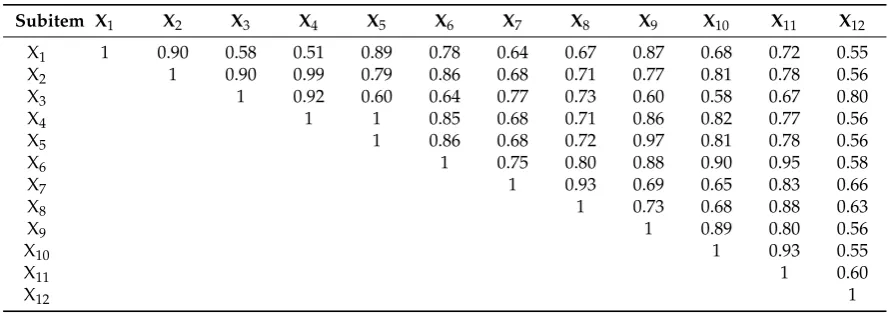
To further highlight the attributes of all the classes of the flood control materials, they are further divided according to Level 3 evaluation indices. According to Table2, the absolute degrees of the grey incidence of Xiand Xj(∀i≤j(i,j=1, 2, . . . , 12))were calculated, and the upper triangular matrix for Level 3 evaluation indices was obtained, as presented in Table5.
Table 5.The upper triangular matrix for the Level 3 evaluation indices.
Subitem X1 X2 X3 X4 X5 X6 X7 X8 X9 X10 X11 X12
X1 1 0.90 0.58 0.51 0.89 0.78 0.64 0.67 0.87 0.68 0.72 0.55
X2 1 0.90 0.99 0.79 0.86 0.68 0.71 0.77 0.81 0.78 0.56
X3 1 0.92 0.60 0.64 0.77 0.73 0.60 0.58 0.67 0.80
X4 1 1 0.85 0.68 0.71 0.86 0.82 0.77 0.56
X5 1 0.86 0.68 0.72 0.97 0.81 0.78 0.56
X6 1 0.75 0.80 0.88 0.90 0.95 0.58
X7 1 0.93 0.69 0.65 0.83 0.66
X8 1 0.73 0.68 0.88 0.63
X9 1 0.89 0.80 0.56
X10 1 0.93 0.55
X11 1 0.60
X12 1
Based on the calculations, the results of the final grey clustering analysis are as follows:
S1={X1}
Water2018,10, 1506 10 of 12
S4={X5, X9} S5={X6, X10, X11}
S5={X12}
4.5. Results Analysis
(1) The attributes of X1, X12are prominent and are separated from the other classes. At the same time, according to the Level 2 indices, because X1 and X12 have a relatively high correlation (0.9), we may consider grouping these two types of materials, namely block stones and wood, into one class, placing them in the outfield and sheltering them from rain.
(2) X2, X3, X4, X7, X8can be grouped into one class. We can see from the results of classifying the Level 3 evaluation indices that the absolute degrees of incidence of X2and X3, X2 and X4are 0.90 and 0.99, respectively, whereas the degree of incidence of X7and X8is 0.93. However, the results of classifying Level 2 indices show that the absolute degrees of incidence of X2and X3, X4, X7, X8are 0.93, 0.91, 0.90, and 0.99, respectively. After an overall consideration, we should group metal wire nets, line throwing apparatuses, woven bags, geotextiles, and filter pads into one class. Their common attributes are low costs, high utilisation frequency and low reserve requirements.
(3) The degrees of incidence of X5and X9in Level 2 indices and Level 3 evaluation indices are 0.92 and 0.97, respectively, allowing them to be grouped into one class. Tents and life jackets have the highest utilisation frequency, and their cost levels and reserve requirements are average. They rank relatively high in terms of importance.
(4) X6, X10, X11 can be grouped into one class. The degrees of incidence of their Level 2 indices are 0.97, 0.95, and 0.97, and the degrees of incidence of their Level 3 evaluation indices are 0.90, 0.95, and 0.93, so we can group lighting vehicles, assault boats and power generators into one class, They are characterised by a high importance and relatively high costs.
4.6. Strategy Recommendation about Flood Control Materials Classified Storage
In provincial flood control materials storage warehouses, the above materials are classified and stored according to factors such as importance, reserve, cost, and etc., such as putting metal wire nets, line throwing apparatuses, woven bags, geotextiles, and filter pads these similar materials together, storing tents, life jackets, and etc., in the same area, and placing lighting vehicles, power generators, and assault boats in the same area, etc. Then we locate the storage according to the size of the material. It is more appropriate to adopt a simple location storage strategy because flood control materials are generally relatively large and the frequency of storage is low.
5. Conclusions
By means of grey cluster analysis and evaluation, this paper comprehensively considers the three factors affecting the importance, cost, and reserve of flood control materials, and constructs a comprehensive evaluation index system of three levels of flood control materials based on the correlation between different types of materials. Taking the Zhenjiang Sub-center Storage of Flood Control Material Reserve Center of Jiangsu Province Water Resources for an example, we divide the flood control materials into four categories. By storing various types of materials in categories, it proposes classification storage strategies and classification management strategies to provide a scientific basis for flood control materials for the Jiangsu Province.
Water2018,10, 1506 11 of 12
and making a scientific analysis and summary to form clustering indicators. On the other hand, it is necessary to learn from the experience of flood control materials storage, conduct a detailed investigation, analysis, and evaluation of existing experience strategies, and use mathematical tools to construct appropriate models to properly calibrate clustering weights and clustering coefficients so that the clustering calculation results are closer to the actual situation of flood control materials storage management. In this paper, only a few of the main factors are considered comprehensively. If the other factors can be considered more systematically, the applied method can give superior results to common sense, and the clustering results will be closer to the actual situation of flood control material reserve management.
Author Contributions:All authors contributed equally to this work. In particular, W.W. developed the original idea for the study and designed the methodology. L.H. revised the manuscript. W.L. drafted the manuscript. Y.Z. performed investigation and case study. P.J. performed data curation. D.P. helped develop the results analysis and further developed the review of the literature. All authors have read and approved the final manuscript.
Funding:This research was funded by the Humanities and Social Sciences of Ministry of Education Planning Fund (No. 18YJAZH092); Jiangsu Water Conservancy Science and Technology Project (No. 2017059 and No. 2018071); and the Fundamental Research Funds for the Central Universities (No. 2017B15614).
Acknowledgments:The authors would like to thank all the HFCMRC staff and especially Jianbin Wei, Yi Han and Jiang Liu for data collection.
Conflicts of Interest:The authors declare no conflict of interest.
References
1. Chang, M.S.; Tseng, Y.L.; Chen, J.W. A scenario planning approach for the flood emergency logistics preparation problem under uncertainty.Transp. Res. Part E2007,43, 737–754. [CrossRef]
2. Kates, R.W.Hazard and Choice Perception in Flood Plain Management; Department of Geo Research Paper no. 78; University of Chicago Press: Chicago, IL, USA, 1962.
3. Saddagh, M.H.; Abedini, M.J. Enhancing MIKE11 updating kernel and evaluation its performance using numerical experiments.J. Hydrol. Eng.2012,17, 252–261. [CrossRef]
4. Wang, W.; Huang, L.; Liang, X.D. On Simulation-based Reliability of Complex Emergency Logistics Network in Post-accident Rescue.Int. J. Environ. Res. Public Health2018,15, 79. [CrossRef] [PubMed]
5. Wang, W.; Huang, L.; Guo, Z.X. Optimization of Emergency Material Dispatch from Multiple Depot Locations to Multiple Disaster Sites.Sustainability2017,9, 1978. [CrossRef]
6. Garrido, R.A.; Lamas, P.; Pino, F.J. A stochastic programming approach for floods emergency logistics.
Transp. Res. Part E Logist. Transp. Rev.2015,75, 18–31. [CrossRef]
7. Leeuw, S.; Vis, I.F.A.; Jonkman, S.N. Exploring logistics aspects of flood emergency measures.J. Conting. Crisis Manag.2012,20, 166–179. [CrossRef]
8. Alem, D.; Clark, A.; Moreno, A. Stochastic network models for logistics planning in disaster relief.Eur. J. Oper. Res.2016,255, 187–206. [CrossRef]
9. Hausman, W.H.; Schwarz, L.B.; Graves, S.C. Optimal Storage Assignment in Automatic Warehousing Systems.Manag. Sci.1976,22, 629–638. [CrossRef]
10. Larson, T.N.; March, H.; Kusiak, A. Heuristic approach to warehouse layout with class-bassed storage.
IIE Trans.1997,29, 337–348. [CrossRef]
11. Thonemann, U.W.; Brandeau, M.L. Optimal storage assignment policies for automated storage and retrieval systems with stochastic demands.Manag. Sci.1998,44, 142–148. [CrossRef]
12. Park, B.C.; Foley, R.D.; Frazelle, E.H. Performance of miniload systems with two-class storage. Eur. J. Oper. Res.2006,170, 144–155. [CrossRef]
13. Ene, S.; Özurk, N. Storage location assignment and order picking optimization in the automotive industry.
Int. J. Adv. Manuf. Technol.2012,60, 787–797. [CrossRef]
14. Brynzr, H.; Johansson, M.I. Storage location assignment: Using the product structure to reduce order picking times.Int. J. Prod. Econ.1996,46, 595–603. [CrossRef]
Water2018,10, 1506 12 of 12
16. Li, M.L. Goods classification based on distribution center environmental factors.Int. J. Prod. Econ.2009,119, 240–246. [CrossRef]
17. Muralidharan, B.; Linn, R.; Pandit, R. Shuffling Heuristics for the Storage Location Assignment in an AS/RS.
Int. J. Prod. Res.2006,33, 935–945. [CrossRef]
18. Arreola-Risa, A.; De Croix, G.A. Inventory management under random supply disruption and partial backorders.Int. J. Logist.1998,45, 687–703. [CrossRef]
19. Banomyong, R.; Sopadang, A. Using Monte Carlo simulation to refine emergency logistics response models: A case study.Int. J. Phys. Distrib. Logist. Manag.2010,40, 709–721. [CrossRef]
20. Gajpal, P.; Ganesh, L. Criticality analysis of spare using the analytic hierarchy process.Int. J. Prod. Econ. 1994,35, 293–298. [CrossRef]
21. Axsater, S. A heuristic for triggering emergency orders in an inventory system.Eur. J. Oper. Res.2007,176, 880–891. [CrossRef]
22. Chang, S.H. Analysis of the Travel Distance and the Number of Storage Location for Storage Location Allocation Methods in a Warehouse System.J. Soc. Korea Ind. Syst. Eng.2006,29, 58–66.
23. Bai, X.Z.; Wang, Y.F.; Liu, H.N.; Guo, S. Symmetry Information Based Fuzzy Clustering for Infrared Pedestrian Segmentation.IEEE Trans. Fuzzy Syst.2018,26, 1946–1959. [CrossRef]
24. Son, L.H. DPFCM: A novel distributed picture fuzzy clustering method on picture fuzzy sets.Expert Syst. Appl. 2015,42, 51–66. [CrossRef]
25. Guo, Z.X.; Zhang, Q. Application of fuzzy clustering analysis in classification of emergency materials.
Comput. Eng. Appl.2009,45, 208–211.
26. Le-Duc, T.; De Koster, R. Travel distance estimation and storage zone optimization in a 2-block class-based storage strategy warehouse.Int. J. Prod. Res.2005,43, 3561–3581. [CrossRef]
27. Chen, H.; Xie, J.; Shen, Y.; Wang, N. Research on the Cooperative Inventory Models of Flood Prevention Materials.Syst. Eng.-Theory Pract.2007,27, 91–98.
28. Delgado, A.; Romero, I. Environmental conflict analysis using an integrated grey clustering and entropy-weight method.Environ. Model. Softw.2016,77, 108–121. [CrossRef]