O R I G I N A L A R T I C L E
Open Access
Transient bending analysis of a functionally
graded circular plate with integrated surface
piezoelectric layers
Ali Asghar Jafari
1, Ali Akbar Jandaghian
2and Omid Rahmani
2*Abstract
Background:Thin and piezoelectric materials are widely used as sensors or actuators in smart structures by embedding or surface-mounted them.
Methods:This paper report on the exact, explicit solution for the transient bending of a circular functionally graded (FG) plates integrated with two uniformly distributed actuator layers made of piezoelectric material based on the classical plate theory (CPT). The material properties of the FG substrate plate are assumed to be graded in the thickness direction according to the power-law distribution in terms of the volume fractions of the constituents and the distribution of electric potential field along the thickness direction of piezoelectric layers is simulated by a quadratic function. The form of the electric potential field in the piezoelectric layer is considered such that the Maxwell static electricity equation is satisfied. The governing equations are solved for clamped and simply supported edge boundary condition of the circular plate. The solutions are expressed by elementary Bessel functions and derived via exact inverse Laplace transform. Results and Conclusions:It is seen that the power index (g) and thickness of piezo-layer have significant effect on the deflection amplitude and natural frequency of piezo-FG plate.
Keywords:Functionally graded material; Piezoelectric; Transient bending; Elasticity solution
Background
The active and controllable mechanical properties of piezoelectric materials are extensively recognized as one of the most important resources for the development of intelligent self-monitoring and self-adaptive lightweight structures (Rahmani and Noroozi Moghaddam 2014). Adaptive structures, incorporating piezoelectric patches for sensing and actuation, are now broadly used in the field of active and passive vibration and shape control, in medical instruments, in measuring apparatus, and in micro-electromechanical systems (Jandaghian et al. 2013). A metal substrate surface bonded or embedded by a piezoelectric layer has received considerable atten-tion throughout the last decades for practical designs of sensors and actuators because of the electromechani-cally coupling characteristics (Jandaghian et al. 2014).
Recently, functionally graded (FG) materials which exhibit smooth variation of material properties (Rahmani and Pedram 2014) have been studied for developing smart FG structures (Rahmani et al. 2010). By utilizing piezoelectric materials as actuators or sensors, smart FG structures have been made with capabilities of self-controlling and self-monitoring. The design of devices including active piezoelectric materials requires, as an initial step, an efficient modeling of the electrical, mech-anical, and coupling properties of the host structure, the piezoelectric elements, and their interactions. In the fol-lowing, a review of recent findings and developments in modeling of smart FG structures will be presented. Pan and Han (2005) presented an exact solution for multi-layered rectangular plate made of functionally graded, anisotropic, and linear magneto-electro-elastic materials. In this work, the influence of the exponential factor, the magneto-electro-elastic properties, and loading types on induced magneto-electric-elastic fields have been investi-gated. Batra (Batra and Liang 1997; Vel and Batra 2001) investigated the vibration behavior of a rectangular * Correspondence:[email protected]
2
Smart Structures and New Advanced Materials Laboratory, Mechanical Engineering Department, University of Zanjan, Zanjan 45371-38791, Iran Full list of author information is available at the end of the article
laminated elastic plate with embedded piezoelectric sensors and actuators with a piezoelectric plate subjected to transient thermal loading. Batra and Geng (2002) con-sidered a FG viscoelastic layer but a homogeneous PZT constraining layer and performed the three-dimensional transient analysis of the problem with the finite element method (FEM). He et al. (2001) suggested a finite element formulation based on the classical laminated plate (CLP) theory for the shape and vibration control of the FG material plates with integrated piezoelectric sensors and actuators and used a constant velocity feedback control algorithm for the active control of the dynamic response of the plate through closed-loop control. Reddy and Cheng (2001) studied the bending of a FG rectangular plate with an attached piezoelectric actuator. They have employed the transfer matrix and asymptotic expansion techniques to obtain a three-dimensional asymptotic solu-tion. Bhangale and Ganesan (2006) studied the static behav-ior of functionally graded, anisotropic, and linear magneto-electro-elastic plates, using a semi-analytical finite element plate model. In this study, the material constitution was as-sumed to vary in an exponential way across the thickness direction. A FE formulation was suggested by Liew et al. (2002) for modeling and controlling piezoelectric shell laminates under coupled displacement, temperature, and electric potential fields. The base shell was of FG material type that consists of combined ceramic-metal materials with different mixing ratios of the ceramic and metal con-stituents. Ray and Sachade (2006) presented a finite elem-ent model for the static analysis of FG plates with a layer of piezoelectric fiber reinforced composite material and inves-tigated the effect of varying the fiber angle in the piezoelec-tric fiber reinforced composite layer on its actuating capability of the functionally graded plates. Ootao and Tanigawa (Ootao and Tanigawa 2000; Tanigawa 2001) stud-ied the FGM simply supported rectangular plate bonded to a piezoelectric material. A study on the nonlinear vibra-tion and dynamic response of a FG material plate with surface-bonded piezoelectric layers in thermal environ-ments was developed by Huang and Shen (2006). The nonlinear formulations were based on the higher-order shear deformation plate theory (HSDT) including thermo-piezoelectric effects. In this study, they accounted to heat conduction and temperature-dependent material proper-ties, and a variation through the plate thickness both for the temperature field and for the electrical field intensity was assumed. Wang and Noda (2001) investigated a smart FG composite structure composed of a metal layer, piezoelectric layer, and a FG layer in between.
A study on FG beams with surface-integrated piezoelec-tric actuators and sensors based on a state space formula-tion was carried out by Bian et al. (2006). In their study, a spring layer modeled the bonding adhesive between the host beam and the piezoelectric layers in order to consider
its effect. The bonding conditions were simulated through the consideration of different spring layer parameters. Free axisymmetric vibration problem of piezoelectric coupled thin circular (Ebrahimi and Rastgo 2008) and thin annular (Ebrahimi and Rastgoo 2008) FGM plates has been carried out by Ebrahimi and Rastgoo. Also, Ebrahimi et al. suggested an analytical solution to the analysis of smart moderately thick shear deformable annular (Ebrahimi et al. 2009) and circular (Ebrahimi et al. 2008) FG plate based on Mindlin's plate theory. Wang et al. (2001) studied free vibration of a circular plate surface bonded by two piezoelectric layers, based on the Kirchhoff theory. They have shown that the mode shape of the electric potential obtained from free vibration analysis is generally to be nonuniform in the radial direc-tion in contrast to what is commonly assumed. Zhang et al. present an exact, explicit solution to study the static and transient bending characteristics of a thin piezoelectric cir-cular plate under electromechanical loading, grounded over the whole surface and built-in or simply supported at the edge (Zhang et al. 2004). A study on the performance of vertically reinforced 1-3 piezoelectric composite distributed actuator in the active constrained layer damping system bonded to a FG plate was carried out by Ray and Batra (2007). They modeled the deformations of each layer by the first-order shear deformation theory. Hosseini-Hashemi et al. suggested an analytical solution to the in-vestigation and vibration of thick plates. They studied free vibration of piezoelectric coupled thick circular/annu-lar FG plates with different boundary conditions based on Reddy's third-order shear deformation theory (TSDT) (Hosseini Hashemi et al. 2010), thick circular isotropic plate (Hosseini-Hashemi et al. 2010b), and smart Reddy plate (Hosseini-Hashemi et al. 2010a).
electric potential by appropriate polynomials in the ra-dial coordinate. Shiyekar and Kant (2010) investigated the bidirectional flexure behavior of FG plates with integrated piezoelectric fiber reinforced composites. They considered the HSDT theory to analyze the performance of this plate subjected to electromechanical loadings. The electrostatic potential was assumed as layer-wise linear through the thickness of the piezoelectric layer. Shen (2005) presented a postbuckling analysis for a simply supported and func-tionally graded plate with piezoelectric actuators subjected to the combined action of mechanical, electrical, and thermal loads. The governing equations in his study were based on a thermo-piezoelectric higher-order shear deformation plate theory. Fakhari et al. (2011) suggested a FE formulation based on the HSDT plate theory to investigate the nonlinear natural frequencies, time, and frequency responses of FG plate with surface-bonded piezoelectric layers under thermal, electrical, and mechan-ical loads. Numermechan-ical results have been presented to study the effects of the volume fraction exponent, the applied voltage in piezoelectric layers, the thermal load, and the vibration amplitude on nonlinear natural frequencies, and time response of the plate with integrated piezoelectric layers was studied. Hashemi et al. (2012) developed an analytical solution for the free vibration of piezoelectric coupled FG thick circular/annular plates on the basis of Mindlin's first-order shear deformation plate theory (FSDT) and studied the effects of coupling between in-plane and transverse displacements on the frequency parameters. Komeili et al. (2011) carried out the bend-ing of problem of beams made of FG piezoelectric mate-rials under a combined thermo-electro-mechanical load. They considered different shear deformation theories to perform a parametric study focused on the evaluation of the effect of the material composition, voltage, end supports, shear deformation, and the slenderness ratio on the thermo-electro-mechanical performance. Loja et al. (2013) studied the static and free vibration behavior of functionally graded sandwich plate-type structures, using B-spline finite strip element models based on different shear deformation theories. Geometrical nonlinear static and free vibration analyses of FG piezoelectric plates using FEM were studied by Behjat and Khoshravan (2012). On their work, different sets of mechanical and electrical loadings were considered. The plate with FG piezoelectric material was considered to vary gradually through the thickness by a power law distribution. The electric poten-tial was assumed to vary in a quadratic way through the thickness and was considered to be a nodal degree of freedom. Liew et al. (2003) presented a FE model for the static and dynamic piezothermoelastic analysis and con-trol of FGM plates under temperature gradient environ-ments using integrated piezoelectric sensor/actuator layers. They also applied a feedback control algorithm that
couples the direct and inverse piezoelectric effects to provide active control of the integrated FGM plate in a closed-loop system.
To the best knowledge of authors and from carried out literature review, there are no studies on the transient motion of FG circular plate integrated with piezoelectric material. In this work, the transient bend-ing of a thin, circular FGM plate integrated with piezoelec-tric layers under axisymmepiezoelec-tric mechanical loading is presented for different boundary conditions. The piezoelec-tric layers are elecpiezoelec-trically grounded over the edge, and electrodes at the two surfaces of the piezoelectric layers are shortly connected. The properties of the substrate plates were graded in the thickness direction according to a vol-ume fraction power law distribution. A consistent formula-tion based on the classical plate theory that satisfies the Maxwell static electricity equation is proposed for the piezoelectric layers. The distribution of electric potential field in the thickness direction of the piezoelectric layers is simulated by a quadratic function, and the solutions are presented in terms of a single, elementary Bessel function. In the following, the explicit time history of the solution is achieved by precise inverse Laplace trans-formation. Consequently, accurate results of system characteristics can simply be acquired applying straight-forward numerical process.
Methods
The effective material properties of the FG plate are assumed to vary through the thickness of the plate. The property variation is assumed to be in terms of a simple power law distribution which can be expressed by
P¼ðPc−PmÞ
2zþh 2h
g
þPm ð1Þ
From the above equation, the effective Young's modulus Eand shear modulusGcan be determined as
E zð Þ ¼ðEc−EmÞ
z 2hþ
1 2
g
þEm ð2Þ
G zð Þ ¼ðGc−GmÞ
z 2hþ
1 2
g
þGm ð3Þ
Also, Poisson's ratioν is assumed to be constant, and the densityρchange in the thickness directionzwill be
ρð Þ ¼z ρc−ρm z 2hþ
1 2
g
þρm; ð4Þ
where subscripts ‘m’ and ‘c’ refer to the metal and ceramic constituents, respectively.
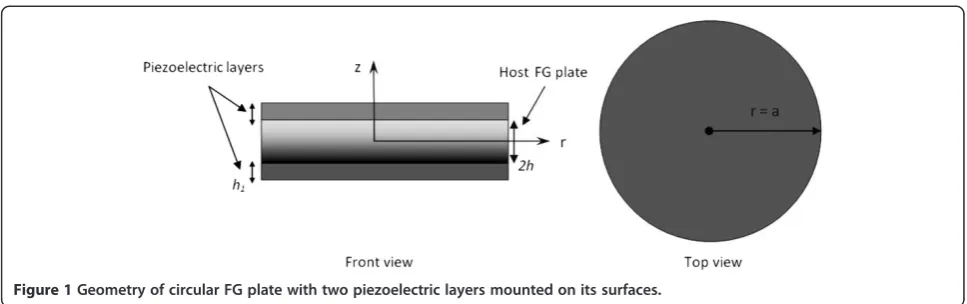
layers bonded perfectly to the upper and lower surfaces of the host layer, with outer radiusa, host plate thickness 2h, and piezoelectric layer thickness h1, as depicted in
Figure 1.
In this study, according to the ratio of the plate radius to its thickness, the Kirchhoff assumption for thin plates is applicable, whereby the shear deformation and rotary inertia can be omitted. In addition, the axisymmetric ap-plied external load is assumed.
According to symmetry, the displacement and strains in the circular plate are considered as (Ebrahimi and Rastgo 2008)
uzð Þ ¼r;t w rð Þ;t ð5Þ
urð Þ ¼r;t −z∂
uz
∂r ð6Þ
uθð Þ ¼r;t 0 ð7Þ
Where uz, ur, and uθ are the displacements in the transversezdirection, radialrdirection, and tangentialθ direction of the plate, respectively. The poling direction of the piezoelectric material is considered to be in the z direction. The strainεin the FG plate and the piezoelectric layer with respect to the radial and tangential directions and the shear component are given by
εr¼−z∂
2w
∂r2 ð8Þ
εθ¼−z∂w
r∂r ð9Þ
εrθ ¼0 ð10Þ
The stress components in the FG circular plate are adopted as (Timoshenko et al. 1959)
σ1
r ¼
E zð ÞðεrþνεθÞ
1−ν2 ð11Þ
σ1
θ¼
E zð ÞðεθþνεrÞ
1−ν2 ð12Þ
By substituting Equations 8 and 9 into Equations 11 and 12,
σ1
r ¼ −zE zð Þ
1−ν2
∂2w
∂r2 þ ν r
∂w
∂r
ð13Þ
σ1
θ¼−1zE z−νð Þ2 1 r
∂w
∂r þν
∂2w
∂r2
ð14Þ
τrθ¼0 ð15Þ
The stress components in the piezoelectric layer can be expressed as (Timoshenko et al. 1959)
σ2
r ¼CE11εrþCE12εθþCE13εz−e31Ez ð16Þ
σ2
θ¼CE12εrþCE11εθþCE13εz−e31Ez ð17Þ
σ2
z ¼CE13εrþCE13εθþCE33εz−e33Ez ð18Þ
For thin plate theory σ2
z ¼0, soεzin the plane stress condition is derived from Equation 18:
εz¼
e33Ez−C13ðεrþεθÞ
C33 ð
19Þ
Substituting Equation 19 into Equations 16 and 17 gives σ2
r ¼C E
11εrþCE12εθ−e31Ez ð20Þ
σ2
θ¼CE12εrþCE11εθ−e31Ez ð21Þ
where the superscripts 1 and 2 refer to the variables in the FG structure and the piezoelectric material, re-spectively. e31 and e33 are the piezoelectric constants of the piezoelectric layer. CE11; CE12 and e31 are trans-formed reduced material constants of piezoelectric medium for the plane stress problem and are expressed by (Wang et al.2001)
CE11¼CE11− C
E
13
2
CE33 ð22Þ
CE12¼CE12− C
E
13
2 CE
33
ð23Þ
e31 ¼e31− CE13 CE 33
e33 ð24Þ
CE11; CE12andCE33are the elastic modulus of the piezo-electric material in the radial and tangential directions, measured at constant electric field; two piezoelectric layers are bonded to the FG plate and are proposed to be used as an actuator or sensor. There are a number of models representing the input electric potential for such a piezoelectric layer. In this study, we adopt the following potential function (Wang et al. 2001):
φðr;z;tÞ ¼ 1− 2z−2h−h1 h1
2
" #
ϕð Þr;t ; ð25Þ
wherez is measured from the mid-plane of the plate in the global z direction, h1 is the thickness of the piezo-electric layer, and φ(r,t) is the electric potential on the mid-surface of the piezoelectric layer, and the electrodes on each piezoelectric layer are short circuit.
On the basis of Equation 25, the components of the electric field intensity E and electric flux density D are expressed as (Wang et al. 2001)
Er ¼−∂φ ∂r¼ 1−
2z−2h−h1 h1
2
" #
∂ϕ
∂r ð26Þ
Eθ ¼−∂∂φθ¼0 ð27Þ
Ez ¼−∂∂φ
z¼
8ðz−h−h1=2Þ
h21 ϕ ð28Þ
Dr¼Ξ11Er¼−Ξ11 1−
2z−2h−h21 h1
2
" #
∂ϕ
∂r ð29Þ
Dθ¼Ξ11Eθ ¼0 ð30Þ
Dz¼Ξ33Ezþe31ðεrþεθÞ
¼8Ξ33ðz−h−h1=2Þ h21 ϕþe
2
31z∇2w; ð31Þ
where Ξ11 and Ξ33 are reduced dielectric constants of the piezoelectric layer in the plane stress condition, which are expressed by Ξ11¼Ξ11; Ξ33¼Ξ33þ e233=CE33
. Er,
Eθ, andEzare the electric field intensities in ther,θ, andz
directions, respectively;Dr,Dθ, andDzare the related
elec-tric displacements.Ξ11andΞ33are the dielectric constants
of the piezoelectric layer; ∇2is the Laplace operator and expressed by
∇2¼ ∂2
∂r2þ 1 r
∂ ∂r
Equilibrium equations
To achieve the equilibrium differential equation of the coupled circular plate, resultant moments obtained as (Timoshenko et al. 1959)
Mr ¼
Z
hþh1
−h−h1
zσrdz¼
Zh
−h
zσ1
rdzþ2
Z
hþh1
h
zσ2
rdz
¼− ðD1þD2Þ∂ 2w
∂r2þ νD1þ
CE12
CE11D2 !
∂w r∂rþ
4 3h1e31ϕ
" #
ð32Þ
Mθ ¼
Z
hþh1
−h−h1
zσθdz¼
Zh
−h
zσ1θdzþ2
Z
hþh1
h
zσ2θdz
¼− νD1þ
CE12
CE11 D2
!
∂2w
∂r2þðD1þD2Þ
∂w r∂rþ
4 3h1e31ϕ
" #
ð33Þ
and the resultant shear force is given by
Qr¼∂Mr
∂r þ Mr−Mθ
r ; ð34Þ
where the thickness of the FG plate is 2h; the piezoelec-tric layer extends fromz = htoz = h + h1.
Substituting Equation 32 into Equations 33 and 34 and substituting the final results into the governing equation for the Kirchhoff circular plate,
∂Qr ∂r þ
Qr
r −
Zh
−h
ρ1ð Þz ∂2u
z ∂t2 dzþ2
Z
hþh1
h
ρ2 ∂2u
z ∂t2
0 @
1
Aþf ¼0; ð35Þ
where ρ1(z) and ρ2 are densities of the FG plate and piezoelectric layer, respectively, andf=f(r,t) is the ex-ternal load.
In the following, the piezoelectric coupled circular FGM plate equation is derived as:
D1þD2
ð Þ∇4w rð Þ þ;t 4 3h1e31∇
2ϕð Þr;t
þ2ðρhþρ2h1Þ∂ 2w rð Þ;t
∂t2 ¼f rð Þ;t ;
where
D1¼
Zh
−h
z2E zð Þ
1−ν2 dz; D2¼ 2
3h1 3h2þ3hh1þh21
CE
11
andρ¼21h
Z h
−h
ρ1ð Þz dz:
Note that all of the electrical variables primarily must sat-isfy Maxwell's equation, which requires that the divergence of the electric flux density vanishes at any point within the media as (Timoshenko et al. 1959)
Z
hþh1
h ∂Dr
∂r þ Dr
r þ
∂Dz ∂z dz
dz¼0: ð37Þ
Substituting Equations 29 and 31 into Equation 37 yields h21Ξ11
12Ξ33∇
2ϕð Þr;t −ϕð Þ þr;t h21e231 8Ξ33 ∇
2w rð Þ ¼;t 0: ð38Þ
In the next section, the solution of two coupled partial differential Equations 36 and 38 will be discussed according to the following mechanical and electrical boundary condi-tions and symmetry constraints for the simply supported and fully grounded piezoelectric coupled FG plate.
Analytical solution procedure
The results of transient bending analysis are given below for two boundary conditions, corresponding to the simply supported and clamped circular plate.
Simply supported circular plate
The initial conditions and boundary conditions are t ¼ 0 :w¼w_ ¼ϕ¼ϕ_ ¼0: ð39Þ
r ¼ a: w ¼ Mr¼φ¼0; z¼ h :
φ¼0; z¼ ðhþh1Þ: φ¼0;
ð40Þ
where, in Equation 39,w_ ¼∂w
∂t andϕ_ ¼
∂φ
∂t.
For the external loadf(r,t) in Equation 36, we consider f rð Þ ¼;t F rð ÞH tð Þ; ð41Þ
where F(r) is given, and H(t) is the Heaviside step function.
Introducing the Laplace transforms
wð Þ ¼r;s
Z∞
0
w rð Þe;t −stdt and ϕð Þr;s
¼
Z∞
0
ϕð Þr;t e−stdt ð42Þ
and taking the Laplace transform of Equations 36 and 38yields
D1þD2
ð Þ∇4wð Þ þr;s 4 3h1e31∇
2ϕð Þr;s
þ2ðρhþρ2h1Þs2wð Þ ¼r;s F rð Þ
s
ð43Þ h21Ξ11
12Ξ33∇
2ϕð Þr;s −ϕð Þ þr;s h21e231 8Ξ33∇
2wð Þ ¼r;s 0:
ð44Þ
According to Equation 32,
Mr¼− ðD1þD2Þ∂ 2w
∂r2þ νD1þ
C12 C11 D2 1 r ∂w
∂rþ 4 3h1e31ϕ
ð45Þ
According to (Rao 2007), to simplify the solution, the boundary condition of Equation 35 is assumed approxi-mately as (Sneddon 1995)
Mr ¼− ðD1þD2Þ ∂ 2w
∂r2 þ 1 r ∂w ∂r þ4 3h1e31ϕ
ð46Þ
The transient solution is written in terms of Bessel function, so we consider
wð Þ ¼r;s X ∞
j¼1
Ajð ÞsJ0 αjr ð47Þ
ϕð Þ ¼r;s X∞
j¼1
Bjð ÞJs 0 αjr ð48Þ
Aj(s) and Bj(s) are unknown functions and should be determined. Moreover, F(r) is expanded into a series in terms of Bessel functions, as
F rð Þ ¼ q1J0ðα1rÞ þ q2J0ðα2rÞ þ : : : ;
¼X∞
j¼1
qjJ0 αjr ð49Þ
where qj can be determined by orthogonality of Bessel
functions as follows:
qj¼ 2 a2
1 J2
1 αja
Z
a
0
rq rð ÞJ0 αjr dr ; j¼1;2;… ð50Þ
In Equations 47, 48, and 50,J0(αr) andJ1(αr) are Bessel
functions of first kind of order zero and one, respectively (Abramowitz and Stegun 1964), and αj are the positive roots of
It should be noted that the solutionsw*(r) andφ*(r) in Equations 47 and 48 satisfy Equations 43 and 44 and all initial and boundary conditions in the problem.
Substituting Equations 47 and 48 into Equation (44) gives
Bjð Þ ¼s −p0α2
j
1þp1α2
j
Ajð Þs ð52Þ
Substituting Equations 47, 48, 49, and 53 into Equation 43 gives
Ajð Þ ¼s
qj
sD α4
j þλs2þCj
ð53Þ
whereD = D1+ D2, and
p0¼4h1e31 3D ; p1¼
h21Ξ11 12Ξ33;
p2¼h 2 1e31 8Ξ33λ
¼2ðρhþρ2h1Þ D ; Cj¼
p0α4
j
1þp1α2j
Assumingaj¼ ffiffiffiffiffiffiffiffiffiffi α4
jþCj λ q
, consequently,
Ajð Þ ¼s
qj
sD s2þa2
j
ð54Þ
The inverse Laplace transform is applied tow*(r,s) and φ*
(r,s)to derive the final solution in the time domain. The inversions of Aj(s) and Bj(s) in Equations 54 and 52 are simply derived using standard Laplace transform tables, e.g., (Spiegel 1965). Denoting the inversion ofA(s) byA
t
ð Þ, the result forAj(s) is
Ajð Þ ¼t L−1 Ajð Þs
¼ qj
D α4
j þCj
1−cos ajt
j ¼ 1;2;…
ð55Þ
The result forBj(s) follows directly from Equations 52 and 55
Bjð Þ ¼t L−1 Bjð Þs
¼ −p0α2j
1þp1α2
j
qj
D α4
j þCj
1−cos ajt
j ¼ 1;2;… ð56Þ
with Equations 55 and 56, the exact and explicit solu-tions for the transient problem can be expressed as
wðr;tÞ ¼X ∞
j¼1
Ajð Þt J0 αjr
ϕð Þ ¼r;t X ∞
j¼1
Bjð Þt J0 αjr
ð57Þ
The final solutions for the bending moments Mr(r,t) and Mθ(r,t) are obtained introducing Equation 57 into Equations 32 and 33.
Clamped circular plate
The initial conditions and boundary conditions are t ¼ 0 :w¼w_ ¼ϕ¼ϕ_ ¼0: ð58Þ
r ¼ a: w ¼ dw=dr ¼φ; z¼ h : φ¼0
z¼ ðhþh1Þ: φ¼0 ð59Þ
For the solution, we consider
wð Þ ¼r;s X ∞
j¼1
A′jð ÞJs 0 αjr þC sð Þ
r2−a2; ϕð Þr;s ¼X∞
j¼1
B′jð ÞJs 0 αjr ð60Þ
where A0jð Þs , B0jð Þs , andC(s) are unknown functions and should be determined. Substitutingw*(r,s) andφ*(r,s) into Equations43and44should satisfy
A′jð Þαs 4j−p0α2jB′jð Þ þs λs2hAj′ð Þ þs C sð Þr2−a2i¼ qj sD ð61Þ
−p1α2jB′jð Þs −B′jð Þ þs p2 4C sð Þ−α2jA′jð Þs
h i
¼0 ð62Þ
A supplementary expansion is presented as λr2–a2 ¼ c1J0ðα1rÞ þ c2J0ðα2rÞ þ : : : ;
¼X∞
j¼1
cjJ0 αjr ð63Þ
where cj is a constant and can be obtained by the
orthogonality of Bessel functions as follows:
cj¼
2 a2
1 J2
1 αja Z
a
0
r r 2−a2λJ0 αjr dr ;j¼1;2;… ð64Þ
It should be noted that the solutionsw*(r) andφ*(r) in Equation 60 satisfy Equations 43 and 44 and all initial and boundary conditions in the problem, excludingdw/ dr =0 atr = a. Therefore, providingC(s) is fixed to fulfill
r ¼ a : dw=dr ¼ 0 ð65Þ
where according to Equation 60, the solutions of the individual terms are
2C sð Þa−αjJ1 αja
Aj 0
s
ð Þ ¼ 0: ð66Þ
Substituting A0jð Þs from Equation 66 into Equation 62 and a supplementary expansion 4¼X
∞
j¼1
qjJ0 αjr , one derives
B′jð Þ ¼s
p2αj qjJ1 αja
−2aαj
2a 1þp1α2
j
A′jð Þs ð67Þ
where it is obtained by the orthogonality of the Bessel functions as follows:
qj¼ 8 aαjJ1 αja
ð68Þ
Substituting Equations 67 and 63 into Equation 61 gives
A′jð Þ ¼s qj D λþcjαjJ1ð Þαja
2a
1
sD s2þa2
j
ð69Þ
Table 1 Material properties of the piezoelectric coupled FGM plate (Ebrahimi and Rastgo 2008)
Property Value
Host FG plate
Ec= 205 (GPa) ρc= 7,800 (kg/m3)
Em= 200 (GPa) ρm= 8,900 (kg/m3)
PZT CE
11¼ 132 109 CE12¼ 71 109 CE
33¼ 115 109 CE13¼ 73 109
CE11¼85:7 109 CE
12 ¼24:7 109 e31=−4.1 (C/m2) e33= 14.1 (C/m2)
e31¼−13:05 Cð =m2Þ Ξ11= 7.124 × 10⁻⁹(F/m) Ξ33= 5.841 × 10⁻⁹(F/m)
ρ2= 7,500 (kg/m3)
with
aj¼
ffiffiffiffiffiffiffiffiffiffiffiffiffiffiffiffiffiffiffiffiffiffiffiffiffi
α4
j−βj
λþcjαjJ1ð Þαja
2a
v u u
t ; βj¼
p0p2α3j qjJ1 αja
−2aαj
2a 1þp1α2
j
;
The inverse Laplace transform is applied tow*(r,s) and φ*
(r,s)to derive the final solution in the time domain. The inversions ofA′j(s) andB′j(s) in Equations 69 and 67 are simply derived using standard Laplace transform ta-bles, e.g., (Spiegel 1965).
Representing the inversion ofA′(s) byA′ð Þt , the result forA′j(s) is
A′jð Þ ¼t L−1 A′jð Þs
h i
¼ qj
D α4
j−βj
1−cos ajt
;j ¼ 1;2;… ð70Þ
B′jð Þ ¼t L−1 B′jð Þs h i
¼βj
α2
j
qj
D α4
j−βj
1−cos ajt
;j ¼ 1;2;…
ð71Þ
The result for C(s) follows directly from Equations 66 and 70
C tð Þ ¼L−1½C sð Þ ¼ 1 2a
X∞
j¼1
A′jð Þαt jJ1 αja
ð72Þ
Note that forj= 1,2,…, βj is negative, and as a result, αj4−βj4in Equation 70 is always greater than zero, mak-ingA′j always bounded.
With Equations 70, 71, and (72), the exact and explicit solutions for the transient problem can be expressed as
w rð Þ ¼;t X ∞
j¼1
A′jð ÞJt 0 αjr þC tð Þ r2−a2
ð73Þ
ϕð Þ ¼r;t X ∞
j¼1
B′jð ÞJt 0 αjr ð74Þ
Results and discussion
In this section, a set of case studies was considered to evaluate on the performance of the models on the transient analysis of FG three-layer circular plates. The geometric size and material parameters for the FG plate used in the numerical analysis are presented in Table 1. In this example, the thickness ratio of the piezoelectric layer and main plate (h1/2h) is 1/10. The radius of the circular
plate is equal to 0.6 m, and the thickness of the FG host is 0.01 m; also, the external load equal to 1 kPa is applied uniformly on the top of the piezoelectric layer.
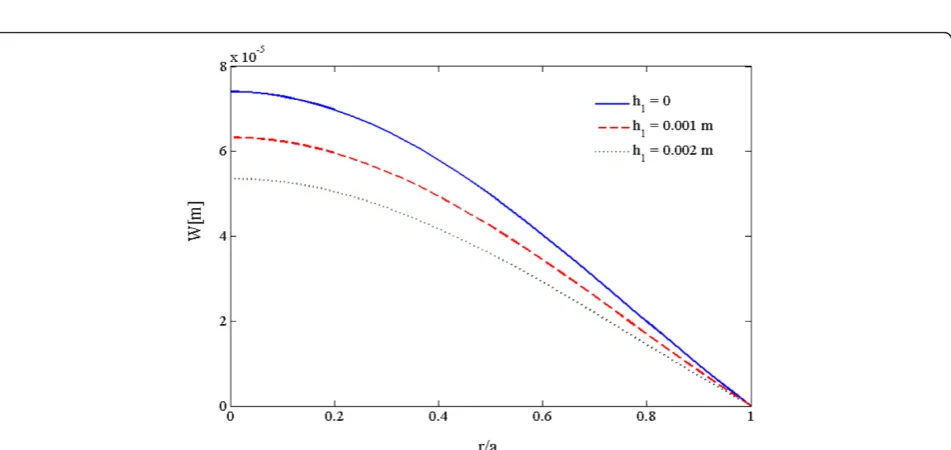
Figure 4Effect of piezoelectric layer on radial deflection of FG plate forg= 2 (clamped).
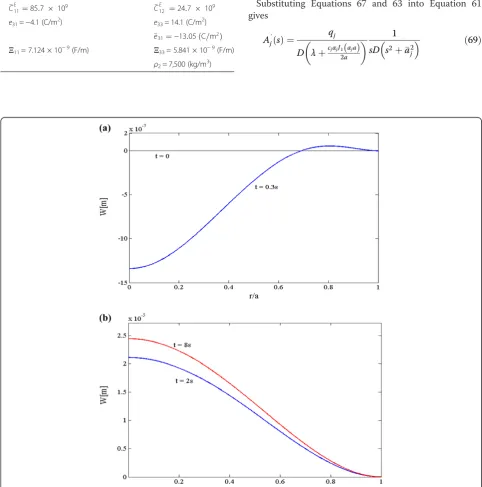
Figure 2 shows the radial distribution of the deflection of plate forg= 0 and clamped boundary condition at different moments in time: briefly after applying the uniform load, Figure 2a, and later in time. The curves in Figure 2 show that the initial conditions (59) and boundary conditions at r= 0:dw/dr= 0 and atr=a:w=dw/dr= 0 are satisfied.
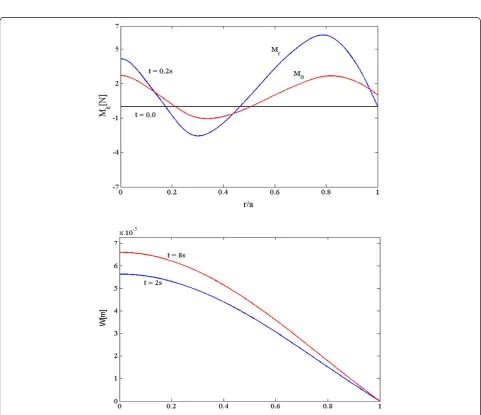
Also, Figure 3 shows the radial distribution of bending moment of plate forg= 0 and simply supported boundary condition at different moments in time. The curves shows that the initial conditions (40) and boundary conditions at r = a: w=Mr= 0 are satisfied. These results demonstrate that the newly developed solution is numerically stable and enables the calculation of the plate characteristics anywhere within the plate and for small as well as large times.
Figures 4 and 5 show the radial deflection of piezoelectric FG structure for piezoelectric layers with difference thick-ness for clamped and simply supported boundary condi-tions att= 2 s. It is noticeable that by increasing the value ofh1, the deflection of plate decreases under the same value
of transverse load. Also, it can be observed that by increas-ing the value of piezoelectric layers from 0 to 0.001 m, the deflection of the compound plate decreases by approxi-mately 14% and that by increasing from 0 to 0.002 m, the deflection of the compound plate decreases by approxi-mately 28% for both boundary conditions.
Also, Figure 6 shows the center deflection of piezo-FG plate at time t= 0.2 s for different values of gunder the same value of mechanical load. As seen from Figure 6, the deflection of the piezo-plate decreases by increasing g. This is due to the fact that higher values of power law index g correspond to high portion of ceramic in comparison with the metal part, thus making such FG plate less flexible. The highest values for deflection are obtained for full metal
Figure 6Effect of power index on the deflection of plate atr= 0.
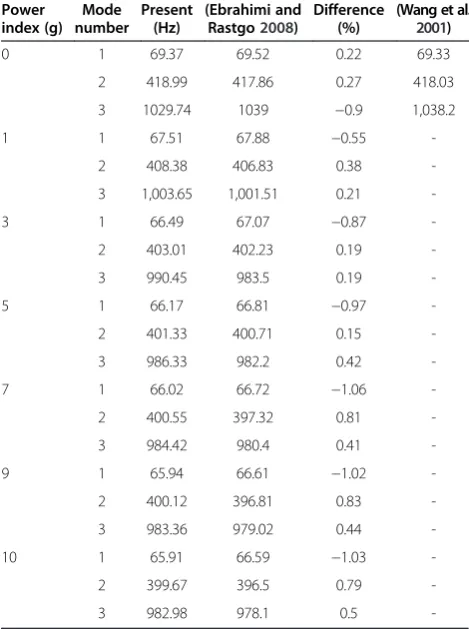
Table 2 The first three mode resonance frequencies (Hz) for piezo-FG plate for various values of power index
Power index (g)
Mode number
Present (Hz)
(Ebrahimi and
Rastgo2008)
Difference (%)
(Wang et al. 2001)
0 1 69.37 69.52 0.22 69.33
2 418.99 417.86 0.27 418.03 3 1029.74 1039 −0.9 1,038.2
1 1 67.51 67.88 −0.55
-2 408.38 406.83 0.38
-3 1,003.65 1,001.51 0.21
-3 1 66.49 67.07 −0.87
-2 403.01 402.23 0.19
-3 990.45 983.5 0.19
-5 1 66.17 66.81 −0.97
-2 401.33 400.71 0.15
-3 986.33 982.2 0.42
-7 1 66.02 66.72 −1.06
-2 400.55 397.32 0.81
-3 984.42 980.4 0.41
-9 1 65.94 66.61 −1.02
-2 400.12 396.81 0.83
-3 983.36 979.02 0.44
-10 1 65.91 66.59 −1.03
-2 399.67 396.5 0.79
-plate (g= 0), while the lowest deflection is obtained for full ceramic plate (g→∞). This is because an increase in the value of the power law index results in an increase in the value of elasticity modulus. In other words, the host plate becomes less flexible as the power law index increases. It can be seen that the deflection of the system decreases by increasing g and stabilizes for g values greater than 7. In fact, for g >> 1, the FGM plate becomes a ceramic plate and the compound plate transforms into a laminated plate with ceramic core as a main plate.
Note that when a dynamic system is suddenly sub-jected to nonperiodic excitation force F(t), the response of the system is called transient response. Transient os-cillations occur with the natural frequency of the system, and its extent depends on the type of stimulation. In a spring-mass system or a continuous system, when the system is stimulated by a step function, the response is as follows (Loja et al. 2012):
w xð Þ ¼;t GF0: 1−cos ωjt
ð75Þ
where G is a coefficient, and ωj is the natural
fre-quency of the system. The comparison between the above equation and Equation 55shows that aj=ωj(i.e.,
ωj¼aj¼ ffiffiffiffiffiffiffiffiffiffi α4
jþCj λ q
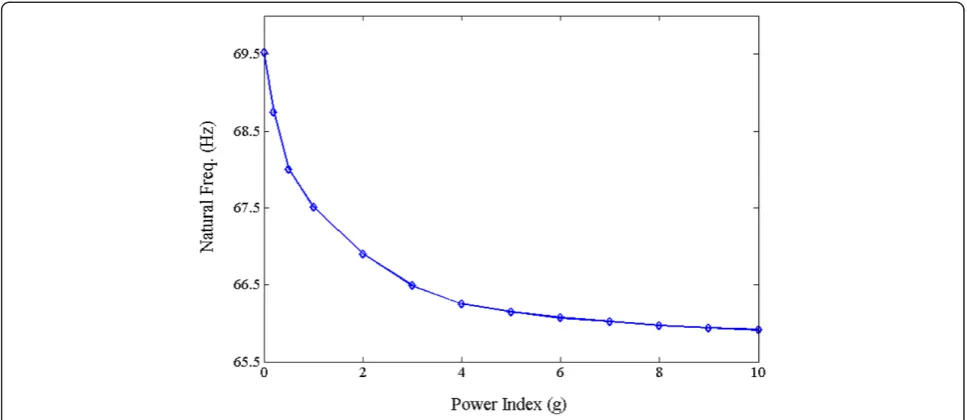
Þ, where, in this study,ωjis the axsym-metric natural frequency of the system. By calculating aj, the axsymmetric natural frequencies of the system are obtained. Table 2 shows the first three axisymmetric natural frequencies of piezo-FG plate for different values ofg. The obtained results in Table 2 indicate that by increasing the value ofg, the frequency of the system decreases. In order to see better the effect ofgvariations on the natural frequency of the different plates, Figure 7 also illustrates these variations for the first-mode shape.
As seen from Figure 7, the natural frequencies of the system decrease as g increases and stabilized g values greater than 7. In fact, forg>> 1, the FGM plate becomes a ceramic plate, and the compound plate transforms into a laminated plate with ceramic core asshost plate. This de-creasing trend of natural frequency for smaller values of g is more pronounced, for example, by increasing the value of gfrom 1 to 3 (approximately 200%), the frequency of the first mode for the compound plate decreases by 1.32% but by increasing g from 3 to 9 (approximately 200%) of the same plate and for the same mode, the frequency decreases by 0.71%. Table 3 shows the effect of the piezoelectric layer on the natural frequency of the sys-tem. As seen from this table, by increasing the piezo-electric layer, the natural frequency increases and the piezo-effect is more obvious when there is a thicker piezoelectric layer on the main plate.
Conclusion
In this paper, the transient bending of a three-layer piezo-electric circular FG plate based on the Kirchhoff plate theory is studied. The material properties of the FG plate are assumed to vary through the thickness of the plate based on the power law distribution. Also the distribution of electric potential in the piezoelectric layers follows a
Figure 7Effect of power index on the natural frequency (first mode).
Table 3 Effect of piezoelectric layer on resonance frequencies
Thickness ratio First mode Second mode Third mode
1/12 68.65 417.62 1,026.62
1/10 69.52 418.99 1,029.74
1/8 71.52 420.96 1,034.82
quadratic function in short circuited form. The solution is pre-sented in terms of elementary Bessel functions and analytical inverse Laplace transforms. The solution enables the efficient determination of the plate characteristics anywhere within the plate for small as well as large times with reliable precision. It can be observed that the power index (g) has significant effect on the deflec-tion amplitude and natural frequency of the piezo-FG plate. It is shown that the thickness of the piezo-layer has significant effect on the deflection amplitude and natural frequency of the piezo-FG plate.
Competing interests
The authors declare that they have no competing interests.
Authors’contributions
AAJ carried out the analytical solution, AA and OR conceived of the study, and participated in its design and coordination. All authors read and approved the final manuscript.
Author details 1
Faculty of Mechanical Engineering, K.N.Toosi University of Technology, Pardis St., Tehran 19697, Iran.2Smart Structures and New Advanced Materials
Laboratory, Mechanical Engineering Department, University of Zanjan, Zanjan 45371-38791, Iran.
Received: 24 February 2014 Accepted: 1 July 2014
References
Abramowitz, M, & Stegun, IA. (1964).Handbook of Mathematical Functions: With Formulars, Graphs, and Mathematical Tables(Vol. 55). New York: Courier Dover Publications.
Alibeigloo, A. (2010). Thermoelasticity analysis of functionally graded beam with integrated surface piezoelectric layers.Composite Structures, 92(6), 1535–1543. Batra, R, & Geng, T. (2002). Comparison of active constrained layer damping by
using extension and shear mode piezoceramic actuators.Journal of Intelligent Material Systems and Structures, 13(6), 349–367.
Batra, R, & Liang, X. (1997). The vibration of a rectangular laminated elastic plate with embedded piezoelectric sensors and actuators.Computers & Structures, 63(2), 203–216.
Behjat, B, & Khoshravan, M. (2012). Geometrically nonlinear static and free vibration analysis of functionally graded piezoelectric plates.Composite Structures, 94(3), 874–882.
Bhangale, RK, & Ganesan, N. (2006). Static analysis of simply supported functionally graded and layered magneto-electro-elastic plates.International Journal of Solids and Structures, 43(10), 3230–3253.
Bian, Z, Lim, C, & Chen, W. (2006). On functionally graded beams with integrated surface piezoelectric layers.Composite Structures, 72(3), 339–351.
Ebrahimi, F, & Rastgo, A. (2008). An analytical study on the free vibration of smart circular thin FGM plate based on classical plate theory.Thin-Walled Structures, 46(12), 1402–1408.
Ebrahimi, F, & Rastgoo, A. (2008). Free vibration analysis of smart annular FGM plates integrated with piezoelectric layers.Smart Materials and Structures, 17(1), 015044.
Ebrahimi, F, Rastgoo, A, & Kargarnovin, M. (2008). Analytical investigation on axisymmetric free vibrations of moderately thick circular functionally graded plate integrated with piezoelectric layers.Journal of Mechanical Science and Technology, 22(6), 1058–1072.
Ebrahimi, F, Rastgoo, A, & Atai, A. (2009). A theoretical analysis of smart moderately thick shear deformable annular functionally graded plate. European Journal of Mechanics-A/Solids, 28(5), 962–973.
Es’haghi, M, Hashemi, SH, & Fadaee, M. (2011). Vibration analysis of piezoelectric FGM sensors using an accurate method.International Journal of Mechanical Sciences, 53(8), 585–594.
Fakhari, V, Ohadi, A, & Yousefian, P. (2011). Nonlinear free and forced vibration behavior of functionally graded plate with piezoelectric layers in thermal environment.Composite Structures, 93(9), 2310–2321.
Hashemi, SH, Khorshidi, K, Es’haghi, M, Fadaee, M, & Karimi, M. (2012). On the effects of coupling between in-plane and out-of-plane vibrating modes of smart functionally graded circular/annular plates.Applied Mathematical Modelling, 36(3), 1132–1147.
He, X, Ng, T, Sivashanker, S, & Liew, K. (2001). Active control of FGM plates with integrated piezoelectric sensors and actuators.International Journal of Solids and Structures, 38(9), 1641–1655.
Hosseini Hashemi, S, Es’haghi, M, & Karimi, M. (2010). Closed-form vibration analysis of thick annular functionally graded plates with integrated piezoelectric layers.International Journal of Mechanical Sciences, 52(3), 410–428.
Hosseini-Hashemi, S, Es’haghi, M, & Rokni Damavandi Taher, H. (2010a). An exact analytical solution for freely vibrating piezoelectric coupled circular/annular thick plates using Reddy plate theory.Composite Structures, 92(6), 1333–1351. Hosseini-Hashemi, S, Es’haghi, M, Rokni Damavandi Taher, H, & Fadaie, M. (2010b). Exact closed-form frequency equations for thick circular plates using a third-order shear deformation theory.Journal of Sound and Vibration, 329(16), 3382–3396.
Huang, X-L, & Shen, H-S. (2006). Vibration and dynamic response of functionally graded plates with piezoelectric actuators in thermal environments.Journal of Sound and Vibration, 289(1), 25–53.
Jandaghian, A, Jafari, A, & Rahmani, O. (2013). Exact solution for Transient bending of a circular plate integrated with piezoelectric layers.Applied Mathematical Modelling, 37(12), 7154–7163.
Jandaghian, A, Jafari, A, & Rahmani, O. (2014). Vibrational response of functionally graded circular plate integrated with piezoelectric layers: An exact solution. Engineering Solid Mechanics, 2(2), 119–130.
Kargarnovin, M, Najafizadeh, M, & Viliani, N. (2007). Vibration control of a functionally graded material plate patched with piezoelectric actuators and sensors under a constant electric charge.Smart Materials and Structures, 16(4), 1252.
Komeili, A, Akbarzadeh, AH, Doroushi, A, & Eslami, MR. (2011). Static analysis of functionally graded piezoelectric beams under thermo-electro-mechanical loads.Advances in Mechanical Engineering, 2011, 1–10.
Li, X, Ding, H, & Chen, W. (2008). Three-dimensional analytical solution for functionally graded magneto–electro-elastic circular plates subjected to uniform load.Composite Structures, 83(4), 381–390.
Liew, K, He, X, Ng, T, & Kitipornchai, S. (2002). Active control of FGM shells subjected to a temperature gradient via piezoelectric sensor/actuator patches.International Journal for Numerical Methods in Engineering, 55(6), 653–668.
Liew, K, He, X, Ng, T, & Kitipornchai, S. (2003). Finite element
piezothermoelasticity analysis and the active control of FGM plates with integrated piezoelectric sensors and actuators.Computational Mechanics, 31(3–4), 350–358.
Loja, M, Soares, M, & Barbosa, J. (2013). Analysis of functionally graded sandwich plate structures with piezoelectric skins, using B-spline finite strip method. Composite Structures, 96, 606–615.
Ootao, Y, & Tanigawa, Y. (2000). Three-dimensional transient
piezothermoelasticity in functionally graded rectangular plate bonded to a piezoelectric plate.International Journal of Solids and Structures, 37(32), 4377–4401.
Pan, E, & Han, F. (2005). Exact solution for functionally graded and layered magneto-electro-elastic plates.International Journal of Engineering Science, 43(3), 321–339.
Rahmani, O, & Noroozi Moghaddam, MH. (2014). On the Vibrational Behavior of Piezoelectric Nano-Beams.Advanced Materials Research, 829, 790–794. Rahmani, O, & Pedram, O. (2014). Analysis and modeling the size effect on
vibration of functionally graded nanobeams based on nonlocal Timoshenko beam theory.International Journal of Engineering Science, 77, 55–70. Rahmani, O, Malekzadeh, K, & Khalili, SMR. (2010). Analytical Solution for Free
Vibration of Sandwich Structures with a Functionally Graded Syntactic Foam Core.Materials Science Forum, 636, 1143–1149.
Rao, SS. (2007).Vibration of continuous systems. New Jersey: John Wiley & Sons. Ray, M, & Batra, R. (2007). Vertically reinforced 1-3 piezoelectric composites
for active damping of functionally graded plates.AIAA Journal, 45(7), 1779–1784.
Ray, M, & Sachade, H. (2006). Finite element analysis of smart functionally graded plates.International Journal of Solids and Structures, 43(18), 5468–5484. Reddy, J, & Cheng, Z-Q. (2001). Three-dimensional solutions of smart functionally
Shen, H-S. (2005). Postbuckling of FGM plates with piezoelectric actuators under thermo-electro-mechanical loadings.International Journal of Solids and Structures, 42(23), 6101–6121.
Shiyekar, S, & Kant, T. (2010). An electromechanical higher order model for piezoelectric functionally graded plates.International Journal of Mechanics and Materials in Design, 6(2), 163–174.
Sneddon, IN. (1995).Fourier transforms. New York: Courier Dover Publications. Spiegel, MR. (1965).Laplace transforms. New York: McGraw-Hill.
Tanigawa, Y. (2001). Control of the transient thermoelastic displacement of a functionally graded rectangular plate bonded to a piezoelectric plate due to nonuniform heating.Acta Mechanica, 148(1–4), 17–33.
Timoshenko, S, Woinowsky-Krieger, S, & Woinowsky, S. (1959).Theory of plates and shells, vol 2. New York: McGraw-hill.
Vel, SS, & Batra, R. (2001). Exact solution for rectangular sandwich plates with embedded piezoelectric shear actuators.AIAA Journal, 39(7), 1363–1373. Wang, B, & Noda, N. (2001). Design of a smart functionally graded
thermopiezoelectric composite structure.Smart Materials and Structures, 10(2), 189.
Wang, Q, Quek, S, Sun, C, & Liu, X. (2001). Analysis of piezoelectric coupled circular plate.Smart Materials and Structures, 10(2), 229.
Zhang, X, Veidt, M, & Kitipornchai, S. (2004). Transient bending of a piezoelectric circular plate.International Journal of Mechanical Sciences, 46(12), 1845–1859.
doi:10.1186/s40712-014-0008-5
Cite this article as:Jafariet al.:Transient bending analysis of a functionally graded circular plate with integrated surface piezoelectric layers.International Journal of Mechanical and Materials Engineering
20141:8.
Submit your manuscript to a
journal and benefi t from:
7Convenient online submission
7Rigorous peer review
7Immediate publication on acceptance
7Open access: articles freely available online
7High visibility within the fi eld
7Retaining the copyright to your article