R E S E A R C H
Open Access
OGRO: The Overview of functionally characterized
Genes in Rice online database
Eiji Yamamoto
1, Jun-ichi Yonemaru
1*, Toshio Yamamoto
1and Masahiro Yano
2Abstract
Background:The high-quality sequence information and rich bioinformatics tools available for rice have contributed to remarkable advances in functional genomics. To facilitate the application of gene function information to the study of natural variation in rice, we comprehensively searched for articles related to rice functional genomics and extracted information on functionally characterized genes.
Results:As of 31 March 2012, 702 functionally characterized genes were annotated. This number represents about 1.6% of the predicted loci in the Rice Annotation Project Database. The compiled gene information is organized to facilitate direct comparisons with quantitative trait locus (QTL) information in the Q-TARO database. Comparison of genomic locations between functionally characterized genes and the QTLs revealed that QTL clusters were often co-localized with high-density gene regions, and that the genes associated with the QTLs in these clusters were different genes, suggesting that these QTL clusters are likely to be explained by tightly linked but distinct genes. Information on the functionally characterized genes compiled during this study is now available in the Overview of Functionally Characterized Genes in Rice Online database (OGRO) on the Q-TARO website (http://qtaro.abr.affrc.go. jp/ogro). The database has two interfaces: a table containing gene information, and a genome viewer that allows users to compare the locations of QTLs and functionally characterized genes.
Conclusions:OGRO on Q-TARO will facilitate a candidate-gene approach to identifying the genes responsible for QTLs. Because the QTL descriptions in Q-TARO contain information on agronomic traits, such comparisons will also facilitate the annotation of functionally characterized genes in terms of their effects on traits important for rice breeding. The increasing amount of information on rice gene function being generated from mutant panels and other types of studies will make the OGRO database even more valuable in the future.
Keywords:Rice (Oryza sativaL), Functionally characterized genes, QTL, Database
Background
Rice is a model plant species for which many genetic and genomic resources have been developed. These resources include high-quality genome sequence infor-mation (Goff et al. 2002; Yu et al. 2002; International Rice Genome Sequencing Project 2005), high-efficiency transformation systems (Hiei and Komari 2008), bio-informatics tools and databases (reviewed by Nagamura and Antonio 2010), mutant panels (Chern et al. 2007; Miyao et al. 2007), and publicly available populations for genetic analysis such as backcross inbred lines (BILs) and chromosome segment substitution lines (CSSLs)
(Fukuoka et al. 2010). These resources have contributed to remarkable advances in rice functional genomics du-ring the last two decades, and many genes have been functionally characterized (Jiang et al. 2011). Because rice is an important food crop as well as a model plant, information derived from functional genomics research needs to be applied to rice breeding.
So far, most of the genomics research that has been applied to rice breeding has been related to quantitative trait locus (QTL) analysis, because, in many cases, agro-nomically useful alleles represent naturally occurring al-lelic variations that were identified as QTLs in cultivars, landraces, or wild species (Yamamoto et al. 2009; Xing and Zhang 2010; Miura et al. 2011). Information on rice QTLs from published articles has been compiled and is publicly available in the Gramene-QTL database (Ni * Correspondence:[email protected]
1
National Institute of Agrobiological Sciences, 2-1-2 Kannondai, Tsukuba, Ibaraki 305-8602, Japan
Full list of author information is available at the end of the article
et al. 2009); http://www.gramene.org/qtl/) and the QTL Annotation Rice Online database (Q-TARO; Yonemaru et al. 2010; http://qtaro.abr.affrc.go.jp/). Several of the genes responsible for QTLs have been cloned, but most have not yet been identified. Mapped QTL regions are often long enough to contain many genes, and introgres-sion of such QTL regions may result in linkage drag, which results from the introgression of one or more un-favorable genes that are closely linked to the genes re-sponsible for the target QTL. In cases where a QTL has been fine-mapped or the causal gene(s) have been iden-tified, the problem of linkage drag can be overcome by means of marker-assisted selection of recombinants bet-ween the target gene or QTL and nearby unfavorable genes (Fukuoka et al. 2009).
With the exception of genes that have been identified as those responsible for QTLs, most of the functionally characterized genes in rice have not been analyzed for allelic variation and functional differences in natural populations. However, such information is useful for QTL cloning using the candidate gene approach and for candidate gene association studies (Ehrenreich et al. 2009; Emanuelli et al. 2010). For these approaches, it is necessary to make the list of candidate genes involved in the trait of interest readily available for individual experi-mental design. It is also important that the genomic locations of functionally characterized genes can be readily compared with the location of QTLs involved in the same trait. Rice databases such as Gramene (Youens-Clark et al. 2011) and Oryzabase (Kurata and Yamazaki 2006) include information on gene function from published research. However, it is necessary to re-arrange the data provided by these databases for carrying out the abovementioned approaches. We also found that several functionally characterized genes are not included
in those databases, probably because information on such genes was published in agronomy and breeding journals rather than in genetics, genomics, or molecular biology journals.
In this study, our goal was to facilitate the application of gene function information to the study of natural variation in rice. To accomplish this, we comprehen-sively searched for articles related to rice functional gen-omics and established a list of functionally characterized genes. Information on each gene was summarized to fa-cilitate direct comparison with QTL information from Q-TARO (Yonemaru et al. 2010). We also compared the genomic locations of functionally characterized genes and QTLs. The information on functionally characte-rized genes obtained in this study was compiled in a new database, the Overview of Functionally Characterized Genes in Rice Online database (OGRO), which is located on the Q-TARO website (Yonemaru et al. 2010; http:// qtaro.abr.affrc.go.jp/ogro).
Results and discussion
Extraction of information on functionally characterized genes in rice
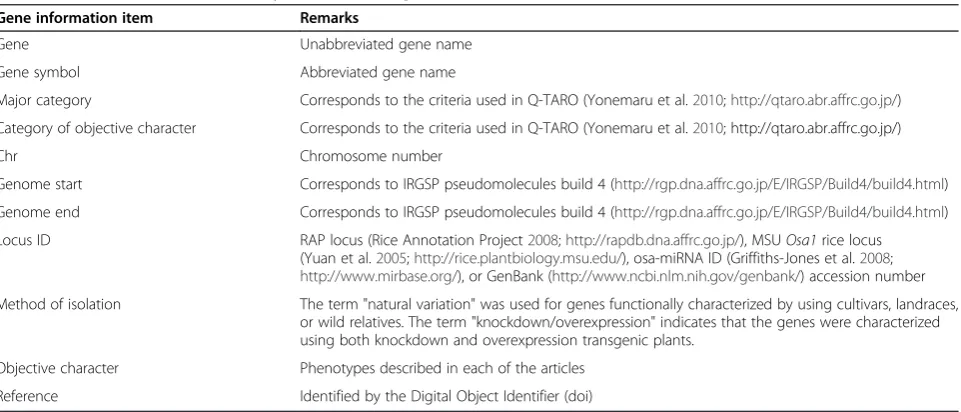
To establish the list of functionally characterized genes in rice, we conducted a comprehensive search for ar-ticles related to rice functional genomics, and we ex-tracted information on gene function by manually checking every article identified in the search. As of 31 March 2012, 702 functionally characterized genes were annotated based on the information from 707 articles. The categories of information extracted for each of the functionally characterized genes are listed in Table 1. The list of functionally characterized genes includes seven microRNAs (miRNAs) that have been associated with specific phenotypes (Xie et al. 2006; Zhu et al.
Table 1 Information on functionally characterized genes extracted from each article
Gene information item Remarks
Gene Unabbreviated gene name
Gene symbol Abbreviated gene name
Major category Corresponds to the criteria used in Q-TARO (Yonemaru et al.2010;http://qtaro.abr.affrc.go.jp/)
Category of objective character Corresponds to the criteria used in Q-TARO (Yonemaru et al.2010; http://qtaro.abr.affrc.go.jp/)
Chr Chromosome number
Genome start Corresponds to IRGSP pseudomolecules build 4 (http://rgp.dna.affrc.go.jp/E/IRGSP/Build4/build4.html)
Genome end Corresponds to IRGSP pseudomolecules build 4 (http://rgp.dna.affrc.go.jp/E/IRGSP/Build4/build4.html)
Locus ID RAP locus (Rice Annotation Project2008;http://rapdb.dna.affrc.go.jp/), MSUOsa1rice locus (Yuan et al.2005;http://rice.plantbiology.msu.edu/), osa-miRNA ID (Griffiths-Jones et al.2008;
http://www.mirbase.org/), or GenBank (http://www.ncbi.nlm.nih.gov/genbank/) accession number
Method of isolation The term "natural variation" was used for genes functionally characterized by using cultivars, landraces, or wild relatives. The term "knockdown/overexpression" indicates that the genes were characterized using both knockdown and overexpression transgenic plants.
Objective character Phenotypes described in each of the articles
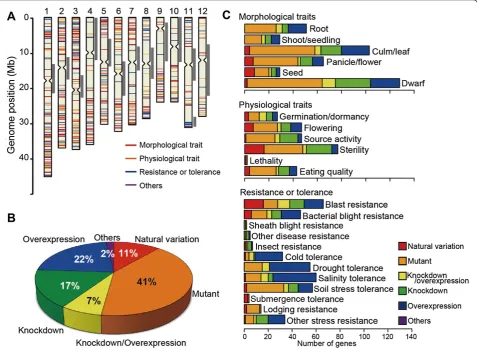
2009; Gao et al. 2010; Gao et al. 2011a). Figure 1A shows the genomic distribution of the 702 functionally charac-terized genes. Among these, four genes were absent from the reference genome sequence (Oryza sativa L. ssp.japonicacv. Nipponbare):qSW5/GW5for grain size (Shomura et al. 2008; Weng et al. 2008),Sub1Afor sub-mergence tolerance (Xu et al. 2006), and SK1 and SK2 for internode elongation in floating rice (Hattori et al. 2009). Genomic regions with few to no functionally characterized genes generally corresponded to hetero-chromatic regions (Figure 1A; Cheng et al. 2001; Li et al. 2008).
There are 44 755 gene loci, excluding transposable ele-ments (TEs) and ribosomal protein or tRNA loci, in RAP (Rice Annotation Project 2008; http://rapdb.dna. affrc.go.jp/), and 491 miRNA loci in release 18 miRbase (Griffiths-Jones et al. 2008; http://www.mirbase.org/). The functionally characterized genes compiled during this study represent only 1.6% of these loci. In Arabidopsis, a
model dicot species, 5826 genes have been functional-ly characterized, accounting for more than 20% of the gene loci in this species (Lamesch et al. 2012). Con-sidering both the number and the proportion of func-tionally characterized genes in Arabidopsis, it seems that the functional characterization of rice genes is far from complete.
For the gene information item "method of isolation" (Table 1), the genes identified by using cultivars, land-races, or wild relatives were described as "natural varia-tion". Among the 702 functionally characterized genes, 11% (80 genes) had been identified through natural vari-ation. Another 41% (286 genes) were identified by mu-tant analysis, and 48% (336) were identified by using transgenic plants (isolation method classified as "overex-pression", "knockdown", "knockdown/overex"overex-pression", or “others”; Figure 1B). This breakdown indicates that both forward- and reverse-genetics approaches are valuable methods in rice functional genomics.
We annotated the functionally characterized genes based on the phenotypes described in each of the articles (Table 1). The phenotypes related to each gene were classified into "major category" and "category of objective character" (Table 1). These categories are identical to those used in Q-TARO (Yonemaru et al. 2010; http:// qtaro.abr.affrc.go.jp/). Genes associated with multiple traits were counted within each relevant category.
The number of functionally characterized genes within each category is shown in Figure 1C. The variability in the number of functionally characterized genes among the dif-ferent categories (Figure 1C) probably reflects the agro-nomic importance of each trait and the interests of individual researchers rather than the actual number of genes involved in each trait. In the major category "resist-ance or toler"resist-ance", transgenic approaches ("overexpression", "knockdown", and "knockdown/overexpression") were used for functional analysis more frequently than for genes in the major categories "morphological trait" and "physiological trait" (Figure 1C). This difference might be due to the difficulty in screening mutant and natural populations for traits related to resistance or tolerance. Within the major category "resistance or tolerance", most of the genes in the categories "cold", "drought", and "salinity" were characterized by overexpression ana-lysis (Figure 1C). The overexpressing plants often showed pleiotropic effects such as growth retardation (Abbasi et al. 2004; Ye et al. 2009; Nakashima et al. 2007), suggesting that complex mechanisms control these abiotic stress tolerances in rice.
Comparison of genomic locations between functionally characterized genes and QTLs
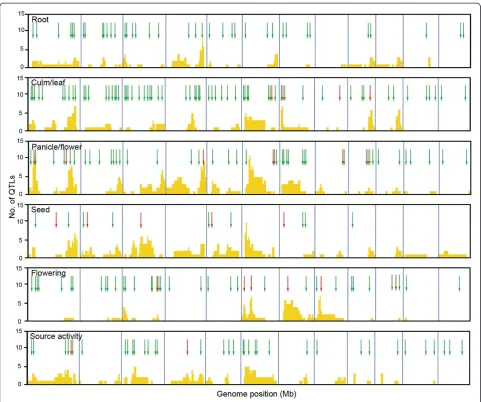
QTL analysis has been used extensively in rice to iden-tify the chromosomal locations and phenotypic con-tributions of QTLs, and this information has been compiled in two databases, Gramene-QTL database (Ni et al. 2009; http://www.gramene.org/qtl/) and Q-TARO (Yonemaru et al. 2010; http://qtaro.abr.affrc.go.jp/). The gene function information gathered in the present study was arranged to enable direct comparison with the QTL information (trait classification and genomic location) in Q-TARO (Table 1). We performed a genome-wide com-parison of the genomic locations of functionally charac-terized genes in several trait categories with those of the QTLs in Q-TARO (Figure 2). Because most of the genes functionally characterized by using natural variation were identified as genes responsible for QTLs, it was not unexpected to find that most of their genomic locations were included in QTL regions associated with those same traits (Figure 2). Moreover, the genomic locations of functionally characterized genes identified by mutant
and transgenic plant analysis also showed good
correspondence with QTL locations (Figure 2), indicat-ing that these genes are good candidates for the genes responsible for the QTLs. The increasing amount of in-formation on rice gene function will make the candidate gene approach for identifying genes responsible for QTLs even more powerful.
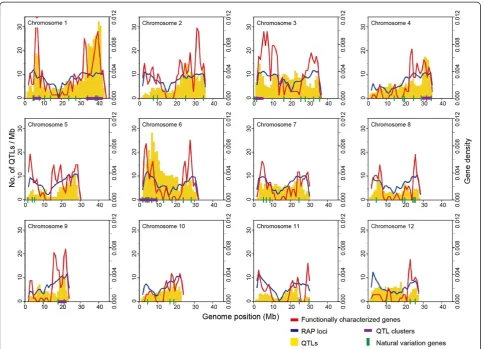
Understanding the cause of these QTL clusters is import-ant for designing breeding strategies. If QTL clusters con-tain tightly linked but distinct genes, as in these examples, the problem of linkage drag can be overcome by repeated crossing and careful marker-assisted selection to break the linkage between desirable and undesirable genes and to se-lect the ideal combination of alleles.
Public database of functionally characterized genes in rice
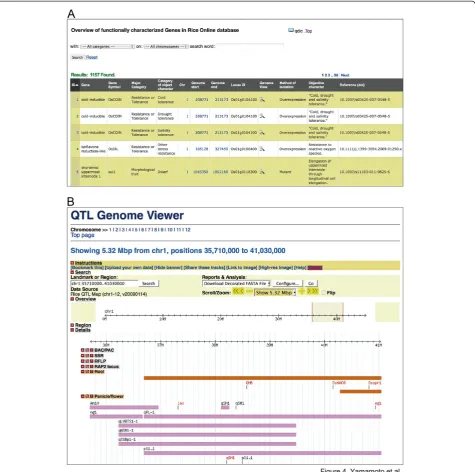
OGRO is available on the Q-TARO website (Figure 4; Yonemaru et al. 2010; http://qtaro.abr.affrc.go.jp/ogro). Figure 4A shows a screen shot of an information table
from the database. The desired information is displayed by selecting trait categories and chromosome locations from the drop-down boxes, or by specifying search text (Figure 4A, top). To view the genomic location of a target gene or to compare the genomic locations of genes and QTLs, the user can either specify the genomic location in the genome viewer or zoom in graphically (Figure 4B). By default, the loci are grouped by trait category, allowing the locations of genes and QTLs for each trait to be easily compared. Dragging and dropping of the horizontal infor-mation bars at the top of the window facilitates the com-parison of genes and QTLs in different trait categories.
Although recent advances in next-generation sequen-cing technologies have enabled re-sequensequen-cing of a large
number of rice genomes (Xu et al. 2011) as well as high-throughput genotyping and large-scale genetic variation surveys (McNally et al. 2009; Ebana et al. 2010; McCouch et al. 2010; Nagasaki et al. 2010; Yamamoto et al. 2010), analysis of gene function is still indispens-able both for understanding fundamental phenomena and for genomics-based breeding. Increasing numbers of mutant panels have been developed in rice, and their comprehensive analysis is ongoing (Chern et al. 2007). These experiments will provide additional information on gene function, which will be added to the database as it becomes available.
Conclusion
In this study, we comprehensively searched for articles related to rice functional genomics and extracted in-formation on 702 functionally characterized genes (Figure 1). The information on each gene was organized
to enable direct comparison with the QTL information in Q-TARO (Yonemaru et al. 2010; http://qtaro.abr.affrc. go.jp/), which will facilitate a candidate-gene approach to identifying the genes responsible for QTLs (Figure 2). Because the QTL descriptions in Q-TARO contain infor-mation on agronomic traits, such comparisons will also facilitate the annotation of functionally characterized genes in terms of their effects on traits important for rice breeding. We found that the genes responsible for QTLs in QTL clusters were identified as different genes (Figure 3). Considering this evidence along with the data showing co-localization of QTL clusters and high-density gene regions (Figure 3), our results suggest that many QTL clusters are caused by distinct but tightly linked genes. Information on the functionally charac-terized genes compiled in this study is now available in OGRO on the Q-TARO Web site (Figure 4; http:// qtaro.abr.affrc.go.jp/ogro). The increasing amount of
information on rice gene function being generated from mutant panels and other types of studies will make the OGRO database even more valuable in the future.
Methods
Extraction of gene information from published articles
Functional genomics studies have been done using many different approaches, and the degree of functional characterization differs substantially among genes. To
avoid ambiguity, we established two main criteria for functionally characterized genes in rice. The first was verification of function: gene function had to be demon-strated in rice through direct evidence based on comple-mentation tests, mutant analysis, or transgenic plant analysis. The second was verification of the phenotype: there had to be evidence that the function of the gene affected the phenotype of the rice plant. Functional
ana-lysis using other organisms such as yeast and
Arabidopsis was not counted as meeting this criterion because such experiments do not necessarily indicate that the gene has a biological role in rice.
Articles related to rice functional genomics were identi-fied by searching the Web of Science database (http://apps. webofknowledge.com/) with the search terms "rice" and "Oryza sativa". Because rice studies span a broad range of research fields, the following categories were surveyed: AGRICULTURE MULTIDISCIPLINARY, AGRONOMY,
BIOTECHNOLOGY & APPLIED MICROBIOLOGY,
CELL BIOLOGY, GENETICS & HEREDITY, MULTIDIS-CIPLINARY SCIENCES, and PLANT SCIENCES. To make this search comprehensive, the time span was set to "All" (i.e., all publications since 1899). As of 31 March 2012, we identified a total of 14 102 articles using these search conditions. All of the articles were then manually checked, and articles containing information on gene function that met our criteria for functionally characterized genes were selected. The result was a total of 707 articles. For each gene meeting the criteria for a functionally characterized gene, we extracted information including the gene locus ID, genome position, method of isolation, related traits, and reference information (doi) (Table 1). Whenever possible, the RAP ID number (Rice Annotation Project 2008; http:// rapdb.dna.affrc.go.jp/) was used as the gene locus ID number. If there was no corresponding ID in RAP, the Michigan State University (MSU) locus number (Yuan et al. 2005; http://rice.plantbiology.msu.edu/) or GenBank (http://www.ncbi.nlm.nih.gov/genbank/) acces-sion number was used. Information on genome position (start and end) was based on International Rice Genome Sequencing Project (IRGSP) Pseudomolecules build 4.0 (http://rgp.dna.affrc.go.jp/E/IRGSP/Build4/build4.html). The genome positions of genes not found in the reference genome (Oryza sativa L. ssp. japonica cv. Nipponbare) were indicated by using either a position adjacent to the deleted sequence or the positions of the flanking markers used for positional cloning. Under the method of isolation, "knockdown/overexpression" indicates that the genes were characterized by using both knockdown and overexpres-sion transgenic plants.
Comparison of genomic locations and densities between functionally characterized genes and QTLs
We compared the relative genome positions and distri-butions of functionally characterized genes and QTLs within each of the trait categories. The genome position of each functionally characterized gene was represented by the midpoint between the genome start and genome end positions (Table 1). The QTL information was extracted from Q-TARO (Yonemaru et al. 2010; http:// qtaro.abr.affrc.go.jp/).
We also performed comparisons across all of the trait categories between the density of functionally characterized
genes, the density of RAP loci and the number of QTLs. The density of functionally characterized genes or RAP loci at each point in the genome was expressed as the propor-tion of the total number of genes (loci) contained within the surrounding 1-Mb block, calculated by using a window size of 2 Mb. The number of QTLs was counted within every 1-Mb block along the genome sequence.
Database construction
All data on the functionally characterized genes annotated in this study were compiled in OGRO (http://qtaro.abr. affrc.go.jp/ogro). Like Q-TARO (Yonemaru et al. 2010; http://qtaro.abr.affrc.go.jp/), OGRO consists of two Web applications: a gene information table and a genome viewer. The Web applications were implemented as Perl scripts and CGI modules. The database was constructed using MySQL, a relational database management system. We used the GBrowse viewer (http://gmod.org/wiki/ Main_Page), which was configured to access OGRO from within the Q-TARO genome viewer.
Competing interests
The authors declare that they have no competing interests.
Authors’contributions
All four authors designed and performed the research, and wrote and approved the manuscript.
Authors' information
EY, JY, TY: National Institute of Agrobiological Sciences, 2-1-2 Kannondai, Tsukuba, Ibaraki 305–8602, Japan. MY: National Institute of Agrobiological Sciences, 1–2 Ohwashi, Tsukuba, Ibaraki 305–8634, Japan.
Acknowledgements
We thank the staff of the Rice Applied Genomics Research Unit,
Agrogenomics Research Center, National Institute of Agrobiological Sciences, for data checking. We also thank H. Minami, N. Namiki, and S. Takeshita for construction of the Web-based interfaces for the database. This work was supported by grants from the Program for Promotion of Basic and Applied Researches for Innovations in Bio-oriented Industry, Japan, and from the Ministry of Agriculture, Forestry and Fisheries of Japan (Genomics for Agricultural Innovation, GIR1003).
Author details
1National Institute of Agrobiological Sciences, 2-1-2 Kannondai, Tsukuba,
Ibaraki 305-8602, Japan.2National Institute of Agrobiological Sciences, 1-2 Ohwashi, Tsukuba, Ibaraki 305-8634, Japan.
Received: 14 May 2012 Accepted: 13 September 2012 Published: 24 September 2012
References
Abbasi F, Onodera H, Toki S, Tanaka H, Komatsu S (2004) OsCDPK13, a calcium-dependent protein kinase gene from rice, is induced by cold and gibberellin in rice leaf sheath. Plant Mol Biol 55:541–552
Chen J, Ding J, Ouyang Y, Du H, Yang J, Cheng K, Zhao J, Qiu S, Zhang X, Yao J, Liu K, Wang L, Xu C, Li X, Xue Y, Xia M, Ji Q, Lu J, Xu M, Zhang Q (2008) A triallelic system of S5 is a major regulator of the reproductive barrier and compatibility of indica-japonica hybrids in rice. Proc Natl Acad Sci USA 105:11436–11441
Cheng Z, Buell CR, Wing RA, Gu M, Jiang J (2001) Toward a cytological characterization of the rice genome. Genome Res 11:2133–2141
study-phenotype scoring and seed propagation of a T-DNA insertion-induced rice mutant population. Plant Mol Biol 65:427–438
Ebana K, Yonemaru JI, Fukuoka S, Iwata H, Kanamori H, Namiki N, Nagasaki H, Yano M (2010) Genetic structure revealed by a whole-genome single-nucleotide polymorphism survey of diverse accessions of cultivated Asian rice (Oryza sativaL.). Breed Sci 60:390–397
Ehrenreich IM, Hanzawa Y, Chou L, Roe JL, Kover PX, Purugganan MD (2009) Candidate gene association mapping of Arabidopsis flowering time. Genetics 183:325–335
Emanuelli F, Battilana J, Costantini L, Le Cunff L, Boursiquot JM, This P, Grando MS (2010) A candidate gene association study on muscat flavor in grapevine (Vitis viniferaL.). BMC Plant Biol 10:241
Fukuoka S, Nonoue Y, Yano M (2010) Germplasm enhancement by developing advanced plant materials from diverse rice accessions. Breed Sci 60:509–517 Fukuoka S, Saka N, Koga H, Ono K, Shimizu T, Ebana K, Hayashi N, Takahashi A,
Hirochika H, Okuno K, Yano M (2009) Loss of function of a proline-containing protein confers durable disease resistance in rice. Science 325:998–1001 Gao P, Bai X, Yang L, Lv D, Li Y, Cai H, Ji W, Guo D, Zhu Y (2010) Over-expression
ofosa-MIR396cdecreases salt and alkali stress tolerance. Planta 231: 991–1001
Gao P, Bai X, Yang L, Lv D, Pan X, Li Y, Cai H, Ji W, Chen Q, Zhu Y (2011a) osa-MIR393: a salinity- and alkaline stress-related microRNA gene. Mol Biol Rep 38:237–242
Gao Z, Zeng D, Cheng F, Tian Z, Guo L, Su Y, Yan M, Jiang H, Dong G, Huang Y, Han B, Li J, Qian Q (2011b)ALK, the key gene for gelatinization temperature, is a modifier gene for gel consistency in rice. J Integr Plant Biol 53:756–765 Goff SA, Ricke D, Lan TH, Presting G, Wang R, Dunn M, Glazebrook J, Sessions A,
Oeller P, Varma H, Hadley D, Hutchison D, Martin C, Katagiri F, Lange BM, Moughamer T, Xia Y, Budworth P, Zhong J, Miguel T, Paszkowski U, Zhang S, Colbert M, Sun WL, Chen L, Cooper B, Park S, Wood TC, Mao L, Quail P et al (2002) A draft sequence of the rice genome (Oryza sativaL. ssp.japonica). Science 296:92–100
Griffiths-Jones S, Saini HK, van Dongen S, Enright AJ (2008) miRBase: tools for microRNA genomics. Nucleic Acids Res 36(Database issue):D154–D158 Hattori Y, Nagai K, Furukawa S, Song XJ, Kawano R, Sakakibara H, Wu J,
Matsumoto T, Yoshimura A, Kitano H, Matsuoka M, Mori H, Ashikari M (2009) The ethylene response factors SNORKEL1 and SNORKEL2 allow rice to adapt to deep water. Nature 460:1026–1030
Hiei Y, Komari T (2008)Agrobacterium-mediated transformation of rice using immature embryos or calli induced from mature seed. Nat Protoc 3:824–834 International Rice Genome Sequencing Project (2005) The map-based sequence
of the rice genome. Nature 436:793–800
Jiang Y, Cai Z, Xie W, Long T, Yu H, Zhang Q (2011) Rice functional genomics research: Progress and implications for crop genetic improvement. Biotechnol Adv. doi:10.1016/j.biotechadv.2011.08.013
Jiao Y, Wang Y, Xue D, Wang J, Yan M, Liu G, Dong G, Zeng D, Lu Z, Zhu X, Qian Q, Li J (2010) Regulation ofOsSPL14by OsmiR156 defines ideal plant architecture in rice. Nat Genet 42:541–544
Kasajima I, Ebana K, Yamamoto T, Takahara K, Yano M, Kawai-Yamada M, Uchimiya H (2011) Molecular distinction in genetic regulation of nonphotochemical quenching in rice. Proc Natl Acad Sci USA 108:13835–13840
Kojima S, Takahashi Y, Kobayashi Y, Monna L, Sasaki T, Araki T, Yano M (2002)
Hd3a, a rice ortholog of the ArabidopsisFTgene, promotes transition to flowering downstream ofHd1under short-day conditions. Plant Cell Physiol 43:1096–1105
Konishi S, Izawa T, Lin SY, Ebana K, Fukuta Y, Sasaki T, Yano M (2006) An SNP caused loss of seed shattering during rice domestication. Science 312: 1392–1396
Kurata N, Yamazaki Y (2006) Oryzabase. An integrated biological and genome information database for rice. Plant Physiol 140:12–17
Lamesch P, Berardini TZ, Li D, Swarbreck D, Wilks C, Sasidharan R, Muller R, Dreher K, Alexander DL, Garcia-Hernandez M, Karthikeyan AS, Lee CH, Nelson WD, Ploetz L, Singh S, Wensel A, Huala E (2012) The Arabidopsis Information Resource (TAIR): improved gene annotation and new tools. Nucleic Acids Res 40(Database issue):D1202–1210
Li X, Wang X, He K, Ma Y, Su N, He H, Stolc V, Tongprasit W, Jin W, Jiang J, Terzaghi W, Li S, Deng XW (2008) High-resolution mapping of epigenetic modifications of the rice genome uncovers interplay between DNA methylation, histone methylation, and gene expression. Plant Cell 20:259–276
Lin F, Chen S, Que Z, Wang L, Liu X, Pan Q (2007) The blast resistance genePi37
encodes a nucleotide binding site leucine-rich repeat protein and is a member of a resistance gene cluster on rice chromosome 1. Genetics 177:1871–1880
McCouch SR, Zhao K, Wright M, Tung CW, Ebana K, Thomson M, Reynolds A, Wang D, DeClerck G, Ali Md L, McClung A, Eizenga G, Bustamante C (2010) Development of genome-wide SNP assays for rice. Breed Sci
60:524–535
McNally KL, Childs KL, Bohnert R, Davidson RM, Zhao K, Ulat VJ, Zeller G, Clark RM, Hoen DR, Bureau TE, Stokowski R, Ballinger DG, Frazer KA, Cox DR, Padhukasahasram B, Bustamante CD, Weigel D, Mackill DJ, Bruskiewich RM, Rätsch G, Buell CR, Leung H, Leach JE (2009) Genomewide SNP variation reveals relationships among landraces and modern varieties of rice. Proc Natl Acad Sci USA 106:12273–12278
Miura K, Ashikari M, Matsuoka M (2011) The role of QTLs in the breeding of high-yielding rice. Trends Plant Sci 16:319–326
Miura K, Ikeda M, Matsubara A, Song XJ, Ito M, Asano K, Matsuoka M, Kitano H, Ashikari M (2010)OsSPL14promotes panicle branching and higher grain productivity in rice. Nat Genet 42:545–549
Miyao A, Iwasaki Y, Kitano H, Itoh J, Maekawa M, Murata K, Yatou O, Nagato Y, Hirochika H (2007) A large-scale collection of phenotypic data describing an insertional mutant population to facilitate functional analysis of rice genes. Plant Mol Biol 63:625–635
Mizuta Y, Harushima Y, Kurata N (2010) Rice pollen hybrid incompatibility caused by reciprocal gene loss of duplicated genes. Proc Natl Acad Sci USA 107:20417–20422
Nagamura Y, Antonio BA (2010) Current status of rice informatics resources and breeding applications. Breed Sci 60:549–555
Nagasaki H, Ebana K, Shibaya T, Yonemaru JI, Yano M (2010) Core single-nucleotide polymorphisms—a tool for genetic analysis of the Japanese rice population. Breed Sci 60:648–655
Nakashima K, Tran LS, Van Nguyen D, Fujita M, Maruyama K, Todaka D, Ito Y, Hayashi N, Shinozaki K, Yamaguchi-Shinozaki K (2007) Functional analysis of a NAC-type transcription factor OsNAC6 involved in abiotic and biotic stress-responsive gene expression in rice. Plant J 51:617–630
Ni J, Pujar A, Youens-Clark K, Yap I, Jaiswal P, Tecle I, Tung CW, Ren L, Spooner W, Wei X, Avraham S, Ware D, Stein L, McCouch S (2009) Gramene QTL database: development, content and applications. Database 2009:bap005
Ookawa T, Hobo T, Yano M, Murata K, Ando T, Miura H, Asano K, Ochiai Y, Ikeda M, Nishitani R, Ebitani T, Ozaki H, Angeles ER, Hirasawa T, Matsuoka M (2010) New approach for rice improvement using a pleiotropic QTL gene for lodging resistance and yield. Nat Commun 1:132. doi:10.1038/ncomms1132 Qu S, Liu G, Zhou B, Bellizzi M, Zeng L, Dai L, Han B, Wang GL (2005) The
broad-spectrum blast resistance genePi9encodes a nucleotide-binding site– leucine-rich repeat protein and is a member of a multigene family in rice. Genetics 172:1901–1914
Rice Annotation Project (2008) The Rice Annotation Project Database (RAP-DB): 2008 update. Nucleic Acids Res 36(Database issue):D1028–1033
Sasaki A, Ashikari M, Ueguchi-Tanaka M, Itoh H, Nishimura A, Swapan D, Ishiyama K, Saito T, Kobayashi M, Khush GS, Kitano H, Matsuoka M (2002) Green revolution: a mutant gibberellin-synthesis gene in rice. Nature 416:701–702
Shomura A, Izawa T, Ebana K, Ebitani T, Kanegae H, Konishi S, Yano M (2008) Deletion in a gene associated with grain size increased yields during rice domestication. Nat Genet 40:1023–1028
Wang ZY, Zheng FQ, Shen GZ, Gao JP, Snustad DP, Li MG, Zhang JL, Hong MM (1995) The amylose content in rice endosperm is related to the post-transcriptional regulation of thewaxygene. Plant J 7:613–622
Weng J, Gu S, Wan X, Gao H, Guo T, Su N, Lei C, Zhang X, Cheng Z, Guo X, Wang J, Jiang L, Zhai H, Wan J (2008) Isolation and initial characterization ofGW5, a major QTL associated with rice grain width and weight. Cell Res
18:1199–1209
Xie K, Wu C, Xiong L (2006) Genomic organization, differential expression, and interaction of SQUAMOSA promoter-binding-like transcription factors and microRNA156 in rice. Plant Physiol 142:280–293
Xing Y, Zhang Q (2010) Genetic and molecular bases of rice yield. Annu Rev Plant Biol 61:421–442
Xu X, Liu X, Ge S, Jensen JD, Hu F, Li X, Dong Y, Gutenkunst RN, Fang L, Huang L, Li J, He W, Zhang G, Zheng X, Zhang F, Li Y, Yu C, Kristiansen K, Zhang X, Wang J, Wright M, McCouch S, Nielsen R, Wang J, Wang W (2011) Resequencing 50 accessions of cultivated and wild rice yields markers for identifying agronomically important genes. Nat Biotechnol 30:105–111 Yamamoto T, Nagasaki H, Yonemaru J, Ebana K, Nakajima M, Shibaya T, Yano M
(2010) Fine definition of the pedigree haplotypes of closely related rice cultivars by means of genome-wide discovery of single-nucleotide polymorphisms. BMC Genomics 11:267
Yamamoto T, Yonemaru J, Yano M (2009) Towards the understanding of complex traits in rice: substantially or superficially? DNA Res 16:141–154 Yano M, Katayose Y, Ashikari M, Yamanouchi U, Monna L, Fuse T, Baba T,
Yamamoto K, Umehara Y, Nagamura Y, Sasaki T (2000)Hd1, a major photoperiod sensitivity quantitative trait locus in rice, is closely related to the Arabidopsis flowering time geneCONSTANS. Plant Cell 12:2473–2484 Ye H, Du H, Tang N, Li X, Xiong L (2009) Identification and expression profiling
analysis of TIFY family genes involved in stress and phytohormone responses in rice. Plant Mol Biol 71:291–305
Yonemaru JI, Yamamoto T, Fukuoka S, Uga Y, Hori K, Yano M (2010) Q-TARO: QTL Annotation Rice Online Database. Rice 3:194–203
Youens-Clark K, Buckler E, Casstevens T, Chen C, Declerck G, Derwent P, Dharmawardhana P, Jaiswal P, Kersey P, Karthikeyan AS, Lu J, McCouch SR, Ren L, Spooner W, Stein JC, Thomason J, Wei S, Ware D (2011) Gramene database in 2010: updates and extensions. Nucleic Acids Res 39:D1085–1094 Yu J, Hu S, Wang J, Wong GK, Li S, Liu B, Deng Y, Dai L, Zhou Y, Zhang X, Cao M, Liu J, Sun J, Tang J, Chen Y, Huang X, Lin W, Ye C, Tong W, Cong L, Geng J, Han Y, Li L, Li W, Hu G, Huang X, Li W, Li J, Liu Z, Li L et al (2002) A draft sequence of the rice genome (Oryza sativaL. ssp.indica). Science 296:79–92 Yuan Q, Ouyang S, Wang A, Zhu W, Maiti R, Lin H, Hamilton J, Haas B, Sultana R, Cheung F, Wortman J, Buell CR (2005) The Institute for Genomic Research Osa1 rice genome annotation database. Plant Physiol 138:18–26
Zhao K, Tung CW, Eizenga GC, Wright MH, Ali ML, Price AH, Norton GJ, Islam MR, Reynolds A, Mezey J, McClung AM, Bustamante CD, McCouch SR (2011) Genome-wide association mapping reveals a rich genetic architecture of complex traits inOryza sativa. Nat Commun 2:467. doi:10.1038/ncomms1467 Zhou B, Qu S, Liu G, Dolan M, Sakai H, Lu G, Bellizzi M, Wang GL (2006) The eight
amino-acid differences within three leucine-rich repeats between Pi2 and Piz-t resistance proteins determine the resistance specificity toMagnaporthe grisea. Mol Plant Microbe Interact 19:1216–1228
Zhu QH, Upadhyaya NM, Gubler F, Helliwell CA (2009) Over-expression of miR172 causes loss of spikelet determinacy and floral organ abnormalities in rice (Oryza sativa). BMC Plant Biol 9:149
doi:10.1186/1939-8433-5-26
Cite this article as:Yamamotoet al.:OGRO: The Overview of functionally characterized Genes in Rice online database.Rice20125:26.
Submit your manuscript to a
journal and benefi t from:
7Convenient online submission
7Rigorous peer review
7Immediate publication on acceptance
7Open access: articles freely available online
7High visibility within the fi eld
7Retaining the copyright to your article