R E S E A R C H
Open Access
Estimation of conservation value of myrtle
(
Myrtus communis
) using a contingent
valuation method: a case study in a Dooreh
forest area, Lorestan Province, Iran
Neda Amiri
1*, Seyed F. Emadian
2, Asghar Fallah
3, Kamran Adeli
4and Hamid Amirnejad
5Abstract
Background:Around 2000 plant species occur naturally in Lorestan Province of which 250 species are medicinal and myrtle is one of them. Myrtle is a shrub whose leaves and fruits have medicinal value and thus, if managed and harvested properly, could produce sustained economic benefits. In recent years, however, over half of the myrtle site areas was destroyed, due to inappropriate management and excessive harvesting practices. Thus, coming up with a practical harvesting approach along with identifying those factors damaging the sites, seems to be very crucial. Methods:In our investigation, we calculated the conservation value per hectare of myrtle in the Dooreh forest area in Lorestan Province. Using the Contingent Valuation (CV) and Double Bounded Dichotomous Choice (DBDC) methods, we determined the willingness to pay (WTP) for myrtle conservation. The WTP was estimated with a logit model for which indices were obtained based on a maximum precision criterion.
Results:The results showed that 86.67 per cent of people were willing to pay for the conservation of these myrtle sites. Average monthly WTP per family was calculated as $0.79. The annual conservation value in terms of WTP for the preservation of the myrtle sites in Dooreh was estimated as $102,525. Among the variables of the model presented, education had a positive impact, while the amount proposed for payment and family size had a negative impact on the WTP.
Conclusions:Our estimate of the value of myrtle conservation should provide justification for policy makers and decision making bodies of natural resources to implement policies in order to conserve the natural sites of this species more effectively.
Keywords:Conservation value, Myrtle, Contingent valuation method, Double Bounded Dichotomous method, Logit model
Background
Non-timber forest products are goods of biological ori-gin other than timber, derived from forests, other wooded areas and trees outside forests (FAO Forestry 1999). In this context non-timber forest products in-clude all kinds of animals, resin, tannin, medicinal and industrial plants and non-food products including mate-rials or plant parts having medicinal properties, are ed-ible and of industrial use (Noubissie et al. 2008). In recent years, issues related to non-timber forest
products, particularly the conservation of their natural habitat as well as their production, has attracted consid-erable interest in the world. The main reasons are the role of these products in providing livelihood and food for rural communities in order to reduce poverty along with supporting various environmental goals such as conservation of biodiversity (FAO Forestry 1999). Non-timber forest products (NTFPs) are accepted as a verit-able means of achieving poverty alleviation because of their role in sustaining this livelihood, for food security and environmental objectives such as biodiversity con-servation (FAO Forestry 1999).
* Correspondence:[email protected]
1Department of Forestry, Sari Agricultural and Natural Resource University, Sari, Iran
Full list of author information is available at the end of the article
Valuation of NTFPs has received a great deal of atten-tion (Lindal 1994). Many attempts have been made to value these non-marketed forest products to their full extent, especially the NTFPs. Extraction and increased trade of NTFPs has been advocated as an alternative to timber-focused utilization on the grounds that it could be pursued without causing tropical deforestation. Con-sequently, NTFPs are thought to be capable of playing a constructive role in forest conservation and develop-ment. This assumes that their harvest, even at a com-mercial level, would have little or no adverse ecological impact on a forest. This can be questioned, however, since the impact on the forest ecosystem of an increase in harvesting NTFPs is not fully known (Gunatilake et al. 2006; Peters 1994). Lescuyer (1996) argues that the estab-lishment of a monetary value for each NTFPs leads to a change in the modes of use of the resource which, in turn, can cause or accelerate a process of restrictive appropri-ation of these resources. In many parts of the world, NTFPs provide off-farm employment to a large part of the rural population and accounts for a considerable share of household income. These resources are essential, espe-cially for the rural poor and women, and may, in some cases, provide them with the only source of personal in-come (Rodda 1991; Falconer 1996). But economic prob-lems may sometimes result in increasing the harvest of those NTFPs that have higher values, particularly those that can be sold on the international market. This is the kind of situation that may sometimes result in very high costs in terms of damage to forest ecosystems (Kengen 1997).
Conservation valuation seeks to create awareness about the need for decisions to optimize the economic management of resources and assists the development of a strategy for sustainable development in a region. Valu-ation of environmental services and functions is import-ant for a number of reasons, such as: 1) recognizing and understanding of environmental and ecological interests by humans, 2) providing environmental issues to deci-sion makers and country planning experts and 3) provid-ing the link between economic policies and income derived from natural resources.
Economic valuation of natural and environmental re-sources includes two categories, i.e., use values and non-use values (Pearce and Pearce 2001; Molaei 2009). Use values are associated with the consumption of products, while non-use values are related to enhancement of their utility to people without direct consumption of the products. Non-use values which reflect the concept of conservation consist of existence values, bequest values and option values. Existence value refers to the intrinsic value of a resource, even if people have never seen or used the resource (Torras 2000). Bequest value or future generation value is the desirability resulting from
knowledge in preserving natural resources for future generations (Pearce and Pearce 2001). Option value measures the preference of individuals to preserve nat-ural resources for possible future use (Lee and Han 2002). Alternatively, existence value can be considered the willingness of a society to pay for the conservation of natural resources, bequest value may be understood as the willingness to pay (WTP) for conservation of re-sources for the benefit of future generations, while op-tion value can be defined as the willingness of society to pay for the conservation of resources for possible future use (Lee and Han 2002).
Researchers have attempted to estimate forest conser-vation values using various approaches. For example, Echeverria et al. (1995) estimated the value of existence benefits in Costa Rica’s forests, based on a Contingent Valuation (CV) method and came up with a value of $238 per hectare of forest per year. Lehtonen et al. (2003) estimated the average conservation value of forests in southern Finland in terms of the willingness to pay at $23.80 per household per year, using CV in con-junction with Double Bounded Dichotomous question-naires and a logit regression model. In another study, Leong et al. (2005) studied the conservation value of forests in mountainous areas of Malaysia and estimated conservation values ranging from 20 to 27 Ringgits per individual respondent. Gurluk (2006) used a Contingent Valuation approach to study the value of ecosystem ser-vices in a region in Turkey and estimated it at $76.94 per year per household. Tao et al. (2012), also using a CV method, estimated the annual household willingness to pay for conservation of Heshui forest ecosystems in China’s Jiangshi Province at 238 Yuan per year. Molaei in (2009) used a Contingent Valuation method to assess the conservation value of Arasbaran forest ecosystems and showed that 81.7 % of the people from this area were willing to pay some money for conservation of the forest ecosystem. They estimated the annual WTP for the conservation of these forest ecosystems at about $3.31 per household and $197.321 per hectare of forest land. Peron and Esmaeili (2010) used the Contingent Valuation approach to estimate the conservation value of mangrove forests in Hormozgan province in Iran and found that 92 % of the respondents were willing to pay some money to conserve these mangrove forests. They estimated the average conservation value per individual at $12.65 and at $76.94 per hectare of forest.
Nigeria and concluded that people were willing to pay $55.40 for conservation of their forest for non-timber for-est products. Khosravi and Sabouhi (2011), used the same method to estimate the annual conservation value for all tamarisk trees in the Fahliyan riparian area in province of Fars in Iran at $4588. In the same study they estimated the monthly conservation value of each tamarisk tree at $0.163. Molaei and Kavousi Kelashmi (2011) using the same technique, but with a One-Half Bound format, estimated the conservation value of the chandelier lily at $0.192 based on a linear model and $0.285 with a logarithmic model.
Our investigation dealt with myrtle (Myrtus communis
L.) forest sites in Dooreh, a city in Lorestan Province, Iran. Myrtle, as a non-timber forest product, is an ever-green medicinal plant. It belongs to the family Myrta-ceae and is found naturally in many parts of the province. This valuable shrub forms dense populations at low elevations at some of its natural habitats. Given its ability to grow and develop in some unfavorable cir-cumstances, such as warm climates, myrtle is one of those plants that plays a significant role in the conserva-tion of its environmental habitat. This plant contains two important volatile oil substances, i.e., Myrtenol and Depantyn, which are very valuable to the pharmaceut-ical industry and thus, potentially myrtle can play an important role in the local economy (Makkizadeh Tafti et al. 2006). As well, this species, is of importance in maintaining environmental sustainability in semiarid re-gions. Because of its evergreen features it helps to make the landscape more attractive and aids the restoration of natural ecosystems (Salehnia 2008).
Unfortunately, due to excessive harvesting, dense nat-ural stands of myrtle are nonexistent. However, reforest-ation and afforestreforest-ation of this plant have been proposed as feasible options. These are effective strategies to in-crease employment, support the regional pharmaceutical industry and increase family incomes in the community (Mirabad et al. 2011). The Khorraman Pharmaceutical Company is operating as a monopoly for it is the only pharmaceutical industry in the province that uses myrtle oil extracts to produce herbal medicines such as Belfarol, Myrtol, Rectol and Aphtoplex. Each year, an average of nearly 120 t of myrtle is harvested by rural people in the region and sold to this company, resulting in a signifi-cant increase in the income of rural households, accounting for 63.38 per cent of their total monthly in-come during the harvest months (Amiri 2013). Frequent and excessive harvesting of myrtle shrubs by villagers, without training and knowledge of the species and its proper harvesting operation, inflict a great deal of dam-age on the habitat of this species (Amiri, 2013). This is consistent with the earlier findings by Karimi (2012), who reported that nearly half of the myrtle habitat was
destroyed or converted into agricultural lands and the remaining half showed a dramatic decline in productiv-ity. Overall, observations on the distribution of myrtle in Dooreh and interviews conducted with local people, have shown that the most important factors contributing to the destruction of the myrtle forest sites in order of importance are: 1) a lack of sound management prac-tices and/or management incompetence, 2) excessive harvesting practices by the Khorraman Pharmaceutical Company to produce herbal medicines, 3) excessive har-vesting practices and management by villagers for per-sonal consumption and burning of myrtle habitats for the purpose of changing myrtle sites into agricultural land, 4) improper harvest operations by unskilled indi-viduals, 5) lack of expertise in conservation of myrtle forests and their management, 6) weather condition in recent years and 7) excessive harvesting of myrtle branches for feeding livestock (Amiri 2013) (Fig. 1).
The purpose of our study was to estimate the conser-vation value of the myrtle habitat in Dooreh in order to provide the means and justification for forest policy makers and managers to support conservation of the habitat of this species and to stop its current horrifying destruction. Clearly, due to its various benefits, more at-tention need to be devoted and resources allocated to restore these damaged and destroyed myrtle habitats.
Methods
The study area
Our investigation was conducted in a single stand of myrtle located in Dooreh, Lorestan province. The city is located in the western part of the province, 36 km from the provincial capital, Khorramabad, at longitude 48°02’17”and latitude 33°39’56”, at an elevation of 1118 m (Fig. 2).
Contingent valuation method
We used a Contingent Valuation method (CVM) to esti-mate the conservation value of myrtle forests in the Dooreh area. In this method a hypothetical market is assumed in which contingent questionnaires are distrib-uted among respondents and completed in their pres-ence or delivered by mail. The respondents are asked about their Willingness to Pay (WTP) for the quality and level of improvement of environmental products, or about their Willingness to Accept (WTA) a loss from inflicting damage to their resources (Bohm 1972; Dahlberg 1974; Hanemann 1991; Bateman & Willis 1999).
modified and adjusted the Double- bounded Choice and proposed a Double- bounded Dichotomous Choice (DDC) method. This method requires determining one higher price proposed for the respondents in addition to the initially lower price proposal. Proposing the higher price depends on the initial responses or to their feed-back on the initially proposed lower price (Venkatacha-lam 2003).
The first section of the questionnaire contained ques-tions regarding socio-economic aspects of individual re-spondents, such as age, gender, occupation, education, place of residence, family size, income and membership in environmental organizations. The main questions, re-lating the WTP on the part of the respondents for con-servation of myrtle in Dooreh, i.e., those related to the acceptance or rejection of the bids for willingness to pay, were introduced in a Double- bounded Dichotomous
Choice format. Forty questionnaires were initially completed in which open questions, without any pro-posed prices for willingness to pay, were asked. Thus, ac-cording to the preliminary information obtained from these questionnaires, the proposed prices were deter-mined as 20,000 Rials for the main bid, 10,000 Rials for the lower and 30,000 Rials for the upper bid.
In order to derive the model for estimating WTP, it was assumed that the individual respondent either ac-cepted the proposed price for conservation value to maximize his utility as described below (Eq. 1) or, alter-natively, rejected it (Hanemann 1984).
U 1ð ; Y−A;SÞ þ∈1≥U 0ð ; Y;SÞ þ∈0 ð1Þ
Where U is respondent, Y his/her income, A the proposed price, S the socio-economic features affected Fig. 1Two contrasting myrtle habitats (a) healthy (b) damaged
by his/her taste and∈1,∈0are independent random
var-iables with a zero mean. The utility difference (ΔU) due to using an environmental resource, is described as fol-lows (Eq. 2):
ΔU¼Uð1; Y−A;SÞ−Uð0; Y;SÞ þð∈1−∈0Þ ð2Þ
ΔU > 0 implies the respondent maximizes his or her util-ity by saying“yes”and would agree to pay the amount for conservation of the myrtle (Park and Loomis 1996). The format of the double bounded questionnaire in CVM has a dependent variable with dual choice, which requires a qualitative choice model. In general, for studying regres-sion models with a dual choice dependent variable, linear probability models, logit, probit and Tobit models are used (Nakhaei 1389). To investigate the effect of descriptive var-iables, such as economic and social factors, on the WTP, we used a logit regression model. The probability (Pi) that
the individual accepts an offer (A) based on the logit model, can be expressed as follows (Lee and Han 2002):
Pi¼FnðΔUÞ
1 1þ expð−ΔUÞ
¼ 1
1þ expf−ðα−βAþγYþθSÞg
ð3Þ
Where Fn(ΔU) is the cumulative distribution function
with one standard logistic difference including some of the socio-economic factors. The coefficients θ, γ, β are estimates where θ and γ> 0 and β≤0. (Lee and Han 2002). The expected WTP was calculated using logit models by actually integer numbers between 0 and the highest proposed value (Lehtonen et al., 2003). We opted for this method because it maintained the stability and compatibility of theoretical constraints, statistical ef-ficiency and congregate ability (White and Lovett 1999).
The logit model utilizes maximum likelihood specifica-tions and is the most common technique for estimating expected WTP (Piriet al., 2009). This was calculated by integer numbers between 0 and the highest proposed value: (Eq. 4).
E W TPð Þ ¼
Z MaxA
0
FnðΔUÞdA
¼ Z MaxA
0
1
1þ exp½−αþβA dA ð4Þ
Where E (WTP) is the expected amount of WTP and α*
(see Eq. 5) the interception adjustment value, added to the main interception (α) value, estimated after socio-economic variables were inserted in the logit model.
α¼ αþγ
YþθS
ð Þ ð5Þ
Logit models may be developed as either linear or semi-logarithmic functions in order to estimate both use and conservation values. In the former model, the prob-ability of accepting the proposed price is merely a func-tion of the proposed price itself. However, in the latter model, the probability is a function of the proposed rela-tive price over income for simplicity and convenience in computation, we used a linear logit model to compute the mean WTP (Molaei and Kavousi Kelashmi 2011).
To estimate the conservation value of the myrtle habi-tat, selected households from both urban and rural com-munities of Dooreh were asked to participate as part of our sample population. The required sample size for simple random sampling was calculated (Cochran 1977) for the 95 % confidence interval with an allowed error of 4 % (Eq. 6). This resulted in a sample size of 270. How-ever, to enhance accuracy, the number of household sampled in the area and participated in our study was increased to 300 (Eq. 6).
n¼t
2s2
d2 ¼ 1:96 ð Þ2
0:335 ð Þ2
0:04
ð Þ2 ¼269:45≃270 ð6Þ
where nis the number of samples; tis Student’stvalue for 95 % confidence interval, s2 is the sample variance anddis the allowed sampling error. Our interviews were focused on individuals who were independent in terms of income and when faced with the proposed amount, were able to make a decision easily. For the purpose of statistical analysis and mathematical calculations the pa-rameters required for the logit model, we used SHA-ZAM and Excel.
Results
Socio-economic status of respondents
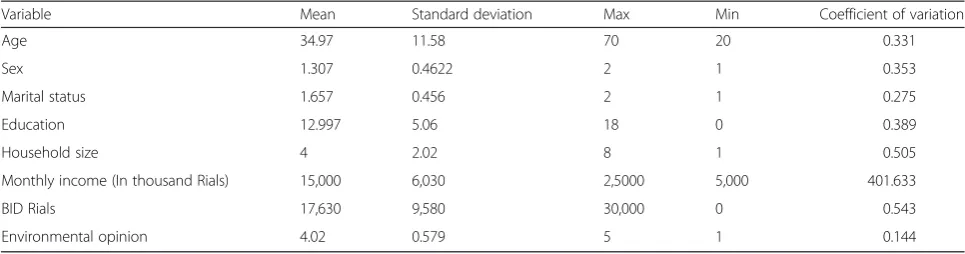
Descriptive statistics of the socio-economic characteris-tics of the respondents are presented in Table 1. Of the total number of respondents, 208 (69.33 %) were male and 92 (30.67 %) were female. As this table shows the average age was 35 years, the number of years of educa-tion was 13, the average size of the household consisted of 4 people with a monthly household income of 15,000 Rials ($.44), the proposed bid was 17,630 Rials ($.52) and the environmental opinion was around 4.
Conservation value of Myrtle
Out of 300 respondents, 260 (86.67 %) were willing to pay something for the conservation of Myrtle habitats of Dooreh, while the other 40 (13.33 %) were not interested to pay anything (Table 2).
than 10,000 Rials ($0.29) and the remaining 40 individ-uals were not willing to pay anything.
Of the 193 people who had accepted the first offer of 20,000 Rials ($0.59), 120 rejected the 30,000 Rials ($0.88) bid and the rest agreed to pay 30,000 Rials ($0.88).
Out of 73 persons who had accepted the first offer of 30,000 Rials ($0.88), 19 were willing to pay up to 50,000 Rials ($1.47), 15 people agreed to pay the maximum bid of 100,000 Rials ($2.94), 14 persons were willing to pay a maximum amount of 150,000 Rials ($4.41) and only four respondents showed a willingness to pay up to 200,000 Rials ($5.88). The remaining 21 individuals did not want to exceed 30,000 Rials.
Forty of the respondents were not willing to pay for myrtle habitat conservation. When asked for their lack of interest, 60 per cent believed that it should be the respon-sibility of the government, not of individuals (Table 3).
The logit regression method provided the following model for the conservation value of the Dooreh myrtle forest:
WTP¼α0þα1x1þα2x2þα3x3þα4x4þei ð7Þ
where WTPi is the willingness of respondentito pay,x1
represents education (0 for illiterate, 10 for below dip-loma, 12 for dipdip-loma, 14 for post diploma degree, 16 for bachelor degree, 18 for master degree and above) ;x2is
household size, x3household income in thousand Rials
5,000 ($0.15), 7,500 ($0.22), 12,500 ($0.37), 17,500 ($0.51), 22,500 ($0.67), 25,000 ($0.73)) andx4represents
the bids in Rials (0, 10,000 ($0.29), 20,000 ($0.59), 30,000 ($0.88)).
Table 4 shows the estimated coefficients, levels of stat-istical significance and the effect of descriptive variables of the logit model on the dependent variable (based on maximum likelihood estimation). In arriving at the final logit model those variables, not statistically significant but with coefficients of the expected sign, were elimi-nated in order to obtain a more accurate model (Table 4). In the end, we obtained the following model:
WTP ¼ 1:970 þ 0:049 E–0:581 HS þ 0:003 I–0:002 SD
ð8Þ
In this equation E is education, HS is Household Size, I is Income and SD is Suggested Donation.
The results also show that variables such as price, in-come and household size were effective in accepting the bids at less than the 10% statistical level. As well, it should be noted that the variables price and family size had a negative effect, while income and education had a positive effect on the WTP on the part of the respondents.
Moreover, the variables bid and income were statistically significant at the one per cent level of significance and were the most important factors in the WTP to conserve the myrtle forest. As the amount of the bid increased, the willingness to pay of people reduced substantially. This means that their elasticity to pay is inversely related with the price of perceived services provided, since their low
Table 1Statistical results of the socio-economic characteristics of the respondents (monetary values are in thousand Rials)
Variable Mean Standard deviation Max Min Coefficient of variation
Age 34.97 11.58 70 20 0.331
Sex 1.307 0.4622 2 1 0.353
Marital status 1.657 0.456 2 1 0.275
Education 12.997 5.06 18 0 0.389
Household size 4 2.02 8 1 0.505
Monthly income (In thousand Rials) 15,000 6,030 2,5000 5,000 401.633
BID Rials 17,630 9,580 30,000 0 0.543
Environmental opinion 4.02 0.579 5 1 0.144
Table 2Response to three proposed bids for the purpose of myrtle conservation
Response BID 1 (20,000 Rials) BID 2 (10,000 Rials) BID 3 (30,000 Rials)
Yes Frequency 193 67 73
Per cent 64.33 22.33 24.33
NO Frequency 107 40 120
Per cent 35.63 13.33 40
Total Frequency 300 107 193
income levels have a negative effect on their support to conserve natural myrtle forest sites.
In terms of ranking the estimated coefficients, the sec-ond most important factor for accepting the bid for myr-tle conservation was the income of the respondents. The higher their income, the higher their willingness to pay. This represents an indication of the status of well-being of the community, important from a development point of view. In other words, as income increased, the aware-ness on the part of people towards the environment became more positive and responsive who did not view the environment only from an economic stand point, but rather considered other aspects of it as well. At lower income levels, all resources were primarily seen as economic and revenue generators.
Another variable significantly related with the WTP was the size of the household. As this increased, the will-ingness to pay decreased considerably. The probability of rejecting the bids by large households was higher than that of household of smaller size, for households with more family members were less capable financially and thus had a relatively lower willingness to pay for myrtle conservation.
Education of the respondents had also an important effect on their willingness to pay. The proportion of re-spondents with university education was the highest at 33.49 % of all participants. The level of education was directly related with household income, i.e., people with a high level of education had a more positive attitude to-ward the environment and the benefits that can be de-rived from it and, as a result, had a higher willingness to pay for the conservation of myrtle habitats.
In order to determine changes in the probability of the WTP in estimating the conservation value due to a one unit change in one of the independent variables, it was
necessary to calculate their marginal effect. We also cal-culated elasticity to show the relative importance of the descriptive variables of the model in response to changes in the willingness to pay for the conservation of this myrtle forest ecosystem.
The proposed bid was the most important descriptive variable for determining the probability of willingness to pay for the conservation of myrtle forest resources in Dooreh. It showed that a one unit change in the amount of proposed bid changed the probability of accepting the bid by 1.8 %. Furthermore, due to the marginal effect of this variable, a one unit change in the amount of the proposed bid changed the probability of a positive re-sponse to the WTP by 0.0004534 in favor of the conser-vation of myrtle forest sites.
The estimated coefficient for the income variable was significant at the 1 % statistical level. With its positive sign, as expected, it meant that a one per cent change in income, the probability of accepting the amount of the proposed bid would be changed by 1.732 %. Also, in terms of the marginal effect of this variable, a one unit change in the income of the respondent, the probability of accepting the proposed bid to conserve the myrtle forest resources of Dooreh, changed by 0.665 × 10⁻³.
The estimated coefficient of household size was also significant at the 1 % level and implied that a one unit change in the size of a household, the proposed bid for myrtle forest conservation changed by 1.26 %. In terms of marginal effect, a one unit change in household size changed the likelihood of a positive response on the part of the respondent in the WTP for myrtle forest conser-vation by 0.144.
The estimated coefficient of education was significant at the 5 % level. Therefore, one additional year spent on education, increased the probability of accepting the bid for conservation of myrtle forest by 0.284 % unit. The marginal effect of this variable suggests that one add-itional year spent on formal education, increased the probability of reacting positively to the willingness to pay for myrtle forest conservation by 0.012.
In addition, we calculated the McFadden coefficient of determination as 0.234, suggesting that the explanatory variables of the model explained the dependent variable
Table 4Estimated regression coefficient of the most effective variables of the logit model
Variable Estimated coefficient Standard deviation t-value pvalue Elasticity Marginal effect
Constant coefficient 1.97 1.097 1.796 0.073 0.881 –
Educationa 0.049 0.024 2.031 0.042 0.284 0.121 × 10⁻¹
Household sizeb −0.581 0.081 −7.159 0 −1.26 −0.144
Monthly incomeb(in thousand Rials) 0.0027 0.0003 8.998 0 1.732 0.665 × 10⁻³
BID (Rials) −0.0018 0.0002 −9.122 0 −1.8 −0.456 × 10⁻³
Likelihood ratio statistic = 157.656, probability (LR statistic) = 0, McFadden R-square = 0.234, Percentage of right predictions = 0.76,a
Statistical significance at 5 % level.bStatistical significance at 1 % level
Table 3Lack of willingness to pay
Lack of willingness to pay Per cent Frequency
Due to financial reason 12.5 5
Must be paid by the permanent land users 10 4
Must be paid by the government 60 24
very well. Another useful criterion for goodness of fit of the model was the classification of the respondents in two groups, i.e., those who accepted the bid for myrtle forest conservation and those who rejected it. The pro-portion of correct predictions of the model was 76 per cent, implying that 76 % of the respondents indeed cor-rectly answered “Yes” or “No” when asked about their willingness to pay.
The expected average WTP according to the logit model, using maximum likelihood was calculated by nu-merical integration in the range of zero to the maximum amount of the proposed bid as follows:
E W TPð Þ ¼
Z
30000
0
1
1þexpf−ð2:134299−0:001845BIDÞg
dA
¼26820
ð9Þ
Based on Eq. (9), the expected willingness to pay per household for the conservation of myrtle stands in Dooreh, was estimated to be 26,820 Rials ($0.79) per month which meant that each family was willing to pay an equivalent amount of 321,840 Rials ($9.47) per year to conserve the habitat of this species.
The overall conservation value of the myrtle forests in Dooreh (VMFD) was calculated using the following relationship:
VMFD ¼ AAWH NHD ð10Þ
In this equation, AAWH is the annual average of WTP per households and NHD is the number of house-holds in Dooreh.
Given the 10,831 households currently living in Dooreh (Office of Lorestan provincial governor, 2013), we obtained ultimately the following conservation value:
VMFD ¼ ð26;820 12Þ 10831 ¼ 3;485;849;040 Rials
Thus we estimate that the entire town of Dooreh is willing to pay 3.5 billion Rials (about $102,525) annually for the conservation of their myrtle forest resources. Given that the remaining area of myrtle sites consist of only a little more than 8 ha, our final estimate of the conservation value of myrtle resources per hectare in Dooreh is:
VMFD=ha ¼ 321840 108318:2175 ¼ 424;198;240 Rials
Hence, the annual conservation value per hectare of the myrtle forest resources in Dooreh was estimated as 424,198,240 Rials ($12,476).
Considering the exchange rate of 34,000 Rials per U.S. dollar, these calculations imply that each household is prepared to spend an equivalent amount of $9.47 out of their total annual income for the conservation of myrtle forest resources, valued at around $12,476.
Discussion and conclusions
Based on the results of our study, we come to the con-clusion that the WTP per year per household and the conservation value per hectare in Dooreh were higher than those reported by Molaei and Kavousi Kelashmi (2011) and Khosravi and Sabouhi (2011). We suggest two reasons for this discrepancy: 1) traditional know-ledge on the part of this rural community about value and potential of this species, as well as their awareness of the extent of the damage inflicted on the natural habi-tat of this species; 2) the increased benefits derived from the exploitation of myrtle in terms of additional seasonal income earned by the community from harvesting and selling this species and an appreciation for other envir-onmental values of this rapidly vanishing plant. The local knowledge in the community about the medicinal value of myrtle is based on its traditional belief in and experience from the consumption of this species, as well as on the positive impact of employment and financial rewards in the manufacture of several medicinal prod-ucts by the local pharmaceutical company. A fundamen-tal problem in harvesting this species, however, is lack of proper skills in people involved in harvesting operation of this species, which has eventually led to the degrad-ation of over half of its natural habitat.
In general, the local community now has a better un-derstanding of how valuable myrtle is to them. Such an understanding has gradually been developed as the local people began to realize the extent of myrtle forest dam-age in their area and hence, the need for its conserva-tion. In short, the main reason why local people are willing to pay something for conservation of their myrtle forest resources is entirely economical, since 86 % of them are willing to pay some money for its conservation. The remaining 14 % who were not willing to pay any-thing were apparently doing so for financial reasons, given their low level of income. Interestingly, for the same obvious reason, this latter group did not have a fa-vorable response for the conservation of any other spe-cies either. This is the type of situation where the need to educate local people is felt the most, in order to en-hance their understanding of environmental issues and the conservation of flora and fauna in their own com-munity. Unfortunately, due to poor management, no ef-fective policy has been proposed or implemented, despite its neglect over the years.
lower from those reported by Lehtonen et al. (2003), Leong et al. (2005), Gurluk (2006) and Tao et al. (2012). Apparently this was because in our study several other economically valuable aspects of valuation, other than the medicinal value of myrtle, such as timber produc-tion, habitat, regulatory and information functions, were not taken into consideration. A relatively stronger cur-rency, higher levels of average income and education could also have been mentioned as additional reasons for the higher WTP reported in their research. It is also worth mentioning that Leong et al. (2005) and Peron and Esmaeili (2010)) estimated the forest value based on per hectare per person in a given household, instead of household as a whole, which raises the estimated WTP per household per year.
In contrast, the estimated WTP per household per year and the conservation value per hectare estimated by us were higher than those mentioned by Echeverria et al. (1995) and Molaei (2009), apparently because these stud-ies were more recent than those mentioned earlier. Clearly, this 20 year span together with inflation had a sig-nificant impact on lowering the nominal value in the local currency. In the present study, the respondents were pri-marily local people, whereas in earlier investigations, the respondents were not necessarily from the study area and as a result had a very low or even zero WTP.
In this study, the annual WTP per household and the conservation value per hectare were also lower from those reported by Chukwone and Okorji (2008). We cite as possible reasons the following issues: 1) the lower average income and education level of the respondents in the current study had both a significant and positive (impact on their willingness to pay; 2) valuation was based on only one NTFP, i.e., myrtle, instead of all the available NTFPs in the forest; each of which could have a further positive impact on the WTP on the part of the respondents due to their effect on the level of family income. This was consistent with the findings of Chukwone and Okorji (2008), except for the fact that in their study women had a higher WTP, primarily because they were more engaged with harvesting NTFPs than men and perhaps their higher WTP reflected a level of acknowledgment for the value of NTFPs on their part.
According to the explanatory variables of our model, as the respondents became better educated, their under-standing of myrtle forests and the value of conservation of these resources became more profound, their WTP was higher. Therefore, it is expected that educating people about the importance and economic value of myrtle would increase their willingness to pay. In general, the higher their education, the higher their WTP and the more their tendency to preserve the environment. Similar results were found by Echeverria et al. (1995), Lehtonen et al. (2003), Leong et al. (2005), Tao et al. (2012), Chukwone
and Okorji (2008), Peron and Esmeili (2010), Molaei (2009), and Khosravi and Sabouhi (2011).
Among the explanatory variables of the model, income levels had the highest impact on the elasticity of the willing-ness to pay. In other words, as incomes rise, the tendency to pay more for the conservation of the habitat of this spe-cies increased and as well, their opinion about environmen-tal issues became more positive. This would probably indicate that implementation of appropriate financial incen-tives and policies with regard to rural economic develop-ment in the Dooreh forest areas and surrounding villages could lead to an improvement of economic conditions and employment in this rural community, which would then lead to an increase in their income and thus WTP to pro-tect the myrtle forest area from further degradation. Educa-tion and income are two important factors with a significant impact on the opinion of rural people on envir-onmental issues. With increasing income, the elasticity for the WTP to preserve their environment increased. In con-trast, people with low incomes were rather more concerned to give priority to satisfy their basic needs. This results was consistent with what many investigators such as Echeverria et al. (1995), Lehtonen et al. (2003), Leong et al. (2005), Tao et al. (2012), Chukwone and Okorji (2008), Peron and Esmeili (2010), Molaei (2009), and Khosravi and Sabouhi (2011) had reported earlier.
Furthermore, smaller households with their relatively lower daily expenditures were willing to pay more for myrtle habitat conservation compared to larger house-holds. All the same, if larger households had a higher level of income, they were also willing to pay more des-pite their relatively larger family size. Such a result is consistent with the findings by Tao et al. (2012), Molaei (2009) Peron and Esmeili (2010).
In general, economic hardship in the rural community living in or adjacent to the myrtle forest areas of Dooreh, induces people to rely on excessive harvesting of myrtle for additional income which eventually led to the deg-radation of nearly 50 % of the natural myrtle forest resource (Karimi, 2012).
The rural households in the study region have trad-itionally been harvesting myrtle in publicly-owned for-ests for their own consumption as well as for earning additional income. The problems of poverty, unemploy-ment and a difficult economic situation dominating the rural forest communities in the region are considered to be the major causes for illegal harvesting of myrtle and the rapid degradation of its habitat. As well, the gradual but illegal encroachment of agriculture in this forest area by local farmers has had a significant impact on the process of myrtle habitat reduction and destruction.
owners harvest myrtle inappropriately and without the ne-cessary skills. Also, these people tend to trespass on gov-ernment owned sites for illegal harvest of myrtle. For both reasons, severe destruction of the myrtle habitat is the con-sequence. As mentioned earlier, the root of the problem is socio-economic and deserves special attention by the local as well as regional forest manager Estimating the value of conservation of this myrtle habitat could provide strong in-centive and justification for the authorities in the Iranian Forest and Range Organization to allocate sufficient re-source to restore and/or conserve the habitat of this spe-cies. Unfortunately, so far forest management approaches and policy making and implementation by the government authorities have not been effective in solving the problem of illegal harvesting and or helping conservation and res-toration of this myrtle habitat. Thus, the outlook for this species appears to be rather dim, unless prompt, strong and effective action is taken by the authorities and suffi-cient resources allocated to support such an action.
The results of this study emphasize the need and im-portance of formulating and implementing appropriate policies for myrtle forest conservation and restoration by the Iranian executive authorities and policy makers man-aging the natural resources of our country.
Although estimating the conservation value of myrtle forest highlights the importance of lowering degradation and deforestation of these resources, by itself this is not a sufficient for very obvious reasons. When the basic needs of rural people are not met and they suffer from insuffi-cient income and poverty, they tend to put more pressure on natural resources and, in this case, damage the myrtle by excessive harvesting. This could eventually lead to a permanent loss of the few remaining myrtle sites and their conversion to agricultural land. In such a situation, the rural community would, by no means, be willing to spend money to maintain myrtle habitat, but would be more en-gaged in damaging it by excess harvesting and ultimately by converting it to agricultural land. Therefore, we believe it would be equally important to educate the local popula-tion about proper harvesting methods and management of this species by trained and knowledgeable individuals.
Although the current status of the myrtle habitat rep-resents a serious threat to its continued existence, in the end we believe and conclude that with proper manage-ment and policies, such as restoration of the myrtle for-est resources, together with necessary financial and administrative support, the present situation can be turned around into an opportunity for the provincial economy and an increase in employment.
Endnotes
1
The exchange rate between Rial and US dollar at the time of publication of this article was 34,000 Rials per US dollar.
Competing interests
The authors declare that they have no competing interests.
Authors’contributions
Research leading to this paper supported by the Sari Agricultural and Natural Resource University, and financed primarily by the university division of Higher Education. Also the branch Office of Lorestan Province of Natural Resources provided significant help and assistance during the entire process of gathering field data and completing the required questionnaires. Shortcomings and mistakes, if any, are the responsibility of the authors.
Acknowledgements
We would like to express our profound appreciation to the people of Dooreh for their hospitality and for being so receptive and cooperative during our entire field work. Our special thanks also go to the authorities and foresters in the Lorestan branch of the Office of Natural Resources for all the help and assistance provided during the entire process of gathering field data and completing the required questionnaires.
Author details
1Department of Forestry, Sari Agricultural and Natural Resource University, Sari, Iran. 2
Department of Forest Sciences, Gorgan Agricultural and Natural Resource University, Gorgan, Iran.3Department of Forestry, College of Natural Resources, Sari Agricultural Sciences and Natural Resources University, Sari, Iran.4Department of Forestry, Faculty of Agricultural, University of Lorestan, Lorestan, Iran.5Department of Agricultural Economics, Sari Agricultural and Natural Resource University, Sari, Iran.
Received: 5 April 2015 Accepted: 9 October 2015
References
Amiri N (1392). Economic Valuation of Myrtle (Myrtus communisL.) using market price, substitution cost, opportunity cost and Contingent Valuation methods (Case study: the city of Dooreh Lorestan Province). M.S. Thesis. Sari University of Agricultural Sciences and Natural Resources. Faculty of Natural Resources, p 84
Bateman I, Willis K (1999) Valuing Environmental Preferences, Theory and Practice of the Contingent valuation Method in the US, EU, and Developing Countries. Oxford University Press, New York, NY, pp 511–539
Bohm P (1972) Estimating Demand for Public Goods. An Experiment. Eur Econ Rev 3:111–130
Chukwuone NA, Okorji CE (2008). Willingness to pay for systematic management of community forests for conservation of non-timber forest products in Nigeria’s rainforest region. Econ Poverty Environ Nat-Res Use, 117–137 Cochran WG (1977) Sampling techniques, 3rd edn. Whley and Sons,
USA, p 428
Dahlberg A (1974) Geografisk rorlighet: Sociala och economiska effecter (Geographic mobility: social and economic effect). University of Umea Sweden, Department of Economics (in Swedish)
Echeverria J, Hanarahan M, Solorzano R (1995) Valuation of nonpriced amenities provided by the biological resources within the Monterverde Cloud Forest preserve, Costa Rica. Ecol Econ 13:43–52
Falconer J, Arnold JEM (1989) Forestry and food security. FAO Forestry Paper 90. Rome: Food and Agriculture Organization of the United Nations (FAO). FAO Forestry (1999) Towards a harmonized definition of non-wood forest
products. Unasylva 50(198):63–64, http://www.fao.org/docrep/x2450e/ x2450e0d.htm
Gunatilake HM, Senaratne DMAH, Abeygunawardena P (1993) Role of non-timber forest products in the economy of peripheral communities of Knuckles national wilderness area of Sri Lanka: A farming systems approach. Economic Botany 47(3): 275-281
Gurluk S (2006) The estimation of ecosystem services value in the region of Misi Rural Development Project: Results from a contingent valuation survey. J Forest Policy Econ 9(3):209–218
Hanemann WM (1984) Welfare evaluation in contingent valuation experiments with discrete responses. Am J Agr Econ 66:332–341.
Hanemann WM (1991) Willingness to pay and willingness to accept. How much can they differ? Am Econ Rev 81:635–647.
Karimi MA (2012) Investigating the most important degradation factors of myrtle (Myrtus communis L.) in Lorestan province (A case study in Chegnei forest area). Tehran Research Centre of Scientific-Applied University, Iran Kengen S (1997) Forest valuation for decision making: Lessons of experience and
proposals for improvement. Food and Agriculture Organization of the United Nations, No: 165.
Khosravi M, Sabouhi M (2011) Estimating conservation value of tamarisk in Fahliyan river bank using by contingent valuation method. J Environ Sci 4:73–82 Lee C, Han S (2002) Estimating the use and preservation values of national parks
tourism resources using a contingent valuation method. Tour Manag 23:531–540
Lehtonen E, Kuuluvainen J, Pouta E, Rekola M, Li C (2003) Non-market benefits of forest conservation in southern Finland. Environ Sci Policy 6:195–204 Leong PC, Zakaria M, Ghani ANA, Mohd A (2005) Contingent valuation of a
Malaysian Highland Forest: non market benefits accrued to local residents. J Appl Sci 5(5):916–919
Lescuyer G (1996) Monetary valuation of the non-timber forest products (NTFPs): Does it contribute to determine a sustainable management of those resources? Paper presented at the 6th International Conference of the Association for the Study of the Common Property (IASCP), Berkeley, 5-8 June 1996 (mimeo.)
Lindal M (1994) A comment on the valuation of non-wood forest benefits In: Proceedings of a workshop on evaluation of forest benefits through a total evaluation of production, environmental and social functions of forests. Forest value. Pp. 71-89. Prague-Jiloviste, 13-16 September. United Nations Economic Commission for Europe/Food and Agriculture Organization of the United Nations (FAO)
Makkizadeh tafti M, Farhoodi R, Naghdi badi H, Mehdizadeh A (2006) Determining the best treatment for germination enhancement of three medicinal plants seeds:Rubia tinctourumL.,Echinacea angustifoliaD.C. and
Myrtus communisL. Quart J Sci Res Med Arom Plants Iran 2:105–116 Molaei M, Kavousi Kelashmi M (2011) Estimating conservation value ofLilium
ledebouriiusing contingent valuation method with double one-dimensional choice. J Agr Econ Dev 25:322–329
Molaei M (2009). The economic-environmental valuation of Arasbaran forest ecosystem. PHD Thesis, Department of Agricultural Economics, Faculty of Agricultural Economics and Development, Tehran University
Noubissie ET, Chupezi J, Ndoye O (2008). Studies on the Socio-Economic Analysis of socio-economic non-timber forest products (NTFPs) in Central Africa. Synthesis of reports of studies in the Project GCP/RAF/398/GER. Fao. Yaounde, Cameroon, FAO GCP/RAF/398/GER Enhancing Food Security in Central Africa through the management and sustainable use of NWFP: p 43 Park T, Loomis J (1996) Joint estimation of contingent valuation survey
responses. Environ Res Econ 7:149–162
Pearce DW, Pearce CJT (2001) The Value of Forest Ecosystem. A Report to the Secretariat Convention on Biological Diversity
Peron S, Esmaeili A (2010) The estimated of non-market value mangrove forest in the Hormozgan province. J Agr Econ Dev 2:162–168
Peters CM (1994) Sustainable harvest of non-timber plant resources in tropical moist forest: An ecological primer. Biodiversity Support Program. World Wildlife Fund, The Nature Conservancy and the World Resources Institute. Washington, D.C.: World Wildlife Fund.
Piri M, Mosanane Mozafari M, Javdan A (2009) Estimating existence value of forests using willingness to pay of people (Case study: Forest of Arasbaran). J Forest Wood Prod Dept Nat Res 4:343–357
Rodda A (1991) Women and the Environment. London: Zed Books
Salehnia A (2008) Investigating medicinal and environmental importance of myrtle Tao Z, Yan H, Zhan J (2012) Economic valuation of forest ecosystem services in
Heshui watershed using contingent valuation method. Proc Environ Sci 13:2445–2450
Torras M (2000) The total economic value of Amazonian deforestation, 1978–1993. Ecol Econ 33:283–297
Venkatachalam L (2003) The contingent valuation method: a review. Environ Impact Assess Rev 24:89–124
White PCL, Lovett JC (1999) Public preferences and willingness to pay for nature conservation in the North York Moors National Park. UK. J Environ Manage 55:1–13
Submit your manuscript to a
journal and benefi t from:
7 Convenient online submission
7 Rigorous peer review
7 Immediate publication on acceptance
7 Open access: articles freely available online
7 High visibility within the fi eld
7 Retaining the copyright to your article