Date of publication xxxx 00, 0000, date of current version xxxx 00, 0000. Digital Object Identifier 00.0000/ACCESS.2019.DOI
Robustness-Driven Hybrid Descriptor for
Noise-Deterrent Texture Classification
AYESHA SAEED1, FAWAD1, (Student Member, IEEE), MUHAMMAD JAMIL KHAN1,
(MEMBER, IEEE), MUHAMMAD ALI RIAZ1, (MEMBER, IEEE), HUMAYUN
SHAHID1,(MEMBER, IEEE), MANSOOR SHAUKAT KHAN2, YASAR AMIN1, (SENIOR
MEMBER, IEEE), JONATHAN LOO3, (MEMBER, IEEE), AND HANNU TENHUNEN4,5,
(MEMBER, IEEE)
1
ACTSENA Research Group, Telecommunication Engineering Department, University of Engineering and Technology Taxila, Punjab, 47050, Pakistan
2
Mathematics Department, COMSATS University Islamabad, Park Road, Tarlai Kalan, Islamabad 45550, Pakistan
3
School of Computing and Engineering, University of West London, St Mary’s Road, Ealing, W5 5RF, London, United Kingdom
4
Department of Electronic Systems, Royal Institute of Technology (KTH), Isafjordsgatan 26, Stockholm, SE 16440, Sweden
5
Department of Information Technology, TUCS, University of Turku, Turku 20520, Finland
Corresponding author: Fawad (e-mail: [email protected]).
The work was supported by Higher Education Commission (HEC) of Pakistan under Technology Development Fund TDF-67/2017 and ASR&TD-UETT faculty research grant.
ABSTRACT A Robustness-Driven Hybrid Descriptor (RDHD) for Noise-deterrent Texture classification is presented in this paper. This work offers the ability to categorize a variety of textures under challenging image acquisition conditions. An image is initially resolved into its low-frequency components by applying wavelet decomposition. The resulting low-frequency components are further processed for feature extraction using completed joint-scale local binary patterns (CJLBP). Moreover, a second feature set is obtained by computing the low order derivatives of the original sample. The evaluated feature sets are integrated to get a final feature vector representation. The texture-discriminating performance of the hybrid descriptor is analyzed using renowned datasets: Outex original, Outex extended and KTH-TIPS. Experimental results demonstrate a stable and robust performance of the descriptor under a variety of noisy conditions. An accuracy of 95.86%, 32.52% and 88.74% at noise variance of 0.025 is achieved for the given datasets, re-spectively. A comparison between performance parameters of the proposed work with its parent descriptors and recently published work is also presented.
INDEX TERMS Feature descriptor, Texture classification, Gaussian derivatives, Wavelet decomposition, Local binary pattern, Noise robust
I. INTRODUCTION
In image processing, the texture is a measure of the visual appearance of an object such as smoothness, roughness, and grainy nature, etc., It is a fundamental feature of natural images and represents the complexity of the spatial arrange-ment of local pixels. A plethora of texture categories exist in nature. Texture classification is the process of categorization based on its unique characteristics [1] [2]. Applications of texture classification include: detection of surface defects [3] [4], identification of tissues in tomography images [5] [6] [7], robotic vision [8] [9] [10] [11] [12], analysis of sonar imagery [13], recognition of facial expressions [14] [15], detection of a moving object [16] [17]. The performance of texture classification depends on two main factors: 1) image feature representation and (2) feature classification. A feature
of texture have been proposed.
This work proposes a method for robust classification of texture by transforming an image into a noiseless represen-tation. This is accomplished by using a wavelet transform that effectively represents an image into its low-frequency components. The presented framework is divided into the following steps: Initially, an image is resolved into its low noise coefficients using a wavelet transform and LBP based textural features are extracted. Afterward, the first and sec-ond order differential responses of the original sample are calculated and transformed into a feature representation. The two feature sets are integrated to form a final feature representation. Experimental results prove the continuous high discriminating and robust performance in the presence of Additive White Gaussian Noise. The proposed RDHD provide more deterrence against additive white Gaussian noise, as well as invariance to orientation, scale, and illu-mination changes when evaluated on Outex, Outex extended [53], and KTH-TIPS [54] dataset on several recently reported descriptors.
Remaining contents of the paper are organized as follows. Sect. II reviews methodology of important related texture descriptors, Sect. III discusses proposed hybrid descriptor, Sect. IV details the experimental setup (noise conditions, datasets and classification algorithm), Sect. V covers the analysis of noise robustness and discusses the results of the proposed descriptor while Sect. VI concludes the paper.
II. RELATED WORK
We start our discussion from a popular feature descriptor, Local Binary Pattern (LBP), proposed by Ojala et al. [30]. The texture operator fulfills the characteristics necessary for an ideal feature descriptor, except that it is noise intolerant [46]. LBP considers a small circular area of pixels in an image and computes pixel differences against the center pixel value. The differences are then converted to binary representation using a threshold function. The problem arises when noise corrupts the center pixel value in the smooth gray intensity region; thus the texture pattern is changed [35] [49]. The issue of noise intolerance associated with LBP is solved by another operator LTP (Local Ternary Pattern) [31]. The authors propose to introduce a user-defined threshold that changes the central pixel value. This, in turn, allows preserv-ing the original textural pattern in the smooth gray intensity region. Some other methods that add noise robustness to the LBP texture representation are as follows. Soft LBP (SLBP) has been proposed by Ahonen et al. [32]. The operator achieves noise robustness by replacing the threshold dependent function in LBP with a fuzzy logic function. Another method, Noise Resistant LBP (NRLBP) is proposed in [33], which recovers the noise-free LBP pattern from a noisy pattern by assigning a random state to the minute pixel differences in the smooth region and then sets a value such that a noise-free coded pattern is formed. If no noise free
pattern can be formed, then a noisy non-uniform pattern is maintained. Chen et al. have proposed Robust LBP (RLBP) [34]. It translates the noisy codes to noise-free uniform codes by changing the specified bit of LBP. The results show that RLBP is more noise robust than LBP.
In [41] Haar wavelet, Ridgelet, and Fourier transform applied to the input image before the feature extraction process. This approach provides rotation invariance for the noisy texture, but in the presence of scale, and illumination variations its performance degrades. In [42], the rotation and scale invari-ant texture representation is obtained through Local Gabor Wavelets Binary Patterns (LGWBPs). However, LGWBPs contain redundant features, which increases the time com-plexity as well as degrade the efficiency. In [43] Extended Mapping Local Binary Pattern (EMLBP) is proposed, which provides the rotation invariant version of the local binary pattern. However, the descriptor is very sensitive to the noise in the input images. The Overlapped Multi-oriented Tri-scale Local Binary Pattern (OMTLBP) [44] is robust against AWGN noise even in the presence of variations in orienta-tion, scale, and illumination. However, the feature vector of OMTLBP is large.
A completed representation of LBP (CLBP) is proposed by Guo et al. [45]. In contrast to LBP, which considers only the signs of differences for the feature representation, CLBP considers the sign along with the magnitude of differences as well as the center gray value of the local circular region. The features corresponding to the sign, magnitude, and center components are integrated to obtain an improved texture characterization. The magnitude and center components are based on global mean thresholding operation, which provides noise robustness. Song et al. [36] have computed local contrast patterns (LCPs) from their own designed set of difference kernels. After application of kernels, the LCPs are obtained by converting the resulting responses into their coded versions. A final texture feature representation is obtained by combining LCPs from each kernel. LCP outperforms LBP, LTP, and CLBP in the presence of noise. In MRELBP [39], Liu et al employ local image medians of pixels rather than local pixel brightness to achieve a noise robust feature representation.
con-trast to BRINT, averaging is done in the radial direction along multiple scales. DALBP shows performance close to BRINT while it surpasses LBP, LTP, CLBP and MRELBP. Averaging operation on pixels results in a low frequency extraction of texture information and thus making the pattern more robust to noise. Joint of scales Local Binary Pattern, JLBP [46] goes one step ahead of the approaches devised in BRINT and DALBP. JLBP performs pixel averaging first on the same scale and then on multiple scales, starting from the largest scale. Therefore, JLBP achieves better noise robustness. In [48], a noise robust texture descriptor LETRIST (Locally Encoded Transform Feature Histogram) is presented. In LETRIST noise robustness is achieved using low order filters and global mean for preparation of texture codes.
III. PROPOSED HYBRID DESCRIPTOR
This section outlines the steps to formulate a discriminat-ing and noise-deterrent representation of image texture. The proposed framework is a combination of two feature sets. The first feature set is extracted from wavelet approximated sub-image, while the second feature set is obtained through the Gaussian derivative filter response. The DWT provides shift invariance and noise robustness to the first feature set of our proposed method [50]. The CJLBP descriptor contains a multi-scale fusion stage, which offers scale invariance to the proposed framework. The multi-scale fusion stage of CJLBP is modified to enhance the scale invariance of the descriptor as shown in Fig. 1. Equal weight is assigned to each element of the fused patch in the modified CJLBP. Using a feature set based on Gaussian derivative filters enhances the discrimina-tive power of the proposed hybrid texture descriptor. Fig. 1 provides a road-map for the proposed scheme composed of three sequential stages detailed as follows.
A. MULTI-RESOLUTION DECOMPOSITION
Conversion of the input image data into low-frequency com-ponents serve as the first step towards setting up a discrim-inant and noise-robust texture representation. The proposed descriptor requires to transform the input image into a noise-free representation while retaining spatial information. The above is achieved using multi-resolution analysis wherein efficient representation of the input image in the spatial-frequency joint domain allows for spectral components to be analyzed locally. 2D discrete wavelet transform is used to decompose the input image into its constituent low-frequency components via discrete approximation of Meyer (commonly referred to as demey waveform) [51] [52]. The wavelet transformation of the input image results in four sub-bands: one approximate and three detailed images. The proposed descriptor focuses on low-frequency, noise-free components present in the approximated sub-image, and largely ignores the information content in the detailed sub-images. The ap-proximate sub-image contains the low-frequency (noiseless) information from the whole image. The decomposition of a
noisy image into its sub-images is represented in Fig. 2 (a). LetN(px, py)represent a noisy image of sizePx×Py, where pxandpy are the positions of pixel intensities in horizontal
and vertical directions, respectively. Now, let W(wx) rep-resent a 1-D low pass filter of sizewx applied horizontally along the imageN(px, py). The resulting imageNL(px1, py) is represented in (1).
NL(px1, py) =S N(px, py)∗W(wx)
. (1)
where S(.) is a desampling operator applied along x-direction and px1 = px/2. Similarly, we apply W(wy) vertically on NL. The imageNLL(px1, py1) is represented in (2) and is one fourth of size ofN(px, py).
NLL(px1, py1) =S NL∗W(wy)
. (2)
where, ∗ denotes convolution operation and py1 = py/2. NLL(px1, py1)represents the approximated sub-image and is utilized for feature extraction as discussed in the next step.
B. FEATURE COMPUTATION
Feature computation plays a very critical role in the proposed framework as: 1) the choice of feature descriptors affects the discrimination power of the proposed hybrid descriptor. 2) feature extraction from low-frequency data does not apply to all kinds of feature descriptors. Therefore, we aim to compute features that are noise potent and discriminative at the same time. We start our discussion from the computation of robust noise features. The first set of features is based on LBP descriptor. The LBP operator does not involve the calculation of higher order statistics (such as2ndorder
pixel-differences); therefore the extraction of features from the low noise data improves the performance of the hybrid descriptor. Among the LBP based descriptors, we use CJLBP operator for feature portrayal. We choose CJLBP_SMC operator of the CJLBP descriptor. We have modified the multi-scale fusion stage of CJLBP to improve the scale invariance of the descriptor as shown in Fig. 2(b). Equal weight is assigned to each element of the fused patch in the modified CJLBP. The low-frequency sub-band NLL as shown in (2) is used
for feature extraction. Since the features are obtained from the wavelet approximation of the image, the obtained fea-ture vector is notated as WCJ_SMC since the feafea-tures are obtained from the wavelet approximation of the image.
W CJ_SM C=
=X(W CJ_S, W CJ_M, W CJ_C). (3)
Input image
LL LH
HL HH
(a) Wavelet Decomposition
𝐠𝟏 𝟏 𝐠𝟏
𝟓 𝐠𝟏
𝟑
𝐠𝟏 𝟕
𝐠𝟏 𝟐 𝐠𝟏
𝟒
𝐠𝟏 𝟖 𝐠𝟏
𝟔
𝐠𝟎 𝟎
Local 5 x 5 segment of the LL
sub-band (c) WCJ_SMC{1, (2,3)}
WCJ_S
WCJ_M
WCJ_C
(g) Feature Vector (RDHD)
1st order
Derivative Filter at 3-scales
Min/Max Response
Feature Construction &
Quantization
Multi-scale Fusion
LET3 LET2 LET1
(f) RLET-Feature
Min Max Max
2nd order
Derivative Filter at 3-scales
STEPS:
1)- Multiresolution Decomposition
2)- Feature Computation
3)- Feature Integration
(b) Multi-scale Fusion
𝐏𝟏 𝟏 𝐏𝟏
𝟐 𝐏𝟏
𝟑 𝐏𝟏
4
𝐏𝟏 𝟓
𝐏𝟏 𝟔
𝐏𝟏 𝟕
𝐏𝟏 𝟖
𝐏𝟐 𝟏 𝐏𝟐
𝟐 𝐏𝟐
𝟑 𝐏𝟐
𝟒 𝐏𝟐
𝟓 𝐏𝟐
𝟔 𝐏𝟐
𝟕
𝐏𝟐 𝟖
𝐏𝟐 𝟗
𝐏𝟐 𝟏𝟎
𝐏𝟐 𝟏𝟏
𝐏𝟐 𝟏𝟐
𝐏𝟐 𝟏𝟑 𝐏𝟐𝟏𝟒
𝐏𝟐 𝟏𝟓
𝐏𝟐 𝟏𝟔 𝐠𝟎
𝟎
𝐠𝟏 𝐢=
𝟏
𝟑 𝐏𝟏𝐢+ 𝐏𝟐(𝐤 + 𝟐𝐢 − 𝟐) 𝟐
𝐤=𝟏
(d) Filter responses
(e) Quantization
FIGURE1:The flow diagram of our proposed Robustness-Driven Hybrid Descriptor (RDHD) for texture representation.
FIGURE2:Wavelet decomposition using subband coding.
W CJ_MT ,y1,y2=
=
T−1
X
t=0
s(mt,y1+mt,y2−cy1−cy2)2t.
(4)
where mt,yn is the absolute difference of the t
th
neighbor-hood of center pixel in the local segment at scale yn. The
cynis the average value of mt,ynof whole image. The center
component is represented as:
W CJ_CT ,Y =s(2gc,y1,y2−c). (5)
s(x) =
(
1 x≥0
0 x <0. (6)
where gc is the central pixel of the local segment, c
This implies that the addition of second-order derivative features will add discrimination to our proposed feature representation. The second feature set is directly extracted from the noisy imageN, as it requires to compute both low and high-frequency image statistics, for example, first and second order derivative responses, respectively. Therefore, it is best to use the initial image (without wavelet dissection). The feature vector is computed as followed by LETRIST operator. Firstly, the low order Gaussian derivative filters are applied to the noisy imageN, and the extrema responses are calculated. This is represented mathematically as follows.
N1θmax=
q
Nx2
1 +N
y2
2 . (7)
N2θmax=
1 2
N2x+N2y+
q
(Nx
2 −N
y
2)2+ 4N
xy2
2
. (8)
N2θmin=
1 2
N2x+N2y−
q
(Nx
2 −N
y
2)2+ 4N
xy2
2
. (9)
H1θ= cos(θ)H1x+ sin(θ)H1y. (10)
and
H2θ= cos2(θ)H2x+ sin2(θ)H2y−sin(2θ)H2xy. (11)
whereNθ
1 = N1∗H1θ andN2θ =N2∗H1θ, the first and second order filtersHθ
1 andH2θare described mathematically in (10) and (11) and ∗ denotes the convolution operation. The Hn is the Gaussian nth order derivative filter at the
rotation angleθandHx
1,H
y
1,H2x,H
y
2 are the x and y first and second order derivatives respectively, and cosθ, sinθ
are the interpolation parameters for the basis functions [48]. The extrema responses are computed at three scales e.g.,
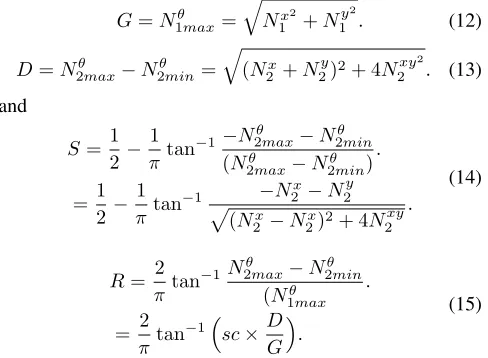
Nσ2 = 3. Now the transformed featuresT ={G, D, S, R}
are computed using the extrema responses as follows.
G=N1θmax=
q
Nx2
1 +N
y2
1 . (12)
D=N2θmax−N2θmin=
q
(Nx
2 +N
y
2)2+ 4N
xy2
2 . (13)
and
S= 1
2− 1
πtan
−1−N2θmax−N2θmin
(Nθ
2max−N2θmin) .
= 1 2−
1
πtan
−1 −N
x
2 −N
y
2
p
(Nx
2 −N2x)2+ 4N
xy
2
.
(14)
R= 2
πtan
−1N
θ
2max−N2θmin
(Nθ
1max .
= 2
πtan
−1sc×D
G
.
(15)
wherescis a parameter to control the value ofR. Now the transformed features {G, D} and {S, R} are converted to
binary codes by using the quantizers B1(x) and B2(x) as shown in (16) and (17), respectively.
B1(x) =
(
0 mX
X > p
1 otherwise (16)
B2(x) =
0 X ∈[0, δ] 1 X ∈[δ,2δ] · · ·
A−1 X ∈[(A−1)δ,1]
(17)
where, X ∈ {G, D}, mX and is the average of the transmute feature map of x and p is a scalar of control. The X ∈ {S, R} and A is the calibration level so the calibration step is δ = L1. For a discerning feature vector calibration level is set toLS = 3andLR = 5forsiandr
transmute features, respectively. The quantization levels are set toLS = 3,LR= 5andLG=LD= 2. The Quantization stage is shown in Fig. 1 (e). The three histograms namely
LET1,LET2andLET3are built using the combinations of
{G, D, S}across adjacent scales(σ2
1, σ22)and(σ22, σ23)and
{R} across the three scales,(σ2
1, σ22, σ23) respectively. The three histograms are concatenated to form Robust Locally Encoded Transformed (RLET) feature vector shown in Fig. 1 (f).
RLET =LET1kLET2kLET3. (18)
where,kdenotes the concatenation operation. RLET features contribute necessary discrimination power to the hybrid de-scriptor which is required at the high noise level.
C. FEATURE INTEGRATION
After feature computation, we now join the two histogram based feature sets into a joint representation as shown in Fig. 1 (g). Let f1(.) and f2(.) represent the computation of two feature sets on the wavelet resolved image NLL
and noisy image N, respectively. Then, the image statistics RDHD (Robustness-Driven Hybrid Descriptor) presents a discriminating and noise robust texture representation. This is expressed as follows.
RDHD=f1(NLL(px1, py1))kf2(N(px, py)). (19)
where,kdenotes the concatenation operation on the two sets of features.
The hybrid descriptor RDHD has a feature dimension that is the sum of the number of variables in individual feature vectors. The first feature set consists of a 200-bin histogram while the second feature set represents a 413-bin histogram. Thus, the final feature set represents a 613-bin histogram.
(a) (b) (c)
FIGURE3:Sample images from three datasets: (a) Outex Original, (b) Outex Extended and (c) KTH-TIPS. Four classes from
each dataset are displayed along rows. Three samples from each class are displayed along columns.
results section, we validate the above arguments through the evaluation of classification performance on relevant datasets. The discrimination is provided by the computation of two contrasting feature sets. Robustness against the rotation of texture is provided from the encoding of an individualize texture pattern at multiple angles using the LBP’s rotation invariance methodology and steerable Gaussian derivative fil-ters. Robustness against gray scaling and shifting is provided through the use of difference operator while computing the two feature sets, which effectively cancels out the gray shift. The Gray scaling is avoided from the use of global gray-mean value in the quantization step.
IV. EXPERIMENTAL SETUP
To demonstrate the discriminating and noise resistant prop-erty of our feature descriptor, we perform experimentation on three texture datasets, Outex Org. (original), Outex Ext. (extended) and KTH-TIPS. The example images of each dataset are displayed in Fig. 3. The datasets are modified in relevance to our work and images are deprived of additive white Gaussian noise (AWGN), with zero mean. For a com-prehensive study, we divide the experimental setup into two parts. The first experiment is carried on three datasets, and the images are corrupted by AWGN with noise variance level determined by{σ2}[40]. Noise is added in the image using the following equation.
In(x, y) =Iorg(x, y) + (
1 √
2πσ)(e
−(Iorg(x,y)−µ)2
2σ2 ). (20)
whereIorg is the original image andIn is the noisy image. Figure 4 shows the original versus noisy images (σ2={0.01,
(a)
FIGURE4:Comparison of original images (leftmost) vs their noisy versions with noise variance σ2 ={0.01,0.02,0.03} (from left to right).
0.02,0.03}) for the three datasets. The second experiment is performed only on the Outex Org. dataset which is corrupted with AWGN noise determined by a self defined noise level discussed in [49].
0.00 0.01 0.02 0.03 0.04 20 30 40 50 60 70 80 90 100 C l a s s i f i c a t i o n A c c u r a c y ( % )
Noise Variance ( )
Proposed (8, [2 3]) Proposed (8, [1 2 3]) LETRIST CJLBP (8, [2 3]) CJLBP (8, [1 2 3]) CLBP (24, 3)
Outex TC10
(a)
0.00 0.01 0.02 0.03 0.04
20 30 40 50 60 70 80 90 100
Proposed (8 ,[2 3]) Proposed (8, [1 2 3]) LETRIST CJLBP (8, [2 3]) CJLBP (8, [1 2 3]) CLBP (24, 3)
C l a s s i f i c a t i o n A c c u r a c y ( % ) oise Variance Outex TC12h (b)
0.00 0.01 0.02 0.03 0.04
20 30 40 50 60 70 80 90 100
Proposed (8 ,[2 3]) Proposed (8, [1 2 3]) LETRIST CJLBP (8, [2 3]) CJLBP (8, [1 2 3]) CLBP (24, 3)
C l a s s i f i c a t i o n A c c u r a c y ( % )
Noise Variance ( ) Outex TC12t
(c)
FIGURE5:Classification performance vs noise variance plots
of various techniques for Outex Dataset:(a) TC10, (b) TC12h, and (c) TC12t.
A. OUTEX AND OUTEX EXTENDED
Outex dataset [53] contains images for a variety of image orientations and lightening intensities. The original dataset comprises of twenty-four different texture categories while the extended version contains sixty-eight texture categories and thus provides a more challenging environment compared to the original version. Each category has twenty images of resolution 128 ×128. An image is generated for three brightness conditions (“Inca", “TL84" and “Horizon") and for nine different angles of orientation. The following two sub-sets and their extended versions are used:
Outex T C10: There are4320 (24×20×9)sample images of inca condition. From these images,480 (24×20)samples are at an angle of0° and are used as a training set. While the left3840image samples taken under remaining eight angles are used for testing of classification accuracy.
Outex T C12: It is a bigger collection having 9120 (24× 20×9) images. The images have 2 sub-categories, TC12t and TC12h. The 4320 images for TC12t are captured for illuminate“T184”and 4320 for TC12h are captured under “horizon”and“T L84”. Training samples are480 (24×20) images at an angle of0° under illuminate“inca”.
Outex T C20: It is an extended version of the TC10 test suite. There are12,240 (68×20×9)sampled images.1360 (68×20)samples are used as a training set. While the left 10880image samples are used for testing.
Outex T C24: It is an extension of TC12 having 4080 (68×20×9)images. There are two sub-categories, TC24t and TC24h. Training samples are 1360 (68×20) images while2720 (68×20×2)are used for testing.
B. KTH-TIPS
The KTH-TIPS (textures under varying illumination, pose and scale) is a challenging material database for texture cate-gorization [54]. It is designed to test the texture operator for varying conditions of lightning, pose, and scale (the distance of material from the camera), unlike CURet dataset, which doesn’t provide scale variations [48]. There are ten material categories in total; each class contains eighty-one images. Each material is captured under variable illumination, for nine scale variations and nine poses. We split images of each folder in train and test sets in ratio (49.4/50.6), hence the train set contains40/81random samples and rest are taken for test set [48]. The classification performance is measured as an average of numerical results from a hundred random classification turns.
C. CLASSIFICATION ENVIRONMENT
TABLE1:Classification performance of proposed method vs traditional methods on Outex Org. dataset atσ2= 0.025
Ref Method TC10 TC12t TC12h Average
[30] LBP{T = 8, Y = 1} 38.32 34.41 35.11 35.93
CLBP{T = 8, Y = 1} 35.33 31.30 33.30 33.31
[45] CLBP{T = 16, Y = 2} 47.71 46.04 47.10 46.41
CLBP{T = 24, Y = 3} 50.39 45.90 45.06 47.11
[39] M RELBP{T = 8} 48.20 69.90 69.80 62.63
[40] DALBP{T = 8} 72.00 67.60 66.30 68.63
[35] BRIN T{T = 8, Y = 3} 73.22 68.50 67.90 69.80
CJ LBP_SM C{T= 8, Y = (1,2)} 64.60 58.9 60.43 61.31
[46] CJ LBP_S/M/C{T = 8, Y = (1,2,3)} 77.7 72.03 73.47 74.4
CJ LBP_SM C{T= 8, Y = (2,3)} 81.60 75.60 75.57 77.59
LV QP_SM C{T = 8, Y = 1} 49.30 49.50 50.00 49.6
[47] LV QP_SM C{T = 16, Y = 2} 83.00 86.00 86.80 85.20
LV QP_S/M/C{T = 24, Y = 3} 91.50 87.80 87.00 88.76
[41] RINR 80.70 - -
-[43] EM CLBPeriu246(P, R) = (8, 1) 91.33 85.93 88.77 88.67
[48] LET RIST{LS= 3, LR= 5} 96.25 92.84 94.86 94.65
This work RDHD 97.76 94.39 95.42 95.86
feature vector and all the trained feature vectors. Chi-square statistic is expressed in (21).
C(K, L) =
B
X
b=1
(Kb−Lb)2 (Kb−Lb)
. (21)
where B is the total number of bins, Kb, Lb are re-spectively the values of trained and test image at the bth
bin. A small value of C(K, L) shows a close similarity between the test vectorKand trained vectorL. The classifier assigns to the test feature vector, the class of train feature vector for which, the Chi-square statistic is small, e.g., the majority of similar class train feature vectors in the nearest neighborhood.
V. EXPERIMENTAL RESULTS AND ANALYSIS
This section presents the analysis of the noise-robust perfor-mance of the proposed hybrid descriptor under a variety of noisy conditions and presents comparisons with closely re-lated descriptors. A variety of parameter settings allows for a comprehensive comparison of the classification performance. The classification accuracy is taken as a measure of feature descriptor's noise sensitivity. When the classification accu-racy is high, for a certain variance of the noise, the feature descriptor is said to be noise tolerant. All implementations of the algorithm have been carried out using Matlab 2018a, with core i5, Core 2 Duo 2.6 GHz, 8GB RAM. The comparison of feature dimensionality and computation complexity is presented in Table 2. The results of the two experimental phases are discussed as follows.
TABLE2: Feature dimension and computational complexity
compared with other methods using an image of size 128×
128.
Ref Descriptor Feature Feature extraction Name dimension time (ms)
[37] VZ-MR8 2440 262
[38] BIF 1296 282
[39] MRELBP 800 293
[35] BRINT_CSM 2592 246
[45] CLBP_SMC 2200 119
This Work RDHD 613 224
A. PERFORMANCE ANALYSIS WITH AWGN (σ2)
Firstly, we evaluate the performance of the proposed operator for Outex Org. dataset. Fig. 5 presents the performance com-parison of proposed descriptor at two parametric conditions (T, Y) e.g., (8, [2, 3]) and (8, [1, 2, 3]) with the techniques CLBP (24, 3), CJLBP (8, [1, 2, 3]), CJLBP (8, [2, 3]) and LETRIST (LS = 3, LR = 5). From Fig. 5, it is noticeable
that the proposed hybrid operator shows close performance at the given scale-resolution settings. Similar is the case with CJLBP_SMC. Therefore, there is no need to refer to the parameters while discussing the two operators.
We perform analysis by assuming three variance regions: 1) noiseless region where σ2 = 0, 2) low noise region,
σ2 ∈ [0.005 0.02], and 3) high noise region, σ2 ∈ [0.025 0.04]. The following observations can be made:
TABLE3:Classification performance on outex extended (TC20 and TC24) and KTH-TIPS
Noise Var.{σ2}
(a) Outex Ext. Method 0 0.005 0.01 0.015 0.02 0.025 0.03 0.035 0.04
CJ LBP_SM C{T= 8, Y = (2,3)} 90.87 37.65 34.63 33.71 32.80 32.26 31.22 30.42 11.75
TC20 LET RIST{LS= 3, LR= 5} 95.43 52.05 40.33 34.98 31.44 28.52 26.10 24.80 15.78
RDHD 95.77 58.03 46.66 40.46 35.33 32.54 30.14 28.36 17.86
CJ LBP_SM C{T= 8, Y = (2,3)} 82.43 37.65 34.63 33.71 32.80 32.26 31.22 30.42 11.75
TC24h LET RIST{LS= 3, LR= 5} 96.43 52.05 40.33 34.98 31.44 28.52 26.10 24.80 15.78
RDHD 96.03 58.03 46.66 40.46 35.33 32.54 30.14 28.36 17.86
CJ LBP_SM C{T= 8, Y = (2,3)} 82.72 37.65 34.63 33.71 32.80 32.26 31.22 30.42 11.75
TC24t LET RIST{LS= 3, LR= 5} 96.47 52.05 40.33 34.98 31.44 28.52 26.10 24.80 15.78
RDHD 96.40 58.03 46.66 40.46 35.33 32.54 30.14 28.36 17.86
(b) KTH TIPS
CJ LBP_SM C{T= 8, Y = (3,2)} 94.63 90.75 89.00 85.73 83.08 81.66 79.49 78.34 77.59
LET RIST{LS= 3, LR= 5} 98.31 96.40 94.45 92.40 91.04 87.94 85.37 83.63 81.41
RDHD 98.26 96.14 94.14 92.87 91.22 88.74 86.52 85.90 84.13
TABLE4:Classification performance of proposed method vs traditional methods on Outex Org. dataset at noise level k.
TC10 TC12h TC12t
Ref N oiseP arameter(k) 10 20 30 40 10 20 30 40 10 20 30 40
CLBP{T = 8, Y = 1} 96.87 94.97 93.69 91.58 88.56 85.71 85.13 83.72 92.01 89.12 88.35 86.48
[45] CLBP{T = 16, Y = 2} 98.33 97.63 96.38 93.69 94.12 91.64 90.46 87.40 95.60 93.77 91.32 89.53
CLBP{T = 24, Y = 3} 98.80 98.12 95.62 93.33 98.80 98.12 95.62 93.33 98.80 98.12 95.62 93.33
AHP{T = 8, Y = 1} 96.40 91.50 82.10 72.1 90.00 87.50 83 80 89.13 85.06 82.24 79.00
[49] AHP{T = 16, Y = 2} 99.00 98.57 96.20 90.79 95.70 94.50 92.70 87.80 94.12 92.00 90.00 87.00
AHP{T = 24, Y = 3} 99.00 98.88 96.89 89.92 96.19 94.70 92.92 89.00 97.00 95.13 90.80 89.92
CJ LBP_SM C{T = 8, Y = (1,2)} 97.78 97.57 96.30 95.72 93.05 90.60 87.15 85.92 94.69 92.47 90.48 87.98
[46] CJ LBP_SM C{T = 8, Y = (1,2,3)} 98.41 98.33 97.57 96.77 94.93 93.26 91.71 89.07 96.34 94.07 92.77 91.48
CJ LBP_SM C{T = 8, Y = (2,3)} 98.43 98.09 97.68 97.50 95.48 94.09 93.40 92.52 95.99 95.88 94.97 92.38
RDHD 100 99.95 99.79 99.71 99.72 99.35 99.26 98.13 99.93 99.75 99.54 99.21
showing high discrimination power. This indicates that LETRIST contributes discriminating features to the pro-posed operator.
2) In low noise region, the hybrid descriptor shows greater performance than LETRIST with a classification accu-racy difference of approximately 1.1% at σ2 = 0.02. This indicates that the proposed operator is noise robust than LETRIST and CJLBP_SMC.
3) In high noise region, the hybrid descriptor continues to show high performance. A classification accuracy of 94% at σ2 = 0.04is achieved. This indicates that the proposed operator is able to discriminate texture under high noisy conditions with better accuracy.
To further evaluate the robustness of the proposed op-erator on Outex dataset, Table 1 presents the comparison with six related techniques over a variety of scale-resolution parameter setting, at noise varianceσ2 = 0.025. The indi-vidual and average classification performance is computed for TC10, TC12h, and TC12t testing suits. The hybrid de-scriptor is compared to LBP, CLBP, CJLBP, LVQP, BRINT, MRELBP, DALBP, and LETRIST. The operators LVQP and CLBP_SMC are evaluated for the following
paramet-ric conditions: (T, Y) {(8,1),(16,2) and(24,3)}, while CJLBP_SMC is evaluated for (8,[1 2]),(8,[1 2 3]), and (8,[2 3]). The best performance of CLBP_SMC is achieved at (24, 3) since the above parameter setting allows to com-pute both the micro as well as macro-texture. Therefore, the discriminating power of CLBP_SMC is improved. A similar trend in performance is observed for LVQP and CJLBP_SMC. While discussing the results, we will compare the best results of CLBP_SMC, CJLBP_SMC, and LVQP and will avoid mentioning the parameter setting. Noticeably, our method achieves the highest average classification ac-curacy of 95.86%, indicating that high noise robustness is provided. The operators LBP, CLBP, and MRELBP show degraded performance because the descriptors are not effec-tive in the presence of noise. In comparison to BRINT and DALBP, which show close performance among each other, our descriptor performs with a high margin of approximately 27.23%. The operators LETRIST and LVQP on the other hand, appear as the second and third best performers, respec-tively.
vari-ance ofσ2={0.005,0.01,0.015,0.02,0.025,0.03,
0.035and0.4}. The hybrid descriptor is put in comparison with the following two descriptors, CJLBP_SMC [46], and LETRIST [48], with the following parameter setting{T = 8, Y = (2,3)}, and {LS = 3, LR = 5}, respectively. For the Outex Ext. dataset following observations can be made. Firstly, the classification accuracy is not close to 90%, indicating the challenging conditions provided by the dataset. Secondly, the trend of performance among the descriptors re-mains same as in Outex Org. dataset. For example, LETRIST performs better than CJLBP_SMC and the hybrid descriptor outperforms both. This indicates that for the given dataset, the hybrid descriptor also outperforms BRINT, MRELBP and DLABP. In Table 3 (b), a similar trend in performance occurs for KTH-TIPS dataset e.g., proposed > LETRIST
> LVQP >CJLBP_SMC. In the light of results of Table 1 and 3 we conclude that the proposed descriptor success-fully categorizes the texture in the presence of noise and outperforms the noise robust descriptors e.g., CJLBP_SMC, BRINT, MRELBP, DALBP, LVQP, and LETRIST.
B. PERFORMANCE ANALYSIS WITH AWGN (K)
Experiment 2 is performed to compare the noise robustness of our proposed descriptor against Adaptive Hybrid Descrip-tor (AHP) [49] over the range ofk={10,20,30,40}. Table 4 lists the robustness measure of the proposed descriptor in comparison with CLBP, CJLBP and AHP. The operators AHP and CLBP_SMC are evaluated for the following scale-resolution conditions: (T ,Y){(8,1),(16,2)and(24,3)}, while CJLBP_SMC is evaluated for (8,[1 2]),(8,[1 2 3]) and (8,[2 3]). From Table 4, it is observed that when k increases for a certain test suit, the classification performance of the texture descriptors decreases. Therefore, the results are discussed only for the worst case of k=40.
From the numerical results, it is observed that AHP achieves the lowest performance. This shows that the methodology adopted by AHP, when compared to the men-tioned descriptors, is not effective against noise. CLBP_SMC performs better than AHP, since it involves the usage of global mean magnitude and central gray level. CJLBP_SMC outperforms CLBP_SMC since it involves the operation of multi-scale fusion, which makes it robust against noise. On the other hand, the proposed descriptor outperforms the above descriptors by achieving the highest classification ac-curacy of 99.71,98.13, and 99.21for the respective TC10, TC12h and TC12t test suits at k=40.
From the results of experiment 1 and 2, the performance of the hybrid descriptor on Outex and KTH-TIPS datasets demonstrates that the use of wavelet transform and the pro-posed feature computation and integration technique offers a robust texture representation.
VI. CONCLUSION
In this paper, a method of noise robust classification of texture is presented and validated. The proposed method is based on calculating features from low-frequency image
information, which forms the basis of our noise robust image model. Three stages are involved in the proposed system. Firstly, multiresolution decomposition of a noisy image is performed, and the low noise components are achieved us-ing 2DDWT. Then, the evaluated components are subjected to LBP based feature extraction. To achieve discrimination power a second feature set is considered, which is based on first and second order differential responses from Gaussian derivative filters. The two feature sets are integrated to obtain a final feature representation that is robust and discriminative in the presence of noise. The hybrid descriptor is examined under a variety of image acquisition conditions provided by following three renowned datasets: Outex original, Outex extended and KTH-TIPS. It is found that the presented descriptor performs robust classification of texture for ad-ditive Gaussian noise with varying variance levels of up to
σ2= 0.04. The descriptor surpasses other leading techniques such as CJLBP_SMC, BRINT, MRELBP, DALBP, LVQP, AHP, and LETRIST. In future studies, the aim is to reduce the length of the feature vector by considering techniques of feature dimensionality reduction. Moreover, some other methods of noise reduction in an image can be considered to improve the classification performance further.
REFERENCES
[1] L. Li, C. Jie, F. Paul, Z. Guoying, C. Rama, P. Matti, “A survey of recent advances in texture representation,” , vol. 3, 2018, [online] Available: https://urlzs.com/EmPs5.
[2] L. Li, F. Paul, G. Yulan, W. Xiaogang, P. Matti, “Local binary features for texture classification: Taxonomy and experimental study,” Pattern Recognit., vol. 62, pp. 135–160, 2017.
[3] Mohan, Arun, Poobal, “Crack detection using image processing: A critical review and analysis”, Alex. Eng. J., vol. 57, pp. 787-798, 2018
[4] R. Ruoxu, H. Terence, T. K. Chen, “Automatic Microstructure Defect Detection of Ti-6Al-4V Titanium Alloy by Regions-Based Graph,” IEEE Trans. Emerging Topics omputational Intell., vol. 1, no. 2 pp. 87–95, 2017. [5] F. Reza, S. Ashok, F. Behzad, “Advanced Tissue Characterization and Texture Analysis Using Dual-Energy Computed Tomography Horizons and Emerging Applications,” Neuroimaging Clin., vol. 27, pp. 533–546, 2017.
[6] D. Carole, T. Rebecca, S. V., Vineeta, S. Carolina A, B. Hamid, G. Ashish and M. Donna, “Role of quantitative computed tomography texture analysis in the differentiation of primary lung cancer and granulomatous nodules,” Quantitative imaging in medicine and surgery, vol. 6, no. 1, pp. 6, 2016.
[7] M. Manoj, V. S. Jochen, M. Robert, A. Hatem, “Texture analysis and machine learning for detecting myocardial infarction in noncontrast low-dose computed tomography: unveiling the invisible,” Investig. Radiol., vol. 53, no. 6, pp. 338–343, 2018.
[8] M. Leandro, R. F. Pedro, A. Jefferson, S. J. Wellington, J. A. H. Souza, de Albuquerque, V. Hugo C, “A novel mobile robot localization approach based on classification with rejection option using computer vision,” Comput. Electr. Eng., vol. 68, pp. 26–43, 2018.
[9] L. Shan, Y. Wenzhen, A. Edward, C. Anthony G, F. Raul, “Vitac: Feature sharing between vision and tactile sensing for cloth texture recognition,” in 2018 IEEE Int. Conf. Robotics and Automation (ICRA), pp. 2722–2727, 2018.
[10] M. Chris, B. James, M. Michael, B. Jonathan, M. Joslin, F. Jennifer, “Automating analysis of vegetation with computer vision: Cover estimates and classification”, Ecol. Evol., vol. 8, no.12,pp. 6005–6015 , 2018. [11] Y. Yijun, R. Jinchang, L. Yinsheng, W. James FC, I. Winifred, C.
Kuo-Ming, “Adaptive fusion of color and spatial features for noise-robust retrieval of colored logo and trademark images,” Multidimens. Syst. Signal Process., vol. 27, no.4,pp. 945–968, 2016.
retrieval of colored logo and trademark images,” Multidimens. Syst. Signal Process., vol. 27, no.4,pp. 945–968, 2016.
[13] F. Elias, P. George, G. Maria, F. George, “An automatic target detection algorithm for swath sonar backscatter imagery, using image texture and independent component analysis,” Remote Sens., vol. 8, no.5,pp. 373, 2016.
[14] Deshmukh, Gaurav V., B. Smriti H, “Facial Expression Recognition using Bandlet Transform and Centre Symmetric-Local Binary Pattern” in 2018 5th Int. Conf. Signal Process. Integr. Netw. (SPIN), pp.726–729, 2018. [15] Z. Yuqian, L. Ding, H. Thomas, “Survey of Face Detection on Low-quality
Images,” in 2018 13th IEEE Int. Conf. Automatic Face Gesture Recognit. (FG 2018), pp. 769–773, 2018.
[16] Athira. AP, V. Midhula, Mohan. R., “Moving Object Detection Using Local Binary Pattern and Gaussian Background Model,” Ind. Interact. Innov. Sci., Eng. Tech., vol. 1, pp. 367–376 ,2018
[17] K. Shiva, S. Reza, “Vehicle detection, counting and classification in various conditions,” IET Intell. Transp. Syst., vol. 10, no.6,pp. 406–413, 2016.
[18] L. Jinzhu, Z. Dong, J. Huanyu, “Discriminating Leaves Affected with Tomato Yellow Leaf Curl through Fluorescence Imaging Using Texture and Leaf Vein Features,” Transact. ASABE, vol. 59, no.6,pp.1507–1515, 2016.
[19] L. Patrick, E. Robin, S.Natalie NC, G. Sanjay, F. Michael, M. Anant, “Stable and discriminating features are predictive of cancer presence and Gleason grade in radical prostatectomy specimens: a multi-site study,” Scientific reports, vol. 8, no.1,pp. 14918, 2018.
[20] Y. Guo, G. Zhao, and M. PietikaInen, “Discriminative features for texture description,” Pattern Recognit., vol. 45, no.10,pp. 3834–3843, Oct. 2012 [21] L. Liheng, L. Yuhui, X. Liang, Li. Zhenjiang, L. Han, D. Ningning, L. Wenwu, Y. Zhenghan, W. Zhenchang, J. Erhu, “Application of texture analysis based on apparent diffusion coefficient maps in discriminating different stages of rectal cancer,” J. Magn. Reson. Imaging, vol. 45, no.6,
pp. 1798–1808, 2017.
[22] Y. Peng, Z. Fanlong, Y. Guowei, ‘Fusing DTCWT and LBP based features for rotation, illumination and scale invariant texture classification,” IEEE access, vol. 6, pp. 13336–13349, 2018.
[23] D. Chathurika, M. Sasan, B. Michael, N. Mahesan, “Rotation invariant texture descriptors based on Gaussian Markov random fields for classifi-cation,” Pattern Recognit. Lett., vol. 69, pp. 15–21, 2016.
[24] Z. Lefei, Z. Qian, D. Bo, H. Xin, T. Y. Yan, T. Dacheng, “Simultaneous spectral-spatial feature selection and extraction for hyperspectral images,” IEEE Transact. Cybern., vol. 48, no. 1,pp. 16–28, 2018.
[25] X. Hong, G. Zhao, M. Pietikainen, and X. Chen, “Combining LBP differ-ence and feature correlation for texture description,” IEEE Trans. Image Process., vol. 23, no.6,pp. 2557–2568, Jun. 2014.
[26] A.Ömer F et al., “Multi-category EEG signal classification developing time-frequency texture features based Fisher Vector encoding method,” Neurocomputing, vol. 218, pp. 251–258, 2016.
[27] R. C. Gonzalez, “Image Restoration and Reconstruction”, Digital Image Process, 3rd ed., India: Pearson Prentice Hall, 2011, 322-330
[28] D. Steven, S. Vincent, B. Stephen, W. Gordon, H. Felix, “Dirty pixels: Optimizing image classification architectures for raw sensor data,”, 2017, [online] Available: https://arxiv.org/abs/1701.06487
[29] S. Zhun, O. Mete, Z. Yan, L. Xing, O. Takayuki, “Feature quantization for defending against distortion of images, in ” Proc. IEEE Conf. Comput. Vis. Pattern Recognit., pp. 7957–7966, 2018.
[30] T. Ojala, M. Pietikainen, T. Maenpaa, “Gray scale and rotation invariant texture classification with local binary patterns,” Eur. Conf. Comput. Vision, pp. 404–420, 2000
[31] X. Tan, B. Triggs, “Enhanced local texture feature sets for face recognition under difficult lighting conditions,” IEEE Trans. image Process., vol. 19, pp. 1635–1650, 2010.
[32] T. Ahonen, M. Pietikainen, “Soft histograms for local binary patterns,” in Proc. Finnish Signal Process. Symp., FINSIG, vol. 5, no.9,pp. 1, 2007. [33] J. Ren, X. Jiang, J. Yuan, “ Noise-resistant local binary pattern with an
embedded error-correction mechanism,” IEEE Trans. image Process., vol. 22, pp. 4049-4060, 2013.
[34] J. Chen, V. Kellokumpu, G. Zhao, M. Pietikainen, “RLBP: Robust Local Binary Pattern,” BMVC, vol. 106, pp. 68-76, 2013.
[35] L. Liu, Y. Long, P. W. Fieguth, S. Lao, G. Zhao, “BRINT: binary rotation invariant and noise tolerant texture classification,” IEEE Trans. image Process., vol. 23 ,pp. 3071-3084, , 2014.
[36] T. Song, H. Li, F. Meng, Q. Wu, B. Lua, B. Zeng, M. Gabbouj , “Noise-robust texture description using local contrast patterns via global mea-sures,” IEEE signal Process. Lett., vol. 1,pp. 93–96, 2014.
[37] M. Varma and A. Zisserman, "A statistical approach to texture classifi-cation from single images," Int. J. Comput. Vision., vol. 62, no. 1, pp. 61â ˘A ¸S81, 2005.
[38] M.Crosier, and L. D. Griffin, "Using basic image features for texture classification," International journal of computer vision., vol.88, no. 3, pp. 447-460, 2010.
[39] L. Liu, S. Lao, P. W. Fieguth, Y. Gua, X. Wang, M. Pietikainen, “Median robust extended local binary pattern for texture classification,” IEEE Int. Conf. image Process. (ICIP), vol. 25, 2015.
[40] Z. Pan, X. Wu, Z. Li, Z. Zhou, “Local adaptive binary patterns using di-amond sampling structure for texture classification,” IEEE signal Process. Lett., vol. 24,pp. 828–832, 2017.
[41] M. M. Feraidooni, and D. Gharavian, "A new approach for rotation-invariant and noise-resistant texture analysis and classification," Machine Vision and Applications., vol. 29, no. 3, pp. 455-466, 2018.
[42] H. Hadizadeh, "Multi-resolution local Gabor wavelets binary patterns for gray-scale texture description," Pattern Recognition Letters., vol. 65, pp. 163-169, 2015.
[43] M. H. Shakoor, and R. Boostani, "Extended mapping local binary pattern operator for texture classification," International Journal of Pattern Recog-nition and Artificial Intelligence., vol. 31, no. 06, pp. 1750019, 2017. [44] Fawad, M. J. Khan, M. A. Riaz, H. Shahid, M. S. Khan, Y. Amin, J.
Loo, and H. Tenhunen "Texture Representation through Overlapped Multi-oriented Tri-scale Local Binary Pattern", IEEE Access, vol. 7, no. 1, pp. 66668-66679, May. 2019.
[45] Z. Guo, L. Zhang, D. Zhang, “A completed modeling of local binary pattern operator for texture classification,” IEEE Trans. image Process., vol. 19, pp. 1657–1663, 2010.
[46] X. Wu, J. Sun, “Joint-scale LBP: a new feature descriptor for texture classification,” Vis. Comput., vol. 33,pp. 317–329, 2017.
[47] P. Zhibin, F. Hongcheng, Z. Li, “Texture classification using local pattern based on vector quantization,” IEEE Trans. image Process., vol. 24, no.
12,pp. 5379–5388, 2015.
[48] T. Song, H. Li, F. Meng, Q. Wu, J. Cai, “Letrist: locally encoded transform feature histogram for rotation-invariant texture classification,” IEEE Trans. circuits Syst. video Tech., vol. 28 no.7,pp. 1565–1579, Jul. 2018 [49] Z. Ziqi, Y. Xinge, C. C. Philip, T. Dacheng, O. Weihua, J. Xiubao, Z. Jixin,
“An adaptive hybrid pattern for noise-robust texture analysis,” Pattern Recognit., vol. 48, no.8,pp. 2592–2608, 2015.
[50] J. R. Benjamin, and T. Jayasree, "Improved medical image fusion based on cascaded PCA and shift invariant wavelet transforms," International journal of computer assisted radiology and surgery., vol. 13, no. 2, pp. 229-240, 2018.
[51] B. Adel, J. Abdolabbas, N. S. Mehdi, Z. Dariush, “Weed segmentation using texture features extracted from wavelet sub-images,” Biosyst. Eng., vol. 157, pp. 1–12, 2017.
[52] B. Adel, J. Abdolabbas, N. S. Mehdi, Z. Dariush, “Mammogram classifica-tion using two dimensional discrete wavelet transform and gray-level co-occurrence matrix for detection of breast cancer,” Neurocomputing, vol. 154, pp. 1–14, 2015.
[53] T. Ojala, T. Maenpaa, M. Pietikainen, J. Viertola, J. Kyllonen, S. Huovine, “Outex - new framework for empirical evaluation of texture analysis algorithms,” Object Recogniion. supported by user interaction for service robots, vol. 1, pp. 701–706, 2002.
AYESHAreceived her B.Sc. degree in Telecom-munication from University of Engineering and Technology Taxila, Pakistan, in 2017. She joined Association for Computing Machinery (ACM) so-ciety in 2016 and played active part as finance secretary and general member. She has actively or-ganized many technical events in university cam-pus. She is currently pursuing the M.Sc. thesis in Telecommunication Engineering from the same university. Her research interests include infor-mation security systems, computer vision, pattern recognition, and image processing.
FAWAD received his BS degree in Telecommu-nication from National University of Modern Lan-guages, Pakistan, in 2011. In 2012, he joined Zong China mobile company as Transmission Engineer. He received MS degree from the Military College of Signals, National University of Science and Technology, Pakistan in 2016, which was followed by his Graduate Assistant job in Ghulam Ishaq Khan Institute of Engineering Sciences and Tech-nology. He is currently pursuing the Ph.D. thesis in Telecommunication Engineering from University of Engineering and Technology Taxila, Pakistan. His research interests include computer vision, pattern recognition, and image processing.
MUHAMMAD JAMIL KHANreceived the B.Sc.
Engineering degree in Computer Engineering, The M.Sc. degree in Telecommunication Engineering, and the Ph.D. degree in Computer Engineering from University of Engineering and Technology, Taxila, Pakistan, in 2005, 2009 and 2016 respec-tively. He is currently Assistant Professor and di-rector of Embedded Systems and Digital Signal Processing Laboratory in the same University. He is also the founder of Virtual Reality Simulation Laboratory at the University. He has authored or co-authored numerous technical articles in well-known international journals and conferences. His current research interests include multimedia content analysis, RF identifi-cation and machine learning.
MUHAMMAD ALI RIAZreceived his M.S. and B.S. degree in Electrical Engineering from Iowa State University, USA in 2010 and 2009 respec-tively. Afterwards, he joined the Department of Electrical and Computer Engineering, Iowa State University, USA as a Research Assistant. He is currently serving as Assistant Professor associated with ACTSENA research group at University of Engineering and Technology, Taxila. Ali is work-ing towards the design and implementation of chipless RFID tags based on electromagnetic signature and their signal processing applications. He also serves as the director of Electronics and Measurements laboratory at his department. His research work has been featured in a number of ISI-indexed journals.
HUMAYUN SHAHIDreceived his BS degree in Communication Systems Engineering from the In-stitute of Space Technology, Islamabad in 2008. He joined Space and Upper Atmosphere Research Commission (SUPARCO) where he worked on radiation-hardened space grade components for telemetry subsystems. In 2011, Humayun com-pleted his MS in Signal Processing from Nanyang Technological University, Singapore. Thereafter, he joined the department of telecommunication engineering at the University of Engineering and Technology, Taxila where he currently works as an Assistant Professor. Humayun is affiliated with the ACTSENA research group working towards design and signal processing-related aspects of electromagnetic transduction-based sensor-incorporated chipless RFID tags. He is also the director at the departmental Antenna and RF laboratory. His research work has been featured in a number of ISI-indexed journals and international conferences.
MANSOOR SHAUKAT KHAN received his
B.Sc. degree from PU Lahore, Pakistan in 1994, M.Sc. degrees in Statistics from University of ARID Agriculture Rawalpindi, Pakistan in 2000. He received his Ph.D. from Beijing Institute of Technology (BIT), P.R. China in January 2016. Currently, he is working as an Assistant Professor, department of mathematics, at COMSATS Uni-versity Islamabad, Pakistan. His research interests include mathematical modeling & optimization, quality & reliability engineering, survival analysis, spatial data analysis, and data science. He has more than 10 research papers in reputed journals and proceedings of international conferences. Most recently he received National Research Program for Universities award from HEC Pakistan.
JONATHAN LOO received his MSc degree in Electronics from the University of Hertfordshire, UK in 1998 and his Ph.D. degree in Electronics and Communications from the same university in 2003. He leads a research team of 8 Ph.D. students in the area of communication and networking. He is presently Professor and Chair in Comput-ing and Communication EngineerComput-ing in School of Computing and Engineering University of West London, UK. His research interest includes net-work architecture, communication protocols, netnet-work security, embedded systems, video coding and transmission, wireless communications, digital signal processing, and optical networks. He has successfully graduated 13 PhDs as Principle Supervisor and contributed over 175 publications in the aforementioned specialist areas.