201 Volume and Issues Obtainable at Center for Sustainability Research and Consultancy
Journal of Business and Social Review in Emerging Economies
ISSN: 2519-089X (E): 2519-0326Volume 5: No. 1, June 2019
Journal homepage: www.publishing.globalcsrc.org/jbsee
Technical Resources in E-training Acceptance
1
Zainab Bello
1
Waziri Umaru Federal Polytechnic, Birnin Kebbi,Nigeria : [email protected]
ARTICLE DETAILS ABSTRACT
History
Revised format: May 2019 Available Online: June 2019
This paper examines the role of availability of resources in the acceptance of e-training in the Nigerian civil service. Perceived ease of use (PEOU) and Perceived usefulness (PU) of Technology Acceptance Model (TAM) was used as the base for consideration
Questionnaires were used to collect data from 450 heads of departments. The framework of the paper made up of technological infrastructure, internet facility, PEOU and PU was tested with SmartPLS 2.0 M3 software.
This paper found both that PU and PEOU indicated strong predictive role in e-training acceptance. In addition, technological infrastructure was found significant. However, internet facility had in significant effect in e-training acceptance.
This paper showed that availability of resources can help in the acceptance of e-training in the Nigerian civil service. This will help to improve the outlook and overall performance in the civil service. It will be beneficial to policy makers and government agencies in developing policies regarding training, create awareness of the benefits of accepting e-training in the public sector leading to better performance and efficiency. Relationships of technological infrastructure and internet facility which are necessary in the acceptance of e-training in the Nigerian civil service were examined in this paper.
© 2019 The authors, under a Creative Commons Attribution-NonCommercial 4.0
Keywords
E- Training Acceptance, Technical Resources, TAM , Nigeria
JEL Classification:
M53, M59
Corresponding author’s email address: [email protected]
Recommended citation: Bello, Z., (2019). Technical Resources in E-Training Acceptance. Journal of Business
and Social Review in Emerging Economies, 5 (1), 201-212
DOI: 10.26710/jbsee.v5i1.671
1. Introduction
In any economy, knowledgeable human capital is regarded crucial to attaining set goals for organizations. This has made organizations commit huge resources for the training and growth of their work force (Obi-Anike & Ekwe, 2014). There has been an observed upsurge in the acceptance of technology in the operations of most organisations (Mckay & Vilela, 2011). This is as a result of the changes and advancement in the use of technology in carrying out operations including training in most organisations (Ramayah, Ahmed & Hong, 2012).
202
information has to be dealt with in a smaller time frame by workers (Ramayah et al., 2012). This includes training related issues (Mohsin & Sulaiman, 2013). Training executives feel the necessity to provide knowledge and skills more speedily and adequately each and every time it is needed (Mohsin & Sulaiman, 2013). In the era of just-in-time technology, just-in-just-in-time training turns out to be a critical part for success in organizations (Mohsin & Sulaiman, 2013). This has made training to expand beyond what is available in the traditional class room.
Training could be seen as the planned process in which knowledge or skills are acquired or changed in order to derive better performance in certain activity (Abba & Sawha, 2009). The importance of training workers in organisations has been emphasized (Abba & Dawha, 2009) and it has been suggested as a way of improving and optimizing employee’s performance. Training is one of the key strategic tools for organizations to get competitive advantage over others with intellectual human capital in the global village (Mohsin & Sulaiman, 2013). Therefore, training methods should be effective to yield better and sustainable performance (Mohsin & Sulaiman, 2013). The training method could either be conventional or e-training.
In the conventional (traditional) training method, the trainee and trainer have to be physically present in the same venue for training to take place. However, with the conventional training methods, issues have been identified that stands as limitations to trainees which includes issues like distance to training centres, time of training, training content, cost, work schedules and family responsibilities (Alrawashdeh & Huda, 2010). Even though traditional training cannot be totally replaced, the pressures of growing workforce, diminishing budgets for traditional training and the constraints of schedule makes e-training an attractive alternative (Alrawashdeh & Huda, 2010).
Additionally, while attracting and retaining the right people is a challenge in itself, the additional task of providing company-specific training can create further demands upon time and resources. This is especially true where constant change in the business environment requires continuous training. In this context, traditional training method is no longer capable of satisfying the organizational demand for continuous manpower training (Mohsin & Sulaiman, 2013). Thus, organisations engage in providing online training facilities and therefore turn to electronic training for their workforce for the acquisition of knowledge and skills (Mohsin & Sulaiman, 2013).
E-training could be seen as a web based educational system which utilizes computer network and information technology (Hsbollah & Idris, 2009). Basically, e-training are activities that are conducted via the internet and it is considered to be much faster and cheaper, convenient, available 24/7, and flexible (Mohsin & Sulaiman, 2013). In recent years, e-training has been considered one of the most promising fields in Human Resource (HR) educational technologies (Amara & Atia, 2016). It has become a standard in most organization and corporate arenas (Amara & Atia, 2016). E-training has developed as a fresh way of skill preparation and information attainment (Amara & Atia, 2016). It has increased in popularity as organizations strive to provide flexible, reliable and fast learning environment in a cost saving manner (Lorenzetti, 2005). This goes to show that e-training is proven to be more effective and interactive than traditional training (Mohsin & Sulaiman, 2013). It has also been argued that owing to fast advancement of technology and communication infrastructure, e-training has become the innovative approach of training in most organizations (Amara & Atia, 2016; Ramayah, et al., 2012).
Adjusting to the e-training trend has been easy for organisations in developed countries due to the fact that, environment and mind set of these countries revolve around technology (Ramayah, et al., 2012). Developing countries are also hopping on the e-training bandwagon in the hope of getting the benefits of the trend (Ramayah et al., 2012). In the African continent, some countries have started using technology to train. This advancement is evident in the report of the Commonwealth which showed type of information and communication technologies being use in Africa (Nneka, 2010). However, Africa is still in the infancy stage of e-training. This is shown in the African database survey conducted with 70 per cent low connectivity (Unwin, 2008). Nevertheless, there is interest in the usage of information technology (Nneka, 2010). Developing countries like Nigeria particularly the civil service has not joined the technological trend in general and e-training in particular with observed in-availability of resources (El-Rufia, 2011). This is surprising as Nigeria is a country with technological presence (Uwaifo & Uddin, 2009). Proper awareness of the benefits of joining the technological world has been attributed to this drawback in the Nigerian civil service (Okifo & Igbunu, 2015).
203 influence employees to accept e-training (Davies 1989). Furthermore, it has been suggested that it is necessary to examine e-training acceptance before it can be implemented in any organisation (Harfoushi & Obiedat, 2011). In this assessment, the perceive usefulness (PU) and perceived ease of use (PEOU) of e-training will help to determine the acceptance of the system (Davies, 1989). Additionally, since e-training acceptance requires the assessment of the level of the employee’s awareness based on their attitude and belief, then there is need to examine the factors that will encourage the acceptance of the system (Buabeng, 2012) by the employees in the Nigerian civil service. Literature has shown that among these factors are availability of resources (Park Kim & Kim, 2014). Due to the peculiar nature of Nigeria and the civil service being large and conservative in its operation (El-Rufia, 2011), this paper examines technological infrastructure and internet facility as dimensions of availability of resources. Additionally, since research on the acceptance of e-training in the Nigerian civil service is scarce, this paper therefore examines the role of availability of resources in the acceptance of e-training in the Nigerian civil service with PEOU and PU as the base for consideration.
2. E-Training Acceptance
E-training acceptance is agreeing to use e-training system based on the awareness of e-training benefits (Harfoushi & Obiedat, 2011). Since Programmed Logic for Automatic Teaching Operations (PLATO) was developed in the 1960s, more interactions can be done online today (McKay & Vilela, 2011). Globally, online training environment has become part of most organisations (Athey, 2012). Traditional way of training is nearly phased out with the advancement in information and communication technologies which have made training more flexible (Salawudeen, 2010). Due to the drawbacks of traditional training (Bonk & Wisher, 2002) more organisations have accepted e-training (Loh et al., 2013). Although acceptance of e-training system has not reached some countries, there is an increase of around 40 per cent in organisations and individuals using the e-training system (McKay & Vilela, 2011).
In order for e-training to be accepted there is need for the employees in an organisation to have adequate knowledge of e-training and how it differs from traditional training. Furthermore, they need to know how e-training system is designed, its characteristics and the benefit of accepting e-training (Amara & Atia, 2016; Harfoushi & Obiedat, 2011). Therefore, when employees accept e-training, there will be an interactive two way information flow, training will be collaborative in which the trainees learn through practice and self-research (Amara & Atia, 2016). Furthermore, search and investigations will be done over the internet which permits trainees time to digest and interpret information. Additionally, individual difference on abilities to handle training and system related issues are taken into considerations (Amar & Atia, 2016; Harfoushi & Obiedat, 2011). With e-training acceptance, organisations can have speedy growth in innovations, and absorb these innovations with education, ICT, and the digital knowledge (Amar & Atia, 2016). Accepting e-training will present large number of trainees with equal opportunities for training at different levels bringing about savings in time and training cost (Amar & Atia, 2016). E-training acceptance builds interactive relationship between trainers and trainees, improves the trainee’s skill in the use of computers as well the internet, which is very helpful career wise (Harfoushi & Obiedat, 2011).
204
2.1 Technology Acceptance Model
An extension of the theory of reasoned action, the technology acceptance model (TAM) assesses elements that can stimulate either the rejection or acceptance of technology (Davis, 1989; Venkatesh & Davis, 2000). Perceived usefulness and perceived ease of use are the two vital variables of the TAM (Purnomo & Lee, 2013). Lee (2006) endorsed the continual refining of PU and PEOU as bases so as to assess their strength in technology acceptance. Sabrina (2007) suggested that TAM should be tested in differing cultural settings as Jebakumar and Govindaraju (2009) argued outcomes in applying TAM varies with cultures. The goal here is to use PU and PEOU, the two key constructs in the TAM, as a base in examining the role of the dimensions of availability of resources in e-training acceptance in the Nigerian civil service.
2.1.1 Perceived Usefulness
Perceived usefulness (PU) refers to an individual’s perception that the use of a particular system can advance performance in their job (Davies, 1989). PU is one of the key construct of TAM that has effect on individual attitude in relation to acceptance of information system (Davies, 1989). When a user believes that a system can help in being rewarded with bonuses, raise or promotion that system is said to be high in PU (Davies, 1989). In carry out any activity, an individual usually tries to assess the effort that will be required for that activity (Bugembe 2010). Therefore, when a system is perceived to be useful in comparison to other system, users are more likely to accept it (Purnomo & Lee, 2013).
Purnomo and Lee (2013) stated that acceptance is the product of a rational assessment of the system which guides the decision to accept. PU serves as base in TAM and the construct is used to determine the connections between acceptance and the external variables of a study (Han, 2003). Furthermore, PU has shown significant close connections in system acceptance (Davies et al., 1989; Han, 2003; Purnomo & Lee, 2013). This is because user assesses their performance based on their opinion of how that system can help in their performance. Therefore, that contributes to PU being the belief that information system will lead to quality work activity (Purnomo & Lee, 2013).
It has been argued that due to the worth of outcomes, individual acceptance of system is affected by PU (Purnomo & Lee, 2013). This is because training will be accepted if users have belief that the relationship between e-training and performance is a positive one (Harfoushi & Obiedat, 2011). Therefore, PU is important in determining user’s acceptance of e-training (Davies et al., 1989). Applied in the perspective of this study, PU is the belief relating to e-training outcome.
Ong et al. (2004) found that when the objective is acceptance of system, PU effect is direct and most significant as long as the system provides contents that are useful and attractive to the user. Employees may perceive e-training system useful if they perceived e-training system to be useful. Studies (Lee et al., 2014; Purnomo & Lee, 2013) have shown that PU has direct significant effect on acceptance. Therefore, this study hypothesis is that:
H1: PU has significant relationship with e-training acceptance
2.1.2 Perceived Ease of Use
Perceived ease of use (PEOU) refers to the level an individual believes the use of a certain system would be effortless (Davies 1989). PEOU is one of the key construct of Technology Acceptance Model (TAM) that has effect on individual attitude in relation to acceptance of information system (Davies, 1989). In carry out any activity, an individual usually tries to assess the effort that will be required for that activity (Bugembe 2010). Therefore, when a system is perceived to be easy to use in comparison to other system, users are more likely to accept it (Davies, 1989).
205 It has been found that when e-training acceptance is perceived by users to be laden with effort in usage, individual will not accept it (Harfoushi & Obiedat, 2011). However, PEOU plays an important role by helping to lessen the doubts that come with the acceptance of any new system (Elliott & Frank, 2008). Therefore, PEOU is important in determining user’s acceptance of e-training system (Davies, et al 1989). Applied in the perspective of this paper, PEOU is the belief that using e-training will be effortless.
Ong et al. (2004) found PEOU to be significant predictor of acceptance of system which is concur by Lee et al. (2011). These studies indicated that in the acceptance of new system, PEOU has positive and direct effect. Their findings are in line with the findings of Venkatesh and Davis (2000) which suggested that PEOU has direct and strong effect on acceptance which further strengthens the original work of Davis et al. (1989). Employees will perceive e-training system useful if they perceived the system to be easy to use. Studies have shown that PEOU has significant effect on acceptance directly (Lee et al., 2011; Ong et al., 2004). PEOU have however been found to have in significant effect on acceptance (Chong et al., 2010). Furthermore, studies have shown that PEOU through PU has significant effect on acceptance (Ong et al., 2004; Rym et al., 2013). These studies have shown that PEOU can affect attitude indirectly via PU depending on the study factors which are external to TAM usage (Legris, et al., 2003; Lie et al., 2009). Therefore, this paper hypothesized that:
H2: PEOU has significant relationship with PU
H3: PEOU has significant relationship with e-training acceptance
2.2 Technological Infrastructure
Technological infrastructure is considered as part of technological architecture (Nchunge, Sakwa & Mwangi, 2013). Furthermore, Bhattacherjee and Hikmet (2008) referred to technological system as system which is required for the implementation of technology in organisations. This study looks at technological infrastructure as the physical technological resources that can aid e-training acceptance.
The operations of organisations have been greatly influenced by the developments in technological infrastructure. This can be seen in emergence and strengthening of the world economy which has been transformed into information and knowledge based economies (Nchunge et al., 2013). This has made many organisations particularly in the developed countries to use technology to stay in operation. Selim (2007) stated that technological infrastructure is an important organisational capability that should be considered as an effective source of value. Availability of technological capacity is an important factor to be considered when introducing new system in an organisation (Bhattacherjee & Hikmet, 2008).
To have successful e-training acceptance in an organisation, there is need for appropriate technological medium and channels to allow for sharing of information and communication (Selim, 2007). It is necessary to ensure that the infrastructures are reliable, up to date and of good quality. With reliable technological infrastructure e-training will be accepted (Yiong, Sam & Wah, 2008).
In the Nigeria civil service, infrastructure is one of the major challenges facing the sector. The country like many developing countries is still suffering from digital divide (Akpodiete, 2012). Furthermore, it is also believed that infrastructure and ICT literacy are combinations that are necessary in the usage of technology and communications tools to create, manage, evaluate as well as integrate information in order to have an enabling e-training environment in the Nigerian civil service. This is why speakers at Nigeria Computer Society (NCS), 2013 conference advocated a robust infrastructure deployment for the country. The forum had noted Infrastructures are needed to create, manage, implemented appropriately and successfully services that involve technology.
Studies have found infrastructure to be important in usage as well as it relate significantly to acceptance of systems (Bhattacherjee & Hikmet, 2008; Özgen, 2012). Infrastructure has important role in the acceptance of electronic learning in educational institutions (Yiong et al., 2008). However, Thompson (2010) reported a contradicting result; there was no statistical prove in his study that infrastructure support had influence on system acceptance. Therefore, this study hypothesis that:
206
2.3 Internet Facilities
Internet is a set of systems that enables two or more computers to send and receive information from one another (Jebakumar & Govindaraju, 2009). For this study Internet facility refers to the availability of open standard network connectivity to aid e-training acceptance (Jebakumar & Govindaraju, 2009). The availability of internet facilities has been stated to provide greater convenience thereby enhancing the acceptance of technology (Jebakumar & Govindaraju, 2009). It has been stated that in technology acceptance internet facilities is a critical factor (Martins & Kellermanns, 2004) because in e-training, effective communication between trainers and trainees is done mostly via the internet.
Furthermore, studies have argued that less stress and dissatisfaction on access and connectivity will further enhance the acceptance of e-training as well as its success (Jebakumar & Govindaraju, 2009; Martins & Kallermanns, 2004). The availability of internet facilities helps in facilitating smooth information exchange. It has been argued that internet facilities allows trainees to receive from trainers innovations that helps in stimulating as well as enhancing learning (Brown, 2002). Manipulations, creativity and initiatives from both trainees and trainers are very much supported with the presence of internet facilities Jebakumar & Govindaraju, 2009). Jebakumar and Govindaraju (2009) found availability of internet facilities to relate significantly with PEOU. Their result showed that availability of internet facilities is an important factor to be considered in the acceptance of electronic training. Adika (2003) found people access to internet will make them to use technology more. In addition, Ehikhamenor (2003) argued that although 50.4 per cent of Nigerian scientists had access to internet, availability of infrastructure and issue with ease of use is the constraint faced by the respondents of his study. Some studies results agreed with Ehikhamenor’s findings (Oduwole, 2004; Luambano & Nawe, 2004). Therefore this paper hypothesis that:
H5: Internet facility has significant relationship with PEOU.
3. Methodology
To achieve the aim of this paper, data were collected with the use of questionnaires. Since the focus of this paper is the Nigerian civil service, the population for this paper were all the federal ministries. The country has twenty - seven (27) federal ministries. Each of the 35 states has Twenty – four (24) while there are three additional federal ministries in the Federal Capital Territory (FCT), Abuja making it twenty –seven (27) in total. There are two hundred and thirty- eight (238) departments in each state and two hundred and fifty – seven (257) departments in FCT, Abuja giving a population of eight thousand five hundred and eighty – seven (8587) departments. The sample size for this population is 367 (Krejcie & Morgan, 1970). 40 per cent was added to this sample size in order to minimize low response rate (Salkind, 1997). This gives 514 as the sample size for this paper. The unit of analysis is individual and the respondents are the heads of each selected department.
Cluster sampling was used to collect data considering that there are six (6) geo-political zones in the country. Two zones were randomly selected from cluster of five (5) zones in Nigeria. One zone was not assessable due to insecurity in the zone. Considering the determined sample size of 514 and the number of Federal ministries in each state, one state was also selected at random from each of the two selected zones. Therefore, the Federal Capital Territory (FCT), Abuja was picked from the North-central while Kaduna state was picked from the North-west. The Federal Capital Territory (FCT), Abuja has 27 Federal ministries with 257 heads of department while Kaduna state has 24 Federal ministries with 238 heads of departments, making the total heads of departments from all the ministries of the two selected samples to be 495.
514 questionnaires were distributed to the targeted respondents and a total of 472 questionnaires were retrieved. However, 22 questionnaires were incomplete and therefore not useable (Hair et al., 2013). Therefore, 450 questionnaires that were fully completed were used for analysis in this paper. SPSS version 2.0 was used to clean the data after collection. SmartPLS 2.0 M3 software of Partial Least Square (PLS) path modelling analysis method (Ringle et al., 2005) was used to determine the validity and reliability of the variables. In addition, to test the measurement and structural models, PLS algorithm was used to assess convergent and discriminant validity, reliability of individual item, and internal consistency which determined the measurement model fit (Hair et al., 2013).
207 correlations among latent construct in order to derive discriminant validity that is adequate. Composite reliability coefficient has also been suggested to be much better from the range of .7 and above (Hair et al., 2013). Additionally, bootstrapping procedure was used to evaluate the structural model in order to get the t-statistics (Hair et al., 2013).
This paper considered PLS path modelling to be the appropriate method of analysis due to several reasons. First, in PLS, the relationships between variables (structural Model) and the relationship of latent variables (Measurement model) and their indicators can be simultaneously estimated (Duarte & Raposo, 2010). Furthermore, since this paper is explorative with the application of technology acceptance model (TAM) theory, the approach of path modelling is required. This is because studies have suggested that when research is prediction-oriented, the appropriate approach to use should be the path modelling in PLS (Hair et al., 2013).
Additionally, non-normal data are treated well with PLS since in social science data tend to have the problem of normality (Osborne, 2010), in PLS analysis of data do not necessary need to be normal (Chin, 1998). Therefore, to avoid problem of normality that might occur during analysis of data PLS was considered for this paper.
4. Findings/Discussion
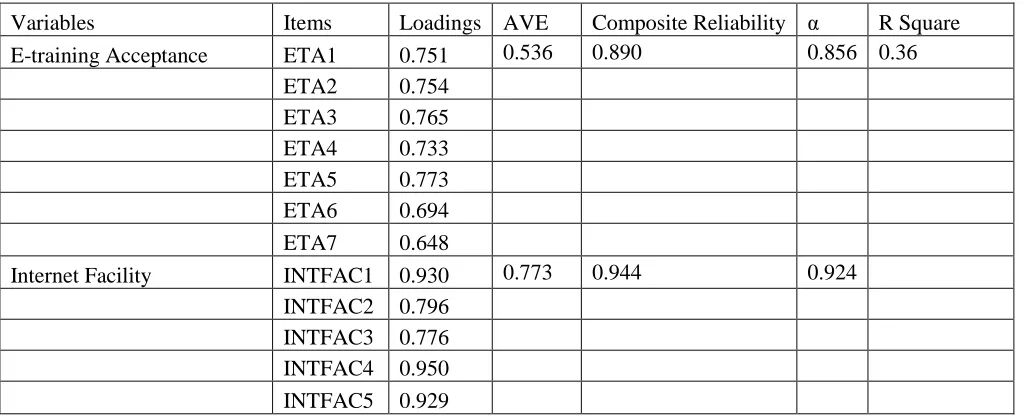
In order to get the reliability and validity of the constructs the measurement model was assessed. Table 1 presents the over view of the analysed results.
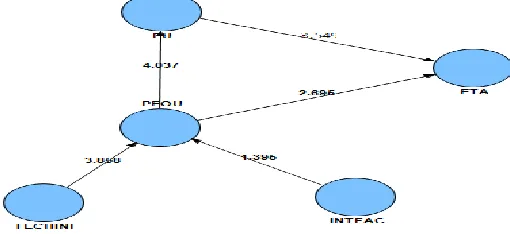
Figure 1: Measurement Model
Table 1:Over View of Results
Variables Items Loadings AVE Composite Reliability α R Square
E-training Acceptance ETA1 0.751 0.536 0.890 0.856 0.36
ETA2 0.754
ETA3 0.765
ETA4 0.733
ETA5 0.773
ETA6 0.694
ETA7 0.648
Internet Facility INTFAC1 0.930 0.773 0.944 0.924
INTFAC2 0.796
INTFAC3 0.776
INTFAC4 0.950
208
Perceived Ease Of Use PEOU1 0.534 0.548 0.856 0.789 0.24
PEOU2 0.773
PEOU3 0.819
PEOU4 0.817
PEOU5 0.720
Perceived usefulness PU1 0.842 0.642 0.899 0.860 0.25
PU2 0.791
PU3 0.774
PU4 0.828
PU5 0.769
Technological Infrastructure TECHINF1 0.758 0.549 0.856 0.788
TECHINF2 0.822
TECHINF3 0.783
TECHINF4 0.533
TECHINF5 0.773
Table 1 showed individual item loading above the required values of between .50 and .70 (Hair et al 2011) indicating items reliability. In addition, internal consistency was reliable with values for cronbach alpha (α) more than .50, coefficient of composite reliability exceeded the least accepted range of .70 (Hair et al., 2011). All the average extracted variance (AVE) of each construct reached the accepted range of .50 (Chin, 1998).
Furthermore, the correlations that exist between variables as compared to the square roots of AVE indicated discriminant validity adequacy (Fornell & Larcker, 1981). This is presented in Table 2.
Table 2: Square root of average variance extracted(AVE) and Latent Variance Correlations
Variables ETA INTFAC PEOU PU TECHINF
ETA 0.732
INTFAC 0.116 0.879
PEOU 0.499 0.211 0.740
PU 0.533 0.056 0.497 0.801
TECHINF 0.651 0.179 0.477 0.529 0.741
In addition, R square showing the explained variance of construct(s) in the endogenous variable is given as 36 per cent for ETA, 24 per cent for PEOU and 25 per cent for PU respectively. In order to test the relationships between variables that had been hypothesized, the structural model was assessed.
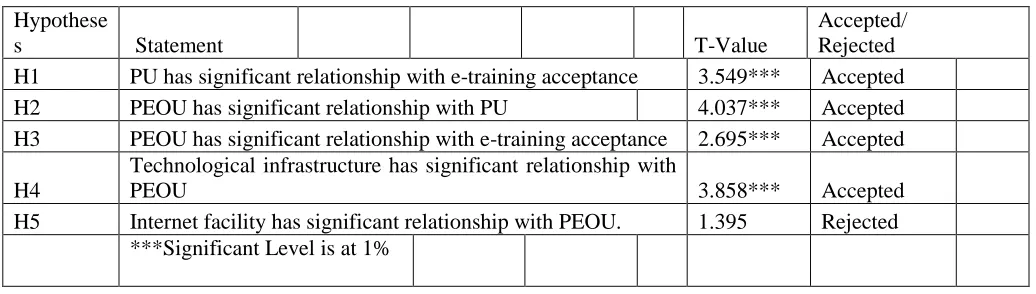
209 The t-value significance level was calculated by a two- tailed estimation (Hair et al., 2013). Base on the t-value rule of thumb for interpretation for two tail relationship (1.65 = 10%, 1.96 = 5% and 2.57 = 1% significance level respectively), Table 3 presents the result of hypotheses testing.
Table 3: Results of Hypothesis
Hypothese
s Statement T-Value
Accepted/ Rejected
H1 PU has significant relationship with e-training acceptance 3.549*** Accepted
H2 PEOU has significant relationship with PU 4.037*** Accepted
H3 PEOU has significant relationship with e-training acceptance 2.695*** Accepted
H4
Technological infrastructure has significant relationship with
PEOU 3.858*** Accepted
H5 Internet facility has significant relationship with PEOU. 1.395 Rejected
***Significant Level is at 1%
Table 3 shows that H1, H2, H3 and H4 were supported at 1 per cent statistical significance (t=3.549, 4.037, 2.695 and 3.695 respectively, t > 2.57). This indicates that all variables of this paper with the exception of internet facility have effect in e-training acceptance.
5. Conclusion/Implication
The purpose of this paper is to examine the role that availability of resource has in e-training acceptance in the Nigerian civil service taking into consideration the PU and PEOU of the system. Availability of resources in this paper has two dimension; technological infrastructure and internet facility.
The framework of this study was proposed to assess the acceptance of e-training in the Nigerian civil service. This study included critical factors and tested them with SmartPLS 2.0. The results of this paper show the Nigerian scenario particularly the civil service.
E-training acceptance is important and necessary in organisations and studies have been assessing this in several settings and cultures in order to meet up with the trend in technology. The findings of this paper show the effect of each variable examined. Both TAM constructs and technological infrastructure were found to have significant effect on e-training acceptance. However, internet facility was not significant in this paper.
As stated above, the findings of this study establish that PU and PEOU have direct significant influence on e-training acceptance as well as PEOU having effect on e-e-training acceptance through PU. This shows that perceived belief and attitude are crucial in technology acceptance. This result is contrary to the findings of Purnomo and Lee (2013) However, this paper’s result agrees with other studies results on this relationship (Lee et al., 2011; Rym et al., 2013). The findings of this paper with regards to the two key TAM constructs indicate that the heads of departments in the Nigerian civil service perceive e-training as useful and have the confidence and belief that they can operate the system. The result of this paper reaffirms the predictive strength of PU and PEOU in technology acceptance.
210
The findings indicated that internet facility did not have effect on e-training acceptance. This finding is contrary to findings of Jebakumar and Govindaraju (2009). This result indicates that internet facility is not influential in determining the acceptance of e-training in the Nigerian civil service. Although it has been agued repeatedly that availability of internet facility is a critical factor in technology usage, this study result shows the negative issues that surrounds internet in Nigeria (Bankole, 2013), that there is sceptic perception about involvement of internet in e-training acceptance.
This paper showed that e-training as an alternative to conventional training can positively affect organisations in developing countries, particularly Nigeria. Indicating that with e-training, organisational performance could be much better and particularly making the civil service move forward to another way of engaging as well as delivering knowledge to building a skilful workforce. Furthermore, the process of e-training acceptance could motivate decision-makers to seek support from higher authorities in the provision of resources to the ministries. This could help to improve the workforce thereby leading to more growth in the civil service and consequently contributing to the country’s growth.
In addition, more literature was generated with regards to e-training acceptance particularly in the Nigerian civil service. Furthermore, the predictive strength of the key TAM constructs was tested in a different setting to ascertain its ability in technology acceptance with regards to developing countries and particularly the Nigerian civil service. The literature showed contradictions on the researched constructs thus this paper confirmed the relationships of the researched construct with TAM showing the effects on how and why the said relationships exist. Empirically, four (4) relationships were supported with evidences.
This paper examined two external variables in addition to the TAM constructs as well as focusing only on the federal ministries in Nigeria; future research can investigate more critical factors. Furthermore, the scope of focus can be broadened by future research to include more stakeholders and other African countries. This can help in generalisation of results. In addition, this paper used SmartPLS 2.0, other soft-ware can be utilized for analyses which may give more significant results.
Reference
Amara, N. B., & Atia, L. (2016). E-training and its role in human resources development. Global Journal of Human Resource Management, 4(1), 1-12.
Bankole, O. M. (2013). The use of internet services and resources by scientists at Olabisi Onabanjo University, Ago Iwoye, Nigeria. Program, 47(1), 15-33.
Bhattacherjee, A., & Hikmet, N., (2008). Re-conceptualizing organizational support and its effect on information technology usage: evidence from the health care sector. The Journal of Computer Information Systems, 48(4), 69-75.
Chin, W. W. (1998). The partial least squares approach to structural equation modeling. In G. A. Marcoulides (Ed.), Modern Methods for Business Research (295-336). Mahwah, New Jersey: Laurence Erlbaum Associates. Chong, A. Y. L., Ooi, K. B., Lin, B., & Tan, B. I. (2010). Online banking adoption: an empirical
analysis. International Journal of Bank Marketing, 28(4), 267-287.
Davis, F. D. (1989). Perceived usefulness, perceived ease of use, and user acceptance of information technology. MIS quarterly, 13 (3), 319-340.
Davis, F. D., Bagozzi, R. P., & Warshaw, P. R. (1989). User acceptance of computer technology: A comparison of two theoretical models. Management Science, 35 (8), 982-1003.
Duarte, P., & Raposo, M. (2010). A PLS model to study brand preference: An application to the mobile phone market. In V. Esposito Vinzi, W. W. Chin, J. Henseler & H. Wang (Eds). Handbook of Partial Least Squares (449-485), Springer Berlin Heidelberg.
Ehikhamenor, F. A., (2003). Internet facilities: use and non-use by Nigerian university scientists. Journal of Information Science, 29(1), 35-48.
El-Rufia, N. (2011). Reforming Nigeria: Reforming our dysfunctional public service. White paper. Retrieved from: http://el-rufai.org/reforming-our-dysfunctional-public-service/
Fornell, C., & Larcker, D. F. (1981). Evaluating structural equation models with unobservable variables and measurement error. Journal of Marketing Research 18, 39-50.
Geladi, P., & Kowalski, B. (1986). Partial least-squares regression: A tutorial. Analytica Chimica Acta, 185, 1-17. Hair Jr, J. F., Hult, G. T. M., Ringle, C., & Sarstedt, M. (2013). A Primer on Partial Least Squares Structural
211 Hair, J. F., Ringle, C. M., & Sarstedt, M. (2011). PLS-SEM: Indeed a silver bullet. Journal of Marketing Theory
and Practice, 18, 139-152.
Harfoushi, O., & Obiedat, R. (2011). E-Training Acceptance Factors in Business Organizations. iJET, 6(2), 15-18. Hsbollah, H. M., & Idris, K. M. (2009). E-learning adoption: the role of relative advantages, trialability and
academic specialisation. Campus-Wide Information Systems, 26(1), 54-70.
JebaKumar, C., & Govindaraju, P., (2009). Virtual learning environment: A study of virtual learning environment with reference to perception of college students in Tamilnadu (South India). Communication policy research South 4th Conference, Negombo.
Lee, Y. H., Hsieh, Y. C., & Hsu, C. N. (2011). Adding Innovation Diffusion Theory to the Technology Acceptance Model: Supporting Employees' Intentions to use E-Learning Systems. Educational Technology & Society, 14(4), 124-137.
Lee, Y. H., Hsiao, C., & yah, S. H, Purnomo, S. H. (2014). An empirical examination of individual and system characteristics on enhancing e-learning acceptance. Australasian Journal of Educational Technology, 30(5). McKay, E. and Vilela, C. (2011). Corporate sector practice informs online workforce training for Australian
government agencies: towards effective educational-learning systems design. Australian Journal of Adult Learning. 51(2), 302.
Mohsin, M., & Sulaiman, R. (2013). A study on e-training adoption for higher learning institutions. International Journal of Asian Social Science, 3(9), 2006-2018.
Nchunge, D.M., Sakwa, M. & Mwangi, W. (2013). Assessment of ICT infrastructure on ICT adoption in educational institutions: A descriptive survey of secondary schools in Kiambu county Kenya. Journal of Computer Science & Information Technology, 1 (1), 32-45.
Obi-Anike, H. O., & Ekwe, M. C. (2014). Impact of training and development on organizational effectiveness: Evidence from selected public sector organizations in Nigeria. European Journal of Business and Management, 6(29), 66-75.
Ong, C. S., Lai, J. Y., & Wang, Y. S. (2004). Factors affecting engineers’ acceptance of asynchronous e-learning systems in high-tech companies. Information & management, 41(6), 795-804.
Osborne, J. W. (2010). Improving your data transformations: Applying the box-cox transformation. Practical Assessment, Research & Evaluation, 15, 12, 1-9.
Özgen, C. (2012). Toward an understanding of acceptance of electronic performance support systems: What drives users ‘perceptions regarding usefulness and ease of use? Doctoral dissertation. Middle East Technical University.
Purnomo, S. H., & Lee, Y. H. (2013). E-learning adoption in the banking workplace in Indonesia an empirical study. Information Development, 29(2), 138-153.
Ramayah, T., Ahmad, N. H., & Hong, T. S. (2012). An assessment of e-training effectiveness in multinational companies in Malaysia. Educational Technology & Society, 15(2), 125-137.
Ringle, C. M., Wende, S., & Will, S. (2005). SmartPLS 2.0 beta: University of Hamburg, Hamburg. Retrieved from http://www.smartpls.de/forum/index.php.
Rym, B., Olfa, B. & Mélika, B. M. B. (2013). Determinants of E-Learning Acceptance: An Empirical Study in the Tunisian Context. American Journal of Industrial and Business Management, 3(3), 307-321.
Selim, H.M. (2007). Critical success factors for e-learning acceptance: Confirmatory factor models. Computers and Education, 49(2), 396-413.
Venkatesh, V., & Davis, F. D. (2000). A theoretical extension of the technology acceptance model: four longitudinal field studies. Management science. 46(2), 186-204.
Yiong, B.L.C., Sam, H.K. & Wah, T.K. (2008). Acceptance of e-learning among distance learners: a Malaysian
perspective. Proceedings: Ascilite Conference. Retrieved from: