© Global Society of Scientific Research and Researchers
http://ijcjournal.org/
Distributed Denial of Service Attack Challenges in Cloud
Computing: A Review
Adesegun O. A.
a*, Izang A. A
b, Nzenwata J. Uchenna
c, Udosen Alfred Akpan
da,b,c,dDepartment of Computer Science, School of Computing and Engineering Sciences Babcock University,
Ilishan-Remo, PMB4005 Ogun State, Nigeria
aEmail: [email protected]
bEmail: [email protected]
cEmail: [email protected]
dEmail: [email protected]
Abstract
Cloud computing as an ever-evolving technology has appeared to be a new discovery, with a history that can be traced to the 1960s, yet the computing paradigm has not been fully adopted till date. This is due to the security and trust management issues associated with the paradigm. Studies so far have shown remarkable efforts in the area of cloud computing security but has paid little attention to the area of application-based denial of service and its distributed variant. To this end, this paper highlights the Extensive Mark-up Language Denial of Service (XDoS) and the Extensive Mark-up Language Distributed Denial of Service (XDDoS) as one of the security challenges that inhibit the adoption of cloud computing. So many researchers in this field have proposed different solutions to this issues, however, it was observed that there is a need for an efficient and more effective counter-measures solution against XDoS and its distributed variant XDDoS which are application based denial of service that can be found in software as a service (SaaS) cloud computing service model.
Keywords: Cloud Computing; Distributed DoS; Extensive Mark-up Language XDoS; Infrastructure as a
Service; Platform as a Service and Software as a Service.
1. Introduction
Cloud computing, which appears to be a new discovery, but it has a history that can be traced to the 1960s. The 1960s was the era of mainframe computers. Innovations of that time led to the change of how mainframe computers were used.
---
Their usage was predicated on direct access, one user at a time to complete the many tasks. After a few years, timesharing was introduced. This implied that multiple users could use the mainframe servers. By the 1970s, mainframe users saw the first implementation of virtualization and symmetric multi-processing. It was during this era that John McCarthy stated that “Computation may someday be organised as a public utility” [1]. There was a further shift in how computing was done by the 1980s from the centralized paradigm of computing to the client server approach. The development of communication systems helped facilitate the shift. As a result companies could have their application software installed on a server and through the communication media, access those applications and data from desktop computers. The disadvantage to this shift was an initial heavy capital expenditure in the purchase of hardware. The Internet and its protocols were standardised in the 1990s and as a result a company named SalesForce was able to host and distribute customer relationship management software over the internet on a subscription basis by 1995. SalesForce on its website force.com was also able to host a platform on their servers that enabled developers to build applications hosted on their servers. It was at this point that virtualization of hardware (that is, the creation of a guest machine inside a host machine) was just gaining popularity [2]. Many definitions have been given in relation to cloud computing but this research having gone through, defines it as an on-demand resource sharing that is based on the internet as the communication medium between devices used. Essentially there is an abstraction between the resources being shared and the architecture the cloud service provider employs to deliver those shared resources. Several resources could be shared ranging from infrastructure, platforms and software among others.
2. Characteristics of Cloud Computing.
Ease of Use: One of the criteria for any computing paradigm to be classified as cloud computing is for resources to be requested for when needed and released to the cloud service provider when not needed [3].
At-Scale/Elasticity: With cloud computing, because users can request for resources as needed there is disillusionment that, there is an infinite amount of resource available for use [4]. For instance, with the use of Dropbox cloud storage facility, one pays for whatever capacity one requires to store data and can increase this storage capacity as the need arises. Abstraction: An important characteristic of the cloud computing model is its reliance on abstraction, such that the details of how the cloud service provider delivers the service is not shown or known by the client; that is, the infrastructural architecture is hidden from the user [2]. For instance, how many racks of servers, routers, and switches and so on which the provider uses in providing its services are not known to the client. All that the client wants is value for services paid for. This has to reach a minimum standard. Usually a legal document called the Service Level Agreement (SLA) is signed by the provider and client to ensure that their money’s worth of services are delivered.
Multi-tenancy: A single implementation or set up by a cloud service provider is able to serve several clients [4]. For instance Google Apps can be used by many people at the same time without any conflict.
dynamically created and paid for by the client. All those virtual machines would have their operating systems and would be used as different computers, thereby maximising the cloud provider resources. This wouldn’t have been the case if virtualization were not used.
Automation: Without manual intervention, it is possible for the cloud environment to dynamically allocate more resources to users as needed [2]. For instance, if a user is running a processor intensive task, instead of the program hanging and not responding, the cloud automatically allocates more processing capacity to that virtual machine. Once that program is done, executing the extra processing capacity is withdrawn.
Metered Billing: This is otherwise known as pay as you go. In this characteristic of the cloud computing, cloud service providers’ customers/clients are liable to only pay for whatever resources they use [5]. Clients no longer need to worry about the initial cost of purchase of any equipment or commit to a level of usage of resources provided by the cloud service provider. This model makes it easy for small and medium enterprises to have computer resources without too much investment in technological set up of their enterprise. Just like the example above about automatic resource allocation of processing capacity as needed, at the time the server is running a processor intensive task the customer would be billed. As soon as that program is done executing that extra allocation of resource is released, leaving the user to only pay for services rendered. In other words a pay-as–you-go approach is used.
Broad Network Access: Cloud computing resources are available over networks, which encourages the use of thin and thick clients such as tablets, mobile phones, laptops among others [6]. This enables users to access their resources more flexibly. Depending on the architecture users may be able to have access to and use the resource they paid for anywhere in the world through the use of the internet as a medium between the cloud service providers and cloud service providers’ client.
2.1 Review of Related Works
approaches in the cloud with their various advantages and disadvantages. As a result of the preceding problem statement, objective and methodology the researcher concluded that firewalls are not sufficient to deal with security issues in cloud computing. They made a case for the use of IDS systems in the cloud computing environment. Lonea, Popescu & Tianfield reported that cloud computing has numerous challenges. They highlighted the fact that among these challenges, security issues are major challenges hindering the total adoption of the computing paradigm. As a result the paper alluded to the fact that of all the security issues DDoS is a major security challenge as confirmed by the International Data Corporation (IDC) in August 2008 [2]. The paper highlighted the fact that intrusion detection systems (IDS) are a good way of mitigating DDoS and assuring usable cloud computing services. However the problem with this method is that the IDS sensors generate a lot of false positives. This problem is the main problem their paper tries to address. As an add-on the paper also tries to address the problem analysis of logs generated by the IDS sensors. The main objective of the study was to detect and analyse DDoS attack in cloud computing environment. The researchers intended to complete this objective by completing a thorough review of related works, analysis and understanding the Dempster-Shafer Theory which is the algorithm they proposed in their Virtual Machine (VM)-based IDS. The paper used an experimental research design whereby the researchers used Dempster-Shafer Theory (DST) operations in 3-valued logic and Fault-Tree Analysis (FTA) for each VM- based Intrusion Detection System. The cloud topology as depicted in figure 1 was used in this research.
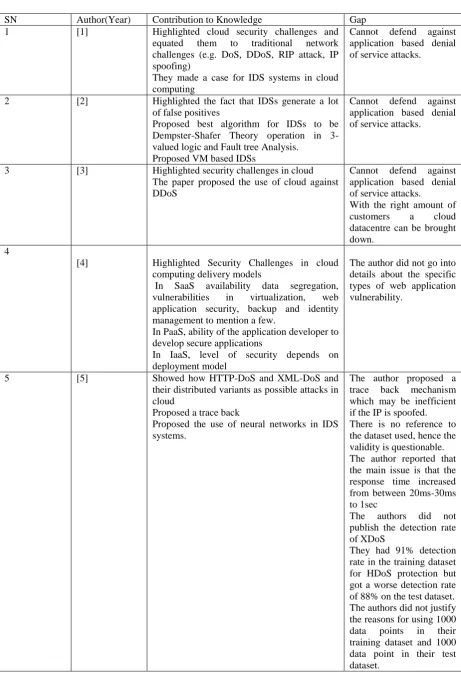
Table 1: Summary of Reviewed work and their shortcomings
SN Author(Year) Contribution to Knowledge Gap
1 [1] Highlighted cloud security challenges and
equated them to traditional network challenges (e.g. DoS, DDoS, RIP attack, IP spoofing)
They made a case for IDS systems in cloud computing
Cannot defend against application based denial of service attacks.
2 [2] Highlighted the fact that IDSs generate a lot of false positives
Proposed best algorithm for IDSs to be Dempster-Shafer Theory operation in 3-valued logic and Fault tree Analysis.
Proposed VM based IDSs
Cannot defend against application based denial of service attacks.
3 [3] Highlighted security challenges in cloud
The paper proposed the use of cloud against DDoS
Cannot defend against application based denial of service attacks.
With the right amount of customers a cloud datacentre can be brought down.
4
[4] Highlighted Security Challenges in cloud computing delivery models
In SaaS availability data segregation, vulnerabilities in virtualization, web application security, backup and identity management to mention a few.
In PaaS, ability of the application developer to develop secure applications
In IaaS, level of security depends on deployment model
The author did not go into details about the specific types of web application vulnerability.
5 [5] Showed how HTTP-DoS and XML-DoS and
their distributed variants as possible attacks in cloud
Proposed a trace back
Proposed the use of neural networks in IDS systems.
The author proposed a trace back mechanism which may be inefficient if the IP is spoofed. There is no reference to the dataset used, hence the validity is questionable. The author reported that the main issue is that the response time increased from between 20ms-30ms to 1sec
The authors did not publish the detection rate of XDoS
The paper compiled various suggestions by other researchers in the field as well as suggested some solutions to the highlighted problems in cloud computing. Chonka, Xiang, Zhou & Bonti described cloud computing as cloud service providers renting out spaces on their physical machines for a specific amount of time. They pointed out that space on the physical machine could mean dynamic virtual machines and flexible hosted software services. They added that each machine and software share the notion that delivered resources should be allocated and de-allocated on demand and at the same time providing real performance. Studies in this paper, conducted by E-Crime Congress and KPMG showed that online customers are most at risk as time goes by reporting 60% poisoned websites and 40% of their respondents reporting an increase in technical sophistication of attacks. They described DDoS as node systems attacking one node all at the same time, flooding it with messages in order to use up its networking resources or crash the application [10]. Fowler stated that it is usually better for corporations to pay ransoms than to see their systems go off line as a result of DDoS. Their paper tried to establish the fact that there could be other variations of the DDoS such as the Hyper-text Transport Protocol Denial of Service (HTTP-DoS) and Extensible Mark-up Language Denial of Service (XML-DoS) as well as their distributed version which could be from multiple points to a single primary victim. The aim of their study was to show how to protect cloud computing against HTTP-DoS and XML-DoS. In order to meet up with this main objective the researchers did a review of related works, they showed how this kind of attack is possible in the cloud computing environment of SaaS using real attack traffic as provided by the StuPot project and they also showed how to mitigate this problem using their Service Oriented Trace-back Architecture [11].
3. Conclusion
Form the review, it can be observed that most of the proposed solutions to detect or militate against application based DDoS (XDoS and XDDoS) in cloud computing by current researches do not effectively and efficiently solve the problem (see table 1) hence a counter-measure for XDDoS attacks in cloud computing service model is required, so that the cloud computing paradigm can be fully adopted by organisation, knowing that their businesses would not be hampered by XDoS and its distributed variant. Cloud computing as one of the recent trends in the world of Information Technology which has come with numerous benefits as highlighted in the earlier part of this paper has come to stay and should be adopted as a new paradigm by organizations and business owners. Cloud computing as a technology has a lot of challenges and issues associated with it which include, trust issues, security issues, insider threat issues, quality of service of cloud providers, reliability and availability of data, etc. this issues has hindered its adoption for a while now, but despite all this issues, companies keep migrating to the cloud on a daily basis.
4. Recommendation
References
[1] P. Zaroo, "A Survey of DDoS attacks and some DDoS defense mechanisms," Advanced Information Assurance (CS 626), 2002.
[2] ARBOR, "The Importance of On-Premise DDoS Protection," ARBOR NETWORKS, 2013.
[3] R. Arora and K. S. Bajaj, "Highly Effective Advanced Technology "HEAT" Re-defining Technology for Hospital Management," International Journal of Management & Behavioural Sciences, vol. Special Edition, pp. 68-73, March 2013.
[4] Skillsoft, "Cloud Computing Basics," 2013.
[5] CISCO, "Cisco Cloud Computing - Data Center Strategy, Architecture and Solutions. Point of view white paper for U.S. public sector," Cisco Systems, Inc., 2009.
[6] C. Gong, J. Lui, H. Chen and Z. Gong, "The Characteristics of Cloud Computing," in International Conference on Parallel Processing Workshops, 2010.
[7] F. Fan, F. Lei and J. Wu, "The Integration of Cloud Computing and the intrction," in Networked Computing and Advanced Information Management (NCM), 2011 7th International Conference, Gyeongju, 2011.
[8] P. Mell and T. Grance, "The NIST Definition of Cloud Computing (Recommendations of the National Institute of Standards and Technology)," National Institute of Standards and Technology US Department of Commerce, Gaithersburg, MD 20899-8930, 2011.
[9] C. Modi, D. Patel, B. Borisaniya, H. Patel, A. Patel and M. Rjarajan, "A survey of intrusion detection techniques in cloud," Jornal of Network and Computer Applications, pp. 42-57, 2013.
[10] A. M. Lonea, D. E. Popescu and H. Tianfield, "Detecting DDoS Attacks in Cloud Computing Environment," International Journal of Computing Communication & Control, pp. 70-78, 2013.
[11] F. Sabahi, "Cloud Computing Security Threats and Responses," in Communication Software and Networks (ICCSN), 2011 IEEE 3rd International Conference, Xi'an, 2011.
[12] S. Subashini and V. Kavitha, "A survey on security issues in service delivery models of cloud computing," Journal of Network and Computer Applications., vol. 34, no. 1, pp. 1-11, 2011.
[13] A. Chonka, Y. Xiang, W. Zhou and A. Bonti, "Cloud Security defence to protect cloud computing against HTTP-DoS and XML-DoS," Journal of Network and Applications, vol. 34, pp. 1097-1107, 2011.
![Figure 1: Private Cloud Topology [7]](https://thumb-us.123doks.com/thumbv2/123dok_us/8397938.1685368/4.595.129.468.380.738/figure-private-cloud-topology.webp)