17~. tions of 1939 and 1959 at the Athenian Agora, built into the Post-Herulian Wall and tower adjacent to the remains known as the Southeast Temple (Fig. 1).1 Among them is a series comprising marble Doric entablature blocks (A 1, B 1-3, C 1, 2, D 1-8), marble Doric column drums and capitals (E 1-6), one Doric anta capital (F 1), and several related wall blocks (G 1-8). The entablature series consists of an epistyle block, three epistyle backers, eight triglyphs, and two metope fragments, all of which had apparently been re- used together on a structure of the early Roman period.2 The re-used column drums and capitals belong to four columns of milky white marble which, because of their scale and finding place, have been associated with the same Roman structure. The anta capital has the upper part of the anta shaft carved on it; this shaft has a width which is the same as the lower diameter of the columns and therefore presumably was employed along with the columns in their second use. Incorporated into the wall as well, just beneath two of the epistyle backers, are five wall blocks which were set in a row; these are of the same milky white marble-used for the columns and are to be associated with them. Other blocks from this series now lie on the ground near by.
' See p. 421 below. I would like to thank Alison Adams most warmly for her interest and help in this study, particularly for the dating of the pottery for which she secured the expertise of Kathleen Slane. I am indebted to Evelyn Smithson, Evelyn Harrison, and John Traill for their help and thoughtful sugges- tions concerning some of the following material and to my wife for reading the manuscript and making further valuable suggestions. Both the temples dealt with in this article were carefully excavated and recorded by Dorothy Burr Thompson. The drawings initialed A. P. were made by A. Petronotis in 1964. This article emanated from the desire of H. A. Thompson to have a comprehensive study made of the Southeast Temple; his work with and identification of the re-used architectural members which appear herein, including those from Sounion, were crucial to this study, and his later comments have been most helpful.
Works frequently cited will be abbreviated as follows:
Agora XIV = H. A. Thompson and R. E. Wycherley, The Athenian Agora, XIV, The
Agora of Athens, Princeton 1972
Guide3 = H. A. Thompson, The Athenian Agora, A Guide, 3rd ed., Athens 1976
Thompson, "Agora: 1951" = H. A. Thompson, "Excavations in the Athenian Agora: 1951," Hesperia 21, 1952, pp. 83-113
Thompson, "Agora: 1959" = H. A. Thompson, "Activities in the Athenian Agora: 1959," Hesperia 29, 1960, pp. 327-368
2 Indications of an early Roman date for the re-use are the hook clamps and mason's letters (see
footnote 42 and Figs. 5, 7). Also indicative is the fact that the structure must have been demolished shortly
after the Herulian invasion of A.D. 267 in order for its components to be incorporated into the Post-Heru-
lian Wall, and therefore it must have been erected earlier during the great building programs of the 1st and 2nd centuries after Christ.
American School of Classical Studies at Athens is collaborating with JSTOR to digitize, preserve, and extend access to Hesperia
i~~~~~0i
TEMPLE OF ARES
Li
~~~~~~~~~~0
ODEION
ALTAR OF
ZEUS AGORAIOS(7) JI
BASE ATHENA *0L
I14012 S 654
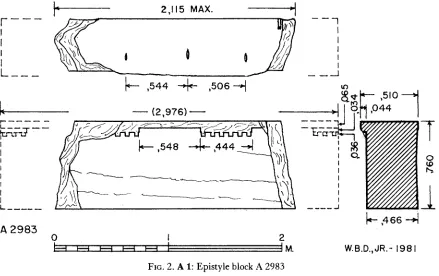
The most informative piece from the Doric entablature series is the epistyle block A 1 (Fig. 2). Below the taenia are preserved a complete regula, a complete interspace, and the beginning of another regula; these give, for the frieze above, widths of 0.444 m. and 0.548 m. for the triglyphs and metopes, respectively, most uncanonical proportions since a tri- glyph of 0.444 m. should be accompanied by a metope of ca. 0.666 m. Although the block is broken away at both ends, we know from the fact that it continues beyond both regulae that it was of the elongated type with two full regulae and two half-regulae at the ends, with a restorable length of 2.976 m. (Fig. 2).4 On its top surface are pry holes which indicate that the superposed triglyphs and metope-backers had been separate blocks and that, on this member, they were pried into place from their left sides.
3The catalogue of blocks may be found at the end of this article on pp. 438-451.
K
-544-
506 tok ~~~- (2,976)- T1l hP044
k-,548 -444
4T
KI0..0
K
.466-A 2983
0 1 2
F=:q P=I I !M. W.B.D.,JR.- 1981 1 - - -
FIG. 2. A 1: Epistyle block A 2983
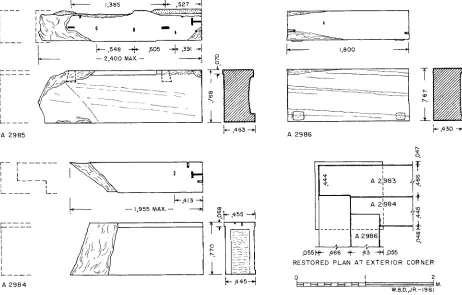
The backer blocks for the epistyle are less informative. Two of them, B 1 and B 2, retain large, deep T-clamp cuttings from their original use and hook-clamp cuttings from their second use (Fig. 3); they also have hook-clamp cuttings at the back for attachment to the epistyle, as does the epistyle block itself for attachment to them. There are pry holes on top for prying the antithema blocks of the frieze into place, and since they bear no relationship to the spacing of the frieze units, it is apparent that the jointing of the antithemata ignored that of the frieze. One of the two epistyle backers, B 2, has two lewis cuttings for lifting it into place.5 If one were to assume that the cuttings were spaced symmetrically for equilib- rium during lifting, the block would have been 2.439 m. long, which is 0.537 m. shorter than the epistyle block; in this case an improbably small amount of only 0.039 m. would have been broken off at its left end, an almost impossible occurrence because of the nearly horizontal striations of the marble (Fig. 3). Since this is the only extant block of the series to have lewis cuttings, it is more reasonable to assume that it was of the full length of 2.976 m. and was the last one to be laid in its course, probably over a central columnar spacing.6 If so,
I The crudeness of workmanship both of the right lewis cutting and of the T-clamp cuttings in gener-
al suggests a pre-Sullan date in the 2nd century B.C. for the original carving of the epistyle series. The
buildings from which the epistyle and frieze members originally came must have been destroyed by Sulla in 86 B.C. in order for these components to have been available for re-use.
6 Lewis cuttings were asymmetrically placed at times on long blocks in order, apparently, to allow one
1,385 54 527 -
_ fl=
0~~~~~~~
I 4,~~~548 + 605 +,9 *1,800A
2,400 MAX.-
0
=
~~~~~~~~~~~7T - :-=-=-d-T-
A 2985 A 2986
OD
I [_ _ _ n I _ | | | t ~~~~~~~~~~~~~A 2l986 F4
0~~~~~~~~~~~~~~~~~~0
I4- -I 95 MH 04|
I i ~~~~~~~~~~~~~~~RESTORED PLAN AT EXTERIOR CORNER
A 2984
1
A 2 MW.B.D.,JR -1981
FIG. 3. B 1-3: Epistyle backers A 2984-A 2986
the epistyle block A 1 was most probably not from the same span since the left clamp cutting which connects the backer B 2 to the epistyle has no corresponding mate on A 1.
The third backer block, A 2986 (B 3), was not re-used but was cut in Roman times to supplement the others (Fig. 3). It is of a complete length of only 1.800 m. and has no T- clamp cuttings on top, merely cuttings for hook clamps. Vestiges of two lifting bosses remain on the exposed face. Unlike its companions, which have well-carved bands of anathyrosis at three edges of each end, this block has only a single vertical band of anathyrosis on the left end and none on the right, and both ends are very roughly picked. It seems probable that the right end was hidden in wall construction.
I' - t6v'-~<xj F-wes /A
e 1271
h 108 -
- ,557- - - ,33 MAX. ,15
-, 0i=-<X 26 '11(
013 3
L
< I RON
0)
~~~~~~~~~~A 3000
___ ~~~~~~~~0 50
W. B. D.,JR.- 19 81
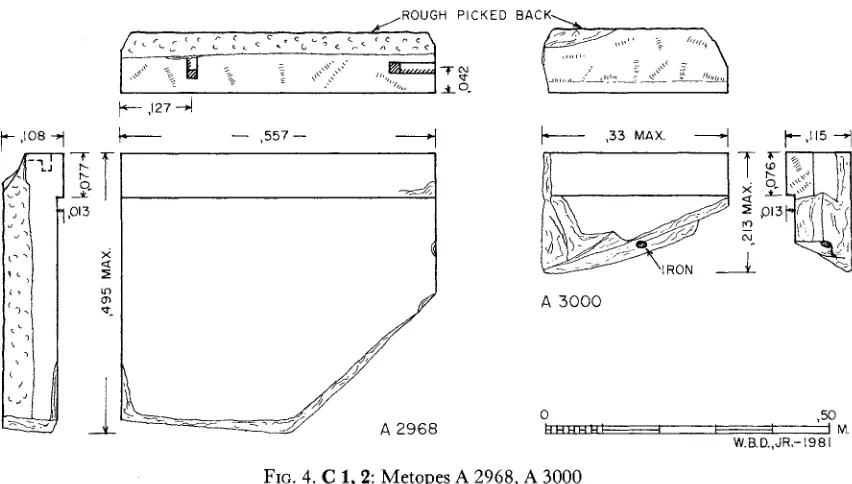
FIG. 4. C 1, 2: Metopes A 2968, A 3000
series of epistyle backer blocks. This was cut off ca. 0.073 m. at the bottom and cut back ca. 0.03 m. at the front; the large, deep T-clamp cutting, useless for the block as a triglyph since it lies too close to the metope, and the hollowed back, with top and bottom bands of anathy- rosis, are identical to the corresponding features on epistyle backer B 2 (Fig. 3).
The other seven triglyph blocks have a variety of styles, shapes, and sizes, with widths ranging from 0.488 to 0.573 m. (Figs. 15-17, 19-23) and depths from 0.39 to 0.7425 m. They originated in at least four different buildings which may be dated from the Classical to the Late Hellenistic period.7 They have one feature in common, however: they all were cut down to the same height in order to be re-used in the same building, and then from that building they found their way together to their final resting place in the late Roman tower dated after A.D. 267 (Fig. 1). Five of them bear each a setting letter, representing a series
from A to TI (Fig. 5), while the information on a sixth is lacking since the top is broken away.8 Alpha (A 2982: D 8) is a corner block, and beta (A 2978: D 4) was certainly the next in the series. When they are placed on our epistyle, with their widths of 0.503 and 0.573 m., only 0.424 m. remains for the width of the intervening metope, a dimension which is even less than that of the regula and superposed triglyph during the first use of the epistyle block (Fig. 10).
7 The widths of the triglyphs show that they belonged to buildings which varied in size from that of
the Hephaisteion up to that of some structure larger than the temple of Apollo at Bassai.
8 Of the three triglyph blocks which do not have setting letters, two, D 5 and D 6, are of a late type
A 2982 A 2978 A 2977 A 2976 A 2975 TRIGLYPH BLOCKS
A 3804
A 3449 A 3448 A 1598
Ifs'
A 3447 A1616 A 3451 A 1599
COLUMN DRUMS FROM SOUN ION
0 05 1
IM. W.B.D.,JR.-1981'
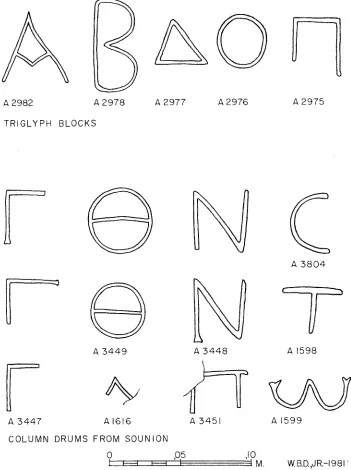
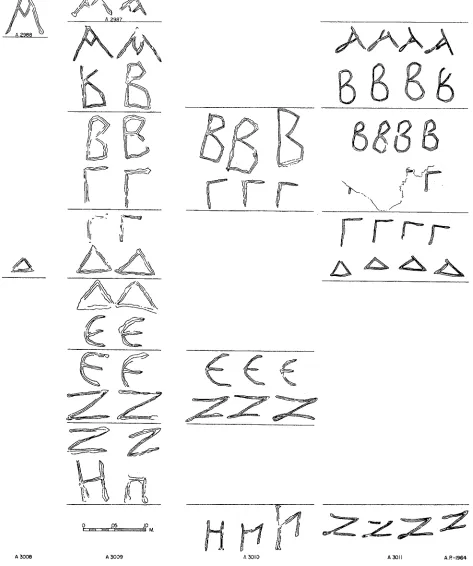
FIG. 5. Setting letters on triglyph blocks and on column drums from Sounion
It is generally accepted that the four Doric columns had been brought to Athens from the unfinished Classical "stoa" at Thorikos (Fig. 6).9 At that time, for resetting, their mem-
+
~~~00
010 20 30
M.
W.B.D.,JR.- 1981
FIG. 6. Plan of the "stoa" at Thorikos
bers were lettered in the typical fashion of the Roman period in alphabetical order, in this case starting at the capitals with A, AA, AAA, and AAAA (Figs. 7, 24, 25). The columns had not been finished at Thorikos (P1. 96:a), and the fluting, which had been started only at the bottom of the shafts and on the capitals, was completed in Athens (P1. 96:b).1I As stated
at the ends, was intended to serve, it was not that of a temple. Dinsmoor considered it to be a telesterion (The Architecture of Ancient Greece, London 1950, p. 196), and Stais suggests that it was a sanctuary (see Appendix, p. 451). The construction of the "stoa" probably never progressed above the column capitals since the one complete capital at the Athenian Agora was not smoothly finished on its top resting surface and has no cuttings for anchoring an epistyle (E 2a). It is most doubtful that even part of the building was finished since, had any of the entablature existed, the necessary elements from it would have been brought to Athens along with the columns. Figure 6 is taken from the Dilettanti Society, The Unedited Antiquities of Attica, London 1817, pp. 57-59, pls. 1-3.
A 2987
7 -5
A3008 A3009 A 3010 A3011 AP-1964
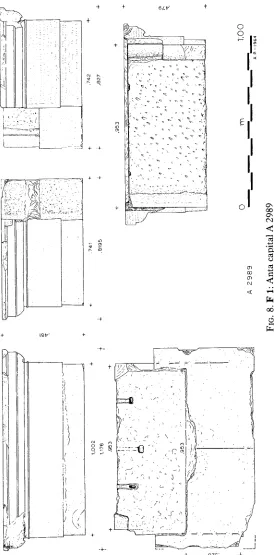
from Thorikos because the width of its shaft matches exactly the lower diameter of the columns.1 1 The capital, which was never entirely finished, has a perplexing feature. On its top surface at the back, where it joined either an extended spur wall or the corner of a cella wall, there are three hook-clamp cuttings, the middle one of which was mostly cut away when a rectangular area, with a width of 0.953 m. and a length exactly half the length of the block from back to front, was chiseled down 0.025 m. (Fig. 8). The outer two clamp cuttings were made at this time. No matter in what position in a building the anta is placed, it should have carried an epistyle which would have overlain both the original upper surface and the recessed surface. A supposition that the anta flanked columns in antis in the Roman period appears most unlikely, since an epistyle beam of the fapade, framing onto the capital from the side, would have had a width of bearing of only ca. 0.32 M.12 It seems most probable,
therefore, that the anta was used with a prostyle arrangement of columns; a problem during the construction of the building, caused most certainly by varying heights of material re- used at the epistyle level, must have forced the making of the recessed rectangular cutting which is only very slightly wider than the combined epistyle and antithema course. Another enigma concerning the block is whether it was re-used or was cut especially for the construc- tion of the Roman period. The cut-down top suggests re-use, but the form of the moldings near its top leads one to second thoughts. The hawksbeak molding is Classical in profile, close in form to that used at Bassai and of a shape which was discontinued in the second half of the 4th century B.C.; but the scotia behind it and the fillet below that are most un-Classi- cal. The capital, therefore, must be of the Roman period but copying the Classical type of hawksbeak, and the cut-down top was merely an adjustment made during construction of the building.13
The wall blocks, like the columns, are of Thorikos marble;14 they should be associated not with the Thorikos "stoa" (see above, footnote 9) but with some as yet unknown building or possibly with the temple of Dionysos beside the theater. Their prime interest to us is that they provide us with a wall thickness of 0.625 m. (cf. G 1-5; Fig. 26).15 Three blocks of the series are from a wider wall, or walls, with two rows back to back (G 6-8; Fig. 27). Since these three blocks vary in thickness and height, one cannot know the width of the original wall in which they were employed.
" Agora XIV, p. 167.
12 Limited by the recessed cutting and the projection of the capping moldings, over which it would not
have been allowed to bear.
13 Cf. Agora XIV, p. 167.
14 Like that of the columns, this marble is milky white, heavily striated with narrow blue-grey and
white laminations which clearly show its sedimentary limestone origin. As a result the marble both chips and fractures easily. At Thorikos the ground is covered with fragments of this material.
15 If their protective surfaces had been removed, their thickness would have been reduced by twice
+ 1,00R + ,, , . . 7 1.-f<r1 r^4 1 -
+~~~~~~~~~
L_ _ _ 0 . 1 0 '-- -} -' - I-
+ 1,002 + +.71+ +,4+Q
1176 + - ,8195 + 1 ,827 9 +
+ ,953 9
0~~~~~~~~~~~~~~~~~~~~~
+, - A G- 964
FIG. 8 F Anta capta A 2 989-- ? ?
69,439
0 0 69X0064857/ o 158,273
o g0 LI 6f38 X68,27
oo
g~~~~~~ 52070Q.tl
068,46 135 4S 2070b - 68,34 68,35
C~.-8,35 58,305
PAING8LOCK-7,4868,408
0 68,328-M Lti 68,35
70~~~~~~~~~~~~~
0 16:1
<
\
~~~~~~~~~~BLOCKS OF
\\ ~~~~~~~~~~~CLASSICAL MiNT
, ~~~~~SOUTHEAST TEMPLE SOUTHWEST TEMPLE
\ \10 5 10
\ \4 JR.-L1981 t- :-- i M. t 1 W.BS.D.,
FIG. 9. Actual-state plan of the Southeast and Southwest temples
Also from the same part of the Post-Herulilan Wall came three broken marble Dor'ic rakilng-geison blocks of the 5th century B.C. and parts of an early rakilng- and flank-sima
HYPOTHETICAL RESTORATION OF THE DORIC SERIES TO THE SOUTHEAST TEMPLE
The Southeast Temple was discovered in 1959, the same year in which many of the architectural members discussed above were found in the neighboring late Roman tower, a scant three meters to the northeast (Fig. 1). It was probably this coincidence of timing as much as the proximity of places of finding that helped to lead in that same year to the suppo- sition that the architectural members might well derive from the temple,16 which has been dated in the 1st century after Christ.17 We shall attempt here a restoration of this building using these Doric architectural components.
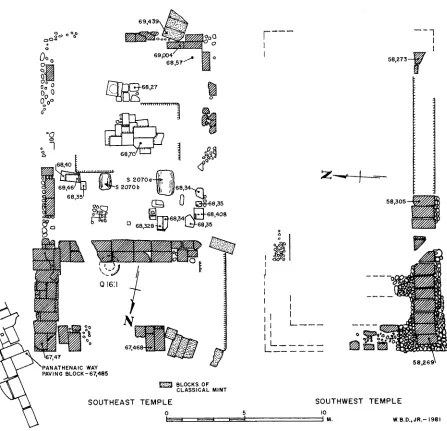
The temple consists of two parts, the cella and the pronaos, facing slightly west of north and commanding the approach up the Panathenaic Way toward the Akropolis (Fig. 1). The over-all structure was 20.30 m. in length, 11.20 m. across the cella, and ca. 12.10 m. across the deep pronaos (Fig. 9). Nearly centered in the cella was an enormous statue base, the cuttings for which measure ca. 6.70 x 4.40 m.; a number of the poros and conglomerate blocks of the core are still in situ. Parts of the side and back walls of the cella still stand. They are ca. 0.90 m. thick and are composed of re-used poros blocks and rubble, once covered with stucco. No separate foundations were employed, the masonry merely resting on shallow, irregular beddings.
At the rear corners of the cella, parts of an original floor of clay still exist, at an eleva- tion of 68.57 m. above sea level. This floor was cut down considerably below that of the pre- existing Mint of the late 5th century B.C., which the temple partially overlies (Fig. 1).18
The front part of the cella, however, in front of the statue base, was apparently paved; a number of miscellaneous underpinning blocks still remain, with cuttings on their top sur- face which indicate a floor composed of large rectangular slabs. Since the elevations of these supporting members vary from 68.297 to 68.408 m. above sea level, the slabs must have varied from 0.273 to 0.162 m. in thickness. Their other dimensions undoubtedly varied considerably as well. Two pry holes which exist on adjacent blocks indicate a width of 0.62 m. for one slab.
Of the pronaos nothing now remains except part of the lowest course of the founda- tions, which are of very different character from the side and back walls of the cella. They are composed primarily of large blocks, both poros and conglomerate, producing thicknesses for this course of 1.70 m. front, 1.40 m. side, and 1.35 m. rear, under the door wall. The ele- vation at the top of these foundations is 67.47 m. above sea level, or 1.10 m. below the cella floor. As could be expected, nothing of the floor of the pronaos is preserved.
If we turn now to the epistyle block A 1 which was found in the near-by tower and which gives modular widths of 0.444 m. and 0.548 m. for the superposed triglyphs and metopes, it becomes apparent that the front frieze course would have required twelve tri- glyphs and eleven metopes for a total length of 11.36 m. in order to fit with the foundations of 12.10 m. across the pronaos and with the dimension of 11.20 m. across the cella walls.
-P
T- -, Trp
2
T- /-Tt
A B r aM
1 1760 4- 1,984 2,976 44 1,984 4 1,760
67_485 67.47
0 1 2 3 4 5 10
M.
W.8.D.,JR.-1981
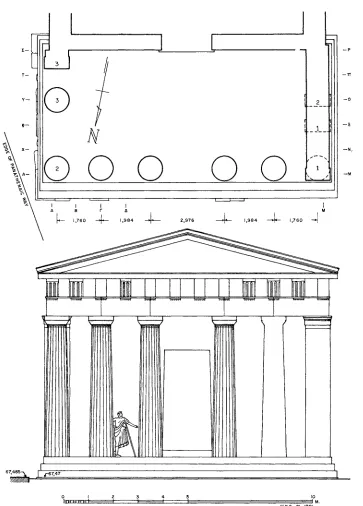
This arrangement forces a restoration of a widened central span with two intercolumnar triglyphs (our epistyle block of 2.976 m.) and narrower spans at either side with one inter- columnar triglyph (Fig. 10). The intermediate axial column spaces would become 1.984 m. and the end axial spaces 1.76 m.19 Since the Thorikos columns at the Agora have a lower diameter of 0.984/1.001 m., the intercolumnar spaces adjacent to the center one would become ca. 1.00 m. and the end intercolumnar spaces only ca. 0.76 m., which is less than the column diameters. Such a design is unprecedented.20
Another problem is that only four columns were brought from Thorikos, the A, AA, AAA, and AAAA series (Fig. 7).21 It seems most strange that six, or eight, columns would not have been transported to Athens since the architect presumably knew what he was doing and what was needed for the job. It is tempting, faced with this problem, to suggest that the building was tetrastyle in antis with anta capital F 1 and a corresponding anta terminating one of a pair of spur walls which ran the full depth of the porch; the location of the recess, 0.025 m. deep, on top of the anta capital rather negates the idea, however (see p. 418 above). We are more or less forced, if we use these columns here, to suppose that two mismatched columns would have been employed to fill out a hexastyle facade and that two additional mismatched columns would probably have been placed on the return of the flanks; these return columns would be most unsymmetrically located if they were to fall in canonical fashion under triglyphs (Fig. 10, column 2 to column 3 to anta 3).22
Subtracting the length of the stylobate (11.565 m.)23 from the width of the foundation
at the fagade (ca. 12.10 m.), only one half of ca. 0.535 m., or ca. 0.267 m., would be left for each side return of the crepidoma and euthynteria. The extant foundation must itself have been the euthynteria since (1) its northeast corner lies only 0.015 m. below the level of the closely adjacent paving block of the Panathenaic Way (Figs. 9, 10), meaning that if a higher euthynteria course were placed on the foundations it would most unconventionally have been exposed for its full height along the front of the temple, and (2) this foundation course is more carefully constructed than the to-be-hidden foundation, lying at the same level,
19 (2 x 0.444) + (2 x 0.548) = 1.984 m., (21/2 x 0.444) + (2 x 0.548) = 2.206 m.; edge of entablature to
flank tangent of corner column is ca. 0.055 m., giving 2.261 m. from which is subtracted one half the column diameter, or 0.5005 m., giving 1.76 m.
20 At Thorikos the columns were spaced a canonical 2.300/2.331 m. on center; the corner spaces were
2.128 m., and the widened space at the center of the flanks was 3.485 m.
21 It has been suggested that the third and fourth columns of the series, with lower diameters of 0.984
and 1.001 m., represent normal and corner columns (Thompson, "Agora: 1959," p. 341). The Dilettanti give measurements of 1.008 and 1.027 m. for the normal and corner columns at Thorikos, and so there seems to have been some variation. The lowest drums of 16 of the original 38 columns were still in situ at Thorikos in 1812 (Fig. 6).
22 Another possibility on the flanks is that there was an elongated spur wall with the anta brought for-
ward part way from the cella wall toward the corner column, thus eliminating the need for columns on the returns. See positions of column 1 to anta 1 and of column 1 to anta 2 on Figure 10. Such a solution with
no columns in antis was not often used, however. For examples where it does appear, see the temples of
Artemis-Cybele at Sardis; Athena at Paestum; Athena at Lindos; Zeus Sosipolis and Tyche at Magnesia-
ad-Maeandrum; and, closer to home, Temple C at Corinth, after A.D. 77.
23 Axial spacing between corner columns: 2.976 + 2(1.984) + 2(1.76) = 10.464 m. Add to this twice
one half the column diameter, or 1.001 m., plus twice 0.05 m. from edge of column to edge of stylobate, or
A 2988 EL.66122
ELEV. ,00 ENDOF PAVIN
0 10 20
M. W.B.D.,JR.- 1981
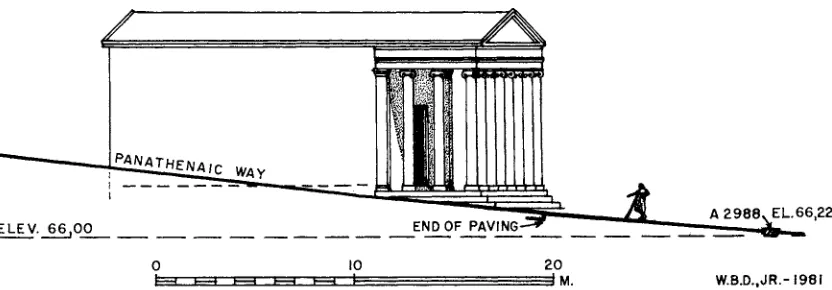
FIG. 11. Section through the Panathenaic Way with the Southeast Temple in elevation
under the front wall of the cella (P1. 96:c, d), although the preserved east flank of the foun- dation/euthynteria was itself hidden by the rapidly rising incline of the Panathenaic Way (Fig. 11). Since the top of the euthynteria course lies at 67.47 m. above sea level, and the floor of the cella lies at + 68.57 m., a difference of 1.10 m., there must have been four intervening steps with risers of 0.275 m. each; one of these would have been for the thres- hold, to step up from the pronaos to the cella floor, thus leaving us a three-step crepidoma. Examining again the side returns of the crepidoma, we have ca. 0.267 m. from the edge of the stylobate to the edge of the euthynteria. From this, ca. 0.05 m. must be subtracted for the set-back from the edge of the euthynteria to the lowest step. We are therefore left with only ca. 0.217 m. for the two treads of the return, or token steps of ca. 0.1085 m. each (Fig. 10).
An additional problem which arises with any of the attempted restorations is the em- barrassing relationship that would result between the antae, or rather the spur walls back of them, and the flank walls of the cella. The distance across the spur walls would automatical- ly become 11.402 m. because of the front column spacings. The dimension across the cella walls is 11.20 m. Thus a jog of 0.101 m. would be created between the planes of the spur walls and cella walls, the surfaces of which should be the same (Fig. 10); according to ancient practice, it is only the widened anta itself which was allowed to project outward from this plane, 0.032 m. in the case of our anta.
Still another slight problem is caused by the wall blocks which were brought from Thorikos. The greater number are the blocks which are dressed on both sides, with a thick- ness of only 0.625 m. Since the side and back walls of the cella are still partly extant, with a thickness of ca. 0.90 m., the only possible location for the narrower blocks is in the front wall of the cella, the foundation for which has a massive width of 1.35 m. To conform with the rest of the structure, this front wall should be at least 0.90 m. thick.
11.20 m. and across antae 11.264 m. The axial spacing of the antae, and therefore of the outer columns as well, would be 10.262 m. The axial spacings of the six columns can be calculated as being 1.915 m. for the corners and 2.145 m. for the three normal ones, which is
ca. 0.17 m. less than those of the "stoa" at Thorikos. We are still faced, however, with the problem of having only four columns for a plan that needs six or, with the returns, more probably eight.
Since there are insurmountable difficulties in attempting to combine the Doric archi- tectural elements with the Southeast Temple, let us look further afield for a home for the members from Thorikos and for the accompanying entablature.
HYPOTHETICAL RESTORATION OF THE DORIC SERIES TO THE SOUTHWEST TEMPLE
In 1933 the scanty remains of what is called the Southwest Temple came to light. More work was carried out in 1951. Here again we have a simple plan with cella and pronaos, although this front porch is quite shallow (Fig. 9). The building, which faces almost true west towards the Tholos (Fig. 1), has been dated like the Southeast Temple in the early Roman period.24
The best preserved part of the structure is the foundation at its southwest corner, com- posed of large conglomerate blocks with a packing of stones and very poor, sandy mortar both under and built up against the sides of the blocks. The front wall of the cella is indicat- ed by the beginning of a cross wall of stone packing. The location of the back wall is some- what nebulous, but it must have turned north very shortly beyond the two fragmentary conglomerate blocks at the east end of the south flank wall. The crucial north flank wall, which would give the width of the building, is sketchily preserved in only one short stretch and consists of a very faint break in the stratigraphy, where the inner line of the foundation trench cut through, and of a few stones from the underpacking of the foundations that preserve mortar of the kind used on the south flank.25 According to these remains the temple measured ca. 20.50 m. in length, ca. 10.48 m. across the conglomerate blocks of the cella (repeating on the north the conditions on the south), and ca. 11.28 m. across the upper packing at the pronaos.26 The depth of the porch from the outer edge of the packing under the colonnade to the center of the front wall of the cella is 4.20 m.
It has been suggested that the Ionic material which was transported to the Agora from the temple of Athena at Sounion was used on this foundation,27 but only a maximum of six of the Sounion columns could have been accommodated here, and eight or more were brought to the Agora. It seems much more likely that our Thorikos material, with four columns and the attendant entablature members, reposed on this narrower temple.28 There can be little objection to the distance of the Southwest Temple from the findspots of the
24 Thompson, "Agora: 1951," pp. 90-91; Agora XIV, p. 166; Guide3, p. 31. Its orientation is ascribed
to its setting with the massive Odeion blocking it to the east and the center of activities in that part of the Agora, from which the temple would be viewed, lying to the west.
25 Dr. John Travlos kindly provided the measurements which he took in 1951 for the location of the
remains of the north wall.
26 Published by H. A. Thompson as ca. 11.00 m. ("Agora: 1951," p. 90 and Agora XIV, p. 165). 27Agora XIV, p. 166. See H. A. Thompson, "Itinerant Temples of Attica," AJA 66, 1962, p. 200 and W. B. Dinsmoor, Jr., Sounion (guide), Athens 1974, pp. 42, 52 for the moving of the temple to Athens.
Tr 1E B r ~ ] MA
A B r f E Z K
2,750 -14- 2,976 2,750 A
0 I 2 3 4 5 0,E
u~~~~~~~~~~~~~SE
MAN
TO>H e[EW I , _ I | I I ~~~~~~~~~~~~~~~~~~~~~~~M.
WBD.,JR.- 1981
Doric members in the Post-Herulian Wall some 170 meters away since a ceiling beam weighing some 9400 pounds was transported to the same spot in the late wall from the temple of Ares, an even greater distance (Fig. 1).
If we now place the Doric epistyle block A 1 with its modular regulae of 0.444 m. and interspacings of 0.548 m. on this temple, we arrive at ten triglyphs and nine metopes, giving a total length of entablature of 9.372 m. This scheme demands four columns canonically spaced, 2.976 m. on center in the middle and 2.75 m. on center at the ends, with two tri- glyphs over each intercolumniation (Fig. 12).7 The axial spacing between corner columns was 8.476 m., and so the dimension across the corner columns was 9.477 m. Thus the distance across the stylobate was 9.577 m. Anta capital F 1 gives us a width of anta the same as the lower diameter of the column, 1.002 m. vs. 1.001 m. The distance across antae was therefore also 9.477 m. The return from anta to the attached spur wall back of it is 0.032 m., and so the distance across spur walls, and also across the walls of the cella, had to be 9.413 m. From the Thorikos wall blocks we have a wall thickness of 0.625 m. The cella walls were then 8.788 m. apart on centers. Since the conglomerate blocks of the foundation are ca. 1.40 m. wide, the foundation blocks of the flanks were ca. 10.48 - 1.40 = ca. 9.08 m.
apart on centers. Thus the center lines of the upper walls fitted very comfortably only ca. 0.146 m. within the center lines of the foundation walls below them.
The crepidoma under the columns certainly utilized the heavy stone packing which is still preserved in good part to the full height of the conglomerate foundation against which it abuts. The, space left for the steps and euthynteria on the flanks is ca. 11.28 - 9.577 (stylo-
bate width) = 1.703 m. 2 = ca. 0.85 m. This allows for a normal three-step crepidoma with two treads of 0.32 m. each and a projection of the euthynteria of 0.05 m., the latter leaving a comfortable margin of ca. 0. 16 m. to the edge of the stone packing below.
There are other benefits in utilizing this temple foundation for our Doric architectural components. With our wall thickness of 0.625 m., the clear depth of the porch from the edge of the stylobate would have been 3.04 M.30 The anta and spur wall projected 0.74 m. from the cella wall, and the center of the corner column in front lay 0.55 m. back from the edge of
the stylobate, giving a dimension of 3.04 - 0.74 - 0.55 = 1.75 m. On the top of anta capital
F 1 the depressed cutting, 0.025 m. deep and the same width as the spur wall, begins 0.32 m. behind the front face of the anta below. The distance from this cutting to the center of the corner column was therefore 1.75 + 0.32 = 2.07 m. (Fig. 12).
Let us now turn to the epistyle backer block B 3 with a length of 1.80 m. This is the Roman supplement to the series, with only hook clamps and no T-clamp cuttings. If one places this block to span between the anta and corner column, with its left end which has a vertical band of anathyrosis aligned with the edge of the cutting, 0.025 m. deep, on the anta
29 The width of abacus of capital E 2a is 1.006 m., the thickness of epistyle block A 1 plus backer B 3
is 0.466 + 0.43 = 0.896 m. The projection of abacus beyond epistyle is ?(1.006 - 0.896) = 0.055 m. (Fig.
3). The distance from the center of the corner column to the corner of the epistyle is therefore ?/2(1.006) -
0.055 = 0.448 m. The end column spacings are ?/2(9.372 - 2.976 - 2[0.448]) = 2.75 m.
30 Edge of packing to center of door wall is 4.20 m. From this we subtract 0.31 m. for half the wall
block that would have abutted B 3 at right angles, but this adjustment could not have been seen from below. Epistyle-backer block B 1 has a maximum preserved length of 1.955 m., broken off at the left end. If this were placed over the two last columns at the south, it would require a length of 2.732 m. to end at the back of the return block B 3. A partial overlap of the two members would then have occurred, but the broken-off end could well have been notched in canonical fashion at the re-entrant corner, 0.43 m. in this instance, so that both backers had sufficient bearing surface on the capital of the corner column (Figs. 3, 12). The exposed length of backer B 1 would therefore have been 2.732 - 0.43 = 2.302 m.
Epistyle backer B 2 has a preserved length, of full thickness for the entire length, of 2.40 m., and so could not have been employed as an end block. In fact, a case has already been made above, in the discussion of this member with its lewis cuttings, that it was most probably the last-laid backer over a central span. Here, therefore, it would have lain just to the north of B 1, over the central columns.
We are now left with the epistyle block from the front of the faade, A 1. It has been shown above that this member must have had an original length of at least 2.976 m., with two full and two half-regulae. Such a reconstruction would make it the central block in our series, back-to-back with B 2. But this is impossible since the more centrally located hook- clamp cutting on the back of the backer has no counterpart on our facing block. A 1 must therefore have been a corner block with three full regulae and one half-regula, with a length of 3.196 m. It could have come from either end but is shown at the south end of the building for convenience (Figs. 3, 12).
As previously mentioned, eight triglyphs (D 1-8), as well as two metope fragments (C 1, 2), were found together with the rest of the material and can safely be accepted as be- longing with the epistyle in its period of re-use since one of them, D 3, was made especially to fit with the epistyle. Five of the triglyphs have placing letters cut on their top surfaces. These are A, B, A, 0, and II. 0 and II, the 15th and 16th letters of the alphabet, must have appeared on the flank returns. Since there are ten triglyphs on the faade, we must restore three additional triglyphs, excluding the corner one, on each flank, a hypothetical (A), (M),
and (N) on the south,
(B),
0, and II on the north (Fig. 12).31The Southwest Temple is an attractive candidate for the Thorikos and related material not only because the members and foundations fit each other so well, and in a more or less canonical manner, but also because its siting for the display of our mishmash of elements is comparatively unobtrusive; the Southeast Temple commanded the Panathenaic Way so prominently that the architectural patchwork, if placed on it, would have been an eyesore to all visitors on their way to the Akropolis (Fig. 1).
31 With this restoration, a triglyph is not centered over the anta. This lack of relationship of elements
O JO .20
FIG. 13. Capital A 1595 from Sounion, restored
THE SOUTHEAST TEMPLE AGAIN, WITH HYPOTHETICAL RESTORATION OF AN IONIC SERIES Another architectural series,32 Ionic in style and originally from the temple of Athena at Sounion, was found in the same part of the Post-Herulian Wall from which came the Doric members we have now assigned to the Southwest Temple. This series from the wall is composed of twelve column drums, a complete capital and three fragments of others, and a fragment of a column base, found only a few meters from the Southeast Temple. Three other column drums, eight other fragments of capitals, a geison block, and part of the epi- kranitis were found scattered to the north and west of the temple in late context, i.e., late Roman, Byzantine, and Turkish. Another find, possibly important for the purpose of attri- bution, is a small fragment of the crowning molding of the epistyle course, too insignificant to be bothered with in later times; this little piece, A 2004, was found where it presumably had fallen in A.D. 267, or shortly after, when it very likely broke off during demolition of the Southeast Temple and landed directly in front of the building in late sandy fill.
The fifteen column drums which have been found to date come from a minimum of eight columns. They were marked with incised letters on their bed surface when they were being dismantled at Sounion, the same letter given to each of the four drums of any one column (Fig. 5). At the Agora the letters F, 0, A, N, II, C, T, and X are represented on twelve drums, while three drums do not preserve letters. Since we have both gamma and omega, the third and twenty-fourth letters of the Greek alphabet, it is probable that all twenty-seven of the original columns at Sounion were labeled, but we do not know if the Agora was the final destination for the entire lot. Apparently, no drums were left at Sou- nion. The capitals and fragments of capitals, including the one found in the area of the
32 This material will not be presented in detail at this time since it will eventually appear fully in
53! .1
.. .~~~~~~~~~~~~~~~~~~~~~~~~~~~~~~~~~~M
1,531
,_.. . ... . ._.... .. ...M0
W. S. D.,JR.- 1981
Agora and now in the National Museum, N.M. 4478 (cf. Fig. 13), represent a maximum of thirteen columns; it is probable that the number is slightly less, however, since two or three of the less distinctive fragments could have belonged to the same capital.
At Sounion the columns of the facade were spaced an average of 1.531 m. on center, while those of the only colonnaded flank were 1.667 m. on center. At the three corners of the original colonnade, the epistyle course employed six blocks which were mitered at their common joint over the corner columns. Three had lengths to fit the shorter column spacings and three to fit the wider ones.33 Since four corner blocks of the same length never existed, for the four blocks needed at the two corners of the colonnade as restored on the Southeast Temple at the Agora the same scheme as the original one would have had to be re- employed, a longer and shorter mitered block meeting over each corner column. The closer column spacings of the facade at Sounion had to be copied on the facade at Athens since eight columns with the wider spacing of 1.667 m. on center would have overhung the foun- dations of the Southeast Temple, and seven columns, with one directly in front of the door to the cella, would have been unthinkable. Eight columns at 1.531 m. on center work admir- ably with the width of 11.20 m. across the walls of the cella, however, where the antae, with a face of 0.599 m. to match the lower diameter of the columns above the apophyge, would have a normal return to the flank walls of the cella of 0.058 m. (Fig. 14). The eight columns also work adequately with the flank returns of the crepidoma, allowing 0.117 m. for the width of each of the steps, as compared to 0.1085 m. when one tries to place the Doric blocks and the columns from Thorikos on this foundation;34 but the narrowness of these steps would not really be a problem to anyone who wanted to enter the temple from the side since the incline of the Panathenaic Way was so steep at this juncture that the steps rapidly died out and at the anta one could step up directly onto the stylobate (Fig. 11). The stylobate of the one-step crepidoma at Sounion was probably brought to Athens and re-used since only one broken fragment of this course was found at Sounion.
On the flanks of the porch of the Southeast Temple the wider column spacing of 1.667 m. would have been employed, as was shown above from the lengths of the corner epistyle blocks. With two additional columns of this spacing on each flank, plus an appro- priate Ionic anta, the restoration is completed. Twelve of the columns from Sounion thereby find a home on the Southeast Temple where they actually create a building far more aes- thetically pleasing with its facade of eight columns than the original with its ten columns.
DATING OF THE TEMPLES
For the dating of the Southeast Temple, H. A. Thompson wrote that "the evidence is very slender, consisting as it does of little beyond a few handfuls of pottery gathered from
3 At Sounion, of the four mutilated epistyle blocks which were left behind, one is a corner block of the
longer type.
34 Seven spaces give 7 x 1.531 = 10.717 m. center to center of corner columns. To this add 0.716 m.
mortar in its foundations, would suggest ... the early Roman period."36
The pottery for dating the construction of the buildings is indeed meager, much of it unidentifiable and some lots containing obvious intrusions. The more informative material is presented here.
THE SOUTHEAST TEMPLE
1. From packing back of south wall:
Rim and shoulder fragment of a round-mouthed jug (Agora V: G 103, p. 32, pl. 7), 1st half of
2nd century after Christ or later.
Bowl fragment with West Slope decoration and body sherd from a spirally grooved conical bowl, both 2nd century B.C.
2. From packing against west wall:
Body fragments of coarse and cooking ware, noth- ing identifiable as earlier than 2nd century after Christ.
3. From cleaning bedding of west wall:
Fragment of Alpha Globule lamp (Agora VII: 436, p. 107, pl. 14), second half lst-early 2nd century after Christ.
Amphora toe (Agora V: K 113, p. 69, pl. 15), 3rd century after Christ (a handle from the same
type of amphora was found in post-destruction material).
4. From earth under conglomerate blocks of cult- statue base:
Rim of a beehive(?), perhaps Hellenistic or early Roman.
Wheel-ridged, coarse body sherds, not earlier than 3rd century after Christ.
5. From cleaning east wall bedding in pronaos: Rim of Eastern Sigillata B cup (Agora V: G 173,
p. 40, pl. 67), second half lst-first half 2nd cen- tury after Christ.
Red painted body sherd, 2nd century after Christ. Body sherd of an amphora with white slip on ex-
terior, 2nd century after Christ.
Other body fragments which could be 2nd century after Christ but not earlier.
As can be seen, of the identifiable pottery from the Southeast Temple almost nothing exists as early as the 1 st century after Christ. The material from the 3rd century after Christ is intrusive.37 We are then left primarily with sherds from the 2nd century which should date the construction of the building. Since the roof sima which originated with the temple of Poseidon at Sounion was most probably brought to Athens at the turn of the millennium to be re-used on the temple of Ares in the Athenian Agora,38 it must have come from a separate and earlier foray than the one in which the temple of Athena at Sounion was carried off. The transport of Athena Sounias, however, must have been carried out before Pausanias rounded Cape Sounion by ship in the middle of the 2nd century at which time he saw only the temple of Poseidon, which he was misinformed was the temple of Athena (Pausanias, i.1.1), and before the Nymphaion, apparently of the Antonine period, was
35 Thompson, "Agora: 1959," p. 343. 36 Thompson, "Agora: 1951," p. 91.
37 In group 3, the 3rd-century amphora toe is of the same amphora type as that found in post-destruc-
tion material, and in group 4, since none of the base blocks were removed, the sherds were gathered from the outer edges of the blocks and must be from destruction material.
38 W. B. Dinsmoor, Jr., "The Temple of Poseidon: A Missing Sima and Other Matters," AJA 78,
tightly wedged into the area between the Southeast Temple, the "Enneakrounos", and the East Building (Fig. 1).
The corroboration of a date in the first half of the 2nd century after Christ for the construction of the Southeast Temple comes from its relationship to the paving blocks of the Panathenaic Way. As mentioned above (p. 423), the foundation/euthynteria course which is still extant lies only 0.015 m. below the adjacent block of the roadway (Figs. 9, 14). The occurrence of similar levels at this point would have been most fortuitous if the construction of the temple had preceded the paving of the Panathenaic Way. The temple must therefore have been built after the paving was in place, and the euthynteria took its level from the close-lying paving block. For the dating of these paving blocks of the Panathenaic Way there are two criteria. One is that the work was done prior to the completion of the Hadri- anic aqueduct, finished by Antoninus in A.D. 140,39 since the branch to the Agora that runs
behind the stoa of the Eleusinion is zigzagged where it crosses under the Panathenaic Way in order to avoid the near-by paving slabs which still lie in situ. The other and more enlight- ening evidence comes from the pottery which was found imbedded in the road construction and taken to be associated with the laying of the blocks. This is noted variously as early Roman and late 1st-early 2nd century after Christ (Broneer Type XXVII lamp handle of late 1st century after Christ, lamp of A.D. 90-11540). The most secure deposit came from
under a slab which was raised and then put back in place; it consists of a casserole (P 27247) and a strainer (P 27248) which are very close to Agora V groups G and H, lst-2nd centu- ries and 1st half of the 2nd century after Christ. We can therefore confidently date the Southeast Temple in the period after the paving of the Panathenaic Way, before Pausanias and before the Nymphaion, somewhere in the 1st half of the 2nd century after Christ. The temple becomes part of the general program of this half-century for the architectural expan- sion of the southeast part of the Agora along with the Library of Pantainos, the Nymphaion, and the Southeast Stoa.
THE SOUTHWEST TEMPLE
1. From cleaning the south wall: Classical and Hellenistic sherds.
Coarse-ware basin fragment, 2nd-3rd century af- ter Christ.
Wheel-ridged cooking-pot fragment, 2nd-3rd century after Christ.
Fragment with Attic imitation of African red slip, Hayes Form 5041 (cf. Agora V: J 33 or K 36), 3rd-4th century after Christ.
2. From green packing against the south side of the south wall:
Primarily Classical and Hellenistic sherds. One unidentified, red-glazed foot of a plate.
3. From cleaning the south wall:
2nd-century B.C. moldmade bowl fragments.
Fragments of bottoms of basins, undatable. Fragment of cooking pot, early 2nd-mid-3rd
century after Christ.
4. From over the west cross wall:
Floor of Eastern Sigillatta A plate, 1st century
B.C.-lst century after Christ.
Fragments of micaceous water jars in two fabrics, late 1st century after Christ and later.
Fragment of coarse-ware basin, 2nd-3rd century after Christ.
39 CIL III, 549; cf. P. Graindor, Athens sous Hadrien, Cairo 1934, p. 251.
40 0. Broneer, Corinth, IV, ii, Terracotta Lamps, Cambridge, Mass. 1930, pp. 186-212.
5. From cleaning the south wall:
Classical and Hellenistic plate fragments. Two Hellenistic basin rims.
Eastern Sigillatta A bowl rim, 1st century B.C.-
1st century after Christ.
Rhodian amphora handle, 1st century after Christ.
Cnidian amphora toe, late Hellenistic-early Roman.
Two rim fragments of Attic Roman basins, lst- 2nd century after Christ.
This pottery for dating the Southwest Temple is less illuminating than the scrappy remains of the walls with which it is associated. Destruction debris obviously contaminated the lots since they contain Herulian and post-Herulian sherds. The only lot which is homo- geneous is No. 5. Aside from some earlier pieces which do not affect the dating, there is no material that must be later than the early part of the 1st century after Christ. Consequently, it seems plausible to assign the building to the Augustan period as part of an architecturally balanced design for the west side of the Agora along with the temple of Ares and the altar of Zeus Agoraios(?). 2 The construction certainly preceded that of the Civic Offices which partially obstructed the view of the temple (Fig. 1).
IDENTIFICATION OF THE TEMPLES
One of Thompson's arguments for assigning the Thorikos material to the Southeast Temple lies with column capital A 2988 (E la) which belonged to column A 3008. The capital is located 14.50 meters north of the Southeast Temple, underlying a mill race of the third quarter of the 5th century after Christ.43 He states that the capital was placed in its present position in the road at a much earlier date than the Herulian destruction and that the wear on it from foot traffic is pre-Herulian.4 He assumes that it was brought to the Southeast Temple along with the other Thorikos material but was rejected for the building because of damage and was used instead to fill a pothole.
The perplexing problem presented by this capital lies with the extremely heavy wear it sustained which, in part, entirely removed the face of the abacus down to the echinus. If it were not for this wear, its present location could easily be explained: the break at the corner occurred during demolition of the Southwest Temple, and during its post-Herulian trip
42 The two series of mason's marks from Thorikos and Sounion are markedly different from one
another, yet in neither case would it be prudent to attempt precise dating on the basis of such small num- bers of isolated letters. Both series, however, undoubtedly fall within the first two centuries after Christ. The most interesting palaeographic feature is the strongly cursive tendency in the Thorikos series, espe- cially in the alpha, epsilon, zeta and eta. All these letter forms are best paralleled in the papyri of early Imperial date, and this lettering must have been done by someone who was more used to writing on papy- rus than on marble. Cf. R. Seider, Paldographie der griechischen Papyri II, 1970, nos. 15 and 19.-H. A. Thompson.
43 Not six meters north as stated in Thompson, "Agora: 1959," p. 341. For the date see A. W. Parsons,
"A Roman Water Mill in the Athenian Agora," Hesperia 5, 1936, p. 88.
from the temple to the fortification wall some careless workmen dropped and forgot about it only 8 meters from that stretch of the wall where its companion members were re-used for the second time. It seems illogical that a capital which was transported all the way from Thorikos to the Athenian Agora would be discarded at the last minute because of a broken corner, if this break did occur in transit; the break could fairly easily have been mended on this vitally needed one-of-four capitals, no matter on what building it was to be re-used, and, mended, it would be much more sightly than an orphan replacement from some other dismantled building. The fact of the heavy wear remains, however. Such wear is easily explainable in the pre-Herulian period of more than 200 years if the block reposed then, as it did later, on the west edge of the early Roman Panathenaic Way (Fig. 1). But the wear is very difficult to explain in the post-Herulian period of 180 years or so, before the block was covered by the mill race of ca. 460; for part of this time it, along with the paved street to the south and the few remaining paving blocks of the street further north, lay buried under accumulated debris on the east side of a presumably much less traveled road. The Panathe- naic Way at this time must have made a westward loop to skirt around the projecting towers of the fortification at either end of the Library of Pantainos, and the southern return of this loop to the normal course of the Panathenaic Way must have partially overlaid the South- east Temple.
The question of how and when the capital reached its final resting spot will remain unresolved in this study. But whether the capital was or was not re-employed as an architec- tural member in the Agora, the matter of identification and reconstruction of the temples is not affected.
Within the cella of the Southeast Temple were found two large fragments of a colossal female statue in Pentelic marble.45 She is estimated to have been nearly four meters in height. Evelyn Harrison suggests a date for the figure between 420 and 410 B.C., and be-
cause of the drapery and folds, which closely resemble those of the Capitoline Demeter, she is confident that our statue represented Demeter.
The excavator of the temple, D. B. Thompson, noted that the fragment of the lower torso was found lying in loose black earth under, but not built into, a Byzantine wall within the cella of the Southeast Temple and that the pottery in the earth under the statue was Justinian ware. In a notebook cross section she shows that this lower torso was found north of the statue base, 4.5 m. west of the small rectangular under-floor block which is at eleva- tion + 68.35 m. (Fig. 9), a location which agrees with that shown in the notebook photo- graphs. In addition, the cross section shows the statue overlying a lime-slaking pit, with its broken back 0.29 m. above floor level and its broken stomach 0.50 m. below floor level. Because of the circumstances of its finding, this large fragment could not have been lying where it had fallen from the base. Indeed, the lime-slaking pit must have been out of use when the lower torso arrived at its last resting place under the Byzantine wall. The reason for its being there was certainly to provide solid support for the wall in this area of loose earth. The second fragment, the upper torso, also found to the north of the statue base, is
45 E. B. Harrison, "New Sculpture from the Athenian Agora, 1959," Hesperia 29, 1960, pp. 371-373.
the many small fragments of the statue which were found in conjunction with them, were intended for a lime kiln or for chinking open joints in the Post-Herulian Wall.46 Another fragment, part of a right foot, had been found five years earlier in a near-by modern house wall.47 It has been considered to be part of our statue.48
The colossal Demeter statue must have originated elsewhere if she is of the 5th century
B.C. and the temple Roman in date. H. A. Thompson used her presence in the temple as a
strong argument that the columns from Thorikos were incorporated in the Southeast Tem- ple. From an inscription (IG 11/1112, 2600) it is known that a temenos of Demeter and Kore existed at Thorikos.49 Thompson expanded the meaning of the word temenos to signify a building. Then, on the assumption that the only building found so far on the plain below the theater at Thorikos was a temple and, in fact, the temple of Demeter and Kore, it was natural to arrive at the thought that the columns of the "temple" and the cult figure from the "temple" were brought together and used together in the Southeast Temple, where the fragments of a Demeter statue were found. But the strange building at Thorikos could not possibly have been a temple (Fig. 6).5? It apparently was never roofed, and no interior walls were ever built, so there would have been no protection for cult figures within the enclosure. It is a possibility, of course, that our Demeter came from Thorikos, since she had to have been transplanted from somewhere, but neither she nor our wall blocks could have emanat- ed from the "stoa", and there is therefore no need to connect her with the architectural components from that building. There is also no reason to assume that a transplanted tem- ple had to be associated with its original divinity when it was re-erected.
One may wonder whether our Demeter maintained her identity in the Roman period and did not become some other divinity or Imperial cult figure; the statue base was so immense that it could have supported several colossi. Since the statue's head was a separate piece, set in a socket, it could have been replaced easily to represent Vibia Sabina Augusta or Faustina Augusta in the guise of Ceres or Demeter, or the statue may have retained its identity as Demeter but hardly in connection with the Eleusinion, more than 100 meters distant, and its rites. After leaving the Odeion, Pausanias (i.14.1) says that near by is the Enneakrounos (i.e. the Southeast Fountain House), and above or beyond the fountain are temples, one to Demeter and Kore while in the other there is an image of Triptolemos. There is nothing in his mention of the location of the temple of Demeter and Kore to suggest that he was referring to the Southeast Temple (Fig. 1). It would be strange if these Eleusin- ian figures, and Demeter especially, were not all housed within the Eleusinian Sanctuary. Pausanias says that he had wanted to describe all the objects in the Eleusinion that admitted
46 Ibid., p. 371, note 8.
47 S 1823. Ibid., p. 372, note 12. This is not a left foot as stated in Thompson, "Agora: 1959," p. 341
and Agora XIV, p. 167.
48 Professor Harrison has informed me that she is now not so certain of its identification. 49 See Appendix, pp. 451-452.
of description but was prevented from doing so by a vision in a dream. If the Southeast Temple were to be considered an extension of the Eleusinion, dedicated to Demeter and Kore, its exposed setting by the Panathenaic Way would have made its objects readily vis- ible to all curious eyes and would not have been so secret that Pausanias could not mention them; the temple which has been uncovered within the Eleusinion, on the other hand, was sheltered from view by precinct walls through which access was gained by means of a single, easily controlled propylon. Finally, if the Southeast Temple were the temple of Demeter mentioned by Pausanias, a building erected very shortly before he visited Athens, where were the representations of the Eleusinion Demeter and Kore lodged for some six centuries prior to its erection-? It seems quite possible that the mother and daughter who were in- volved in the rites inhabited another temple, located in the eastern part of the Eleusinion which still awaits excavation. We are unfortunately left with no positive identification of the Southeast Temple.
For the Southwest Temple we cannot definitely assign any cult statue. One possibility, based on its proximity, is the Pentelic marble torso of an Athena which has been dated about 420-410 B.C. and which can be restored to an original height of about two meters.51 It has been suggested in previous publications that she may have been a statue by Lokros of Paros (a sculptor otherwise unknown) which was seen by Pausanias within the temple of Ares. Her finding place, however, was in a Byzantine wall at old grid reference 1 5/M in Section N, which equals new grid K/16-10/17, 47 meters south of the temple of Ares and only 20 meters northeast of the Southwest Temple (Fig. 1).
Our Athena is very similar to one in white marble found not long ago at Palmyra.52 Although it is an Athena Parthenos type, she held a spear in her upraised right hand and had a shield which apparently was plain. A work of the 2nd century after Christ, it was finely and carefully carved and followed the Classical traditions in its stance, folds of the drapery, etc. After restoration, the figure measures 2.14 m. in height to the dome of the helmet, about the same scale as ours, and she may very well have been modeled on our Athena. As Professor Harrison points out, however, our statue could hardly have supported a Parthenos-type head like the one from Palmyra. It is tempting to think that the Athena at the Athenian Agora came from the temple of Athena at Sounion, but the scale seems much too small; the temple at Sounion, from the large size of its statue base and great height of ceiling, would more appropriately have contained a cult figure about twice as big, or about four meters in height.53
51 S 654. Preserved height ca. 0.495 m., width 0.613 m., thickness 0.389 m. Preserved from just below
the waistline to the neck. See T. L. Shear, "The Current Excavations in the Athenian Agora," AJA 40, 1936, pp. 196-198, fig. 14; W. B. Dinsmoor, "The Temple of Ares at Athens," Hesperia 9, 1940, p. 1, note 4; R. E. Wycherley, The Athenian Agora, III, Literary and Epigraphical Testimonia, Princeton
1957, p. 54, no. 117; A. Delivorrias, "Die Kultstatue der Aphrodite von Daphni," AntP VIII, iii, Berlin 1968, p. 20; Agora XIV, p. 164; A. Delivorrias, Attische Giebelskulpturen und Akrotere des funften Jahr- hunderts, Tuibingen 1974, p. 142; Guide3, pp. 201-202; E. Vierneisel-Schlorb, Glyptothek Munchen, Katalog der Skulpturen, II, Klassische Skulpturen des 5. und 4. Jahrhunderts v. Chr., Munich 1979, pp. 181, 183 (no. 15).
52 M. Galikowski, "Le temple d'Allat a Palmyre," RA, fasc. 2, 1977, pp. 266-269, figs. 12, 13. I thank
Evelyn Harrison for bringing this find to my attention.
14 and 37, it bears an inscription which states that the council of the Areopagus (honors) Julia Augusta Boulaia mother of Tiberius Augustus. Because of this base, a connection between the temple and the Imperial family has been suggested in the past.54
Tempting as it is to identify the Southwest Temple with Athena or with the Imperial family, there is no proof of a connection with either cult, and the identification of the build- ing must remain obscure.
CONCLUSIONS
From the evidence of the physical remains one may now reasonably conclude that the Southeast Temple at the Athenian Agora was constructed of material brought from the temple of Athena at Sounion (a site which was probably already abandoned by the Augus- tan era when the sima of the temple of Poseidon was presumably dismantled), and that the Southwest Temple was constructed of material brought from the unfinished 'stoa" at Thor- ikos (a site which was probably abandoned by the end of the 4th century B.C. when the town was deserted) and of other material from Athenian buildings which had been destroyed by Sulla in 86 B.C. The Southeast Temple was erected in the first half of the 2nd century after Christ and the Southwest Temple in the first half of the 1st century after Christ. The identification of the buildings is less conclusive. The Demeter-type statue of the 5th century
B.C. from the Southeast Temple may have been given a new identity in the Roman period,
since it is difficult to associate an Eleusinian Demeter in the exposed Southeast Temple with the enclosed and restricted Eleusinian precinct farther up the hill, and there is nothing except the proximity of their find spots to tie either the 5th-century B.C. statue of Athena (S 654) or the statue base of Livia of the 1st century after Christ (I 4012) to the Southwest Temple.
CATALOGUE OF DORIC ARCHITECTURAL MEMBERS All measurements are in meters.
A. Doric Epistyle Block
1. A 2983 Fig. 2
H. 0.76, max. pres. L. 2.115, D. 0.466, H. taenia 0.065, L. regula 0.444, L. interspace 0.548. From the tower foundations of the Post-Herulian Wall near the northeast corner of the Southeast Temple.
Broken at both ends and roughly picked at the right. Taenia and regulae badly worn. Anathyrosis
along the upper and lower back edges. On top: a hook-clamp cutting at the back from re-use; three pry cuttings from the original use. Pentelic marble.
B. Epistyle Backer Blocks
1. A 2984 Fig. 3
H. 0.770, max. pres. L. 1.955, D. 0.445, H. taenia 0.068.
54 Thompson, "Agora: 1951," p. 91, Agora XIV, p. 166. Cf. M. Crosby, Hesperia 6, 1937, p. 464 and