A HELLENISTIC
PITHOS FROM CORINTH
(PLATE 16)
I[N December, 1965 and January, 1966, the American School of Classical Studies
investigated three ancient wellshafts located near Oakley House in Ancient Corinth, on the property of Nikolaos Katsoulis.' The third of these wells, which was
INxxu lOcms.
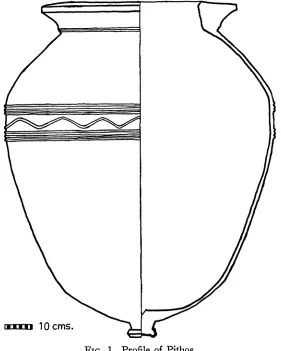
FIG. 1. Profile of Pithos.
'The clearing of the three wellshafts, all apparently belonging to a single water system, was undertaken at the request of the Ephor, Mr. Pallas. The excavation of Katsoulis Well No. 3 (Corinth Grid J 17/j 5) was supervised by Professor Henry S. Robinson, then Director of the School, who kindly gave me permission -to publish the pithos. I am also grateful to Charles K. Williams, II, and Miss Kathryn Butt, respectively Field Director and Secretary of the Corinth Excavations, for making available working space for the preparation of this note.
American School of Classical Studies at Athens is collaborating with JSTOR to digitize, preserve, and extend access to
Hesperia
74 ELIZABETH MACNEIL BOGGESS
filled with material predominantly of the fourth and second centuries B.C., yielded
many fragments of a large decorated pithos, together with twenty-one of the lead clamps with which it had been mended in antiquity.2 All the essential elements of the shape were preserved, and it was possible to restore the few missing portions of the pithos in plaster (P1. 16, a).
DESCRIPTION
Height 1.85 meters, maximum diameter 0.94 m., diameter of rim 0.68 m.,
diameter of mouth 0.42 m., width of top of rim 0.125 m., average thickness of wall 0.02-0.025 m., diameter of foot 0.085.
The pithos is ovoid in shape, neckless, and with a canted rim which slopes slightly downward toward the outside (Fig. 1). The inner edge of the rim is bevelled, and the outer edge forms a narrow vertical fascia above the slightly concave return to the shoulder (Fig. 2). At the base of the return, just above the narrowest part,
I cm.
FIG. 2. Detail of Rim.
are two small ridges, semicircular in section. The shoulder curves out to the point of greatest diameter, which is reached at approximately two-thirds of the total height from the foot. The body then contracts gradually without noticeable curvature to a point approximately 0.20 m. above the foot, and thereafter is rounded. The stump- foot with bevelled lower edge (Fig. 3) emerges rather abruptly from the rounded base of the belly.
A broad band of decoration, varying in width between 0.13 and 0.14 m., appears around the point of greatest diameter. The ornament consists of applied clay strips, each approximately a centimeter wide and intended to be semicircular in section. Most
A HELLENISTIC PITHOS FROM CORINTH 75
of the strips have, however, been flattened, probably a result of handling before firing. From top to bottom, the decoration (Figs. 1; P1. 16, a) consists of three horizontal ridges, a wavy ridge, three more horizontal ridges. A red slip was applied, somewhat carelessly, over the entire zone of decoration.
FABRIC AND MANUFACTURE
The pithos is made of tile fabric, a clay which fires red to buff and which contains light and dark inclusions. Marie Farnsworth's analysis has shown that Corinthian tile fabric differs from regular Corinthian potter's clay by the addition of a special tempering agent called mudstone, which, when fired, resembles grog.8 The dark inclusions in the fabric of this pithos are mudstone, while the light im- purities are small pebbles. The exterior of the pithos bears traces of a light red
_ cm.
FIG. 3. Detail of Foot.
surfacing or wash, which contrasts with the darker red of the slip over the decorated zone.
The exact technique of manufacture is not clear. The pithos could have been made completely by hand, or on the wheel, or with the aid of a shaping device in the interior, or by a combination of these techniques.4 It might have been made in one piece or in two. In the latter case, the body (including the foot) was possibly thrown upsidedown on the wheel first, and the rim would then have been added manually when the pot was upright.
The pithos was evidently damaged during firing. There is a zone of black dis- coloration on the lower portion, and by following those cracks which were mended in antiquity it can be seen that the vessel had not broken apart (Fig. 4). It is interesting
3 Marie Farnsworth, " Greek Pottery: A Mineralogical Study," A.J.A., LXVIII, 1964, p. 224. Ancient Corinthian potters used tile fabric for terracotta sculpture as well as for pithoi and tiles.
4 A summary of present knowledge concerning the methods of constructing pithoi of various
76 ELIZABETH MACNEIL BOGGESS
to note that there are no traces of clamps or of drill holes for clamps in the zone of decoration or above it. Of the twenty-one preserved lead clamps, sixteen are still in place on the pithos. The remaining five (P1. 16, b) were not attached to fragments of the pithos and may therefore be studied separately.
Each clamp consists of a rectangular outer strip, bevelled on all four sides, and a plain inner strip, joined together at each end by biconical pins (P1. 16, b, c and d). Three clamps (a, b and c) preserve the entire upper strip, and vary in length from 0.075 to 0.095 m. A greater variation is observed in the lengths of the clamps still
r.- IO cmns.
FIG. 4. Map of Pithos showing Orig'inal Cracks with Preserved Clamps and Drill Holes.
in place on the pithos, ranging up to 0. 10-0. 12 m. All are approxilmately the same width (0.015-0.02 in.). Two of the clamps (c and d) preserve an entire pin and a piece of the insi'de strip, but the distance between the inner and outer stri'ps is not the same in both cases, one (c) being 0.02 m. and the other (d) 0.025 m. The pins of the other clamps are broken at the peak of the cone, suggesting that here was a j'oin between the parts of the clamp.
DATE AND CONCLUSIONS
A HELLENISTIC PITHOS FROM CORINTH 77
ance in dating. All that can be said concerning the rim is that it is a type common in the period after 400 B.C., but probably not much used after 200 B.C. The profile
of the body, also, is frequently encountered among Hellenistic pithoi. Only the distinctive foot, similar but not identical to the feet of certain amphoras from various parts of the Greek world, points to a date in the latter part of the fourth century B.C.5
This is, however, not necessarily a valid comparison, as pithoi are in general so con- servative in form and so long-lived that precise dating within a type such as the Hellenistic neckless variety is impossible.
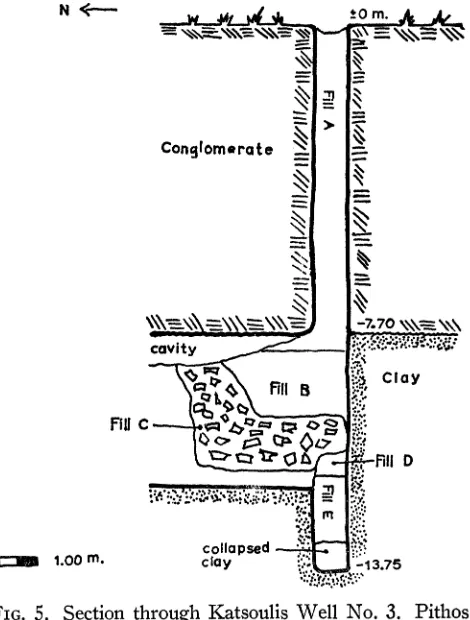
The fragments of the pithos came from the lower portion of the wellshaft and from an adjacent tunnel into the clay stratum immediately below the conglomerate rock (Fig. 5). The majority of the pottery from this part of the shaft is from the
N * -- _
Conglom*rate
r
i.oom. clay 1375
gi ~~~~~~Fill D
1 00 m.
~~clollapsed
FIG. 5. Section through Katsoulis Well No. 3. Pithos came from Fill C.
second century B.C., with nothing later than 146 B.C., but with some material from
the fourth century B.C.6 The pithos could, therefore, have been made as early as the
6 For example, amphoras from Thasos, such as Agora SS 14261, and from Rhodes, Agora
P 27711. Note also the foot of a third-century Corinthian amphora, Agora P 3979.
78 ELIZABETH MACNEIL BOGGESS
fourth century or as late as the beginning of the second century B.C. It was probably
smashed during the sack of 146 B.C., after which it was thrown into the abandoned wellshaft.
The importance of the Corinthian pithos is primarily its decoration. Hitherto, ornament on the body, as opposed to the rim, has not been attested for Hellenistic pithoi. The position of the decoration suggests, moreover, that the vessel was not to be sunk in the ground up to (or over) the rim, as was usual in Hellenistic times, but only as far as the bottom of the ornamental zone. The absence of clamps in the upper portion indicates that this intention was carried out. The pithos was probably not, therefore, an ordinary household storage jar but rather for use in a public building such as a temple or clubhouse.
ELIZABETH MACNEIL BOGGESS
PLATE 16
CLo
"0~~~~~~~~-
z
0~~~ri~~~~~~~~~~~~~j
_4- X B
________ : I B
00 1 t l
3 > z~~~~~