A Secured Service Model of Cloud Computing
Environment using ECC Algorithm
Dr. M. Gobi J. John Bosco
Assistant Professor Research Scholar
Department of Computer Science & Engineering Department of Computer Science & Engineering Chikkanna Government Arts College, Tirupur. Chikkanna Government Arts College, Tirupur.
Abstract
Cloud computing is becoming increasingly popular in distributed computing environment. Processing and Data storage is used in cloud environment. Cloud computing is Internet-based computing, in which shared resources, software, and information are made available to devices on demand. It reduces cost and complexity of service by providers. It allows users to access applications continuously. For both, cloud providers and consumers; availability, integrity, authenticity, confidentiality, and privacy are important concern. Security of service model of clouds is considered from multiple perspective including access control, service continuity and privacy while protecting together the service provider and the user. Security problems of service model of clouds are explored and classified. In this paper handle to some major security issues of current cloud computing environments.
Keywords: Cloud computing; service model of cloud; availability; integrity; authenticity; privacy; confidentiality _______________________________________________________________________________________________________
I. INTRODUCTION
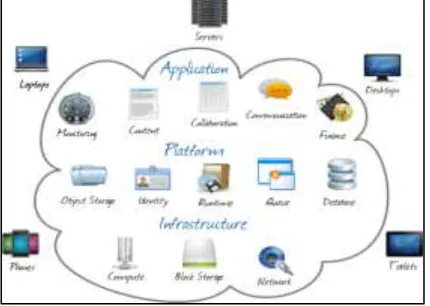
There are several major cloud computing providers with Amazon, Sales force, Google, Yahoo, Microsoft and others that are providing cloud computing services. Cloud computing providers provide a variety of services to the customers and these services include e-mails, storage, infrastructure-as-a-services, software-as-a-services etc. The attractiveness of cloud computing is not only to large enterprises but also startups, entrepreneurs, medium companies and small companies would benefit greatly and they will have a opportunities and alternative that is not available to them in the past that would save them billions of dollars because with cloud computing they will have the choice to only rent the necessary computing power, communication capacity and storage space from a large cloud computing provider that has all of these assets connected towards the Internet. The cloud service providers tend to offer services that can be grouped into three categories: infrastructure as a service, platform as a service, and software as a service. These categories group together the countless layers illustrated in Figure, with approximately overlap.
II. CLOUD COMPUTING ARCHITECTURE
In the progressively prevalent cloud computing, datacenters play an ultimate role as the major cloud infrastructure providers, for example Microsoft Azure, Amazon, and Google. Datacenters position for the utility computing service to software service providers who auxiliary provide the application service to end users over Internet. The later service has wide been termed “Software as a Service (SaaS)”, and the prior service has newly been called “Infrastructure as a Service (IaaS)”, everywhere the software service provider is also mentioned to as cloud service provider. To yield advantage of computing and storage assets providing by cloud infrastructure providers, data owners outsource gradually data to the datacenters concluded cloud service providers, e.g., the online storage facility provider, which are not completely trusted by data owners.
As a general data structure to define the relation between entities, the graph has been increasingly used to model complicated organizations and schema less data, such as the personal social network (the social graph), the relational data base, Considered for the protection of users’ privacy, these sensitive data have to be encrypted before outsourcing to the cloud. Furthermore, nearly data are invented to be shared among trusted partners to all organizations. There have stayed revealed attacks on cloud computing providers and this paper discusses recommended steps to handle cloud security, issues to illuminate before adopting cloud computing, the need for a governance strategy and good governance technology, cloud computing strengths, faults, analyzes the profits and cloud computing information security management. This paper has discussed approximately of the services being provided.
Software as a Service (SaaS):
If provide software services on demand. The use of single occurrence of the application runs on the cloud services and multiple end users or client organizations. The most usually known example of SaaS is salesforce.com, though many other examples have revive market, including the Google Apps offering of basic corporate services including email and word processing. Even though salesforce.com led the definition of cloud computing by a limited years, it now operates by leveraging its companion force.com, which can be demarcated by way of a platform as a service.
Platform as a Service (PaaS):
Platform as a service condenses a layer of software and make available it as a service that can be used to build higher level services. There are at least two perspectives on PaaS provisional on the perspective of the producer or consumer of the services:
Someone producing PaaS potency produce a platform by participating an OS, middleware, application software, and even a development environment that is before provided to a customer as a service. For example, somebody developing a PaaS offering might base it on a set of Sun VM hypervisor virtual machines that include a NetBeans integrated development environment, a Sun GlassFis Web stack and support for additional programming languages such as Perl or Ruby.
Someone using PaaS would see an summarized service that is presented to them through an API. The customer interacts by the platform through the API, before the platform does what is necessary to manage and scale itself to provide a specified level of service. Virtual appliances can be hush-hush as instances of PaaS. A content switch appliance, for example, would have all of its component software unseen from the customer, and only an API or GUI for configuring and deploying the service provided to them. PaaS assistances can provide for every phase of software development and testing, or they can be specialized everywhere a particular area such as content management. Commercial examples of PaaS include the Google Apps Engine, which assists applications on Google’s infrastructure. PaaS services such as these can provide a powerful origin on which to deploy applications, however they may be forced by the capabilities that the cloud provider indicates to convey.
Infrastructure as a Service
Infrastructure as a service delivers basic storage and compute capabilities as consistent services over the network. Servers, storage systems, switches, routers, and other systems are united and made available to holder workloads that range from application components to high performance computing applications. Commercial samples of IaaS include Joyent, whose main product is a line of virtualized servers that afford a highly available on demand infrastructure.
III. THREAD AND CLOUD COMPUTATION
Step to Cloud Security:
Understand: the cloud by appreciating how the cloud's uniquely loose structure affects the security of data sent into it. This can be done by consuming an in-depth understanding of how cloud computing transmit and handles data.
Demand Transparency: by constructing sure that the cloud provider can hoard detailed information on its security architecture and is agreeable to accept regular security audit. The regular security appraisal should be from an independent body or centralized agency.
Reinforce Internal Security: by making sure that the cloud provider's internal security technologies and practices with firewalls and user access controls are very strong and can lattice very well through the cloud security measures.
Contemplate the Legal Implications: by significant how the laws and regulations will affect what you lead into the cloud. Pay attention: by constantly observing any development or changes in the cloud technologies and practices that may
impression your data's security.
Information Security Principles:
Integrity: Data integrity ensures that the data is maintained in its original state and has not been intentionally or accidentally altered or deleted.
Confidentiality: Data confidentiality requires that information be available or disclosed only to authorized individuals, entities or IT processes.
Threats
Attacks by Other Customers Shared Technology Vulnerabilities Failures in Provider Security Availability and Reliability Issues
Integrating Provider and Customer Security Systems Legal and Regulatory Issues
Insecure Application Programming Interfaces Perimeter Security Model Broken
Data Loss/Leakage Malicious Insiders Unknown Risk Profile
Account, Traffic Hijacking & Service
IV. SECURITY ISSUES IN CLOUD COMPUTING
User Access:
Ask providers for unambiguous information on the hiring and oversight of privileged administrators and the controls concluded their access to information. Major Companies should demand and enforce their own hiring principles for personnel that will operate their cloud computing environments.
Data Segregation:
Realize what is done to segregate your data, and probe for proof that encryption schemes are deployed and are effective.
Disaster Recovery:
Ask the provider for a contractual commitment to sustenance specific types of investigations, such as the research involved in the discovery phase of litigation, and verify that the provider has successfully supported such activities in the past. Deprived of evidence, don't assume that it can do so.
Long-term Viability:
Ask forthcoming providers how you would get data back if they were to fail or be assimilated, and find out if the data would be in a arrangement that you could easily import into a replacement application.
V. CRYPTOGRAPHY
Cryptography is the science of writing in secret code and is an ancient art; the first documented use of cryptography in writing dates back to circa 1900 B.C. when an Egyptian scribe used non-standard hieroglyphs in an inscription.
Plaintext: The original intelligible message. Cipher text : The transformed message
Key: Some critical information used by the cipher, known only to the sender & receiver. Encryption: The process of converting plaintext to cipher text.
Decryption : The process of converting cipher text back into plaintext
Types of Cryptography:
Hash Functions: Uses a mathematical transformation to irreversibly "encrypt" information, providing a digital fingerprint. Primarily used for message integrity
Secret Key Cryptography (SKC): Uses a single key for both encryption and decryption; also called symmetric encryption. Primarily used for privacy and confidentiality.
Elliptic Curves over Zp:
Elliptic curve cryptography makes use of elliptic curves in which the variables and coefficient are all restricted to elements of a finite field. Two families of elliptic curves are used in cryptographic applications: prime curve over Zp, Suppose we have an elliptic curve, E, over Zp. In this case we have a cubic equation in which the variables and coefficients take values on the set of integers 0, 1, ...(p − 1) and all calculations are performed modulo p.
y 2 ≡ x 3 + ax +B (mod p)
We write Ep(A, B) for the set of integers (x, y) that satisfy the above equation, together with a point at infinity, ∞. The set E11(1, 6) is the set of integers (x, y) that satisfy
y 2 ≡ x 3 + x + 6 (mod 11) We can see that (x, y) = (7, 9) is in this set as
9 2 (mod 11) = (73+ 7 + 6) (mod 11) 81 (mod 11) = 356 (mod 11) ⇐⇒ 4 = 4
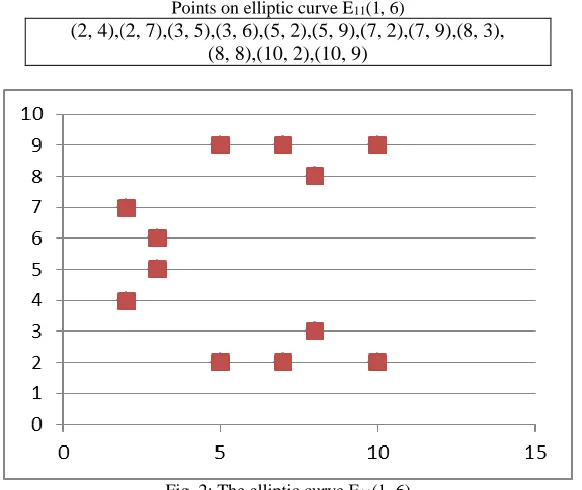
To find all the points in E11(1, 6) we find all the possible values x 3 + x + 6 (mod p) and then see what values of y2 will match. Table – 1
Points on elliptic curve E11(1, 6)
(2, 4),(2, 7),(3, 5),(3, 6),(5, 2),(5, 9),(7, 2),(7, 9),(8, 3), (8, 8),(10, 2),(10, 9)
Fig. 2: The elliptic curve E11(1, 6)
VI. CLOUD COMPUTING USING ECC ALGORITHM
Security in cloud computing is an evolving area in today’s world. It is subject of concern for Cloud Technology Services. One of the measures which customers can take care of is to encrypt their data before it is stored on the cloud. This work is intended towards providing security service such as confidentiality in the cloud services can use Elliptic Curve Cryptography (ECC) algorithm instead of familiar and generalized RSA for data encryption because of its advantages in terms of smaller key sizes, lower CPU time and less memory usage.
Global Public Elements:
Eq(a,b) Elliptic curve with parameter a,b and q, where q is a prime or an integer of the form 2m . G Point on elliptic curve whose order is large value n.
User A key Generation:
Select private: nA nA<n
Calculate public: PA where PA = nA x G
User B key Generation:
Select private: nB nB<n
Calculation of Secret Key by User A:
K=nA x PB
Calculation of Secret Key by User A:
K=nB x PA
Encryption:
Encryption is the process of converting original plain text (data) into cipher text (data). To encrypt and send a message Pm to B, A choose a random positive integer k and produces the cipher text Cm consisting of the pair of points:
Cm= {kG,Pm+kPB}
Decryption:
Decryption is the process of converting the cipher text(data) to the original plain text(data). Note that A has used B’s public key PB. To decrypt the cipher text, B multiplies the first point in the pair by B’s secret key and subtracts the result from the second point:
Pm + kPB - nB(kG)=Pm + k(nBG) - nB(kG) = Pm
VII. EXPERIMENTAL RESULT
Encryption:
The encryption process take P=751; Ep(-1,188),which is equivalent to the curve y2=x3-x+188; and G=(0,376). Suppose that A wishes to send a message to B that is encoded in the elliptic point Pm(676,558) and that A select the random number k=386.B’s public key is PB=(201,5).
We have = 386(0,376) = (676,558) and (562,201) + 386(201,5)=(385,328). Thus A sends the cipher text or Cm={(676,558),(385,328)}.
Decryption:
The decryption process take P=751; Ep(-1,188),which is equivalent to the curve y2=x3-x+188; and G=(0,376). We have =(562,201)+386(201,5)- (676,558).
Thus B decrypted a message Pm=(676,558).
VIII. CONCLUSION
Cloud computing is a true for cost savings to the enterprises but the security risk are also expensive. Enterprise is considering cutting down on cost and increasing profit. The asset of cloud computing in information risk management is the facility to manage risk more effectively from a integrate point. Cloud computing is as a new marvel which is set to reform the way that is used the Internet. There are many new technologies emerging at an express rate. Each technology is made by the potential of human at ease. However, one must be very careful to appreciate the security risks and challenges stood in exploiting these technologies. Cloud computing is no exception. In this paper security issues in Service Model of Cloud computing Environment which are currently handled in the cloud computing are highlighted. In this research paper tried to solve availability, integrity, confidentiality in service model of cloud computing using Elliptic Curve Cryptography (ECC).
REFERENCES
[1] B.Hari Krishna, S.Kiran,GMurali, R.Pradeep Kumar Reddy . Security issues in service model of cloud computing environment. ScienceDirect:87(2016)246-251.
[2] Buyya R, Chee Shin Y, Venugopal S, Broberg J, Brandic I. Cloud computing and emerging IT platforms: vision, hype, and reality for delivering computing as the 5th utility. Future Generation Computer Systems; 2009; 25(6):599–616.
[3] Armbrust M, Fox A, Griffith R, Joseph A D, Katz R, Konwinski A, Lee G, Patterson D, Rabkin A, Stoica I, Zaharia M. A View of Cloud Computing. Communications of the ACM ; 2010; 53(4):50–58.
[4] Takabi H, Joshi J B D, Ahn G. Security a and privacy challenges in cloud computing environments. IEEE Security & Privacy;2010;8(6):24–31.
[5] Sangroya A, Kumar S, Dhok J, Varma V. Towards analyzing data security risks in cloud computing environments. Communications inComputer and Information Science; 2010; 54 :255–265.
[6] Boss G, Malladi P, Quan D, Legre gni L, Hall H. Cloud computing, 2009. http://www.ibm.com/developerswork/websphere/zones/hipods/ library.html. [7] ]Peter Mell, Timothy Grance. The NIST Definition of Cloud Computing (Draft). NIST. 2011. http://www.production
scale.com/home/2011/8/7/the-nist-definition-of-cloud-computingdraft.html#axz z1X0xKZRuf.
[8] Cloud Security Alliance. Security gui dance for critical areas of focus in cloud computing(v2.1). Decemeber, 2009.
[10] Jinzhu Kong, “A Practical Approach to Improve the Data Privacy of Virtual Machines” 2010 IEEE 10th International Conference on Computer and Information Technology (CIT), June 29 -July 1 ,2010, pp. 936-941.
[11] Esteves, R.M. and Chunming Rong, “Social Impact of Privacy in Cloud Computing” in 2010 IEEE Second International Conference on Cloud Computing Technology and Science (CloudCom), N ov. 30-Dec. 3 ,2010, pp. 593-596.