Page 57 www.ijiras.com | Email: [email protected]
Elastic Scattering Of
And
Using An Effective Mass
Dependent M3Y-Type Interaction
Raymond Chivirter ABENGA
Department of Pure and Applied Physics, College Natural and Applied Sciences, Veritas University, Abuja, Nigeria
Joseph O. FIASE
Department of Physics, Faculty of Science, Benue State University, Makurdi, Benue State, Nigeria
I. INTRODUCTION
Elastic scattering is an important source of information on nuclear matter properties. It is the simplest reaction between a projectile and a target that can be induced by hadronic interaction. This information is obtained through the studies of the optical potential that is found to reproduce measurement of the elastic scattering cross section [1]. According to Kurkcuoglo et al., in [2] the elastic scattering of light heavy ion has been studied extensively both experimentally and theoretically in nuclear physics with the aim to determine the most suitable potential form to explain experimental data. In many nuclear reaction processes the nucleon-nucleon potential is one of the most important quantities, for example in elastic scattering of alpha-nucleus and light heavy-ion (HI) systems [3]. By using the potential between nuclei we can evaluate the cross sections of different nuclear reactions [4]. In the present work we have used an effective interaction fitted from the lowest order constrained variational approach produced by Fiase et al., within the double folding model approach to provide a unified description and understanding of the elastic scattering of light heavy ion systems: at
and at
and 48 .
This paper is organized as follows: In Section 2, a brief summary of the expression of the mass-dependent M3Y-type effective interaction for (A=16) is given. In Section 3, we define the folding model as included in the nuclear reaction video (NRV) code. In Section 4, we present the results of our findings and other relevant discussions are made. Finally, we make the conclusions of our findings in Section 5.
II. THE M3Y-TYPE EFFECTIVE INTERACTION Various potentials have been used in optical model analysis. These potentials are found to reproduce nuclear matter properties such as binding energy, nuclear incompressibility and pressure but that which became known as the M3Y interaction is probably the most widely used [6]. In this work we adopt the M3Y-type interaction constructed by Fiase et al., using the lowest order constrained variational approach. Thus using the data of Table V from the determined best fit-interaction strength (in produced by Fiase et
Abstract: Optical model analyses of the elastic scattering of at and at and 48 have been performed using the folding model approach of the NRV code. Accurate measurements of elastic differential cross section were obtained using an effective mass dependent nucleon-nucleon interaction. The results of the analyses reveal that there is excellent agreement between the experimental data and the theoretical results at large angles ( >80°) up to 120° for the system of . The theoretical results approximate the experimental data quite reasonably well and this proves that the effective mass dependent M3Y-type interaction is a good interaction for the studies of nuclear matter properties.
Page 58 www.ijiras.com | Email: [email protected] al., [5] we obtain an effective interaction for A=16 with
and as:
and
Equations (1) and (2) are the direct and exchange parts of the effective interaction fitted from the lowest order constrained variational (LOCV) approach.
But studies have shown that this density independent M3Y interaction fails to reproduce nuclear matter properties at the saturation condition hence the need to introduces the density dependence factor of the form [7]
. (3)
where are the original effective interactions and is the density dependence. In this work the density chosen is of the form [7, 8]:
. (4) The parameters are fitted in order to ensure the saturation of nuclear matter and to reproduce correct value of the nuclear matter binding energy,
at . The parameters of the function
of the M3Y-type (A=16) interaction are listed in Table 1.
Table 1: Parameters of the density dependent M3Y-type interaction
However, most calculations use the form of the nucleon-nucleon interaction supplemented by the zero range pseudo-potential [9]. The zero range pseudo-pseudo-potential takes account of the exchange effect arising from the knock-on exchange effect via the operator . In this regard the effective interaction takes the form [10]
(5) where is the realistic two-body interaction and is the strength of the pseudo-potential which approximates the exchange part.
In the present calculation, the magnitude of for the M3Y-type interactions has been determined by approximate calculations of heavy-ion scattering and the result was found to be
.
III. FOLDING POTENTIAL
The double-folding procedure is applied to calculation of heavy-ion interaction potential using realistic nucleon-nucleon (NN) interaction [11]. In this model the optical potential for heavy-ion scattering is obtained by averaging an appropriate NN interaction over the matter distributions within the two colliding ion in the form [11,12]
, (7)
where the integration is performed over the projectile and target volumes, is the effective nucleon-nucleon interaction and are the density distributions of nuclear matter in the nuclei . The nuclear and charge densities of the projectile or target nuclei are described using either the Fermi-type function or the Gaussian-type function.
IV. RESULTS AND DISCUSSIONS
A. THE ANALYSIS OF ELASTIC SCATTERING OF AT
The elastic scattering data of at are obtained using the density-dependent form of our M3Y-type effective interactions of equations and the results are compared to that of [1]. The data obtained is presented in Table 2 with fit parameters.
System Interaction (
MeV) (mb)
( mb) M3Y-type
A 16 289 1.60 0.20 817.55 2045.33
300 1.60 0.20 809.91 2037.94
Table 2: Parameters of the elastic scattering of
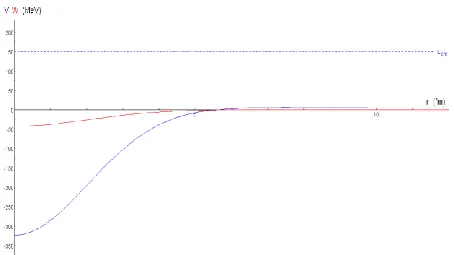
Figure 1: Radial shape of the real folded potential of the
elastic scattering of data at
The radial shapes of the real folded potential and the strengths are also obtained and the result presented in Figures 1 and 2 respectively. The strength of the real potential was found to be approximately for the analysis at both
and .
Figure 2: Radial shape of the real folded potential of the
elastic scattering of data at
Interaction C α Β
Page 59 www.ijiras.com | Email: [email protected] The angular distribution of the elastic scattering of
at using our
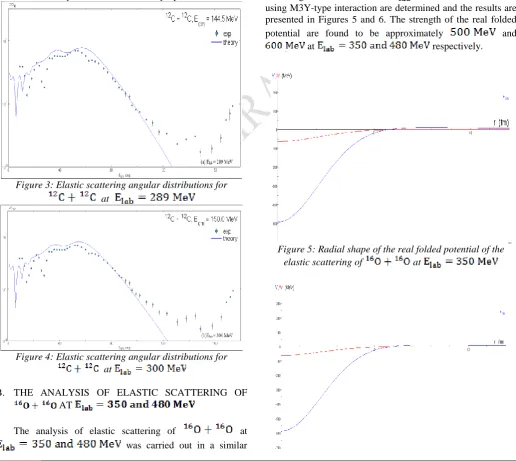
M3Y-type effective interaction is presented in Figures 3 and 4. Reasonably good fits are obtained at all energies with renormalization factor ( ) of 1.6 given in Table 2. The data has shown a reasonably good fit to the experimental data at small angles characterised by a heavy minima around
and maxima between then
with a smooth falloff at . The refractive rainbow pattern is also seen at angles around 40o and 100o. However the data fail to extend the good fit at large angles greater than 100o which has a reflective pattern, this has also been reported by [1] as the anomalous large angle scattering of . The failure of the theoretical result to reproduce the reflective pattern at angles above 100o as seen in Figures 3 and 4 can also be attributed to the attractive nature of the M3Y-type effective interaction. However, the fit at small angles has established our M3Y-type effective interaction to be a physically correct interaction and a good interaction for the studies and description of nuclear matter properties.
Figure 3: Elastic scattering angular distributions for at
Figure 4: Elastic scattering angular distributions for at
B. THE ANALYSIS OF ELASTIC SCATTERING OF AT
The analysis of elastic scattering of at was carried out in a similar
way as reported in Section 4.1. The result of this analysis is similar to the “generalized” folding model [1] that was applied to the study of the elastic scattering of at energies 350 and using the M3Y-Paris and M3Y-Reid interactions. The folding model analysis of
at has been performed with a
mean renormalization factor of for the M3Y-type interaction. The parameter values for the optimum fits are listed in Table 3.
System Interacti
on
(
MeV) (mb) (mb)
M3Y-type
A 16
350 1.65 0.20 1020.77 2484.77
480 2.00 0.20 987.54 2540.61
Table 3: Parameters of the optical model analysis of the elastic scattering of
The results of the real folded potential of the elastic
scattering of at
using M3Y-type interaction are determined and the results are presented in Figures 5 and 6. The strength of the real folded potential are found to be approximately and
at respectively.
Figure 5: Radial shape of the real folded potential of the
Page 60 www.ijiras.com | Email: [email protected] Figure 6: Radial shape of the real folded potential of the
elastic scattering of at
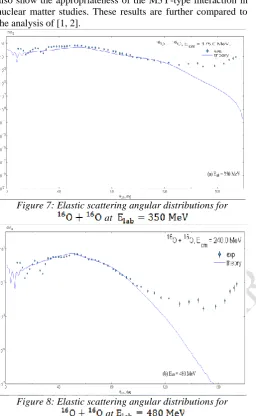
The plots of the differential cross sections are also obtained and the results are shown in Figures 7 and 8. The theoretical results are compared to the experimental data to also show the appropriateness of the M3Y-type interaction in nuclear matter studies. These results are further compared to the analysis of [1, 2].
Figure 7: Elastic scattering angular distributions for at
Figure 8: Elastic scattering angular distributions for at
The calculated angular distributions of the reaction for
at with the
density dependent M3Y-type interaction are represented by the solid curves of Figures 7 and 8. The results of the theoretical calculations also approximate the experimental data of the differential cross sections quite reasonably just as the analysis of . It can be seen that the theoretical results fit the experimental data very well at angles between 40 for the two systems. The fit extend quite reasonably well beyond 120 in the case of at but deviate at large angles ( at which was also reported to be the case by Brandan and Satchler in their studies of the interaction between light heavy-ion [1].
V. CONCLUSION
The folding model analyses of elastic scattering of at the energies reported in Section 4.1 were computed using the folding model search code of NRV. The results for the depth of the real potentials and the differential cross sections were also obtained and discussed. The search led to a good fit as seen in Figures 3 and 4. The result have shown that, the M3Y-type interactions fit the experimental quite well and the good approximation at angles between 40 to about 100 has established the M3Y-type interaction as a good interaction for nuclear matter studies. This agreement is satisfactory, particularly since no free parameter is used in the construction of the real potential (except as is different from unity). The values of from Table 2 show that, the renormalization factor is slightly larger than unity. This indicates that on the average the folding model with the M3Y-type interaction predicts light heavy-ion real potential reasonably well. In the elastic scattering analysis of , the mean values of renormalisation factor from Table 3 also differs from unity.
REFERENCES
[1] Brandan, M. E., and Satchler, G. R., (1997). The interaction between light heavyions and what it tells us. Physics Reports 285, PP. 143-243.
[2] Kurkcuoglu, M. E., Aytekin H., and Boztosun I., (2006). Optical Model Analysis of the (_ ^16)O+(_ ^16)O nuclear scattering reaction around E_lab=5MeV/nucleon. G.U. Journal of Science 19(2) pp. 105-112.
[3] Gao-Long, Z., Hao, L., and Xiao-Yun, L., (2009). Nucleon-nucleon interactions in the double folding model for fusion reactions. Chinese Physics B and IOP Publishing Ltd. 18 (01), pp. 136-141.
[4] Denisov, V., Yu. and Davidovskaya, O. I., (2010). Elastic Scattering of Heavy Nuclei and Nucleus-Nucleus Potential with Repulsive Core. Physics of Atomic Nuclei 73(3), pp.404-411
[5] Khao, T. Dao, Satchler, G. R. and von Oertzen, W. (1997). Nuclear incompressibility and density dependent nn interaction in the folding model for nucleus-nucleus potential. Physical Review C 56(2) pp. 954-969
[6] Fiase, J. O., Devan, K. R. S., and Hosaka, A., (2002). Mass dependence of M3Y-type interaction and the effect of tensor correlations. Physical Review C66, pp. 014004-10.
[7] Moharram, S. A., and El-Shal, A. O., (2002). Spin polarized cold and hot dense neutron matter. Turk. J. Phys 26. pp. 167-177.
[8] Khao, D. T., and von Oertzen W., (1993). A nuclear matter study using the density dependent M3Y-interaction. Physics Letters B 304, pp. 8-16.
[9] Becks, C. (2010). Lecture notes in Physic 818: Cluster in nuclei. Springer, 1, p. 229.
Page 61 www.ijiras.com | Email: [email protected] [11]Satchler, G. R. and Love, W. G. (1979). Folding model
potentials from realistic interaction for heavy-ion scattering. Physics Reports (Review Section of Physics Letters) 55, (3), pp. 183-254.