Parameter Estimation Algorithm for Storm
Intensity Model with Single Return Period Based
on Multicellular Gene Expression Programming
Yuzhong Peng
College of Computer and Information Engineering, Guangxi Teachers Education University, Nanning, China; Email: [email protected];
Jie Li
Department of Mathematics and computer science, Guangxi Liuzhou Teachers college, Liuzhou, China; Email: [email protected]
Chang’an Yuan
Key Lab of Scientific Computing &Intelligent Information Processing in Universities of Guangxi, Guangxi Teachers Education University, Nanning, China;
Email: [email protected]
Baoqin Hu
Key Lab of Beibu Gulf Environment Change and Resource Use of ministry of Education, Guangxi Teachers Education University, Nanning, China
Email:[email protected]
Abstract—To resolve the difficulty of parameter estimation of Storm rainfall intensity formulation, a new multicellular GEP parameter estimation algorithm, named MC_GEP_MPO, with a novel individual coding scheme based on Gene Expression Programming algorithm is proposed in this paper. MC_GEP_MPO is used for solving the parameter estimation problem of the single return period of rainfall intensity forecast model using historical rainfall statistical data as a learning example. And its effectiveness in real compute instance has been evaluated. The compared experiment result shows that the proposed method exploring for parameter estimation of Storm rainfall intensity formulation is feasible and precise.
Index Terms— Multicellular Gene Expression Programming, Multi-parameter optimization. Storm rainfall intensity, parameter estimation
I. INTRODUCTION
Rainstorm is a kind of common natural disaster; it can form a mass of surface runoff which may easily cause huge danger within a short time. Single return period of rainfall intensity forecast model is an important and basic model for the management of rainstorm disaster, which has a dominant significance to research the climate feature of local rainfall (space-time distribution). It is also the important basis to forecast the rainstorm surface runoff and to confirm the designing flow of disaster prof engineer. This model is widely used in basic engineer designs and constructions, such as, bridge and culvert, irrigation, transportation, flood control and waterlogged elimination, cities and towns constructions and water environment's effectiveness evaluation of rainfall runoff. The conformation of the rainfall intensity forecast model
has a direct relation to scientific construction of the basic facilities of the rainstorm disaster prevention and has a great influence on cities disaster prevention and decrease and the cities environment. Hence, it has a great significance to pursue a kind of rainstorm intensity forecast model with high precision and reliable calculation result.
In China, the ways to build up an area rainstorm intensity model is firstly through the relationships between the returned period, rainfall intensity and rainfall duration, which is based on the selected rainfall duration materials, and then figure out the rainstorm intensity formula in accordance with the three relationships [1]. Rainstorm intensity forecast model is an overdetermined nonlinear equation, the parameter evaluation of which is something about the nonlinear optimizing problem. The calculation will be complicated, the universality will be poor, global optimal solution cannot be gained easily, and some special requirements during the practical optimizing calculation cannot be considered if adopting the traditional methods of graphic method combined with linear least square method or optimization regression method to evaluate the parameters. So it is necessary to discuss a more suitable method of nonlinear parameter optimization to solve the parameter estimation problem of rainstorm intensity forecast model, so as to improve the precision of rainstorm intensity forecast.
optimization. And it achieved better performance than traditional methods [2]-[5]. Gene expression programming is a new promising evolutionary algorithm which was based on genotype and phenotype and was developed from Genetic Algorithm (GA) and Genetic Programming (GP) in recent years. It has a very high efficiency and precision [6]-[7], and is widely used by researchers in various knowledge discovery and optimization problems [8]-[12]. We have tried to use gene expression programming to solve the parameter estimation problem of rainstorm intensity forecast model with single return period and obtained some good preliminary results in [13].This paper proposes a more effective parameter estimation algorithm for rainstorm intensity forecast model with single return period based on multicellular Gene expression programming (hereafter named as MC_GEP_MPO). Experiment results of numerical sample show that MC_GEP_MPO can well solve the problem of parameters fitting and global optimization for the nonlinear rainstorm intensity forecast model with single return period. And it is an expected new way for its high calculating accuracy.
II. BACKGROUND
A. Problem Description
According to China's current urban drainage criteria, single return period rainstorm intensity formula often uses the model as shown in (1) [1].
n b) a/(t t) n, b, f(a,
I= = + (1)
where, I means rainstorm intensity (mm/min), t means
rainfall duration (min); a ,,bn are dimensionless parameters of local of the model, who determine the correlation between the rainfall intensity of different return period I and rainfall duration t. and varies
according to place. They can be obtained through the corresponding urban rainfall data of a great number of years. Obviously, to use the rainstorm intensity formula in application, model parameter estimate is a key problem. The model can be used in local rainstorm disaster management after getting right parameter values.
The model as shown in (1) is a problem of solving overdetermined nonlinear equations. Its parameter fitting is just the problem of multi-parameter optimization in nonlinear model that is difficult to get the global optimal solution using traditional methods. Do not break general, this problem can be described as follows: set Q (C, U) as
a general nonlinear system model, where, C = {Cj | j = 1, 2,... P} are p parameters of the model to estimate; U is
the model input vector; V is the model output vector.
Then optimization problems can be solved using m
groups input and output data {(Uk, Vk) | k = 1, 2,... , m} of
the multi-parameter nonlinear model, as follows (2)
(2)
. : j j j
s t a ≤ ≤c b
Equation (2) above, the f is the optimization guidelines
function. aj and bj are respectively the upper and lower the threshold of the variable cj. is to get the norm; q is a real constant whose value is determined to the actual requirement of modeling. When q = 2, expression is just
the residual sum of squares (LS). As a result, the parameter optimal estimation problem of rainfall intensity forecast model with single return period can be described as:
(
)
min ( , , )
n qf a b n
=
∑
a t
+
b
−
i
(3)Equation (3) above, t is the measured value of rainfall
duration, i is the measured value of storm intensity. We
try to use the gene expression programming algorithm with the measured rainfall data to solve the problem shown as (3) in order to draw a single return period rainstorm intensity forecast model.
B. Brief Introduction of Gene Expression Programming
GEP is a new adaptive evolutionary algorithm based on genotype and phenotype in recent years. It combines the ideas of the simple linear chromosomes of GA and the bifurcation structure of different size and shape of GP, what make it be able to solve difficult problems with simple code. For limited space in this article, we will make a brief introduction of the GEP. Please read the literature [6] for detailed content. Chromosomes of GEP are composed of one or several genes by connecting with operators. The gene is made up of a head and a tail with the head encompassing functions and terminals, and the tail containing only terminals, of which function set is formed by all function symbols, needed while solving problems. The terminal set is made up of known symbols describing the problems, such as variable or constant. And the head length h, tail length t and the largest
number of function arguments n must meet the following relations: t=h× (n -1) +1.
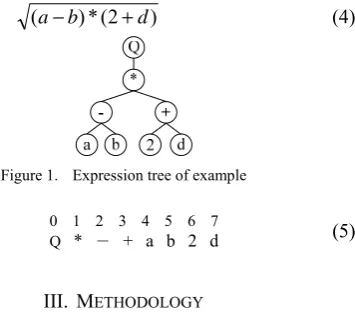
In GEP, just like in other evolutionary methods, after the results of each generation evolution undergo the moderate evaluation of fitness function, high fitness individuals are retained, and have a higher chance to breed future generations by moving in cycles. The algorithm will not stop until a satisfactory solution or expected evolution algebra has been achieved. The phenotype of a chromosome expresses a candidate solution in the solution space of the problem to solve. At the time of evolution, GEP codes the individuals into the linear string of fixed length firstly, and does genetic operations in this linear string. GEP, finally, transfers the linear string into the expression tree to evaluate the fitness according to the fitness function. Its coding rules can be simply described as the following: The algorithm builds the expression tree (ET) with genome according to their semantic, and traverses the ET from top to bottom, then from left to right, and the derived symbol serials are effective parts of the gene code (known as K-expression). The following expression (4), which can be described with the expression tree (phenotype) shown as Fig. 1 and the gene segment (genotype) shown as expression (5), is 1
min ( , )
q m
k k
k
f Q C U V
=
taken as an example to illustrate the chromosome coding method of GEP.
) 2 ( * )
(a−b +d (4)
Figure 1. Expression tree of example
(5)
III. METHODOLOGY
The [7] designed a GEP - PO algorithm, based on the in GEP, to solve the problem of parameter optimization. The idea of homologous genes was found from [7] using for function mining. And the [10] modified it for function optimization. Each terminal character at the end of the homologous gene denotes a common gene. Function operators of the head denote the connections symbols among genes. And it can flexibly connect several genes dynamically to form a cell through each homologous gene function operator of the head. The idea of homologous genes using in GEP is in favor of reusing and retaining the excellent gene structure in chromosomes. In order to improve search quality and efficiency, the homologous gene and cell systems thinking are introduced in this paper to solve parameter estimation problem. We design a MC_GEP_MPO algorithm based on the multicellular GEP algorithm for parameter estimation, and used it on the optimal fitting of the single return period rainstorm intensity model.
To solve the problem of parameter estimation of the rainstorm intensity forecasting model, the structure and encoding method of chromosome of MC_GEP_MPO are designed as follows:
A. Related Concepts
Definition 1 (gene). Gene is a 5-tuple expressed as G = (Q, F, T, DC, Op), where Q is genotype, and F is the function set, and T is the terminal set, and Op is the
genetic operator set, and DC, whose length is equal with the length of the tail, is the Constant domain.
Definition 2 (homeotic gene). Homeotic Gene is a 4-tuple expressed as H = (Q, FH, TH, the delta), where Q is genotype, FH is operator set of gene, TH is the terminal set of the homeotic gene whose terminal is ordinary genes and denote a normal gene in chromosome. The δ is the genetic operators set of the homeotic gene.
Definition 3 (cell). Cell is a 3-tuple expressed as C = (G, nG, H), where G is the gene set, nG =|G|>=2 is the gene amount included in a cell, H is the homeotic gene set. Each cell contains multiple genes with a homologous gene to denote a dimension of the problem space.
Definition 4 (chromosome). Chromosome is a 3-tuple expressed as CH = {Cs, DCs, S}, where Cs is the cell set, DCs is the constant set, S is the fitness value of the chromosome corresponding to a given data set. Each cell in chromosome is corresponding to a parameter to estimate. So, the three parameters of the rainstorm intensity forecasting model can be encoded in a chromosome with three different cells to evolve in algorithm.
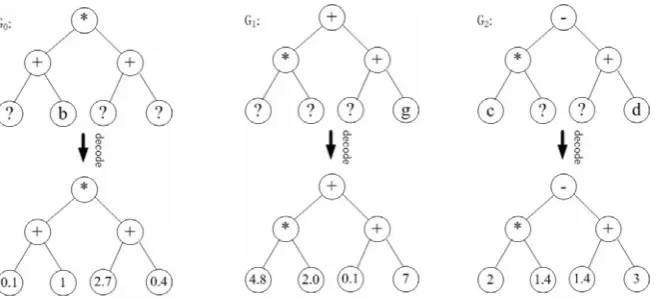
For instance, suppose an example gene shown as Fig. 2, the parameters include gene head length h=3,gene number nG=3, function set F={+,-,*,/}, terminal set T={?,0,1,...,9}, where ? is a constant whose value is determined by the corresponding code in DC, homeotic gene head length H=3, FH=F, constant set DCs={0.1,3.2,4.8,0.4,2.0,1.4,1.2,2.7,0.3,4.6}. Its three cells C1, C2 and C3 represent the 3 parameters of storm intensity forecast model a, b, n respectively. Its genotype and its corresponding three ETs are shown as Fig. 2 and Fig. 3.
Where, lowercase letters represent the corresponding integers, capital letters, whose area correspond to the constant domain, denote the position of corresponding constant array. Each gene/homeotic gene is separated by red line as shown in Fig. 2 and the area shown italic and bold is homeotic gene. The decoding process of the chromosome is shown as Fig. 3 and Fig. 4. And the final decoding result (To simplify, this example does not take into account the value range of parameters.) is a = -1.9267, b = -57.4162, n = 75.247.
0 1 2 3 4 5 6 7 Q * - + a b 2 d
0123456789A 0123456789A 0123456789A 0123456 0123456 0123456 *++?b??AHDB +*+???gCEAD -*+c??dFFBC *+/0221 -/*2010 +*-1012
B. Genetic Operators
Genetic operators operation is extremely important in genetic evolution algorithm. In the MC_GEP_MPO system, several genetic operators are designed for the genetic modification of chromosomes according to the structural characteristics of the individual coding:
1) One point crossing, Two points crossing, Mutate, Inversion, Insertion Sequence Transposition (IS), Root Insertion Sequence Transposition (RIS) and Gene transposition are both consistent with the canon GEP algorithm.
2) DC Mutation: DC mutation can only take place at positions of DC domain on a genome according to the given probability. However, the component of DC domain can only be changed into other random number (or alternative) in its scope.
3) Constant Mutation: Constant mutation can only take place on elements of the constant set of the chromosome according to the given probability. A random number is generated in the given scope to replace the previous one.
4) Alternative selection method: Canon GEP uses the well-known roulette-wheel method for selecting individuals. However, the stochastic tournament method, what is better than the roulette-wheel method on the optimal fitting of the rainstorm intensity forecasting model [13], is used for selecting individuals in the MC_GEP_MPO system.
C. Individual Assessment
Due to mismatch values what are calculated from rainstorm intensity forecasting models and actually measured value, the calculated intensity value point will distribute two sides of the actually measured intensity value curve. And it has a deviation Δ= I-
i
j (Where, Imeans the calculated rainstorm intensity values of various durations in a return period,
i
jis the corresponding actualmeasured value in the duration, j=1,2,...,m. m is the total
amount of the same return period of different rainfall intensity i).The objective function for the measured
rainfall intensity value and the calculating model of fitting the smallest residual sum of squares according to the principle of least squares and the absolute minimum standard deviation criterion on optimal fitting, namely
(
)
(
)
21
min ( , , ) m j n j
j
Fitness f a b n a t b i
=
= =
∑
+ −(6)
s.t. (a ,,b n)∈S
where, S is the confidence intervals of a b, and n.
Certainly, a b, and n are just the optimal parameter
values of the rainstorm intensity forecasting model when Expression (6) taking the minimum.
D. MC_GEP_MPO Algorithm Frame
The main process description of MC_GEP_MPO algorithm is as follows:
Algorithm 1 (MC_GEP_MPO)
Input: population size, pausing condition, gene head
length, gene amount, homeotic gene head length, function sets, terminator sets, the probabilities of various genetic operators, the tournament size, the upper and lower bounds of the various parameters optimization space;
Output: the optimal chromosome;
Step1: Load the initial configuration of algorithm;
Step2: Initialize the population and produce the first
generation of chromosomes;
Step3: Do chromosome decoding, randomly generate a
new chromosome to replace the chromosome if any gene of the chromosome is not within the feasible region S when decoding; And to evaluate chromosome fitness value of the current group;
Step4: Go to Step5 if stop conditions are not met,
otherwise go to Step9;
Step5: Keep the best individual directly into the next
generation;
Step6: Do genetic operation on other individuals of the
current population;
Step7: Go the same as Step3;
Step8: Select individuals into the next generation by
tournament selection strategy, and go to Step4;
Step9: Output the optimal solution of current objective
function; and the algorithm end.
IV. EXPERIMENT AND PERFORMANCE ANALYSIS
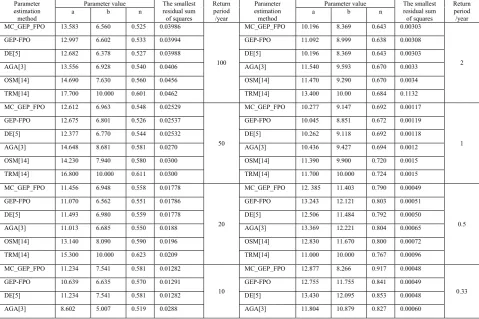
In order to verify that the MC_GEP_MPO algorithm has superiority to the parameters fitting and optimizing of rainstorm intensity forecasting model, this paper will respectively solve the parameter fitting and optimizing problem of storm intensity forecasting model with Single Return Period through using the MC_GEP_MPO algorithm and the GEP-FPO algorithm presented in [13] which is based on the GEP-PO presented in [7] (parameters setting of two GEP algorithm are shown in Table I). It also compares with other algorithms including
Traditional regression method (hereinafter referred to as TRM), and the optimum seeking regression method (hereinafter referred to as OSM) from [14] ,and the accelerating genetic algorithm (AGA) from [3] , and Differential Evolution Algorithm (DE) from [5]. All the
experimental data {(
t ,
ji
j ), j=1,2,...,m}(detailed shownin [14]) are statistical data of different return period of storm intensity and rainfall duration. They are extensively used in the research field. According to experience in the project, the model parameters value scope set a∈ [3,30], b∈ [0,100], n ∈ [0,2]. The Comparison results of the
experiment are shown in Table II.
TABLE I.
PARAMETERS SETTING OF TWO PARAMETERS OPTIMIZATION ALGORITHM BASED ON GEP IN THIS PAPER
parameters value parameters value
MC_GEP_MPO GEP-FPO MC_GEP_MPO GEP-FPO generations 200 200 mutation rate 0.2 0.2 population size 100 100 inversion rate 0.1 0.1 Function set + - * / + - * / IS transposition rate 0.1 0.1 Terminal set ?1, 2, ..., 9 ? 2-point cross rate 0.3 0.3 Gene head
length
5 5 1-point cross rate 0.3 0.3 Number of Gene 4 4 Constant mutation
rate
0.05 0.05 Homeotic gene
head length
5 none DC mutation rate 0.05 0.05 Constant set size 10 10 Selection method stochastic
tournament, scale=20
roulette-wheel
TABLE II.
COMPARISON RESULTS OF MC_GEP_MPO AND OTHER PARAMETER ESTIMATION ALGORITHMS
Parameter estimation method
Parameter value The smallest
residual sum of squares
Return period /year
Parameter estimation method
Parameter value The smallest
residual sum of squares
Return period /year
a b n a b n
MC_GEP_FPO 13.583 6.560 0.525 0.03986
100
MC_GEP_FPO 10.196 8.369 0.643 0.00303
2
GEP-FPO 12.997 6.602 0.533 0.03994 GEP-FPO 11.092 8.999 0.638 0.00308
DE[5] 12.682 6.378 0.527 0.03988 DE[5] 10.196 8.369 0.643 0.00303
AGA[3] 13.556 6.928 0.540 0.0406 AGA[3] 11.540 9.593 0.670 0.0033
OSM[14] 14.690 7.630 0.560 0.0456 OSM[14] 11.470 9.290 0.670 0.0034
TRM[14] 17.700 10.000 0.601 0.0462 TRM[14] 13.400 10.00 0.684 0.1132
MC_GEP_FPO 12.612 6.963 0.548 0.02529
50
MC_GEP_FPO 10.277 9.147 0.692 0.00117
1
GEP-FPO 12.675 6.801 0.526 0.02537 GEP-FPO 10.045 8.851 0.672 0.00119
DE[5] 12.377 6.770 0.544 0.02532 DE[5] 10.262 9.118 0.692 0.00118
AGA[3] 14.648 8.681 0.581 0.0270 AGA[3] 10.436 9.427 0.694 0.0012
OSM[14] 14.230 7.940 0.580 0.0300 OSM[14] 11.390 9.900 0.720 0.0015
TRM[14] 16.800 10.000 0.611 0.0300 TRM[14] 11.700 10.000 0.724 0.0015
MC_GEP_FPO 11.456 6.948 0.558 0.01778
20
MC_GEP_FPO 12. 385 11.403 0.790 0.00049
0.5
GEP-FPO 11.070 6.562 0.551 0.01786 GEP-FPO 13.243 12.121 0.803 0.00051
DE[5] 11.493 6.980 0.559 0.01778 DE[5] 12.506 11.484 0.792 0.00050
AGA[3] 11.013 6.685 0.550 0.0188 AGA[3] 13.369 12.221 0.804 0.00065
OSM[14] 13.140 8.090 0.590 0.0196 OSM[14] 12.830 11.670 0.800 0.00072
TRM[14] 15.300 10.000 0.623 0.0209 TRM[14] 11.000 10.000 0.767 0.00096
MC_GEP_FPO 11.234 7.541 0.581 0.01282
10
MC_GEP_FPO 12.877 8.266 0.917 0.00048
0.33
GEP-FPO 10.639 6.635 0.570 0.01291 GEP-FPO 12.755 11.755 0.841 0.00049
DE[5] 11.234 7.541 0.581 0.01282 DE[5] 13.430 12.095 0.853 0.00048
OSM[14] 12.890 8.680 0.610 0.0326 OSM[14] 13.160 11.950 0.850 0.00061
TRM[14] 14.400 10.000 0.636 0.0317 TRM[14] 10.900 10.000 0.810 0.00108
MC_GEP_FPO 14.723 10.584 0.597 0.00741
5
MC_GEP_FPO 19.000 14.313 0.971 0.000483
0.25
GEP-FPO 10.442 7.655 0.597 0.00754 GEP-FPO 20.338 14.765 0.986 0.000496
DE[5] 10.321 7.472 0.595 0.00740 DE[5] 18.712 14.214 0.967 0.00048
AGA[3] 12.152 9.196 0.630 0.0082 AGA[3] 18.279 14.200 0. 961 0.00053
OSM[14] 11.870 8.600 0.630 0.0084 OSM[14] 16.790 13.490 0.940 0.00072
TRM[14] 13.400 10.000 0.653 0.0090 TRM[14] 11.600 10.000 0.868 0.00176
The smallest residual sum of squares, fitted in the rainstorm intensity model using the original data, evaluated by various optimization methods in the Table II, conduces following points: (1) the smallest residual sum of squares of the parameter fitting and optimizing results by six methods are basically decreases as the storm return period decreases (namely, storm return period shorter, computing precision of model higher, and parameter fitting results better). All the smallest residual sum of squares, between model calculation values and measured values, were both less than 0.05 in all return periods. Certainly, they all meet the requirement of the national project criterion [1]. (2) two parameter estimation algorithms that GEP MC_GEP_MPO and GEP-FPO both obtain significantly better fitting results than what get from the traditional regression method, the optimization regression method and AGA, for all 10 test groups of return period rainfall data. It shows that parameters fitting method of storm intensity forecasting model based on GEP is not affected by whether the model is linear, continuous, and differentiable. It is not restricted by the amount of parameters and constraints either. It directly does global adaptive optimization under the guidance of objective function of Expression (6) in Section 3.4, and obtains the global optimal solution easily. Therefore, parameters fitting have high precision and practicability. (3) In the experiment of 10 test groups of return period rainfall data fitting, five test groups of return period rainfall data fitting solved by MC_GEP_MPO are superior to the results solved by Differential Evolution Algorithm, and three test groups of return period rainfall data fitting solved by MC_GEP_MPO are equal with Differential Evolution Algorithm, and only two test groups of return period rainfall data fitting solved by MC_GEP_MPO are slightly worse than Differential Evolution Algorithm. It shows that, in storm intensity forecasting model, parameters fitting and optimization performance of MC_GEP_MPO are better than that of Differential Evolution Algorithm in the overall context. (4) In the experiment of every test group of return period rainfall data fitting, MC_GEP_MPO has better performance than the GEP-FPO algorithm. It shows that the proposed MC_GEP_MPO algorithm has better fitting and optimization performance than GEP-FPO algorithm based on standard GEP. Nonetheless, while chromosome of MC_GEP_MPO and chromosome of GEP-FPO have the same head length, chromosome of MC_GEP_MPO would have longer chromosome length what usually causes chromosome more complex and taking a little more time to encode and to decode it.
In a word, the MC_GEP_MPO algorithm proposed in this paper is very effective, which is used to solve the parameters fitting and optimization problem of storm intensity forecasting model successfully.
V. CONCLUSIONS
Gene expression programming is a kind of knowledge discovery and optimization tool with heuristic random search invented based on the simulated biological evolution. It is a research hotspot in the field of intelligent computing in recent years. In this paper, we study using Multicellular Gene Expression Programming to fit nonlinear system model parameters, and design a parameter estimation algorithm named as MC_GEP_MPO for the rainfall intensity forecasting model, and finally study on fitting parameters of the rainstorm intensity forecasting model with single return period. The experimental results show that MC_GEP_MPO algorithm with its characteristics of parallel search and global convergence can overcome the shortcomings of traditional methods effectively, and achieve a good model fitting accuracy and effectiveness. It is expected to be a new effective tool to improve the efficiency and quality of storm disaster management work. Our future work will continue to study the proposed method to expand to parameters optimization and prediction problems of all kinds of natural disasters model.
ACKNOWLEDGMENT
The authors would like to thank Professor KaiPing Lin. This work was supported in part by the National Science Foundation of China Grant # 61363037, and the National Science Foundation of Guangxi Grant #2012GXNSFBA053161, and the scientific research project of the Guangxi Education Department #201010LX293, the 2013 school-level research projects of Guangxi Teachers Education University. ChangAn Yuan is the corresponding author.
REFERENCES
[1] National Bureau of Standards, GB50014-2006 Outdoor Drainage Design Code, Beijing: China Standard Press, 2006. (in Chinese)
[3] X. H. Yang, J. L. Jing, and G. T. Zhang, “Accelerating genetic algorithm and its application to estimating parameters of storm intensity formula,” Journal of Natural Disasters, vol. 7, no. 3, pp. 71-76, 1998. (in Chinese) [4] C. W. Zou, J. Q. Xiong, and Z. Y. Li, “Improved ant
colony algorithm and its application to parameters optimization in storm intensity formula,” Journal of Sichuan University(engineering science edition), vol. 37,no. 5, pp. 9-13, 2005. (in Chinese)
[5] X. J. Xu, D. L. Qian, and J. L. Zhang, “Application of the differential evolution algorithm in estimating parameters of the storm intensity formula,” Journal of Hefei University of Technology(natural science),vol. 31, no. 4, pp. 645-647, 2008. (in Chinese)
[6] C. Ferreira, “Gene expression programming: A new adaptive algorithm for solving problems,” Complex Systems, vol. 13, no. 2, pp. 87-129, 2001.
[7] C. Ferreira, Gene Expression Programming: Mathematical Modeling by an Artificial Intelligence, Second ed., Springer-Verlag, 2006.
[8] V. K. Karakasis and A. Stafylopatis,. “Efficient evolution of accurate classification rules using a combination of gene expression programming and clonal selection,” IEEE Transactions on Evolutionary Computation, vol. 12, no. 6, pp. 662-678, 2008.
[9] K. K. Xu, Y. T. Liu, et al., “A novel method for real parameter optimization based on gene expression programming,” Applied Soft Computing, vol. 9, pp. 725-737, 2009.
[10]Y. Z. Peng, C. A. Yuan, et al., “A multi-cellular gene expression programming algorithm for function optimization,” Control Theory and Application, vol. 27, no. 11, pp. 1585-1589, 2010.
[11]C. A. Yuan, Y. Z. Peng, et al., Gene Expression Programming Algorithm Principle and Application, Beijing: Science Press, 2010. (in Chinese)
[12]J. Jedrzejowicz and P. Jedrzejowicz, “Experimental evaluation of two new GEP-based ensemble classifiers,” Expert Systems with Applications, vol. 38, pp. 10932-10939, 2011.
[13] Y. Z. Peng, C. A. Yuan, et al., “A new evolutionary algorithm for parametric fitting of the storm intensity calculation model,” Journal of Guangxi University, Nat Sci Ed, vol. 38,no. 5, pp.1173-1178, 2013. (in Chinese)
[14]K. Yang and X. R. Cheng, “B statistical coefficient algorithm for rainstorm intensity formula,” Yangtze River, vol. 27, no. 3, pp.16-22, 1996.
Yuzhong Peng received his master's
degree in Computer Application Technology from Guangxi Teachers Education University, in China, in 2009. He is an Associate Professor at Guangxi Teachers Education University. He is a CCF member. His research interests are in Evolutionary Computation and Data modeling.
Jie Li received her master's degree in
Computer Application Technology from East China Normal University, in China, in 2012. She is a lecturer at Guangxi Liuzhou Teachers college. Her research interests are in Evolutionary Computation and Data modeling.
Dr. Chang’an Yuan received the Ph.
D. degree in Computer Application Technology from the Sichuan University, in China, in 2006. He is a professor at Guangxi Teachers Education University. His research interests include Computational intelligence and Data mining.
Dr. Baoqing Hu received the Ph. D.