ISSN (Online): 2320-9364, ISSN (Print): 2320-9356
www.ijres.org Volume 7 Issue 4 Ser. I ǁ 2019 ǁ PP. 24-29
A Study on the Characteristics of Cow ManureDrying and
Combustion
Naining Liu
*,Seung-Hwan Lim
**,Jin-Do Chung
***†*Graduate School, Department of Energy and Climate Fusion Technology, Hoseo University, Asan, 31499, Republic of Korea
**Korea East-West Power Corporation, Ulsan, 44543, Republic of Korea ***†
Department of Environmental Engineering, Hoseo University, Asan, 31499, Republic of Korea
Abstract: Interest in new and renewable energy is growing worldwide in response to global warming and the depletion of fossil fuels, and Korea, which relies on imports for most of energy, utilize and distribute various new and renewable energy sources in response to this global trend. Accordingly, this study was analyzed for the odor of cow manure fuel, combustion exhaust, ash, dryer and boiler exhaust during the drying and combustion. The analysis results of the dried cow manure fuel, the water content, ash component, sulfur composition, and heavy metals were found to be satisfied with the overall quality standard of the livestock excrement solid fuel. The results of the combustion exhaust analysis, the experimental values of PM10, CO, and HCl were all higher than the emission acceptance criteria in the initial, mid and post stages of boiler operation, and concentrations of As, Cd and Hg are not detected. And the concentrations of Ni, Pb, Cr, fluoride compounds, nitrogen oxides and dioxin were lower than the standard. The results of the XRF analysis show that the main components were SiO2, P2O5, CaO and K2O. P2O5 in the ash can be a source of fertilizer, so it is deemed necessary to examine the possibility through further experiments. The results of the analysis of the drying emission showed that the concentration of ammonia, methylmercaptane, sulfuric acid, dimethyldysulfide and trimethylamine was higher than the emission acceptance criteria, while the concentration of dimethylacid was lower than the emission acceptance standard.The results of the analysis of the combustion emission were analyzed as non-detection of trimethylamine, while the concentration of methylmercaptane, hydrogen sulfide, dimethylsulfide and dimethyldysulfide was higher than the emission acceptance standard.
Key Words: Cow manure, Combustion exhaust, XRF, Odor analysis
--- --- Date of Submission: 29-11-2019 Date of acceptance: 16-12-2019
---
I.
Introduction
In response to global warming and the depletion of fossil fuels be concerned with new and renewable energy is growing in Korea, which relies on imports for most of its energy, is striving to develop, utilize and distribute various new and renewable energy sources in response to this global trend[1]. Since the incidence of domestic livestock excretion is on the rise, the land is continuously decreasing, it is necessary to develop a method to efficiently treat livestock excrement in addition to livestock excretion and liquidfuelization.[2, 3]
As the Korean livestock sector will develop in a way that will contribute to environmental degradation and cyclical farming, in a longer term, livestock excretion should be seen as part of biomass resources as a renewable energy alternative to fossil fuels.[4, 5].
Recently, there has been growing interest in using cow manure as a solid fuel and as a source of energy, but due to the high water content, the high energy using to remove moisture from solid fuelification has become a problem[6, 7]. Currently, solid fuelification technology that removes moisture and nonflammable substances by using flammable solid wastes such as waste synthetic resins, waste paper, and waste wood products as raw materials and manufactures solid fuel through processes such as grinding, separating, screening, and drying molding.
Europe's solid fuel production is led by Germany, Italy and Spain. In particular, Germany developed the world's first separate and selected technology in 1980 and is currently known to produce and use the combustible waste RDF (Refuse Derived Fuel) based on the best technology level. In 2008, 78 facilities nationwide were found to produce 2 million tons of RDF from 7.2 million tons of waste per year under the Ministry of Environment's Comprehensive Waste Energy Policy announced in 2008[8].
Japan has been promoted with policy and institutional support to establish a biomass town by actively utilizing biomass in the region, such as the Comprehensive Strategy of Biomass in Japan, which started in 2002, and the plan to promote the use of biomass in 2012.
In 2005, the U.S. conducted a study to identify conditions for coal and mix by analyzing the combustion characteristics of sedimentary excretion of cows in Iowa Province, and developed an exhaust gas remover device to reduce the generation of pollutants of the cow manure in the air. In addition, the U.S. analyzed the amount of heat generated by dairy cattle breeders sedimentary excretion in 2006 focusing on the state of Texas, and is conducting related research and development on the characteristics of used solid fuel of the heat generated by coal and cow manure mixed.
The U.K. analyzed the management performance of poultry in 2013, and the effect of increasing and reducing greenhouse gases in farming households through the empirical study of the household temperature system using the farm-type relay incineration boiler, and is operating a large-scale generation system.
The solid-fueled research of livestock excretion has long been studied outside the country as an alternative to petroleum energy, especially in Mongolia and India, where it has been used as a fuel for a long time by using horse and cow excretion, but does not develop to an industrial level because the local occurrence of fuel makes transportation difficult and the amount of the fuel is not produced on a large scale.
The quality control of solid fuel is required to obtain quality and grade certification of solid fuel products from the certification authority designated by the environment minister based on Article 25 of the Act on the Saving of Resources and Promotion of Recycling[1].
The Korea environment corporation has designated and operated the solid fuel certification institute, and 4 research institutes have designated, the Korea institute of machinery & materials, the Korea institute of energy research, the Korea testing laboratory and the Korea testing and research institute[10].
Odors in many places, and there are many different types of odors in different countries, and 22 kinds of substances are regulated in Korea[11, 12]. The elements that make up the odor include carbon(C), hydrogen(H), oxygen(O), nitrogen(N), sulfur(S), and chlorine(Cl) and so on, so each odor material has different elements, so the strength of the odor, and physical and chemical characteristics are different.
The odor materials generated in livestock facilities include amines, aromatic nitrogen compounds, sulfide compounds, esters, aldehydes, ketones, phenols and fatty acids. Amines tend to have a high minimum detection concentration and low level of odor contribution. The aromatic nitrogen compound is a major source of odor in livestock facilities, including indole and skatole, and its low minimum detection concentration, which causes bad odor[13-15]. Sulfide compounds are detected at very low concentrations and are highly irritating, such as hydrogen sulfide, dimethylenethylsulfide, and dimethylisulfide, and are also methylmercoptan, which occurs frequently during anaerobic conditions. The aromatic compounds and esters have a relatively high minimum detection concentration compared to other substances and have a low incidence, which makes their contribution to odor. Aldehydes and ketones are also partially produced in the congratulatory speech, but their actual contribution to odor inducement is relatively low compared to other substances.
In Article 2 of the act on the conservation of the Atmospheric Environment, ‘atmospheric pollutants’ refer to gas and particulate matter that exist in the air that is recognized as the cause of air pollution, and ‘atmospheric pollutant discharge facilities’ shall be defined by the Environment Ordinance as facilities, machinery, instruments, and other objects that discharge air pollutants into the air.
II.
Materials and Methods
2.1. Analysis of cow manure fuel
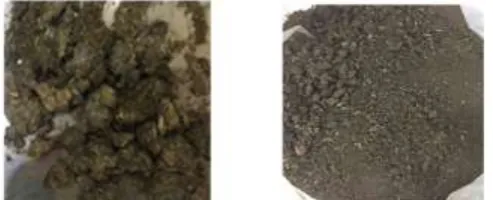
In this study, analysis is carried out by grinding the dried cow manure into small particles. The low heating value, moisture, ash, and sulfur content in the specimen were analyzed. The heavy metal analysis used CP-AES and ICP-MS to analyze the contents of mercury(Hg), lead(Pb), cadmium(Cd) and chromium(Cr) in the specimen. As shown in Fig. 1, analyzed with dried cow manure fuel.
2.2. Analysis of boiler exhaust gas in combustion
The lab-scale fluidized layer reactor for combustion testing consists of a sample input system, a fluidized layer reactor, two cyclones, a cooler and an impact separator. The initial setting temperature was set to 500℃ and stabilized at approximately 790℃.
In the operation of the pilot, the initial combustion stage is the state of incomplete combustion in the boiler due to the initial injection of fuel, the medium combustion stage is the fixed state of combustion, and the post-combustion is the state of complete combustion in which the existing fuel is burned to the end without continuing to inject the fuel. Depending on the state of operation of the boiler, the components of exhaust gas vary, especially the difference in the amount of carbon monoxide and dust produced. Dust (PM10), carbon
monoxide (CO), oxides of sulfur dioxide(SO2), nitrogen oxides(NOx), hydrogen chloride(HCl), nickel(Ni),
arsenic(As), cadmium(Cd), lead(Pb), chromium(Cr), fluoride and mercury(Hg) were analyzed a total of three times each at the initial, medium and post stages of boiler operation, and Dioxin was analyzed only once in the medium or post stages of boiler operation.
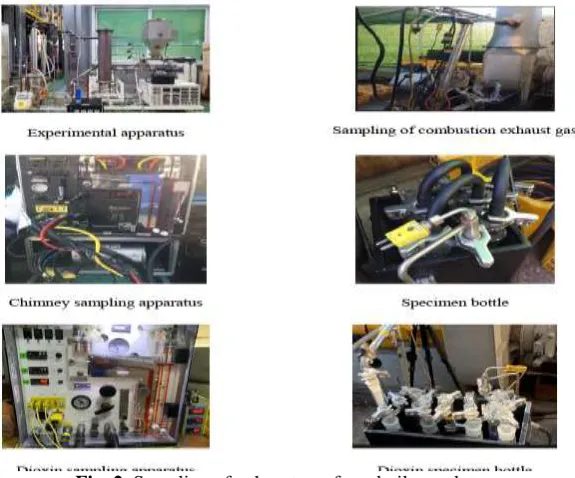
To measure the content of SOx and NOx in boiler combustion emissions was analyzed, using the TESTO 350 K(TESTO SE & CO, KGaA, a real-time gas analyzer). As shown in Fig. 2, boiler combustion exhaust was sampled and analyzed.
Fig. 2. Sampling of exhaust gas from boiler outlet
2.3. Analysis of combustion ash
After the experiment, the bed ash generated from the pilot plant boiler was recovered and XRF was analyzed.As shown in Fig. 3, combustion ash was sampled and analyzed.
Fig. 3. Sampling of ash
2.4. Analysis of odor
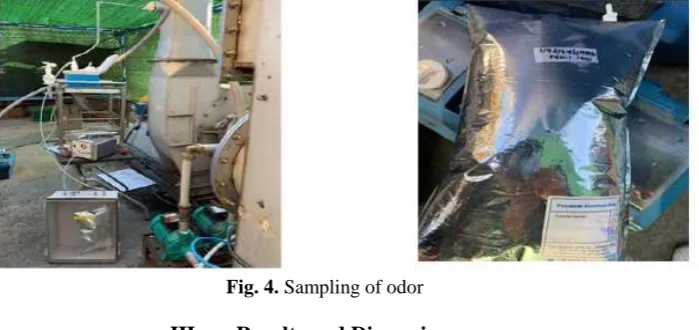
amine class substances by precedence, among the 22 designated bad substances specified by the act on the prevention of odor. The exhaust gas of the dryer and boiler was analyzed of one times at each point.As shown in Fig. 4, odor was sampled and analyzed.
Fig. 4. Sampling of odor
III.
Results and Discussion
3.1. Analysis of cow manure fuel
As shown in Table 1, based on the analysis results of the dried cow manure fuel, the water content, ash component, sulfur composition, and heavy metals were found to be satisfied with the overall quality standard of the livestock excrement solid fuel. The lower heating value generation was low, but it is deemed to be usable as fuel. In addition to the cow manure, corn straw and reeds can be mixed in equal proportions, and the heat content of the fuel is known to represent 3,500∼4,000 kcal/kg depending on the ratio of sawdust to mixed. If a separate dry cow manure additive is added, an exothermic rate of 4,500∼5,000 kcal/kg is also known to be possible. Due to the high heat output, it is possible to fully burn and produce less ash.
Table 1. Results of fuel analysis
Division Unit Standard Case 1 Case 2 Case 3 Average Lower heating value kcal/kg > 3,000 3000 2800 2600 2800
Water content wt.% < 20 4.8 5.8 11.8 7.5 Ash component wt.% < 30 27.5 27.8 28.7 28.0
Sulfur Composition wt.% < 2 0.65 0.75 0.71 0.70
Heavy metals
Hg
mg/kg
< 1.2 0.02 0.02 0.02 0.02
Cd < 9 0.22 0.42 0.48 0.37
Pb < 200 6.9 5.2 5.9 6.0
Cr < 70 23.0 35.3 15.3 24.5
3.2. Analysis of boiler exhaust gas in combustion
As shown in Table 2, based on the results of the combustion exhaust analysis, the experimental values of fine dust(PM10), carbon monoxide(CO), and hydrogen chloride(HCl) were all higher than the emission acceptance
criteria in the initial, mid and post stages of boiler operation, and the concentration of particulate(PM10) and carbon
monoxide(CO) was higher than the standard. Concentrations of arsenic(As), cadmium(Cd) and mercury(Hg) are not detected. The concentrations of nickel(Ni), lead(Pb), chromium (Cr), fluoride compounds, nitrogen oxides and dioxin were lower than the standard.
However, since the actual operation system has an emission control system, PM10 concentration can be discharged below the emission standard using an ESP(Electrostatic Precipitators).
Table 2. Results of combustion emission gas analysis
Division Unit Emission Permit Standard Analysis result of Early stage Analysis result of Metaphase Analysis result of Later stage Average
PM10 ㎎/㎥ < 20 304.6 158.6 72.1 178.4 SOX ppm < 30 137.30 44.00 16.00 65.77
NOX ppm < 70 46.60 49.60 7.70 34.63
CO ppm < 50 2053.3 1930.00 194.30 1392.53
Dioxin ng-TEQ/㎥ < 0.1 0.070 0.070
HCl ppm < 15 202.68 41.65 29.46 91.26 Ni ㎎/㎥ < 2 0.004 0.005 0.006 0.005
As ppm < 0.25 N. D. N. D. N. D. -
Cd ㎎/㎥ < 0.02 N. D. N. D. N. D. -
Pb ㎎/㎥ < 0.2 0.018 0.023 - 0.021
Cr ㎎/㎥ < 0.3 0.008 0.007 0.008 0.008 Fluoride
Compound ppm < 2 0.541 0.546 0.238 0.0442
Hg ㎎/㎥ < 0.08 N. D. N. D. N. D. -
3.3. Analysis of combustion ash
As shown in Table3, the results of the XRF analysis show that the main components were SiO2, P2O5, CaO
and K2O. P2O5 in the ash can be a source of fertilizer, so it is deemed necessary to examine the possibility through
further experiments. As SO3 components are present in the ash, it is deemed that the presence of CaO components in
the cow manure sample prevents SOx generation by reacting with S components in the specimen.
Table 3. Results of XRF(X-ray fluorescence) analysis
Division Unit Analysis result Division Unit Analysis result
Na20 wt% 4.76 V2O5 wt% N. D.
MgO wt% 7.26 Cr2O3 wt% N. D.
Al2O3 wt% 5.08 MnO wt% 0.38
SiO2 wt% 40.1 Fe2O3 wt% 2.51
P2O5 wt% 13.9 CuO wt% 0.02
SO3 wt% 1.51 ZnO wt% 0.12
K2O wt% 6.53 NiO wt% 0.02
CaO wt% 17.4 SrO wt% 0.03
TiO2 wt% 0.25 ZrO2 wt% 0.01
3.4. Analysis of odor
As shown in Table 4, the results of the analysis of the drying emission showed that the concentration of ammonia(72.7 ppm), methylmercaptane(0.0136 ppm), sulfuric acid(0.0350 ppm), dimethyldysulfide(0.0196 ppm) and trimethylamine(4.161 ppm) was higher than the emission acceptance standard, while the concentration of dimethylacid was lower than the emission acceptance standard.
The results of the analysis of the combustion emission were analyzed as non-detection of trimethylamine, and ammonia was lower than the emission acceptance standard(applied to other areas). While the concentration of methylmercaptane, hydrogen sulfide, dimethylsulfide and dimethyldysulfide was higher than the emission acceptance standard, in particular, the concentration of hydrogen sulfide was higher than the emission acceptance standard.
Odor substances generated in livestock facilities include amine and sulfide compounds, which are high in minimum detection concentration, which causes concentration of ammonia and trimethylamine.
www.ijres.org 29 | Page]
Table 4. Results of odor analysis
unit: ppm
Analysis item Emission Permit Standard (industrial area)
Emission Permit Standard (Other areas)
Discharge gas of the dryer
Discharge gas of the boiler
Ammonia < 2 < 1 72.7 0.0400
Methylmercaptane < 0.004 < 0.002 0.0136 0.0160 Hydrogen sulfide < 0.06 < 0.02 0.0350 0.9970
Dimethylsulfide < 0.05 < 0.01 0.0068 0.0109
Dimethyldysulfide < 0.03 < 0.009 0.0196 0.0130
Trimethylamine < 0.02 < 0.005 4.161 N. D.
IV.
Conclusions
Based on the results of the cow manure fuel analysis, it is believed that the fuel that is dried for about 6% is likely to be used as fuel by reaching the legal quality standard of 3,000 kcal/kg for livestock excretion solid fuel, and the content of water content, ash component, sulfur composition and heavy metals is below the quality standard. Combustion emission analysis shows that dust (PM10), carbon monoxide (CO), and hydrogen
chloride (HCl) should be installed with baghouse or other controls because the concentration was higher than the emission acceptance standard, while dioxin, nitrogen oxides, fluoride compounds and heavy metals(Pb, Ni, Cr, Cd, Hg) are found to be below the emission limit. Based on the analysis results of XRF, the main components were SiO2, P2O5, CaO and K2O. P2O5 in the ash can be a source of fertilizer, so it is deemed
necessary to examine the possibility through further experiments. According to the results of the odour analysis, only the dimethyl salts were found to be lower than the emission acceptance criteria (applied to other areas) for the exhaust gas of the dryer. The concentrations of ammonia, methylmercaptane, hydrogen sulfide, dimethylsulfide and trimethylamine were higher to the emission acceptance standard, especially the concentrations of ammonia were significantly higher. The concentrations of methylmercaptane, hydrogen sulfide and dimethyldysulfide are not significantly different than the emission acceptance standard.
References
[1]. Korea Environment Corporation, Study on the quality and grading standards of livestock manure solid fuel products, Ministry of Environment, 2013.
[2]. Korean Ministry of Agriculture, Food and Rural Affair, Yeild of livestock manure in Korea, 2016.
[3]. K. H. Jeong, J. K. Kim, D. J. Lee, W. M. Cho, B. Ravindran and J. H. Kwag, Effect of drying process on cow manure solidified fuel applications, Organic Resource Society, 2016; 24: 105-112.
[4]. K. Y. Cho, Livestock manure is no longer a problem but a great resource, Gapyeong livestock agricultural cooperative association, [cited 04 June 2018]. Available from:http://www.gp21.com/mobile/view.asp?group_name=301&intNum=32603.
[5]. S. B. Lee, Trends in Japanese livestock manure processing technology, Korea Rural Economic Institute, 2016; 45-66.
[6]. H. W. Bae, Jeongeup City Livestock Manure Public Treatment (Fuelization) Facility Installation Project feasibility study service, Jeongeup-si, Jeollabuk-do, 2016; 6.
[7]. S. H. Lim, A study on drying characteristics and optimum operation of cow manure using disk dryer and duct rotary dryer, Department of Energy & Climate Fusion Technology Graduate School, Hoseo University, 2018; 1-4.
[8]. J. H. Min, A Study on the Establishment and Management of Small Use Facilities for RDF Demand Expansion, Ministry of Environment, 2009.
[9]. J. S. Lee, Shaped system development for energy recycling of cow dung, Sangji University Graduate School, 2016; 1-9.
[10]. K. D. Cho, Climate atmospheric environment influence and management strategy using solid fuel, the Incheon Institute, 2016; 20-22.
[11]. C. M. Oh, A study on the technology trends of odor emission of pig Manure, Department of Industrial Engineering, Sungkyunkwan University, 2015; 62-66.
[12]. Ministry of Environment, Odor investigations for the improvement of the source material management plan studies, 2001. [13]. J. A. Kim, Study on the characteristics odorous compounds emitted from animal waste treatment facility, Graduate School of
Communication Technology , Korea University, 2018; 6-9.
[14]. D. M. Ha, An optimal management system for the liquid manure to reduce the bad odor, Department of Animal Resources Technology Graduate School, Gyeongnam University, 2016; 28-29.
[15]. M. C. Choi, A study of estimating livestock distribution using GIS and odor diffusion characteristics, Department of Environmental Industry Engineering Graduate School, Korea National University of Transportation, 2017; 7-21.
[16]. Y. S. Choi, H. S. Choi, S. Z. Kim, K. D. Yoon, Investigation of dioxin concentration in combustion of various RDF in coal boiler, Korea Society for New and Renewable Energy, 2008; 452-455.