ISSN (Online): 2320-9364, ISSN (Print): 2320-9356
www.ijres.org Volume 4 Issue 4 ǁ April. 2016 ǁ PP.25-31
Experiment and Numerical Simulation of Droplet Impact on a
Sphere Particle
Zhiwei Zheng
1, Dashu Li
2, Xingqi Qiu
1 1(School of Chemical Engineering, China University of Petroleum, Qingdao 266580, China) 2(CNOOC
Research Institute, Beijing 100028, China)
ABSTRACT:- In order to explore the mechanism of droplet impacting on a sphere particle, experiments and numerical simulation were carried out. High speed camera was used to observe the dynamic motion of droplet during impingement. Numerical model using coupled level set and volume of fluid method including heat transfer and thermal contact resistance was developed, which was validated by experiments. Results show that spreading is an important characteristic for droplet impact on a sphere particle as the effect of gravity and surface structure on droplet spreading is obvious. Pressure gradient inside droplet is the main factor of droplet spreading. Heat transfer is much larger at the edge than impact point and droplet surface, which decreases as droplet spreading with time. Affected by Rayleigh Taylor instability, the edge of the droplet is easy to breakup. The spreading factor and velocity are closely related to impact velocity and droplet initial diameter.
Keywords:- Droplet impact, spreading factor, spreading velocity, sphere particle
I.
INTRODUCTION
Droplet impingement widely exists in many industries[1-4], like ink-jet printing, thermal/plasma spraying, spray cooling, engine combustion. Droplet impact on the substrate is a strong transient and nonlinear process with complex topology structure of phase interface, which attracts much effort for many years[5-7]. Despite many experiment and simulation investigations on dynamics of droplet impact on flat surface, the publications concerning droplet impact on small targets are quite limited. The small target has the size which can be comparable to droplet size. It is clear that droplet impact onto small targets is quite different from large substrate, especially like spheres and particles. Bakshi[8] investigated the impact of droplets onto a spherical target by experimental and theoretical method. They observed the initial drop deformation phase, the inertia dominated phase, and the viscosity dominated phase of the film dynamics. They also presented the effect of droplet Reynolds number and target-to-drop size ratio on the dynamics of the film flow on the surface of the target. Hardalupas[9]conducted experiments to investigate the phenomenon of monodisperse water-ethanol-glycerol solution droplets (160-230 μm diameter) impinging at velocity of 6-13m/s upon a spherical surface (0.8-1.4mm diameter). They observed crown liquid jet with the effect of surface roughness, droplet kinetic energy and liquid properties. Rozhkov[10] presented the results of the collision of water drops(2.8-4mm diameter) impact on a steel disk(3.9 mm diameter) at the impact velocity of 3.5m/s. They observed the effect of rupture wave on liquid jet disintegration. Mitra[11] carried out research about droplet impact on a highly thermally conductive spherical surface. They also studied the effect of Weber number on droplets spreading. In fact, droplet impact on a small target has enormous applications in new areas on drop/spray impact.
In this article, the process of droplet impacting on a sphere particle is investigated experimentally and numerically. High speed camera is used to record the dynamic motion of droplet during impingement. A numerical model using coupled level set and volume of fluid (CLSVOF) method[12] considering heat transfer and thermal contact resistance is developed. The material properties and boundary conditions in the model is consistence with experimental condition. The constant property of material is replaced by thermophysical property. The Marangoni stress boundary is applied to solve the stress at liquid and solid phase interface. Thermal contact resistance is also considered as it is an important factor in liquid and solid coupling model. The numerical model is validated by experiment. Also, the mechanism of flow and heat transfer during droplet impingement is revealed. Moreover, the influence of some typical deposition parameters like impact velocity and initial diameter of droplet on spreading factor and velocity are highlighted.
II.
EXPERIMENTAL
METHOD
shooting area. The impact velocity of the droplet can also be controlled by adjusting the height of sliding support.
1 lights; 2 high speed camera; 3 substrate; 4 droplet; 5 coordinate frame; 6 steel sphere; 7 computer; 8 needle; 9,11 flow control valve; 10 sliding support; 12 liquid tank; 13 thermocouple; 14 heating equipment
Figure 1 Experiments system
The high speed camera (Basler Company) is set with a horizontal contained angle of 15o with a frame rate of 10000 per second. The image resolution is 1024×512. The pixel analyze method is programmed by Matlab. Considering the droplet is not a sphere but an ellipsoid, an equivalent diameter (Dh2Dv)1/3 [13]is used, where Dh , Dv is horizontal and vertical diameter of the droplet. In this work, diesel droplet is used, the initial diameter of droplet D0=2.378±0.05mm, the impact velocity U0=1.49m/s, the diameter of sphere particle dp=10mm. The impact velocity is the average velocity in 0.5ms before the droplet contact with the liquid film. The temperature of the droplet is 345K, the temperature of substrate is 298K. Fig.2 is the geometric model of droplet impacting on a sphere, where Ds is spreading diameter, thus the spreading factor is f= Ds/D0, the dimensionless time is also defined as t*=t U0/ D0.
Figure2 Droplet impact on a sphere surface
III.NUMERICAL
METHOD
In CLSVOF method,its control equation are: v 0 (1)
[ ( ) ] [ ( ) ] p [ ( )( T)] ( )
t
ν vv v v g F (2)
( ( )c Tp ) ( ( )c Tp ) ( T)
t
v (3)
Where v is velocity vector, F is the source term of surface tension, gis gravity vector, pis pressure, ( )
and
( )are dynamic viscosity and density respectively, cpis specific heat, Tis temperature, is heat conductivity coefficient.The source term of surface tension is solved by CSF(continuum surface force) model proposed by Brackbill[14], which can be expressed as:
( ) H( )
F κ (4)
In addition, to impose the effect of contact angle, the surface normal at the cell next to the wall can be expressed as:
cos sin
w w
n
n (5) Where, nwand
ware the unit vectors normal and tangential to the wall, is the contact angle at the wall. Here an experimentally measured equilibrium contact angle is used in this model, which can be reasonably capable of predicting the hydrodynamic characteristics. The thermal contact resistance is introduced in this model. The Marangoni stress can be expressed as:d T
dT
(6)
In this paper, a two dimensional model was used to study the process of droplets impact on a sphere particle. In order to improve the calculation precision of phase interface, the grid near the wall surface was refined adaptively. By the grid independence test, the grid size was decided as 0.03mm, which can ensure the accuracy of calculation and save the calculation time and cost. The total grid number was 462000. The initial diameter of droplet D0 changes from 1mm to 3mm, U0 changes from 1.2m/s to 3.5m/s, dp is constant of 10mm.
The proposed model was solved by Finite Volume Method (FVM), using PRESTO! for calculating pressure. SIMPLE scheme was applied to couple pressure and velocity. The CICSAM[15] algorithm was used for tracking gas-liquid interface. QUICK method was applied in the equation discretization, which can improve the computational accuracy.
IV.
RESULTS
AND
DISCUSSION
4.1 Model test
Fig.3 is the comparison of the experimental results with numerical simulation. Where D0=2.378mm, U0=1.49m/s, dp=10mm. The experimental observed results of droplet motion morphology agree well with simulation at the stage of spreading. Fig.3 also shows that the spreading factor of experiments is also close to that of simulation.
Figure 3 Comparison between simulation and experiments
4.2 Flow and heat transfer of droplet
1.6ms 2.6ms
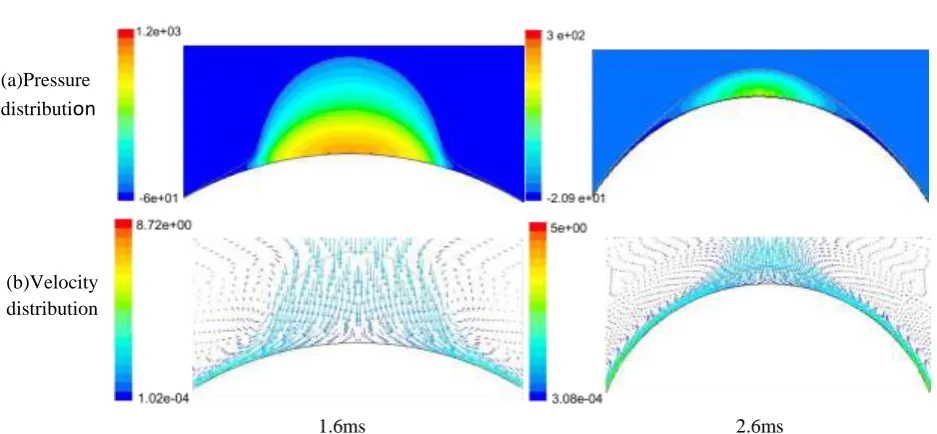
Figure 4 Pressure and velocity distribution of droplet
Fig.5 shows the temperature and vorticity distribution. Temperature of droplet is higher than the wall, thus heat transfers from the droplet to the wall. As can be seen, t=1.6ms, temperature gradient at the impact center is 750K/mm, much larger than that at the droplet surface(30K/mm). This can be attributed to the different means of heat transfer, where heat transfer is dominated by heat conduction at the impact center, while at the surface, heat transfer is dominated by heat convective. At the same time, temperature gradient at the spreading edge is 3214K/mm, much larger than that at the impact center and droplet surface. This can be explained that liquid film at the spreading edge is much thinner than the main body of droplet, according to Fourier's law the heat transfer amount is larger, so temperature changes obviously at the spreading edge. When t=2.6ms, temperature gradient at the impact center decreases to 450K/mm, while temperature gradient at droplet surface decreases to 15K/mm. At the same time, temperature gradient at the edge decreases to 1500K/mm. This can be deduced that heat flux decreases as droplet spreading with time.
Fig.5 also shows that the spreading edge of the droplet has a larger vorticity than that of the main body of the droplet. Due to the effect of Rayleigh Taylor instability, droplet is easy to breakup at the spreading edge.
1.6ms 2.6ms
Figure 5 Temperature and vorticity distribution of droplet
4.3 Influence of impact velocity
Fig.6 plots the spreading factor changing with dimensionless time t* of different impacting velocity. Where D0=2mm, dp=10mm, U0 is 1.2, 2.5, 3.5m/s. As can be seen, spreading factor increases with (a)Pressure
distributi
on
(b)Velocity distribution
(b)Vorticity distribution
dimensionless time, droplet with larger impact velocity has a larger spreading factor, and dimensionless time is longer for reaching its maximum. The spreading factor increases from 1.1 to 1.8 as the impact velocity increases from 1.2m/s to 3.5m/s. The reason for this could be that droplets with larger impact velocity have a larger kinetic energy, this energy could be offset by viscous dissipation and effect of surface tension when spreading. Therefore, droplets with larger impact velocity spread more easily.
Figure 6 Effect of impact velocity on spreading factor
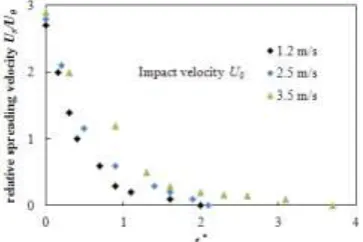
Fig.7 shows the relative spreading velocity (Us/U0) of droplet changing with time at different impact velocity. As can be seen, the initial spreading velocity is largest, then it decreases with dimensionless time, when droplet reaches it maximum spreading factor, its spreading velocity decreases to 0m/s. Droplets with larger impact velocity has a lager spreading velocity, and dimensionless time taking for it decreasing to 0m/s is longer. This could be attributed to the larger kinetic energy for droplets with larger impact velocity. Thus, the initial spreading velocity is an important factor for droplet spreading.
Figure 7 Effect of impact velocity on spreading velocity
4.4 Influence of droplet diameter
Fig.8 shows droplets with different initial diameter D0, impacting at 1.2m/s on a sphere particle with dp=10mm, where the diameter changes from 1mm to 3mm. As can be seen, the spreading factor increases with dimensionless time, droplet with larger initial diameter has a larger spreading factor, and dimensionless time is longer for reaching spreading factor maximum. The maximum spreading factor increases from 1.7 to 2.7 with the initial diameter increases from 1mm to 3mm. This could be attributed to larger kinetic energy of droplets with larger diameter. Droplets with larger initial diameter spread more easily.
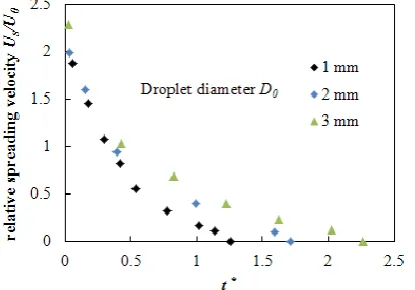
Fig.9 shows the relative spreading velocity of droplet changing with time at different initial diameter. As can be seen, the initial spreading velocity is largest, then it decreases with dimensionless time, when reaching the maximum spreading factor, spreading velocity decreases to 0m/s. Droplets with larger diameter has a lager spreading velocity, and dimensionless time taking for it decreasing to 0m/s is longer. From the above analysis, it can be known that initial diameter and impact velocity are important factors of droplet spreading.
Figure 9 Effect of droplet diameter on spreading velocity
V.
CONCLUSION
Droplet impact on a sphere surface was experimentally and numerically investigated. The numerical results agree well with experiment. Numerical analysis shows that spreading is an important characteristic for droplet impact on a sphere particle as the effect of gravity and surface structure on droplet spreading is obvious. Pressure gradient inside the droplet is the main source of droplet spreading. Heat transfer is much larger at the edge than the impact point and surface of droplet, which decreases as droplet spreads with time. Affected by Rayleigh Taylor instability, the edge of the droplet is easy to breakup. The spreading factor and velocity are closely related to impact velocity and droplet initial diameter. The study of droplet impact on a sphere particle is a start to investigate new application of droplet impingement. In the future research works will focus on droplet impact on substrates of different surface structures.
ACKNOWLEDGEMENTS
The authors gratefully acknowledge the Fundamental Research Funds for the Central Universities of Ministry of Education of China(Grant No. 15CX06052A)
REFERENCES
[1]. Moreira A L N, Moita A S, Panao M R. Advances and challenges in explaining fuel spray impingement: how much of single droplet impact research is useful?, Progress in energy and combustion science, 36(5), 2010, 554-580.
[2]. Li Dahsu, Qiu Xingqi, Yu Lei, et al. Review of Spray Droplet Impact on a surface. Industrial Heating, 43(2), 2014, 1-4.
[3]. Rein M. Phenomena of liquid drop impact on solid and liquid surfaces. Fluid Dynamics Research, 12(2), 1993, 61.
[4]. Shinoda K, Murakami H. Splat morphology of yttria-stabilized zirconia droplet deposited via hybrid plasma spraying. Journal of thermal spray technology, 19(3), 2010, 602-610.
[5]. Chandra S, Avedisian C T. On the collision of a droplet with a solid surface. Proceedings of the Royal Society of London. Series A: Mathematical, Physical and Engineering Sciences, 432(1884), 1991, 13-41.
[6]. Li Dashu, Qiu Xingqi, Cui Yunjing, et al. Numerical analysis on impacting velocity effect on spray oil droplet impacting onto a surface during diesel engine cold starting. Transactions of the Chinese Society for Agricultural Machinery, 45(6), 2014, 25~31.
[7]. Escure C, Vardelle M, Fauchais P. Experimental and theoretical study of the impact of alumina drops on cold and hot substrates. Plasma Chemistry and Plasma Processing, 23(2), 2003, 185-221.
[8]. Bakshi S, Roisman I V, Tropea C. Investigations on the impact of a drop onto a small spherical target. Physics of Fluids, 19(3), 2007, 032102.
[10]. Rozhkov A, Prunet-Foch B, Vignes-Adler M. Impact of water drops on small targets. Physics of Fluids, 14 (10), 2002, 3485-3501.
[11]. Mitra S, Sathe M J, Doroodchi E, et al. Droplet impact dynamics on a spherical particle. Chemical Engineering Science, 100, 2013, 105-119.
[12]. Yokoi K. Numerical studies of droplet splashing on a dry surface: triggering a splash with the dynamic contact angle. Soft Matter, 7(11), 2011, 5120-5123.
[13]. Rioboo R, Marengo M, Tropea C. Time evolution of liquid drop impact onto solid, dry surfaces. Experiments in Fluids, 33(1), 2002, 112-124.
[14]. Brackbill J U, Kothe D B, Zemach C. A Continuum Method for Modeling Surface Tension. Journal of Computational Physics, 100(2), 1992, 335-354.