Study Of Spectrum Sensing Techniques For
OFDM Based Cognitive Radio
Monika Tripathi
Department of Electronics, Madhav Institute of Technology and Science Gwalior, India [email protected]
Abstract: Nowadays OFDM (Orthogonal Frequency Division Multiplexing) techniques are adopted by many existing or progressing wireless communication standards.OFDM’s sensing and spectrum shaping capabilities together with its flexibility and adaptivity make it the best transmission technology for CR system. Spectrum sensing helps to detect the spectrum holes (unutilized bands of the spectrum) providing high spectral resolution capability.Thus, a robust spectrum sensing algorithm for OFDM modulated signals is highly decide to implement CR when the primary signal uses OFDM modulation. Motivated by this demand,a Time-Domain Symbol Cross-correlation based spectrum sensing algorithm (TDSC method) is presented in this paper.The algorithm makes use of the property that the mean of the TDSC of two OFDM symbols is not zero if they have embedded the same frequency-domain pilot tones. We propse a new decision statistic for the signal detection based on the special feature –Cyclic Prefix embedded in OFDM signal. Further, in this paper we used to control the Transmit Power for cognitive radio.Different spectrum sensing techniques for OFDM based cognitive radio are discussed in this paper.
Keywords: Cognative Radio, OFDM, Spectrum Sensing, Energy Detection, Matched Filter, Cyclostationary Feature Detection.
I. Introduction
The cognitive radio concept dates back to 1998 when the idea was first conceived by Sir Joseph Mitola III at the Royal Institute Of Technology in Stockholm. The major driving factor behind was the ever increasing requirement for the radio spectrum. There was an unusual drive for improved communication speeds. The only way to provide communication flexibility was by efficiently utilizing the radio spectrum. Cognitive Radio turns out to be a solution to the spectral crowding problem by introducing the opportunistic usage of frequency bands. These frequency bands must not be occupied by licensed users. One most important component of a cognitive radio is its ability to measure, sense, learn,and be aware of the parameters related to the radio channel characteristics, the availability of radio spectrum as well as power, the user requirements and their applications, and also other operating restrictions. In cognitive radio terminology, primary user (PU) can be defined as the user who possesses higher priority on the usage of any specific part of the spectrum. Secondary user is the one with much lower priority. The secondary user gets access to this spectrum in such a way that it do not cause any sort of interference to the already existing primary user. Therefore a secondary user should have cognitive radio capabilities, such as sensing the spectrum reliably so as to check whether the band of the spectrum is being used by any primary user and to change its own radio parameters in order to exploit the unused band of the spectrum [2]. Spectrum sensing can be described as an art of performing measurements on a part of the radio spectrum and forming a decision related to the spectrum usage based upon the earlier measured data. Now a day, the service providers face a situation in which they require a larger amount of spectrum to satisfy the increasing quality of service (QoS) requirements of the users. This is the reason for the increased interest in unlicensed spectrum access, and spectrum sensing is an important enabler for this. Spectrum sensing is to detect the presence (or absence) of a primary user [1,3]. For CR to achieve this objective, the CR needs to be highly flexible and adaptable. A special case of multicarrier transmission known as orthogonal frequency division multiplexing (OFDM) is one of
the most widely used technologies in current wireless communications systems.
II. OFDM-BASED CR
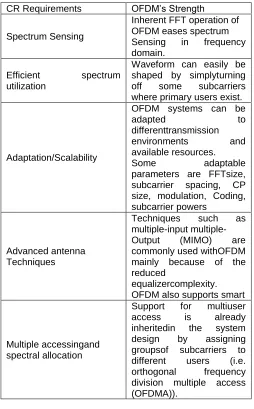
Table-1: Summary of CR’s requirements and OFDM’s strength.
CR Requirements OFDM’s Strength
Spectrum Sensing
Inherent FFT operation of OFDM eases spectrum Sensing in frequency domain.
Efficient spectrum utilization
Waveform can easily be shaped by simplyturning off some subcarriers where primary users exist.
Adaptation/Scalability
OFDM systems can be
adapted to
differenttransmission
environments and
available resources.
Some adaptable
parameters are FFTsize, subcarrier spacing, CP size, modulation, Coding, subcarrier powers
Advanced antenna Techniques
Techniques such as multiple-input multiple- Output (MIMO) are commonly used withOFDM mainly because of the reduced
equalizercomplexity. OFDM also supports smart
Multiple accessingand spectral allocation
Support for multiuser access is already inheritedin the system design by assigning groupsof subcarriers to different users (i.e. orthogonal frequency division multiple access (OFDMA)).
III. OFDM Signal Generation
OFDM systems rely on orthogonal multi-carriers which are optimally spaced to carry the data. The spectrum sensing forODFM systems in blind environment poses a greaterchallenge which relies on centre frequency, carrier spacing, and bandwidth estimations. Spectrum utilization techniques for ODFM systems goes one step beyond other systems an utilize the null subcarriers (subcarriers not utilized by primaryuser), technique known as spectrum spooling. The QAM symbols generated are surpassed through the Inverse Fourier Transform algorithm. The IFFT is necessaryto compute the frequency response of the time variantfunction. We incorporated IFFT for our input QAM symbolswhich give frequency response in time domain typicallygiving OFDM subcarriers . The receiver computes theFourier transform of the received signal in order to get thedesired symbol period and energy levels. The nature ofOFDM is that it can sustain the changes caused byenvironment variables like fading, interference andattenuation especially at higher frequencies [9].
S(t)
fc
Figure 1. OFDM Signal Generation
OFDM Signals can cope up with severe inter-symbolinterferences (lSI) if the guard bad interval is set with respectto the signal time period and sampling rate. As the symbolstream is low-rate for OFDM signals, we can add guard bandsto avoid any lSI between corresponding parallel streams [9]. A guard band also eliminates the needs of a pulse shapingfilter.The cyclic prefix generators are normally used with guardbands to identify the signal and sub-carrier boundaries at the receiver while taking FFT [8, 9]. The cyclic prefix generator appends the end bits of OFDM signal in guard bands andtransmits along, thus providing a stream of end points alongwith the actual signal, so that the receiver can detect the actuallength of the symbols received. OFDM signal in mathematical form:
S t = Re di+NS/2exp j2π fc−
i + .5
T (t − ts ]
N s 2−1
l=Ns/2
Where T is the OFDM symbol duration, ts being the starting
time of symbol, Ns is no. of subcarriers &di is the complex
symbol for QAM modulation.The signal generated iscorrupted by AWGN channel [11]. Therefore with our assumptionsthe received signal towards the receiver takes a very simpleform of:
x(t) = s(t) + w(t)
where x(t) is the signal to be detected and w(t) is the
additivewhiteGaussiannoise.
IV.Spectrum Sensing Techniques
Spectrum sensing is the process of a cognitive radio sensing the channel and determining if a primary user is present, detecting the spectrum holes. Inthiswediscussaboutthetechniquesusedinspectrumsensing. Threedifferentsignal processingtechniquesthatareused inthesystemsarematchedfilter,energydetectorandcyclostatio naryfeaturedetection. Consider ahypothesistest for signaldetection:
H0: Y[n ]= W[n] n=0,1…N-1
H1: Y[n] = X[n] + W[n] n=0,1…N-1
H0: Primary user is absent.
H1: Primary user is present.
Hereitisassumedthat
arethesamplesofadditivewhiteGaussiannoisewithspectral density i.e W n ~N(0. σ2 ) and is the input
sample sequence. QAM
Symb-ol
IFFT G(T)
T/2
𝐹𝑝 =1 𝑇
LPF 𝑋
A. Energy Detection
Energy detector is also known as radiometry and it is most common method of spectrum sensing because of its low computational and implementation complexities. Moreover, the cognitive user’s receivers do not need any knowledge of the primary user’s signal. The signal is detected by comparing the output of energy detector with threshold which depends on noise floor [4].
Figure 1. Block diagram of energy detector in time domain
T Y = Y2[n] γ H0
H1
< > N−1
n=0
N = 2 (Q−1 P
f − Q−1 Pd (snr)−1− (Pd)]2 =O(SNR)2
Then numberof samplesrequired to optimallydetect
theincomingsignal isO(1/SNR2) [5,7]. Theproblems inusingenergydetectoristhethresholdthatisusedfordetectingp rimarysignalispronetounknownchangesinnoiselevels.Ifthenoi
selevelischangedadaptivelystillthepresenceofin-bandinterferencecancausepoordetectionofsignalenergy.Ifthe channelisnotflatitisnotpossibletosetthethresholdwithrespectt othenotchescausedbyitsfrequencyselectivity.Sincetheenerg ydetectorisonlyconcernedwiththeenergyoftheincomingsignal itdoesnotdifferentiatebetweennoiseandinterference.Incontex ttocognitiveradiosinterferenceandnoiseshouldbetreateddiffer entlybecauseofthepresenceofunlicensedandlicensedusers.D uetotheseproblems energydetectorbecomes proneto falsedetection. Thehypothesis model for transmitterdetection can be definedas:
x t = n t H0
h ∗ s t + n t H1
Herex(t)isthesignalreceivedbytheunlicenseduser, isthesignaltransmittedbythelicensedtransmitter,
n(t)isthenoiseintroducedbyAWGNandisthechannel gain. isthenullhypothesiswhenthereisnoprimarysignaland
indicatesthepresence of
primarysignal[8]Theprobabilityof detection
andfalsealarm aregivenas follows [9].
Pd = P Y >
λ H1
= Qm( 2ϓ, λ)
Pf= P Y >
λ
H0 = ґ(m, λ 2)/ґ(m)
Inthese equation isSNR,λisthresholdandQm a, b is
generalized Marcum Q- function, a and b are nonnegative
real numbers, and m is a positive
integer.Alowdetectionofprobabilitywillresultinabsence of primarysignal and ahighPfwould resultin inefficient spectrum
utilization. The drawbacks of this system are it has poor performance in low SNR regimes[9].
I.Sensing OFDM Systems Under Frequency-Selective Fading Channels
Fig.1.Simplified block diagram of the OFDM transmitter
Fig. 2. Typical OFDM symbol structure
As shown in Fig.2 OFDM signals have a CP,which is a special feature differentiating them from other signals that could be exploited for signal detection.By utilizing the CP,we are presenting a new detection scheme for OFDM signals.
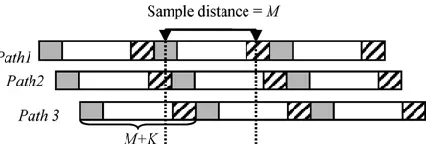
Fig. 3.Received OFDM signal passing through a three-path channel.
A typical OFDM signal received, after passing through a multipath fading channel, at a sensing device is illustrated in Fig. 3 (three paths are drawn for the illustration purpose). The two arrows connected indicate two samples of signals with a sampling time distance of one useful OFDM symbol duration (the symbol duration before adding a CP) or M . It can be seen and will be proved later that the two samples may exhibit strong correlation even in a multipath environment when the first sample falls within the CP duration for any one of the paths, due to the fact that the transmitted CP is a copy of the part of the signal with sampling time distance M . Exploiting the correlation, we examine the following hypotheses:
𝐇𝟎 : ζ = 𝐖𝐝=𝟏𝐳𝐝 =
𝐧𝐝 𝐧𝐌+𝐝∗
𝐄 𝐫𝐝𝟐
𝐖 𝐝=𝟏
𝐇𝟏 : ζ = 𝐖𝐝=𝟏𝐳𝐝 =
(𝐫 𝐝+𝐧𝐝)(𝐫 𝐌+𝐝∗ +𝐧𝐌+𝐝∗ )
𝐄 𝐫 𝐝+𝐧𝐝𝟐
𝐖 𝐝=𝟏
Where zd≜ rdrM+d∗ /E r
d 2 , “*” stands for the Hermitian operation, and the summation is over the observation window W, which can be single continuous time interval or multiple discontinuous subwindows.
Pre-filter Squaring
device
II. Spectrum Sensing for OFDM Systems Employing Pilot Tones and Application to DVB-T OFDM
Statistical Development Of The Correlation Of Two OFDM Symbols
Under the assumption that L, the length of the Cyclic Prefix (CP), is longer than the length of the time-invariant channel, the nth sample of the lthOFDM symbol can be modeled as
xl n =ej(2π f∆nN +θl).1
N H k Xl k N−1
K=0 ej2πkn /N+ wl n
Wheref∆ is the carrier frequency offset normalized to the subcarrier spacing. The phaseθl=
2πf∆lM
N + θc is the initial phase of the lth OFDM symbol where M = N + L is the length of an OFDM symbol. The parameter N is the number of subcarriers, and Xl[k] which is taken from a finite complex
alphabet constellation denotes the data symbols at the kht subcarrier of the lth OFDM symbol. Moreover, H[k] is the complex channel gain of the kth subcarrier and w
l[n] is a sample of a complex additive white Gaussian noise (AWGN) process. We will assume that wl n is a circularly symmetric complex Gaussian random variable which has zero-mean and a variance of σw2/N. Most of the existing standards which adopt OFDM modulation [8][9][10] allocate pilot symbols in the frequency domain and these pilot symbols are calledpilot tones. Let Pa, a = 0, 1, . . .A − 1, denote the sets of all possible pilot tone positions for the transmitted OFDM symbols. Assume that Pa is the set of pilot tone
positions of the lht OFDM symbol and Xl[k] = Pa [k] for k ∈P
a .
Here, we should note that the pilot symbols Pa [k] are predefined and have the same amplitude. For most cases,
Pa [k] is a fixed constant and in some cases they change sign. Assume that the lth and mth OFDM symbols have the same pilot tone positions and define
R(l,m) = 1
N xl
N−1
n=0 n xm∗[m]
which is the Time-Domain Symbol Cross-correlation (TDSC) function of two OFDM symbols.
BMatchedFilter
Itisalinearfilterwhichmaximizesthesignaltonoiseratio.Thema inadvantageofthisfilteristhatitrequireslesstimetoachievehig hprocessinggainbecause of thecoherency[5].If iscompletelyknowntothereceiverthentheoptimaldetectorfort hiscaseis[10]:
T Y = Y n X[n]>< N−1
n=0
ϓ
H1
H0
here
isthedetectionthreshold,thenthenumberofsamplesrequiredf or optimaldetection are
N = [Q−1 P
d − Q−1(Pf)]2(snr)−1 =O(snr)−1
WherePdandPfarethe probabilities of detectionand false detectionrespectivelyThusthenumberofsamplesrequiredforo
ptimaldetectionisO(1/SNR).However, a matched filter effectively requires demodulation of the signal of the licensed user, the primary user. This means that cognitive radio has a priori knowledge of primary user signal at both PHY and MAC layers, e.g. modulation type and order, pulse shaping, packet format. These data can be pre-stored in cognative radio memory, but for performing demodulation it has to perform timing and carriersynchronization, even channel equalization,This is still possible since most primary users have pilots, preambles, synchronization words or spreading codes that can be used for synchronization[8].
C.CyclostationaryFeatureDetection Analternative
methodforthedetectionofprimarysignalsisCyclostationaryFea tureDetectioninwhichmodulatedsignalsarecoupledwithsinew avecarriers,pulsetrains,repeatedspreading,hoppingsequenc
es,orcyclicprefixes.This
resultsinbuilt-inperiodicity.Thesemodulatedsignalsarecharacterizedascycl ostationarybecausethemeanandautocorrelationexhibitperiodi city.Thisperiodicityisintroducedinthesignalformatatthereceive rsoastoexploititforparameterestimationsuchascarrierphase,ti mingordirectionofarrival.Thesefeaturesaredetectedbyanalyzi ngaspectralcorrelationfunction.Themainadvantageofthisfunc tionisthatitdifferentiatesthenoisefromthemodulatedsignalener
gy.Thisisduetothefactthatnoiseisawide-sensestationarysignalwithnocorrelationhowevermodulatedsi gnalsarecyclostationarydue toembeddedredundancy of signalperiodicity
[5].Analogoustoautocorrelationfunctionspectralcorrelationfun ction(SCF)canbe definedas:
Sxα f = lim
T→∞∆t→∞lim1/∆
1
2TXT(t, f + α 2)XT
∗ t, f −α
2 dt
∆t/2
−∆t/2
Wherethefinite time Fouriertransform is given by:
XT t, v = x u e−j2πvu t+T/2
t−T/2 du
Spectralcorrelationfunctionisalsoknownascyclicspectrum. Whilepowerspectraldensity(PSD)isarealvaluedonedimensi onaltransform,SCFisacomplexvaluedtwodimensionaltransf orm.Theparameterαiscalledthecyclic
frequency.Ifα=0thenSCF gives the PSD of the signal.withcyclicspectrumanalysisandpatternrecognitionba sed on neural networks isproposedin[7].
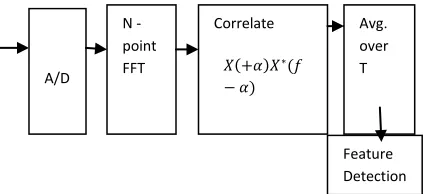
Figure 2 Implementation of Cyclostationary Feature Detector
Becauseof the inherentspectralredundancysignal A/D
N -point
FFT 𝑋 +𝛼 𝑋∗(𝑓 − 𝛼)
Correlate Avg.
over T
selectivitybecomes possible. Analysis ofsignalinthisdomainretainsitsphaseandfrequencyinformati onrelatedtotimingparametersomodulatedsignals[5].Duetoth is,overlappingfeaturesinpowerspectral density arenon overlappingfeaturesin cyclicspectrum.Hence differenttypesof
modulatedsignalsthathaveidenticalpowerspectraldensityca nhavedifferentcyclicspectrum.
Becauseofallthesepropertiescyclostationaryfeaturedetector canperformbetterthanenergydetectorindiscriminatingagain stnoise.Howeveritiscomputationallycomplexandrequiressig nificantlylargeobservationtime.Formoreefficientdetection, theenhancedfeaturedetectionschemecombinedwithcyclicsp ectrumanalysisandpatternrecognitionbased on neural networks isproposedin[7].
D. Comparison between different spectrum sensing techniques:
Detection
Method Advantage Disadvantage
Energy Detector
No need of Primary user information, low
computation & less expensive
Performance poor at low SNR, Lead to false detection.
Matched Filter
Require less time to achieve high
processing gain.
Prior knowledge of primary user required, need coherent detection, require accurate synchronization.
Cyclostationary
Perform well at low SNR condition & uncertain noise power
Computationally complex, Require large observation time.
V. Some other techniques
A. Covariance Detection
This method determines if a primary user is present from the covariance matrix of the received signal, it uses the property that the off diagonal elements of the covariance matrix is non-zero when a primary user is present and zero otherwise [12].
B. Wavelet Detection
For signal detection over wideband channels, the wavelet approach offers advantages in terms of both implementation cost and flexibility in adapting to the dynamic spectrum as opposed to conventional use of multiple narrowband band pass filters (BPF). Unlike the Fourier transform, using sine’s and cosines as basic functions, the wavelet transforms use irregularly shaped wavelets as basic functions and thus offer better tools to represent sharp changes and local features. In order to identify the locations of vacant frequency bands, the entire
wide-band is modeled as a train of consecutive frequency sub bands where the power spectral characteristic is smooth within each sub band but changes abruptly on the border of two neighboring sub bands. By employing a wavelet transform of the power spectral density (PSD) of the observed signal , the singularities of the PSD can be located and thus the vacant frequency bands can be found. One critical challenge of implementing the wavelet approach in practice is the high sampling rates for characterizing the large bandwidth.
C. Eigen value based Detection
Eigenvalue-based Detection (EBD) has been introduced as an efficient technique to perform spectrum sensing in Cognitive Radio (CR). Using the EDB approach, the secondary receiver is able to infer the presence or the absence of a primary signal based on the largest and the smallest eigenvalueof the received signal’s covariance matrix. This technique requires a cooperative detection setting, whichmay be accomplished by multiple antennasor cooperation among different users. The main advantage offered by EDB is its robustness to the problem of noise uncertainty, whichaffects all the previously proposed detection schemes including the widely adopted Energy Detection(ED).
VI. Conclusions
The growing demand of wireless applications has put a lot of constraints on the usage of available radio spectrum which is limited and precious resource. In wireless communication system spectrum is a very important resource. In cognitive radio OFDM basedsystems, reliable spectrum sensing techniques are required in order to avoid interference to the primary users. In this paper, different spectrum sensing techniques are discussed with their advantages and disadvantages.
REFERENCES
[1]. J.Mitola, “Cognitive radio:making software radio more personal,” IEEE Personal Communications, vol. 6, no. 4, pp. 13–18, 1999.
[2]. Federal Communications Commission, "Notice of Proposed Rulemaking: Unlicensed operation in the TV broadcast", ET Docket no. 04-186 (FCC 04- 113) May 2004.
[3]. FCC, “Notice of proposed rulemaking and order,” ET, Docket 03-222, December 2003.
[4]. H.Urkowitz, “Energy detection of unknown deterministic signals." Proc.IEEE, vol.55, pp.523-531, apr.1967.
[5]. A.Sahai, N. Hoven, R. Tandra, “Some Fundamental Limits on Cognitive Radio,” Proc. of Allerton Conference, Monticello, 2004
[7]. A.Fehske, J.D. Gaeddert, J.H. Reed, “A new approach to signal classification using spectral correlation and neural networks,” Proc. IEEE DySPAN 2005, pp. 144–150, 2005.
[8]. S. M. Kay, “Fundamentals of statistical signal processing: Detection theory,” Printice Hall PTR, vol. 2, 1998
[9]. HuseyinArslan, "Cognitive Radio, Software Defined Radio andAdaptive Wireless Systems" 1" Edition, Springer Press 2007, and ISBN:978-1-4020-5541-6.
[10]. M. Schwartz, Mobile Wireless Communications. Cambridge University Press, 2005.
[11]. Omer Ali,, “Analysis of OFDM parameters using Cyclostationary Spectrum Sensing in Cognitive Radio,” 2011 IEEE.
[12]. R. Suresh Babu,“Review of Energy Detection for Spectrum sensing in various channels and its
performance for cognitive radio