ISSN (e): 2250-3021, ISSN (p): 2278-8719
Vol. 09, Issue 5 (May. 2019), ||S (II) || PP 36-41
Cloud Computing in Ad Hoc Networks
1
Deepti Bhanot,
2Dr. Anil Chaudhary
1Dept. Computer Science Vivekanand Global University Jaipur, India
2Dept. Information Technology Swami Keshavanand Institute Of Technology Jaipur,India Corresponding Author: Deepti Bhanot
Abstract:
In this paper, we intend a protocol scheme for network mobility (NEMO) in ruinous scenarios assisted by cloud computing based on Ad-hoc networks. The proposed attempt tries to reduce the network burden on the mobile nodes and also minimizes the link failures during hand overs by availing cloud services while transmitting in between the nodes. This paper describes the route creation for the MANET as well as the route maintenance while maintaining the connectivity within the nodes. It also provides the proper mobility support in Ad Hoc mechanism. The introduction of cloud in MANET improves the quality and thus, attempt to achieve the level of stability.Keywords: Cloud computing, handover, NEMO
--- Date of Submission: 15-05-2019 Date of acceptance: 31-05-2019 ---
I.
INTRODUCTION
In our day to day life like our other major necessities electricity, water, food are essential commodities for happy living . In the same way the mobile devices and their networks have also become the essential necessity of human being. A mobile is not merely a device used for making and receiving calls but instead it is a data processing unit that is capable of performing lot of applications, stores data right from our personal to professional activities. Most of these applications generally run in synchronization with other application eg. if we need to attach a file exceeding the 25 MB limit of file attachment, it asked for use of Google Drive, Drop box or Wallet which is nothing just an example of cloud services which these providers are offering to the users free of cost.
As per the recent analysis the number of mobile phone registration is close to 7.3 billion [1] which means that in the world with every person there is one mobile phone but to avail the services of a mobile device one should get in touch with an external source. This external source which is satisfying the requirement of mobile devices in our research is cloud platform. As we know that for implementing cloud for wider prospect, we need cloud service provider such as Google App Engine, Amazon EC2, IBM Bluemix, Microsoft Azure and a publically available cloud named as Meghdoot. The cloud provide four categories of services to the subscribers. Some public clouds are freely available but some charges as per the usage by the subscribers. As per former work[2-5] in this area a mobile device are evaluated with the possibility of behaving both as a client as well as resource provider for the cloud Computing platform[6] due to which a traditional cloud computing frame work can be ported to mobile devices.The management of a mobile device or the job done at coordinator level is done on the infrastructured cloud which hinders a mobile user from the deployment of cloud computing services because of uavailability of connection or it can be too expensive to afford [7] but to extend the scope of adhoc networks with the avalaibilty of the cloud service the paper is attempting to provide a reliable network access in customary conditions as well as in the nastiest case scenario when there is overall network breakdown (a case of disasters) so that the communication can be made possible to save the lives and to rescue the required asserts because a disaster is a situation which seriously disrupts the routine working of the society or a community including a large amount of material, human, environmental and economic loss and the society or community can not cope up using its own resources. These risk are the production of a collection of both hazard/s and danger [8] . The VC-MANET protocol introduced in the paper mimics the support of connectivity among the mobile nodes in such situations.
II.
CURRENT
STATUS
OF
AD-HOC
NETWORKS
Various researches literature addresses the cloud computing to deal with NEMO, to reduce the packet loss due to link breakage and to reduce the network burden . Christensen [3] intoduced the idea of mobile cloud computing and presents general requirements and key technologies. The author produces an analysis report on context awareness,smart phones, restful based web services and cloud and also explains how to interact these components to create a better experience for mobile phone users. Luo [4] to develop the potential of mobile devices found the idea of using cloud computing. The main aim of this work is to presents the prosibility of such executions by launching a fresh division scheme for tasks. The the cloud to endorse mobile computing is examined is the best part of this paper .Giurgiu et al.[5] the application of the cloud as the repository for mobile applications. Pre processing of the Applications rooted on the current context of the user, so only the batches that can execute on the local device are processed and with the involvement of cloud minimization of the communication overhead are offloaded the computation burden from the mobile device to the cloud. Segmentation policies are judged to employ the execution of application on mobile devices, and do not focus any other issue in relation to mobile cloud computing. Chun and Maniatis [6] in behalf of the device treverse the benifit of cloud computing to run mobile applications. They propose of the formation of clone VMs is to avoid instability of running the part of a program in various architecture and produce same results of running applications/services that will run on mobile devices.Their reserch is strongly bounded to distributed file systems, and assumes cloud connectivity.Marinelli [7] presents Hyrax, which allows moblie devices to utilise cloud computing platform. It is a mobile cloud computing client .Based on Hadoop1, the major aim of the work is to integraration and to put a client into a mobile device. The mobile devices are resource providers but this is introduced without experiment so the general approch is suitable, there are no real thought about mobility and assosiation [8].
III.
NETWORK
SCENARIO
On 5 September, 2014, a disaster relief scenarion happened when the Jhelum River of Kashmir in India was mentioned to be raise 4.40 feet (1.34 m) above the danger sign and in Anantnag district 33 feet(10 m) higher than the danger point. The normal release of water is 2500 m3/s which upgoes to 7000 m3/s [9] due to which there are cracks in the boundary walls of Jhelum and it results in heavy outflow of water into the valley that leads to mass destruction of infrastructure, property and loss of lives since highways, landmarks, buildings and bridges have now all vanished in water the Data on Goole Maps or on Google Earth is inedequate. This also disrupted the established communication network to fullest extent which left the valley without proper communication for so many days. This also poses lot of extremities to rescue relief team to carry out their work.
In situation like this, I tried to create an Ad Hoc network with the involvement of Cloud computing platform.No doubt the existence of this network is not permanent but the condition for which this network is established requires utmost quality to meet this quality metric without considering the cost and attempting to made communication possible to the fullest this concept is introduced. A cloud is a data center of hardware and software. To the general public some clouds are freely accessible and their are some cloud which is made available as pay and use manner is called a public cloud; which provides serivces as utility computing where as private cloud is the internal data center of an organization which is not accesible to the gernal public,as they are large enough to comfort from the benifits of cloud computing. [10]
In this research, I tried to ensure a building of a trustworthy and light weighted MANET communication system with minimal number of link failures. The protocol is for Ad Hoc networks along with Cloud is named as VC-MANE(Virtual Cloud-Mobile Ad Hoc Network ). Now in the next section, I would like to enlighten some of the characteristics of cloud which is a requisite of MANET too.
IV.
NEED
OF
CLOUD
IN
PROTOCOL
accessing virtualized resources and system can be protected to prevent malicious attack. To develop the API interface, JAVA programming language shall be used. I will now present the basic idea behind VC-MANET algorithm in section IV.
V.
PROTOCOL
DESIGN
VC-MANET is a network of mobile workstations where every node has open connections. The protocol is based on virtual clustering where we group the k nodes in the cluster and the node having high stability is marked as the “Super node” of the cluster which maintains the routing table after pruning the node which are sure to violate the (f) parameter of the quality routing and the super node will maintain the routing table of all the node of a cluster. The cloud will also maintain the mirror image of the routing table of the cluster as back up .
If the destination node is in between the cluster, the node refers the routing table maintained by the super node of the cluster and establishes connection thereafter. But if the sink is outside the cluster, the super node of the cluster retrieves the information of the nearest cluster from the cloud and make connection with “super node” of other cluster and later to the destination node. Using this hierarchical structure, we can limit the burden of the routing table formation both at cluster as well as at cloud. With the addition of the cloud the VC-MANET can guarantee to built the routing protocol that is reliable and having less degree of connection break during the data transmission. The protocol proposes two sections for data transmission from source to sink.
i. Path Establishment ii. Path Preservation
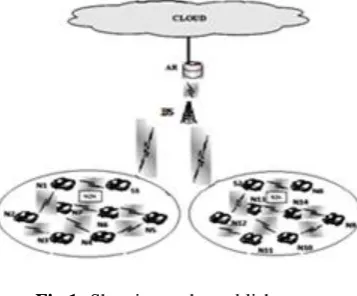
In Fig.1 we demonstrate the path establishment phase of the protocol in two scenarios Node tNode(N2N) and Node to Cloud (N2C).
Fig 1: Showing path establishment
A. Scenario 1 (N2N)
If node N1 requires to establish connection with node N5, node N1 has to refer the routing table maintained by the super node S1 of the cluster1 because both are belonging to same cluster the connection can be established by linking the intermediate nodes from source N1 to destination N5.
B. Scenario 2 (N2C)
If node N1 requires to establishes connection with node N9, node N1 has to refer the routing table maintained by the super node S1 of the cluster1, due to non availability of the node in the cluster the S1 super node of the cluster sends the reference of node N9 to the cloud. The protocol retrieves the address of the cluster where the node N9 is the member from the cloud routing table which maintains the table for the super nodes of the shaped cluster. Here the reference of S2 super node of cluster2 is retrieved. Now N1 establishes connection with node S1, S1 further links node S2 and form S2 the connection is established by linking the intermediate nodes to the N9.
The basic process principle of protocol is a completely distributed algorithm executing locally at every node instantly after startup. A propose module periodically tries, and if found proposes, new cluster. If the proposed cluster are better than the current one, then the proposal is broadcasted to all terminal nodes of all cluster members and a consent algorithm is executed which decides if nodes accept or refuse the proposal. If the cluster is accepted, it is built. Because nodes can crash or may leave groups without notifying other members a periodic consistency check is executed.
A latest trend in ad hoc network routing is the reactive protocols which work on-demand where routes are formed only on denand basis and when needed [12] like AODV,AODV BR[13], multicasting protocols (AMRoute, ODMRP, AMRIS, CAMP and flooding) [14].
Path preservation of protocol is very vital issue in the context of MANETS. Preservation of the active path is one of the crucial need if we design a protocol. One of the objectives of path preservation is to ensure that a set of nodes forming a connected network are able to survive even under the conditions of uncontrolled NEMO and work consistently.
In this paper the cloud is introduced to improve the performance of the protocol . The services offered by the cloud themselves are referred as Software as a Service (SaaS). Some delears use terms such as IaaS (Infrastructure as a Service) and PaaS (Platform as a Service) to describe their products, but the service we looked-for via cloud computing is the implementation of the algorithm in the cloud which continuously detects the link break in between the participating nodes during transmission of data in the active path. The reasons of link break are :
i. Battery drain ii. Less bandwidth iii. Node mobility
The nodes of manets have deficent amounts of energy that is utilised at different rates depending on the power level, the intended receiver and path length. In case of battery drain the transmission is halted until the power backup is provided to the node but in this algorithm the energy is conserved at various levels , first because of the employment of the cloud the intense computations are performed in the cloud memory which has its own power source ,so once after the path establishment the source and intermediate node is concerned with transfer of data packets to the destination and the protocol also maintains the accountability of the transferred data from source to sink which reduces the amount of battery drainage.In case of 2nd and 3rd issues less bandwidth and node mobility respectively of link break the protocol detects the reason but in both the cases the node is available on the network but out of network coverage which reflects that the availability of the node is there but data cannot be transmitted in a healthy way, but because the nodes are mobile in nature they can later be available on the network with their capacity to handle transmission again. In this case as per the earlier literature the process starts for path establishment again but our protocol during link break buffers data on the cloud memory.
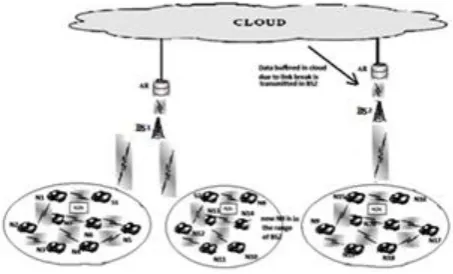
When the destination or the intermediate node is out of network coverage the transmission for that particular node is buffered in the cloud till the node availability on the network and when the node is available the data is transmitted from the cloud to the respective node. The following figures depict the route preservation in MANETS
Fig 2: Nodes showing NEMO
Fig 3: Path establishment during Handover
The protocol constantly checks for the availability of node N9 in the network and as shown in Fig 3 the node N9 is in clustert3 and is accessible via Ar2 so the data buffered in the cloud memory is decrypted and transmitted to N9 and the rest of the transmission of message from N1 to N9 starts from the path N1->S1->Cloud->S3->N9.
VI.
CONCLUSION
In this paper, an idea is proposed that can flourish Ad Hoc networks using the advance technology of cloud computing where much of the work will be focused on the preservation of the active path by the introduction of virtualization of nodes and during the handovers due to network mobility. As per the survey of the previous research, the MANETs are neither stabilized nor even have any central administration. No doubt the existence of this network is not permanent but the condition for which this network is established requires utmost quality. So in this paper, conceptual model of the protocol for next generation of Ad hoc networks is proposed and in the forthcoming research, protocol shall be implemented and simulated results will be produced.
REFERENCES
[1]. “Number of mobile phones to exceed world population" Accessed October 2014,HTTP://www.digitaltrends.com/ mobile/mobile-phone-world-population-2014/
[2]. J.H. Christensen, "Using Restful web-services and cloud computing to create next generation mobile applications," Proceeding of the 24th conference on Object oriented programming systems languages and applications - OOPSLA '09, New York, New York, USA: ACM Press, 2009, p. 627
[3]. X. Luo, "From Augmented Reality to Augmented Computing: A Look at Cloud-Mobile Convergence," International Symposium on Ubiquitous Virtual Reality, vol. 0, 2009, pp. 29-32
[4]. I. Giurgiu, O. Riva, D. Juric, I. Krivulev, and G.Alonso, "Calling the cloud: enabling mobile phones as interfaces to cloud applications," Middleware '09: Proceedings of the 10th ACM/IFIP/USENIX International Conference on Middleware, New York, NY, USA, 2009, pp. 1-20
[5]. B. Chun and P. Maniatis, "Augmented Smartphone Applications Through Clone Cloud Execution," HOTOS workshop, USENIX, 2009
[6]. E. Marinelli, "Hyrax: Cloud Computing on Mobile Devices using MapReduce,", Master Thesis Draft, Computer Science Dept., CMU, September 2009
[7]. Gonzalo Huerta-Canepa KAIST, “A Virtual Cloud Computing Provider for Mobile Devices” ACM Workshop on Mobile Cloud Computing & Services: Social Networks and Beyond. MCS’10, June 15, 2010, San Francisco,California, USA
[8]. From Wikipedia, the free encyclopedia “Disaster.” Accessed on October 2014 HTTP://en.wikipedia.org/wiki/Disaster
[9]. 2014 India–Pakistan floods HTTP://en.wikipedia.org/wiki/2014_India%E2%80%93Pakistan_floods [10]. A VIEW OF CLOUD COMPUTING By Michael Armbrust, Armando Fox, Rean Griffith, Anthony D.
Joseph, Randy Katz, Andy Konwinski, Gunho Lee, David Patterson, Ariel Rabkin, Ion Stoica, Matei Zaharia Communications of the ACM, Vol.53 No. 4, Pages50-5810.1145/1721654.1721672
[11]. RESEARCH AGENDAS IN CLOUD TECHNOLOGY By Ilango Sriram, Ali Khajeh-Hosseini
[12]. AODV-BR: Backup Routing in Ad hoc Networks Sung-Ju Lee and Mario Gerla “Wireless Adaptive Mobility Laboratory” Computer Science Department University of California, Los Angeles Los Angeles, CA 90095-1596
International organization of Scientific Research
41 | Page
[14]. Performance Comparison Study of Ad Hoc Wireless Multicast Protocols Sung-Ju Lee ,MarioGerla,William Su and Rajive Bagrodia Print ISBN: 0-7803-5880-/00
[15]. Public Key Cryptography http://en.wikipedia.org/wiki/Public-key_cryptography
[16]. Implementing digital signature with RSA encryption algorithm to enhance the data security of cloud in cloud computing. Print ISBN: 978-1-4244-7675-6 INSPEC Accession Number: 11745612