ISSN (e): 2250-3021, ISSN (p): 2278-8719
Vol. 09, Issue 3 (March. 2019), ||S (III) || PP 29-38
Web Controlled Door Lock System with Email Alert using
Raspberry Pi
Dhiraj Sunehra
Department of Electronics & Communication Engineering, Jawaharlal Nehru Technological University Hyderabad, Telangana State, India
Corresponding Author: Dhiraj Sunehra
Abstract: In recent days, security and safety of the homes has become a major challenge with increase in thefts
and robberies. House with a traditional door lock system can be easily intruded. Also, a lost key can create problems if it is misused by unauthorized persons. Home owners cannot open the door when the key is lost. Sometimes the user can fail to remember to lock the door. The users don’t have an option to check whether the door is locked or unlocked. In this paper, a Web controlled door lock system with email alert using Raspberry Pi is developed. The main objective of the system is to provide security and simple authorized access to a home. The owner is alerted when there is someone in front of the door or when someone knocks the door. The user can check the image of the visitor through the e-mail sent by the system. The door can be remotely locked/unlocked and opened/closed by the user through a secured web page. The owner can also verify the status of the door and he/she can control it accordingly. This system becomes a desirable component in today’s smart home environment and can be used alongside conventional door-lock system.Keywords: Smart Home, Raspberry Pi 3, Web controlled Door lock, IR sensor, Vibration sensor, Limit switch
--- --- Date of Submission: 06-03-2019 Date of acceptance: 25-03-2019 --- ---I.
INTRODUCTION
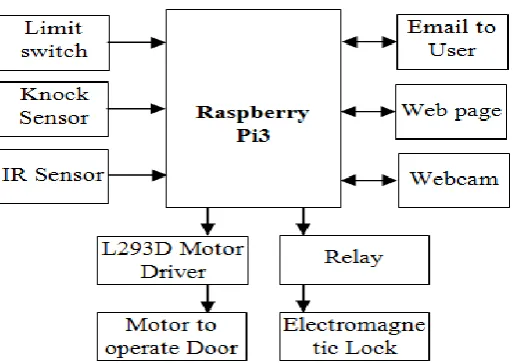
Today security has been a major concern in every home and office. In recent days, a lot of incidents like robbery and intrusion are happening in home and offices. So, where the safety is an important issue, automated security systems are needed. Door locks have become an important part of these security systems. In home, offices and safe lockers we may face the problems with conventional door-locking systems like lost the key, fail to remember to lock the door and cannot inspect the lock status when we are not at home. In this project, a Web controlled Door Lock system is implemented. This system captures the snapshot of visitor when he is in front of the door or knocks the door. An email alert is sent to the owner along with visitor photo. The door lock can be operated remotely by owner through webpage buttons using an internet enabled device such as smart phone. It is also possible to monitor lock status on the webpage. Figure 1 shows the block diagram of a web controlled door lock system.
It consists of Raspberry Pi, knock sensor, IR sensor, limit switch, webcam, relay and motor driver. The limit switch, IR sensor and vibration sensor are acts as input devices. The status of the limit switch, knock sensor and IR sensor is fed to the Raspberry Pi. This sensor data is used to update the status of door and lock on the webpage. An email alert is sent to user along with the picture of the visitor captured by the webcam, when the visitor is in front of the door or knocks the door. User can then check the email and control the door lock mechanism through any internet enabled device such as mobile phone, laptop, etc. The motor driver is providing high current to drive the motor, which is used to operate the door.
II.
LITERATURE REVIEW
Akash V. Batkule et al proposed a system which monitors home security. The system alerts the user through SMS whenever there is unauthorized entry into the home [1]. Lia Kamelia et al presented a solenoid door lock system. The door can be controlled via mobile phone through Bluetooth [2]. Akshay N. Patil et al proposed a smart locking system based on face recognition technology. The door will be opened on successful identification of visitors face. The system also consists of GSM module to alert the owner via SMS [3]. Selvin Pradeep Kumar presented remote controlled door lock system using android application. The application is password protected and the door can be operated after entering corresponding password [4]. Gyanendra Kumar Varma et al proposed a smart door lock system that uses RFID authentication [5]. Jayasree Baidya et al designed a fingerprint based lock system. In this system, fingerprints of authorized persons are enrolled and verified to provide access to control the lock [6].
III.
HARDWARE DESCRIPTION
The salient features of various hardware modules used in the implementation of Web controlled Door lock system are described here.
a. Raspberry Pi 3 Model B Board
Raspberry Pi 3 is an advanced, more powerful board compared to previous versions Pi (Fig. 2). This Pi 3 model has a Broadcom BCM2837 System on Chip module. It has 64 bit quad-core Cortex-A53 CPU with ARMv8 processor operating at 1.2 GHz by default. It has 1GB RAM memory and 512 MB is shared with GPU. It has one Ethernet port having a speed of 10/100 Mbit/s, BCM43143 Wi-Fi on board and Bluetooth (4.1v). It consists of four USB 2.0 ports, 40 GPIO pins, HDMI video output port and audio output port. In Pi 3, CPU requires heat sink for cooling because of more heat generation when over clocked. It supports various operating systems such as Windows, Linux/Unix [7].
Figure 2:Raspberry Pi3 Model B Board
b. IR Sensor
c. Vibration Sensor
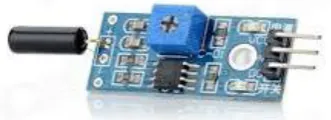
The vibration sensor is used for measurement of flexibility, displacement, vibration, impact and touch (Fig. 4). It consists of LM393 comparator chip and piezoelectric elements, which transmits the electrical signal in response to sensing the vibrations. It is operated at 5-12 V DC supply and a frequency range of 0.5Hz to 20 Hz. In this work, the vibration sensor is used to sense vibrations occurring on the door. When the visitor knocks the door, vibrations produced at the door are detected by the sensor and sent to the Raspberry Pi. The camera will take snapshot of the visitor and send it to the user email account.
Figure 4:Vibration Sensor
d. Relay module
A relay is an electromagnetic device which is used to switch on or switch off the load (Fig. 5). It works on the basic principle of an electromagnetic attraction. When the relay detects current, the coil is energized otherwise de-energized. It is operated at 5V DC supply, 75mA current with coil resistance 70 ohms. The relays are suitable for controlling the high current loads, where the low current or low power signals are used. In this project, relay is used to lock or unlock the door and also it shows the locking status.
Figure 5:Relay module
e. Limit Switch
Limit switch is one type of mechanically actuated sensor that detect the presence or absence of an object. Limit switch is used for knowing the door status, i.e. door is open or close. It is operating at 5V DC supply. The switch has three contacts, i.e. COM (common), NO (normally open) and NC (normally close) (Fig. 6). When an actuator is in contact with object, then COM and NC are connected and NO is disconnected. When the switch is not in contact with the actuator, then COM and NO are connected and NC is disconnected.
Figure 6:Limit Switch
f. L293D Motor Driver
g. Webcam
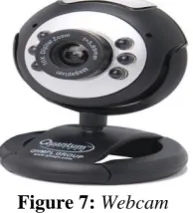
Web camera is interfaced with raspberry pi through USB port, which is used to take pictures and video streaming (Fig. 7). Here, a 1.2 MP quantum series web camera is used to take snapshot of the visitors at home door entrance and sent to the email account. It is necessary to installing the drivers related to web camera into the Raspberry Pi.
Figure 7:Webcam
Various software tools used in the implementation of Web controlled door lock system with email alert includes ExtraPuTTY, Python, PHP and HTML [8, 9].
IV.
EXPERIMENTAL SETUP AND SCHEMATIC DIAGRAM
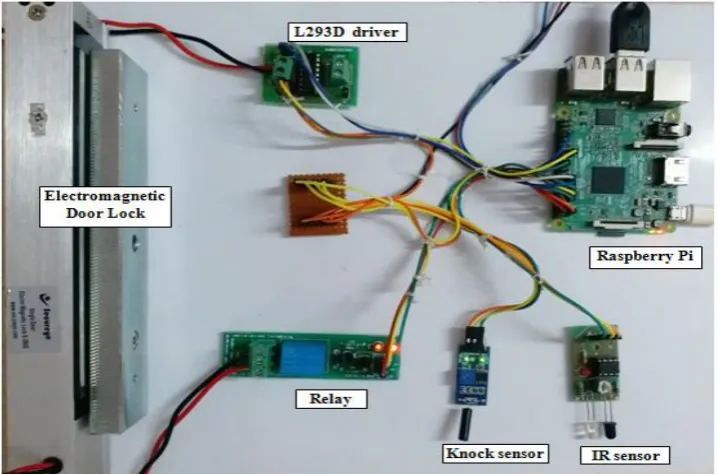
Figure 8 shows the complete experimental setup of Raspberry Pi based Web controlled Door Lock system. It includes the Raspberry Pi board, IR sensor, vibration sensor, limit switch, webcam, relay and electromagnetic lock. When a person (visitor) is in front of the door, the IR sensor senses the movement, and produces a high voltage (5V) at the output which is fed to Raspberry Pi. Similarly, when a visitor knocks the door, vibration sensor detects the vibrations on the door and produces HIGH output which is sent to the Pi. The Raspberry Pi further gives the command to the webcam to capture visitor’s image when a logic HIGH is received from the IR sensor and (or) Vibration sensor. The captured image of the visitor is sent by Raspberry Pi to the owner email account. When the user receives an email alert, he can check the email and can operate the door and lock using the webpage. The door lock can be operated remotely by owner through webpage buttons using an internet allowed device such as mobile phone. The Raspberry Pi senses the switch status and accordingly uploads door status (open or close) on to the webpage. It is also possible to monitor lock status in the webpage.
V.
FLOWCHART OF WEB CONTROLLED DOOR LOCK SYSTEM
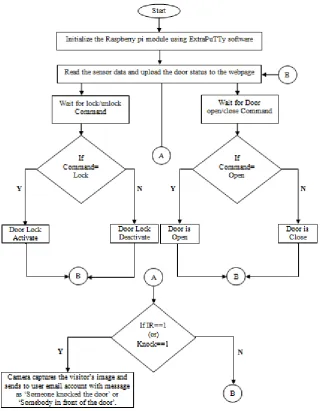
First, we initialize the raspberry pi board using Extra Putty software. After that read the sensor values and upload the lock status, door status to the webpage. If the sensor is enabled, transfer the data to the raspberry pi. From the webpage, based on the commands received by the raspberry pi we can operate the door is open/close and lock/unlock. If the lock command is received by the Raspberry pi, then the door lock is activated otherwise door lock is deactivated. If the open command is received by the Raspberry pi then the door is open otherwise door is closed. If the knock or IR sensor is/are enabled, camera should capture the image of the visitors and transfer it to the Gmail account. The system is waiting for user commands to perform the door lock operation. Figure 11 shows the flowchart of the web controlled door lock system with email alert.
Figure 9:Top view of Experimental Board of the Door Lock system
Figure 11:Flowchart showing sequence of events that occur in the Web controlled Door lock system
VI.
RESULTS AND DISCUSSION
After loggingin, the webpage contains four buttons. Out of these four, two buttons are used for door operation and two are used for lock operation. It also consists of two status bars which indicates door status and lock status (Fig. 13).
Case1:Door is closed and lock is activated. i.e. limit switch is in contact with door and relay triggered. The corresponding output on webpage is displayed as shown in Fig.13.
Figure 13: Webpage View showing output of Case 1
Case 2: Somebody in front of the Door
If the visitor is in front of the door, IR sensor will identify the presence of the visitor, and send a signal to the Raspberry Pi. The camera captures the visitor image and alert is sent to the owner email account along with photo. Figure 14 shows the snapshot of email alert received on owner’s mobile.
Case 3: Someone knocked the Door
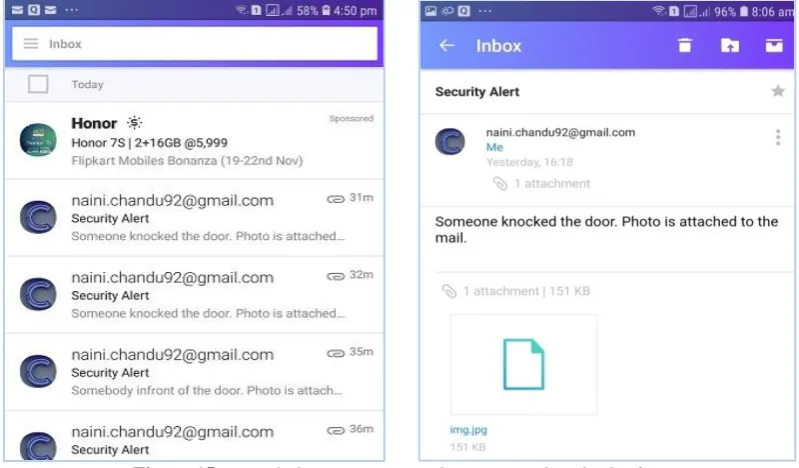
The visitor knocks the door. The knock sensor detects the vibration and the sensor data fed to Raspberry Pi. The camera captures the visitor image and alert sent to the owner email account along with photo. Figure 15 shows email alert with message to the owner when someone knocks the door.
Figure 15: Email alert sent to user when a visitor knocks the door
Case 4: Door lock is de-activated and door is opened.
When a visitor is in front of the door or knocks the door. The user can see the visitor image through email alert. The owner can then open the door lock for visitor by operating buttons on the webpage using any internet allowed device such as laptop/ smart phone. Figure 16 shows the output on webpage displayed when the Door is unlock and open.
Figure 17 shows the door lock system output corresponding to Case 4. The relay is de-energized to unlock the door (electromagnetic lock open). The motor rotates in clockwise direction to open the door.
Figure 17: FrontView of experimental setup of door lock system showing output of Case 4
VII.
CONCLUSIONS
Web controlled door lock system with email alert is implemented by using Raspberry Pi. The conventional door locks have drawbacks such as key lost, fail to remember to lock the door, robberies and intruder entry. The proposed system is useful to reduce the drawbacks of conventional door locks and hazard from unauthorized entry. The owner can open or close the door by using smart phone. The developed system is used to lock and unlock the door remotely, monitor the door status (Lock, unlock, open, close) from the webpage. This system captures the image of the visitor when person is in front of the door or knocks the door. An email alert sent with owner along with visitor photo. The evidence can be recorded if any robbery issue occurs. This system is providing high security to the home and offices. It is helpful to operate the door lock for elderly, physical handicapped persons. During any emergency situations this system provides simple, reliable and faster way to get help to the users. This system provides a security to households, corporate sectors, ATMs, etc.
REFERENCES
[1]. Akash V. Bhatkule, Ulhas B. Shinde, Shrinivas R. Zanwar, “Home Based Security Control System using
Raspberry Pi and GSM”, International Journal of Innovative Research in Computer and Communication Engineering, Vol. 4, Issue 9, Sept. 2016.
[2]. Lia Kamelia, S.R. Alfin Noorhassan, W.S. Mada Sanjaya, W.S. Edi Mulyana, “Door-automation system
using Bluetooth-based android for mobile phone”, ARPN Journal of Engineering and Applied Sciences , Vol. 9, No. 10, October 2014.
[3]. Akshay N. Patil, Rohit B. Ranavare, Dayasagar V. Ballal, Prof. P. P. Kotekar, “Raspberry Pi Based Face
Recognition System For Door Unlocking”, International Journal of Innovative Research in Science and Communication Engineering, Vol. 2, Issue 3, March 2016.
[4]. Selvin Pradeep Kumar S., “Password Based Remote Controlled Door Opening Using Android
Application”, International Journal of Engineering Development and Research, Vol. 4, Issue 4, 2016. [5]. Gyanendra Kumar Verma, Tripathi Pawan, “A Digital Security System with Door Lock System using
[6]. Jayasree Baidya, Trina Saha, Ryad Moyashir, Rajesh Palit, “Design and implementation of a fingerprint based lock system for shared access”, 2017 IEEE 7th Annual Computing and Communication Workshop and Conference (CCWC), March 2, 2017, Dhaka, Bangladesh.
[7]. https://www.raspberrypi.org/
[8]. Richard L. Halterman, “Learning to Program with Python”, 2011 (www.cs.uky.edu/).
[9]. Larry Ullman, “PHP for the Web”, Peachpit Press, San Francisco, 2016.