
e-ISSN: 2278-067X, p-ISSN: 2278-800X, www.ijerd.com
Volume 5, Issue 11 (February 2013), PP. 68-73
Clustering Approach in Route Selection Using Mobile
Agent in Mobile Ad-Hoc Network
Yashpal Singh
1, Kamal Deep
2, S.Niranjan
31,2Research Scholar, Mewar University, Rajasthan, India
3Professor, Department of Computer Science & Engineering ,PDM School of Technology & Management ,
Bahadurgarh, Jhajjar,Haryana,India
Abstract:- Cluster-based mechanisms in ad hoc networks not only make a large network appear smaller, but more importantly. In our scheme, each MN is disseminated to predict its own mobility pattern, and this information is disseminated to its neighbors using a scalable clustering algorithm. The work proposes a prediction based Clustering Approach for Route Discovery Protocol (CARDP)using Mobile Agent in Mobile ad-hoc Network. This paper presents a scalable way to predict mobility, and thus availability of MNs which is achieved with the virtual cluster and it is named as (b,e,m) model. Here we compare our work with other three algorithms in term of cluster head stability. Our clustering algorithm enables adaptability, autonomy, economy, scalability and survivability requirements in managing ad hoc networks by adopting Mobile Agent–Based clustering Approach. In our result cluster stability is measured and improved using clustering
Keywords:- Hierarchical clustering, Mobile Ad-hoc Network (MANET), mobile agent (MA), data gathering, PBNM (prediction based network management.
I. INTRODUCTION
A mobile ad hoc network consists of a set of mobile hosts that form at temporary network without any fixed infrastructure. The nodes operate both as hosts and routers. Due to mobility on nodes, the topology of network may change rapidly and unexpectedly .Hence it is very important to find a route that can obtain highly stable routing and transmission ratio. Ad hoc networks, where mobile nodes communicate via multi hop wireless links, facilitate network connectivity without the aid of any pre-existing networking infrastructure. Cluster-based wireless sensor network saves energy by Mobile Agent (MA) technology .It provides a new idea for the key problem. Mobile Agent entities move in the network and alternate with environment independently by taking executing codes, running state [1], processing results and visiting route and some other information reducing the number of the nodes communicating with the base station. Cluster-based mechanisms in ad hoc networks not only make a large network appear smaller, but more importantly, they make a highly dynamic topology to appear less dynamic. MWSNs can be classified into a flat, two-tier or three-tier hierarchical architecture [2]. Flat or level, network architecture contains a set of heterogeneous devices to communicate in ad hoc mode. These devices are mobile or fixed, but to communicate within the same network. Two-level architecture consists of a set of nodes in place and a set of mobile nodes.
In MANETs, the chances for different configuration changes to occur are very high, and any management architecture should allow the management entities to detect and react to such changes in a flexible way [1]. Most MANET routing protocols focus on finding feasible route path from source to destination node with full utilization of network resources [4]. Mobility prediction has also been applied to determine the duration of life time between two connected mobile nodes. Using this prediction mechanism the propose scheme choose the most stable links in MANETs [3].
II. RELATED WORK
The concept of clustering in MANETs is not new, there have been many algorithms that consider different metrics and have different purposes in mind. However, almost none of them consider mode mobility as a criterion in the clustering process effectively. As a result, they fail to guarantee a stable cluster formation[1].
In a MANET that uses cluster-based services, network performance metrics such as throughput, delay and effective management are tightly coupled with the frequency of cluster reorganization [3]. Therefore, stable cluster formation inessential for better management and QoS support [3].The most popular clustering approaches in the literature are the lowest identifier(Lowest-ID) and maximum-connectivity[5].With Lowest-ID ,CH moves into another region it may unnecessarily replace an existing CH, causing transient instability[4]. But later MN movement and traffic characteristics, the criterion values are used in CH election process which results in instability. This is the case in Lowest Distance Value (LDV) and Highest In-Cluster Traffic(ICT) approaches. In [3], Chiang et al. have shown that the Lowest-ID algorithm performs better than the max connectivity algorithm 3 in terms of stability of clusters (measured by the number of cluster head changes), and they have proposed a small change in the Lowest-ID algorithm to improve performance; the improved version is referred to as LCC which stands for “Least Cluster head Change”. In [6], bounding flooding was proposed to increase the chance of finding feasible branches. In [7], a genetic algorithm was used to perform faster route discovery. In [8], the adaptive QoS protocol was proposed based on the prediction of local performance. Thus, predicting the mobility of nodes is an effective and feasible method. At present, the mobility prediction methods are path availability models [11], prediction-based link availability estimation[12], link expiration time model [13] and prediction strategy. Link expiration time model predicts link stability between two nodes according to the node‟s information such as location, velocity, and direction etc with the aid of Global Position System (GPS). The next section describes how (b, e, m)-model results in stable clustering, and enables proactive management in our management architecture.[3]
III. PROPOSED WORK
3.1 Clustering in MANETs:-
Clustering of nodes into groups results in simplification of addressing and management of the nodes and also yields better performance. Lowest-ID clustering is one of the most popular clustering schemes used in the oldas well as recent ad hoc networks literature. In each cluster, exactly one node, the one with the lowest ID among its neighbors, becomes a cluster head, and maintains cluster memberships of other member nodes. A cluster is identified by its cluster head‟s ID. In [15], an algorithm based on max-connectivity was also proposed, but it performed much worse than the Lowest-ID algorithm in terms of stability of clusters. The cluster head takes the responsibility of coordinating transmissions of packets and route discovery, and thus the network does not have to depend on classic flooding for routing.
3.2 Agent Model in clustering:-
Agents use their own knowledgebase to achieve the specified goals without disturbing the activities of the host. The primary goal of an agent is to deliver information of one node to others in the network. Here, the agents are used to find the multicast routes and to create the backbone for reliable multicasting. There are various type of Agents[3]:
Knowledge Base: The knowledgebase maintains a set of network state variables such as status of the
node (cluster head, child, others) available power, bandwidth, number of movements
Route Discovery Agent (RDA): It is a static agent that runs on nodes, creates agents and knowledge base,
controls and coordinates the activities.
Node Manager Agent (NMA): It maintains the multicast tree and provides group ID to allthe members of
the packet-forwarding nodes
Link Management Agent (LMA): When a node moves out of the communication range or
dies, LMA initiate route error (RERR) message to the upstream node and again initiates
Fig 2 Routing agent model
The mobile agent which resides in the source node provides group ID and distributes multicast key to all the group members
3.3(b, e, m)-Clustering Model:-
The (b,e,m)-Clustering Approach has the following necessary ingredients: 1) The concept of virtual clusters,
2) Mobility prediction model, 3) Clustering algorithm and protocol, 4) Management architecture,
Fig 3 Steps of clustering Approach
3.3.1 The Concept of Virtual Cluster
We introduced multiple virtual clusters, In order to make our mobility prediction, and our clustering mechanism that is (b,e,m) approach [1]. For correct operation of the (b,e,m)-Approach , each MN is supposed
to have a complete picture of the locations of the centers of such virtual clusters (VCCs).If greater mobility
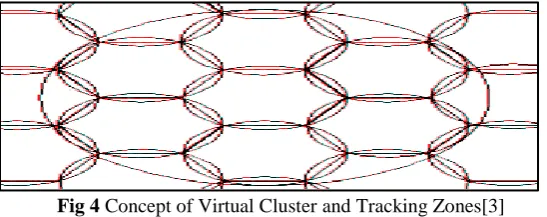
prediction accuracy is required, each virtual cluster can be further split into a number of equal tracking zones
(TZ) as shown in Fig. 4.These TZs are again circular in shape, and can handle the MNs.
Fig 4 Concept of Virtual Cluster and Tracking Zones[3]
In Fig. 4 depicts a virtual cluster (big circle) that consists of seven TZs (smaller circular region).A
N = i2 + j2 + i*j, ………(i)
Where „i‟ and „j‟ are non –negative integers.ie. i=1 and j =2 then N = 7 Again each TZ has its own
unique tracking zone identifier(TZI), which can be determined given the location information. Similarly, each
MN is supposed to know all the tracking zones, and their corresponding identifiers within a particular virtual
cluster. However, in our initial work we consider only the inter-virtual cluster movement pattern of MNs, and greater accuracy in this case is obtained by optimizing the value of virtual cluster radius (R).
3.3.2 Mobility Prediction Mechanism
In mobile ad hoc network, the reliability of a path depends on the stability or availability of each link of this path because of the dynamic topology changes frequently. According this approach the node mobility is the main cause of uncertainty in N/ws, we design a mobility-prediction approach which is based on the Ziv-Lempel algorithms for data compression technique [1][8][9]. It derives a prediction of user mobility based on the accumulated behavior of a specific Mobile node. It is also confirm that the prediction is made without complexity and waste of bandwidth and transmission power. In our approach, each Mobile node is
generating the strings of virtual cluster identifiers (VIDs) and maintaining its respective dictionary in its
memory [12].
In addition to making predictions as to future movements of a particular Mobile node, our cluster approach is used by each MN to predict its approximate residence-times of the virtual clusters. For this purpose,
each MN maintains its mobility database at a specific time in terms of a Mobility Trie[1][4]. This trie is a
probabilistic model corresponding to the dictionary of the LZ78 algorithm [9]. There are two important parameters, interval time (Te)of updated events which are triggered on time-based updating Radius (Tr) of virtual cluster. If „Te‟ is smaller then greater the accuracy of the residence-time, and also higher the tracking overhead. Similarly, the smaller the Radius the better the prediction capability, but the higher the tracking
overhead. So for greater prediction accuracy ,Mobility Tries can be constructed with respect to tracking zones.
In this approach, the higher the number of TZs that a virtual cluster consists of, the greater the accuracy of the residence-time.
3.3.3 Clustering Algorithm and Protocol of (b,e,m) model:-
This clustering algorithm and protocol are mainly due to our mobility prediction model as explained in [12].The Mobility Trie that each MN constructs plays an important role to bring in proactivness in our (b,e,m)-
clustering approach. Each MN „A‟ to determine its residence-time (tav) in virtual cluster „V‟ from its Mobility
Trie. The MN that has the highest Ω(from equ.[1]) can become the primary CH, and the MNs that have the second and third highest values become assistant(secondary) CHs. To form clusters, CH should cover the whole
area of virtual cluster .So CH makes a k-hop cluster where value „k‟ is not necessarily Uniform However,
efforts have been made to limit the value of „k‟, as it is better if every MN is only a fewer hops for proper management.
Example of Virtual clustering is that we have four different packet types such as CALL,
CONNECT_CH,CONNECT_MN and TARGET have been defined for the operation of our clustering protocol. Each cluster head broadcasts a CONNECT_CH packet periodically- every CH_CONNECT_INTERVAL –
within its virtual cluster and each cluster member uncast CONNECT_MN to its respective CH periodically
-Every MN_CONNECT _INTERVAL. On the other hand, if a new MN has not become a member in any cluster, it has to uncast a CALL packet to its respective CHs. Since all mobile nodes except CHsuse unicating as opposed to broadcasting, our clustering algorithm conserves the bandwidth and transmission power.[3]
In addition to other information regarding each virtual cluster, each periodic CONNECT_CH carries
the neighbor-table which is a set of MNs in the cluster and their latest Ω values. From the neighbor-table of
CONNECT_CH, each MN that resides within the same virtual cluster constructs its own neighbor-table, and
hence becomes aware of its neighbors. If any member node has not received a CONNECT_CHpacket from any CH during the last three consecutive CH_CONNECT _INTERVAL periods, Each node of a particular virtual cluster has to broadcast its protocol packet in order for other neighbor nodes to know about its existence[3]. This
enables the MNs within the virtual cluster to select one as their CH in a distributed manner. These control
packets are relayed by intermediate MNs only with in the virtual cluster. This is to enable CHs to get the
topology information of adjacent clusters. Given that each CH knows the predicted residence-time of each MN
within its cluster, it deletes the entry associated with a particular MN exactly „t0‟(system parameter) seconds
3.3.4 Management Architecture:
Network management is a process of controlling a complex data network in order to maximize its efficiency and productivity. Generally it involves data collection, data processing, data analysis, and problem fixing. However, this management related tasks have to be performed in an efficient and scalable way. The clustering protocol is used to simplify the task of proper management in MANETs. [1].In case of information collection and communication strategy, there are three types of network management architectures: centralized, distributed, and hierarchical. In hierarchical model data collection is done by intermediate levels of the hierarchy before forwarding it to upper layers of the hierarchy. Our (b,e,m)-clustering approach facilitates this hierarchical management architecture that makes use of policy-based management technique together with mobile agents forwarding it to upper layers of the hierarchy[8]. The lowest level of this architecture consists of individual managed SNs. Several SNs are grouped into clusters and managed by a cluster head (CH).
Fig 5 Hierarchical Management Architecture [2]
BS: Base Station, SN: Sensor Network CH: Cluster Head,
The cluster should take an optimal size, and should be stable most of the time in order to enable the efficient data collection. These cluster heads are autonomously elected through our (b,e,m)- clustering algorithm. The network manager, serving as a top-level manager, regulates and distributes high level management policies such as QoS parameters and management rules to a group of cluster heads. In hierarchical management, each cluster head provides functionality that is transparent to its network manager, and hence cluster heads are autonomous in this respect.
In our approach it is assumed that all nodes have equal management software modules and states and any node can become either cluster head or cluster member depending on clustering mechanism. Cluster head itself manage entire ad hoc network. The reason why mobile agent technology is used here is that it can dynamically deploy itself in an appropriate node and execute managerial. In our clustering algorithm, since each cluster head knows the predicted lifetime of each of its members, the cluster heads and the mobile code that they originate can perform managerial operations.
Moreover, using Mobility Tries, the cluster head would know the predicted mobility patterns of its member nodes. In case a node moves from one virtual cluster to another, its respective cluster head knows this from the Mobility Trie of the former. Our (b,e,m)-algorithm enables proactive cluster head election process, that leads to continuous management operation without any interruption . In our three-level hierarchy, the network manager is responsible for the PBNM operations, and can function as a policy server or policy decision point [7]. Mobile agent technology is used again in our approach for policy distribution, provisioning, and even for policy monitoring. Our(b,e,m)-clustering model facilitates each node to know about the availability pattern of neighboring nodes, and thus enables the PBNM to be aware of the possible network resources through prediction. The network manager is elected exactly the same way as the cluster head is elected. It responsible for a particular region, and might contain a number of virtual clusters under it.
IV. INITIAL EVALUATION THROUGH SIMULATION
Fig.6 Number of MNs that Attempted to become the CH as a function of Node Degree.
V. CONCLUSIONS
The main objective is to use mobile agent technology for route selection in ad-hoc networks with purpose to improve over traditional schemes in terms of performance, scalability and stability of clusters. A new clustering approach that makes use of intelligent mobility prediction and location information in new long-term MANETs was proposed in this paper. [1]This clustering approach is to enable the development of an automated, intelligent[3],efficient and robust management architecture. To facilitate this, we introduced the virtual cluster concept. in the network management perspective, it results in the following uniquebenefit: [4] We could predict a specific MN‟s future positions and continue managerial operations without interruptions in a proactive way
REFERENCES
[1]. S.Sivavakeesar, G.Pavlou, and Liotta, “Stable Clustering Through Mobility Prediction for
Large-Scale Multihop Intelligent Ad Hoc Networks|”, IEEE WCNC 2004, in press.
[2]. Muhammad Arshad ,Nasrullah Armi, Nidal Kamel and N. M.Saad.“Mobile data collector based routing
protocol for
[3]. wireless sensor networks”.Scientific Research and Essays Vol. 6(29), pp. 6162-6175, 30 November,
2011.
[4]. G.Santhi and Alamelu Nachiappan ,”Adaptive QoS Multicast Routing with Mobility Prediction in
MANET” ,Int.
[5]. Journal of Ad hoc, Sensor & Ubiquitous Computing, 2010,vol.1,No.3
[6]. Bita Safarzadeh, ShahramJamali, HamedAlimohammadi, “ A High Performance Scalable QoS Routing
Protocol for Mobile Ad Hoc Network”, Int. J. Comp. Tech. Appl. ,vol 2 (2), 332-339.
[7]. P.Basu, N.Khan, F. Znati, “Mobility Based Metric for Clustering in Mobile Ad Hoc Networks”,
Workshop on Distributed Computing System, 2001,pp.413-418.
[8]. Barolli L, Koyama A, Shiratori N, “ A QoS Routing Method for Ad-Hoc Networks Based on Genetic
Algorithm”, In: Proceeding of the 14th international workshop ondatabase and expert system
applications,2003, pp.175-179.
[9]. Du X,”QoS Routing Based on Multi-Class Nodes for Mobile Ad Hoc Networks”, Ad Hoc
Network,2004,pp.241-254.
[10]. Sun H, Hughes HD, “Adaptive QoS Routing Based on Prediction of Local Performance in Ad Hoc
Network”, In: Proceeding of IEEE conference on wireless communication and networking ,2003, pp.
1191-1195
[11]. B.McDonald, and F.Znati, “A Mobility-Based Framework for AdaptiveClustering in Wireless Ad Hoc
Networks”, IEEE Journal on SelectedAreas in Communications, vol. 17, August 1999, pp 1466 – 1487.
[12]. XiangbinZhu,Wenjuan Zhang.“A MobileAgent-based Clustering Data FusionAlgorithm in
WSN”,IJECE-2010.
[13]. McDonald et al., “Path availability model for wireless ad hoc networks” Proceeding of IEEE wireless
communications, 1999, (WCNC ‟99).
[14]. Jiang Shengming et al., “A prediction based link availability estimation for mobile ad-hoc networks”
IEEE Infocom, 2001.
[15]. SuW.Lee Sung-Ju et al., “ Mobility predictin and routing in ad-hoc wireless networks”» International
Journal of Network Management, 2001.
[16]. C.-C. Chiang, H.-K. Wu, W. Liu, M. Gerla, “Routing in Clustered Multihop, Mobile Wireless
Networks with Fading Channel,” Proceedings of SICON 1997.
0 50 100 150 200
25 50 75 100 125 150
![Fig 1 .Cluster based wireless sensor network. [2]](https://thumb-us.123doks.com/thumbv2/123dok_us/1373195.1647401/1.595.116.523.619.760/fig-cluster-based-wireless-sensor-network.webp)
![Fig 5 Hierarchical Management Architecture [2]](https://thumb-us.123doks.com/thumbv2/123dok_us/1373195.1647401/5.595.157.440.228.341/fig-hierarchical-management-architecture.webp)