RESEARCH ARTICLE
RE-CONFIRMATION OF VALIDITY OF DECISION MAKING ABILITY AS FOUND
BY STANDARDIZED COGNITIVE ABILITY TEST
*Nanda, H. K., Shruti Marwaha and Geetika Seth
Department of Research and Development,
Centre for Research in Applied Cognitive Sciences,
MaxproIntellithon Ltd. India
ARTICLE INFO ABSTRACT
Decision-making can be defined as problem-solving activity terminated by a solution deemed to be satisfactory. It is therefore a process which can be rational or irrational and can be based on explicit knowledge or tacit knowledge. The decision-making process is regarded as a continuous process integrated in the interaction with the environment. The in hand research was conducted to re-confirm and re-establish the concurrent validity of the numerical value of Decision Making Ability as assessed through the standardized Cognitive Ability Test. The research was conducted in and around Chandigarh. The sample consisted of 240 school going students between 7-16 years of age from different schools. Random sampling was followed. The sample was divided into 4 groups according to their age. The Decision making ability of all the subjects were found in two different stages, using two varied tests, both of which are developed and standardized scientifically. It was established through results that the Cognitive Ability Test is valid measure to recordt the Decision Making Ability of the respondents.
INTRODUCTION
Decision making of children is strongly influenced by the expectations and values they learn from those around them. This occurs through observing others, particularly those close to them, hearing about and discussing values, and having opportunities to make decisions and experience their consequences. Though young children have some skills for making decisions, they do not yet have the experience to understand and decide about the complex situations that adults must deal with. Developing skills for logical thinking and problem-solving supports children’s growing abilities for effective decision making. As children develop skills for managing their thinking as well as their feelings, they become better at putting decisions into practice and at keeping them on track. The ability to think before acting helps children control impulsive behaviour and make better decisions. Being able to think about time and plan ahead provides a basis for children to evaluate options by considering long-term goals, not just immediate circumstances. Decision-making is the process of identifying and choosing alternatives based on the values and
preferences of the decision-maker. Decision-making is
regarded as the cognitive processresulting in the selection of a belief or a course of action among several alternative possibilities. Every decision-making process produces a final choice that may or may not prompt action.
*Corresponding author: Nanda, H. K.,
Department of Research and Development, Centre for Research in
Applied Cognitive Sciences, MaxproIntellithon Ltd. India
Authors have described Decision Making Ability (DMA) as a measurement of speed of decision making ability & response time to accomplish assigned tasks. It is considered to be a backbone factor to achieve success. It is a ratio of application vs. age & time. DMArange is explained as in Table 1. Human decision-making is constrained by its bounded rationality and does not always follow normative prescriptions (Gigerenzer, Todd, & the ABC Research Group, 1999; Kahneman, 2003; Payne, Bettman, & Johnson, 1993; Simon 1990). Nevertheless, individual differences in cognitive abilities and skills predict
normatively superior judgment and decision-making
(Frederick, 2005; Peters & Levin, 2008; Peters, Vastfjall, Slovic, Mertz, Mazzocco, &Dickert, 2006; Stanovich& West, 1998; 2000;2008). A variety of theories, such as dual-process theories, attribute the individual differences to deliberative processes (Baron, 1985; De Neys, 2006; Evans, 2008; Frederick, 2005; Kahneman, 2003; Kahneman& Frederick, 2007; Sloman, 1996; Stanovich& West, 1998; 2000); however, the link between decision processes and abilities is largely uninvestigated. Decisions in general are affected by three sets of factors—decision features, situational factors and individual differences (Einhorn, 1970; Hunt et al., 1989). The normative approach in decision making tries to identify the best principles of making decisions taking into consideration basic rules, mainly statistical and logical ones, and to assess decisions according to them. People need a suite of generally applicable decision-making skills such as extracting relevant information, applying general values in specific settings, and integrating these pieces with a coherent decision rule (Parker &Fischoff,
Article History:
Received 17th August, 2016
Received in revised form 25th September, 2016 Accepted 18th October, 2016
Published online 30th November, 2016
International Journal of Recent Advances in Multidisciplinary Research
Vol. 03, Issue 11, pp.1940-1944, November, 2016
Keywords:
2005). A variety of general skills was identified. Stanovich and West (1998, 2000, 2008) showed correlations among different reasoning and making skills. The view of decision-making competence is very heterogeneous, with different components identified: abilities to understand, appreciate, reason, express a choice (Grisso&Appelbaum, 1998); abilities to structure a decision problem, understand relevant information, integrate information and reason about it, appreciate the personal significance of information and the limits of one’s decision skills (Finucane& Lees, 2005); and belief assessment, value assessment, integration, and metacognition (Parker &Fischhoff, 2005).
Table 1. Decision making ability
Above 1.7 Extreme
1.4-1.7 Excellent 1.0-1.4 Very good 0.8-1.0 Good 0.65-0.80 Above average 0.50-0.65 Average 0.35-0.50 Below par BELOW 0.35 Poor
MATERIALS AND METHODS
Random sampling was undertaken to select subjects both males as well as females from different schools aging between 7-16 years. The sample was divided into four groups.
Fig.1 Sampling
Group1: Subject aging between 07-10 Years Group 2: Subject aging between 10-12 Years Group 3: Subject aging between 12-14 Years Group 4: Subject aging between 14-16 Years
Table 1. Stages of study
Groups Group-1 Group-2 Group-3 Group-4
Age Range 7-10 Yrs 10-12 Yrs 12-14 Yrs 14-16 Yrs
Day-1 Rapport Building
Stage-1 Day-2 DMA tested by Test-1 DMA tested by Test-2 DMA tested by Test-1 DMA tested by Test-2
Day-3 & 4 Halt
Stage-2 Day-5 DMA tested by Test-2 DMA tested by Test-1 DMA tested by Test-2 DMA tested by Test-1
The Groups were compared in two stages. Test-1 used is the Decision Making Questionnaire developed by French DJ, West
RJ, Elander J, Wilding JM. It is a 21-item test used in measuring Decision Making Ability of the respondents. The Test-2 is the developed and standardised Cognitive Ability Test in question. On the first day, rapport was built with the subjects. On the second day, Decision Making Ability of Group-1 (subjects aging between 7-10 years of age) and Group-3 (subjects aging between 12-14 years of age) was initially found using the Test-1. In contrast, those from Group-2 and Group-4 were given Test-Group-2 to test their Decision Making Ability. A halt was given for next two days, following which, the subjects of Groups 1 and 3 were tested for Decision Making Ability through Test-2, while those from Group 2 and 4 were tested for Decision Making Ability using Test-1.The results were calculated using the two tests, the scores were then converted into percentage, broadly ‘out of 100’ so as to carry on the process for evaluating the concurrent validity of the said test.
Statistical Analysis
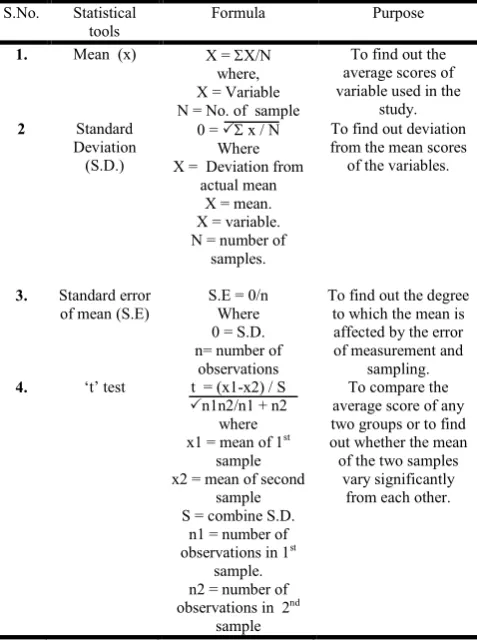
Once the data was obtained, it was coded, tabulated and analyzed, keeping in mind the objectives of the study. Appropriate statistical tools were used to draw meaningful inferences. The statistical tools used in the present study are given in the table below;
Table 2. Statistical tools used for analysis of data
S.No. Statistical tools
Formula Purpose
1. Mean (x) X = X/N where, X = Variable N = No. of sample
To find out the average scores of variable used in the
study.
2 Standard Deviation (S.D.)
0 = x / N Where X = Deviation from
actual mean X = mean. X = variable. N = number of
samples.
To find out deviation from the mean scores
of the variables.
3. Standard error of mean (S.E)
S.E = 0/n Where 0 = S.D. n= number of
observations
To find out the degree to which the mean is affected by the error of measurement and
sampling.
4. ‘t’ test t = (x1-x2) / S
n1n2/n1 + n2 where x1 = mean of 1st
sample x2 = mean of second
sample S = combine S.D.
n1 = number of observations in 1st
sample. n2 = number of observations in 2nd
sample
To compare the average score of any two groups or to find out whether the mean of the two samples
vary significantly from each other.
Table 3. Mean, Standard deviation, standard error and t-values of Test-A & Test-B of subjects aging between 7-10 years (n=60)
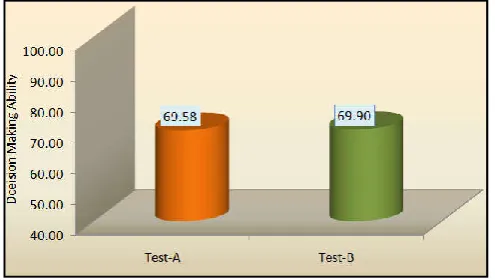
Mean SD SEM t-value Lev of Sig. Test-A 69.58 5.48 0.7 0.344 Not Statistically
RESULTS AND DISCUSSION
It is inevitably true that there was no significant difference in the Decision making ability of respondents aging between 7-10 years as assessed by the two tests. It is crystal clear that there was no significant difference in the Decision making ability of respondents aging between 10-12 years as assessed by the two tests.
Fig. 2. Mean Difference between DMA of subjects aging 7-10 years, as derived from Test A and Test B
Table 4. Mean, Standard deviation, standard error and t-values of Test-A & Test-B of subjects aging between 10-12 years (n=60)
Mean SD SEM t-value Lev of Sig. Test-A 72.00 6.4 0.82 1.45 Not Statistically
Significant Test-B 73.60 5.65 0.72
Fig. 3. Mean Difference between DMA of subjects aging 10-12 years, as derived from Test A and Test B
Fig. 4. Mean Difference between DMA of subjects aging 12-14 years, as derived from Test A and Test B
Table 5. Mean, Standard deviation, standard error and t-values of Test-A & Test-B of subjects aging between 12-14 years (n=60)
Mean SD SEM t-value Lev of Sig. Test-A 68.50 6.45 0.83 1.43 Not Statistically
Significant Test-B 67.00 4.89 0.63
Table 6. Mean, Standard deviation, standard error and t-values of Test-A & Test-B of subjects aging between 14-16 years (n=60)
Mean SD SEM t-value Lev of Sig. Test-A 64.50 3.45 0.44 0.32 Not Statistically
Significant Test-B 65.75 4.89 0.63
Fig. 5. Mean Difference between DMA of subjects aging 14-16 years, as derived from Test A and Test B
It is evident that there was no significant difference in the Decision making ability of respondents aging between 12-14 years as assessed by the two tests.
Conclusion
To conclude, the Decision making ability of the subjects can be accurately notified with the Cognitive ability test in question. The test is found to be reliable and valid measure of Decision Making ability of respondents ranging between 7-16 years of age.
Acknowledgement
Authors express indebtedness to the Almighty, who is the apostle of strength. Authors are inevitably grateful to the subjects and all those directly as well as indirectly involved in the auspicious research work. Genuine thanks are expressed to all the authors/researches whose work is referred for making the present study a real success.
REFERENCES
Ajzen, I. 1988 Attitudes, Personality and Behaviour. Buckingham: Open University Press.
Ajzen, I. and Fishbein, M. 1980. Understanding Attitudes and Predicting SocialBehaviour. Englewood Cliffs, NJ: Prentice-Hall.
Anderson, C.J. 2003. The psychology of doing nothing: forms of decision avoidance result from reason and emotion.
Psychological Bulletin, 129, 139-167.
Appelt, K. C., Milch, K. F., Handgraaf, M. J. J., & Weber,E. U. 2011. The Decision Making Individual Differences
individualdifferences in judgment and
decision-makingresearch. Judgment and Decision Making, 6, 252–
262.
Baddeley AD. Working Memory. Oxford University Press, Oxford, UK, 1986.
Barker, C., Pistrang, N. and Elliott, R. 2002. Research methods in clinical psychology: An introduction for students and practitioners, 2nd ed. Chichester, England: John Wiley & Sons. Bruine de Bruin, W., Parker, A. M., &Fischhoff, B. 2007. Individual differences in adult decision making
competence. Journal of Personality and Social Psychology,
92, 938–956.
Beach, L.R. and Mitchell, T.R. 1978. A contingency model for the selection of decision strategies. Academy of Management Review, 3, 439-449.
Beattie, J., Baron, J., Hershey, J.C. and Spranca, M.D. 1994.
Psychological determinants of decision attitude. Journal of
Behavioral Decision Making, 7, 129-144.
Behara, A. 2004. The role of emotion in decision making: evidence from neurological patients with orbitofrontal damage. Brain and Cognition, 55, 30-40.
Beresford, B. and Sloper, P. 2003. Chronically ill adolescents' experiences of communicating with doctors: a qualitative study. Journal of Adolescent Health, 33, 172-179.
Cobos, P.L., Almaraz, J. and Garcia-Madruga, J.A. 2003. An associative framework for probability judgement: an
application to biases. Journal of Experimental Psychology:
Learning, Memory and Cognition, 29, 80-96.
Connolly, T. and Butler, D. 2006. Regret in economic and psychological theories of choice. Journal of Behavioral Decision Making, 19, 139-154.
Connolly, T. and Zeelenberg, M. 2002. Regret in decision making. Current Directions in Psychological Science, 11, 212-216.
Conolly, T. and Reb, J. 2005. Regret in cancer-related decisions. Health Psychology, 24, S29-S34.
Damasio, A.R. 1994. Descartes’ Error: Emotion, Reason and the Human Brain, Avon Books, New York.
Dhami, M.K. 2003. Psychological models of professional decision-making.Psychological Science, 14, 175-180. Dhami, M.K. and Harries, C. 2001. Fast and frugal versus
regression models in human judgement, Thinking and Reasoning, 7, 5-27.
Dijksterhuis, A. 2004. Think different: the merits of unconscious thought in preference development and
decision making, Journal of Personality and Social
Psychology, 87, 586-598.
Eysenck MW, Keane MT. Cognitive Psychology - A Student's Handbook, Psychology Press Ltd, 2000
Fellows, L. 2004. The Cognitive Neuroscience of human decision-making: a review and conceptual framework. Behavioural and Cognitive Neurosciences Reviews, 3, 159-172.
Folkman, S. 1984. Personal control and stress and coping
processes: a theoretical analysis. Journal of Personality and
Social Psychology, 46, 839-852.
Folkman, S. and Lazarus, R. 1988. Coping as a mediator of
emotion. Journal of Personality and Social Psychology, 54,
466-475.
Harris, J.2003. Time to make up your mind: why choosing is
difficult. British Journal of Learning Disabilities, 31, 3-8.
Harvey, N. and Fischer, I. 1997. Taking advice: accepting help,
improving judgement and sharing responsibilities.
Organizational Behaviour and HumanDecision Processes, 70, 117-133.
Harvey, N., Harries, C. and Fischer, I. 2000. Using advice and assessing its quality. OrganisationalBehaviour and Human Decision Processes, 81, 252-273.
Hastie, R. and Dawes, R.J. 2001. Rational Choice in an Uncertain World: The psychology of judgement and decision making. Sage, Thousand Oaks, CA, US.
Helson, R. and Klohnen, E.C. 1998. Affective coloring of personality from young adulthood to midlife. Personality and Social Psychology Bulletin, 24, 241-252.
Hogarth, R.M. 2001. Educating Intuition. University of Chicago Press, Chicago.
Kahneman, D. and Tversky, A. 1982. The psychology of preferences. Scientific American, 246, 160-173.
Kahnemann, D. and Tversky, A. 1979. Prospect theory: an analysis of decision under risk. Econometrica, 47, 263-291. Lerner, J.S. and Tiedens, L.Z. 2006. Portrait of the angry
decision maker: how appraisal tendencies shape anger's influence on cognition. Journal of Behavioral Decision Making, 19, 115-137.
Lerner, J.S., and Tetlock, P.E. 1999. Accounting for the effects of accountability. Psychological Bulletin, 125, 255-275. Luce, M. 2005. Decision making as coping. Health
Psychology, 24, S23-S28.
March, J. 1994. A Primer on Decision-Making: how decisions happen. Free Press, New York.
McDaniels, T.L., Axelrod, L.J., Cavanagh, N.S. and Slovic, P. 1997. Perception of ecological risk to water environments. Risk Analysis, 17, 341-352.
Mellers, B., Schwatrz, A. and Ritov, I. 1999. Emotion-based choice. Journal of Experimental Psychology: General, 128, 332-345.
Miller, G.A. 1956. Information theory. Scientific American, 195, 42-46.
Nanda HK, Marwaha S, 2015. Suggestive case study on evidence of effectiveness ofcustomized education training based on the outcomes of cognitive ability testing to develop high mental (cognitive) abilities & personality in students between 14-20 year age group to achieve
maximum Employability, International Journal of Applied
Research 2015; 1(4): 47-54
Nanda, H.K., Marwaha, S., Chawla, P. 2015. Development, Item Analysis, Standardization, Review and Expansion of the Cognitive Ability Test for a Wider Age Range (7-16
Years) on a Single Test. International Journal of
Multidisciplinary Research and Development, 2015,
334-350
Nanda, HK., Marwaha, Shruti., Chawla, Pawandeep., Kaur, Baljeet. Development and Standardization of Cognitive
Ability Test for Children. International Journal of Applied
Research, 2015, 1(4): 69-77.
Payne, J.W. 1976. Task complexity and contingent processing in decision making: an information search and protocol analysis. Organization Behavior and Human Performance, 16, 366-387.
Publishing, Malden.
Schwartz, B. 2004.The Paradox of Choice. Harper Collins, New York.
Schwartz, N. 2000. Emotion, cognition and decision making. Cognition and Emotion, 14, 433-440.
Simon, H.A. 1955. A behavioural model of rational choice. Quarterly Journal of Economics, 69, 99-118.
Simon, H.A. 1957. Models of Man: Social and rational. Wiley, New York.
Tiedens, L.Z. and Linton, S. 2001. Judgement under emotional certainty and uncertainty: the effects of specific emotions
on information processing. Journal of Personality and
Social Psychology, 81, 973-988.
Tversky, A. and Kahnemann, D. 1981. The framing of decisions and the psychology of choice. Science, 211, 4481, 453-458.
Weldon MS, Roediger, HL, Challis BH. The properties of retrieval cues constrain the picture superiority effect. Memory & Cognition 1989; 17:95-105.
Wu, G., Zhang, J. and Gonzalez, R. 2004. Decision under risk, in D.J. Koehler andN. Harvey (eds), Blackwell Handbook of Judgement and Decision Making, Blackwell
Zak, A., Collins, C., Harper, L. and Masher, M. 1998. Self-reported control over decision-making and its relationship to intimate relationships. Psychological Reports, 82, 2, 560-562.
Zeelenberg, M. 1999. Anticipated regret, expected feedback
and behavioral decision making. Journal of Behavioral
Decision Making, 12, 93-106.