e-ISSN: 2278-067X, p-ISSN: 2278-800X,
www.ijerd.com
Volume 14, Issue 1 (January 2018), PP.37-43
A survey on energy efficient mac protocols in
Wireless sensor networks
S.S.ponde
1S.S. Lomte
2M
Computer Science and Engineering Dept D.I.E.M.S. Aurangabad Maharashtra, India S. Bidve College of Engineering Latur, Maharashtra,India
Corresponding Author: S.S.ponde
Abstract:
- Users nowadays require mobile solutions to their day to day work, therefore, the demand for wireless devices is at its peak. One such device is the wireless sensor networks (WSN), which are helpful in a variety of application. The mobility comes with the price of power and efficiency, as a limited amount of power is available for the system to consume. In the past years, researchers have devised multiple techniques to overcome the problems of wireless devices. In this paper, we are going to review such techniques, for example, EBMA, Energy efficient EBMA, TDMA, LEACH and much more.Keywords:
-Wireless sensor networks, Power Consumption, EBMA, LEACH---Date of Submission: 20 -01-2018 ---Date of acceptance: 10-02-2018
---I.
INTRODUCTION:
With the introduction of themicro-electromechanical system and its introduction to wireless communication and integrated design that is to be enabled the development of a low cost, low power, and a multi-application sensor. The low power consumption will open up new roads for new robust applications. A wireless sensing element network involves minor in size nodes developing an ad-hoc distributed network to collect the environmental knowledge on the physical set-up [1]. There are four elementary constituents of a node detecting unit, handling unit, broadcasting unit, and control part. Sensors are put in huge areas thanks to the skills of observation and management.The system is made of one or a considerable measure of base stations and tens or a huge number of minor sensor hubs are conveyed amid a physical planetary Nodes notice the physical or region conditions and transfer the data to the required goal over the set-up.
There are wide uses of the wireless sensor network in many regions. One of the uses of the wireless sensor network is to gather data time to time at a distant location during which every sensing element perpetually intellects the atmosphere that directs knowledge once more to sink node, that is set at a far position. The utmost limiting facet of a lifetime of the sensor network is insufficient power reserve of the put in sensors [2]. This is often due the facility supply of the sensors resides a battery with inadequate energy. Conjointly recharging the battery is not possible because it is put in the infeasible background. One of all its most vital difficult issues of WSN’s track is its time period. Efficient utilization of energy is required to prolong the network time period. So necessary thought is to style the algorithm which will maximize the time period of the network [2]. Keeping a little of nodes into small power sleep state is useful to preserve energy. It is achieved by economic cluster and programming of the nodes within the network.
In WSN, nodes, as a rule, they need to share a typical channel. Along these lines, the MAC sub layer assignment is to give reasonable access to channels by staying away from possible impacts. The principalobjective of MAC protocol plan for WSN is energy efficiency so as to draw out the lifetimes of sensors. The purposes of the energy squander in wireless communication are:
• Packet collision: It can happen when nodes don't tune in to the medium before transmitting. Bundles transmitted in the meantime of the impact, wind up noticeably adulterated and should be retransmitted. This causes unnecessary energy squander.
• Overhearing: A node receives a packet which is addressed to another node.
• Control packet overhead: Control bundles are vital for fruitful information transmission. They don't be that as it may speak to helpful information. They are short.
• Over emitting: The node sends data when the receiving node is not ready to accept the incoming transmission. The MAC protocol used to be powerful enough to efficiently use the energy, collision avoidance, scalability, latency, throughput, and adaptability.
II.
TECHNIQUES:
EA-TDMA Protocol
Hubs in the Cluster send his or her recognized information to the leader of the cluster (CH) in their Respective time interims. TDMA-works best under high activity stack Terms. TDMA [2] is the most reasonable for an application containing generous movement load and BMA will be proper for some sort of application including Traffic stack. This plan additionally diminishes vitality utilization nodes are resting aside from the transmitting hub. TDMA-based routine MAC conventions are utilized to evade crashes by settling singular spaces for every hub. A high activity stack implies that all hubs dependably have data to be transmitted. Hubs with exhaust cradles are as yet dynamic their radio amongst their scheduled time and the CH additionally keeps up its radiocommunication at all circumstances to tune into the hubs in the cluster, so that it can squander vitality.
In the EA-TDMA convention, every hub awakens its allotted plan yet kills it immediately if there is no information to transmit, generally Transmits your information to CH. This protocol reduces the transmission of data by the reduction Listening period.
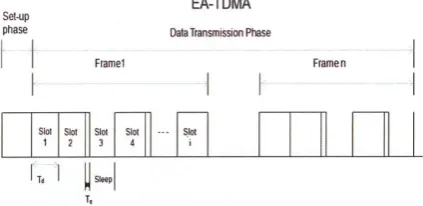
Fig. 1 Operation diagram of EA-TDMA protocol
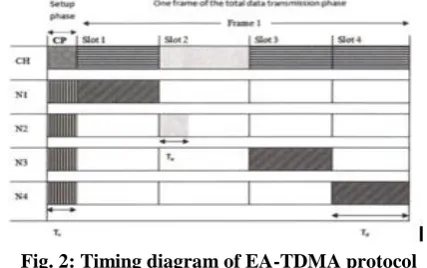
Keeping in mind the end goal to consent to the necessities of the MSW, a few presumptions are: hubs are static the entire time through the system; Energy Normal bundles are practically indistinguishable, however, it can discontinue the bucket at any point in the meantime; CH has a higher power than typical vitality level Nodes, whereas all information spaces in a TDMA schedule are of a similar size. We have separated the operation of the proposed convention into rounds [2]. Each round entails of one set and one Transmission stage. Both collection improvement and CH assurance in the plan organize, while the data transmission The CH and the BS occur in the midst of the transmission of data as portrayed in the going for purposes of intrigue. We accept that the length of the availability in a TDMA plan is Td. The doled out center point turns on your radio and transmits data to The CH in the midst of this period. In case any center point has no data to transmit slaughter your radio rapidly. In this way, we expect that the radio turns off after the Test hour, rather than staying on for the whole day and age of span Td as outlined in Fig. 2 [3].
Setup phase:
Considering the range of use and this review except that the system comprises of a Cluster in which there is a CH situated in the focal point of the cluster. In view of the application and the span of the cluster, coordinate transmission for information correspondence between source hubs to CH rather than multi-hop information transmission. In the arrangement stage, the CH fabricates a TDMA Schedule and communicates the calendar to all hubs inside the cluster. CH [3] likewise illuminates every one of the hubs about the start of the current Round, casing begins/stop time, rack number in around.
Data transmission Phase:
Locations become altered up to suspend form in place of lay setting without facts. Locations in CH transmit the acknowledged facts into the CH assistance.
Fig. 2: Timing diagram of EA-TDMA protocol E-BMA Protocol:
It was observed that the BMA protocol consumes less energy than TDMA when it comes to lower traffic load, but when the author compared the energy efficient version of EA-TDMA the author found that it uses less energy than BMA. This method is implacable since it is associated with the period of BMA which will limit the listening period irrespective of the data transmission. The energy is measured before transmitting the data. In EBMA the energy consumption is disturbed by the activity loads. However when the load increases the disruption which will turn into an overburden. This high moment activity loads the data transmission will be practically buggy.
In E-BMA [5] convention, the source hubs utilize piggybacking to make reinforcement comparing information opening as opposed to sending a control message amid its allotted dispute space. Not at all like BMA, in the new convention, does a sourcing hub not make the Reserve in the dispute opening when the information parcel gets to be distinctly accessible. Rather, it sits tight for one extra edge Duration to check whether there is a progressive information parcel to send.
In the event that a sourcing hub has progressive information bundles to send in a Number of sequential casings, the reservation is made once the underlying information parcel in its relegated conflict opening and the Successive affirmations will be made through piggybacking. Take note of that the piggybacking of a control message requires just 1-bit Additional space in the information bundle, and subsequently, extra power required for stacking a control message into an information parcel
It is immaterial. In E-BMA [5], the source hub handset is off amid the conflict stage when no control Send a message, while in BMA, the transmitter is kept up Idle in comparative circumstances. This permits the E-BMA convention they spare energy in both low and medium activity. To accomplish energy proficiency, the E-BMA Protocol bargains the inactivity of information transmission. Every Data bundle needs to sit tight for extra edge length before it is transmitted to CH area.
The procedure regarding the E-MBA meeting is actually separated into rounds, each game includes a concept phase as well as theconditioning period that will be steady. Hawaii that will be constant includes an assertion state plus one level of real information sign. Both the synthesis of conglomerates And CH collection tend to be created in the arrangement state.
Setup phase:
Considering the particular territory of utilization and its straightforwardness, it is accepted that the system comprises of different settled clusters. In each of the gatherings, there is A CH situated in the focal point of the cluster. In light of the application and size of the cluster, the transmission of the information correspondence between the source hubs and the CH is Instead of multihop information transmission. At In the setup stage, the CH educates everyone of the hubs about the current round, causingbegins/stop time and various edges around.
Contention phase:
Every hub is appointed a particular space in the conflict stage. A hub transmits a 1-bit control Message amid your booked space to save an information opening. In the event that you have an information bundle to transmit; something else, the hub it stays in suspend mode amid that conflict opening. After the control time frame, the CH sets up and Outputs a transmission program for the source hubs.
Rather, the source hub holds the information parcel in the support, and sit tight for a casing span to check whether there is a Consecutive information bundle to send.
Data transmission phase:
The information transmission stage contains at least one edges. The size and length of each edge are settled. Hubs send their information to CH at most once per outline amid its relegated time interim. Amid the Data transmission stage, every source hub turns on its framework. In its doled out information space, it transmits information to the CH. Yes, there are back to back parcels, the information bundle transmitted. It transmits that data through piggybacking.
In the wake of getting every one of the information from the hubs of around, information accumulation. It happens to diminish undesirable information. A lot of energy spared if the information is included locally in the main CH rather than when sending the crude information to the local controller and its collection in BS. So the subsequent information is sent from the CH to the BS utilizing a development gadget Code and a CSMA approach, as utilized as a part of the LEACH convention. Once the CH is prepared to send the amassed information, you should recognize the channel to check whether another person is transmitting utilizing the BS spread code. The CH holds up if the channel is occupied something else, the CH transmits information to the BS. After a Time, the framework starts the following round and the entire procedure is rehashed. Scientific and reenactment models in view of the energy demonstrate for TDMA, EA-TDMA, BMA, And E-BMA to analyze their outcomes regarding movement Characteristics of charge and scattering of energy, which is exhibited In the following area.
TMAC:
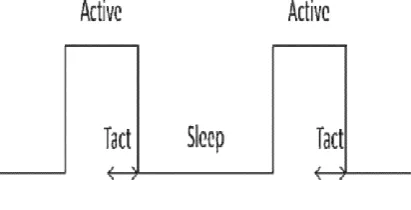
Timeout T-MAC is the convention which is derived from S-MAC convention in which the non-sleep and sleep periods are settled. In TMAC [7] the sensor hub veers off to sleep period if no occasion has happened for a period "tact" as appeared in Fig.3.
Figure 3: TMAC Protocol
There are numerous such occasions like information accepting, begin of listening or sleep period and so forth. Least sit listening period is the time 'Politeness'. The interim Ta is more prominent than the entirety of the dispute time,thelength of an RTS packet, turnaround time and the length of the CTS packet [8]. This entire situation brings about vitality utilization which less in TMAC when contrasted with Sensor S-MAC convention. Be that as it may, this is balanced against high postponement or idleness which T-MAC convention has when contrasted with the S-MAC convention. Focal points:
TMAC can without much of a stretch handle variable load because of element sleeping plan. Detriments: TMAC's real impediment is a nearly dozing issue in which nodes may sleep according to their initiation time and information may get lost particularly for long messages.
SMAC:
The fundamental idea of SMAC is intermittent sleeplisten to plans which are taken care locally by the sensor networks. Nodes which are adjoining structure bunches practically and they share regular timetable. This implies if two nodes are next to each other and fall into two unique groups they wake up at listeningto the schedule of both bunches. This additional element brings about more vitality utilization as nodes wake up to two distinct timestamps. The schedules should have been conveyed to various nodes of the virtual bunch which is refined by SYNC [9] bundles and time in which it is sent is known as synchronization period.
sleep plans. This is known as sleep delay. This hindrance can be overcome by utilizing versatile sensing procedure, and subsequently, the general deferral can be enhanced as proposed in TMAC [7] clarified next. In that system, the catching hub awakens for a little term toward the finish of the transmission. Along these lines, if this hub is the bounce hub, it can take the information instantly from the transmitting/passing hub.
Figure 4: Sensor MAC Protocol
LEACH:
It is a popular energy-efficient adaptive clustering algorithm, where the cluster head nodes are created on the basis of the energy and the cluster heads act as the router for that cluster. LEACH [10] is application specific data dimension algorithm which uses the highest energy node as a cluster and increases the system time of operation. In this protocol, the cluster heads are randomly (Based on energy) shuffled so that the life prolongs and the load of the nodes is also evenly distributed. That are all the disadvantages of the old protocol which were used are overcome in LEACH.
LEACH makes use of three skills particularly
1. Randomized rotation associated with gathering minds and clusters that are corresponding. 2. Localized control and coordination for gathering setup and process.
3. Local compression to lessen communication that is global.
The clustering terminates [11] within the finite iterations as it shuffles the nodes and there can be a finite number of In this section, the analysis of the proposed method is given. nodes present in the cluster in the LEACH. It will not assure cluster that is good circulation and in addition, it thinks consistent power use of nodes.
III.
ANALYSIS:
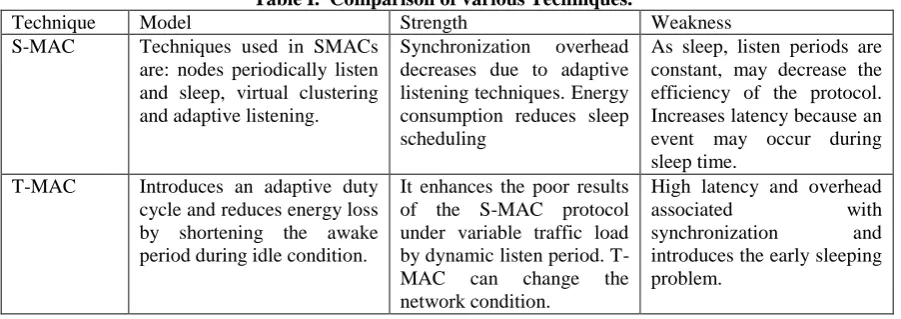
The table below shows the technique, how it is implemented and what are the strength and weakness of the model.
Table I. Comparison of various Techniques.
Technique Model Strength Weakness
S-MAC Techniques used in SMACs are: nodes periodically listen and sleep, virtual clustering and adaptive listening.
Synchronization overhead decreases due to adaptive listening techniques. Energy consumption reduces sleep scheduling
As sleep, listen periods are constant, may decrease the efficiency of the protocol. Increases latency because an event may occur during sleep time.
T-MAC Introduces an adaptive duty cycle and reduces energy loss by shortening the awake period during idle condition.
It enhances the poor results of the S-MAC protocol under variable traffic load by dynamic listen period. T-MAC can change the network condition.
High latency and overhead
associated with
LEACH Distributed cluster formation enables randomized, adaptive, self-configuring features.
The overall throughput of the network increases as latency is reduced and system life increases. Collision and interference are overcome by using
TDMA and CDMA
protocol respectively.
Due to its distributed cluster formation algorithm, it cannot ensure the coverage of the entire network. TDMA schedule introduces a time delay.
EBMA Protocol
The model is based on packet transmission
The system consumes less energy them BMA or TBMA.
The piggyback method is used instead of storing the data values in the memory to save the memory consumption.
The start bit shows the type of data enabling the system to process thepacket accordingly.
It takes polynomial time.
It is non-deterministic
unless you tracked it. The technique is hard to simulate by human simulate.
EA-TDMA It is a conventional MAC protocol where each node wakes up its assigned schedule but turns off its Immediately if there is no data to transmit, otherwise, Transmits your data
It can easily adapt transmission data.
It can send data energy efficiently.
The data packet sends can be higher.
It provides extended battery life.
The time slots are predefined creating a problem in cell shifting.
Multipath distortion can create errors.
IV.
CONCLUSION:
As observed from the above table one of the promising technique is the regression algorithm as the tree structure enhances the speed i.e. the performance of the system. Tree model performs a fast regression tree that helps information gain reduction and prunes it using lowing-error pruning. Missing values are also recovered by dividing the tree. In spite being lengthy and complex, it is one of the best technique.
REFERENCES:
[1]. G. M. Shafiullah, Salahuddin A. Azad, and A. B. M. Shawkat Ali, “Energy-Efficient Wireless MAC Protocols for Railway Monitoring Applications”, IEEE TRANSACTIONS ON INTELLIGENT TRANSPORTATION SYSTEMS, VOL. 14, NO. 2, JUNE 2013
[2]. GMShafiullah, Adam Thompson, Peter J Wolfs, Shawkat Ali, “Energy-Efficient TDMA MAC Protocol for Wireless Sensor Networks Applications”, Proceedings of International Workshop on Internet and Distributed Computing Systems (lDCS' 08) 24 December 2008, Khulna, Bangladesh.
[3]. G. M. Shafiullah, Salahuddin A. Azad, and A. B. M. Shawkat Ali, “Reduction of Power Consumption in Sensor Network Applications using Machine Learning Techniques”
[4]. Injong Rhee, AjitWarrier, Mahesh Aia, Jeongki Min, and Mihail L. Sichitiu, “Z-MAC: A Hybrid MAC for Wireless Sensor Networks”, IEEE/ACM TRANSACTIONS ON NETWORKING, VOL. 16, NO. 3, JUNE 2008.
[5]. Joaquim Oller, IlkerDemirkol, Jordi Casademont, JosepParadells, GerdUlrichGamm,and Leonhard Reindl, “Has Time Come to Switch From Duty-Cycled MAC Protocols to Wake-Up Radio for Wireless Sensor Networks?”, 1063-6692 © 2015 IEEE.
[7]. “Jie Zhang, Jie Wu, Zhao Han, Liefeng Liu, Kaiyun Tian, and Juan Dong”, “Low Power, Accurate Time
Synchronization MAC ProtocolforReal-TimeWirelessDataAcquisition”,
IEEETRANSACTIONSONNUCLEARSCIENCE,VOL.60,NO.5,OCTOBER2013.
[8]. Ou-Yang, and Wendi B. Heinzelman, “Modeling and Performance Analysis for Duty-Cycled MAC Protocols with Applications to S-MAC and X-MAC”, EEE TRANSACTIONS ON MOBILE COMPUTING, VOL. 11, NO. 6, JUNE 2012.
[9]. Raja Jurdak, Antonio G. Ruzzelli, and Gregory M.P. O’Hare, “Radio Sleep Mode Optimization in Wireless Sensor Networks”, IEEE TRANSACTIONS ON MOBILE COMPUTING, VOL. 9, NO. 7, JULY 2010.
[10]. Fabio Iannello, Osvaldo Simeone, and UmbertoSpagnolini, “Medium Access Control Protocols for Wireless Sensor Networks with Energy Harvesting”, IEEE TRANSACTIONS ON COMMUNICATIONS, VOL. 60, NO. 5, May 2012.
[11]. Pei Huang, Chen Wang, Li Xiao, “RC-MAC: A Receiver-Centric MAC Protocol for Event-Driven Wireless Sensor Networks”, 0018-9340 (c) 2013 IEEE.
[12]. Herman Sahota Ratnesh Kumar Ahmed Kamal Jing Huang, “An Energy-efficient Wireless Sensor Network for Precision Agriculture”, 978-1-4244-7755-5/10/$26.00 ©2010 IEEE.
[13]. Pei Huang, Li Xiao, SoroorSoltani, Matt W. Mutka, and Ning Xi, “The Evolution of MAC Protocols in Wireless Sensor Networks: A Survey”, IEEE COMMUNICATIONS SURVEYS & TUTORIALS, VOL. 15, NO. 1, FIRST QUARTER 2013.
[14]. AfraaAttiah, Mustafa ilhanAkba, Mainak Chatterjee, DamlaTurgut, “EE-MAC: Energy Efficient Sensor MAC Layer Protocol”, 9th IEEE International Workshop on Performance and Management of Wireless and Mobile Networks, 2013.