R E S E A R C H
Open Access
Dietary pattern and leisure time activity of
overweight and normal weight children in
Germany: sex-specific differences
Ina B Maier, Yelda Özel, Sabine Wagnerberger, Stephan C Bischoff and Ina Bergheim
*Abstract
Background:Several studies indicate that dietary pattern and leisure time activities of adults not only differ between sexes but also between overweight and normal weight individuals. The aim of the present study was to determine if sex-specific differences in dietary pattern and leisure time activity already exist and are associated with weight status in young childhood.
Methods:Nutritional intake, anthropometric parameters, leisure time activities and socio- demographical factors were assessed in 100 overweight and 51 normal weight children (81 girls and 70 boys), aged 5–8 years.
Results:In general, independent of body weight, boys ate more cheese while girls consumed more vegetables and spent more time with sedentary activities. Moreover, regardless of sex, total energy and macronutrient intake did not differ between normal weight and overweight children. Also, time spent with sportive activities did not differ between groups; however, overweight boys spent significantly more leisure time with sedentary activities than normal weight boys. Furthermore, BMI of mothers and time spent with sedentary activities were identified as independent risk factors for the development of overweight when performing multiple regression analyses. Conclusions:Taken together, results of our study suggest that already at young age sex influences dietary pattern independent of body weight. Furthermore, an increased time spent with sedentary activities and an elevated maternal BMI were found to be associated with an elevated body weight in children. (Trial registration: NCT01306396)
Keywords:Children, Dietary pattern, Obesity, Overweight, Sex, Physical activity
Introduction
The prevalence of overweight and obesity among chil-dren and adolescents in industrialized countries has in-creased dramatically throughout the last three decades. In Germany, the German Health Interview and Examin-ation Survey for Children and Adolescents (KiGGS) re-cently revealed that ~15% of children and adolescents are overweight and of these ~6.3% are even obese accor-ding to the national reference [1]. Overweight is often described as the result of an imbalance between energy intake and energy expenditure [2]. Results of several studies indicate that the dietary pattern of normal weight and overweight children and adolescents differ and that
overweight children more often consume food consid-ered as unhealthy [3]. Indeed, in these studies it was shown that overweight children and adolescents ate su-gar and snacks more frequently than normal weight chil-dren and adolescents, whereas legumes, vegetables and fruits were consumed less frequently. Contrary to these findings, a study by Janssen et al. found no clear asso-ciation between dietary habits and the prevalence of over-weight in adolescents in Canada [4]. Furthermore, Janssen et al. [5] who analysed dietary pattern of 10–16 year old adolescents assessed in 34 different, mainly European countries, reported that the consumption of fruits, vegeta-bles, sweets and soft drinks differs regionally.
Another factor often discussed to influence dietary pattern is sex. Results of several studies in adults indi-cate that women consume more fruit and vegetable than * Correspondence:[email protected]
Department of Nutritional Medicine (180a), University of Hohenheim, Fruwirthstrasse 12, Stuttgart 70599, Germany
men whereas men eat more meat, eggs, milk and sweets [6,7]. Results of epidemiological studies suggest that dietary habits are acquired in childhood and are often maintained into adulthood [8]. In line with this hypo-thesis, several studies analyzing dietary pattern in older children, adolescents and young adults found that fruit and vegetable intake of girls was markedly higher in com-parison to boys whereas boys ate more milk products, cer-eals and meat [9]. However, only scarce information on dietary pattern and possible sex-specific differences of children below the age of 10 years is available and results vary between countries [5,10]. Starting from this back-ground the aim of the present study was to determine if sex-specific differences in dietary pattern and leisure time activity already exist in boys and girls aged 5–8 years and if these differ between normal weight and overweight children.
Methods and procedures
Subjects
The study was approved by the ethics committee of the“Landesärztekammer Baden-Württemberg”(Stuttgart, Germany) and was performed in accordance with the ethi-cal standards of the Helsinki Declaration from 1975 and revised in 1983. Written informed consent was obtai-ned from all subjects and their parents or guardians. A total of 100 overweight children (43 boys, 57 girls) and 51 normal weight children (27 boys, 24 girls) aged 5–8 years were included in the study. All participants were recruited between April 2009 and December 2010 through 117 primary schools in Stuttgart (Germany). The study is registered at http://www.clinicaltrials.gov (NCT01306396).
Anthropometric measurements
Weight was measured without shoes in light clothing to the nearest 0.1 kg by using an electronic calibrated scale (RIBA Model ABW-150K, Geldermalsen, Netherlands). Height was measured in a standing position without shoes using a portable height measure (Leicester Height Mea-sure, Invicta, Leicester, England) to the nearest 0.1 cm. BMI (Body Mass Index) was calculated as weight in kilo-grams divided by height in meters squared and was expressed in kg/m2. In accordance with the German as-sociation of obesity in childhood and adolescence (AGA) BMI values were used to classify children as normal weight (BMI < 90th percentile BMI), as overweight (BMI > 90th percentile BMI) or obese (BMI > 97th per-centile BMI) [11]. In addition, BMI-SDS (BMI standard deviation score) was also calculated according to the German association of obesity in childhood and adoles-cence using reference data for German children [11].
Dietary assessment
To assess dietary pattern as well as total intake of energy and macronutrients, two 24-h dietary recalls were per-formed on independent days with each study participant in the presence of their respective guardian by an expe-rienced dietician. To assess meal sizes, children and pa-rents were shown pictures of meals in different sizes (EPIC picture book, source: International agency for re-search on cancer). Nutritional data were analysed using the computer software EBISpro (Version 8.0, 2007, Germany). To investigate sex-specific differences in dietary pattern, intake of the following 12 different food groups was com-pared between all boys and girls: fruits, vegetables, meat and sausages, fish, pasta and rice and potato, bread and cereals, fat, cheese, milk, eggs, sweets, others. To check for underreporting, the ratio of reported total energy in-take (TEI) and predicted individual basal metabolic rate (BMR) was used as described previously by others [12]. As described before by Sichert-Hellert et al. [13] only recalls with a ratio above the age- and sex-specific cut-off values (for boys 1.04 and girls 1.01) were included in the analysis. As a result, 6 overweight children had to be excluded from the analysis of dietary intake.
Leisure time activities and socio-demographic data
Leisure time activities were assessed using a question-naire adapted and modified from KiGGS [14]. In ad-dition to the general assessment of time spent physical active or sedentary, the questionnaire assessed the kind of physical activity (e.g. cycling or time spent with orga-nized sportive activities like gymnastics and soccer) and sedentary activities (e.g. reading, painting, watching TV). Questions were imposed to both parents/caregivers and children, respectively. Furthermore, socio-demographic characteristics like age, sex, ethnicity, socio-economic status, assessed by the mothers’ and fathers’ level of education, and the weight status of the parents were recorded.
Statistical analysis
Results
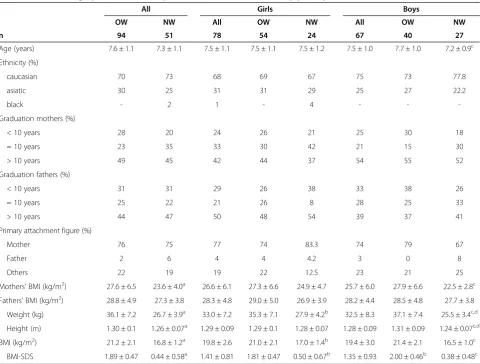
Socio-demographical and anthropometric characteristics Socio-demographical and anthropometric characteristics of study participants are summarized in Table 1. When comparing all children regardless of body weight, no differences between sexes were found regarding age, eth-nicity, socio-economic status and anthropometric pa-rameters (e.g. BMI and BMI-SDS). Socio-demographic parameters of normal weight boys and girls did not dif-fer; however, normal weight girls were significantly taller and heavier than normal weight boys, but mean BMI-SDS did not differ between sexes. BMI-BMI-SDS was signifi-cantly higher in overweight boys than girls. Overweight children regardless of sex were significantly taller, hea-vier and had a higher BMI-SDS than the corresponding normal weight children (Table 1). Age, ethnicity and socio-economic status did not differ between overweight and normal weight children (Table 1). Average BMI of mothers of overweight children was significantly higher in comparison to that of normal weight children. A
similar difference was not found for the BMIs of fathers. In ~75% of all families mothers were described to be the primary attachment figure (see Table 1).
Differences in nutrient intake
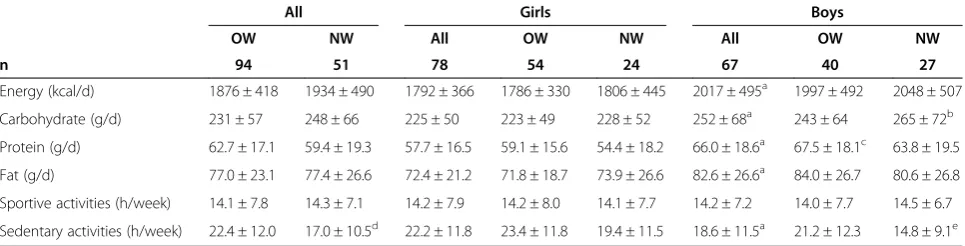
When comparing nutritional intake of normal weight and overweight children no differences in energy and macronutrient intake were found (Table 2). Interestingly, mean energy intake as well as total carbohydrate, protein and fat intake of all boys was significantly higher in com-parison to all girls regardless of weight status. Further-more, total protein intake was also significantly higher in overweight boys compared to overweight girls. In nor-mal weight boys, a significantly higher intake of carbohy-drates was found when compared to normal weight girls (Table 2).
Differences in dietary pattern
In general, in overweight and normal weight children, intake of different food groups e.g. vegetables and fruits
Table 1 Socio-demographical and anthropometric characteristics of study participants
All Girls Boys
OW NW All OW NW All OW NW
n 94 51 78 54 24 67 40 27
Age (years) 7.6 ± 1.1 7.3 ± 1.1 7.5 ± 1.1 7.5 ± 1.1 7.5 ± 1.2 7.5 ± 1.0 7.7 ± 1.0 7.2 ± 0.9c
Ethnicity (%)
caucasian 70 73 68 69 67 75 73 77.8
asiatic 30 25 31 31 29 25 27 22.2
black - 2 1 - 4 - -
-Graduation mothers (%)
< 10 years 28 20 24 26 21 25 30 18
= 10 years 23 35 33 30 42 21 15 30
> 10 years 49 45 42 44 37 54 55 52
Graduation fathers (%)
< 10 years 31 31 29 26 38 33 38 26
= 10 years 25 22 21 26 8 28 25 33
> 10 years 44 47 50 48 54 39 37 41
Primary attachment figure (%)
Mother 76 75 77 74 83.3 74 79 67
Father 2 6 4 4 4.2 3 0 8
Others 22 19 19 22 12.5 23 21 25
Mothers’BMI (kg/m2) 27.6 ± 6.5 23.6 ± 4.0a 26.6 ± 6.1 27.3 ± 6.6 24.9 ± 4.7 25.7 ± 6.0 27.9 ± 6.6 22.5 ± 2.8c
Fathers’BMI (kg/m2) 28.8 ± 4.9 27.3 ± 3.8 28.3 ± 4.8 29.0 ± 5.0 26.9 ± 3.9 28.2 ± 4.4 28.5 ± 4.8 27.7 ± 3.8
Weight (kg) 36.1 ± 7.2 26.7 ± 3.9a 33.0 ± 7.2 35.3 ± 7.1 27.9 ± 4.2b 32.5 ± 8.3 37.1 ± 7.4 25.5 ± 3.4c,d
Height (m) 1.30 ± 0.1 1.26 ± 0.07a 1.29 ± 0.09 1.29 ± 0.1 1.28 ± 0.07 1.28 ± 0.09 1.31 ± 0.09 1.24 ± 0.07c,d
BMI (kg/m2) 21.2 ± 2.1 16.8 ± 1.2a 19.8 ± 2.6 21.0 ± 2.1 17.0 ± 1.4b 19.4 ± 3.0 21.4 ± 2.1 16.5 ± 1.0c
BMI-SDS 1.89 ± 0.47 0.44 ± 0.58a 1.41 ± 0.81 1.81 ± 0.47 0.50 ± 0.67b 1.35 ± 0.93 2.00 ± 0.46b 0.38 ± 0.48c
Values are means ± SD.a
p < 0.05 in comparison to all OW children.b
p < 0.05 in comparison to OW girls.c
p < 0.05 in comparison to OW boys.d
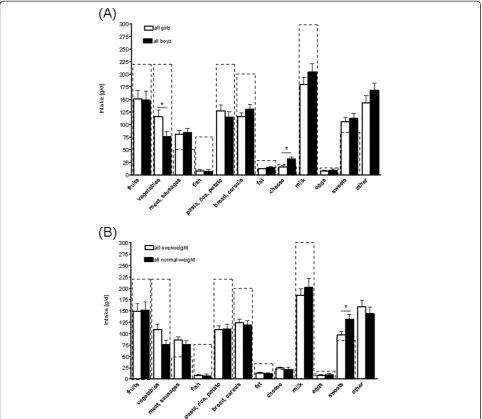
as well as meat did not meet the recommendations of the German research institute for nutrition of children (FKE) [15] (see Figure 1). In Figure 1 dietary pattern of study participants are summarized. Boys ate significantly more cheese in comparison to the girls whereas in girls vegetable consumption was significantly higher. Simi-lar differences were also found when overweight chil-dren were only analysed; however, in normal weight children vegetable intake did not differ between sexes (see Additional file 1).
When comparing dietary pattern of all overweight and normal weight children (Figure 1B) a significantly higher intake of sweets was found for normal weight children. Similar results were also found when dietary pattern of normal weight and overweight boys were compared (see Additional file 1).
Leisure time activities
In Table 2 leisure time activities are summarized for all study participants. When comparing girls and boys inde-pendent of their weight status, time of physical activity during leisure time was similar (~14.5 h/week). However, girls reported to spend significantly more time with se-dentary activities (e.g. painting, reading) during their leisure time than boys. A similar trend was also found when comparing normal weight girls and boys (p = 0.069) but not for overweight children. When comparing average leisure time activities of all overweight and nor-mal weight children, overweight children were found to spend significantly more time with sedentary activities in their leisure time. Similar results were also found for over-weight and normal over-weight boys but not for overover-weight and normal weight girls.
When performing a regression analysis for BMI of mothers, BMI of fathers and sedentary activities, res-pectively a relation of these parameters with BMI-SDS of children was found (Table 3). However, when perform-ing a stepwise multiple linear regression analysis, only BMI of mothers (beta = 0.379, p < 0.05) and time spent
with sedentary activities (beta = 0.213, p < 0.05) were found to be independent risk factors for BMI-SDS.
Discussion
World-wide the prevalence of overweight and obesity has increased dramatically during the last three decades not only in adults but also in children. Intense research efforts have been undertaken to clarify mechanisms involved in the development of overweight and obesity in humans; however, despite these efforts, mechanisms involved are still poorly understood and universally ac-cepted therapies are still lacking. Results of several epi-demiologic studies indicated that dietary pattern of adults not only differ markedly between sexes [10,16], but also between overweight and normal weight indivi-duals [17]. However, similar studies have rarely been performed in children under the age of 10 years and results are contradictory [4,5]. In the present study, we tested the hypothesis that dietary intake differs between normal and overweight children and between boys and girls. It was shown before by others that a long-term overnutrition of ~100 kcal/d may cause overweight [18]. In the present study, total energy and macronutrient in-take did not differ between normal weight and over-weight children and all children being overover-weight or even obese, reached the recommendation to spend one hour per day with sportive activities regardless of weight status [19]. However, leisure time spent with sedentary activity like watching TV was markedly longer in over-weight children regardless of sex whereas time spent physical active (e.g. playing soccer) did not differ bet-ween groups regardless of sex, suggesting that nutritio-nal intake (e.g. total energy intake) of overweight children may have been too high in comparison to energy expend-iture. Indeed in the present study, sedentary activity was identified as an independent risk factor for the develop-ment of overweight in children. These findings are in line with those of other groups, who found a positive asso-ciation between screen time or total media consumption and the degree of overweight [5]. In addition, results of a Table 2 Nutritional intake and leisure time activities of study participants
All Girls Boys
OW NW All OW NW All OW NW
n 94 51 78 54 24 67 40 27
Energy (kcal/d) 1876 ± 418 1934 ± 490 1792 ± 366 1786 ± 330 1806 ± 445 2017 ± 495a 1997 ± 492 2048 ± 507
Carbohydrate (g/d) 231 ± 57 248 ± 66 225 ± 50 223 ± 49 228 ± 52 252 ± 68a 243 ± 64 265 ± 72b
Protein (g/d) 62.7 ± 17.1 59.4 ± 19.3 57.7 ± 16.5 59.1 ± 15.6 54.4 ± 18.2 66.0 ± 18.6a 67.5 ± 18.1c 63.8 ± 19.5
Fat (g/d) 77.0 ± 23.1 77.4 ± 26.6 72.4 ± 21.2 71.8 ± 18.7 73.9 ± 26.6 82.6 ± 26.6a 84.0 ± 26.7 80.6 ± 26.8
Sportive activities (h/week) 14.1 ± 7.8 14.3 ± 7.1 14.2 ± 7.9 14.2 ± 8.0 14.1 ± 7.7 14.2 ± 7.2 14.0 ± 7.7 14.5 ± 6.7
Sedentary activities (h/week) 22.4 ± 12.0 17.0 ± 10.5d 22.2 ± 11.8 23.4 ± 11.8 19.4 ± 11.5 18.6 ± 11.5a 21.2 ± 12.3 14.8 ± 9.1e
Values are means ± SD.a
p < 0.05 in comparison to all girls.b
p < 0.05 in comparison to normal weight girls.c
p < 0.05 in comparison to OW girls.d
p < 0.05 in comparison to all OW children.e
meta-analysis suggest that media consumption often re-places physical activity (e.g. sport) during leisure time [20]. Contrary to the findings in adults [17], in the present study, intake of sweets was markedly higher in normal
weight children than in overweight or obese children. Still, intake of different food groups e.g. vegetables and fruits as well as meat intake of children in general did not meet the recommendations of the German research institute for nutrition of children (FKE). These findings are in line with those of others. Indeed, results of a meta-analysis of stu-dies performed in 34 different countries revealed that nor-mal weight children quite frequently eat more sweets than overweight children [5]. Furthermore, Ortega et al. also reported that total energy intake between overweight and normal weight adolescents did not differ [21], whereas in the studies of Hassapidou et al. [3] and Rocandio et al. [2], total energy intake of normal weight adolescents was even higher than that of overweight study participants. In line with our findings, in the study of Kersting et al. it was also Table 3 Results of univariate regression analysis for risk
factors for overweight using BMI-SDS as dependent variable
Independent variable Regression coefficient p-value
BMI mothers 0,158 0,001
BMI fathers 0,03 0,05
Energy intake −0,004 0,527
Sedentary activities 0,072 0,001
Sportive activities −0,007 0,997
found that vegetable and meat intake of German children do not meet the recommendations of the German re-search institute for nutrition of children (FKE) [22].
Interestingly, whereas BMI of fathers did not differ be-tween normal weight and overweight children, mean BMI of mothers of overweight children was markedly higher than that of the normal weight children. This dif-ference was even more pronounced in boys than in girls, which might be explained with the markedly smaller dif-ference in BMI-SDS between overweight and normal weight girls (Δboys: 1.62 vs.Δgirls: 1.31). Furthermore, multiple regression analysis revealed BMI of mothers as independent risk factor for elevated BMI-SDS of chil-dren. Danielzik et al. also found a closer association be-tween children’s BMI and maternal BMI than paternal BMI [23]. The association with maternal overweight may have different reasons and may even be multifactorial. Indeed, results of studies performed in twins suggest that genetic factors may have a strong effect on the va-riation of BMI [24]. In addition, parents and herein particularly mothers’behaviour may also play an import-ant role, because children’s food environment is usually influenced more by mothers than by fathers [25]. Fur-thermore, the results of Fogelholm et al. indicated that physical activity pattern of children are also associated with that of parents [26]. In the present study ~75% of study participants claimed their mothers to be the pri-mary attachment figure. In addition, the results of the report of the German association of nutrition released in 2008 indicates that only 17% of students, aged 14 years eat lunch at school, indicating that lunch at home is still important in Germany [27]. However, as neither physical activity nor dietary pattern and nutritional intake or ge-netic polymorphisms of parents were assessed in the present study, possible causes of the positive association of maternal BMI with that of children remains to be determined. Taken together, results of the present study suggest that neither a marked overnutrition nor an “ ab-normal” dietary pattern are responsible for the elevated body weight in overweight children, but rather leisure time activity as well as maternal BMI may be risk factors for the development of obesity. However, reasons for this altered physical activity pattern (e.g. negative parental model, genetic backgrounds) but also the maternal in-fluence on children’s body weight remain to be determined.
Sex-specific differences in dietary pattern
Sex-specific differences in nutritional intake and dietary pattern have frequently been reported for adults but also for adolescents (for overview see [6,7,28]). In the present study, we found that boys, regardless of BMI, consumed markedly more cheese while girls, in general, ate more vegetables. In adults, sex-specific differences in dietary pattern and particularly the higher intake of fruit and
vegetable were claimed to be a result of the higher interest of women in nutrition [29] and their better knowledge of the relation of eating pattern and disease prevention [6]. However, during childhood parents and herein particularly mothers have a prominent responsi-bility for children’s diet and it seems to be rather un-likely that parents alter dietary pattern in consideration of sex [30]. Causes of these sex-specific differences in dietary pattern therefore remain to be determined. As already described in other studies particularly for adoles-cents and adults [16,31], we found that total energy and macronutrient intake in boys was markedly higher than in girls, despite only slight differences in weight status. One explanation for this could be the differences in lei-sure time activities, as girls spent significantly more time with sedentary activities than boys. This is in line with the findings of Riddoch et al. who reported sex-specific differences in sportive activities [32]. Furthermore, se-veral studies demonstrated a lower fat mass and higher bone-free lean tissue mass in boys already before the onset of puberty [33], which may result in an increased energy expenditure. However, exact mechanisms under-lying these sex-specific differences have to be deter-mined. Taken together, the results of the present study suggest that dietary pattern differs between boys and girls, aged 5–8 years, regardless of body weight status. Furthermore, the results also indicate that sex-specific differences in leisure time activities are responsible for the fact that no differences in body weight status were found between boys and girls, despite the higher total energy and macronutrient intake in boys.
Limitations
long-term issue. Furthermore, the possibility of statistical type II error cannot be ruled out.
Conclusion
In conclusion, results of our study suggest that not a drastic overnutrition is associated with the development of overweight in children. Rather, leisure time activity and maternal body weight, be it through dietary pattern, sedentary activity or genes, may be critical determinants of weight status of children. Furthermore, the results of the present study also suggest that, independent of weight status, dietary pattern differ in a sex-specific manner already during childhood. Therefore, future efforts to prevent childhood obesity should 1) focus on parental education programs, not only regarding nutri-tional intake but also focusing on decreasing sedentary activity during leisure time (e.g. media consumption) of overweight children and 2) take the sex-specific differ-ences in dietary pattern into account.
Additional file
Additional file 1:Intake of different food groups of (A) normal weight girls and normal weight boys and of (B) overweight girls and overweight boys.Recommendations of the German research institute for nutrition of children (FKE) are shown as dashed lines [15]. *p < 0.05.
Abbreviations
KiGGS: German health interview and examination survey for children and adolescents; BMI: Body Mass Index; BMI-SDS: BMI standard deviation score.
Competing interests
The authors declare that they have no competing interests.
Authors’contributions
IBM conducted research, analysed data and wrote paper, YÖ carried out nutritional interviews, SW conducted research, SCB have been involved in drafting the manuscript, IB designed research, wrote paper and had primary responsibility for final content. All authors read and approved the final manuscript.
Acknowledgement
This work was supported by a grant from the German Ministry of Education and Science (BMBF) (03105084 (IB)).
Received: 6 March 2012 Accepted: 9 January 2013 Published: 15 January 2013
References
1. Kurth BM, Schaffrath RA:[The prevalence of overweight and obese children and adolescents living in Germany. Results of the German health interview and examination survey for children and adolescents (KiGGS)].Bundesgesundheitsblatt Gesundheitsforschung Gesundheitsschutz
2007,50:736–743.
2. Rocandio AM, Ansotegui L, Arroyo M:Comparison of dietary intake among overweight and non-overweight schoolchildren.Int J Obes Relat Metab Disord2001,25:1651–1655.
3. Hassapidou M, Fotiadou E, Maglara E, Papadopoulou SK:Energy intake, diet composition, energy expenditure, and body fatness of adolescents in northern Greece.Obesity2006,14:855–862.
4. Janssen I, Katzmarzyk PT, Boyce WF, King MA, Pickett W:Overweight and obesity in Canadian adolescents and their associations with
dietary habits and physical activity patterns.J Adolesc Health2004, 35:360–367.
5. Janssen I, Katzmarzyk PT, Boyce WF, Vereecken C, Mulvihill C, Roberts C, Currie C, Pickett W:Comparison of overweight and obesity
prevalence in school-aged youth from 34 countries and their relationships with physical activity and dietary patterns.Obes Rev
2005,6:123–132.
6. Baker AH, Wardle J:Sex differences in fruit and vegetable intake in older adults.Appetite2003,40:269–275.
7. Fraser GE, Welch A, Luben R, Bingham SA, Day NE:The effect of age, sex, and education on food consumption of a middle-aged English cohort-EPIC in East Anglia.Prev Med2000,30:26–34.
8. Kelder SH, Perry CL, Klepp KI, Lytle LL:Longitudinal tracking of adolescent smoking, physical activity, and food choice behaviors.Am J Public Health1994,84:1121–1126.
9. Nicklas TA, Webber LS, Thompson B, Berenson GS:A multivariate model for assessing eating patterns and their relationship to cardiovascular risk factors: the Bogalusa Heart Study.Am J Clin Nutr
1989,49:1320–1327.
10. Slimani N, Fahey M, Welch AA, Wirfält E, Stripp C, Bergström E, Linseisen J, Schulze MB, Bamia C, Chloptsios Y, Veglia F, Panico S, Bueno-de-Mesquita HB, Ocké MC, Brustad M, Lund E, González CA, Barcos A, Berglund G, Winkvist A, Mulligan A, Appleby P, Overvad K, Tjonneland A, Clavel-Chapelon F, Kesse E, Ferrari P, Van Staveren WA, Riboli E:Diversity of dietary patterns observed in the European Prospective Investigation into Cancer and Nutrition (EPIC) project.Public Health Nutr2002, 5:1311–1328.
11. Kromeyer-Hauschild K, Wabitsch M, Kunze D, Geller F:Percentile of body mass index in children and adolescents evaluated from different regional German studies.Monatsschr Kinderheilkd2001,149:807–818. 12. Schofield WN:Predicting basal metabolic rate, new standards and review
of previous work.Hum Nutr Clin Nutr1985,39(Suppl 1):5–41.
13. Sichert-Hellert W, Kersting M, Schoch G:Underreporting of energy intake in 1 to 18 year old German children and adolescents.Z Ernahrungswiss
1998,37:242–251.
14. Holling H, Kamtsiuris P, Lange M, Thierfelder W, Thamm M, Schlack R:[The German health interview and examination survey for children and adolescents (KiGGS): study management and conduct of fieldwork]. Bundesgesundheitsblatt Gesundheitsforschung Gesundheitsschutz2007, 50:557–566.
15. Alexy U, Clausen K, Kersting M:Die Ernährung gesunder Kinder und Jugendlicher nach dem Konzept der Optimierten Mischkost. Ernährungsumschau2008,3:168–177.
16. Briefel RR, McDowell MA, Alaimo K, Caughman CR, Bischof AL, Carroll MD, Johnson CL:Total energy intake of the US population: the third National Health and Nutrition Examination Survey, 1988–1991.Am J Clin Nutr1995,62:1072S–1080S.
17. Duvigneaud N, Wijndaele K, Matton L, Philippaerts R, Lefevre J, Thomis M, Delecluse C, Duquet W:Dietary factors associated with obesity indicators and level of sports participation in Flemish adults: a cross-sectional study.Nutr J2007,6:26.
18. Hill JO, Wyatt HR, Reed GW, Peters RJ:Obesity and the environment: Where do we go from here?Science2003,299:853–855.
19. Cavill N, Biddle S, Sallis JF:Health enhancing physical activity for young people: statement of the United Kingdom expert consensus conference. Pediatric Exerc Sci2001,13:12–25.
20. Marshall SJ, Biddle SJ, Gorely T, Cameron N, Murdey I:Relationships between media use, body fatness and physical activity in children and youth: a meta-analysis.Int J Obes Relat Metab Disord2004,28:1238–1246. 21. Ortega RM, Requejo AM, Andres P, Lopez-Sobaler AM, Redondo R,
Gonzalez-Fernandez M:Relationship between diet composition and body mass index in a group of Spanish adolescents.Br J Nutr1995,74:765–773. 22. Kersting M, Alexy U, Kroke A, Lentze MJ:Kinderernährung in Deutschland
-Ergebnisse der DONALD-Studie.Bundesgesundheitsbl. Gesundheitsforsch Gesundheitsschutz2004,47:213–218.
23. Danielzik S, Langnase K, Mast M, Spethmann C, Muller MJ:Impact of parental BMI on the manifestation of overweight 5–7 year old children. Eur J Nutr2002,41:132–138.
25. Safer DL, Agras WS, Bryson S, Hammer LD:Early body mass index and other anthropometric relationships between parents and children. Int J Obes Relat Metab Disord2001,25:1532–1536.
26. Fogelholm M, Nuutinen O, Pasanen M, Myohanen E, Saatela T:Parent–child relationship of physical activity patterns and obesity.Int J Obes Relat Metab Disord1999,23:1262–1268.
27. German association of nutrition (DGE):Report of nutrition. Bonn: German association of nutrition; 2008.
28. Bradlee ML, Singer MR, Qureshi MM, Moore LL:Food group intake and central obesity among children and adolescents in the Third National Health and Nutrition Examination Survey (NHANES III).Public Health Nutr
2010,13:797–805.
29. Fagerli RA, Wandel M:Gender differences in opinions and practices with regard to a“healthy diet”.Appetite1999,32:171–190.
30. Jones LR, Steer CD, Rogers IS, Emmett PM:Influences on child fruit and vegetable intake: sociodemographic, parental and child factors in a longitudinal cohort study.Public Health Nutr2010,13:1122–1130. 31. Troiano RP, Briefel RR, Carroll MD, Bialostosky K:Energy and fat intakes of
children and adolescents in the united states: data from the national health and nutrition examination surveys.Am J Clin Nutr2000, 72:1343S–1453S.
32. Riddoch CJ, Bo AL, Wedderkopp N, Harro M, Klasson-Heggebo L, Sardinha LB, Cooper AR, Ekelund U:Physical activity levels and patterns of 9- and 15-yr-old European children.Med Sci Sports Exerc2004,36:86–92.
33. Taylor RW, Gold E, Manning P, Goulding A:Gender differences in body fat content are present well before puberty.Int J Obes Relat Metab Disord
1997,21:1082–1084.
34. Johansson L, Solvoll K, Bjorneboe GE, Drevon CA:Under- and
overreporting of energy intake related to weight status and lifestyle in a nationwide sample.Am J Clin Nutr1998,68:266–274.
35. Pietiläinen KH, Korkeila M, Bogl LH, Westerterp KR, Yki-Järvinen H, Kaprio J, Rissanen A:Inaccuracies in food and physical activity diaries of obese subjects: complementary evidence from doubly labeled water and co-twin assessments.Int J Obes2010,34:437–445.
doi:10.1186/1475-2891-12-14
Cite this article as:Maieret al.:Dietary pattern and leisure time activity of overweight and normal weight children in Germany: sex-specific differences.Nutrition Journal201312:14.
Submit your next manuscript to BioMed Central and take full advantage of:
• Convenient online submission • Thorough peer review
• No space constraints or color figure charges • Immediate publication on acceptance
• Inclusion in PubMed, CAS, Scopus and Google Scholar
• Research which is freely available for redistribution