R E S E A R C H A R T I C L E
Open Access
Values and value conflicts in implementation
and use of preconception expanded carrier
screening - an expert interview study
Amal Matar
*, Mats G. Hansson and Anna T. Höglund
Abstract
Background:Endeavors have been made to found and incorporate ethical values in most aspects of healthcare,
including health technology assessment. Health technologies and their assessment are value-laden and could trigger problems with dissemination if they contradict societal norms. Per WHO definition, preconception expanded carrier screening is a new health technology that warrants assessment. It is a genetic test offered to couples who have no known risk of recessive genetic diseases and are interested pregnancy. A test may screen for carrier status of several autosomal recessive diseases and X-linked at one go. The technique has been piloted in the Netherlands and is discussed in other countries. The aim of the study was to examine values and value conflicts that healthcare experts recounted in relation to the discussion of implementation and use of preconception ECS in Sweden.
Methods:We interviewed ten experts, who were associated with influencing health policymaking in Sweden. We
employed systematizing expert interviews, which endeavor to access experts’specialist knowledge. There were four female and six male informants, of which four were physicians, three bioethicists, one a legal expert, one a theologian and one a political party representative in the parliament. The participants functioned as members of two non-governmental bodies and three non-governmental organizations. We employed thematic analysis to identify themes, categories and subcategories.
Results:Two main themes surfaced: values and value conflicts. The main categories ofRespect for persons, Solidarity, Human dignity, Do no harm, HealthandLoveformed the first theme, while values conflicting with autonomy and integrity respectively, constituted the second theme. Concepts relating to respect for persons were the most commonly mentioned among the participants, followed by notions alluding to solidarity. Furthermore, respondents discussed values conflicting with Swedish healthcare ones such as equality and solidarity.
Conclusions:The experts highlighted values and concepts that are distinctive of welfare states such as Sweden and delineated how preconception ECS could challenge such values. Moreover, the analysis revealed that certain values were deemed more substantive than others, judging by the extent and detail of inference; for example, respect for persons and solidarity were on top of the list.
Keywords:Moral values, Intrinsic and extrinsic values, Preconception expanded carrier screening, Respect for persons, Solidarity, Human dignity, Health technology
© The Author(s). 2019Open AccessThis article is distributed under the terms of the Creative Commons Attribution 4.0 International License (http://creativecommons.org/licenses/by/4.0/), which permits unrestricted use, distribution, and reproduction in any medium, provided you give appropriate credit to the original author(s) and the source, provide a link to the Creative Commons license, and indicate if changes were made. The Creative Commons Public Domain Dedication waiver (http://creativecommons.org/publicdomain/zero/1.0/) applies to the data made available in this article, unless otherwise stated.
* Correspondence:[email protected]
Background
Value theory, together with theories of rights, are the main branches of ethical theory [1]. While the former judges whether a state of affairs is good or bad, and as such is evaluative in nature, the latter is concerned with appraising actions as either morally right or morally wrong [1, 2]. Values have been categorized into either intrinsic or extrinsic values. An intrinsic value has been described as whatever is“valuable for its own sake, in it-self, on its own, in its own right or as an end”[3]. An ex-trinsic value has been described simply as whatever that is non-intrinsic or as what is valuable for the sake of something it is connected to. Examples of intrinsic values include, freedom, love, health [4].
For decades now, endeavors have been made to found and incorporate ethical values and principles in most, if not all, aspects of healthcare. The prevailing moral ratio-nales prompting activities related to healthcare are pre-serving lives and reduce suffering of those in ill-health, whether mentally or physically [5]. Furthermore, moral principles have been integrated into policymaking [6], communication [7], medical research [8] and health technology assessment [9]. As a result, numerous ethical guidelines and regulations stemmed from these ventures, for example; Declaration of Helsinki for Human Subject Research, issued by the World Medical Association [10].
In the United States of America, Beauchamp and Childress [11] introduced four principles for biomedical ethics. They maintained that the principles of autonomy, beneficence, non-maleficence and justice are universal and relevant in medicine, bioscience and healthcare. Across the Atlantic, Europe had different views. Com-mentators stated that for healthcare provision and medi-cine, these principles are lacking crucial values, such as care and compassion [12].
As a result, the European Commission sponsored a study plan in the 1990s, where researchers from different European countries identified four principles for ethical decision making in bioethics and bio-laws, namely; dig-nity, vulnerability, autonomy and integrity [13]. Human dignity has been emphasized and prized over autonomy, particularly for situations where autonomy is compro-mised, for example with comatose patients [12]. In 2006, the European Union issued a statement on the founding of common moral values for the European healthcare sys-tems which were: universality, equity, access to good qual-ity care and solidarqual-ity. In addition, the document detailed principles that are functional within the health system, such as ensuring patients’ safety and involvement, provision of quality and evidence-based care, and valuing redress and privacy/confidentiality of citizens [14].
In the Nordic countries, values and principles have insti-tuted priority setting measures in healthcare. For example, in Sweden, priority setting procedure was founded on
three values; human dignity, solidarity and medical needs, and cost effectiveness, where the hierarchy of the princi-ples are significant in reaching a priority setting decision [15]. Maintaining the ranking of the principles is crucial in order to circumvent discrimination on the basis of age, personal choices/lifestyles or expensive treatments [16]. In fact, the cost effectiveness principle is only applied in ap-praisal of offers of treatment for the same disease [17].
Moreover, the Swedish Agency for Health Technology Assessment (HTA) - SBU, designed a framework to assess, among other things, ethical concerns of new technologies before their adoption by the healthcare sys-tem. Incorporated within this scheme are ethical princi-ples of justice and equality, autonomy, privacy and cost effectiveness [18]. Furthermore, commentators agreed that assessing moral values as part HTA is essential be-cause some HTs can bear moral sequels or/and the HT themselves possess moral values that may threaten the norms in a society. Lastly, they concurred that HTA it-self is value laden because the process exhibits many value judgements such as deciding on which technology to evaluate, the type of evidence to use and the explica-tion of research results [19]. Addressing values in HTA and HT can overcome the“dissemination problem”, and encourage uptake of efficacious HT by policymakers [5].
Preconception expanded carrier screening (ECS) is a new HT as defined by WHO [20], which involves a genetic test panel offered to a general population or to couples with no prior risk of recessive genetic diseases and are in-terested in becoming parents. A test screens for carrier status of several autosomal recessive and X-linked diseases at one go [21]. The technique has been piloted in the Netherlands [22] and was discussed in other countries [23–25]. To our knowledge there are no offers of precon-ception ECS in Sweden [26].
Since values and ethical principles are prominently con-sidered in the discourse of healthcare, we found it pertin-ent to examine what values have been attended to in association with preconception expanded carrier screen-ing (ECS) implementation and use in Sweden. Moreover, identifying the values and value conflicts can provide in-sights as to ways to improve dissemination of the new technology if it were to be implemented in Sweden.
Aim
The aim of the study was to investigate values that experts described in relation to implementation and use of preconception ECS. The following research questions were examined:
What values do experts express in relation to
preconception ECS?
Do experts detail value conflicts between the described values? If so, what value conflicts are highlighted in relation to preconception ECS?
According to experts, do any of the values
associated with preconception ECS challenge societal norms in Sweden?
Methods
The current study is a secondary analysis of the inter-view transcripts, which ensued from a previous study that examined Swedish policymakers’ views on ethical and social issues pertinent to preconception ECS use and implementation [27]. The present article concen-trated on the informants’discussion of values and value conflicts in relation to preconception ECS.
Expert interviews
The transcripts were obtained by conducting expert inter-view with members of ethics committees in government and non-governmental organizations, that are associated with influencing health policymaking in Sweden. Expert interview gathers data from crystallizing points of know-ledge and competency and thus has been viewed as a rapid and a good source of data. To select an expert, we adopted a social representational approach, which rely on expert’s status and their accomplishments. We performed systematizing expert interviews, as described by Bogner and Menz [28], which endeavor to access experts’ special-ist area of proficiency in a certain field. The goal was pri-marily to access expert’s interpretative knowledge; in the form of their views, interpretations and reasoning. This was particularly important while carrying out secondary analysis of the transcripts. The method is described in fur-ther details elsewhere [27].
Participants
The total number of participants were ten, with four fe-male and six fe-male informants. There were four physi-cians, three bioethicists, one legal expert, one theologian and one political party representative in the parliament. The participants functioned as members of national (nine respondents) and regional (one respondent) com-mittees, or two non-governmental bodies and three gov-ernmental organizations, that attended to ethical and social issues pertaining to healthcare matters. Therefore, the included informants influenced health policymaking in Sweden.
The participants were working for or worked on board the following committees during the duration of data collection:
SBU - Statens beredning för medicinsk och social
utvärdering (The Swedish Council on Technology Assessment in Healthcare)
SMER - Statens medicinsk-etiska råd (The Swedish
Medical Ethics Council)
The ethical board of the National Board for Health
and Welfare - Socialstyrelsen
Sveriges läkarförbund (The Swedish Medical
Association)
Svenska Läkaresällskapet (The Swedish Society of
Medicine)
Data collection
The duration of data collection lasted almost 10 months (from February till November, 2017). First, we consulted the websites of the previously mentioned committees to acquire contact information of potential participants and thereafter, we turned to a snowballing approach to re-cruit interview candidates. That means that we enquired of the respondents who were interviewed for contact de-tails of potentially interested members in the aforemen-tioned boards. A total of 30 members were approached and ten agreed to participate in our study. Reasons for declining were primarily lack of time, but some also expressed feelings of uncertainty about the topic (pre-conception ECS).
After a literature review, a semi structured questionnaire was drafted, appraised and accepted by all three authors. The questionnaire contained three major components; in-quiries on participants’ background and function, ques-tions on healthcare decision-making and, lastly, quesques-tions on ethical and social matters in relation to preconception ECS. The first author carried out the data collection and the interviews were conducted in English.
Most of the interviews (six) were concluded in more than an hour, while the time span was from 41 min to 68 min. Audio recordings of all interviews were per-formed and they were transcribed verbatim.
Analysis
The analysis, using NVivo 11.4.3 software, was per-formed by the first author (AM). ATH analyzed three in-terviews independently and results were compared to analysis of AM. After discussion, differences were recon-ciled and agreement reached [33]. We followed thematic analysis method as described by Ryan & Bernard [34].
We ensured aspects of trustworthiness; credibility de-pendability and transferability were heeded while we planned the study, and collected and analyzed the data. Credibility was attained by opting for various genders, vocations, different committees; governmental and non-governmental, regional and national. We employed the method of expert interviewing to obtain specialized knowledge and experience of participants.
The duration of data collection was approximately ten months, which is relatively a short period during which there were minimal alterations to the interview guide. Moreover, all authors met several times during the ana-lysis process to deliberate results and reach consensus. These measures were undertaken to fulfil the second feature of trustworthiness: dependability [33].
To achieve transferability, the third ingredient of trust-worthiness, [33] we described at length, elsewhere, the health policymaking scene in Sweden, the roles of the boards where respondents belong and the methods used for selection and analysis of the data [27].
Ethical considerations
According to Swedish Ethical Review Act, the study did not necessitate ethical review because it has not involved participants’personal sensitive information. However, the authors followed the requirements for ethical conduct of research as described by Swedish law (SFS 2003: 460) [35]. An e-mail invitation of participation in our study was sent to all potential candidates, attached to which was an overview of the project and background information on preconception ECS. Upon approval of the participant, a time and a location where privacy could be maintained were agreed upon. We requested the consent from all participants to record our interviews and the audio files, together with the transcripts where their names were replaced with a code, were password-secured on a com-puter. Only the authors had access to the data. More-over, in the e-mail request, we notified the research subjects of their capacity to withdraw from the study anytime they wished with no explanation as to why.
Results
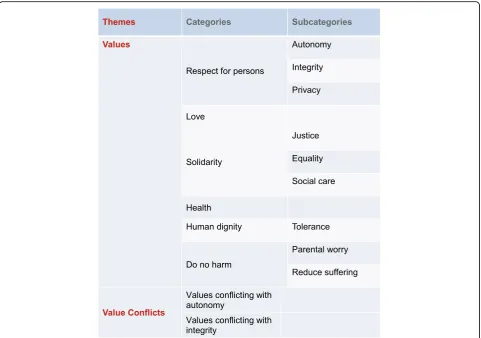
The analysis of the transcripts elicited two main themes; values and value conflicts. The first theme gave rise to six categories namely,respect for persons, solidarity, hu-man dignity, do no harm, health and love. Several sub-categories emerged for respect for persons, solidarity, do no harm and human dignity categories.
Two categories transpired from the second theme; values conflicting with autonomy and values conflicting with integrity. The categories and sub categories are not mutually exclusive and some quotes can fit under one or more category or sub category. An overview of the re-sults is presented in Fig. 1. In the following paragraphs, the results will be described and illustrated by quotes.
Values
Respect for persons
Respects for persons encompassed autonomy, privacy and integrity as subcategories. By far, respect for persons was the most frequently expressed value in relation to implementation and use of preconception ECS.
Autonomy
Participants emphasized the importance of ensuring vol-untariness of participation of couples in preconception ECS and that this should not be regarded as part of rou-tine or regulated by the state, but a true choice to make. In addition, attention should be given to both the process and the content of informed consent while monitoring of the procedure of consenting to preconception ECS.
“How it’s actually done, interviewing people afterwards. What have they really grasped of this information? And how do they perceive this information, has it been sufficient, if it’s been over-information? I mean, if you screen for a very large number of diseases, the complicated information process…I don’t know, really, how they shall do it, but... I think that you can follow or monitor the quality of the in-formation and, as I said, in different steps. If both partners in a partnership are carriers, what kind of information will they get? And you can see, look at the quality there.” (Phys-ician 1).
According to the participants, preconception ECS could be an opportunity to promote reproductive autonomy. However, some respondents voiced concerns regarding the framing and amount of information to potential par-ents, which may confuse rather than enlighten them.
Respondents stated that in Sweden, the Patient Act and the Patient Data Act are legal frameworks to protect patients’autonomy and privacy, which some informants believed, paralleled with increased individualization in the society, where one’s opinions and choices were prized and encouraged.
“Internal autonomy strife”, a term used to describe conflicts arising between partners while making deci-sions regarding preconception ECS, was raised by partic-ipants as another challenge to parents’ reproductive autonomy.
Integrity
commercial interests of screening companies lobbying for use of their panels. Moreover, one respondent stated that potential parents are put in a situation where:
“…it forces them to make choices that they ..otherwise... don’t have to make. In the position they are now, they don’t have to consider those things. But with a program like this, with the information that they would have, it would be difficult not to take that into account and that would force them to make choices that they today do not have to even think about.”(Physician 2).
Privacy
Moreover, the informants voiced concerns of privacy in-fringement of family members and probands who did not participate in the screening program, in cases of couple’s positive results.
Solidarity
Though respect of persons in the form of promoting au-tonomy and protecting integrity and privacy were the most frequently quoted values, concepts related to soli-darity were alluded by all participants. The major
principles reiterated by participants were concepts of
equality, justiceandsocial care.
Equality
The participants said that there was an emphasis in the Swedish legal framework, particularly in the context of healthcare, on equality of people, regardless of their socio- economic status, age, sexual orientations, reli-gious affiliations, or their choice of lifestyle. For example, one informant said:
“It’s really the view on people, perfect and non-perfect so to speak. And everybody, all should be, according to human values, be alike. I mean, it’s very, very basic... It comes with, I mean, sex, religion, whether you are LGBT person or not, that’s in the same area, so to speak.” (Pol-itical party representative).
The example the informants presented was values founding priority setting measures. The measures were put in place to ensure, among other things, equal treat-ment of all who access healthcare, according to respondents.
“….. that some things shouldn’t be taken into account because people should be treated equally. So different
economic situations or different social situations or differ-ent social standings or if you’re in different age groups, that shouldn’t be relevant for whether you get access to treatment or not... or previous lifestyle.”(Bioethicist 1).
Justice
The concept of justice was reflected in the replies re-spondents provided on questions regarding public en-gagement within preconception ECS, where they highlighted the importance of involving all groups in the discussion, not merely the stronger groups in the society or patients groups of spotlight diseases, such as breast cancer. Moreover, justice was a consideration in the dis-tribution of health resources and ensuring programs such as preconception ECS is worthy of spending re-sources on. In addition, there was worry that the in-equalities existing in the society can be imported to screening programs as preconception ECS, which may result in a further worsening of the health of disadvan-taged social groups and rise of elite classes. One partici-pant stated:
“I’m rather skeptical towards having patient involve-ment, because you have to choose some patient represen-tatives rather than others and you often choose among those who are vocal and strong enough. So those with the most serious diseases perhaps will have the weakest voice. And I think there’s a problem of justice here, so to speak.” (Bioethicist 3).
Social care
Solidarity manifested in the form of delivering social care to those born with disability, was underscored by respondents as a vital current practice. According to in-formants, there seemed to be a lot of resources available for the disabled presently. However, the future moral outlook may change particularly if many disabled chil-dren are born, because they can prove economically ex-pensive to take care of. Besides, it constitutes the second principle in the prioritization of health resources in Sweden and it emphasizes maximizing benefits to the most in need in the society. Moreover, society should allow for children of all sorts to exist.
“Then, if you give birth to a child with a disorder ... the society will take care of you and your child. Just as it has always been. Perhaps with... sometimes with inferior quality, but at least it will not be stigmatizing those that prefer not to test.”(Physician 1).
Do no harm
This category encompassed concepts related to reduce suffering, whether that is in the form of preconception ECS inducing parental worry or reducing suffering by averting the birth of very sick children.
Parental worry
Most respondents iterated the potential for parental feel-ings of worry, anxiety, guilt and even fright if parents re-alized their genome was imperfect and might pass on their defective genes to their children. This may worsen their quality of life and inadvertently put them off having children. Further research to examine psychological im-pact of undergoing preconception ECS test on parents was requested.
“If you get the whole genome, who wants to know all the risks for everything. I think it destroys life.”(Physician 3).
Reduce suffering
The potential for preconception ECS to reduce suffering was recognized by participants, particularly in cases of diseases characterized by severe dysfunction and persist-ent pain. In fact, consideration of cost should always come secondary to reduce suffering, since it is morally more valuable. Severe diseases are detrimental to the af-fected child, parents and the family at large. The society can thrive better if there is less suffering, as explained by one informant:
“…diseases or the painful disabledness which is very painful, that’s worth high priority. Very high. And if it’s a disease that maybe is not that painful, but you know that the children will die in two years, then it’s a very high priority. If it’s concerning the suffering, concerning the children, that’s the main question, the really main ques-tion. And the cost for treatment is not of importance, but... That’s not a priority. The suffering, the potential suffering for the children is the most important. To give birth to children that you know have a life with very much pain in one, two years and then the child will die. It’s terrible. It’s terrible for the children, it’s terrible for the parents.”(Theologian).
Human dignity
The category of human dignity reflects the inherent worthiness of humans and tolerance of the disabled. Re-spondents were of the view that respect for human dignity may be challenged with programs such as preconception ECS, because it could change the view on human value. One reason is extensive utilization of technology in repro-ductive medicine causing, what one respondent termed, “technifying” views on human beings and creating baby factories. Another cause could be that healthcare systems may relay a message to the public that only perfect people are encouraged to exist, when they screen for risks of de-fective genes and not actual diseases. There was also a fear that parents would ask to abort fetuses with less severe dis-eases or based on physical attributes such as brown eyes.
being. That the human being is the result of all kinds of technical [interventions].”(Legal expert).
Tolerance
Demoting human value may lead to intolerance to dis-ability, as this respondent stated:
“This selection of elite people, which I think is a dan-gerous way to go. It also puts intolerance and this kind of... intolerance to these people who do not fulfill these criteria if you should... you can do abortion for all these four hundred and ninety-nine conditions. That creates... I think it creates an intolerant society.”(Physician 3).
Health
According to informants, preconception ECS can impact the conception of healthy. One way is by redefining ill-health to encompass “at risk” conditions that needs “fixing”. Another is by changing the traditional setting of healthcare, where an individual visits her/his doctor when s/he experiences a health problem to a situation where healthcare professionals approaches healthy indi-viduals with no prior risk to get tested.
“[Preconception ECS] sort of puts up a standard that you are not supposed to be someone that is at risk or risks (of ) putting children to this world that are suffering from disorders. And that would have impact not only on ... on these specific disorders and these... I mean, it could spread to other disorders and it could spread to the con-ception of poor health in general.”(Physician 2).
Love
Love was mentioned in two contexts. In the first case, it was described as a value that would overrule pragmatism and in-duce couples to remain together, instead of choosing a gen-etically compatible partner, in case of test positive results.
“When it comes to love, I think that emotions overrun the... There are not so many pragmatic people around today, we don’t know in the future, but... It’s... If I may just take a one example? These patient organizations and many of them are about disorders with a distinct genetic component, say diabetes for instance. But there are very many couples that meet there, young people who meet there and then will marry, and they are fully aware of the enhanced risk for their children, of course.”(Physician 1).
In the other context, participants mentioned research that showed that love within a couple can be threatened when they are caring for a severely ill child.
Value conflicts
In this theme, respondents discussed how certain values can be at odds with another in the discussion of precon-ception ECS. At one end preconprecon-ception ECS can promote a certain value, however, this could contradict with
another moral value possessed by or resulting from the technology. The theme is categorized into autonomy value conflicts and integrity value conflicts.
Autonomy value conflicts
Value conflicts may arise between promoting autonomy and cost effectiveness, as some respondents suggested. One informant stated:
“There is this again inbuilt tension between autonomy as a value and cost-effectiveness, because if you want to make sure that you respect the autonomy of participants you would have to have rather ambitious, I would say, information for all participants. And that would be costly in itself. So... There’s sort of an inbuilt conflict between autonomy, respecting autonomy on the one hand, and cost-effectiveness on the other hand.”(Bioethicist 3).
Another value conflict that may transpire, as asserted by other respondents, lies within autonomy itself. Since the promoted objective of preconception ECS is enhancing re-productive autonomy by presenting carrier status and dis-ease information to potential parents, there is a risk that couples become overwhelmed by the information, causing a compromise to their autonomy. Secondly, promoting au-tonomy can conflict with respecting auau-tonomy as some couples may opt out of preconception ECS and that can be interpreted as their wish to be less autonomous. Thirdly, the information ensuing from preconception ECS may re-strict a person’s freedom in some ways, for example, choos-ing a partner only who is compatible with their DNA.
Another value conflicting with autonomy was respecting human dignity. According to the participants, the intrinsic worthiness of being a human should be respected regard-less of their affliction or disability and this can be incom-patible with the concept of promoting autonomy in preconception ECS, which allows to screen away some diseases and disabilities. This was explained by this quote,
“I see the values for the individual couple... their free will to do what they want as independent couple and in-dependent person and the value for (respecting) human life”(Physician 3).
Integrity value conflicts
As for values conflicting with integrity of potential parents, a utilitarian view of maximizing benefits, whether in the form of reducing disease burden or promoting science/re-search advancement, by such a program may clash with maintaining integrity of potential parents. In addition, au-tonomy of potential parents can conflict with privacy of proband family members as this quote describes,
Discussion
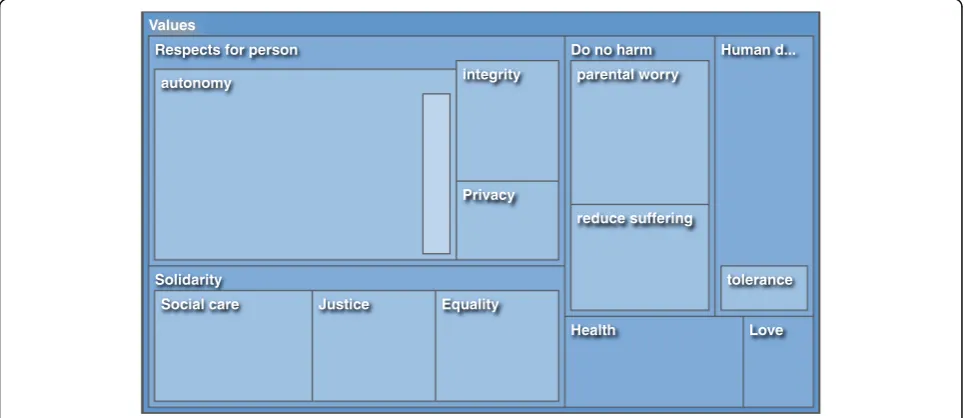
Experts in our study referred to and described particular values and principles and their conflicts when they dis-cussed ethical and social implications of implementation and utilization of preconception ECS in Sweden. Solidar-ity and its subcategories of equalSolidar-ity, justice and social care, were discussed by all experts, whereas respect of persons with reference to autonomy, integrity and priv-acy constituted the lion’s share of reference, even if it was not mentioned by all interviewees. It can be estab-lished that both these categories were of paramount sig-nificance to our experts in addressing preconception ECS. Tagging behind those categories are values of do no harm, human dignity, health and love, respectively. A tree map illustrating the number of quotes is found in Fig. 2. It shows how Respect for persons and Solidarity
are the two largest categories.
Since Sweden is a welfare state, where its healthcare sys-tem is publicly funded, it is no surprise that values such as social care, equal value of people and justice were promin-ently pronounced during the interviews with the experts. In addition, respondents addressed principles of auton-omy, privacy and integrity, which are endorsed by Swedish laws such as the Patient Act (SFS 2014:821) [36] and the Patient Data Act (SFS 2008:355) [37].
Human dignity seems to mean different notions to dif-ferent commentators, which make its definition evasive. But the founding notion appears to be that there is an in-trinsic value in being a human [32, 38], which was af-firmed in the Universal Declaration on Human Rights of 1948 [39]. Other conceptions associated with human dignity are sanctity of life, non-commodification or
commercialization of human beings or their organs/tis-sues, equality of all humans in terms of worth and rights, as well as respect of their moral agency [13,32,38].
Being an all-embracing concept of many notions, hu-man dignity has been employed in debates concerning consent procedures in biobanking and data sharing, commercialization of human beings associated with patenting of genetic materials, and lastly denigration of human worth arguments in relation to embryonic stem cell research and reproductive cloning [32]. In our study, participants referred to human dignity when they men-tioned the threat to inherent value of human beings as result of “technifying” them, or turning offspring into products, or sorting humans into perfect or non-perfect ones, or permitting only certain types of humans to exist. In another context, participants mentioned human dignity in connection to equal treatment of patients within Swedish healthcare, regardless of their religion, socioeconomic status, gender, age and lifestyle. In short, participants used the non-commodification and equality of humans arguments in discussing implementation and use of preconception ECS.
If human dignity proved complicated to define, eluci-dating solidarity is as problematic. Prainsack and Buyx [31] identified four distinctive contexts in which solidar-ity emerged within bioethics. One setting occurs when validating governments’ interference for promoting col-lective good over individual benefit within public health system. Secondly, as a justification or its lack thereof, for delivering aid to poorer countries within a global health setting. The other two contexts where solidarity is brought up are relevant to our study; the first of which
Fig. 2A tree map illustrating the categories and subcategories of the first theme: Values. Each dark blue rectangle denotes a category and the lighter colored rectangles within denote subcategories. Judging by the number/size of reference respect for persons and solidarity are the largest
is within welfare states for just and equitable allocation of resources within healthcare system and social care. In this setting, solidarity is further characterized in terms of risks, income and lifestyle and associated with concepts of justice and equity [31]. This was pinpointed by inter-viewees’ replies when they referred to non-discrimin-atory dispensing of healthcare to patients regardless of their choice of lifestyle or socio economic status. The re-sults show that solidarity can be further characterized in terms of genetic defects or handicap, not merely risks, lifestyle and income. Lastly, solidarity was described by Häyry [12] as a distinctively European value, together with dignity and precaution, contrasting to American liberal values of autonomy, beneficence and justice. Fur-ther, solidarity becomes one of the founding values for European Union healthcare systems, of which Sweden is a part [14].
Prainsack and Buyx [31] define solidarity as “shared practices reflecting a collective commitment to carry costs to assist others”. The“costs”can be categorized as, for ex-ample, economical, emotional or societal. Furthermore, solidarity can be enacted between individuals, or at a group level as a social norm, or lastly institutionalized into a legal system. The latter is characteristic of welfare states with taxpayers’ financed healthcare systems, such as Sweden. Concepts associated with solidarity, such as social care, justice and equitable use of resources were promin-ent in participants’ responses. Furthermore, they referred to contractual level of solidarity in Sweden, as delineated in priority setting measures [15].
The World Health Organization (WHO) defined health as the status of an individual with“complete physical, men-tal and social well-being”, and not simply as lack of disease or functionality [40]. Furthermore, possessing the best ob-tainable health is viewed as a human right, according to the WHO [41]. Philosophers adopted naturalistic or evaluative approaches to define health. Though both concurred that health is lack of ailment or pathology, evaluative theorists stated that disease is influenced by temporal assessment of notions, such as righteousness, well-being and perfection [42]. The naturalists, on the other hand, defines pathology with reference to the biostatistical theory, where normal ranges of function of body processes and organs are con-structed. Beyond these normal ranges lie disease [42].
Health, as discussed by respondents, incorporated con-cepts of well-being and quality of life. But they also acknowledged that parents may define ill health, or dis-ability subjectively, influenced by their cultural, educa-tional and religious bearings. Furthermore, there were contemplations, whether carrier screening programs that identify carrier status of defective genes in a healthy population can redefine the notion of ill health.
With reference to value theory, health is considered a value both intrinsically and extrinsically. Health in itself
and for its own sake has a value, so being healthy has its own worthiness, but it is also instrumental for one’s well-being, access to opportunity, exercise of autonomy and other capabilities [42].
Respects for persons was first featured in Belmont Re-port of 1979, as one of the founding values for participa-tion in research. The main manner this can be professed is via respecting autonomy and safeguarding those with diminished capacity for autonomy [43]. Later, autonomy was embraced as the first principle in biomedical ethics by Beauchamp and Childress [11] and incorporated in European bioethics and bio-laws [13, 38]. According to the later, autonomy is multi-faceted and include; capabil-ity of self-determination, moral cognizance, accountabil-ity and political participation, informed consent and undertaking decisions and acting upon them with no ex-ternal hindrance [13,38].
To our participants, autonomy is a substantive principle to respect in implementation and use of pre-conception ECS, from ensuring voluntary participation of potential parents without external pressure, to circumventing routinization of the screening program as a threat to autonomy, to ensuring proper informed con-sent procedures and delivering of information, to dis-cussing amount and quality of information given by healthcare professionals. Furthermore, experts respected parental pluralistic moral outlooks and the ensuing deci-sions. Therefore, respondents addressed most, if not all, of the aspects of autonomy as detailed in the European bio-laws. One addition the experts divulged was internal autonomy strife, occurring because of differing views be-tween partners concerning participation in a preconcep-tion ECS program.
In addition to autonomy, Johnsson and Eriksson [30] added the principles of integrity and authority as essen-tial components in respect of persons. Integrity is the principle that grapples with one’s social and personal realms. Respecting integrity means acknowledging and withdrawing from a person’s personal, psychological and physical spaces unless invited into them [30]. Preconcep-tion ECS, experts expressed, may threaten potential par-ents’ integrity. In their description, integrity was a parent’s personal space, that could be infringed upon by social pressure to test or the lobbying of commercial companies to screen or healthcare professionals’offer of screening tests to couples. The prospective parents would thereby be compelled to undertake decisions that they would, otherwise, have not known existed.
by offering the test; promoting reproductive autonomy while respecting human dignity are some example of po-tential value conflicts. Furthermore, the new HT could initiate conflicts with existing societal values, such as equality or solidarity, because it can induce a form of elitism. Hofmann [5] discussed how new HTs are value-laden and could trigger conflicts with societal values, which hinder their dissemination. Assessment of ethical and social values as part of HTA was proposed as a way to circumvent the problem of HT diffusion. This could be achieved by identifying such value conflicts and addressing them or by anticipating, in advance, if a new HT will be accepted by the society or not.
Conclusions
Our study examined values and value conflicts as reiter-ated by health policymaking experts in Sweden, when they described ethical and social implications in imple-mentation and use of preconception ECS. The analysis of the interviews disclosed that respect for persons, soli-darity, human dignity, do no harm, health and love were the main values inferred to by experts. In addition, they discussed value conflicting with autonomy and integrity, and, for instance, priority setting and human dignity. Moreover, the analysis revealed that certain values were deemed more substantive than others, judging by the ex-tent and detail of inference; for example, respect for per-sons and solidarity were on top of the list.
Hence, it can be concluded that the interviewed ex-perts highlighted values and concepts that are distinctive of welfare states such as Sweden and that preconception ECS could challenge such values. Determining these conflicts could prove useful to circumvent a dissemin-ation problem, in case of implementing the new technol-ogy. Though our analysis relied on a small sized sample, we believe the results are pertinent to countries with similar contexts.
Acknowledgments
We would like to extend our thanks to all the experts who agreed to be part of the study.
Funding
The research has been funded by the Department of Public Health and Caring Sciences, University of Uppsala. There was no role by the Department of Public Health and Caring Sciences in the design of the study, or collection and analysis of data or the writing of the manuscript.
Availability of data and materials
The datasets used and/or analyzed during the current study are available from the corresponding author on reasonable request.
Authors’contributions
All authors decided on the design and methods of analysis. AM conducted the interviews, analysis of the data and writing of the first draft of the manuscript. ATH helped in the recruitment of participants, the analysis process and provided input and revised the manuscript. MGH has assisted in recruitment of research participants, revised and gave input on the analysis and manuscript. All authors read and approved the final manuscript.
Ethics approval and consent to participate
All procedures performed in the study were in accordance with the Swedish law, the ethical standards of the Swedish institutional and/or national research committee and with the 1964 Helsinki declaration and its later amendments or comparable ethical standards. The participants consented to participate in the study via an email.
Consent for publication
Not applicable.
Competing interests
The authors declare that they have no competing interests.
Publisher’s Note
Springer Nature remains neutral with regard to jurisdictional claims in published maps and institutional affiliations.
Received: 19 November 2018 Accepted: 3 April 2019
References
1. Copp D. The Oxford handbook of ethical theory. New York: Oxford University Press; 2006.
2. Hirose I, Olson J. Zimmerman MJ. In: Value and normativity; 2015. 3. Hirose I, Olson J. Rønnow-Rasmussen T. In: Intrinsic and extrinsic value; 2015. 4. Frankena WK. Ethics: foundations of philosophy series. New Jersey: Prentice
Hall; 1973.
5. Hofmann B. On value-judgements and ethics in health technology assessment. Poiesis Prax. 2005;3(4):277–95.
6. Kenny N, Giacomini M. Wanted: a new ethics field for health policy analysis. Health Care Anal. 2005;13(4):247–60.
7. Rider EA, Kurtz S, Slade D, Longmaid HE III, Ho M-J, JK-h P, et al. The international charter for human values in healthcare: an interprofessional global collaboration to enhance values and communication in healthcare. Patient Educ Couns. 2014;96(3):273–80.
8. National Commission for the Proptection of Human Subjects of Biomedicaland Behavioral Research B, Md. The Belmont report: ethical principles and guidelines for the protection of human subjects of research: superintendent of Documents; 1978.
9. Lehoux P, Williams-Jones B. Mapping the integration of social and ethical issues in health technology assessment. Int J Technol Assess Health Care. 2007;23(1):9–16.
10. World Medical Association. World medical association declaration of Helsinki: ethical principles for medical research involving human subjects. Jama. 2013;310(20):2191.
11. Beauchamp TL, Childress JF. Principles of biomedical ethics. USA: Oxford University Press; 2001.
12. Häyry M. European values in bioethics: why, what, and how to be used. Theor Med Bioeth. 2003;24(3):199–214.
13. Kemp P, Rendtorff JD. The Barcelona declaration. Synthesis Phylosophica. 2008;46(2):239–51.
14. Official Journal of Euopean Union. Council conclusions on common values and principles in European Union health systems (2006/C 146/01). 2006. 15. Hofmann B. Priority setting in health care: trends and models from
Scandinavian experiences. Med Health Care Philos. 2013;16(3):349–56. 16. Swedish National Council on Medical Ethics. The ethical platform for priority
setting in health care. Sweden: Smer Socialdepartementet; 2009. Available from: http://www.smer.se/publications/the-ethical-platform-for-priority-setting-in-health-care/. [cited 2018 20 September].
17. Sabik LM, Lie RK. Priority setting in health care: lessons from the experiences of eight countries. Int J Equity Health. 2008;7(1):4.
18. Heintz E, Lintamo L, Hultcrantz M, Jacobson S, Levi R, Munthe C, et al. Framework for systematic identification of ethical aspects of healthcare technologies: the SBU approach. Int J Technol Assess Health Care. 2015; 31(3):124–30.
19. Saarni SI, Hofmann B, Lampe K, Lühmann D, Mäkelä M, Velasco-Garrido M, et al. Ethical analysis to improve decision-making on health technologies. Bull World Health Organ. 2008;86:617–23.
21. Henneman L, Borry P, Chokoshvili D, Cornel MC, van El CG, Forzano F, et al. Responsible implementation of expanded carrier screening. Eur J Hum Genet. 2016;24(6):e1.
22. University Medical Center Groningen. Testing for serious genetic diseases now possible before pregnancy Netherlands: University Medical Center Groningen; 2016. [cited 2016 10–02-2016]. Available from:https://www. umcg.nl/EN/corporate/News/Paginas/Testing-genetic-diseases-before-pregnancy.aspx.
23. Ekstrand Ragnar M, Tydén T, Kihlbom U, Larsson M. Swedish parents’ interest in preconception genetic carrier screening. Ups J Med Sci. 2016; 121(4):289–94.
24. Chokoshvili D, Janssens S, Vears D, Borry P. Designing expanded carrier screening panels: results of a qualitative study with European geneticists. Personalized Medicine. 2016;13(6):553–62.
25. van der Hout S, Holtkamp KC, Henneman L, de Wert G, Dondorp WJ. Advantages of expanded universal carrier screening: what is at stake? Eur J Hum Genet. 2017;25(1):17–21.
26. Chokoshvili D, Vears D, Borry P. Expanded carrier screening for monogenic disorders: where are we now? Prenat Diagn. 2018;38(1):59–66.
27. Matar A, Hansson MG, Höglund AT.“A perfect society”—Swedish policymakers’ethical and social views on preconception expanded carrier screening. J Community Genet. 2018;1–14.
28. Bogner A, Menz W. The theory-generating expert interview: epistemological interest, forms of knowledge, interaction. In: Bogner A, Littig B, Menz W, editors. Interviewing Experts. London: Palgrave Macmillan UK; 2009. p. 43–80. 29. Emanuel EJ, Wendler D, Grady C. What makes clinical research ethical?
Jama. 2000;283(20):2701–11.
30. Johnsson L, Eriksson S. Autonomy is a right, not a feat: how theoretical misconceptions have muddled the debate on dynamic consent to biobank research. Bioethics. 2016;30(7):471–8.
31. Prainsack B, Buyx A. Solidarity in contemporary bioethics–towards a new approach. Bioethics. 2012;26(7):343–50.
32. Caulfield T, Brownsword R. Human dignity: a guide to policy making in the biotechnology era? Nat Rev Genet. 2006;7(1):72.
33. Graneheim UH, Lundman B. Qualitative content analysis in nursing research: concepts, procedures and measures to achieve trustworthiness. Nurse Educ Today. 2004;24(2):105–12.
34. Ryan GW, Bernard HR. Techniques to Identify Themes. Field Methods. 2016; 15(1):85–109.
35. The Act concerning the Ethical Review of Research Involving Humans 2003: 460 (2003).
36. Patientlag (2014:821), 2014: 821 (2014). 37. Patientdatalag, 2008:355 (2008).
38. Rendtorff JD. Basic ethical principles in European bioethics and biolaw: autonomy, dignity, integrity and vulnerability–towards a foundation of bioethics and biolaw. Med Health Care Philos. 2002;5(3):235–44. 39. United Nations General Assembly. Universal declaration of human rights:
UN General Assembly; 1948.
40. The World Health Organization. Preamble to the Constitution of WHO as adopted by the International Health Conference New York, 19 June - 22 July 1946; signed on 22 July 1946 by the representatives of 61 States (Official Records of WHO, no. 2, p. 100) and entered into force on 7 April 1948. New York: WHO; 1948 [cited 2018 10 September]. Available from: http://www.who.int/suggestions/faq/en/.
41. The World Health Organization. Human rights and health [the internet ]. Geneva: The WHO; 2017. [cited 2018 25 October]. Available from:http:// www.who.int/en/news-room/fact-sheets/detail/human-rights-and-health. 42. Hirose I, Olson J, Hausman DM. The Value of Health. Oxford University
Press; 2015.